International Research Journal of Engineering and Technology (IRJET) e-ISSN: 2395 -0056
Volume: 03 Issue: 01 | Jan-2016 www.irjet.net p-ISSN: 2395-0072
© 2016, IRJET | Impact Factor value: 4.45 | ISO 9001:2008 Certified Journal | Page 1169
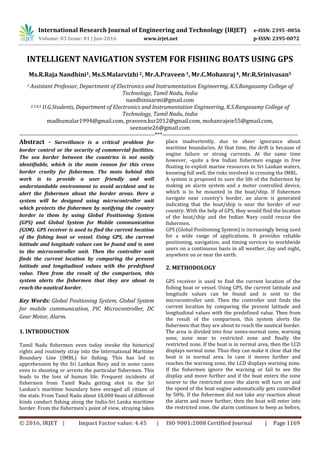
INTELLIGENT NAVIGATION SYSTEM FOR FISHING BOATS USING GPS
Ms.R.Raja Nandhini1, Ms.S.Malarvizhi 2, Mr.A.Praveen3, Mr.C.Mohanraj 4, Mr.R.Srinivasan5
1 Assistant Professor, Department of Electronics and Instrumentation Engineering, K.S.Rangasamy College of
Technology, Tamil Nadu, India
nandhinisarmi@gmail.com
2,3,4,5 U.G.Students, Department of Electronics and Instrumentation Engineering, K.S.Rangasamy College of
Technology, Tamil Nadu, India
madhumalar1994@gmail.com, praveen.ksr2012@gmail.com, mohanrajeie55@gmail.com,
seenueie26@gmail.com
---------------------------------------------------------------------***---------------------------------------------------------------------
Abstract - Surveillance is a critical problem for
border control or the security of commercial facilities.
The sea border between the countries is not easily
identifiable, which is the main reason for this cross
border cruelty for fishermen. The moto behind this
work is to provide a user friendly and well
understandable environment to avoid accident and to
alert the fishermen about the border areas. Here a
system will be designed using microcontroller unit
which protects the fishermen by notifying the country
border to them by using Global Positioning System
(GPS) and Global System for Mobile communication
(GSM). GPS receiver is used to find the current location
of the fishing boat or vessel. Using GPS, the current
latitude and longitude values can be found and is sent
to the microcontroller unit. Then the controller unit
finds the current location by comparing the present
latitude and longitudinal values with the predefined
value. Then from the result of the comparison, this
system alerts the fishermen that they are about to
reach the nautical border.
Key Words: Global Positioning System, Global System
for mobile communication, PIC Microcontroller, DC
Gear Motor, Alarm.
1. INTRODUCTION
Tamil Nadu fishermen even today invoke the historical
rights and routinely stray into the International Maritime
Boundary Line (IMBL) for fishing. This has led to
apprehension by the Sri Lankan Navy and in some cases
even to shooting or arrests the particular fishermen. This
leads to the loss of human life. Frequent incidents of
fishermen from Tamil Nadu getting shot in the Sri
Lankan’s maritime boundary have enraged all citizen of
the state. From Tamil Nadu about 18,000 boats of different
kinds conduct fishing along the India-Sri Lanka maritime
border. From the fishermen’s point of view, straying takes
place inadvertently, due to sheer ignorance about
maritime boundaries. At that time, the drift is because of
engine failure or strong currents. At the same time
however, -quite a few Indian fishermen engage in free
floating to exploit marine resources in Sri Lankan waters,
knowing full well, the risks involved in crossing the IMBL.
A system is proposed to save the life of the fishermen by
making an alarm system and a motor controlled device,
which is to be mounted in the boat/ship. If fishermen
navigate near country’s border, an alarm is generated
indicating that the boat/ship is near the border of our
country. With the help of GPS, they would find the location
of the boat/ship and the Indian Navy could rescue the
fishermen.
GPS (Global Positioning System) is increasingly being used
for a wide range of applications. It provides reliable
positioning, navigation, and timing services to worldwide
users on a continuous basis in all weather, day and night,
anywhere on or near the earth.
2. METHODOLOGY
GPS receiver is used to find the current location of the
fishing boat or vessel. Using GPS, the current latitude and
longitude values can be found and is sent to the
microcontroller unit. Then the controller unit finds the
current location by comparing the present latitude and
longitudinal values with the predefined value. Then from
the result of the comparison, this system alerts the
fishermen that they are about to reach the nautical border.
The area is divided into four zones-normal zone, warning
zone, zone near to restricted zone and finally the
restricted zone. If the boat is in normal area, then the LCD
displays normal zone. Thus they can make it clear that the
boat is in normal area. In case it moves further and
reaches the warning zone, the LCD displays warning zone.
If the fishermen ignore the warning or fail to see the
display and move further and if the boat enters the zone
nearer to the restricted zone the alarm will turn on and
the speed of the boat engine automatically gets controlled
by 50%. If the fishermen did not take any reaction about
the alarm and move further, then the boat will enter into
the restricted zone, the alarm continues to beep as before,
International Research Journal of Engineering and Technology (IRJET) e-ISSN: 2395 -0056
Volume: 03 Issue: 01 | Jan-2016 www.irjet.net p-ISSN: 2395-0072
© 2016, IRJET | Impact Factor value: 4.45 | ISO 9001:2008 Certified Journal | Page 1170
and once it touches the restricted zone, the boat speed will
be decreased partially and the motor will takes a reverse
action.
3. BLOCK DIAGRAM
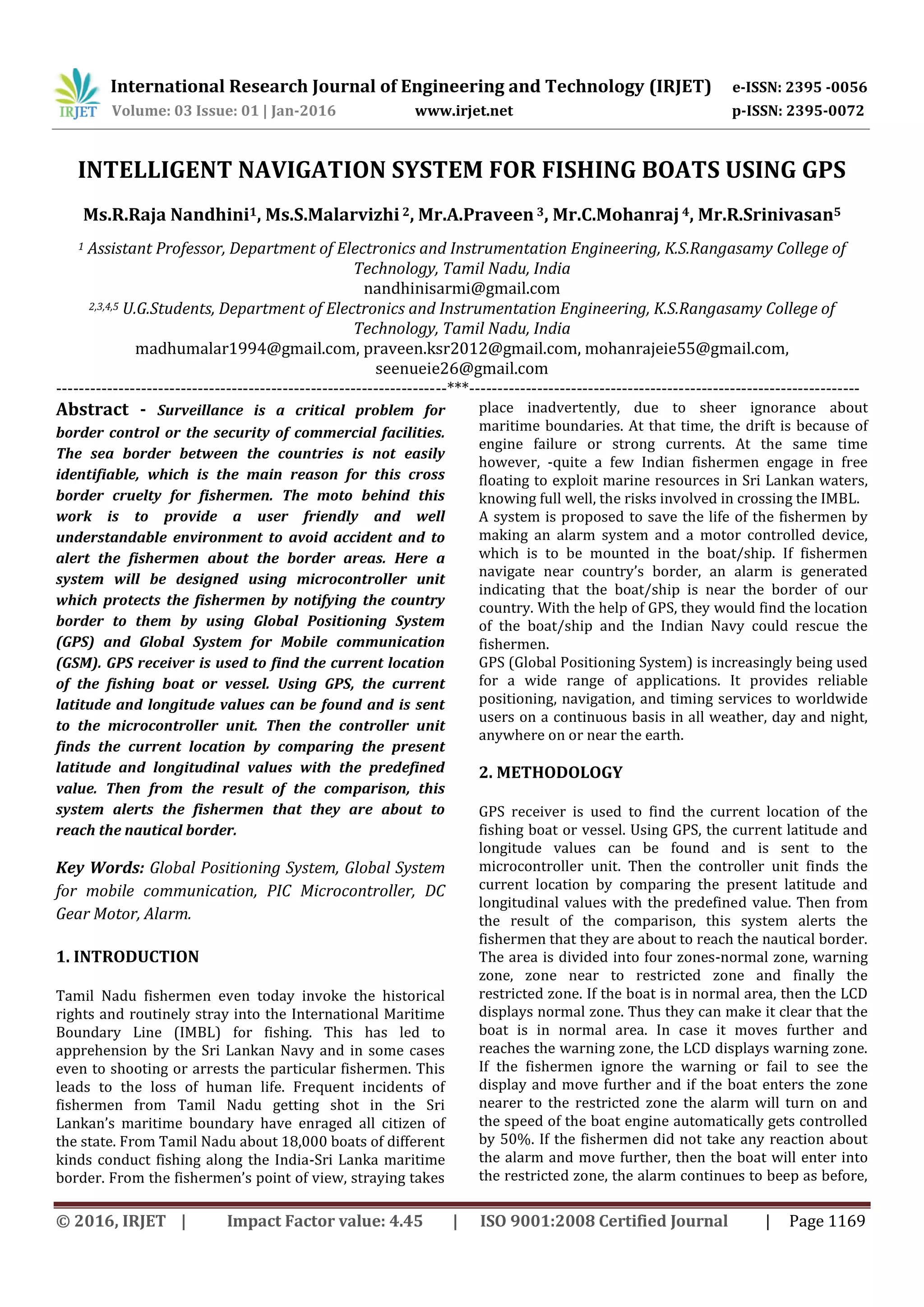
The Global Positioning System (GPS) is a satellite based
navigation system that sends and receives radio signals. A
GPS receiver acquires these signals and provides the user
with information.
Fig-1: Block diagram of the proposed system
3.1 Transmitter Side
The GPS receives the geographical latitudinal and
longitudinal values of the boat/ship from the satellite
through antenna. The border latitudinal and longitudinal
values are already fed to the microcontroller. The
microcontroller receives the GPS value and compares that
value with the preset value. If the value matches beyond 1
Km then the microcontroller actuates the alarm signal and
also displays a warning message in the LCD display. If the
GPS value exceeds the preset value then the GSM is
actuated by the microcontroller. Then the GSM will send a
message to the coastal guards in the Navy.
Fig-2: Transmitter side
3.2 Receiver Side
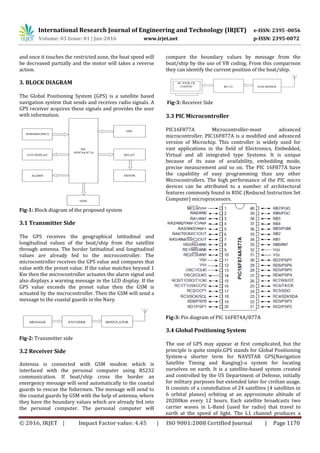
Antenna is connected with GSM modem which is
interfaced with the personal computer using RS232
communication. If boat/ship cross the border an
emergency message will send automatically to the coastal
guards to rescue the fishermen. The message will send to
the coastal guards by GSM with the help of antenna, where
they have the boundary values which are already fed into
the personal computer. The personal computer will
compare the boundary values by message from the
boat/ship by the use of VB coding. From this comparison
they can identify the current position of the boat/ship.
Fig-3: Receiver Side
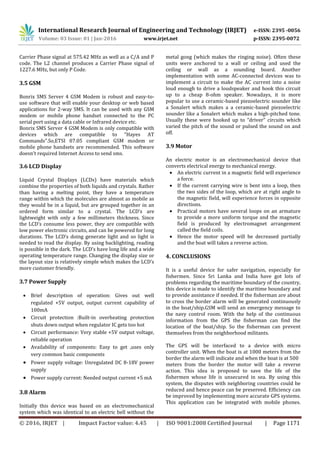
3.3 PIC Microcontroller
PIC16F877A Microcontroller-most advanced
microcontroller. PIC16F877A is a modified and advanced
version of Microchip. This controller is widely used for
vast applications in the field of Electronics, Embedded,
Virtual and all integrated type Systems. It is unique
because of its ease of availability, embedding mode,
precise measurement and so on. The PIC 16F877A have
the capability of easy programming than any other
Microcontrollers. The high performance of the PIC micro
devices can be attributed to a number of architectural
features commonly found in RISC (Reduced Instruction Set
Computer) microprocessors.
Fig-3: Pin diagram of PIC 16F874A/877A
3.4 Global Positioning System
The use of GPS may appear at first complicated, but the
principle is quite simple.GPS stands for Global Positioning
System-a shorter term for NAVSTAR GPS(Navigation
Satellite Timing and Ranging)-a system for locating
ourselves on earth. It is a satellite-based system created
and controlled by the US Department of Defense, initially
for military purposes but extended later for civilian usage.
It consists of a constellation of 24 satellites (4 satellites in
6 orbital planes) orbiting at an approximate altitude of
20200km every 12 hours. Each satellite broadcasts two
carrier waves in L-Band (used for radio) that travel to
earth at the speed of light. The L1 channel produces a
International Research Journal of Engineering and Technology (IRJET) e-ISSN: 2395 -0056
Volume: 03 Issue: 01 | Jan-2016 www.irjet.net p-ISSN: 2395-0072
© 2016, IRJET | Impact Factor value: 4.45 | ISO 9001:2008 Certified Journal | Page 1171
Carrier Phase signal at 575.42 MHz as well as a C/A and P
code. The L2 channel produces a Carrier Phase signal of
1227.6 MHz, but only P Code.
3.5 GSM
Bonrix SMS Server 4 GSM Modem is robust and easy-to-
use software that will enable your desktop or web based
applications for 2-way SMS. It can be used with any GSM
modem or mobile phone handset connected to the PC
serial port using a data cable or Infrared device etc.
Bonrix SMS Server 4 GSM Modem is only compatible with
devices which are compatible to “Hayes AT
Commands”.So,ETSI 07.05 compliant GSM modem or
mobile phone handsets are recommended. This software
doesn’t required Internet Access to send sms.
3.6 LCD Display
Liquid Crystal Displays (LCDs) have materials which
combine the properties of both liquids and crystals. Rather
than having a melting point, they have a temperature
range within which the molecules are almost as mobile as
they would be in a liquid, but are grouped together in an
ordered form similar to a crystal. The LCD’s are
lightweight with only a few millimeters thickness. Since
the LCD’s consume less power, they are compatible with
low power electronic circuits, and can be powered for long
durations. The LCD’s doing generate light and so light is
needed to read the display. By using backlighting, reading
is possible in the dark. The LCD’s have long life and a wide
operating temperature range. Changing the display size or
the layout size is relatively simple which makes the LCD’s
more customer friendly.
3.7 Power Supply
 Brief description of operation: Gives out well
regulated +5V output, output current capability of
100mA
 Circuit protection :Built-in overheating protection
shuts down output when regulator IC gets too hot
 Circuit performance: Very stable +5V output voltage,
reliable operation
 Availability of components: Easy to get ,uses only
very common basic components
 Power supply voltage: Unregulated DC 8-18V power
supply
 Power supply current: Needed output current +5 mA
3.8 Alarm
Initially this device was based on an electromechanical
system which was identical to an electric bell without the
metal gong (which makes the ringing noise). Often these
units were anchored to a wall or ceiling and used the
ceiling or wall as a sounding board. Another
implementation with some AC-connected devices was to
implement a circuit to make the AC current into a noise
loud enough to drive a loudspeaker and hook this circuit
up to a cheap 8-ohm speaker. Nowadays, it is more
popular to use a ceramic-based piezoelectric sounder like
a Sonalert which makes a a ceramic-based piezoelectric
sounder like a Sonalert which makes a high-pitched tone.
Usually these were hooked up to “driver” circuits which
varied the pitch of the sound or pulsed the sound on and
off.
3.9 Motor
An electric motor is an electromechanical device that
converts electrical energy to mechanical energy.
 An electric current in a magnetic field will experience
a force.
 If the current carrying wire is bent into a loop, then
the two sides of the loop, which are at right angle to
the magnetic field, will experience forces in opposite
directions.
 Practical motors have several loops on an armature
to provide a more uniform torque and the magnetic
field is produced by electromagnet arrangement
called the field coils.
 Hence the motor speed will be decreased partially
and the boat will takes a reverse action.
4. CONCLUSIONS
It is a useful device for safer navigation, especially for
fishermen. Since Sri Lanka and India have got lots of
problems regarding the maritime boundary of the country,
this device is made to identify the maritime boundary and
to provide assistance if needed. If the fisherman are about
to cross the border alarm will be generated continuously
in the boat/ship.GSM will send an emergency message to
the navy control room. With the help of the continuous
information from the GPS the fisherman can find the
location of the boat/ship. So the fisherman can prevent
themselves from the neighborhood militants.
The GPS will be interfaced to a device with micro
controller unit. When the boat is at 1000 meters from the
border the alarm will indicate and when the boat is at 500
meters from the border the motor will take a reverse
action. This idea is proposed to save the life of the
fishermen whose life is unsecured in sea. By using this
system, the disputes with neighboring countries could be
reduced and hence peace can be preserved. Efficiency can
be improved by implementing more accurate GPS systems.
This application can be integrated with mobile phones.
International Research Journal of Engineering and Technology (IRJET) e-ISSN: 2395 -0056
Volume: 03 Issue: 01 | Jan-2016 www.irjet.net p-ISSN: 2395-0072
© 2016, IRJET | Impact Factor value: 4.45 | ISO 9001:2008 Certified Journal | Page 1172
This helps in extending its scope not only to maritime
boundary identification, but also to other ideas.
REFERENCES
[1] Arunvijay D, Yuvaraj E, “Design of Border Alert
System for fishermen using GPS”, International
Journal of Students Research in Technology &
Management, vol.2, No.02, March-April 2014.
[2] Jim Isaac D, Eugene Kingsley H, “Advanced border
alert system using GPS and with intelligent Engine
control unit”, International Journal of Electrical
and Computing Engineering (IJECE) ISSN
(Online): 2349-8218 vol.1, June 2015.
[3] Karthikeyan R, Dhandapani A, Mahalingham U,
“Protecting of Fishermen on Indian Maritime
Boundaries”, Journal of Computer Applications,
vol.5, February 2012.
[4] Kiruthika S, Rajasekaran N, “Implementation of
GPS Based Surveillance Navigation System for
Fisherman” International Journal of Scientific
Research and Engineering Studies (IJSRES)
Volume 1 Issue 5, ISSN: 2349-8862, November
2014.
[5] Mohammad A.Al-Khedher, “Hybrid GPS-GSM
Localization of Automobile Tracking System”,
International Journal of Computer Science
&Information Technology, International Journal
of Scientific Research and Engineering Studies
(IJSRES) Volume 1 Issue 5, ISSN: 2349-8862,
November 2014.
[6] Pradip Vanparia, Ghodasara Y R, “Review Paper
On To Study and Enhance Coastal Security System
Using GIS/GPS Tool”, International Journal of
Computer Applications&Information Technology,
vol. 1, No 2, September 2012.
[7] Ramadan N, Mohammad A.Al-Khedher, Sharaf
A.Al-Kheder, “Intelligent Anti-Theft and Tracking
System for Automobiles”, International Journal of
Machine Learning and Computing, vol.2, no.1,
February 2012.
[8] Sathyan T, Hedley M, “Fast and Accurate
cooperative Tracking in Wireless Networks”,
IEEE, vol 12,N0 9,May 2009.
[9] Sivagnanam G, Midhun A J, Krishna N, Maria
Samuel Reuben G, Anguraj A “Coast Guard Alert
and Rescue System for International Maritime
Line Crossing of Fisherman” International Journal
of Innovative Research in Advanced Engineering
(IJIRAE) ISSN: 2349-2163Issue 2, Vol. 2 ,February
2015.
[10] Sivaramaganesh M, Ramya M, Gowtham V,
Bharathi T, Jeevitha G “Implementation of
Maritime Border Alert System”, International
Journal of Innovative Research in Electrical,
Electronics, Instrumentation and Control
Engineering Vol. 2, Issue 3, March 2014.
[11] Suresh Kumar, Sharath Kumar K, “Design of Low
Cost Maritime Boundary Identification Device
Using GPS System”, International Journal of
Engineering Science and Technology, December
2009.
[12] Trieschmann O, Th.Hunsaanger, Barjenbruch U B,
“A Multiple Remote Sensor System for the Aerial
Surveillance of the North Sea and Baltic Sea”,
IEEE, November 2002.
[13] Vinothkumar C, Arunkumaran B, “Implementation
of GPS Based Security System for Safe Navigation
of Fisherman Autoboat”, International Journal for
Research and Development in Engineering
(IJRDE), ISSN: 2279-0500, pp-465-469.

Intelligent Navigation System for Fishing Boats Using GPS

  • 1.
    International Research Journalof Engineering and Technology (IRJET) e-ISSN: 2395 -0056 Volume: 03 Issue: 01 | Jan-2016 www.irjet.net p-ISSN: 2395-0072 © 2016, IRJET | Impact Factor value: 4.45 | ISO 9001:2008 Certified Journal | Page 1169 INTELLIGENT NAVIGATION SYSTEM FOR FISHING BOATS USING GPS Ms.R.Raja Nandhini1, Ms.S.Malarvizhi 2, Mr.A.Praveen3, Mr.C.Mohanraj 4, Mr.R.Srinivasan5 1 Assistant Professor, Department of Electronics and Instrumentation Engineering, K.S.Rangasamy College of Technology, Tamil Nadu, India nandhinisarmi@gmail.com 2,3,4,5 U.G.Students, Department of Electronics and Instrumentation Engineering, K.S.Rangasamy College of Technology, Tamil Nadu, India madhumalar1994@gmail.com, praveen.ksr2012@gmail.com, mohanrajeie55@gmail.com, seenueie26@gmail.com ---------------------------------------------------------------------***--------------------------------------------------------------------- Abstract - Surveillance is a critical problem for border control or the security of commercial facilities. The sea border between the countries is not easily identifiable, which is the main reason for this cross border cruelty for fishermen. The moto behind this work is to provide a user friendly and well understandable environment to avoid accident and to alert the fishermen about the border areas. Here a system will be designed using microcontroller unit which protects the fishermen by notifying the country border to them by using Global Positioning System (GPS) and Global System for Mobile communication (GSM). GPS receiver is used to find the current location of the fishing boat or vessel. Using GPS, the current latitude and longitude values can be found and is sent to the microcontroller unit. Then the controller unit finds the current location by comparing the present latitude and longitudinal values with the predefined value. Then from the result of the comparison, this system alerts the fishermen that they are about to reach the nautical border. Key Words: Global Positioning System, Global System for mobile communication, PIC Microcontroller, DC Gear Motor, Alarm. 1. INTRODUCTION Tamil Nadu fishermen even today invoke the historical rights and routinely stray into the International Maritime Boundary Line (IMBL) for fishing. This has led to apprehension by the Sri Lankan Navy and in some cases even to shooting or arrests the particular fishermen. This leads to the loss of human life. Frequent incidents of fishermen from Tamil Nadu getting shot in the Sri Lankan’s maritime boundary have enraged all citizen of the state. From Tamil Nadu about 18,000 boats of different kinds conduct fishing along the India-Sri Lanka maritime border. From the fishermen’s point of view, straying takes place inadvertently, due to sheer ignorance about maritime boundaries. At that time, the drift is because of engine failure or strong currents. At the same time however, -quite a few Indian fishermen engage in free floating to exploit marine resources in Sri Lankan waters, knowing full well, the risks involved in crossing the IMBL. A system is proposed to save the life of the fishermen by making an alarm system and a motor controlled device, which is to be mounted in the boat/ship. If fishermen navigate near country’s border, an alarm is generated indicating that the boat/ship is near the border of our country. With the help of GPS, they would find the location of the boat/ship and the Indian Navy could rescue the fishermen. GPS (Global Positioning System) is increasingly being used for a wide range of applications. It provides reliable positioning, navigation, and timing services to worldwide users on a continuous basis in all weather, day and night, anywhere on or near the earth. 2. METHODOLOGY GPS receiver is used to find the current location of the fishing boat or vessel. Using GPS, the current latitude and longitude values can be found and is sent to the microcontroller unit. Then the controller unit finds the current location by comparing the present latitude and longitudinal values with the predefined value. Then from the result of the comparison, this system alerts the fishermen that they are about to reach the nautical border. The area is divided into four zones-normal zone, warning zone, zone near to restricted zone and finally the restricted zone. If the boat is in normal area, then the LCD displays normal zone. Thus they can make it clear that the boat is in normal area. In case it moves further and reaches the warning zone, the LCD displays warning zone. If the fishermen ignore the warning or fail to see the display and move further and if the boat enters the zone nearer to the restricted zone the alarm will turn on and the speed of the boat engine automatically gets controlled by 50%. If the fishermen did not take any reaction about the alarm and move further, then the boat will enter into the restricted zone, the alarm continues to beep as before,
  • 2.
    International Research Journalof Engineering and Technology (IRJET) e-ISSN: 2395 -0056 Volume: 03 Issue: 01 | Jan-2016 www.irjet.net p-ISSN: 2395-0072 © 2016, IRJET | Impact Factor value: 4.45 | ISO 9001:2008 Certified Journal | Page 1170 and once it touches the restricted zone, the boat speed will be decreased partially and the motor will takes a reverse action. 3. BLOCK DIAGRAM The Global Positioning System (GPS) is a satellite based navigation system that sends and receives radio signals. A GPS receiver acquires these signals and provides the user with information. Fig-1: Block diagram of the proposed system 3.1 Transmitter Side The GPS receives the geographical latitudinal and longitudinal values of the boat/ship from the satellite through antenna. The border latitudinal and longitudinal values are already fed to the microcontroller. The microcontroller receives the GPS value and compares that value with the preset value. If the value matches beyond 1 Km then the microcontroller actuates the alarm signal and also displays a warning message in the LCD display. If the GPS value exceeds the preset value then the GSM is actuated by the microcontroller. Then the GSM will send a message to the coastal guards in the Navy. Fig-2: Transmitter side 3.2 Receiver Side Antenna is connected with GSM modem which is interfaced with the personal computer using RS232 communication. If boat/ship cross the border an emergency message will send automatically to the coastal guards to rescue the fishermen. The message will send to the coastal guards by GSM with the help of antenna, where they have the boundary values which are already fed into the personal computer. The personal computer will compare the boundary values by message from the boat/ship by the use of VB coding. From this comparison they can identify the current position of the boat/ship. Fig-3: Receiver Side 3.3 PIC Microcontroller PIC16F877A Microcontroller-most advanced microcontroller. PIC16F877A is a modified and advanced version of Microchip. This controller is widely used for vast applications in the field of Electronics, Embedded, Virtual and all integrated type Systems. It is unique because of its ease of availability, embedding mode, precise measurement and so on. The PIC 16F877A have the capability of easy programming than any other Microcontrollers. The high performance of the PIC micro devices can be attributed to a number of architectural features commonly found in RISC (Reduced Instruction Set Computer) microprocessors. Fig-3: Pin diagram of PIC 16F874A/877A 3.4 Global Positioning System The use of GPS may appear at first complicated, but the principle is quite simple.GPS stands for Global Positioning System-a shorter term for NAVSTAR GPS(Navigation Satellite Timing and Ranging)-a system for locating ourselves on earth. It is a satellite-based system created and controlled by the US Department of Defense, initially for military purposes but extended later for civilian usage. It consists of a constellation of 24 satellites (4 satellites in 6 orbital planes) orbiting at an approximate altitude of 20200km every 12 hours. Each satellite broadcasts two carrier waves in L-Band (used for radio) that travel to earth at the speed of light. The L1 channel produces a
  • 3.
    International Research Journalof Engineering and Technology (IRJET) e-ISSN: 2395 -0056 Volume: 03 Issue: 01 | Jan-2016 www.irjet.net p-ISSN: 2395-0072 © 2016, IRJET | Impact Factor value: 4.45 | ISO 9001:2008 Certified Journal | Page 1171 Carrier Phase signal at 575.42 MHz as well as a C/A and P code. The L2 channel produces a Carrier Phase signal of 1227.6 MHz, but only P Code. 3.5 GSM Bonrix SMS Server 4 GSM Modem is robust and easy-to- use software that will enable your desktop or web based applications for 2-way SMS. It can be used with any GSM modem or mobile phone handset connected to the PC serial port using a data cable or Infrared device etc. Bonrix SMS Server 4 GSM Modem is only compatible with devices which are compatible to “Hayes AT Commands”.So,ETSI 07.05 compliant GSM modem or mobile phone handsets are recommended. This software doesn’t required Internet Access to send sms. 3.6 LCD Display Liquid Crystal Displays (LCDs) have materials which combine the properties of both liquids and crystals. Rather than having a melting point, they have a temperature range within which the molecules are almost as mobile as they would be in a liquid, but are grouped together in an ordered form similar to a crystal. The LCD’s are lightweight with only a few millimeters thickness. Since the LCD’s consume less power, they are compatible with low power electronic circuits, and can be powered for long durations. The LCD’s doing generate light and so light is needed to read the display. By using backlighting, reading is possible in the dark. The LCD’s have long life and a wide operating temperature range. Changing the display size or the layout size is relatively simple which makes the LCD’s more customer friendly. 3.7 Power Supply  Brief description of operation: Gives out well regulated +5V output, output current capability of 100mA  Circuit protection :Built-in overheating protection shuts down output when regulator IC gets too hot  Circuit performance: Very stable +5V output voltage, reliable operation  Availability of components: Easy to get ,uses only very common basic components  Power supply voltage: Unregulated DC 8-18V power supply  Power supply current: Needed output current +5 mA 3.8 Alarm Initially this device was based on an electromechanical system which was identical to an electric bell without the metal gong (which makes the ringing noise). Often these units were anchored to a wall or ceiling and used the ceiling or wall as a sounding board. Another implementation with some AC-connected devices was to implement a circuit to make the AC current into a noise loud enough to drive a loudspeaker and hook this circuit up to a cheap 8-ohm speaker. Nowadays, it is more popular to use a ceramic-based piezoelectric sounder like a Sonalert which makes a a ceramic-based piezoelectric sounder like a Sonalert which makes a high-pitched tone. Usually these were hooked up to “driver” circuits which varied the pitch of the sound or pulsed the sound on and off. 3.9 Motor An electric motor is an electromechanical device that converts electrical energy to mechanical energy.  An electric current in a magnetic field will experience a force.  If the current carrying wire is bent into a loop, then the two sides of the loop, which are at right angle to the magnetic field, will experience forces in opposite directions.  Practical motors have several loops on an armature to provide a more uniform torque and the magnetic field is produced by electromagnet arrangement called the field coils.  Hence the motor speed will be decreased partially and the boat will takes a reverse action. 4. CONCLUSIONS It is a useful device for safer navigation, especially for fishermen. Since Sri Lanka and India have got lots of problems regarding the maritime boundary of the country, this device is made to identify the maritime boundary and to provide assistance if needed. If the fisherman are about to cross the border alarm will be generated continuously in the boat/ship.GSM will send an emergency message to the navy control room. With the help of the continuous information from the GPS the fisherman can find the location of the boat/ship. So the fisherman can prevent themselves from the neighborhood militants. The GPS will be interfaced to a device with micro controller unit. When the boat is at 1000 meters from the border the alarm will indicate and when the boat is at 500 meters from the border the motor will take a reverse action. This idea is proposed to save the life of the fishermen whose life is unsecured in sea. By using this system, the disputes with neighboring countries could be reduced and hence peace can be preserved. Efficiency can be improved by implementing more accurate GPS systems. This application can be integrated with mobile phones.
  • 4.
    International Research Journalof Engineering and Technology (IRJET) e-ISSN: 2395 -0056 Volume: 03 Issue: 01 | Jan-2016 www.irjet.net p-ISSN: 2395-0072 © 2016, IRJET | Impact Factor value: 4.45 | ISO 9001:2008 Certified Journal | Page 1172 This helps in extending its scope not only to maritime boundary identification, but also to other ideas. REFERENCES [1] Arunvijay D, Yuvaraj E, “Design of Border Alert System for fishermen using GPS”, International Journal of Students Research in Technology & Management, vol.2, No.02, March-April 2014. [2] Jim Isaac D, Eugene Kingsley H, “Advanced border alert system using GPS and with intelligent Engine control unit”, International Journal of Electrical and Computing Engineering (IJECE) ISSN (Online): 2349-8218 vol.1, June 2015. [3] Karthikeyan R, Dhandapani A, Mahalingham U, “Protecting of Fishermen on Indian Maritime Boundaries”, Journal of Computer Applications, vol.5, February 2012. [4] Kiruthika S, Rajasekaran N, “Implementation of GPS Based Surveillance Navigation System for Fisherman” International Journal of Scientific Research and Engineering Studies (IJSRES) Volume 1 Issue 5, ISSN: 2349-8862, November 2014. [5] Mohammad A.Al-Khedher, “Hybrid GPS-GSM Localization of Automobile Tracking System”, International Journal of Computer Science &Information Technology, International Journal of Scientific Research and Engineering Studies (IJSRES) Volume 1 Issue 5, ISSN: 2349-8862, November 2014. [6] Pradip Vanparia, Ghodasara Y R, “Review Paper On To Study and Enhance Coastal Security System Using GIS/GPS Tool”, International Journal of Computer Applications&Information Technology, vol. 1, No 2, September 2012. [7] Ramadan N, Mohammad A.Al-Khedher, Sharaf A.Al-Kheder, “Intelligent Anti-Theft and Tracking System for Automobiles”, International Journal of Machine Learning and Computing, vol.2, no.1, February 2012. [8] Sathyan T, Hedley M, “Fast and Accurate cooperative Tracking in Wireless Networks”, IEEE, vol 12,N0 9,May 2009. [9] Sivagnanam G, Midhun A J, Krishna N, Maria Samuel Reuben G, Anguraj A “Coast Guard Alert and Rescue System for International Maritime Line Crossing of Fisherman” International Journal of Innovative Research in Advanced Engineering (IJIRAE) ISSN: 2349-2163Issue 2, Vol. 2 ,February 2015. [10] Sivaramaganesh M, Ramya M, Gowtham V, Bharathi T, Jeevitha G “Implementation of Maritime Border Alert System”, International Journal of Innovative Research in Electrical, Electronics, Instrumentation and Control Engineering Vol. 2, Issue 3, March 2014. [11] Suresh Kumar, Sharath Kumar K, “Design of Low Cost Maritime Boundary Identification Device Using GPS System”, International Journal of Engineering Science and Technology, December 2009. [12] Trieschmann O, Th.Hunsaanger, Barjenbruch U B, “A Multiple Remote Sensor System for the Aerial Surveillance of the North Sea and Baltic Sea”, IEEE, November 2002. [13] Vinothkumar C, Arunkumaran B, “Implementation of GPS Based Security System for Safe Navigation of Fisherman Autoboat”, International Journal for Research and Development in Engineering (IJRDE), ISSN: 2279-0500, pp-465-469.