Integrity Constraints
 Domain Constraints
 Entity Integrity
 Referential Integrity
Domain Constraints
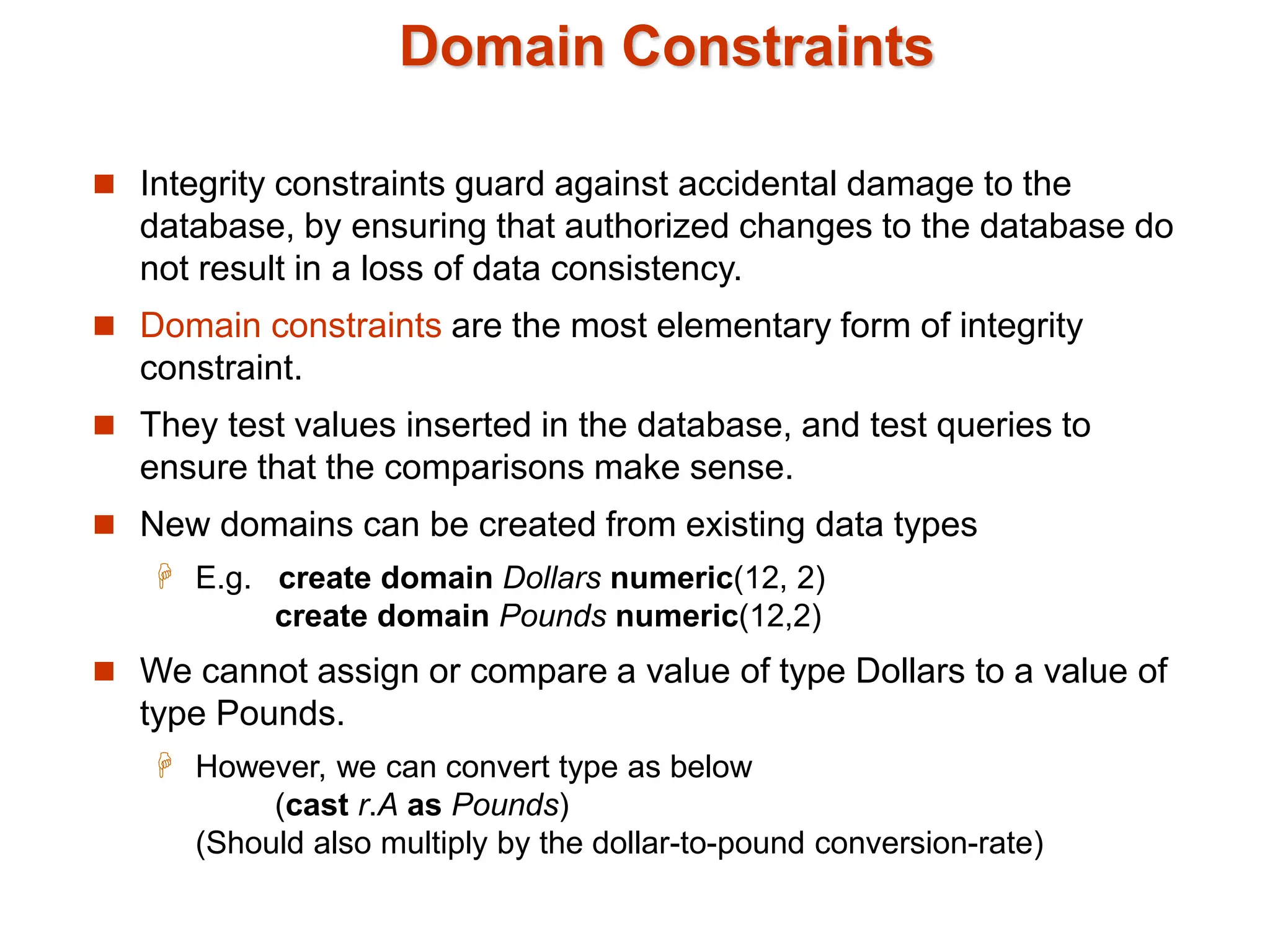
 Integrity constraints guard against accidental damage to the
database, by ensuring that authorized changes to the database do
not result in a loss of data consistency.
 Domain constraints are the most elementary form of integrity
constraint.
 They test values inserted in the database, and test queries to
ensure that the comparisons make sense.
 New domains can be created from existing data types
 E.g. create domain Dollars numeric(12, 2)
create domain Pounds numeric(12,2)
 We cannot assign or compare a value of type Dollars to a value of
type Pounds.
 However, we can convert type as below
(cast r.A as Pounds)
(Should also multiply by the dollar-to-pound conversion-rate)
Domain Constraints (Cont.)
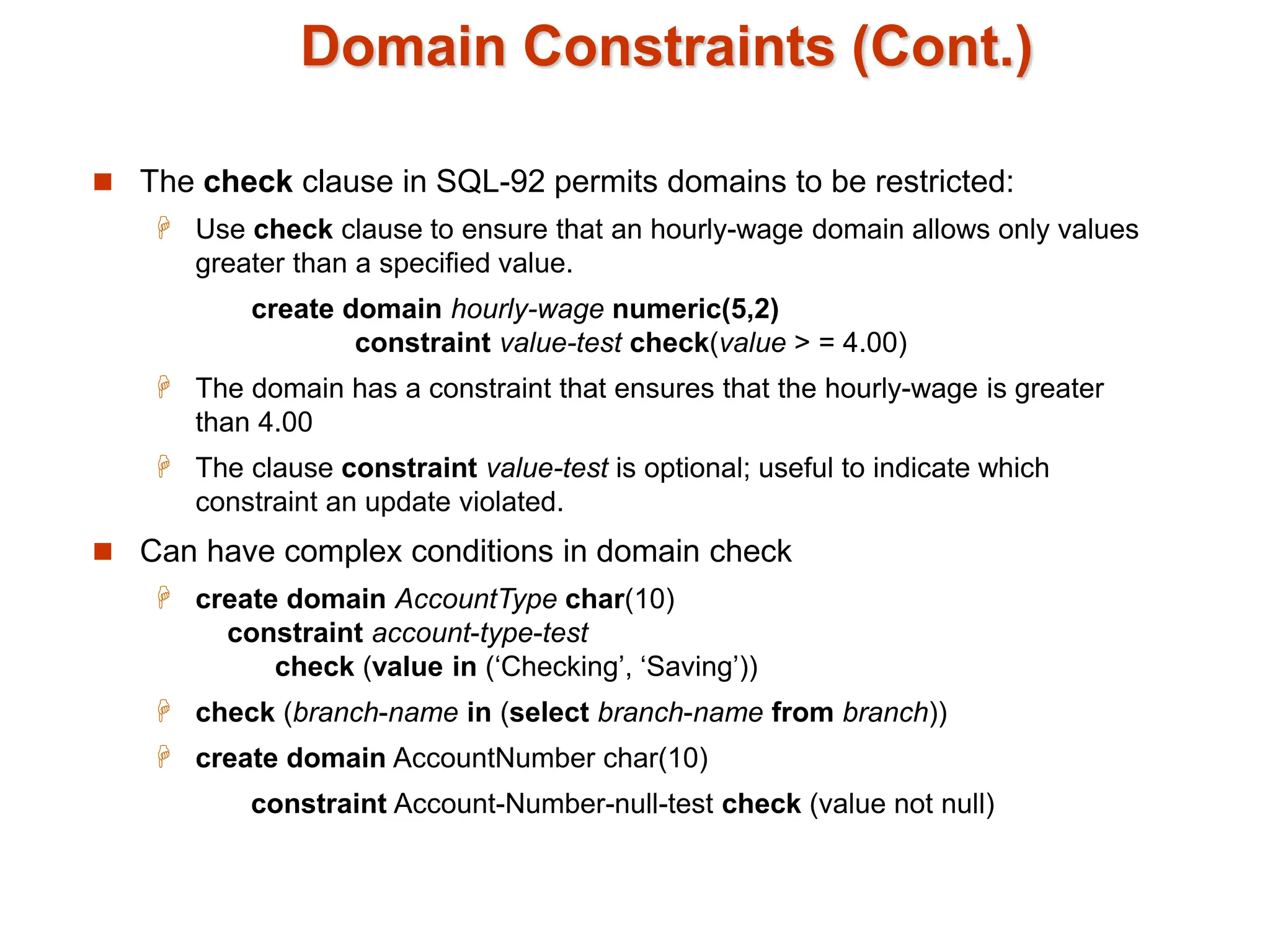
 The check clause in SQL-92 permits domains to be restricted:
 Use check clause to ensure that an hourly-wage domain allows only values
greater than a specified value.
create domain hourly-wage numeric(5,2)
constraint value-test check(value > = 4.00)
 The domain has a constraint that ensures that the hourly-wage is greater
than 4.00
 The clause constraint value-test is optional; useful to indicate which
constraint an update violated.
 Can have complex conditions in domain check
 create domain AccountType char(10)
constraint account-type-test
check (value in (‘Checking’, ‘Saving’))
 check (branch-name in (select branch-name from branch))
 create domain AccountNumber char(10)
constraint Account-Number-null-test check (value not null)
Referential Integrity
 Ensures that a value that appears in one relation for a given set of
attributes also appears for a certain set of attributes in another
relation.
 Example: If “Perryridge” is a branch name appearing in one of the
tuples in the account relation, then there exists a tuple in the branch
relation for branch “Perryridge”.
 Formal Definition
 Let r1(R1) and r2(R2) be relations with primary keys K1 and K2
respectively.
 The subset  of R2 is a foreign key referencing K1 in relation r1, if for
every t2 in r2 there must be a tuple t1 in r1 such that t1[K1] = t2[].
Referential Integrity in the E-R Model
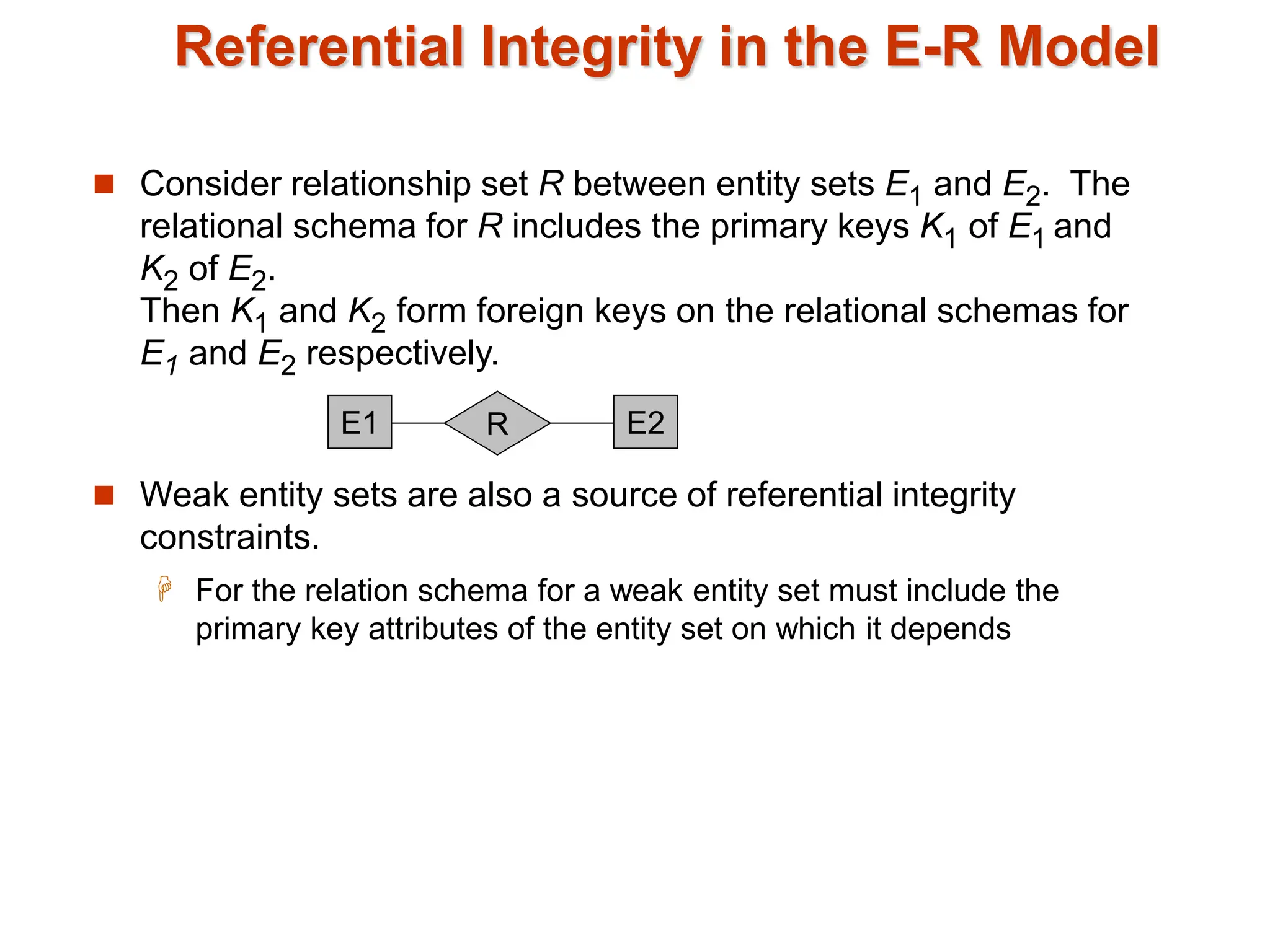
 Consider relationship set R between entity sets E1 and E2. The
relational schema for R includes the primary keys K1 of E1 and
K2 of E2.
Then K1 and K2 form foreign keys on the relational schemas for
E1 and E2 respectively.
 Weak entity sets are also a source of referential integrity
constraints.
 For the relation schema for a weak entity set must include the
primary key attributes of the entity set on which it depends
R
E1 E2
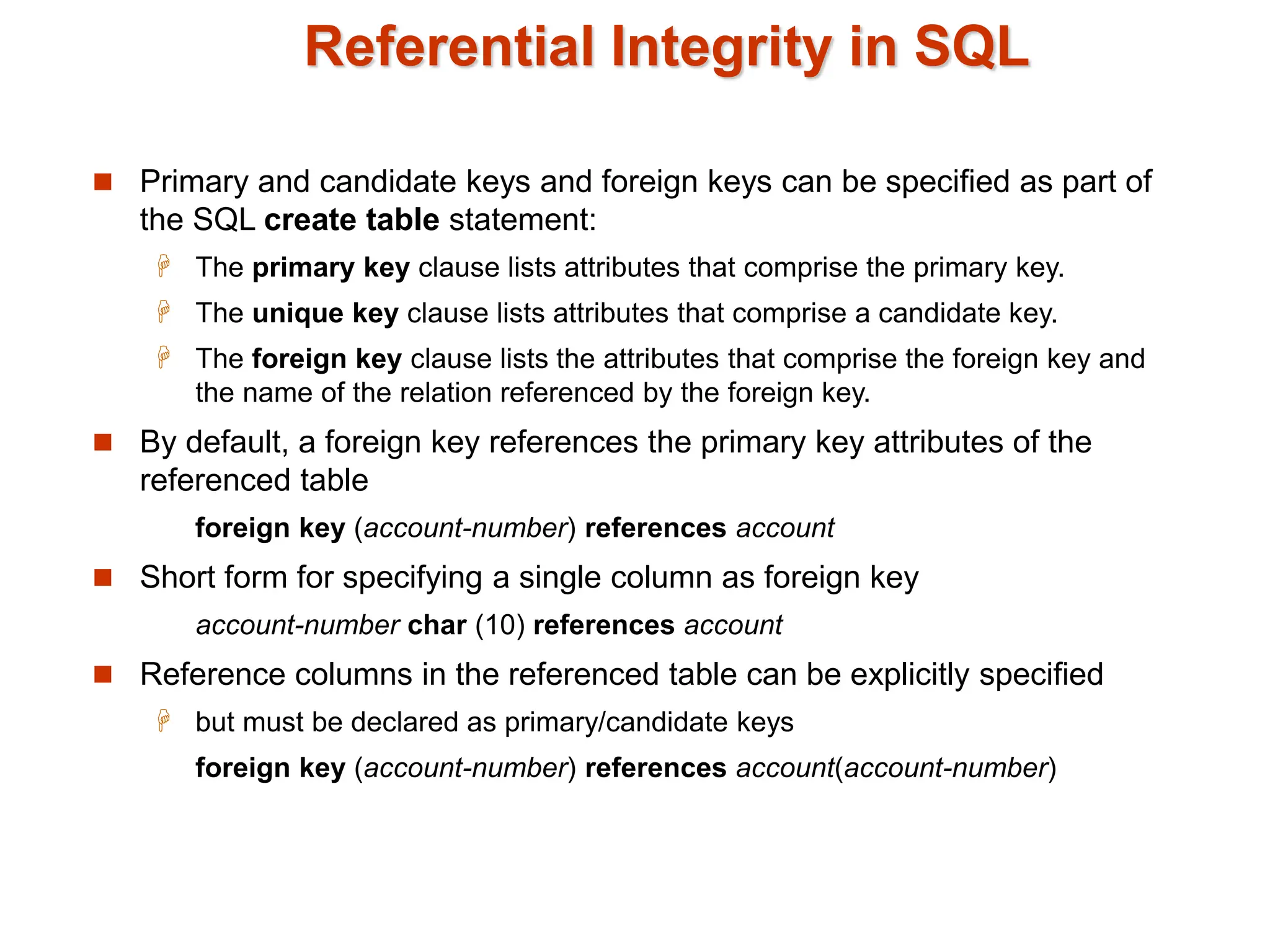
Referential Integrity in SQL
 Primary and candidate keys and foreign keys can be specified as part of
the SQL create table statement:
 The primary key clause lists attributes that comprise the primary key.
 The unique key clause lists attributes that comprise a candidate key.
 The foreign key clause lists the attributes that comprise the foreign key and
the name of the relation referenced by the foreign key.
 By default, a foreign key references the primary key attributes of the
referenced table
foreign key (account-number) references account
 Short form for specifying a single column as foreign key
account-number char (10) references account
 Reference columns in the referenced table can be explicitly specified
 but must be declared as primary/candidate keys
foreign key (account-number) references account(account-number)
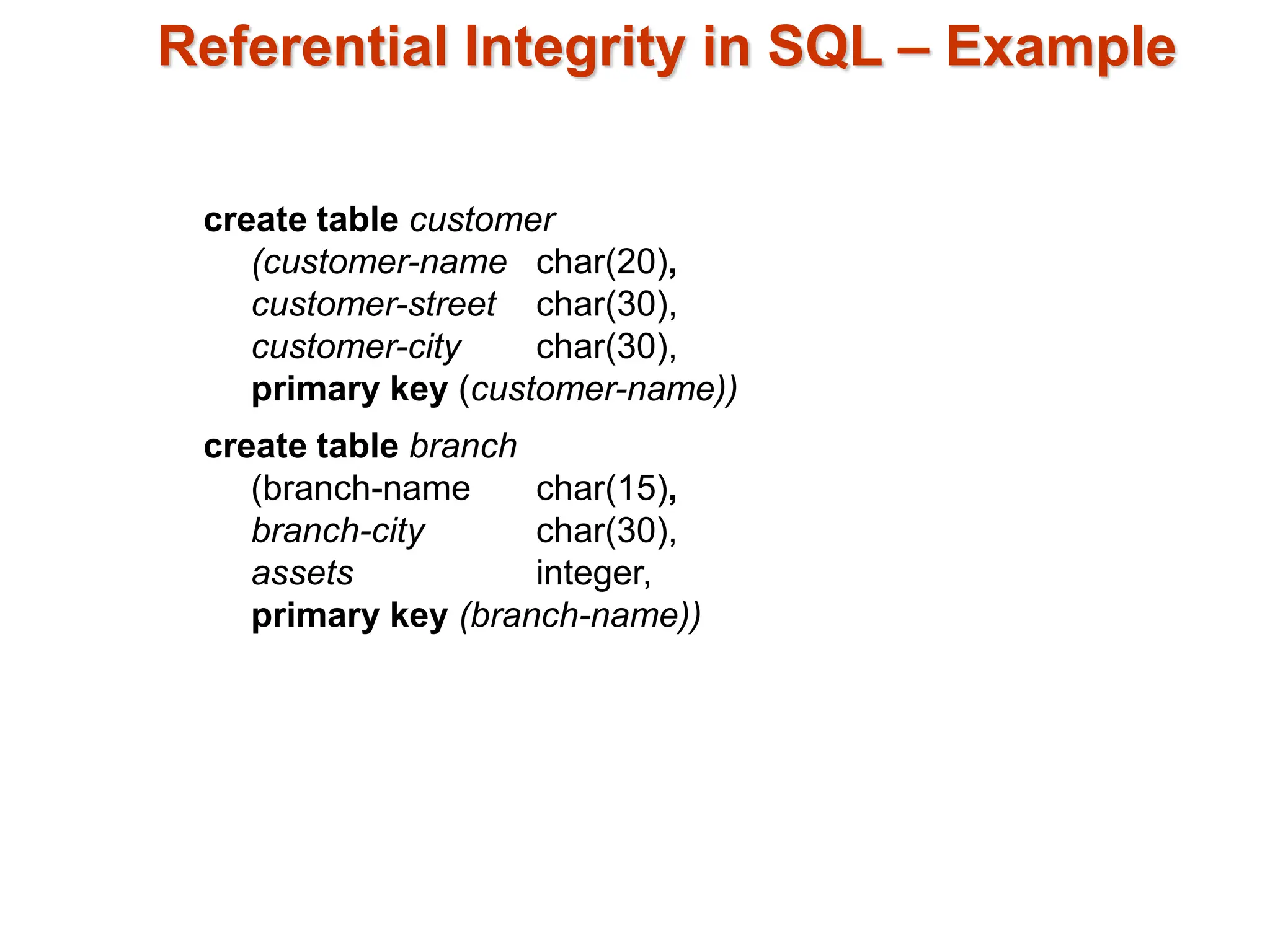
Referential Integrity in SQL – Example
create table customer
(customer-name char(20),
customer-street char(30),
customer-city char(30),
primary key (customer-name))
create table branch
(branch-name char(15),
branch-city char(30),
assets integer,
primary key (branch-name))
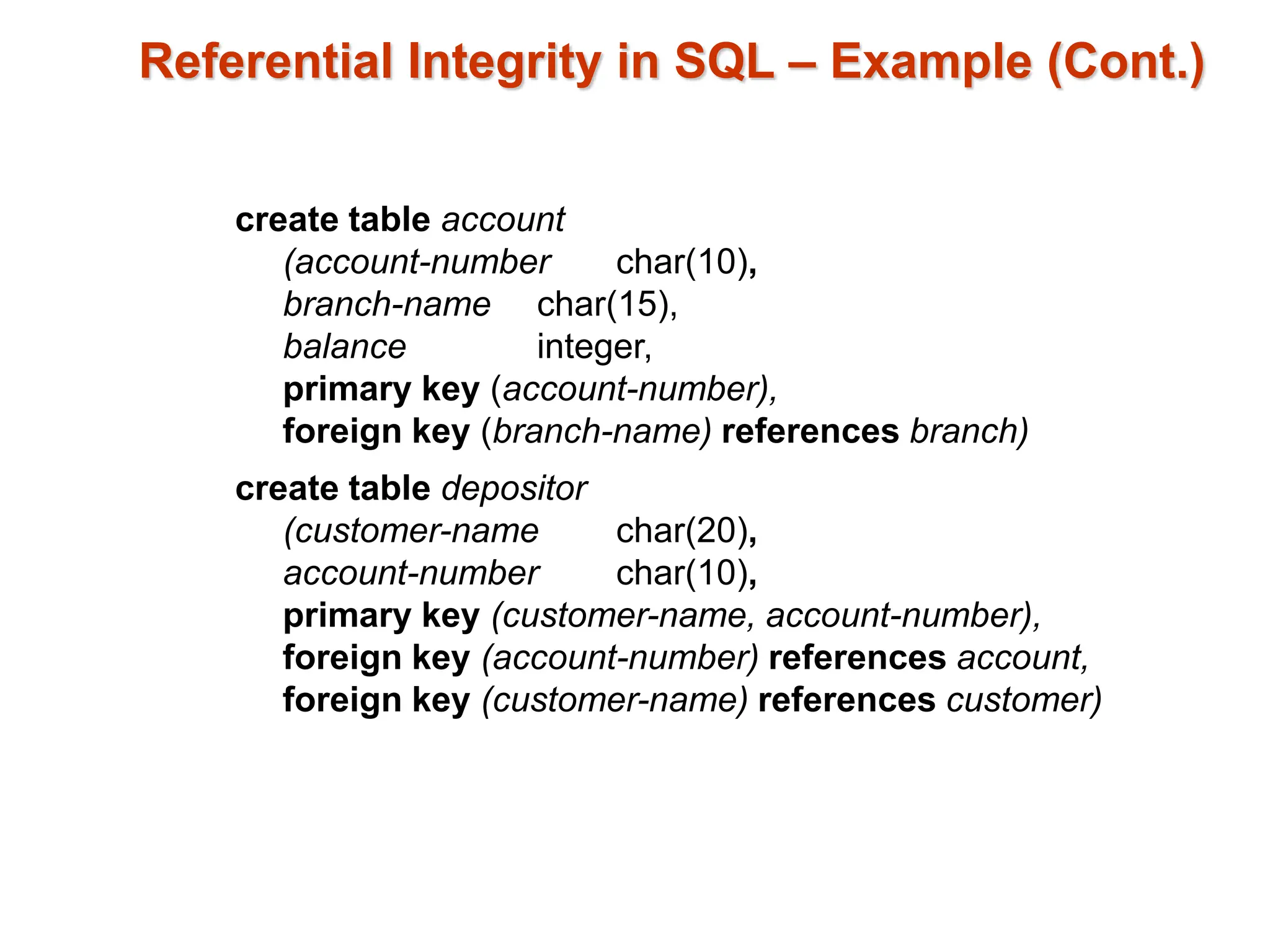
Referential Integrity in SQL – Example (Cont.)
create table account
(account-number char(10),
branch-name char(15),
balance integer,
primary key (account-number),
foreign key (branch-name) references branch)
create table depositor
(customer-name char(20),
account-number char(10),
primary key (customer-name, account-number),
foreign key (account-number) references account,
foreign key (customer-name) references customer)
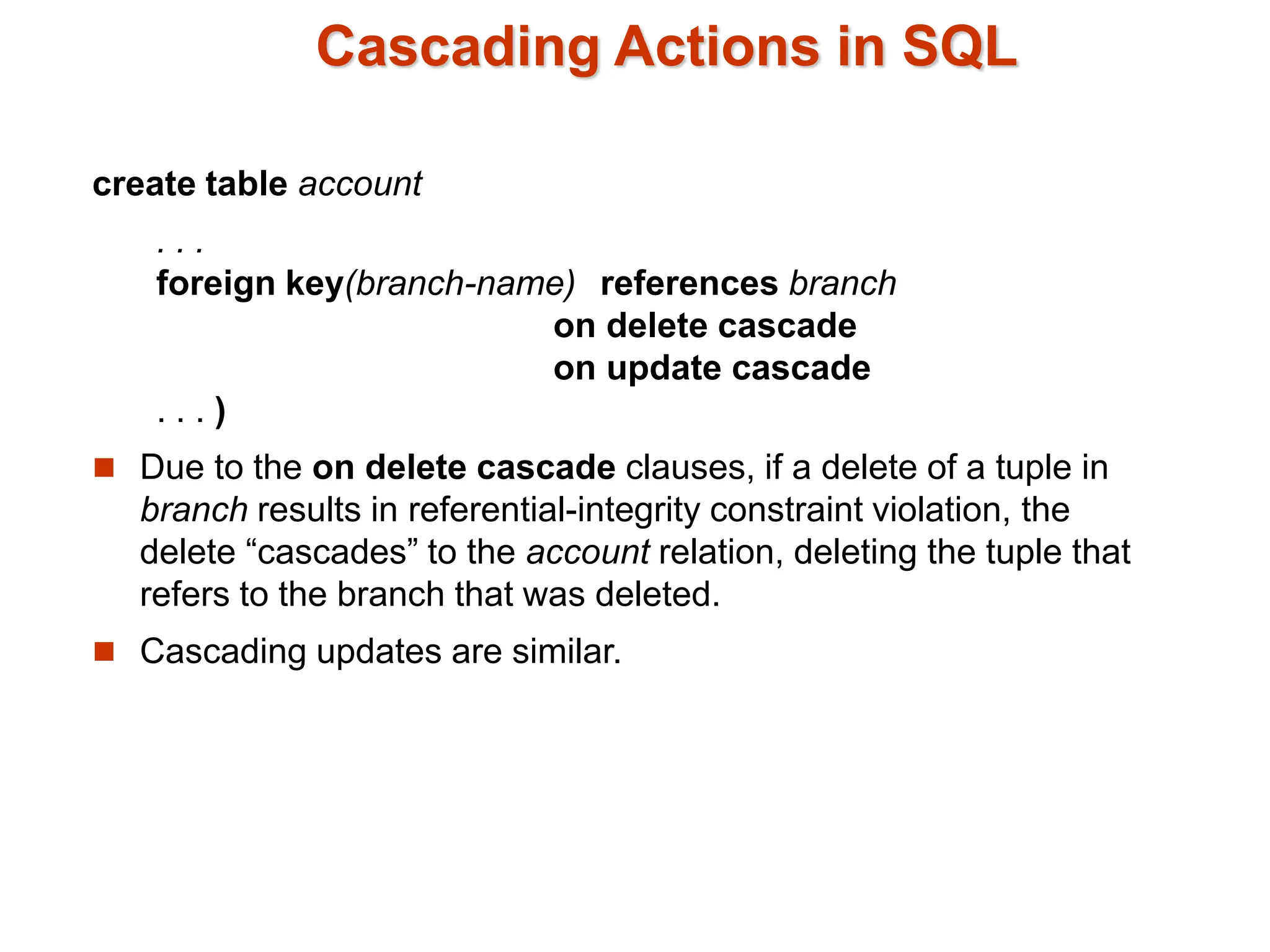
Cascading Actions in SQL
create table account
. . .
foreign key(branch-name) references branch
on delete cascade
on update cascade
. . . )
 Due to the on delete cascade clauses, if a delete of a tuple in
branch results in referential-integrity constraint violation, the
delete “cascades” to the account relation, deleting the tuple that
refers to the branch that was deleted.
 Cascading updates are similar.

Integrity Constraints in Database Management System.ppt

  • 1.
    Integrity Constraints  DomainConstraints  Entity Integrity  Referential Integrity
  • 2.
    Domain Constraints  Integrityconstraints guard against accidental damage to the database, by ensuring that authorized changes to the database do not result in a loss of data consistency.  Domain constraints are the most elementary form of integrity constraint.  They test values inserted in the database, and test queries to ensure that the comparisons make sense.  New domains can be created from existing data types  E.g. create domain Dollars numeric(12, 2) create domain Pounds numeric(12,2)  We cannot assign or compare a value of type Dollars to a value of type Pounds.  However, we can convert type as below (cast r.A as Pounds) (Should also multiply by the dollar-to-pound conversion-rate)
  • 3.
    Domain Constraints (Cont.) The check clause in SQL-92 permits domains to be restricted:  Use check clause to ensure that an hourly-wage domain allows only values greater than a specified value. create domain hourly-wage numeric(5,2) constraint value-test check(value > = 4.00)  The domain has a constraint that ensures that the hourly-wage is greater than 4.00  The clause constraint value-test is optional; useful to indicate which constraint an update violated.  Can have complex conditions in domain check  create domain AccountType char(10) constraint account-type-test check (value in (‘Checking’, ‘Saving’))  check (branch-name in (select branch-name from branch))  create domain AccountNumber char(10) constraint Account-Number-null-test check (value not null)
  • 4.
    Referential Integrity  Ensuresthat a value that appears in one relation for a given set of attributes also appears for a certain set of attributes in another relation.  Example: If “Perryridge” is a branch name appearing in one of the tuples in the account relation, then there exists a tuple in the branch relation for branch “Perryridge”.  Formal Definition  Let r1(R1) and r2(R2) be relations with primary keys K1 and K2 respectively.  The subset  of R2 is a foreign key referencing K1 in relation r1, if for every t2 in r2 there must be a tuple t1 in r1 such that t1[K1] = t2[].
  • 5.
    Referential Integrity inthe E-R Model  Consider relationship set R between entity sets E1 and E2. The relational schema for R includes the primary keys K1 of E1 and K2 of E2. Then K1 and K2 form foreign keys on the relational schemas for E1 and E2 respectively.  Weak entity sets are also a source of referential integrity constraints.  For the relation schema for a weak entity set must include the primary key attributes of the entity set on which it depends R E1 E2
  • 6.
    Referential Integrity inSQL  Primary and candidate keys and foreign keys can be specified as part of the SQL create table statement:  The primary key clause lists attributes that comprise the primary key.  The unique key clause lists attributes that comprise a candidate key.  The foreign key clause lists the attributes that comprise the foreign key and the name of the relation referenced by the foreign key.  By default, a foreign key references the primary key attributes of the referenced table foreign key (account-number) references account  Short form for specifying a single column as foreign key account-number char (10) references account  Reference columns in the referenced table can be explicitly specified  but must be declared as primary/candidate keys foreign key (account-number) references account(account-number)
  • 7.
    Referential Integrity inSQL – Example create table customer (customer-name char(20), customer-street char(30), customer-city char(30), primary key (customer-name)) create table branch (branch-name char(15), branch-city char(30), assets integer, primary key (branch-name))
  • 8.
    Referential Integrity inSQL – Example (Cont.) create table account (account-number char(10), branch-name char(15), balance integer, primary key (account-number), foreign key (branch-name) references branch) create table depositor (customer-name char(20), account-number char(10), primary key (customer-name, account-number), foreign key (account-number) references account, foreign key (customer-name) references customer)
  • 9.
    Cascading Actions inSQL create table account . . . foreign key(branch-name) references branch on delete cascade on update cascade . . . )  Due to the on delete cascade clauses, if a delete of a tuple in branch results in referential-integrity constraint violation, the delete “cascades” to the account relation, deleting the tuple that refers to the branch that was deleted.  Cascading updates are similar.