Ch-1 Introduction
• Data and Information
• Definitions of Database, Database Management System
(DBMS), and Database Systems
• Purpose of Database Systems
• Characteristics of the Database Approach
By:Roshni Sharma
Data and Information
• Data: Data are facts that can be recorded and that have implicit
meaning. Data are the crucial raw facts or raw materials for any
meaningful information. Meaningful information is only possible after
processing such a raw data. Metadata is “data about data” through
which the data are integrated. The metadata provide a description of the
data characteristics and the set of relationships that links the data found
within database. Data is usually regarded as the most fundamental form
of information. Data arranged in useful and meaningful form is known
as information.
• Information: Information is the processed data. In the sense of real
world, information is organized or summarized data. Of course, every
fact or data item can be called information. But we are primarily
concerned with information that would be valuable at a management or
an executive level in a company-particularly for decision-making. This
information is normally higher-level information, summarized from a
much larger set of facts. Consequently, information is different from
data.
By:Roshni Sharma
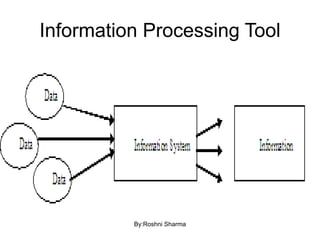
Information Processing Tool
By:Roshni Sharma
Database
• Database is a collection of related data. It can also be
defined as the collection of data that contains information
about one particular enterprise. A database has the
following implicit properties:
• A database represents some aspects of the real world,
sometimes called the miniworld. Changes to the miniworld
are reflected in the database.
• A database is a logically coherent collection of data with
some inherent meanings. A random assortment of data
cannot correctly be referred to as database.
• A database is designed, built, and populated with data for
a specific purpose. It has an intended group of users and
some preconceived applications in which these users are
interested.
By:Roshni Sharma
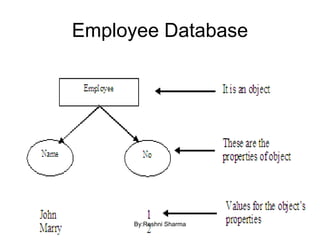
Employee Database
By:Roshni Sharma
Database System
• It is an integrated collection of related files, along with details of the
interpretation of the data contained therein. Database systems are
designed to manage large bodies of information. The management
of data involves:
• Structures for storage of information
• The provision of mechanism for the manipulation of information
• Also the database system must provide for the safety of information
stored despite system crashes or attempts to unauthorized access.
By:Roshni Sharma
Database Management System (DBMS)
• Collection of interrelated data
• Set of programs to access the data
• DBMS contains information about a particular enterprise
• DBMS provides an environment that is both convenient
and efficient to use.
• Database Applications:
– Banking: all transactions
– Airlines: reservations, schedules
– Universities: registration, grades
– Sales: customers, products, purchases
– Manufacturing: production, inventory, orders, supply chain
– Human resources: employee records, salaries, tax deductions
• Databases touch all aspects of our lives
By:Roshni Sharma
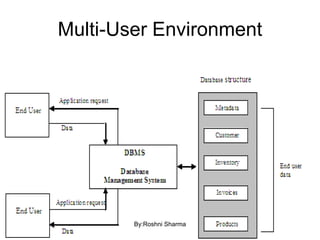
Multi-User Environment
By:Roshni Sharma
Purpose of Database System
In the early days, database applications were built
on top of file systems
Drawbacks of using file systems to store data:
– Data redundancy and inconsistency
• Multiple file formats, duplication of information in different files
– Difficulty in accessing data
• Need to write a new program to carry out each new task
– Data isolation — multiple files and formats
– Integrity problems
• Integrity constraints (e.g. account balance > 0) become part
of program code
• Hard to add new constraints or change existing ones
By:Roshni Sharma
Purpose of Database Systems
(Cont.)
• Drawbacks of using file systems (cont.)
– Atomicity of updates
• Failures may leave database in an inconsistent state with partial
updates carried out
• E.g. transfer of funds from one account to another should either
complete or not happen at all
– Concurrent access by multiple users
• Concurrent access needed for performance
• Uncontrolled concurrent accesses can lead to inconsistencies
E.g. two people reading a balance and updating it at the same time
– Security problems
• Database systems offer solutions to all the above problems
By:Roshni Sharma
Characteristics of the Database
Approach
• Self-Describing Nature of a Database System
-Data Dictionary (Catalog) contains meta-data. It also contains a
complete definition of the database structure and constraints.This
is consulted by DBMS every time when an attempt is made to
access the database.
• Insulation between Programs and Data, and Data Abstraction
-In file systems, the structure of data files is embedded in the
application programs, so changes to the structure of a file may
require changing all programs that access this file. But in DBMS
the structure of data files are stored in Catalog separately from the
access programs.
By:Roshni Sharma
Characteristics of the Database
Approach (Cont.)
• Support of multiple Views of the Data
- A database typically has many users, each of whom may require
a different perspective or View of the database. A multi-user
DBMS whose users have a variety of distinct applications must
provide facilities for defining multiple views. (Example)
• Sharing of Data and Multi-user Transaction Processing
-A DBMS must have concurrency control software to ensure that
several users trying to update the same data do so in a controlled
manner so that the result of the update is correct. Example: The
online transaction processing (OLTP) applications such as airline
flight seat reservation.
By:Roshni Sharma

Introduction to Database Management System.ppt

  • 1.
    Ch-1 Introduction • Dataand Information • Definitions of Database, Database Management System (DBMS), and Database Systems • Purpose of Database Systems • Characteristics of the Database Approach By:Roshni Sharma
  • 2.
    Data and Information •Data: Data are facts that can be recorded and that have implicit meaning. Data are the crucial raw facts or raw materials for any meaningful information. Meaningful information is only possible after processing such a raw data. Metadata is “data about data” through which the data are integrated. The metadata provide a description of the data characteristics and the set of relationships that links the data found within database. Data is usually regarded as the most fundamental form of information. Data arranged in useful and meaningful form is known as information. • Information: Information is the processed data. In the sense of real world, information is organized or summarized data. Of course, every fact or data item can be called information. But we are primarily concerned with information that would be valuable at a management or an executive level in a company-particularly for decision-making. This information is normally higher-level information, summarized from a much larger set of facts. Consequently, information is different from data. By:Roshni Sharma
  • 3.
  • 4.
    Database • Database isa collection of related data. It can also be defined as the collection of data that contains information about one particular enterprise. A database has the following implicit properties: • A database represents some aspects of the real world, sometimes called the miniworld. Changes to the miniworld are reflected in the database. • A database is a logically coherent collection of data with some inherent meanings. A random assortment of data cannot correctly be referred to as database. • A database is designed, built, and populated with data for a specific purpose. It has an intended group of users and some preconceived applications in which these users are interested. By:Roshni Sharma
  • 5.
  • 6.
    Database System • Itis an integrated collection of related files, along with details of the interpretation of the data contained therein. Database systems are designed to manage large bodies of information. The management of data involves: • Structures for storage of information • The provision of mechanism for the manipulation of information • Also the database system must provide for the safety of information stored despite system crashes or attempts to unauthorized access. By:Roshni Sharma
  • 7.
    Database Management System(DBMS) • Collection of interrelated data • Set of programs to access the data • DBMS contains information about a particular enterprise • DBMS provides an environment that is both convenient and efficient to use. • Database Applications: – Banking: all transactions – Airlines: reservations, schedules – Universities: registration, grades – Sales: customers, products, purchases – Manufacturing: production, inventory, orders, supply chain – Human resources: employee records, salaries, tax deductions • Databases touch all aspects of our lives By:Roshni Sharma
  • 8.
  • 9.
    Purpose of DatabaseSystem In the early days, database applications were built on top of file systems Drawbacks of using file systems to store data: – Data redundancy and inconsistency • Multiple file formats, duplication of information in different files – Difficulty in accessing data • Need to write a new program to carry out each new task – Data isolation — multiple files and formats – Integrity problems • Integrity constraints (e.g. account balance > 0) become part of program code • Hard to add new constraints or change existing ones By:Roshni Sharma
  • 10.
    Purpose of DatabaseSystems (Cont.) • Drawbacks of using file systems (cont.) – Atomicity of updates • Failures may leave database in an inconsistent state with partial updates carried out • E.g. transfer of funds from one account to another should either complete or not happen at all – Concurrent access by multiple users • Concurrent access needed for performance • Uncontrolled concurrent accesses can lead to inconsistencies E.g. two people reading a balance and updating it at the same time – Security problems • Database systems offer solutions to all the above problems By:Roshni Sharma
  • 11.
    Characteristics of theDatabase Approach • Self-Describing Nature of a Database System -Data Dictionary (Catalog) contains meta-data. It also contains a complete definition of the database structure and constraints.This is consulted by DBMS every time when an attempt is made to access the database. • Insulation between Programs and Data, and Data Abstraction -In file systems, the structure of data files is embedded in the application programs, so changes to the structure of a file may require changing all programs that access this file. But in DBMS the structure of data files are stored in Catalog separately from the access programs. By:Roshni Sharma
  • 12.
    Characteristics of theDatabase Approach (Cont.) • Support of multiple Views of the Data - A database typically has many users, each of whom may require a different perspective or View of the database. A multi-user DBMS whose users have a variety of distinct applications must provide facilities for defining multiple views. (Example) • Sharing of Data and Multi-user Transaction Processing -A DBMS must have concurrency control software to ensure that several users trying to update the same data do so in a controlled manner so that the result of the update is correct. Example: The online transaction processing (OLTP) applications such as airline flight seat reservation. By:Roshni Sharma

Editor's Notes

  • #2 BY: Roshni Sharma