Prepared by:
Angelie A. Arcenal
Mary Jane R. Laurito
Jylle Marie A. Oliveros
OBJECTIVES:
 I can be able to solve long
method and synthetic
method.
 I can be able to determine what
will be the easier method to be used.
 I can be able to appreciate the
importance of dividing polynomials
and relate it in real life situations.
What is the definition of polynomial?
Polynomials- is an expression of more than two
algebraic terms, especially the sum of several terms
that contain different powers of the same variable(s).
In finding the quotient of polynomials, there are two ways
to divide them which are:
 Algebraic long method - simply the traditional
method of dividing algebraic expression and the ;
 Synthetic Division Method- is a shorthand, or shortcut,
method of polynomial division in the special case of
dividing by a linear factor -- and it only works in this
case. Synthetic division is generally used, however, not
for dividing out factors but for finding zeroes (or roots)
of polynomials.
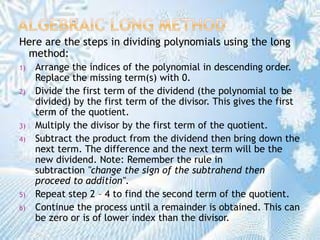
Here are the steps in dividing polynomials using the long
method:
1) Arrange the indices of the polynomial in descending order.
Replace the missing term(s) with 0.
2) Divide the first term of the dividend (the polynomial to be
divided) by the first term of the divisor. This gives the first
term of the quotient.
3) Multiply the divisor by the first term of the quotient.
4) Subtract the product from the dividend then bring down the
next term. The difference and the next term will be the
new dividend. Note: Remember the rule in
subtraction "change the sign of the subtrahend then
proceed to addition".
5) Repeat step 2 – 4 to find the second term of the quotient.
6) Continue the process until a remainder is obtained. This can
be zero or is of lower index than the divisor.
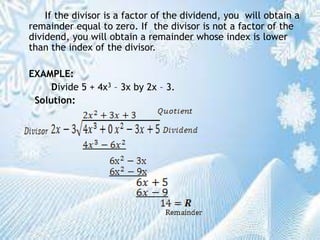
If the divisor is a factor of the dividend, you will obtain a
remainder equal to zero. If the divisor is not a factor of the
dividend, you will obtain a remainder whose index is lower
than the index of the divisor.
EXAMPLE:
Divide 5 + 4x3 – 3x by 2x – 3.
Solution:
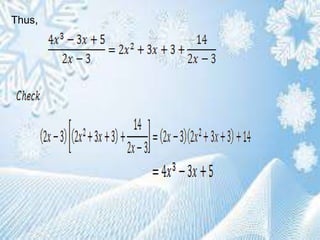
Thus,
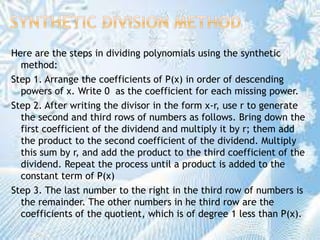
Here are the steps in dividing polynomials using the synthetic
method:
Step 1. Arrange the coefficients of P(x) in order of descending
powers of x. Write 0 as the coefficient for each missing power.
Step 2. After writing the divisor in the form x-r, use r to generate
the second and third rows of numbers as follows. Bring down the
first coefficient of the dividend and multiply it by r; them add
the product to the second coefficient of the dividend. Multiply
this sum by r, and add the product to the third coefficient of the
dividend. Repeat the process until a product is added to the
constant term of P(x)
Step 3. The last number to the right in the third row of numbers is
the remainder. The other numbers in he third row are the
coefficients of the quotient, which is of degree 1 less than P(x).
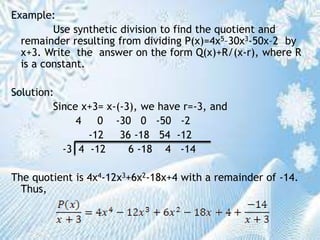
Example:
Use synthetic division to find the quotient and
remainder resulting from dividing P(x)=4x5–30x3-50x–2 by
x+3. Write the answer on the form Q(x)+R/(x-r), where R
is a constant.
Solution:
Since x+3= x-(-3), we have r=-3, and
4 0 -30 0 -50 -2
-12 36 -18 54 -12
-3 4 -12 6 -18 4 -14
The quotient is 4x4-12x3+6x2-18x+4 with a remainder of -14.
Thus,
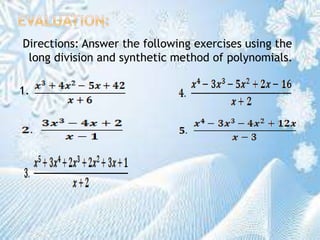
Directions: Answer the following exercises using the
long division and synthetic method of polynomials.
1.
Barnett,Raymond A., Byleen, Karl E., and Ziegler,
Michael P., College Algebra with Trigonometry
(Seventh Edition), Polynomial Division, pp.286-288.
Hornsby, John, Lial, Margaret L., and Schencider,
David, College Algebra and Trigonometry (Second
Edition), Polynomial Division, pp.290.
Mathematics. Laerd.com/maths/algebraic-division-
intro.php

Division of polynomials

  • 1.
    Prepared by: Angelie A.Arcenal Mary Jane R. Laurito Jylle Marie A. Oliveros
  • 2.
    OBJECTIVES:  I canbe able to solve long method and synthetic method.  I can be able to determine what will be the easier method to be used.  I can be able to appreciate the importance of dividing polynomials and relate it in real life situations.
  • 3.
    What is thedefinition of polynomial? Polynomials- is an expression of more than two algebraic terms, especially the sum of several terms that contain different powers of the same variable(s). In finding the quotient of polynomials, there are two ways to divide them which are:  Algebraic long method - simply the traditional method of dividing algebraic expression and the ;  Synthetic Division Method- is a shorthand, or shortcut, method of polynomial division in the special case of dividing by a linear factor -- and it only works in this case. Synthetic division is generally used, however, not for dividing out factors but for finding zeroes (or roots) of polynomials.
  • 4.
    Here are thesteps in dividing polynomials using the long method: 1) Arrange the indices of the polynomial in descending order. Replace the missing term(s) with 0. 2) Divide the first term of the dividend (the polynomial to be divided) by the first term of the divisor. This gives the first term of the quotient. 3) Multiply the divisor by the first term of the quotient. 4) Subtract the product from the dividend then bring down the next term. The difference and the next term will be the new dividend. Note: Remember the rule in subtraction "change the sign of the subtrahend then proceed to addition". 5) Repeat step 2 – 4 to find the second term of the quotient. 6) Continue the process until a remainder is obtained. This can be zero or is of lower index than the divisor.
  • 5.
    If the divisoris a factor of the dividend, you will obtain a remainder equal to zero. If the divisor is not a factor of the dividend, you will obtain a remainder whose index is lower than the index of the divisor. EXAMPLE: Divide 5 + 4x3 – 3x by 2x – 3. Solution:
  • 6.
  • 7.
    Here are thesteps in dividing polynomials using the synthetic method: Step 1. Arrange the coefficients of P(x) in order of descending powers of x. Write 0 as the coefficient for each missing power. Step 2. After writing the divisor in the form x-r, use r to generate the second and third rows of numbers as follows. Bring down the first coefficient of the dividend and multiply it by r; them add the product to the second coefficient of the dividend. Multiply this sum by r, and add the product to the third coefficient of the dividend. Repeat the process until a product is added to the constant term of P(x) Step 3. The last number to the right in the third row of numbers is the remainder. The other numbers in he third row are the coefficients of the quotient, which is of degree 1 less than P(x).
  • 8.
    Example: Use synthetic divisionto find the quotient and remainder resulting from dividing P(x)=4x5–30x3-50x–2 by x+3. Write the answer on the form Q(x)+R/(x-r), where R is a constant. Solution: Since x+3= x-(-3), we have r=-3, and 4 0 -30 0 -50 -2 -12 36 -18 54 -12 -3 4 -12 6 -18 4 -14 The quotient is 4x4-12x3+6x2-18x+4 with a remainder of -14. Thus,
  • 9.
    Directions: Answer thefollowing exercises using the long division and synthetic method of polynomials. 1.
  • 10.
    Barnett,Raymond A., Byleen,Karl E., and Ziegler, Michael P., College Algebra with Trigonometry (Seventh Edition), Polynomial Division, pp.286-288. Hornsby, John, Lial, Margaret L., and Schencider, David, College Algebra and Trigonometry (Second Edition), Polynomial Division, pp.290. Mathematics. Laerd.com/maths/algebraic-division- intro.php