UNESCO ICT COMPETENCY
FRAMEWORK FOR TEACHERS
SUKARNO/17705264002
NURHIDAYAH/17705264004
LANGUAGE EDUCATION SCIENCE
SCHOOL OF GRADUATE STUDIES
YOGYAKARTA STATE UNIVERSITY
23 FEBRUARY 2018
LIFE IS CHANGING.
Life  very transformative and extremely dynamic
In the past:
 No such applications –WA, line, messenger, imo, IG, etc.
 No LCD, no laptop, no mobile phones
Now:
 online shops,
 online communication,
 online transportation, etc.
EDUCATION???
Changing  Using ICT
Modern societies  based on
information and knowledge
Modern societies need to:
 build workforces which have ICT skills to handle
information and are reflective, creative and adept at
problem-solving in order to generate knowledge
 enable citizens to be knowledgeable and resourceful so
they are able to manage their own lives effectively, and are
able to lead full and satisfying lives
 encourage all citizens to participate fully in society and
influence the decisions which affect their lives
 foster cross-cultural understanding and the peaceful
resolution of conflict.
Education system  social
and economic goals
Modern education:
 Teachers  equipped with ICT competencies
 Teachers  help the students become collaborative,
problem solving, creative learners through using ICT
 Students  be effective citizens and members of the
workforce
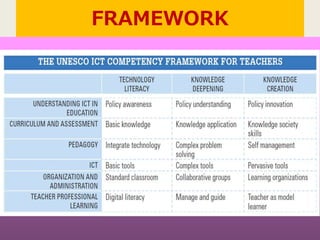
FRAMEWORK
Technology Literacy
 enabling students to use ICT in order to learn more efficiently
Knowledge Deepening
 enabling students to acquire in-depth knowledge of their school
subjects and apply it to complex, real-world problems
Knowledge Creation
 enabling students, citizens and the workforce they become, to create
the new knowledge required for more harmonious, fulfilling and
prosperous societies
FRAMEWORK
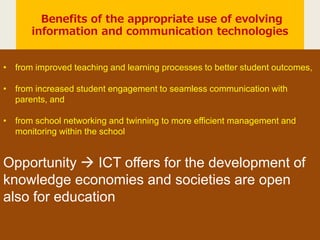
Benefits of the appropriate use of evolving
information and communication technologies
• from improved teaching and learning processes to better student outcomes,
• from increased student engagement to seamless communication with
parents, and
• from school networking and twinning to more efficient management and
monitoring within the school
Opportunity  ICT offers for the development of
knowledge economies and societies are open
also for education
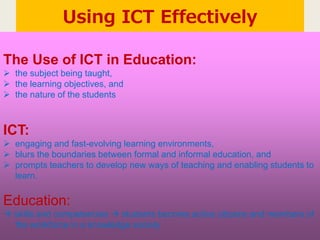
Using ICT Effectively
The Use of ICT in Education:
 the subject being taught,
 the learning objectives, and
 the nature of the students
ICT:
 engaging and fast-evolving learning environments,
 blurs the boundaries between formal and informal education, and
 prompts teachers to develop new ways of teaching and enabling students to
learn.
Education:
 skills and competencies  students become active citizens and members of
the workforce in a knowledge society
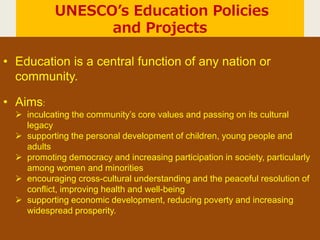
UNESCO’s Education Policies
and Projects
• Education is a central function of any nation or
community.
• Aims:
 inculcating the community’s core values and passing on its cultural
legacy
 supporting the personal development of children, young people and
adults
 promoting democracy and increasing participation in society, particularly
among women and minorities
 encouraging cross-cultural understanding and the peaceful resolution of
conflict, improving health and well-being
 supporting economic development, reducing poverty and increasing
widespread prosperity.
UNESCO’s Education Policies
and Projects
• The ICT Competency Framework for Teachers project  promote
educational reform and sustainable economic development  to reduce
poverty and to improve health and the quality of life
• Emphasizing the quality of learning  four pillars of learning: ‘learning to
live together’, ‘learning to know’, ‘learning to do’, and ‘learning to be’.
The Framework project: linking ICT, education
and the economy
• Emphasizing improvements in the quality of education
• Stresses life-long learning, new learning goals and participation in a learning
society that is based on knowledge building and knowledge sharing
• Building on the relationship between ICT use, education reform, and
economic growth
• The UNESCO report Education in and for the Information Society  ICT can
be a driver for growth and empowerment, with profound implications for
improving education.
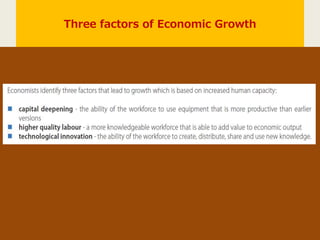
Three factors of Economic Growth
THE THREE APPROACHES OF THE FRAMEWORK
• TECHNOLOGY LITERACY
• KNOWLEDGE DEEPENING
• KNOWLEDGE CREATION
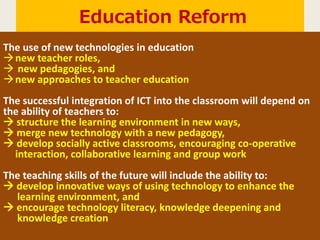
Education Reform
The use of new technologies in education
new teacher roles,
 new pedagogies, and
new approaches to teacher education
The successful integration of ICT into the classroom will depend on
the ability of teachers to:
 structure the learning environment in new ways,
 merge new technology with a new pedagogy,
 develop socially active classrooms, encouraging co-operative
interaction, collaborative learning and group work
The teaching skills of the future will include the ability to:
 develop innovative ways of using technology to enhance the
learning environment, and
 encourage technology literacy, knowledge deepening and
knowledge creation
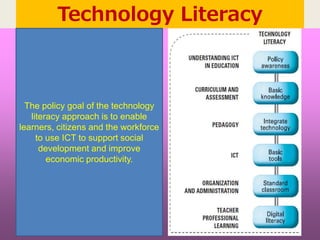
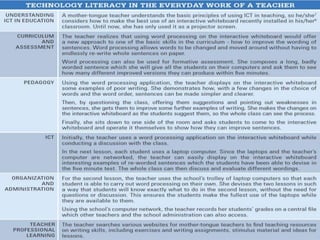
Technology Literacy
The policy goal of the technology
literacy approach is to enable
learners, citizens and the workforce
to use ICT to support social
development and improve
economic productivity.
PELATIHAN PELAYANAN PRIMA DAN
STANDARISASI PENAMPILAN
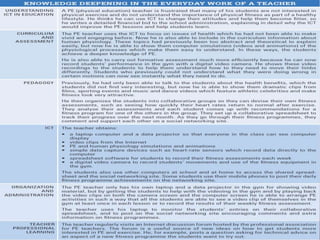
Knowledge Deepening
The aim of the knowledge deepening approach
is to increase the ability of students, citizens,
and the workforce to add value to society and
to the economy by applying the knowledge
gained in school subjects to solve complex,
high priority problems encountered in real world
situations of work, society and in life generally.
Teacher competencies related to the
knowledge deepening approach include the
ability to manage information, structure
problem tasks, and integrate open-ended
software tools and subject-specifi c applications
with student-centred teaching methods and
collaborative projects in support of students’ in-
depth understanding of key concepts and their
application to complex, real-world problems
Teachers should also be able to use ICT to
create and monitor individual and group
student project plans, as well as to access
information and experts and collaborate with
other teachers to support their own
professional learning.
PELATIHAN PELAYANAN PRIMA DAN
STANDARISASI PENAMPILAN
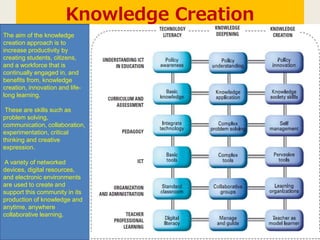
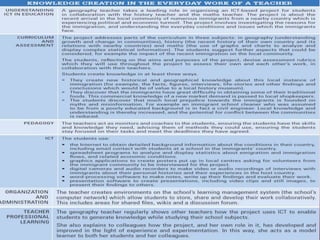
Knowledge Creation
The aim of the knowledge
creation approach is to
increase productivity by
creating students, citizens,
and a workforce that is
continually engaged in, and
benefits from, knowledge
creation, innovation and life-
long learning.
These are skills such as
problem solving,
communication, collaboration,
experimentation, critical
thinking and creative
expression.
A variety of networked
devices, digital resources,
and electronic environments
are used to create and
support this community in its
production of knowledge and
anytime, anywhere
collaborative learning.
PELATIHAN PELAYANAN PRIMA DAN
STANDARISASI PENAMPILAN
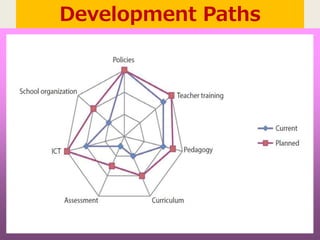
Development Paths
QUESTIONS
1. What is you opinion about ICT-CFT?
2. Based on the Unesco ICT-CFT, as teachers/lecturers, have
you got the competencies?
(If not, what will you do? If yes, what have you got?)
3. Can ICT-based learning replace the position of teachers?
3. What are your plans to develop your competencies in ICT
for language learning?

Unesco ICT-CFT

  • 1.
    UNESCO ICT COMPETENCY FRAMEWORKFOR TEACHERS SUKARNO/17705264002 NURHIDAYAH/17705264004 LANGUAGE EDUCATION SCIENCE SCHOOL OF GRADUATE STUDIES YOGYAKARTA STATE UNIVERSITY 23 FEBRUARY 2018
  • 2.
    LIFE IS CHANGING. Life very transformative and extremely dynamic In the past:  No such applications –WA, line, messenger, imo, IG, etc.  No LCD, no laptop, no mobile phones Now:  online shops,  online communication,  online transportation, etc. EDUCATION??? Changing  Using ICT
  • 3.
    Modern societies based on information and knowledge Modern societies need to:  build workforces which have ICT skills to handle information and are reflective, creative and adept at problem-solving in order to generate knowledge  enable citizens to be knowledgeable and resourceful so they are able to manage their own lives effectively, and are able to lead full and satisfying lives  encourage all citizens to participate fully in society and influence the decisions which affect their lives  foster cross-cultural understanding and the peaceful resolution of conflict.
  • 4.
    Education system social and economic goals Modern education:  Teachers  equipped with ICT competencies  Teachers  help the students become collaborative, problem solving, creative learners through using ICT  Students  be effective citizens and members of the workforce
  • 5.
    FRAMEWORK Technology Literacy  enablingstudents to use ICT in order to learn more efficiently Knowledge Deepening  enabling students to acquire in-depth knowledge of their school subjects and apply it to complex, real-world problems Knowledge Creation  enabling students, citizens and the workforce they become, to create the new knowledge required for more harmonious, fulfilling and prosperous societies
  • 6.
  • 7.
    Benefits of theappropriate use of evolving information and communication technologies • from improved teaching and learning processes to better student outcomes, • from increased student engagement to seamless communication with parents, and • from school networking and twinning to more efficient management and monitoring within the school Opportunity  ICT offers for the development of knowledge economies and societies are open also for education
  • 8.
    Using ICT Effectively TheUse of ICT in Education:  the subject being taught,  the learning objectives, and  the nature of the students ICT:  engaging and fast-evolving learning environments,  blurs the boundaries between formal and informal education, and  prompts teachers to develop new ways of teaching and enabling students to learn. Education:  skills and competencies  students become active citizens and members of the workforce in a knowledge society
  • 9.
    UNESCO’s Education Policies andProjects • Education is a central function of any nation or community. • Aims:  inculcating the community’s core values and passing on its cultural legacy  supporting the personal development of children, young people and adults  promoting democracy and increasing participation in society, particularly among women and minorities  encouraging cross-cultural understanding and the peaceful resolution of conflict, improving health and well-being  supporting economic development, reducing poverty and increasing widespread prosperity.
  • 10.
    UNESCO’s Education Policies andProjects • The ICT Competency Framework for Teachers project  promote educational reform and sustainable economic development  to reduce poverty and to improve health and the quality of life • Emphasizing the quality of learning  four pillars of learning: ‘learning to live together’, ‘learning to know’, ‘learning to do’, and ‘learning to be’.
  • 11.
    The Framework project:linking ICT, education and the economy • Emphasizing improvements in the quality of education • Stresses life-long learning, new learning goals and participation in a learning society that is based on knowledge building and knowledge sharing • Building on the relationship between ICT use, education reform, and economic growth • The UNESCO report Education in and for the Information Society  ICT can be a driver for growth and empowerment, with profound implications for improving education.
  • 12.
    Three factors ofEconomic Growth
  • 13.
    THE THREE APPROACHESOF THE FRAMEWORK • TECHNOLOGY LITERACY • KNOWLEDGE DEEPENING • KNOWLEDGE CREATION
  • 15.
    Education Reform The useof new technologies in education new teacher roles,  new pedagogies, and new approaches to teacher education The successful integration of ICT into the classroom will depend on the ability of teachers to:  structure the learning environment in new ways,  merge new technology with a new pedagogy,  develop socially active classrooms, encouraging co-operative interaction, collaborative learning and group work The teaching skills of the future will include the ability to:  develop innovative ways of using technology to enhance the learning environment, and  encourage technology literacy, knowledge deepening and knowledge creation
  • 16.
    Technology Literacy The policygoal of the technology literacy approach is to enable learners, citizens and the workforce to use ICT to support social development and improve economic productivity.
  • 17.
    PELATIHAN PELAYANAN PRIMADAN STANDARISASI PENAMPILAN
  • 18.
    Knowledge Deepening The aimof the knowledge deepening approach is to increase the ability of students, citizens, and the workforce to add value to society and to the economy by applying the knowledge gained in school subjects to solve complex, high priority problems encountered in real world situations of work, society and in life generally. Teacher competencies related to the knowledge deepening approach include the ability to manage information, structure problem tasks, and integrate open-ended software tools and subject-specifi c applications with student-centred teaching methods and collaborative projects in support of students’ in- depth understanding of key concepts and their application to complex, real-world problems Teachers should also be able to use ICT to create and monitor individual and group student project plans, as well as to access information and experts and collaborate with other teachers to support their own professional learning.
  • 19.
    PELATIHAN PELAYANAN PRIMADAN STANDARISASI PENAMPILAN
  • 20.
    Knowledge Creation The aimof the knowledge creation approach is to increase productivity by creating students, citizens, and a workforce that is continually engaged in, and benefits from, knowledge creation, innovation and life- long learning. These are skills such as problem solving, communication, collaboration, experimentation, critical thinking and creative expression. A variety of networked devices, digital resources, and electronic environments are used to create and support this community in its production of knowledge and anytime, anywhere collaborative learning.
  • 21.
    PELATIHAN PELAYANAN PRIMADAN STANDARISASI PENAMPILAN
  • 22.
  • 23.
    QUESTIONS 1. What isyou opinion about ICT-CFT? 2. Based on the Unesco ICT-CFT, as teachers/lecturers, have you got the competencies? (If not, what will you do? If yes, what have you got?) 3. Can ICT-based learning replace the position of teachers? 3. What are your plans to develop your competencies in ICT for language learning?