I n t e g r a t i n g A g r i c u l t u r e i n N a t i o n a l A d a p t a t i o n P l a n s
INTEGRATING CLIMATE
CHANGE ADAPTATION
INTO PLANNING AND
BUDGETING
Webinar, 11:00 CET
27 September 2017
Rohini Kohli and Glenn Hodes, UNDP
Outline
1. Integrating adaptation into planning
2. Integrating adaptation into budgeting
3. Key messages
1. INTEGRATING CLIMATE
CHANGE ADAPTATION
INTO PLANNING
What is the National Adaptation
Plan (NAP) Process?
• The national adaptation plan (NAP) process was established under
the UNFCCC Cancun Adaptation Framework (2010).
• Its objectives are to reduce vulnerability to the impacts of climate
change, and to facilitate the integration of climate change
adaptation, in a coherent manner, into relevant new and existing
policies, programmes and activities
• In plain-speak, National Adaptation Plans are a means of identifying
medium- and long-term adaptation needs and developing and
implementing strategies and programmes to address those needs
• Integration of climate change into ongoing planning and budgeting
processes is a key component of NAPs
Opportunities for 2030 Agenda
and NAP Alignment
 Institutional arrangements.
 Data coherence.
 Adaptation options as SDG catalysts
 Budget implications.
 Common messaging.
 Accessing climate finance
Adaptation
Impact
monitoring
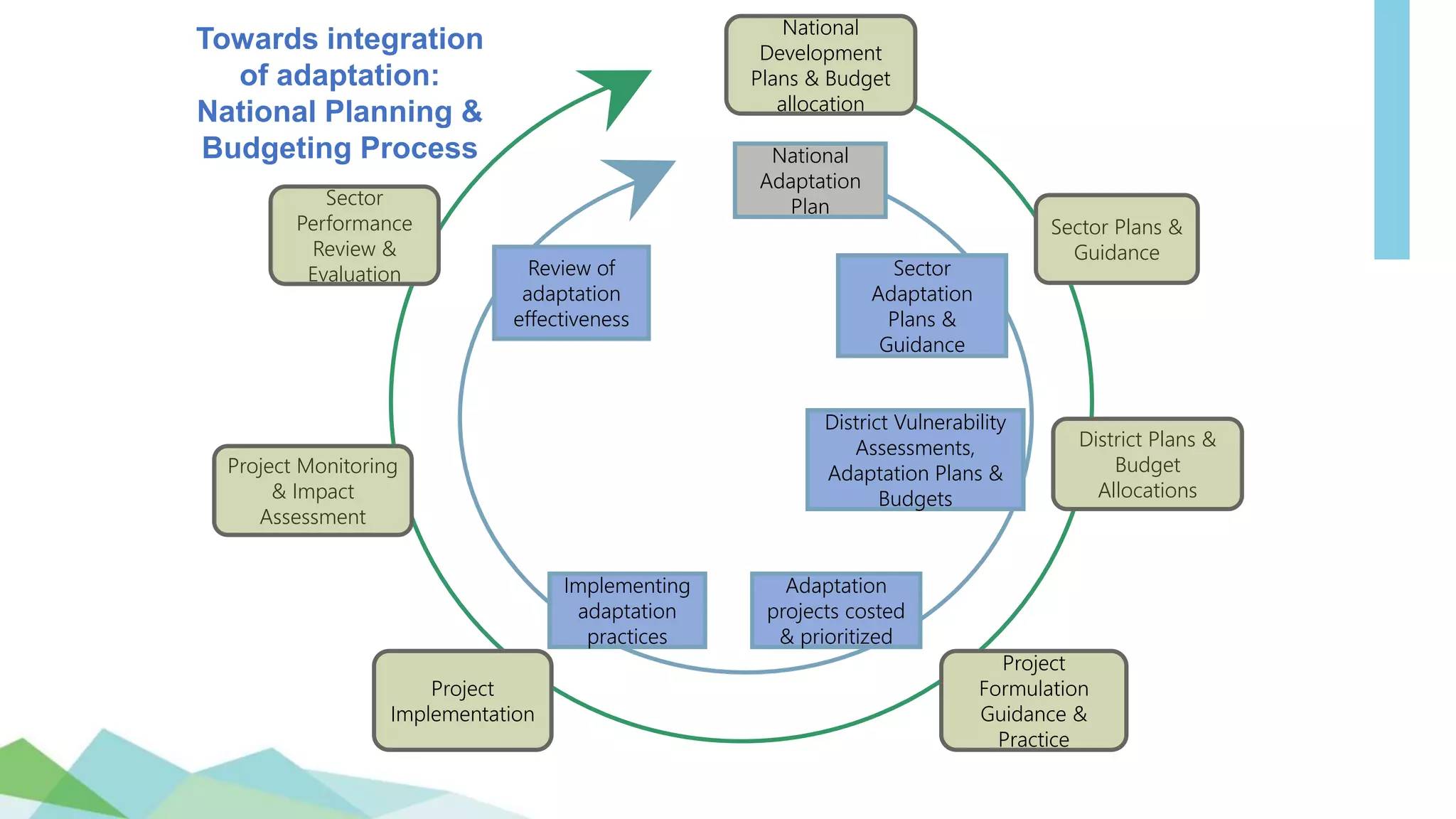
Towards integration
of adaptation:
National Planning &
Budgeting Process
National
Development
Plans & Budget
allocation
National
Adaptation
Plan
Sector
Adaptation
Plans &
Guidance
District Vulnerability
Assessments,
Adaptation Plans &
Budgets
Adaptation
projects costed
& prioritized
Implementing
adaptation
practices
Review of
adaptation
effectiveness
Sector
Performance
Review &
Evaluation
Project Monitoring
& Impact
Assessment
Project
Implementation
Project
Formulation
Guidance &
Practice
District Plans &
Budget
Allocations
Sector Plans &
Guidance
No
content
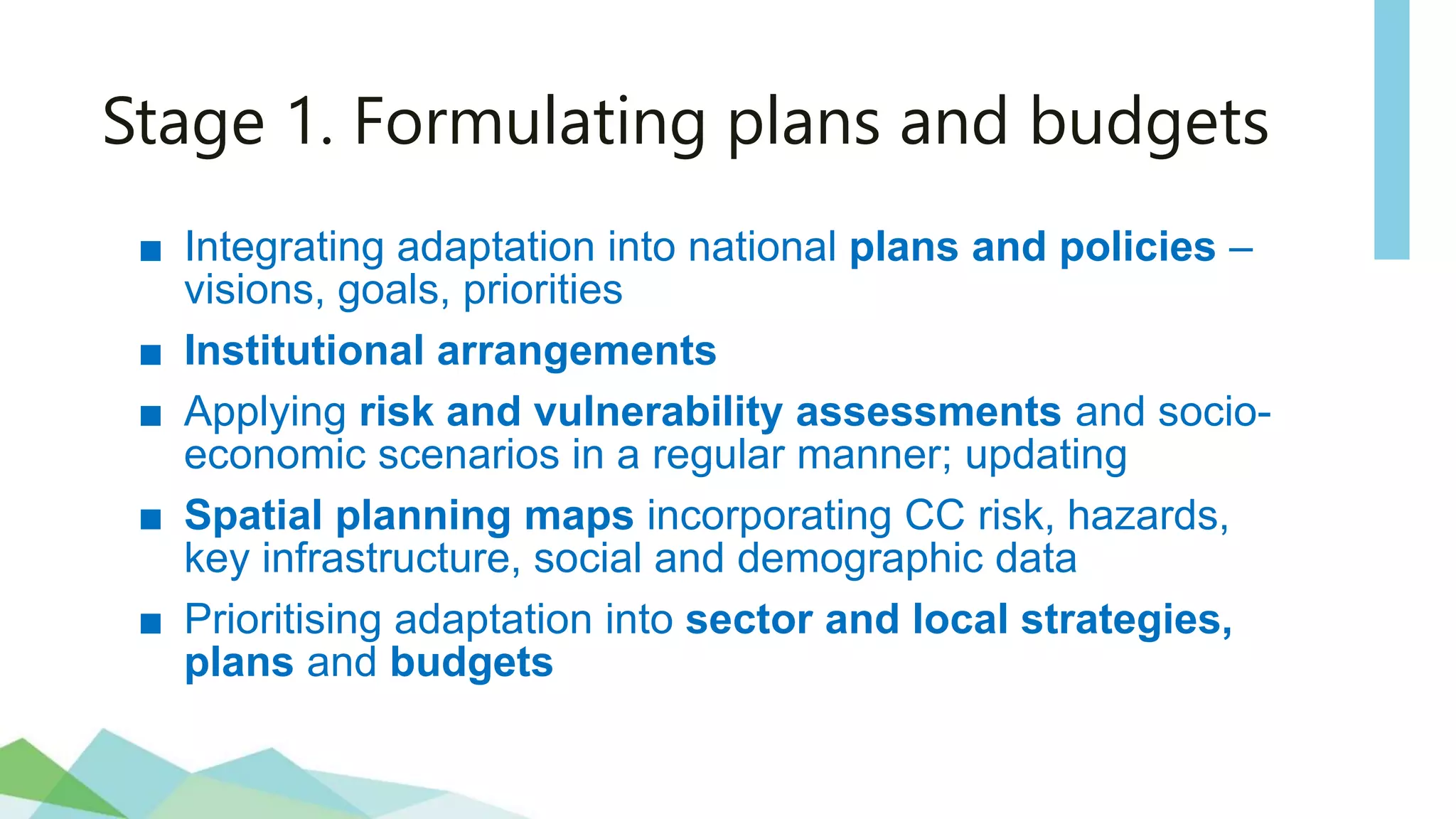
Stage 1. Formulating plans and budgets
■ Integrating adaptation into national plans and policies –
visions, goals, priorities
■ Institutional arrangements
■ Applying risk and vulnerability assessments and socio-
economic scenarios in a regular manner; updating
■ Spatial planning maps incorporating CC risk, hazards,
key infrastructure, social and demographic data
■ Prioritising adaptation into sector and local strategies,
plans and budgets
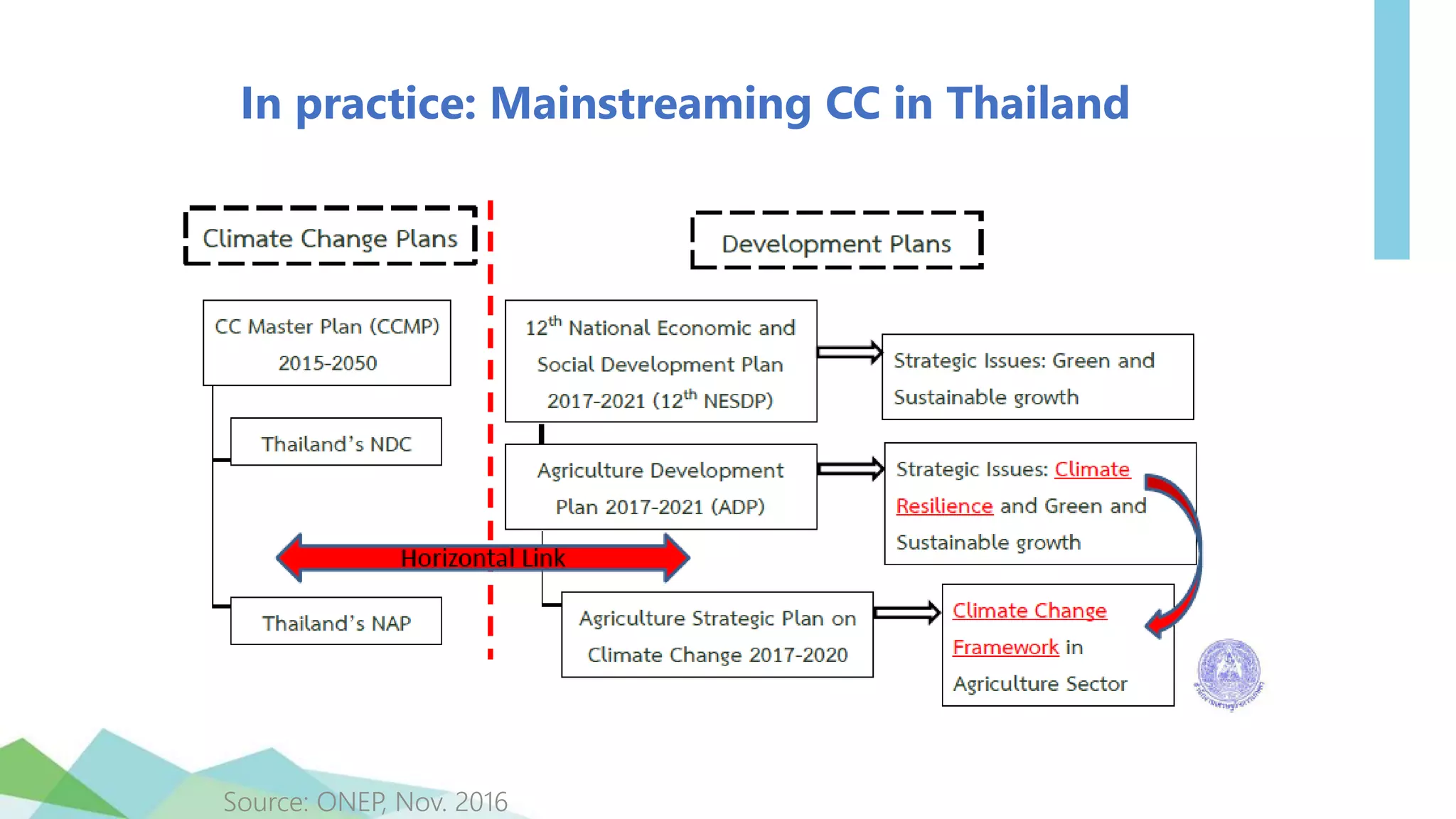
In practice: Mainstreaming CC in Thailand
Source: ONEP, Nov. 2016
Stage 2. Implementing adaptation plans
and policies
 Identifying adaptation options
 Integrated economic appraisal of projects & programmes
 Costing adaptation options and developing realistic financing
plans
 Prioritizing programmes using multi-criteria and economic
tools
 Developing centralized planning/screening guidelines for CC
& DRR for inclusion in official templates/performas
 Gender checklists and gender responsive criteria
• Using climate projections, it is possible to predict
the type of crops that farmers will choose to invest
by 2030, 2050 and 2070.
• As temperature rises: annual crops such as rice,
cereals and vegetables
• As precipitation increases: invest in fruit, cereal
and plantation.
• By 2030, farmers will choose cereal and other
crops. By 2050 and 2070, farmers will invest in
rice and cereal.
• Policy makers: to understand long- term
implications for agriculture and water sectors;
prioritize monitoring, evidence collection and risk
diversification e.g. expanding extension services,
climate information, irrigation and no regret options
Understanding likely impacts and identification of
adaptation options: Sri Lanka
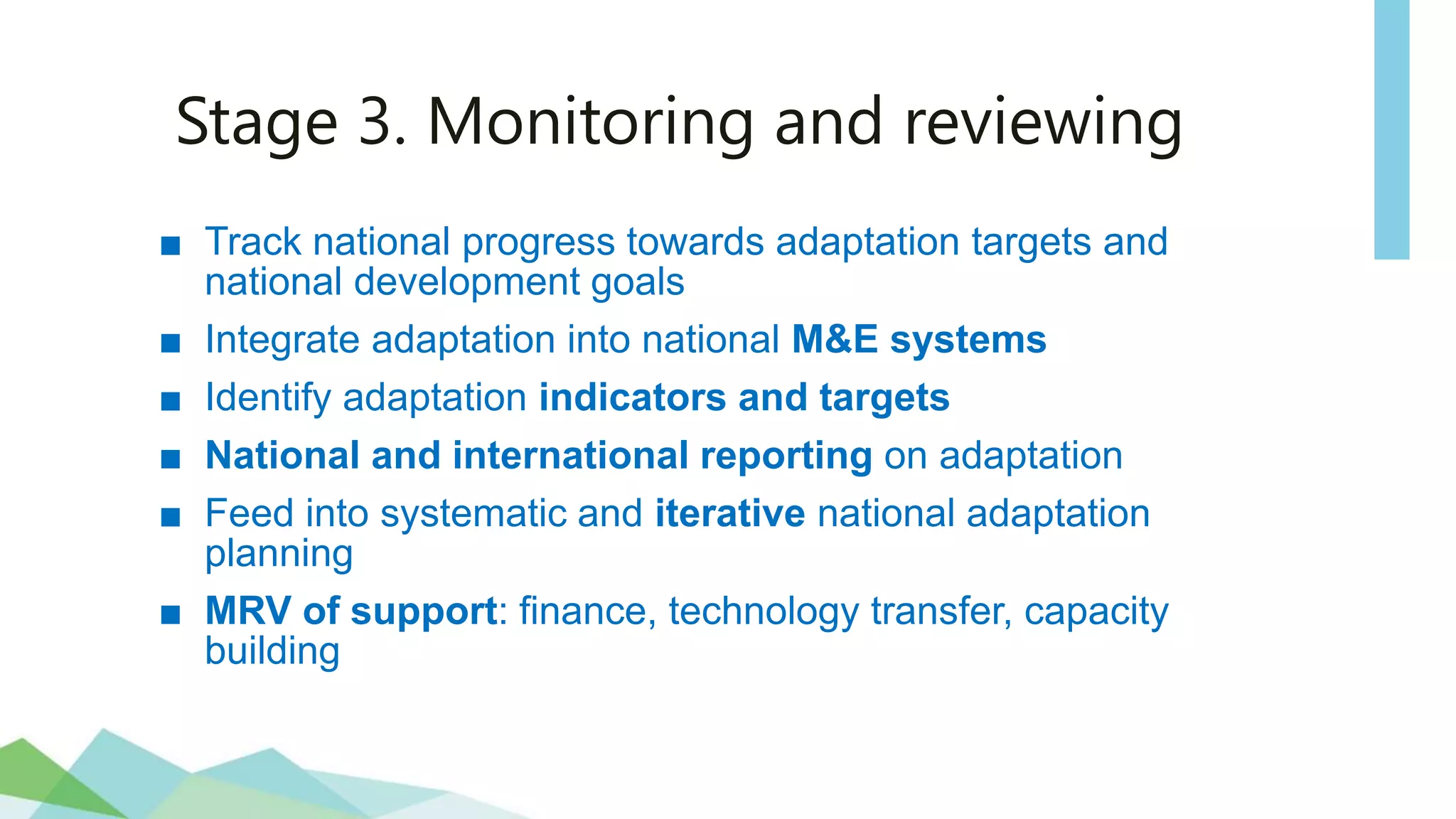
Stage 3. Monitoring and reviewing
■ Track national progress towards adaptation targets and
national development goals
■ Integrate adaptation into national M&E systems
■ Identify adaptation indicators and targets
■ National and international reporting on adaptation
■ Feed into systematic and iterative national adaptation
planning
■ MRV of support: finance, technology transfer, capacity
building
Kenya: MRV+ system under National
Climate Change Action Plan
■ National Climate Change Action Plan 2013 – 2017 (Vision 2030); Kenya
National Adaptation Plan 2015 – 2030
■ MRV+ system: Monitor, report and evaluate of GHG emissions and mitigation
actions; and M&E of adaptation actions
■ Incorporated into National Integrated Monitoring and Evaluation System
■ Climate Change Secretariat in Ministry of Environment; working groups and
technical analysis groups
■ Agriculture: one of the prioritised sectors; included in priority national indicators
(20 in total)
Top-down institutional adaptive capacity for
national to county level
Bottom-up reduction in vulnerability from
county to national level
E.g. % of poor farmers and fishermen with
access to credit facilities or grants
e.g. Nr of ha´s of productive land lost to soil
erosion
2. INTEGRATING CLIMATE
CHANGE ADAPTATION
INTO BUDGETING
Context
 Disconnect between CC policies & action plans and realistic financing
often creates an implementation gap.
 Integration of CC into budget cycle aims to help prioritize, direct,
manage, track, and evaluate climate funding.
 It plays a critical feedback mechanism in policy & planning cycles and
to achieving comprehensive risk management approaches to
development.
 Multiple benefits from systemic, integrated climate financing
frameworks and climate budgeting vs. parallel systems.
The Budget Cycle
■ Entry points to mainstream at all
stages and steps:
– STAGE 1: Formulation
– STAGE 2: Allocation &
Execution
– STAGE 3: Monitoring &
Oversight
■ Where to start? How and Who?
Climate Change
Strategic
budgeting
Annual
budget
formulation
Execution
(incl. GFMIS,
procurement)
reporting
and
monitoring
Budget
evaluation
The reveal
The
reforms
The integration
Mainstreaming CC into the budget
Advocacy for Demand & Accountability
The reveal
The
reforms
The integration
• Climate Public
Expenditure and
Institutional
Review
How well is budget aligned to CC targets and actions
(e.g. NAP key policies and measures)?
Role of a CPEIR
1. Gateway to help assess ability to translate CC objectives
into budget
2. Sets a baseline for tracking and analysing trends in
allocation and expenditure based on agreed typology
3. Illustrates trends in external fund flows
4. Reveals gaps & where to scale-up
5. Recomends systems and policy reforms for
mainstreaming.
THE REVEAL
Top spending ministries:
20
Public Works
& Transport
Agriculture
Water or
Irrigation
Energy Environment
Local
Government
Bangladesh 5% 23% 20%
Cambodia 27% 8% 19%
Kiribati 15%
Nepal
28% 10% 18% 14% 21%
Samoa
20% 17% 15%
Tanzania
14% 30% 30% 12%
Thailand
2% 55% 3% 28%
Uganda 36% 7% 14% 37%
The reveal
The
reforms
The integration
• Budget tagging,
call circulars
Improving how to
allocate, track and justify
budget resources
Tracking expenditure and budget tagging
Benefits of Climate Budget Tagging
■ More comprehensive data on climate-relevant spend enables more
informed decisions and prioritization of investments.
■ Facilitates incorporation of climate considerations in project design,
budget formulation stage.
■ Enables more accountability, increased public scrutiny on public/donor
spending
■ Step toward more robust commitments – NDC adaptation priorities and
NAPs translated into budget allocations and sectoral, sub-national
implementation plans.
■ Cambodia’s ODA database is CC tagged to track implementation of
international commitments and how well they leverage domestic funds.
The reveal
The
reforms
The integration
Climate Change
Financing
Framework & MTEF
integration
NDCs & NAPs fully integrated into
annual & medium term budget
CC Financing Frameworks
Nepal: Toward Robust Sector CC
budgeting
■ First country to introduce CC budget coding
■ Iterative improvement & innovation under CCFF, including “real-time” budget reporting
■ NAP-Ag working to address integration and mainstreaming at sector level:
– Rectify limited convergence of CC Policy/NAP goals with sector budget plans.
– Development of more robust sector budgeting guidelines
■ Current budget code doesn’t capture sub-national level actions/budget. Sub-national
pilots to develop guidelines.
– Capacity building of key officials in MOAD & MOLD.
■ Train MOAD and MOLD officials on using climate budget code and giving sectoral input
to criteria developed at central level.
The reveal
The
reforms
The integration
• Climate budget expenditure reports
• Advocacy briefs
• Civil society – collaborative research
on impact
• Parliament & Media engagement
budget monitoring,
oversight & policy
feedback
Advocacy
for demand & accountability
UN Helps Ministries
Budget for Climate
Change
Pakistan brings cutting-edge
approaches to international
discussions on climate change
finance
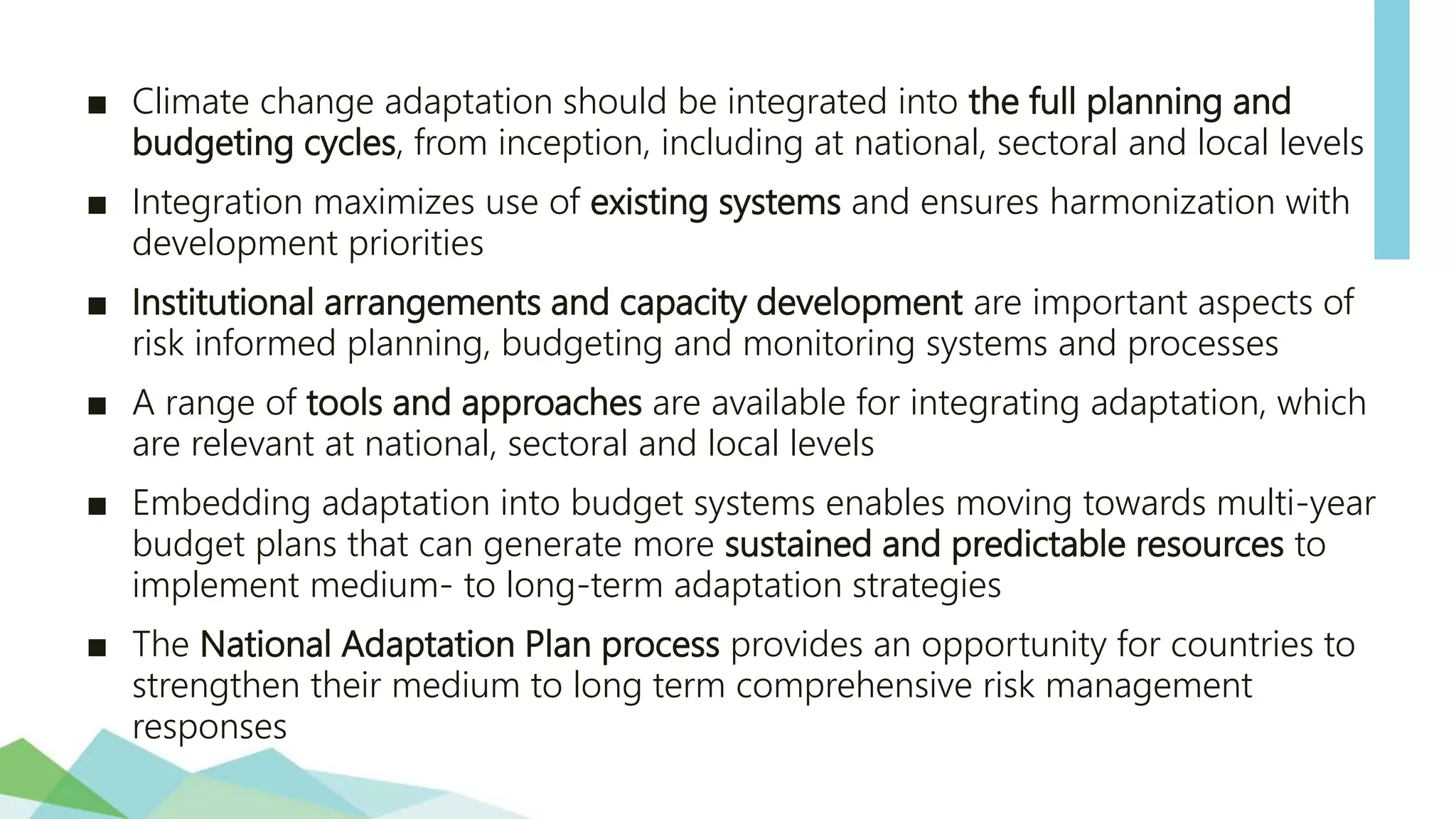
KEY MESSAGES
■ Climate change adaptation should be integrated into the full planning and
budgeting cycles, from inception, including at national, sectoral and local levels
■ Integration maximizes use of existing systems and ensures harmonization with
development priorities
■ Institutional arrangements and capacity development are important aspects of
risk informed planning, budgeting and monitoring systems and processes
■ A range of tools and approaches are available for integrating adaptation, which
are relevant at national, sectoral and local levels
■ Embedding adaptation into budget systems enables moving towards multi-year
budget plans that can generate more sustained and predictable resources to
implement medium- to long-term adaptation strategies
■ The National Adaptation Plan process provides an opportunity for countries to
strengthen their medium to long term comprehensive risk management
responses
fao.org/in-action/naps | adaptation-undp.org/naps-agriculture | international-climate-initiative.com
Thank You

Integrating climate change risks into planning and budgeting

  • 1.
    I n te g r a t i n g A g r i c u l t u r e i n N a t i o n a l A d a p t a t i o n P l a n s INTEGRATING CLIMATE CHANGE ADAPTATION INTO PLANNING AND BUDGETING Webinar, 11:00 CET 27 September 2017 Rohini Kohli and Glenn Hodes, UNDP
  • 2.
    Outline 1. Integrating adaptationinto planning 2. Integrating adaptation into budgeting 3. Key messages
  • 3.
    1. INTEGRATING CLIMATE CHANGEADAPTATION INTO PLANNING
  • 4.
    What is theNational Adaptation Plan (NAP) Process? • The national adaptation plan (NAP) process was established under the UNFCCC Cancun Adaptation Framework (2010). • Its objectives are to reduce vulnerability to the impacts of climate change, and to facilitate the integration of climate change adaptation, in a coherent manner, into relevant new and existing policies, programmes and activities • In plain-speak, National Adaptation Plans are a means of identifying medium- and long-term adaptation needs and developing and implementing strategies and programmes to address those needs • Integration of climate change into ongoing planning and budgeting processes is a key component of NAPs
  • 5.
    Opportunities for 2030Agenda and NAP Alignment  Institutional arrangements.  Data coherence.  Adaptation options as SDG catalysts  Budget implications.  Common messaging.  Accessing climate finance
  • 6.
    Adaptation Impact monitoring Towards integration of adaptation: NationalPlanning & Budgeting Process National Development Plans & Budget allocation National Adaptation Plan Sector Adaptation Plans & Guidance District Vulnerability Assessments, Adaptation Plans & Budgets Adaptation projects costed & prioritized Implementing adaptation practices Review of adaptation effectiveness Sector Performance Review & Evaluation Project Monitoring & Impact Assessment Project Implementation Project Formulation Guidance & Practice District Plans & Budget Allocations Sector Plans & Guidance No content
  • 7.
    Stage 1. Formulatingplans and budgets ■ Integrating adaptation into national plans and policies – visions, goals, priorities ■ Institutional arrangements ■ Applying risk and vulnerability assessments and socio- economic scenarios in a regular manner; updating ■ Spatial planning maps incorporating CC risk, hazards, key infrastructure, social and demographic data ■ Prioritising adaptation into sector and local strategies, plans and budgets
  • 8.
    In practice: MainstreamingCC in Thailand Source: ONEP, Nov. 2016
  • 9.
    Stage 2. Implementingadaptation plans and policies  Identifying adaptation options  Integrated economic appraisal of projects & programmes  Costing adaptation options and developing realistic financing plans  Prioritizing programmes using multi-criteria and economic tools  Developing centralized planning/screening guidelines for CC & DRR for inclusion in official templates/performas  Gender checklists and gender responsive criteria
  • 10.
    • Using climateprojections, it is possible to predict the type of crops that farmers will choose to invest by 2030, 2050 and 2070. • As temperature rises: annual crops such as rice, cereals and vegetables • As precipitation increases: invest in fruit, cereal and plantation. • By 2030, farmers will choose cereal and other crops. By 2050 and 2070, farmers will invest in rice and cereal. • Policy makers: to understand long- term implications for agriculture and water sectors; prioritize monitoring, evidence collection and risk diversification e.g. expanding extension services, climate information, irrigation and no regret options Understanding likely impacts and identification of adaptation options: Sri Lanka
  • 11.
    Stage 3. Monitoringand reviewing ■ Track national progress towards adaptation targets and national development goals ■ Integrate adaptation into national M&E systems ■ Identify adaptation indicators and targets ■ National and international reporting on adaptation ■ Feed into systematic and iterative national adaptation planning ■ MRV of support: finance, technology transfer, capacity building
  • 12.
    Kenya: MRV+ systemunder National Climate Change Action Plan ■ National Climate Change Action Plan 2013 – 2017 (Vision 2030); Kenya National Adaptation Plan 2015 – 2030 ■ MRV+ system: Monitor, report and evaluate of GHG emissions and mitigation actions; and M&E of adaptation actions ■ Incorporated into National Integrated Monitoring and Evaluation System ■ Climate Change Secretariat in Ministry of Environment; working groups and technical analysis groups ■ Agriculture: one of the prioritised sectors; included in priority national indicators (20 in total) Top-down institutional adaptive capacity for national to county level Bottom-up reduction in vulnerability from county to national level E.g. % of poor farmers and fishermen with access to credit facilities or grants e.g. Nr of ha´s of productive land lost to soil erosion
  • 13.
    2. INTEGRATING CLIMATE CHANGEADAPTATION INTO BUDGETING
  • 14.
    Context  Disconnect betweenCC policies & action plans and realistic financing often creates an implementation gap.  Integration of CC into budget cycle aims to help prioritize, direct, manage, track, and evaluate climate funding.  It plays a critical feedback mechanism in policy & planning cycles and to achieving comprehensive risk management approaches to development.  Multiple benefits from systemic, integrated climate financing frameworks and climate budgeting vs. parallel systems.
  • 15.
    The Budget Cycle ■Entry points to mainstream at all stages and steps: – STAGE 1: Formulation – STAGE 2: Allocation & Execution – STAGE 3: Monitoring & Oversight ■ Where to start? How and Who? Climate Change Strategic budgeting Annual budget formulation Execution (incl. GFMIS, procurement) reporting and monitoring Budget evaluation
  • 16.
    The reveal The reforms The integration MainstreamingCC into the budget Advocacy for Demand & Accountability
  • 17.
    The reveal The reforms The integration •Climate Public Expenditure and Institutional Review How well is budget aligned to CC targets and actions (e.g. NAP key policies and measures)?
  • 18.
    Role of aCPEIR 1. Gateway to help assess ability to translate CC objectives into budget 2. Sets a baseline for tracking and analysing trends in allocation and expenditure based on agreed typology 3. Illustrates trends in external fund flows 4. Reveals gaps & where to scale-up 5. Recomends systems and policy reforms for mainstreaming.
  • 19.
  • 20.
    Top spending ministries: 20 PublicWorks & Transport Agriculture Water or Irrigation Energy Environment Local Government Bangladesh 5% 23% 20% Cambodia 27% 8% 19% Kiribati 15% Nepal 28% 10% 18% 14% 21% Samoa 20% 17% 15% Tanzania 14% 30% 30% 12% Thailand 2% 55% 3% 28% Uganda 36% 7% 14% 37%
  • 21.
    The reveal The reforms The integration •Budget tagging, call circulars Improving how to allocate, track and justify budget resources
  • 22.
  • 23.
    Benefits of ClimateBudget Tagging ■ More comprehensive data on climate-relevant spend enables more informed decisions and prioritization of investments. ■ Facilitates incorporation of climate considerations in project design, budget formulation stage. ■ Enables more accountability, increased public scrutiny on public/donor spending ■ Step toward more robust commitments – NDC adaptation priorities and NAPs translated into budget allocations and sectoral, sub-national implementation plans. ■ Cambodia’s ODA database is CC tagged to track implementation of international commitments and how well they leverage domestic funds.
  • 24.
    The reveal The reforms The integration ClimateChange Financing Framework & MTEF integration NDCs & NAPs fully integrated into annual & medium term budget
  • 25.
  • 26.
    Nepal: Toward RobustSector CC budgeting ■ First country to introduce CC budget coding ■ Iterative improvement & innovation under CCFF, including “real-time” budget reporting ■ NAP-Ag working to address integration and mainstreaming at sector level: – Rectify limited convergence of CC Policy/NAP goals with sector budget plans. – Development of more robust sector budgeting guidelines ■ Current budget code doesn’t capture sub-national level actions/budget. Sub-national pilots to develop guidelines. – Capacity building of key officials in MOAD & MOLD. ■ Train MOAD and MOLD officials on using climate budget code and giving sectoral input to criteria developed at central level.
  • 28.
    The reveal The reforms The integration •Climate budget expenditure reports • Advocacy briefs • Civil society – collaborative research on impact • Parliament & Media engagement budget monitoring, oversight & policy feedback Advocacy for demand & accountability
  • 29.
    UN Helps Ministries Budgetfor Climate Change Pakistan brings cutting-edge approaches to international discussions on climate change finance
  • 30.
  • 31.
    ■ Climate changeadaptation should be integrated into the full planning and budgeting cycles, from inception, including at national, sectoral and local levels ■ Integration maximizes use of existing systems and ensures harmonization with development priorities ■ Institutional arrangements and capacity development are important aspects of risk informed planning, budgeting and monitoring systems and processes ■ A range of tools and approaches are available for integrating adaptation, which are relevant at national, sectoral and local levels ■ Embedding adaptation into budget systems enables moving towards multi-year budget plans that can generate more sustained and predictable resources to implement medium- to long-term adaptation strategies ■ The National Adaptation Plan process provides an opportunity for countries to strengthen their medium to long term comprehensive risk management responses
  • 32.
    fao.org/in-action/naps | adaptation-undp.org/naps-agriculture| international-climate-initiative.com Thank You

Editor's Notes

  • #6 Institutional arrangements. Stocktaking for NAP should also consider current arrangements and adapt for planning and cross-sector policy coordination around the SDGs related to CC Data coherence. Stocktaking, collection of data and climate information, setting up of information system for NAP should feed into the SDG monitoring mechanism Adaptation options could be proposed as SDG catalysts Budget implications. CPEIR, climate budget tagging, and activities to support the development of annual and pluriannual budgetary frameworks could feed into SDG budgetary mainstreaming exercise. Common messaging. Identifying opportunities for joint outreach and awareness-raising Accessing climate finance
  • #7 Governments need to address adaptation to climate at all levels in planning, because climate risks magnify development challenges. Existing development planning is informed by understanding of CC implications. Development plans are adjusted to reflect CC risks and opportunities. Continuous monitoring and update of national development plans to reflect CC risks and opportunities in the future.
  • #10 Same approaches can be applied at sectoral level – e.g. appraisal, costing and prioritisation of adaptation options in the agriculture sector specifically Include gender criteria Include adaptation in agriculture sector templates and performas Gender responsive implementation criteria
  • #11 Using climate projections, it is possible to predict the type of crops that farmers will choose to invest by 2030, 2050 and 2070, based on changes in precipitation and temperature. As temperature rises, farmers would focus on annual crops such as rice, cereals and vegetables and would not invest in fruits, plantation and others. As precipitation increases, farmers would invest in fruit, cereal and plantation and would move away from rice, vegetables and other crops. By 2030, farmers will choose cereal and other crops, whereas by 2050 and 2070, farmers will invest in rice and cereal. The training activities as part of the ECCA programme are key area of technical assistance required by countries, as per the United Nations Framework on the Convention of Climate Change’s (UNFCCC) guidelines for countries on the National Adaptation Plan (NAP) process – a process established under the Cancun Adaptation Framework (CAF) to help countries identify their medium- and long-term adaptation needs. Sri Lanka Three hundred and twenty-one households were interviewed spanning the agro-ecological zones of the country, resulting in 321 households detailed data. A whole farm approach based on the Ricardian method has been used, named after David Ricardo’s 1815 work. The marginal impacts of climate (temperature and precipitation) is estimated to give an indication of changes in net revenue when there is a unit change in climate. By changing the values of the climate variables to levels predicted by climate change projections and by comparing the projected net revenue to the current net revenue scenario, the impact of climate change on the agriculture sector is estimated. An example of a policy insight from ECCA In Sri Lanka, an average farmer would lose as much as US$ 94.37 of revenue per acre due to climate change, whereas a medium-scale farm would lose US$ 148.75 of net revenue per acre. If no efforts are undertaken by 2031 to combat climate change and its adverse effects, the poverty rate in Sri Lanka would be as high as 20 percent (currently it is 6.7 percent). By separating the analysis on irrigated vs. rain-fed farms, the report provides evidence on the agriculture sector with implications for the water sector. The ECCA reports provides evidence-based policy insights that are targeted towards supporting policymakers involved in the National Adaptation Plan (NAP) process to better understand the impact of climate change on the agricultural sectors. Case Studies from ECCA 1: Bangladesh – the ECCA Programme was instructive in reviewing and revising the country’s agriculture and water policies. “The study found warming and changing rainfall patterns will become increasingly harmful for farmers. An increase in temperature of one degree Celsius would result in a loss of US$273 per acre for irrigated farms (69% of their income given an average earning of US$394).The study supported that adaptation options for farmers in Bangladesh are strengthened national extension services, irrigation infrastructure in the dry zone of the country and the introduction of new cultivation techniques. Maldives: The ECCA programme has benefited government officials in the Maldives by expanding their knowledge of economic tools, including conducting cost-benefit analyses. They have been able to apply that knowledge to successfully access international funds, such as the Green Climate Fund.
  • #12 Track national progress towards adaptation targets and national development goals – as set out in plans and policies, budgets Integrate adaptation into national M&E systems Identify adaptation indicators and targets National and international reporting on adaptation, incl. accountability on financial spending Feed into systematic and iterative national adaptation planning – provide evidence and learning on what works, what doesn´t
  • #13 KEY MESSAGE: M&E system built around a NAP; agriculture integrated into the NAP and its indicators; use of TAMD approach of process and outcome indicators, aggregated from local level Agriculture: A comprehensive system was built, using the TAMD approach. Agriculture is a prioritised sector, building on existing initiatives such as Kenya Climate Smart Agriculture Programme. Actions are identified for short, medium and long term. M&E: built a Theory of Change around 4 pillars; agriculture in the economic pillar; 10 top-down and 10 bottom-up indicators, agriculture included in both The indicators are dynamic and should be contextualised. Counties and various sectors can use the overall theory of change or develop their own theories of change and adaptation indicators, whose data should be aggregated at the national level TOP DOWN process indicators (capacity, policy implementation etc.): The idea is that these indicators measure the effectiveness of national initiatives to build institutional adaptive capacity at the county level BOTTOM UP process and outcome indicators: measuring vulnerability PROS: integrates adaptation and mitigation top-down and bottom-up Broad engagement of stakeholders, across scales and sectors CONS: resource intensive to run Are the systems in place to roll-out such an ambitious M&E plan? Incl. at local level? Data storage and sharing
  • #16   Opportunities and challenges for mainstreaming adaptation in planning and budgeting processes: key insights from practitioners Highlight UNDP broader approach of mainstreaming finance, country experiences, opportunities and challenges and lessons.   Synergies and alignment between different tools and frameworks Practical challenges and solutions (approaches and tools) Institutional entry points
  • #17 Theory of change
  • #18 Diagnostics
  • #22 THAILAND Capacity building on CC-CBA, and walking stakeholders through mainstreaming entry points as part of budget cycle. Stock take found only 1 dept systematically using CBA. Multi-Criteria Analysis (MCA) indicators and a database being set up as a tool for screening and prioritizing the action plan and programmatic areas. Strengthening project design and appraisal processes within MOAC to integrate CC into budgeting guidelines. Supporting MOAC to develop more bankable budget proposals based on MCA & CC-CBA.
  • #23 Climate Budget Tagging (CBT) is a tool for monitoring and tracking of climate-related expenditures in the national budget system.   It provides comprehensive data on climate-relevant spending: yes and no, it actually depends on the comprehensiveness of the Public Finance Management Information System (PFMIS) comprehensiveness, if the country has funds outside the budget or if Overseas Development Assistance is not captured by the PFMIS, then it will not be comprehensive. It is as good as the government’s PFMIS level of maturity.   enabling government to make informed decisions and prioritize climate investments: It is a key starting point in that process but alone it is not enough at all.  Tagging needs to be complemented by costing of plans/needs assessment, benefit cost analysis and other planning tools to help do that. Otherwise, it will be mostly about reporting and understanding the climate dimension of existing public investment programs. Also, tagging should as much as possible involve line ministries as they are  the one ultimately doing the sector plans. Tagging is a good occasion to get them think about CC under supervision of MOF  and Planning. If they are not involved and it is just an exercise led by Ministry of Finance to do it on its own, the impact is not as valuable. And line ministers  will not think about climate change and how it is relevant to their interventions. Ministry of Finance can not finance climate relevant activities if sector ministries do not submit climate mainstreamed projects.   CBT enables public scrutiny on government’s and donors’ spending on tackling climate change issues strengthening accountability and transparency:  
  • #25 In Cambodia, CC budgeting guidelines were introduced by the Ministry of Economy and Finance linked to the CCFF. This required an analysis of the climate change benefits that can be obtained from key public investments. The Ministry of Agriculture and Forests (MAFF) screened and appraised its climate-relevant programmes, taking into account also gender-responsiveness. As a result of new integrated guidelines, it developed new extension services delivered by state agricultural departments specifically tailored for women. These programs pay attention to domestic and productive needs in planning water-supply infrastructure and using renewable energy for water supply. MAFF found that that its programmes could deliver an additional 15 to 50 percent more benefit, when climate change is taken into account. These benefits and marginal costs have been factored into subsequent annual and medium-term budget proposals to the MOEF. Thailand -
  • #26 CC Responsive: Macroeconomic Framework Project Appraisal Guidelines Sector Work Plans Budget Circular Budget Submissions Budget Negotiations Budget Allocations Budget Hearings Budget Policy Statement and Enactment Green and Climate Change Compatible Procurement Law and Guidelines Climate change tags and weights in budget and accounting systems (FMIS…) Progress reports versus CC Plans, Climate change expenditure reports CC Performance Audits
  • #30 parliament