INTEGERS
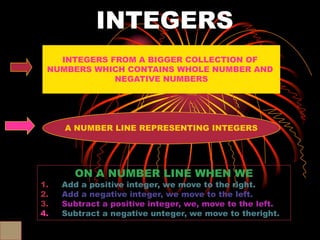
   INTEGERS FROM A BIGGER COLLECTION OF
 NUMBERS WHICH CONTAINS WHOLE NUMBER AND
             NEGATIVE NUMBERS


     A NUMBER LINE REPRESENTING INTEGERS


       ON A NUMBER LINE WHEN WE
1.   Add a positive integer, we move to the right.
2.   Add a negative integer, we move to the left.
3.   Subtract a positive integer, we, move to the left.
4.   Subtract a negative unteger, we move to theright.
PROPERTIES OFINTEGERS
FOR ANY TWO INTEGERS A AND B
a-b=a + additive inverse of b=a + (-b)
a-b(-b) = a + additive inverse of (-b) = a+b


Closure under addition
Sum of two whole numbers is again a whole number. For
example, 17 + 24 = 41 which is again a whole number.
His property is known as the closure property for addition of
the whole numbers. Integers are closed under addition in
general. For any two integers a and b, a + b is an integer.
Integers are closed under subtraction. Thus, if a and b are
two integers then a-b is also an intger.
Commutative property

Addition is commutative for integers.
In general, for any two integers a and b, we can say
                                   a + b = b+a

Subtraction is not commutative for integers.
Because 5 –(-3)=5+3=8, and (-3)-5=-3-5=-8.


           Associative property
 Addition is associative for integers. In
 general for any intgers a,b and c, we can say

                          a+(b+c)=(a+b)+c
Additive identity
   In general, for any integer a
             a+0=a=0+a
   1. (-8)+0= - 8
   2. 0+(-8)= - 8
MULTIPLICATION OF A POSITIVE AND A
NEGATIVE INTEGER

FOR ANY TWO POSITIVE INTEGERS A AND B WE
CAN SAY
                a X (-b) = (-a) X b = - (a X b )
                (-33) X 5 = 33 X (-5) = -165
MULTILICATION OF TWO NEGATIVE INTEGERS


WE MULTIPLY THE TWO NEGATIVE INTEGERS AS
WHOLE NUMBERS AND PUT THE POSITIVE SIGN
BEFORE THE PRODUCT.
THUS, WE HAVE   ( -10 ) x ( -12 ) = 120
SIMILARLY       ( -15) x ( - 6 ) = 90
IN GENERAL, FOR ANY TWO POSITIVE INTEGERS
A AND B,
                ( -a ) x ( -b ) = a x b
Product of three or more Negative Integers


   If the number of negative integers in a
   product is even, then the product is a
   positive integer; if the number of negative
   integers in a product is odd. Then the
   product is a negative integer.
a. ( -4 ) x ( -3 ) = 12
b. (-4 ) x ( -3 ) x ( -2 )= [ ( -4 ) x ( -3 ) ] x ( -2 ) = 12 x ( -2 )= -24
CLOSURE UNDER MULTIPLICATION
Integers are closed under multiplication.
In general,
              a x b is an integer, for all integers a and b.

Statements                                        Inferences
(-20 ) x ( -5 ) = 100                     Product is an integer


   MULTIPLICATION BY ZERO
   IN GENERAL, FOR ANY INTEGER A.
                                     a x 0 = 0 x a =0
   ( -3 ) x 0 = 0
   0 x ( -4 ) = 0
MULTIPLICATIVE IDENTITY
 IN GENERAL, FOR ANY INTEGER A WE HAVE.
                                     ax1=1xa=a
 ( -3 ) x 1 = -3                     1x5=5


ASSOCIATIVITY FOR MULTIPLICATION

   Product of three integers does not depend upon the
   grouping of integers and this is called the associative
   property for multiplication of integers.
   In general, for any three integers a, b and c
                                      ( a x b) x c = a x (b x c )
   [ (-3) x (-2)] x 5 = 6 x 5 = 30
   (-3) x [(-2) x 5] = (-3) x (-10) = 30
DISTRIBUTIVE PROPERTY
IN GENERAL, FOR ANY INTEGERS A, B AND C,
                         a x ( b + c ) =a x b + a x c
A ( -2 ) x (3+5) = - 2x8= -16
  and [(-2) x 3] +[ (-2) x5]= (-6)+ (-10) =-16

IN GENERAL, FOR ANY INTEGERS A, B AND C,
                      ax(b-c)=a x b–a x c
4x(3-8)=4x(-5)= -20
4x3 - 4x8=12 -32= -20
4x(3-8)=4x3 - 4x8

(1)   (-18) x (-10) x 9
      (-18) x (-10) x 9 = [(-18)x(-10)]x9 = 180x9=1620

(2)   (-20) x (-2) x (-5) x7
       (-20) x (-2) x (-5) x 7 = -20x (-2 x -5) x7 = [-20x10] x7
      = -1400
MADE BY –
ROHAN GOEL
CLASS- VII-B

Integers

  • 1.
    INTEGERS INTEGERS FROM A BIGGER COLLECTION OF NUMBERS WHICH CONTAINS WHOLE NUMBER AND NEGATIVE NUMBERS A NUMBER LINE REPRESENTING INTEGERS ON A NUMBER LINE WHEN WE 1. Add a positive integer, we move to the right. 2. Add a negative integer, we move to the left. 3. Subtract a positive integer, we, move to the left. 4. Subtract a negative unteger, we move to theright.
  • 2.
    PROPERTIES OFINTEGERS FOR ANYTWO INTEGERS A AND B a-b=a + additive inverse of b=a + (-b) a-b(-b) = a + additive inverse of (-b) = a+b Closure under addition Sum of two whole numbers is again a whole number. For example, 17 + 24 = 41 which is again a whole number. His property is known as the closure property for addition of the whole numbers. Integers are closed under addition in general. For any two integers a and b, a + b is an integer. Integers are closed under subtraction. Thus, if a and b are two integers then a-b is also an intger.
  • 3.
    Commutative property Addition iscommutative for integers. In general, for any two integers a and b, we can say a + b = b+a Subtraction is not commutative for integers. Because 5 –(-3)=5+3=8, and (-3)-5=-3-5=-8. Associative property Addition is associative for integers. In general for any intgers a,b and c, we can say a+(b+c)=(a+b)+c
  • 4.
    Additive identity In general, for any integer a a+0=a=0+a 1. (-8)+0= - 8 2. 0+(-8)= - 8 MULTIPLICATION OF A POSITIVE AND A NEGATIVE INTEGER FOR ANY TWO POSITIVE INTEGERS A AND B WE CAN SAY a X (-b) = (-a) X b = - (a X b ) (-33) X 5 = 33 X (-5) = -165
  • 5.
    MULTILICATION OF TWONEGATIVE INTEGERS WE MULTIPLY THE TWO NEGATIVE INTEGERS AS WHOLE NUMBERS AND PUT THE POSITIVE SIGN BEFORE THE PRODUCT. THUS, WE HAVE ( -10 ) x ( -12 ) = 120 SIMILARLY ( -15) x ( - 6 ) = 90 IN GENERAL, FOR ANY TWO POSITIVE INTEGERS A AND B, ( -a ) x ( -b ) = a x b
  • 6.
    Product of threeor more Negative Integers If the number of negative integers in a product is even, then the product is a positive integer; if the number of negative integers in a product is odd. Then the product is a negative integer. a. ( -4 ) x ( -3 ) = 12 b. (-4 ) x ( -3 ) x ( -2 )= [ ( -4 ) x ( -3 ) ] x ( -2 ) = 12 x ( -2 )= -24
  • 7.
    CLOSURE UNDER MULTIPLICATION Integersare closed under multiplication. In general, a x b is an integer, for all integers a and b. Statements Inferences (-20 ) x ( -5 ) = 100 Product is an integer MULTIPLICATION BY ZERO IN GENERAL, FOR ANY INTEGER A. a x 0 = 0 x a =0 ( -3 ) x 0 = 0 0 x ( -4 ) = 0
  • 8.
    MULTIPLICATIVE IDENTITY INGENERAL, FOR ANY INTEGER A WE HAVE. ax1=1xa=a ( -3 ) x 1 = -3 1x5=5 ASSOCIATIVITY FOR MULTIPLICATION Product of three integers does not depend upon the grouping of integers and this is called the associative property for multiplication of integers. In general, for any three integers a, b and c ( a x b) x c = a x (b x c ) [ (-3) x (-2)] x 5 = 6 x 5 = 30 (-3) x [(-2) x 5] = (-3) x (-10) = 30
  • 9.
    DISTRIBUTIVE PROPERTY IN GENERAL,FOR ANY INTEGERS A, B AND C, a x ( b + c ) =a x b + a x c A ( -2 ) x (3+5) = - 2x8= -16 and [(-2) x 3] +[ (-2) x5]= (-6)+ (-10) =-16 IN GENERAL, FOR ANY INTEGERS A, B AND C, ax(b-c)=a x b–a x c 4x(3-8)=4x(-5)= -20 4x3 - 4x8=12 -32= -20 4x(3-8)=4x3 - 4x8 (1) (-18) x (-10) x 9 (-18) x (-10) x 9 = [(-18)x(-10)]x9 = 180x9=1620 (2) (-20) x (-2) x (-5) x7 (-20) x (-2) x (-5) x 7 = -20x (-2 x -5) x7 = [-20x10] x7 = -1400
  • 10.
    MADE BY – ROHANGOEL CLASS- VII-B