MADE BY:DIPIN YADAV
SUBMITTED TO:NEELU MAM
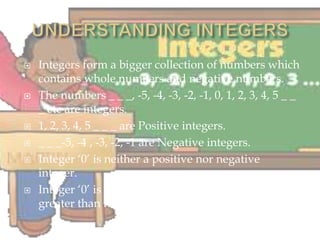
 Integers form a bigger collection of numbers which
contains whole numbers and negative numbers.
 The numbers _ _ _, -5, -4, -3, -2, -1, 0, 1, 2, 3, 4, 5 _ _
_ etc are integers.
 1, 2, 3, 4, 5 _ _ _ are Positive integers.
 _ _ _-5, -4 , -3, -2, -1 are Negative integers.
 Integer ‘0’ is neither a positive nor negative
integer.
 Integer ‘0’ is less than a positive integer and
greater than negative integer.
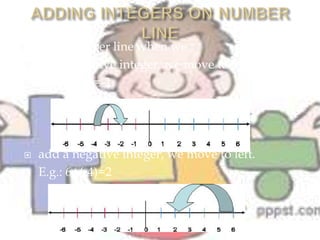
 On a number line when we
 add a positive integer, we move to the right.
 E.g.: -4+2=-2
 add a negative integer, we move to left.
 E.g.: 6+(-4)=2
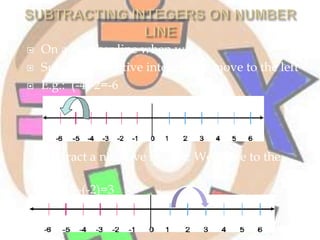
 On a number line when we
 Subtract a positive integer, We move to the left
 E.g.: (-4)-2=-6
 Subtract a negative integer, We move to the
right
 E.g.: 1-(-2)=3
SIGN
E.g.: 6+3=9
E.g.: -9-2= -11
greater value
E.g.: +2-4= -2
-2+4=+2
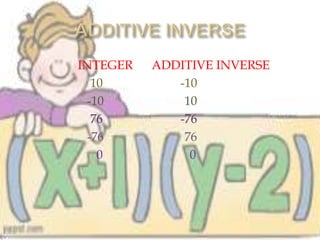
INTEGER ADDITIVE INVERSE
10 -10
-10 10
76 -76
-76 76
0 0
 ADDITION:
Integers are closed under addition. In general
for any two integers a and b, a+b is an integer.
E.g.: -2+4=2
 SUBTRACTION:
Integers are closed under subtraction. If a and b
are two integers then a-b is also an integer.
E.g.: -6-2=-8
 ADDITION:
This property tells us that the sum of two
integers remains the same even if the order of
integers is changed. If a and b are two integers,
then a+b = b+a
E.g.: -2+3 =3+(-2)
 SUBTRACTION:
The subtraction of two integers is not
commutative. If a and b are two integers ,then
a-b = b-a
E.g.: 4-(-6) = -6-4
 ADDITION:
This property tells us that that we can group integers
in a sum in any way we want and still get the same
answer. Addition is associative for integers. In
general, a+(b+c) = (a+b)+c
E.g.: 2+(3+4) = (2+3)+4 =9
 SUBTRACTION:
The subtraction of integers is not associative. In
general, a-(b-c) = (a-b)-c
E.g.: 3-(5-7) = (3-5)-7
5 = -9
 Multiplication of two positive integers:
If a and b are two positive integers then their product
is also a positive integer
i.e.: a x b = ab
 Multiplication of a Positive and a Negative Integer:
While multiplying a positive integer and a negative
integer, we multiply them as whole numbers and
put a minus sign(-) before the product. We thus get a
negative integer. In general, a x (-b) = -(a x b)
 Multiplication of two negative integers:
Product of two negative integers is a positive
integers. We multiply two negative integers as
whole numbers and put the positive sign before the
product. In general,
-a x -b = a x b
 Closure under Multiplication:
The product of two integers is an integer. Integers
are closed under multiplication. In general, a x b is
an integer.
e.g.: -2 x 2 = -4
 Commutativity of Multiplication:
The product of two integers remain the same even
if the order is changed. Multiplication is
commutative for integers. In general, a x b =b x a
e.g.: 2 x (-3) = -3 x 2
 Associativity of multiplication:
The product of three integers remains the same,
irrespective of their arrangements.
In general, if a, b and c are three integers, then a x (b x
c) = (a x b) x c
e.g.: -2 x (3 x 4) = (-2 x 3) x 4 = -24
 Multiplication by zero:
The product of any integer and zero is always.
In general, a x 0 = 0 x a =0
e.g.: -2 x 0 =0
 Multiplicative identity:
The product of any integer and 1 is the integer itself.
In general, a x 1 = 1 x a = a
e.g.: -5 x 1= -5
 Distributivity of multiplication over addition:
If a, b and c are three integers, then
a x (b+c) = a x b + a x c
e.g.: -2 x (4+5) = -2 x 4 + -2 x 5
 Distributivity of multiplication over subtraction:
If a, b and c are three integers, then
a x (b-c) = a x b - a x c
e.g.: -9 x (3-2) = -9 x 3 – (-9) x 2
 Division of two Positive Integers:
If a and b are two positive integers then their
quotient is also a positive integer.
e.g.: 4 ÷ 2 = 2
 Division of a positive and a negative integer:
When we divide a positive integer and a negative
integer, we divide them as whole numbers and
then put a minus sign (-) before the quotient. We,
thus, get a negative integer. In general, a÷ (-b) = (-
a) ÷ b where b = 0
 Division of two negative integers:
When we divide two negative integers, we first
divide them as two whole numbers and then put a
positive sign (+). We, thus, get a positive integer.
 Integers are not closed under division. In other
words if a and b are two integers, then a ÷ b may
or may not be an integer.
 Division of integers is not commutative. In other
words, if a and b are two integers, then a ÷ b = b ÷
a.
 Division by 0 is meaningless operation. In other
words for any integer a, a ÷ 0 is not defined
whereas 0 ÷ a = 0 for a = 0.
 Any integer divided by 1 give the same integer. If
a is an integer, then a ÷ 1 = a.
 For any integer a, division by -1 does not give the
DIPIN PPT OF INTEGER

DIPIN PPT OF INTEGER

  • 1.
  • 2.
     Integers forma bigger collection of numbers which contains whole numbers and negative numbers.  The numbers _ _ _, -5, -4, -3, -2, -1, 0, 1, 2, 3, 4, 5 _ _ _ etc are integers.  1, 2, 3, 4, 5 _ _ _ are Positive integers.  _ _ _-5, -4 , -3, -2, -1 are Negative integers.  Integer ‘0’ is neither a positive nor negative integer.  Integer ‘0’ is less than a positive integer and greater than negative integer.
  • 4.
     On anumber line when we  add a positive integer, we move to the right.  E.g.: -4+2=-2  add a negative integer, we move to left.  E.g.: 6+(-4)=2
  • 5.
     On anumber line when we  Subtract a positive integer, We move to the left  E.g.: (-4)-2=-6  Subtract a negative integer, We move to the right  E.g.: 1-(-2)=3
  • 6.
    SIGN E.g.: 6+3=9 E.g.: -9-2=-11 greater value E.g.: +2-4= -2 -2+4=+2
  • 7.
    INTEGER ADDITIVE INVERSE 10-10 -10 10 76 -76 -76 76 0 0
  • 9.
     ADDITION: Integers areclosed under addition. In general for any two integers a and b, a+b is an integer. E.g.: -2+4=2  SUBTRACTION: Integers are closed under subtraction. If a and b are two integers then a-b is also an integer. E.g.: -6-2=-8
  • 10.
     ADDITION: This propertytells us that the sum of two integers remains the same even if the order of integers is changed. If a and b are two integers, then a+b = b+a E.g.: -2+3 =3+(-2)  SUBTRACTION: The subtraction of two integers is not commutative. If a and b are two integers ,then a-b = b-a E.g.: 4-(-6) = -6-4
  • 11.
     ADDITION: This propertytells us that that we can group integers in a sum in any way we want and still get the same answer. Addition is associative for integers. In general, a+(b+c) = (a+b)+c E.g.: 2+(3+4) = (2+3)+4 =9  SUBTRACTION: The subtraction of integers is not associative. In general, a-(b-c) = (a-b)-c E.g.: 3-(5-7) = (3-5)-7 5 = -9
  • 12.
     Multiplication oftwo positive integers: If a and b are two positive integers then their product is also a positive integer i.e.: a x b = ab  Multiplication of a Positive and a Negative Integer: While multiplying a positive integer and a negative integer, we multiply them as whole numbers and put a minus sign(-) before the product. We thus get a negative integer. In general, a x (-b) = -(a x b)  Multiplication of two negative integers: Product of two negative integers is a positive integers. We multiply two negative integers as whole numbers and put the positive sign before the product. In general, -a x -b = a x b
  • 14.
     Closure underMultiplication: The product of two integers is an integer. Integers are closed under multiplication. In general, a x b is an integer. e.g.: -2 x 2 = -4  Commutativity of Multiplication: The product of two integers remain the same even if the order is changed. Multiplication is commutative for integers. In general, a x b =b x a e.g.: 2 x (-3) = -3 x 2
  • 15.
     Associativity ofmultiplication: The product of three integers remains the same, irrespective of their arrangements. In general, if a, b and c are three integers, then a x (b x c) = (a x b) x c e.g.: -2 x (3 x 4) = (-2 x 3) x 4 = -24  Multiplication by zero: The product of any integer and zero is always. In general, a x 0 = 0 x a =0 e.g.: -2 x 0 =0  Multiplicative identity: The product of any integer and 1 is the integer itself. In general, a x 1 = 1 x a = a e.g.: -5 x 1= -5
  • 16.
     Distributivity ofmultiplication over addition: If a, b and c are three integers, then a x (b+c) = a x b + a x c e.g.: -2 x (4+5) = -2 x 4 + -2 x 5  Distributivity of multiplication over subtraction: If a, b and c are three integers, then a x (b-c) = a x b - a x c e.g.: -9 x (3-2) = -9 x 3 – (-9) x 2
  • 17.
     Division oftwo Positive Integers: If a and b are two positive integers then their quotient is also a positive integer. e.g.: 4 ÷ 2 = 2  Division of a positive and a negative integer: When we divide a positive integer and a negative integer, we divide them as whole numbers and then put a minus sign (-) before the quotient. We, thus, get a negative integer. In general, a÷ (-b) = (- a) ÷ b where b = 0  Division of two negative integers: When we divide two negative integers, we first divide them as two whole numbers and then put a positive sign (+). We, thus, get a positive integer.
  • 18.
     Integers arenot closed under division. In other words if a and b are two integers, then a ÷ b may or may not be an integer.  Division of integers is not commutative. In other words, if a and b are two integers, then a ÷ b = b ÷ a.  Division by 0 is meaningless operation. In other words for any integer a, a ÷ 0 is not defined whereas 0 ÷ a = 0 for a = 0.  Any integer divided by 1 give the same integer. If a is an integer, then a ÷ 1 = a.  For any integer a, division by -1 does not give the