Topic 1 • Day 2
INT-460 Christianity & Culture
What movie most transformed the way you think
about something?

What about it was it transformative?
Discussion questions
Mulan, 2020
• What were the two Chinese concepts in con
fl
ict?

• Why does the
fi
lmmaker want to explain these concepts?

• What is the
fi
lmmaker saying to a Western audience? 

• What can we a
ffi
rm about the
fi
lmmaker’s message?

• What might we disagree with from a Biblical perspective?
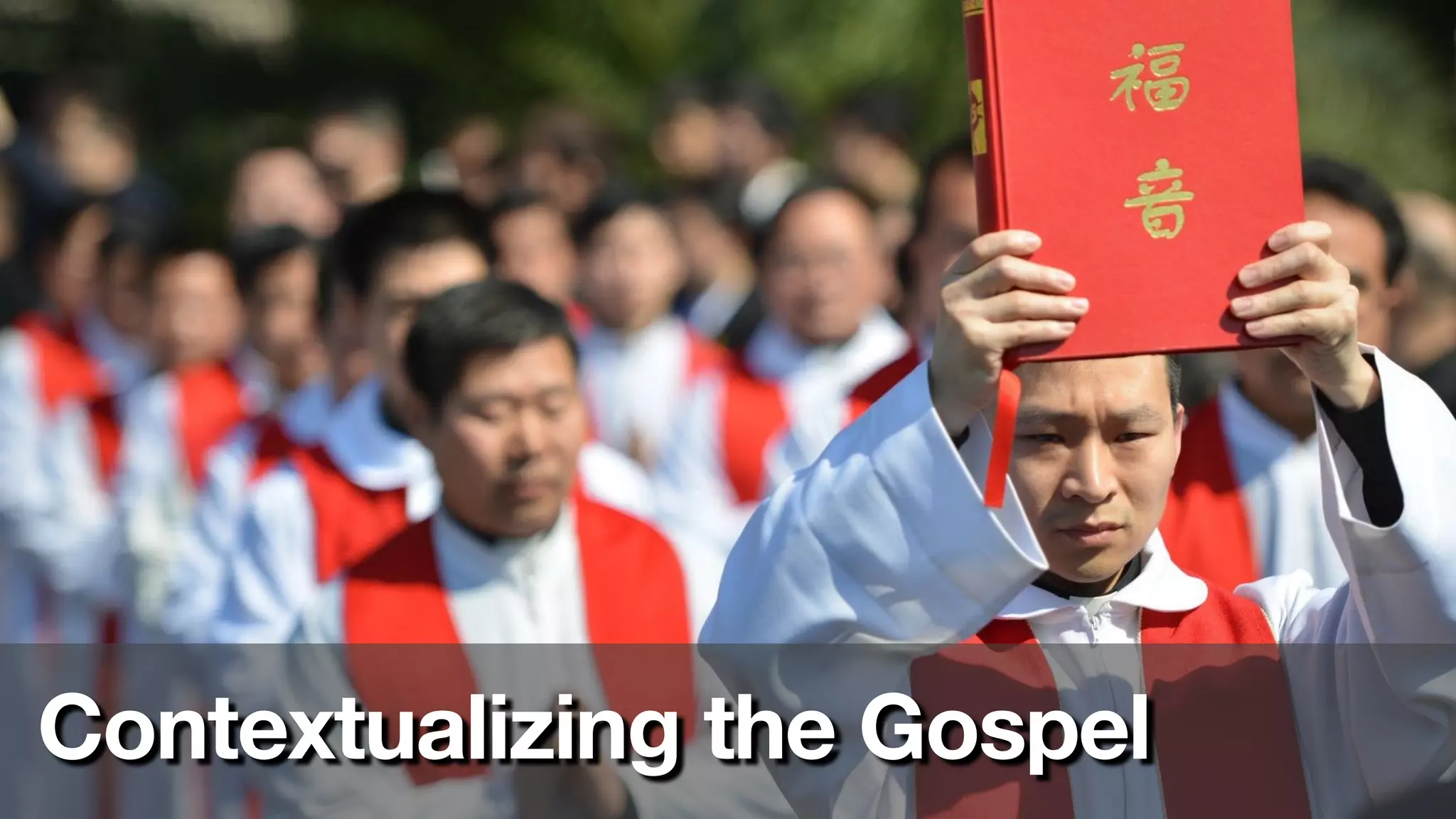
Contextualizing the Gospel
Original cultural context of Gospels
• Jesus’ name was Yeshua

• Preached in Israel

• Preached in Hebrew & Aramaic

• Preached in the synagogues

• Proclaimed himself as Messiah of Israel

• Venues were Jewish festivals like Passover

• Parables used Jewish images
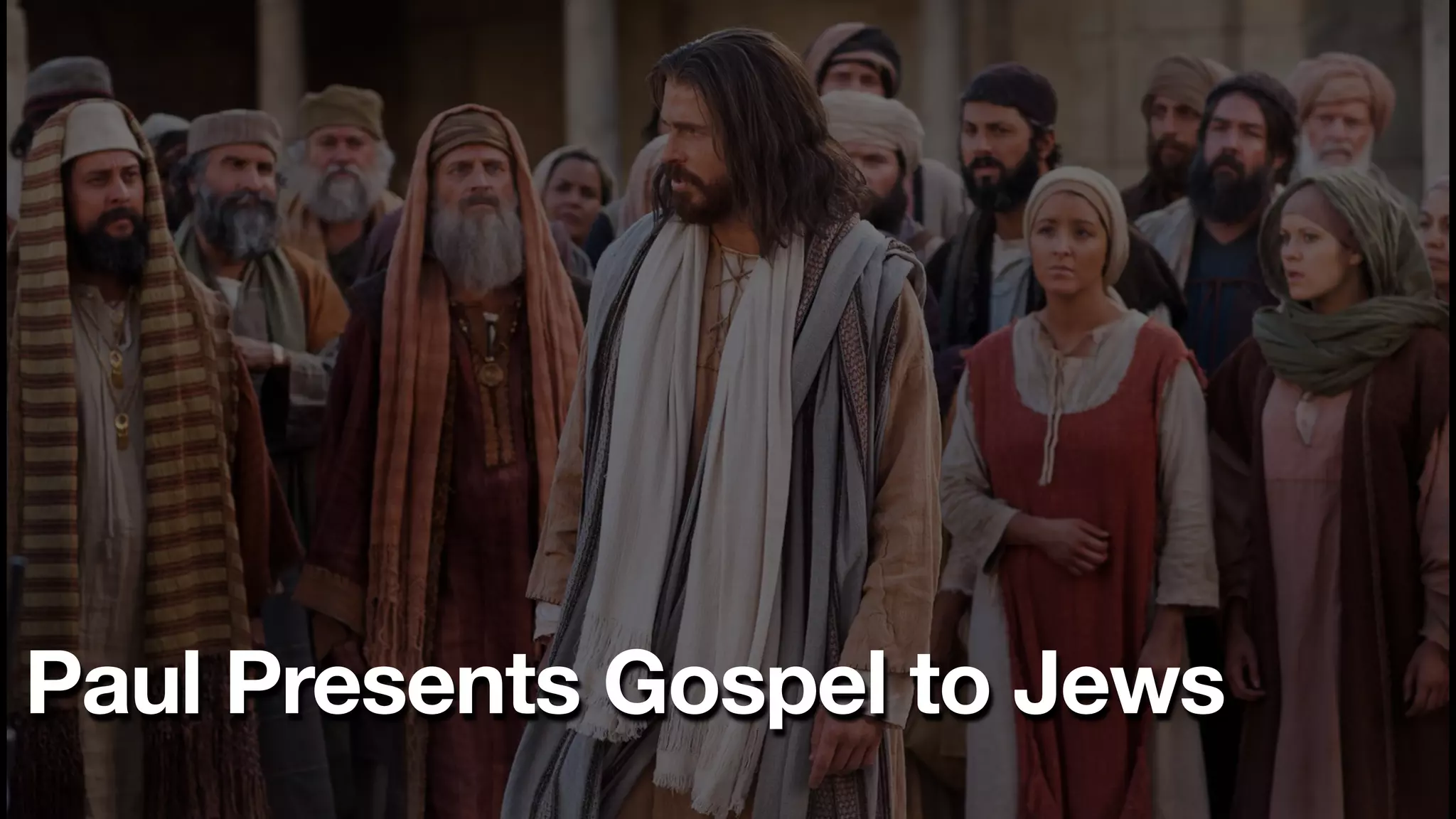
Paul Presents Gospel to Jews
Now when they had passed through Amphipolis and
Apollonia, they came to Thessalonica, where there was a
synagogue of the Jews. And Paul went in, as was his
custom, and on three Sabbath days he reasoned with
them from the Scriptures, explaining and proving that it
was necessary for the Christ to suffer and to rise from the
dead, and saying, “This Yeshua, whom I proclaim to you,
is the Messiah.”


(Acts 17:1–3 ESV)
Some of them were persuaded and joined Paul and Silas,
as did a great many of the devout Greeks and not a few of
the leading women. But the Jews were jealous, and taking
some wicked men of the rabble, they formed a mob, set
the city in an uproar, and attacked the house of Jason,
seeking to bring them out to the crowd.


(Acts 17:4–5 ESV)
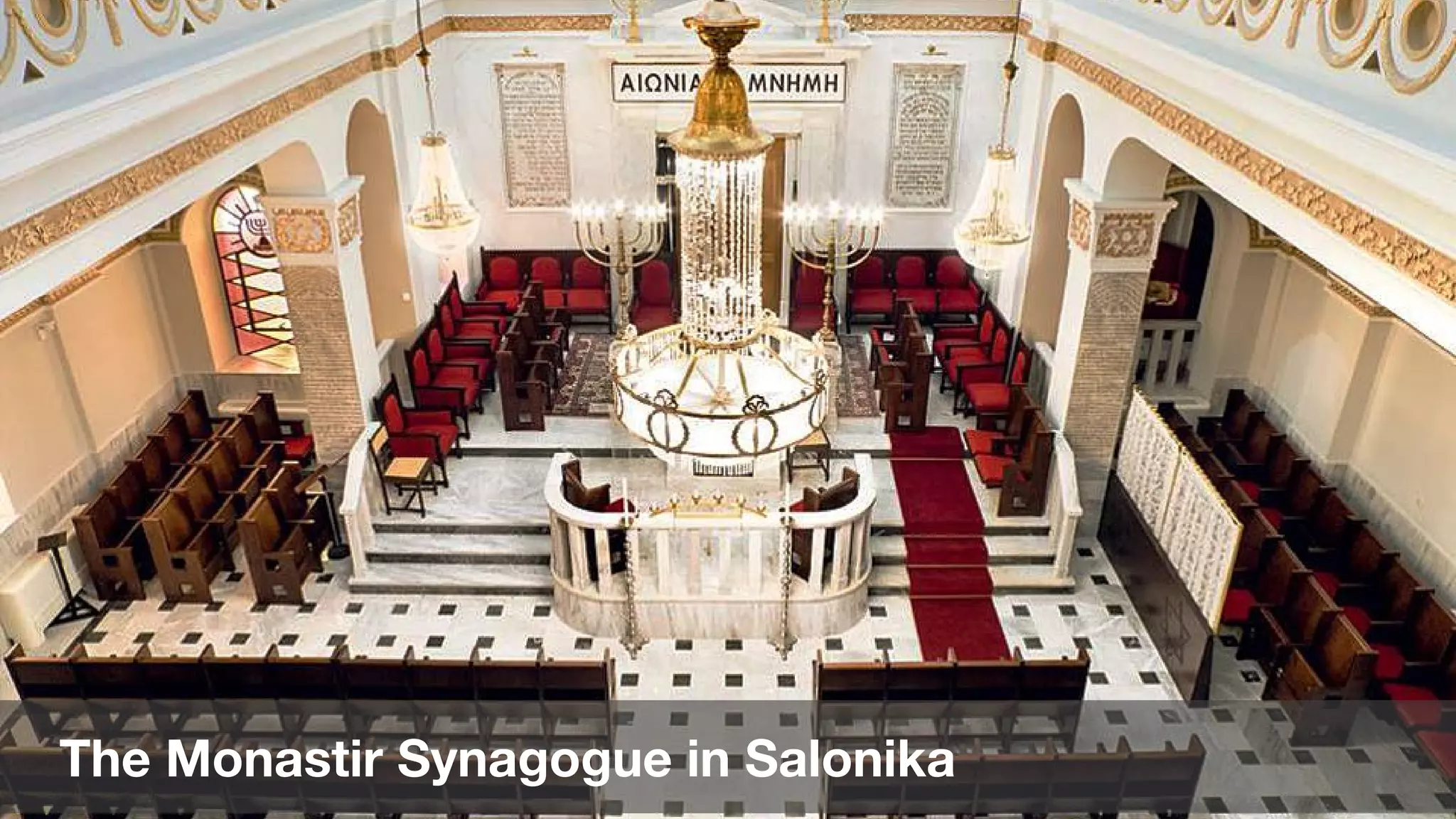
The Monastir Synagogue in Salonika
What was specific to Jewish culture?
Acts 17:1-5
What was specific to Jewish culture?
Acts 17:1-5
•Venue was a synagogue


•Occasion was the Shabbat Derash (sermon)


•Presented Jesus as the Messiah


•Appealed to Old Testament to texts


•Used to Hebrew critical reasoning
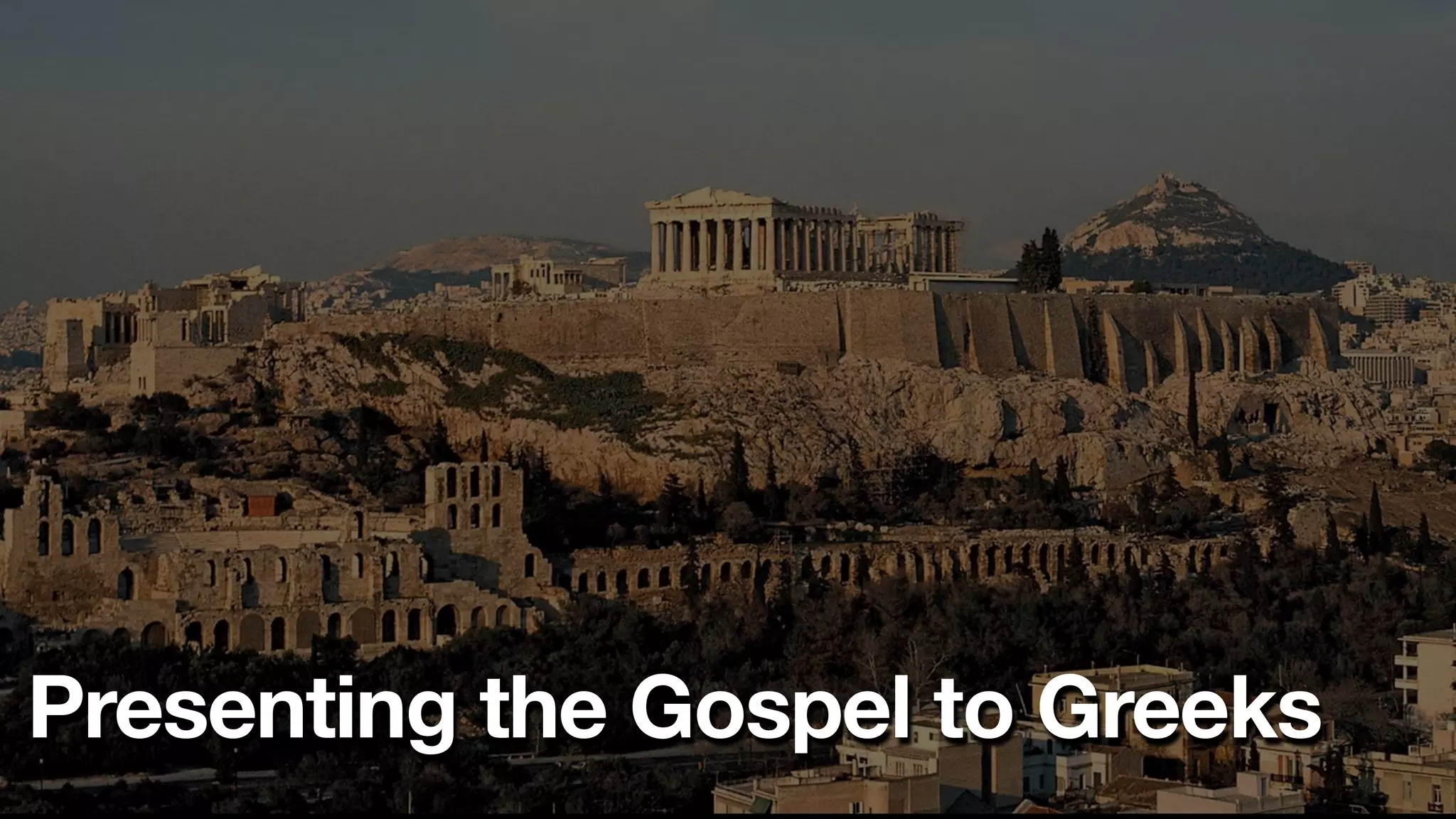
Presenting the Gospel to Greeks
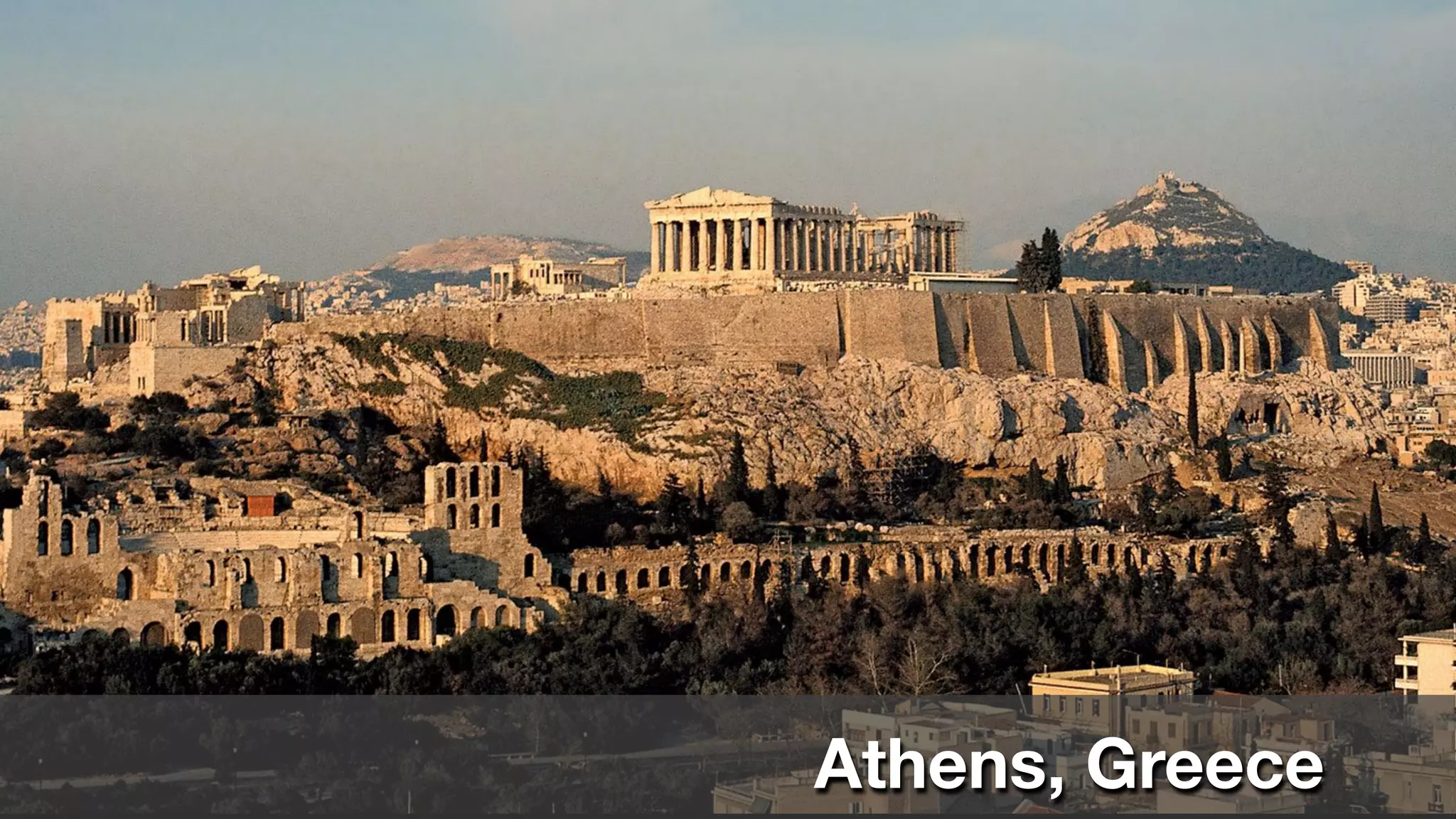
Athens, Greece
While Paul was waiting for them at Athens, his spirit was
provoked within him as he saw that the city was full of
idols. So he reasoned in the synagogue with the Jews and
the devout persons, and in the marketplace every day with
those who happened to be there. Some of the Epicurean
and Stoic philosophers also conversed with him. And
some said, “What does this babbler wish to say?” Others
said, “He seems to be a preacher of foreign divinities”—
because he was preaching Jesus and the resurrection.


(Acts 17:16–18 ESV)
They took him and brought him to the Areopagus, saying,
“May we know what this new teaching is that you are
presenting? For you bring some strange things to our ears.
We wish to know therefore what these things mean.” Now
all the Athenians and the foreigners who lived there would
spend their time in nothing except telling or hearing
something new.


(Acts 17:19–21 ESV)
Paul, standing in the midst of the Areopagus, said: “Men of
Athens, I perceive that in every way you are very religious.
For as I passed along and observed the objects of your
worship, I found also an altar with this inscription: ‘To the
unknown god.’ What therefore you worship as unknown,
this I proclaim to you.


(Acts 17:22–23 ESV)
The God who made the world and everything in it, being
Lord of heaven and earth, does not live in temples made
by man, nor is he served by human hands, as though he
needed anything, since he himself gives to all mankind life
and breath and everything. And he made from one man
every nation of mankind to live on all the face of the earth,
having determined allotted periods and the boundaries of
their dwelling place, that they should seek God, and
perhaps feel their way toward him and find him.


(Acts 17:24–27 ESV)
Yet he is actually not far from each one of us, for “‘In him
we live and move and have our being’; as even some of
your own poets have said, “‘For we are indeed his
offspring.’ Being then God’s offspring, we ought not to
think that the divine being is like gold or silver or stone, an
image formed by the art and imagination of man.


(Acts 17:27–30 ESV)
The times of ignorance God overlooked, but now he
commands all people everywhere to repent, because he
has fixed a day on which he will judge the world in
righteousness by a man whom he has appointed; and of
this he has given assurance to all by raising him from the
dead.”


(Acts 17:30–31 ESV)
When they heard of the resurrection of the dead, some
mocked. But others said, “We will hear you again about
this.” So Paul went out from their midst. But some men
joined him and believed, among whom also were
Dionysius the Areopagite and a woman named Damaris
and others with them. After this Paul left Athens and went
to Corinth.


(Acts 17:32–18:1 ESV)
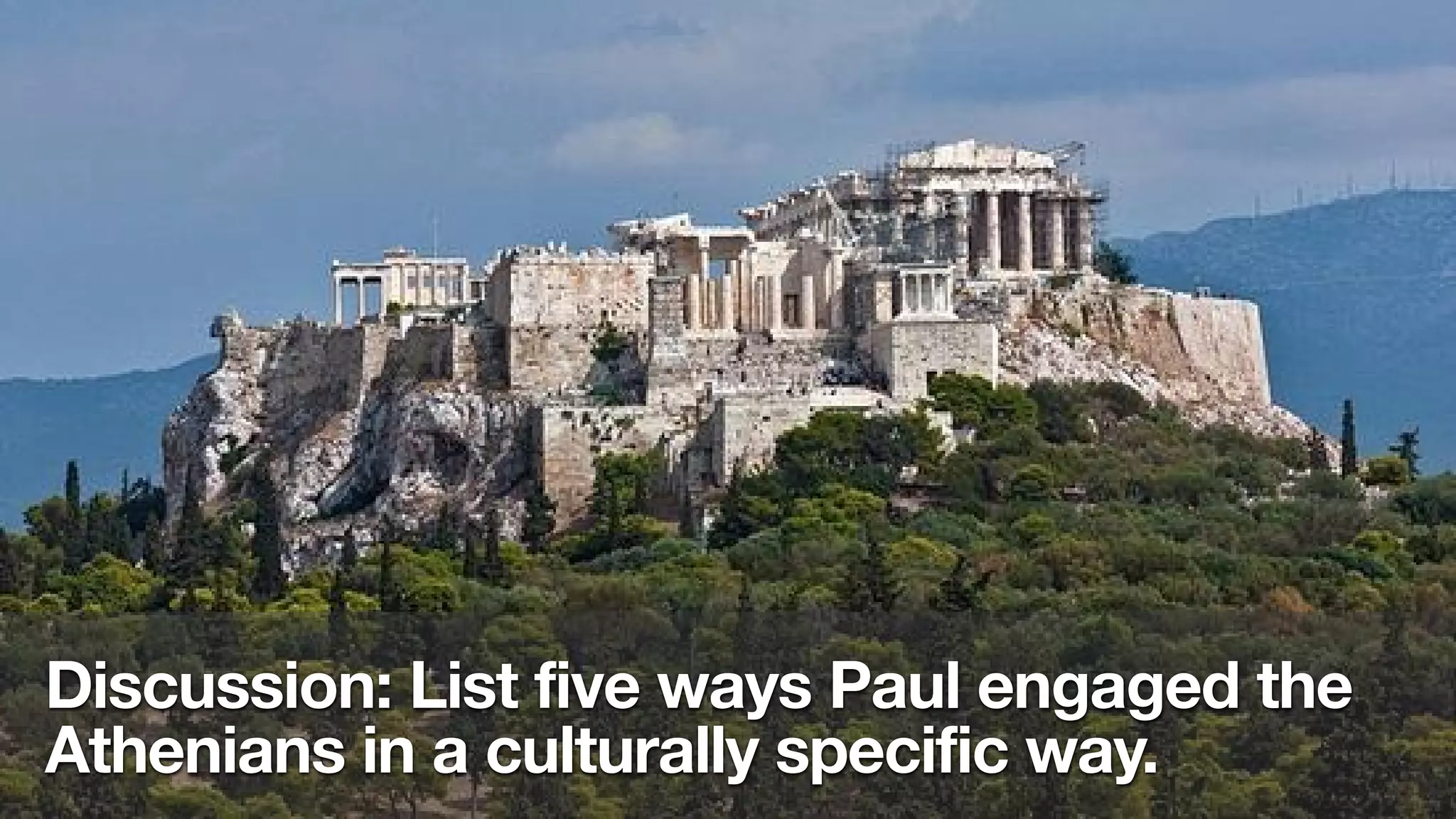
Discussion: List five ways Paul engaged the
Athenians in a culturally specific way.
What was specific to Athenian culture?
Acts 17:16-32
1. Paul found something to affirm


2. Paul found a cultural connection or bridge


3. Paul used a philosophical venue


4. Paul structured it as a philosophical treatise


5. Paul cited Greek literature


6. Paul engaged with contemporary issues (ex. Temple made by hands)
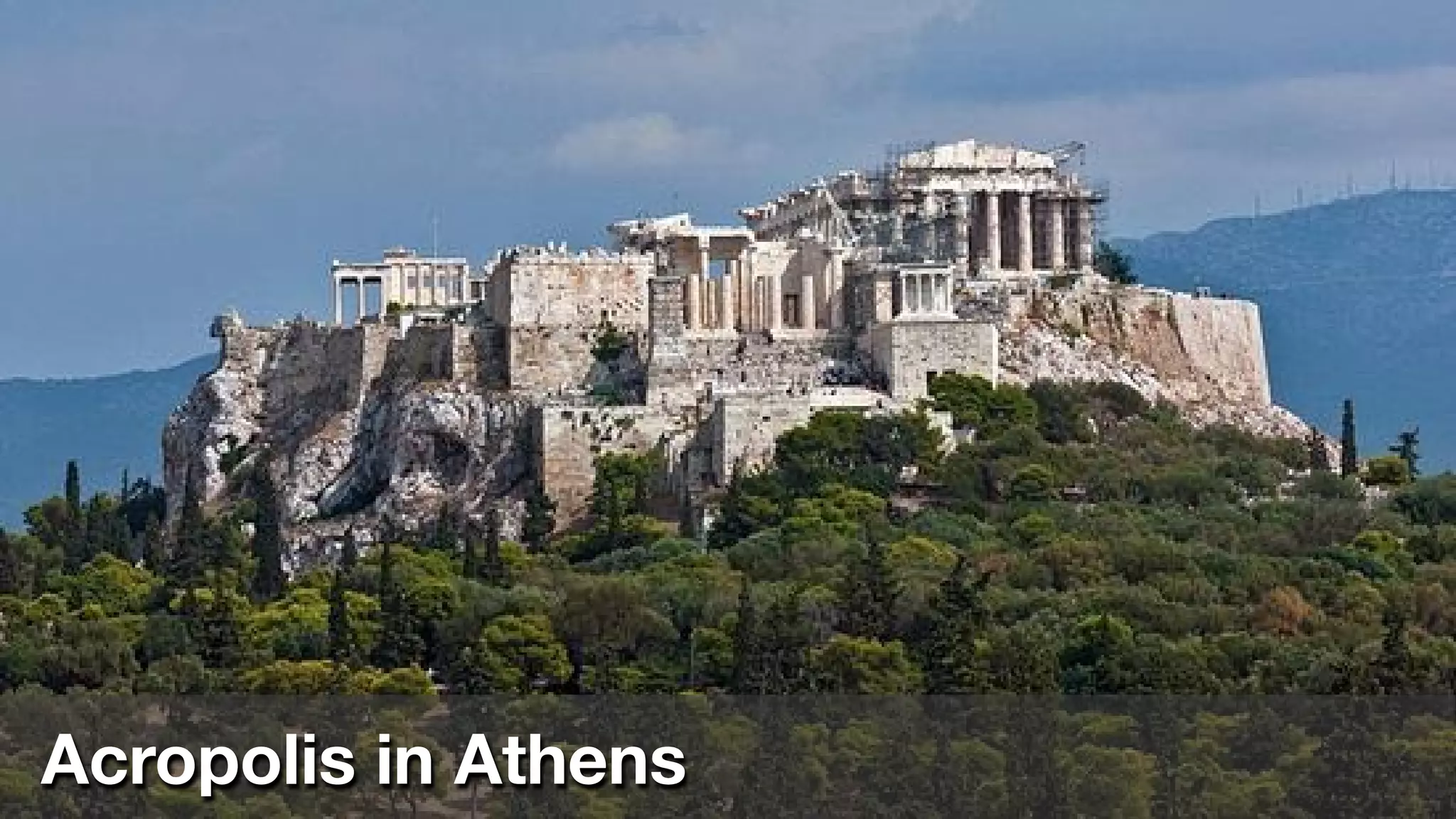
Acropolis in Athens
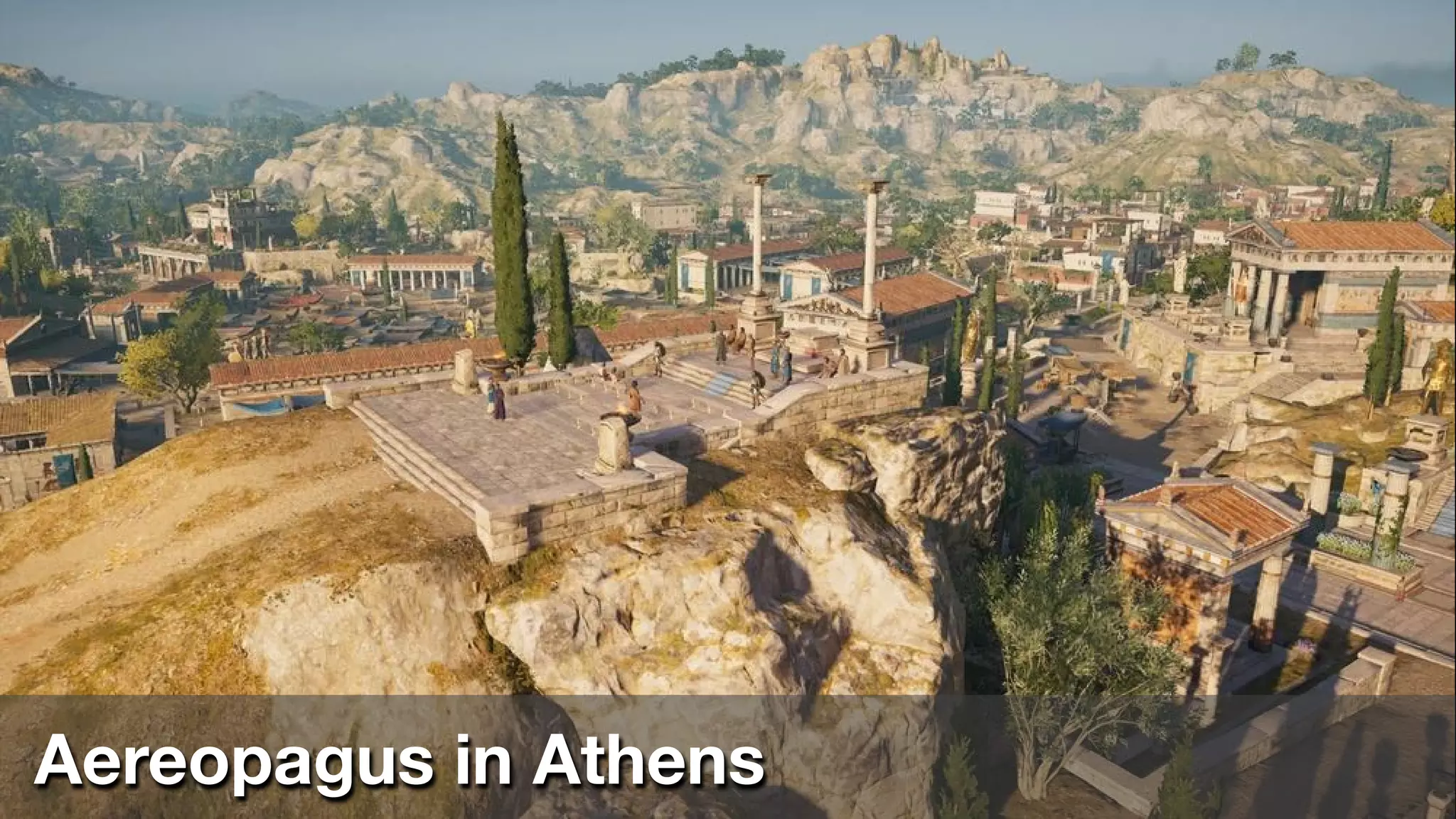
Aereopagus in Athens
What was specific to Athenian culture?
Acts 17:16-32
7. Paul avoided Jewish cultural reference!
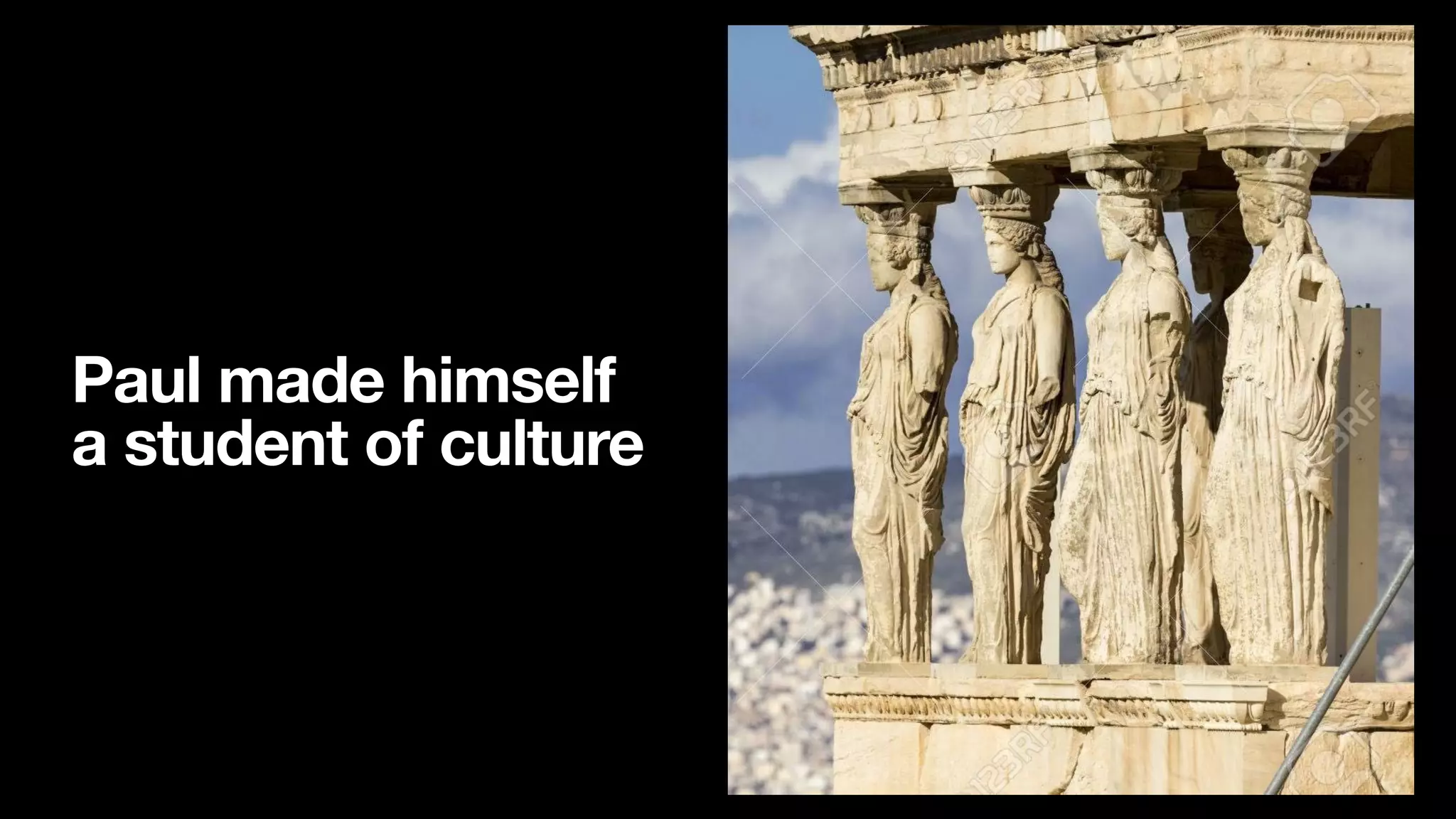
Paul made himself
a student of culture
To the Jews I became as a Jew, in order to win Jews…To
those outside the law I became as one outside the law
(not being outside the law of God but under the law of
Messiah) that I might win those outside the law…I have
become all things to all people, that by all means I might
save some. I do it all for the sake of the gospel, that I may
share with them in its blessings.


(1 Cor 9:20–23 ESV)
1. Paul affirmed his audience
Men of Athens, I perceive that in every way you are very
religious. For as I passed along and observed the objects
of your worship
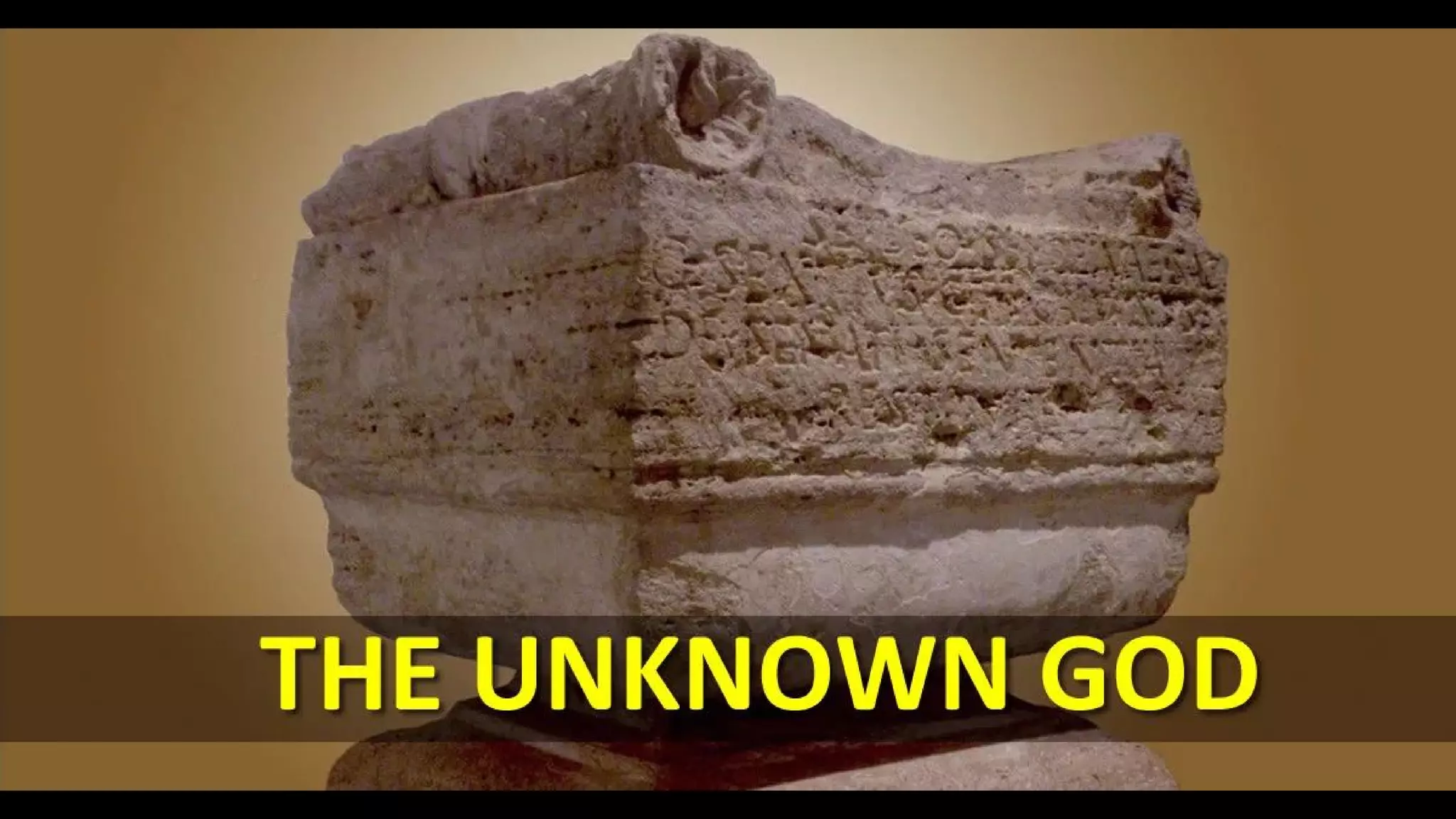
2. Paul identified a bridge to the gospel
As I passed along and observed the objects of your
worship, I found also an altar with this inscription: ‘To the
unknown god.’ What therefore you worship as unknown,
this I proclaim to you.
3. Paul began with agreed beliefs
The God who made the world and everything in it, being
Lord of heaven and earth, does not live in temples made
by man, nor is he served by human hands, as though he
needed anything, since he himself gives to all mankind
life and breath and everything.
4. Paul made use of audience’s literature
Yet he is actually not far from each one of us, for “‘In him
we live and move and have our being’; as even some of
your own poets have said, “‘For we are indeed his
offspring.’ (Acts 17:27–28 ESV)
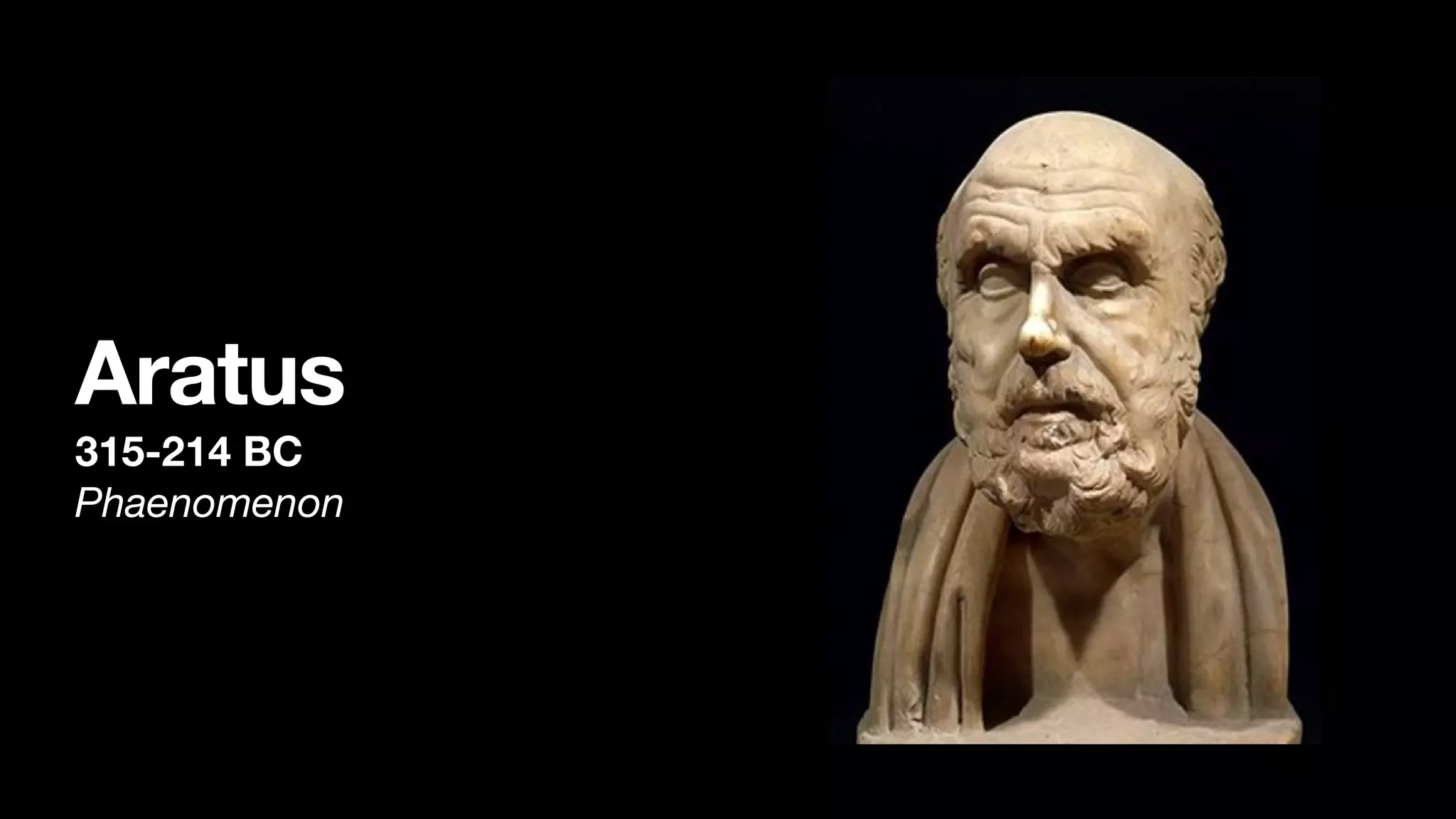
Aratus
315-214 BC
Phaenomenon
5. Paul explained ALL the gospel
He has
fi
xed a day on which he will judge the world in
righteousness by a man whom he has appointed; and of
this he has given assurance to all by raising him from the
dead. (Acts 17:31 ESV)
6. Paul avoided things that alienate
• Paul did NOT talk about the Jewishness of Jesus


• Paul did NOT highlight his own Jewishness


• Paul did NOT insult Greek religion
6. Paul avoided things that alienate
What are ways Christians offend & alienate seeker?
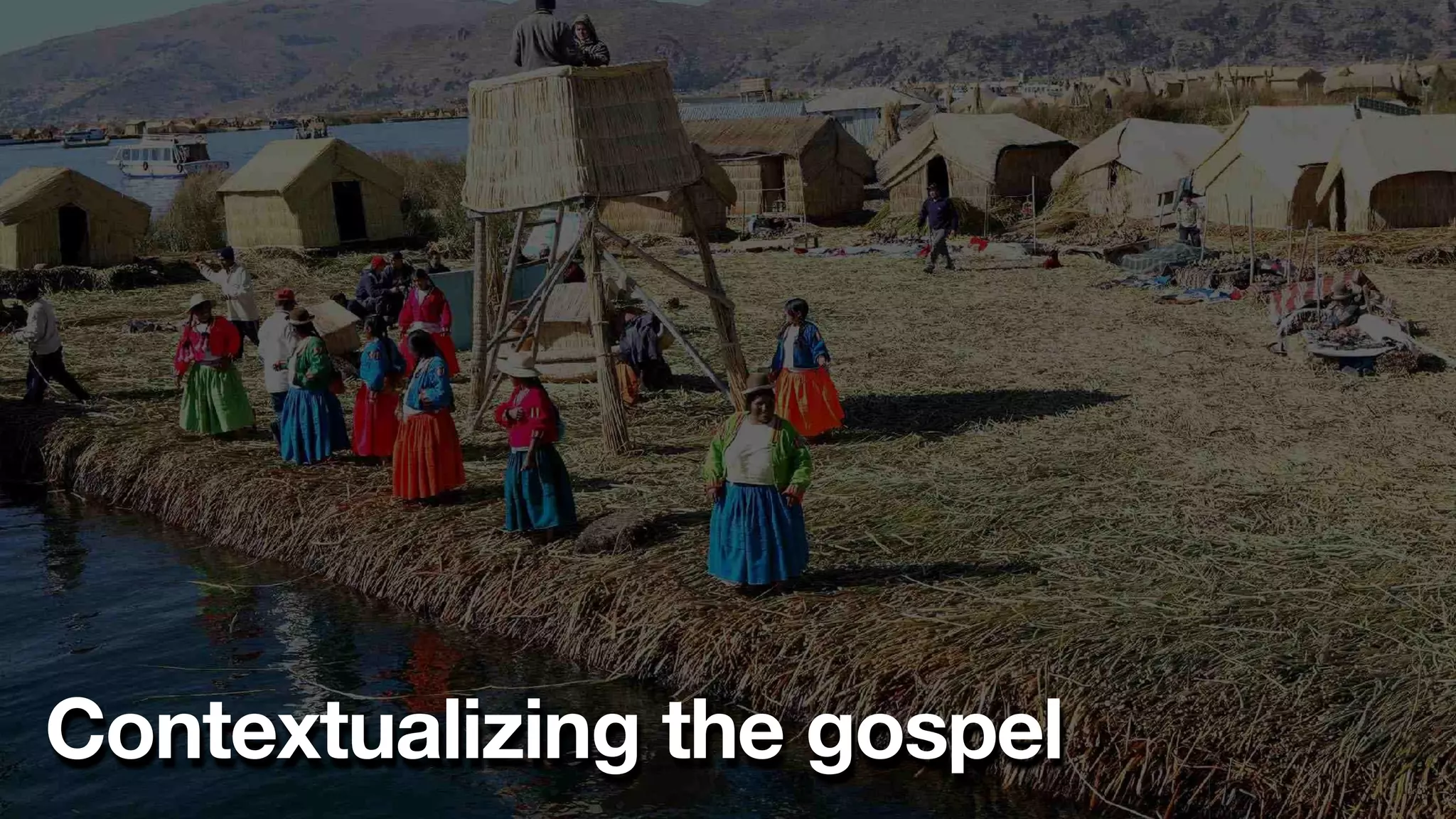
Contextualizing the gospel
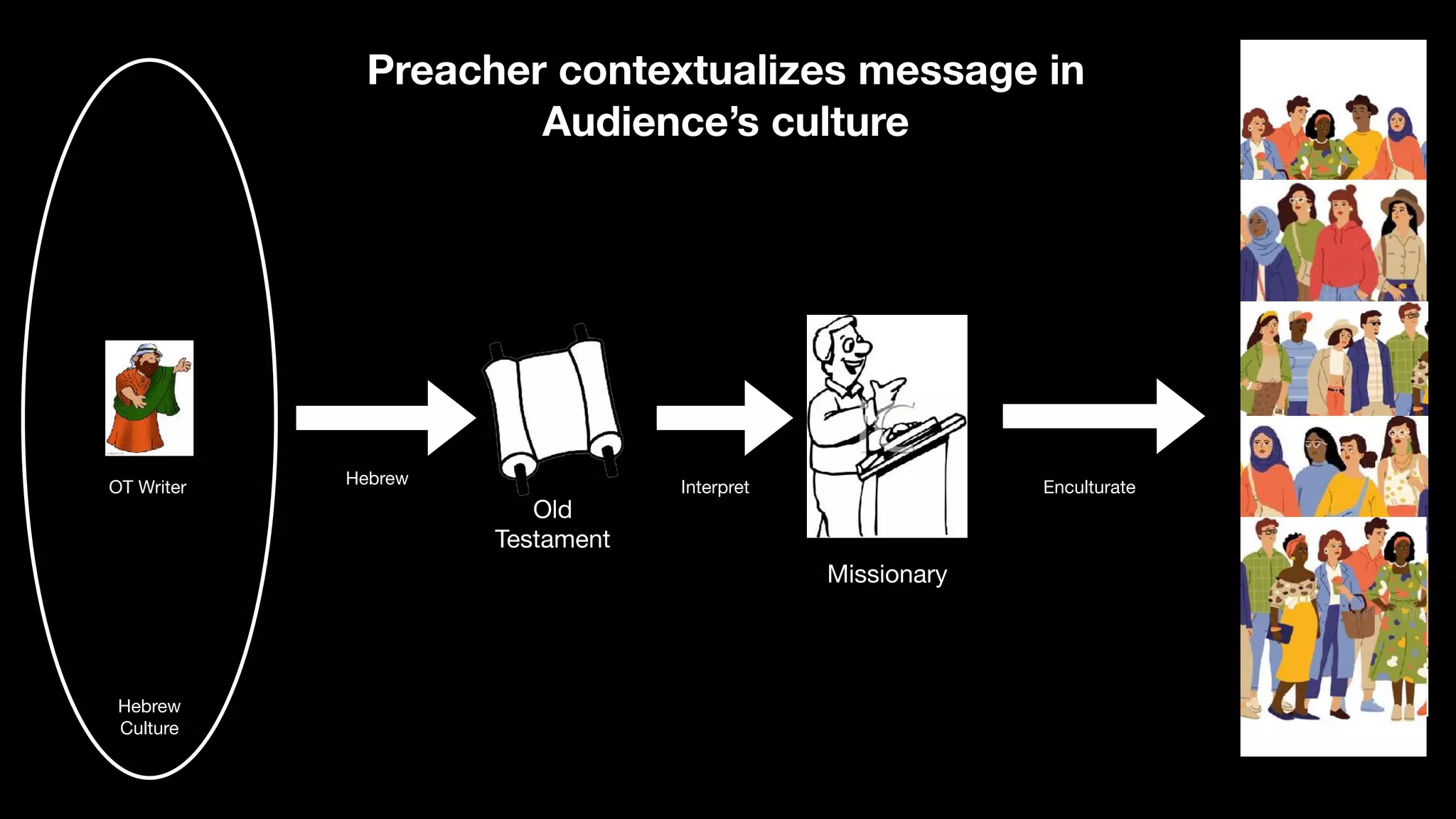
OT Writer
Hebrew

Culture
Old 

Testament
Hebrew Interpret
Missionary
Enculturate
Preacher contextualizes message in
Audience’s culture
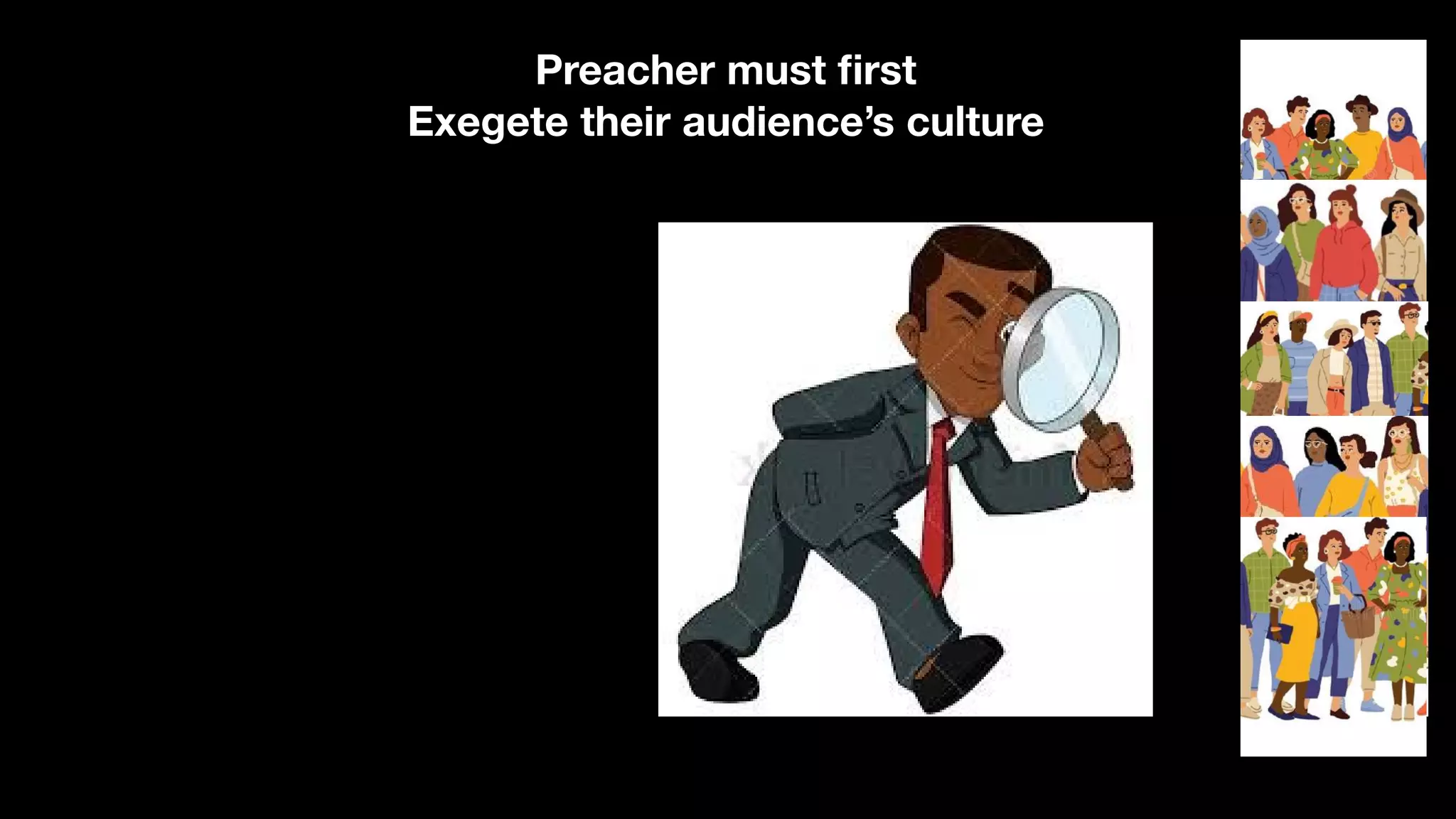
Preacher must
fi
rst
Exegete their audience’s culture
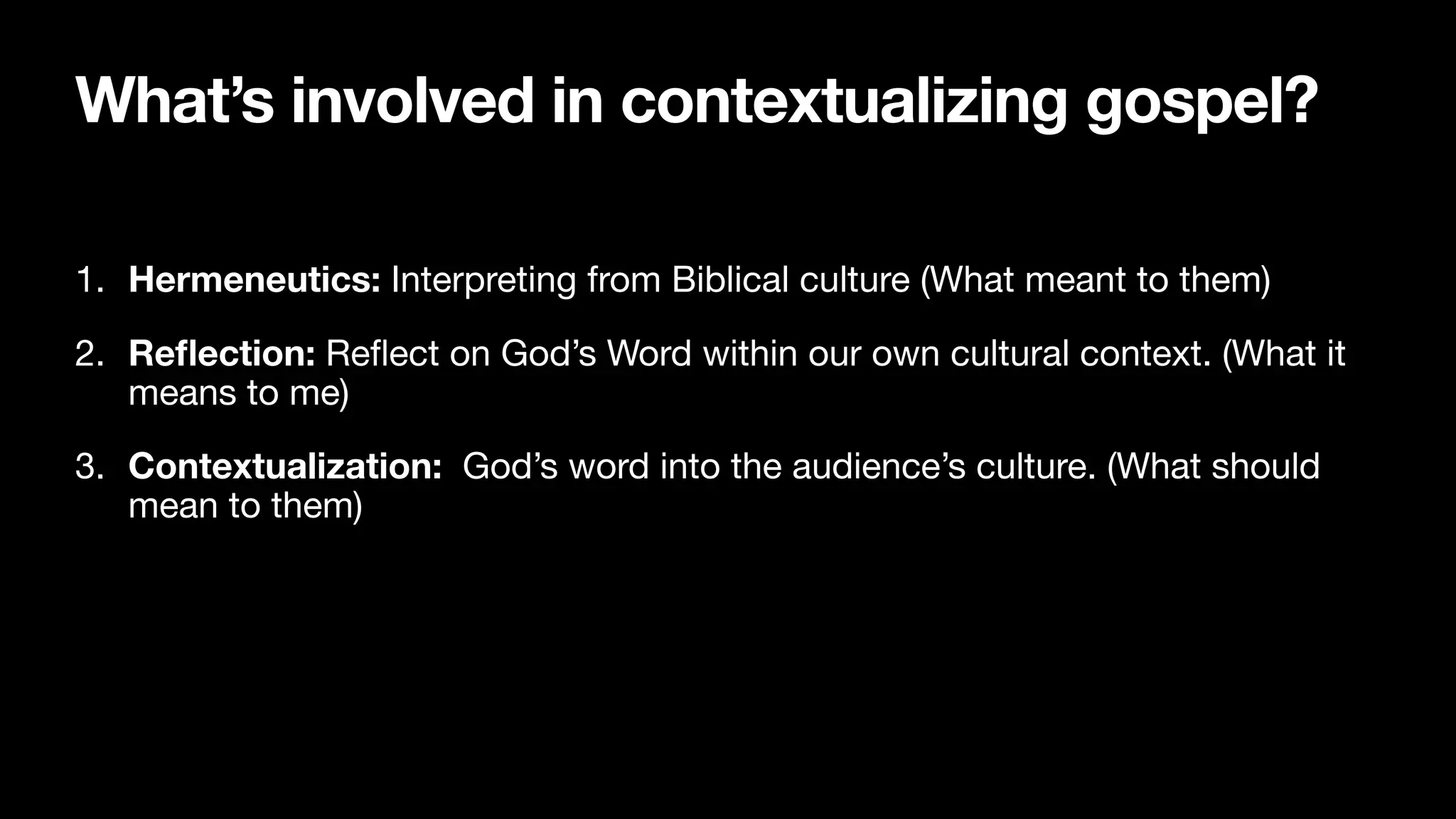
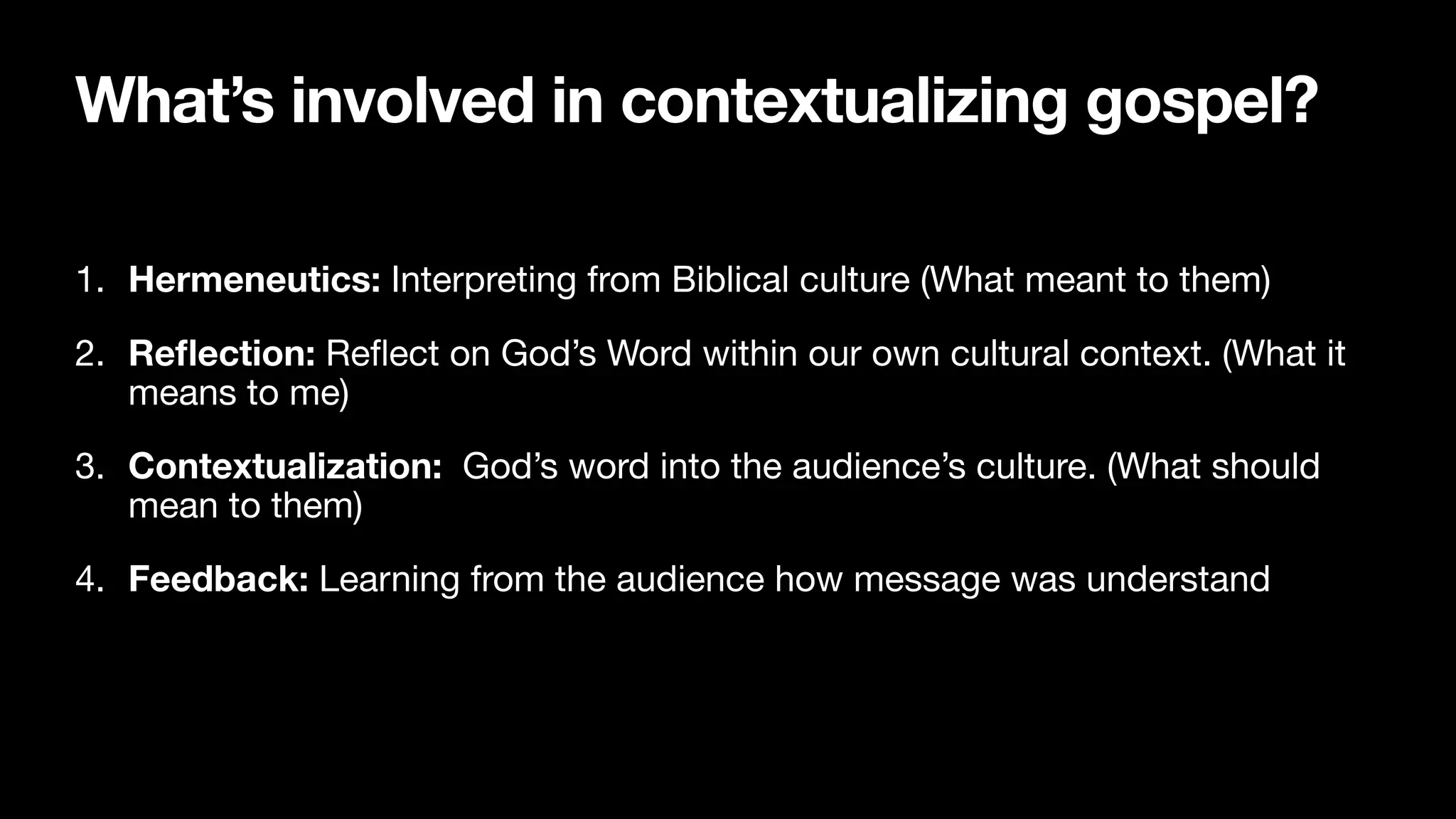
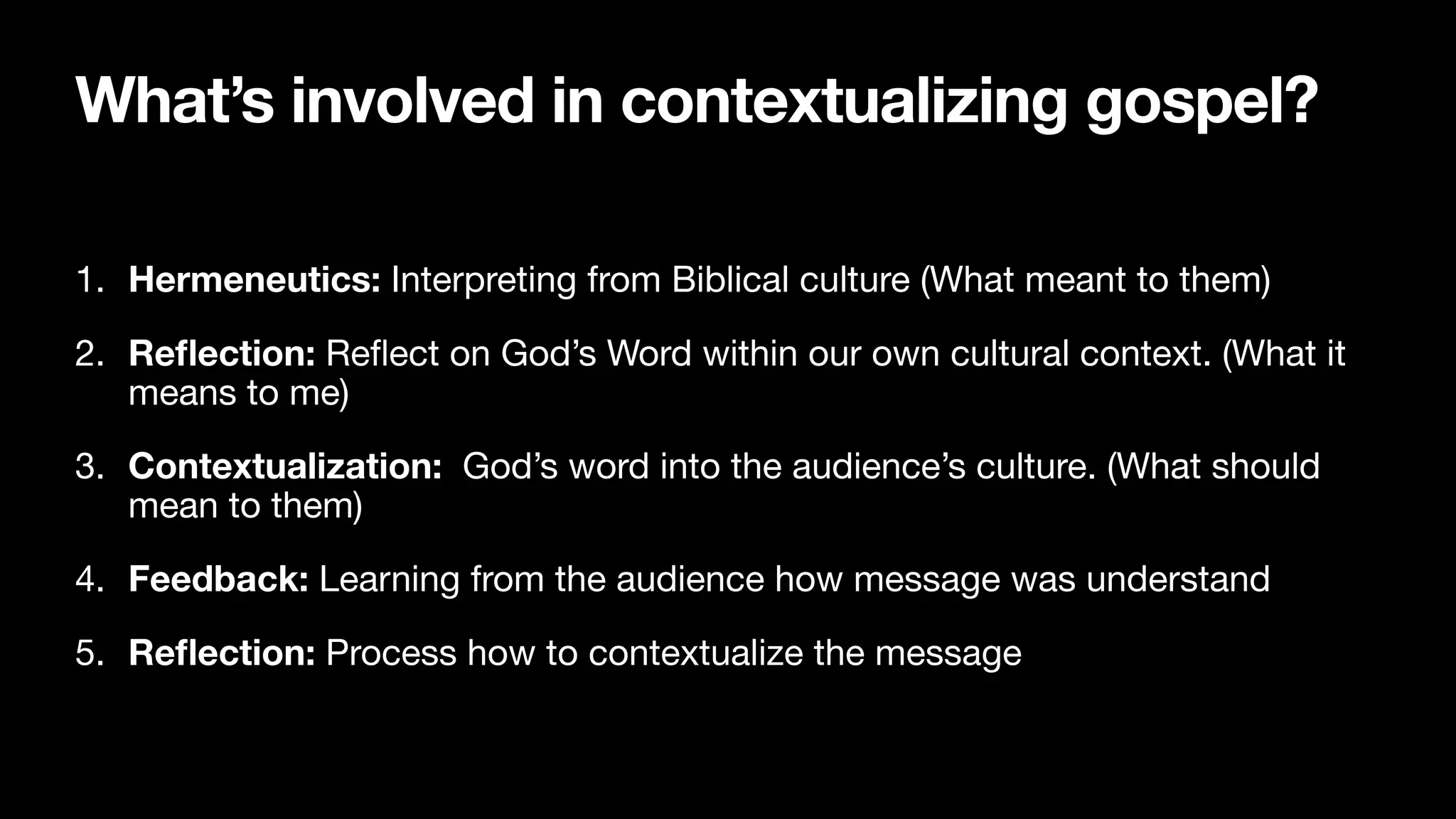
What’s involved in contextualizing gospel?
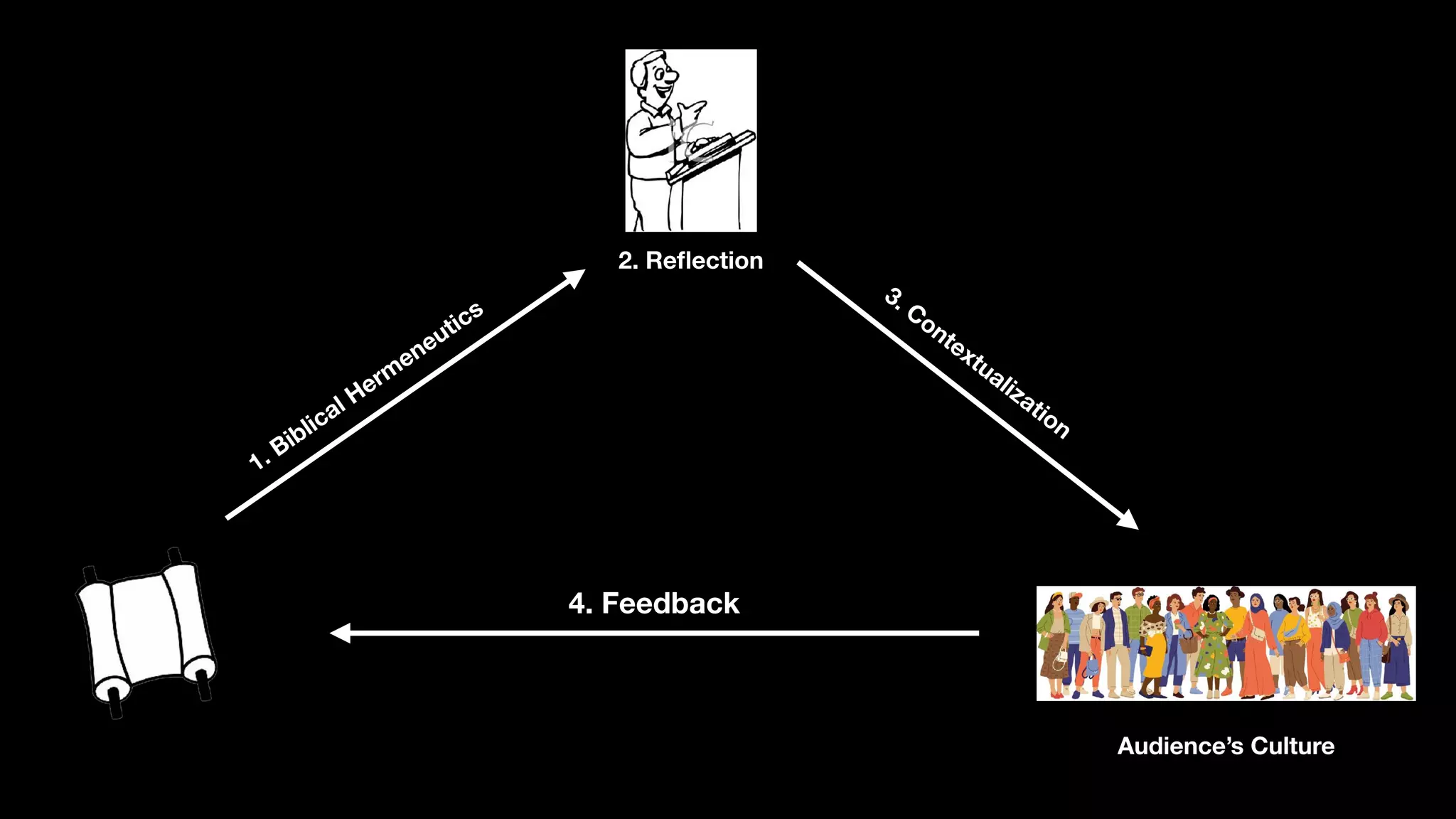
1. Hermeneutics: Interpreting from Biblical culture (What meant to them)
What’s involved in contextualizing gospel?
1. Hermeneutics: Interpreting from Biblical culture (What meant to them)

2. Re
fl
ection: Re
fl
ect on God’s Word within our own cultural context. (What it
means to me)
What’s involved in contextualizing gospel?
1. Hermeneutics: Interpreting from Biblical culture (What meant to them)

2. Re
fl
ection: Re
fl
ect on God’s Word within our own cultural context. (What it
means to me)

3. Contextualization: God’s word into the audience’s culture. (What should
mean to them)
What’s involved in contextualizing gospel?
1. Hermeneutics: Interpreting from Biblical culture (What meant to them)

2. Re
fl
ection: Re
fl
ect on God’s Word within our own cultural context. (What it
means to me)

3. Contextualization: God’s word into the audience’s culture. (What should
mean to them)

4. Feedback: Learning from the audience how message was understand
What’s involved in contextualizing gospel?
1. Hermeneutics: Interpreting from Biblical culture (What meant to them)

2. Re
fl
ection: Re
fl
ect on God’s Word within our own cultural context. (What it
means to me)

3. Contextualization: God’s word into the audience’s culture. (What should
mean to them)

4. Feedback: Learning from the audience how message was understand

5. Re
fl
ection: Process how to contextualize the message
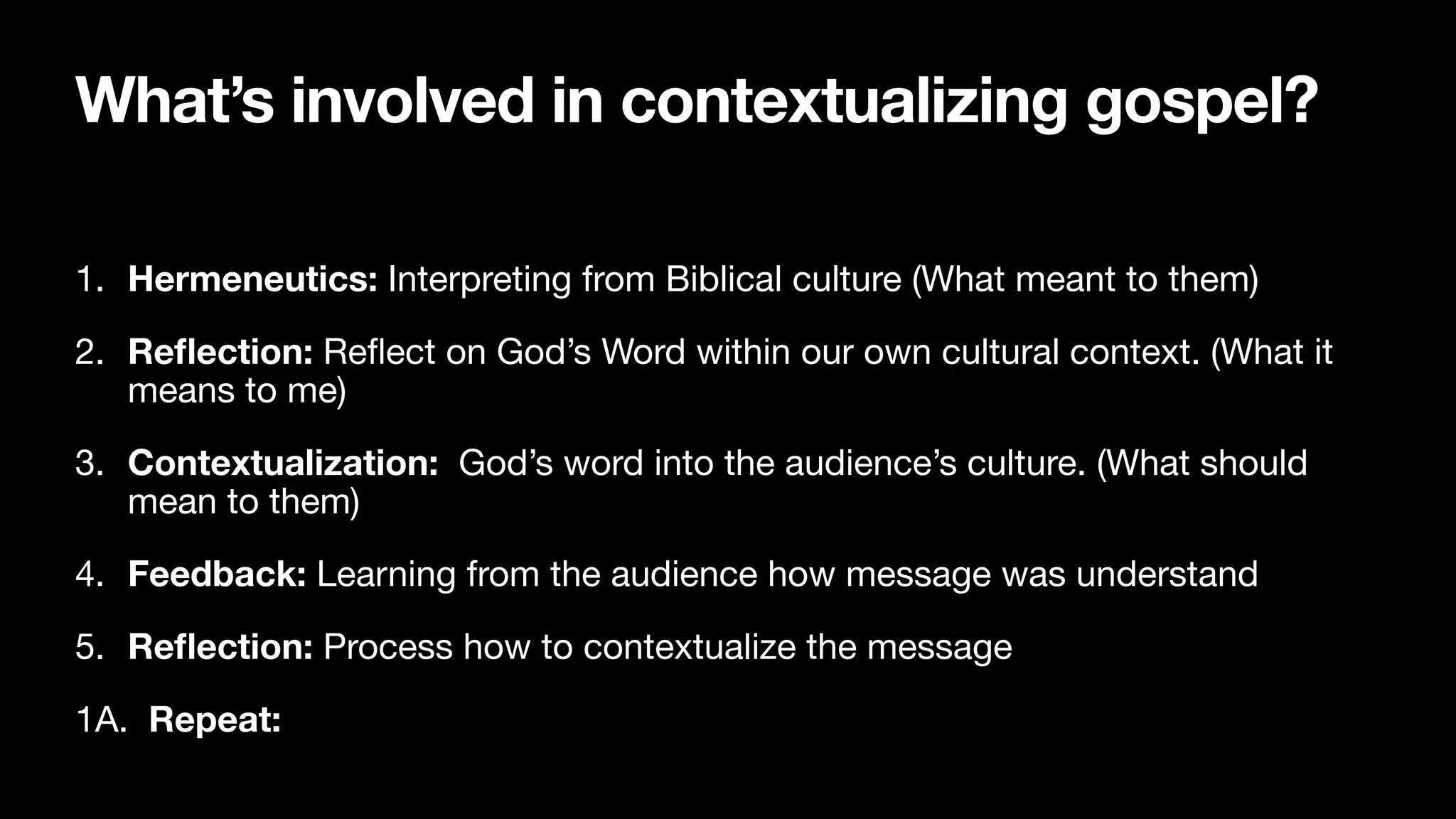
What’s involved in contextualizing gospel?
1. Hermeneutics: Interpreting from Biblical culture (What meant to them)

2. Re
fl
ection: Re
fl
ect on God’s Word within our own cultural context. (What it
means to me)

3. Contextualization: God’s word into the audience’s culture. (What should
mean to them)

4. Feedback: Learning from the audience how message was understand

5. Re
fl
ection: Process how to contextualize the message

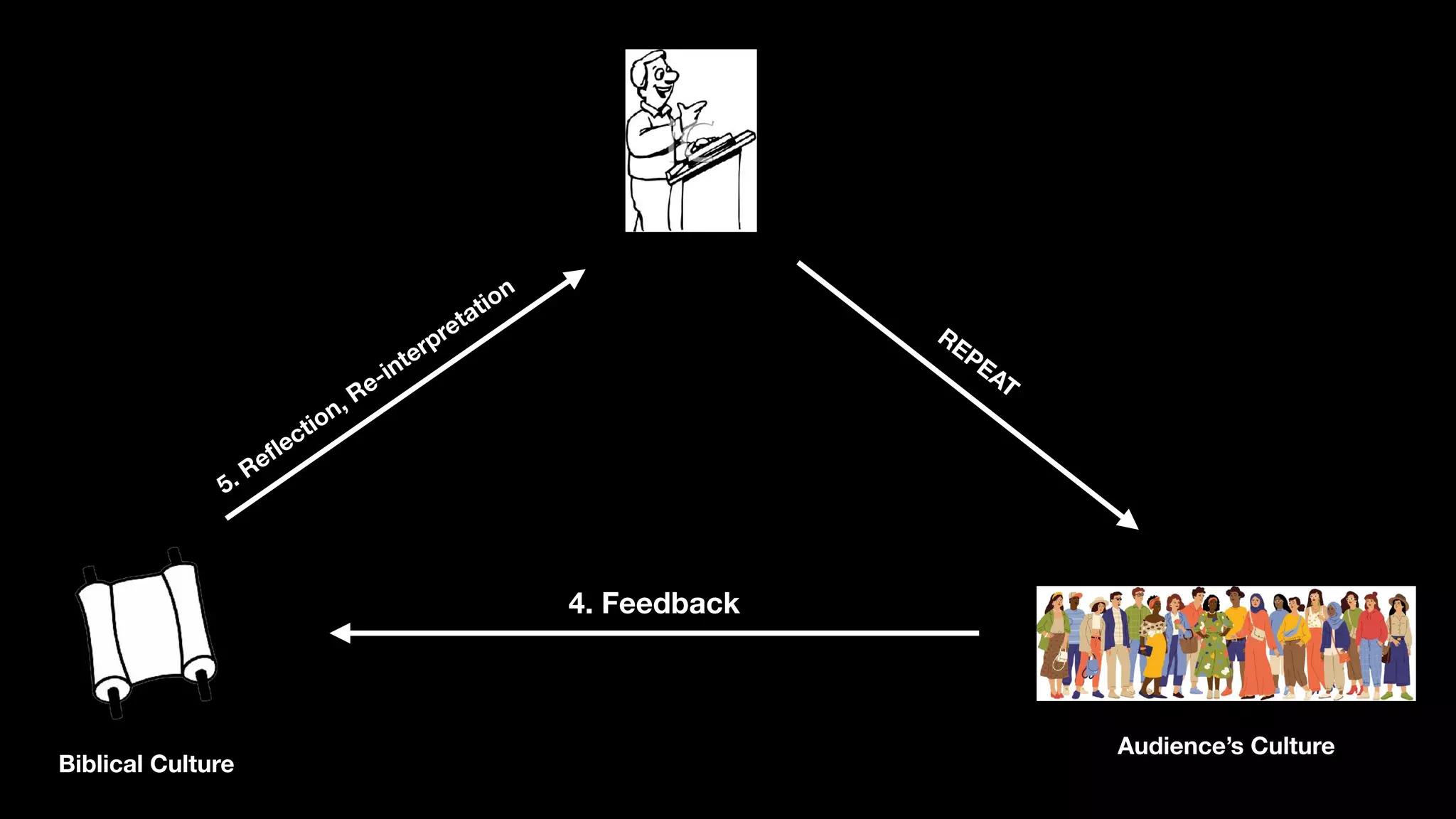
1A. Repeat:
2. Re
fl
ection
Audience’s Culture
1. Biblical Herm
eneutics
3. Contextualization
4. Feedback
Biblical Culture
Audience’s Culture
5. Re
fl
ection, Re-interpretation
REPEAT
4. Feedback
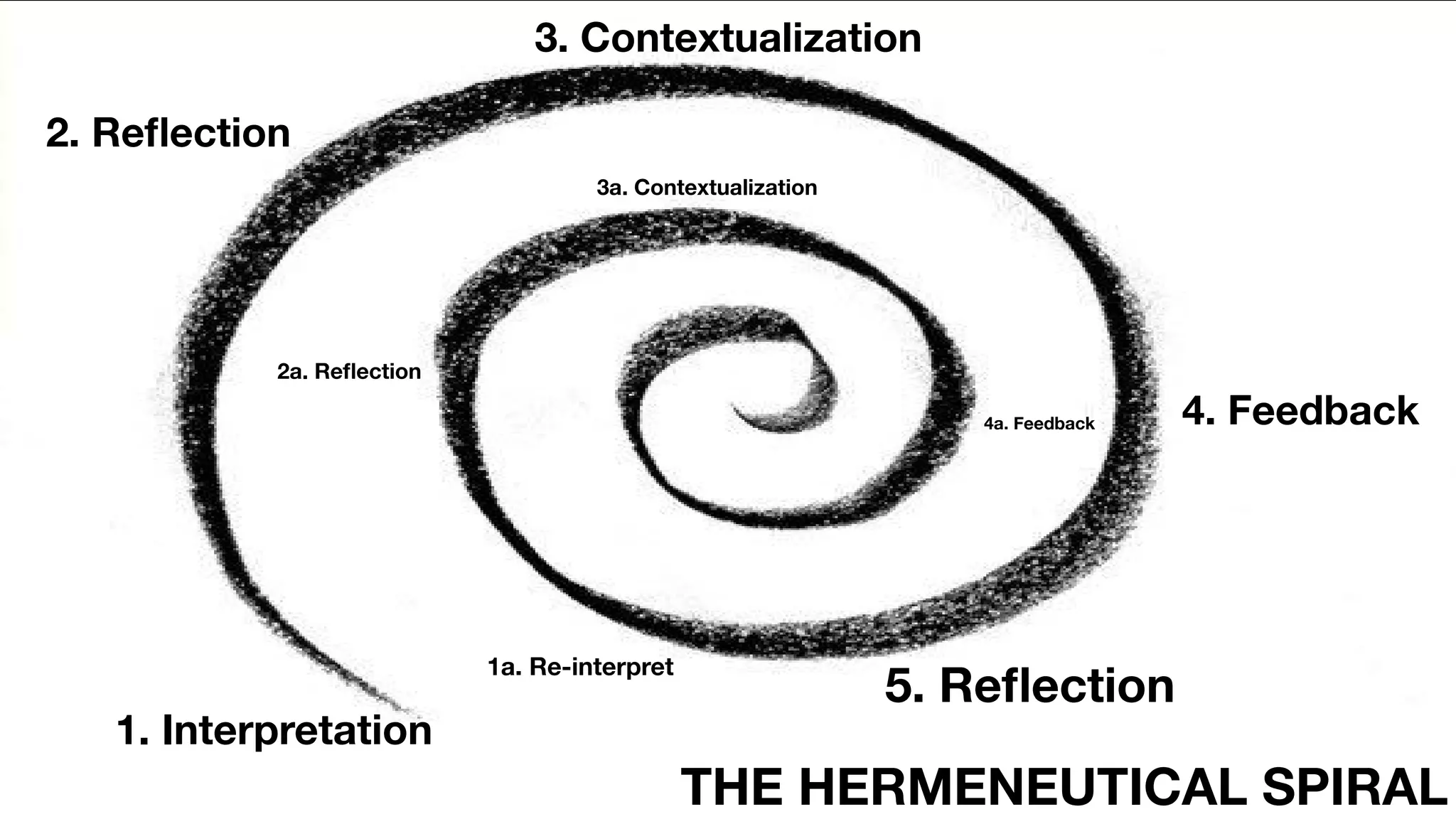
1. Interpretation
2. Re
fl
ection
3. Contextualization
4. Feedback
5. Re
fl
ection
1a. Re-interpret
2a. Re
fl
ection
3a. Contextualization
4a. Feedback
THE HERMENEUTICAL SPIRAL
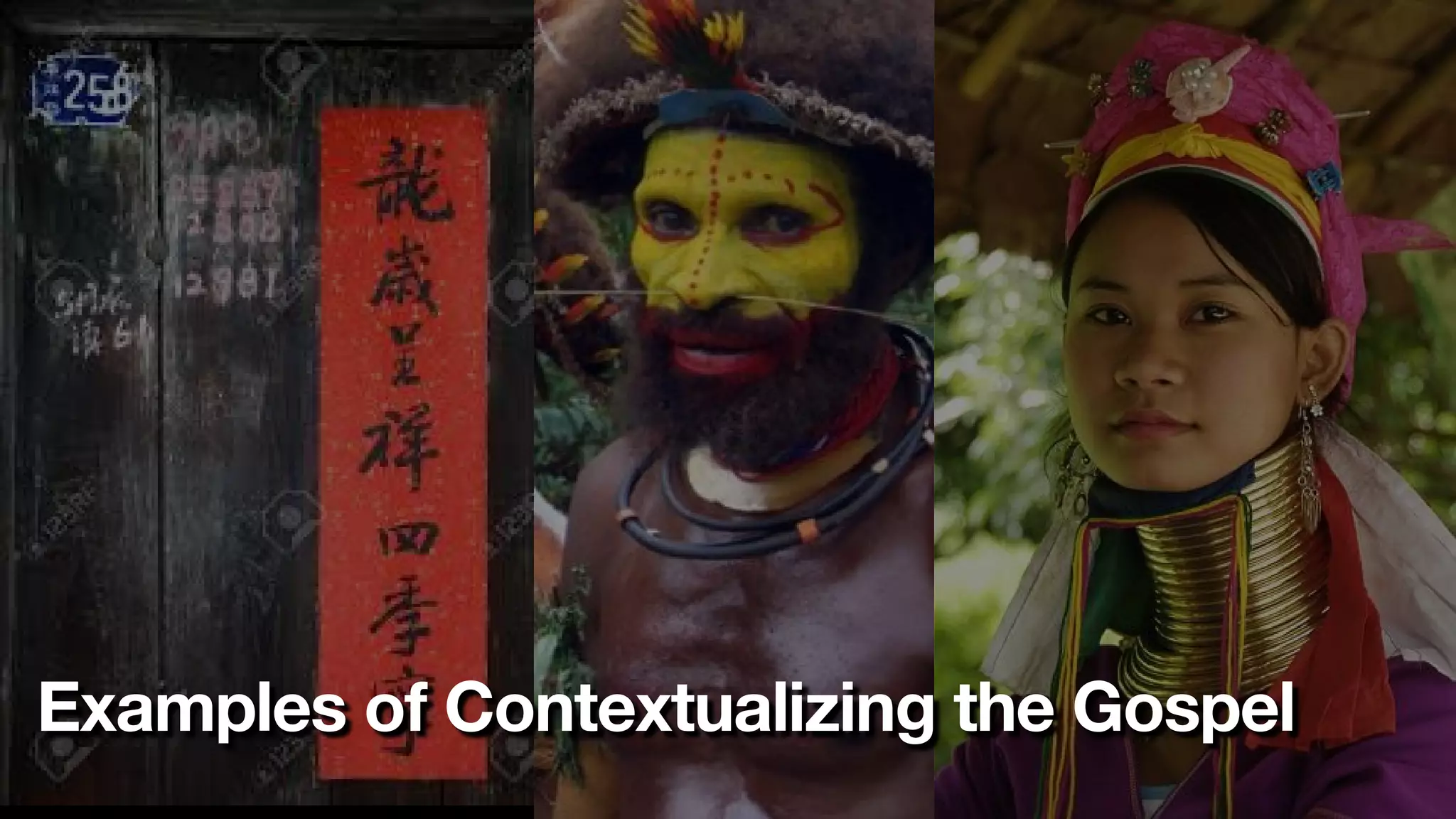
Examples of Contextualizing the Gospel
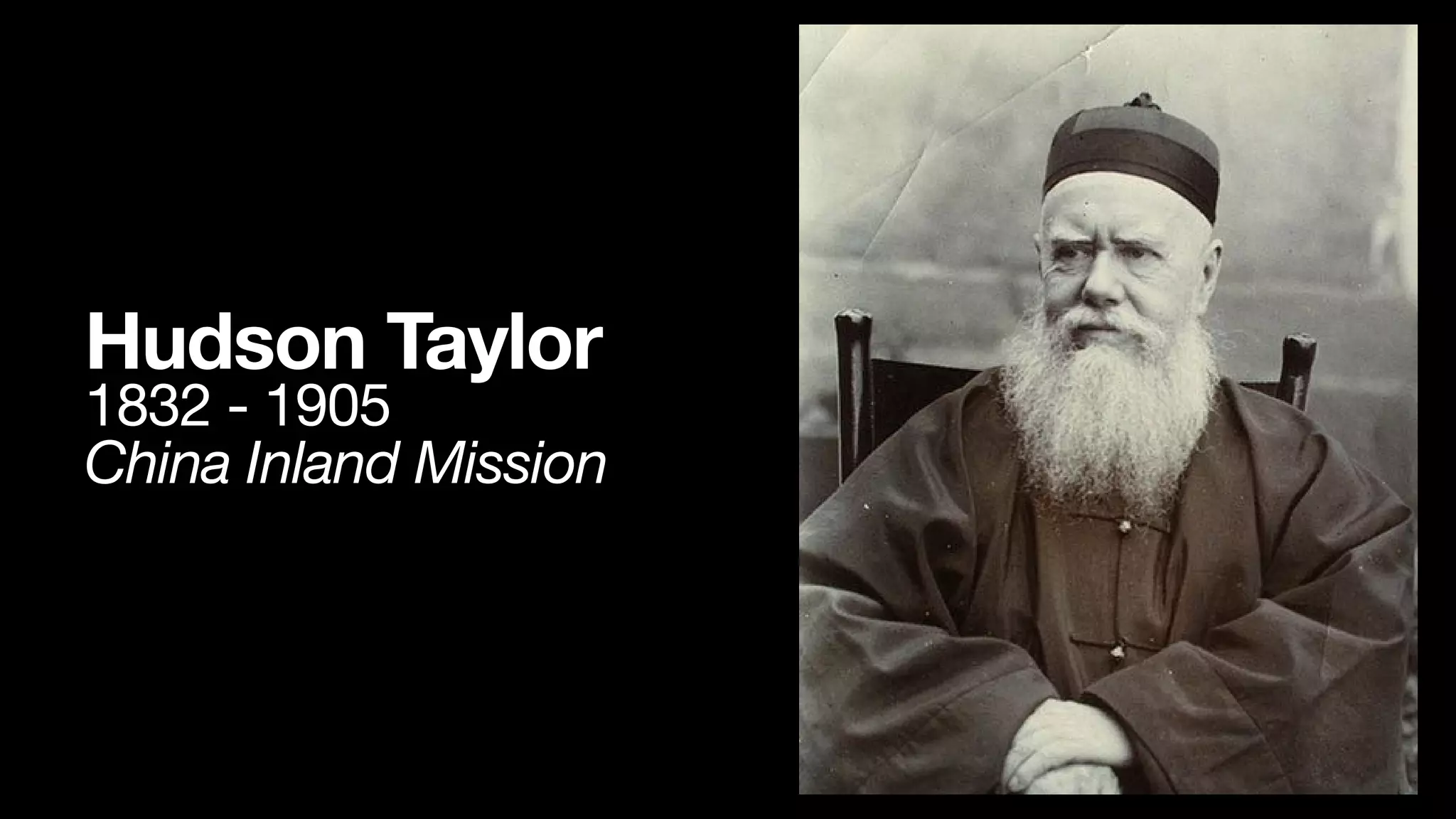
Hudson Taylor
1832 - 1905

China Inland Mission
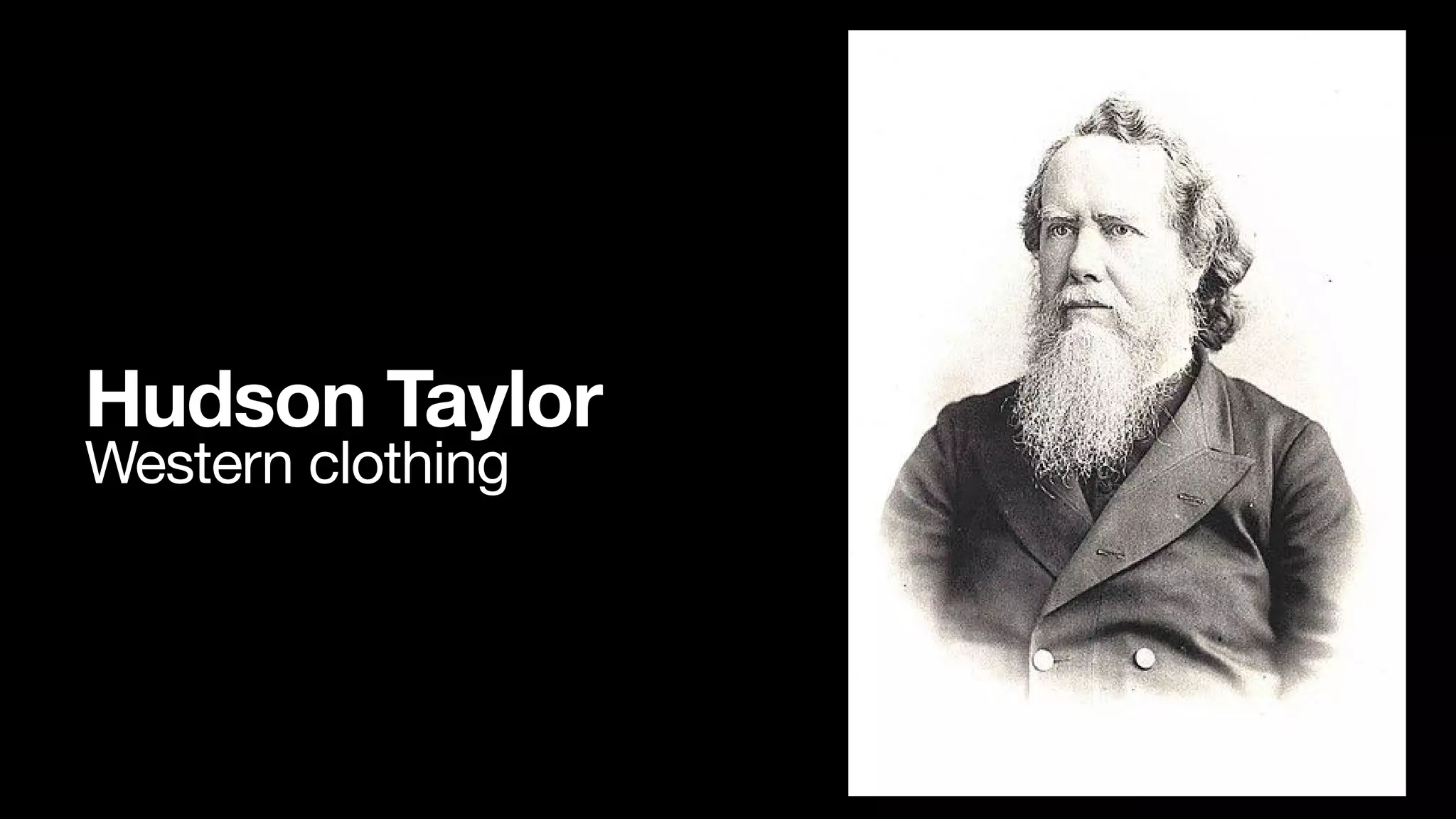
Hudson Taylor
Western clothing
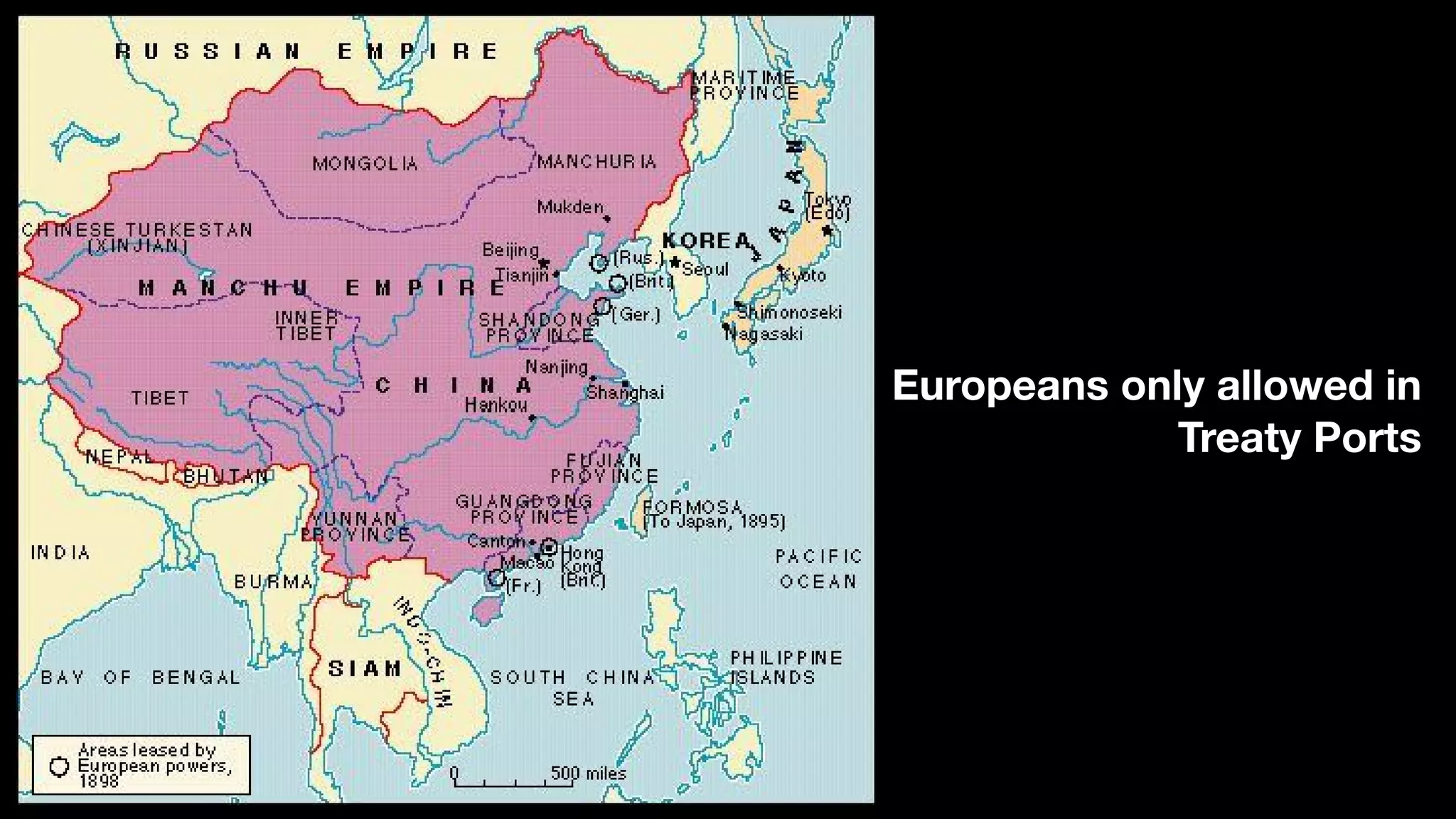
Europeans only allowed in
Treaty Ports
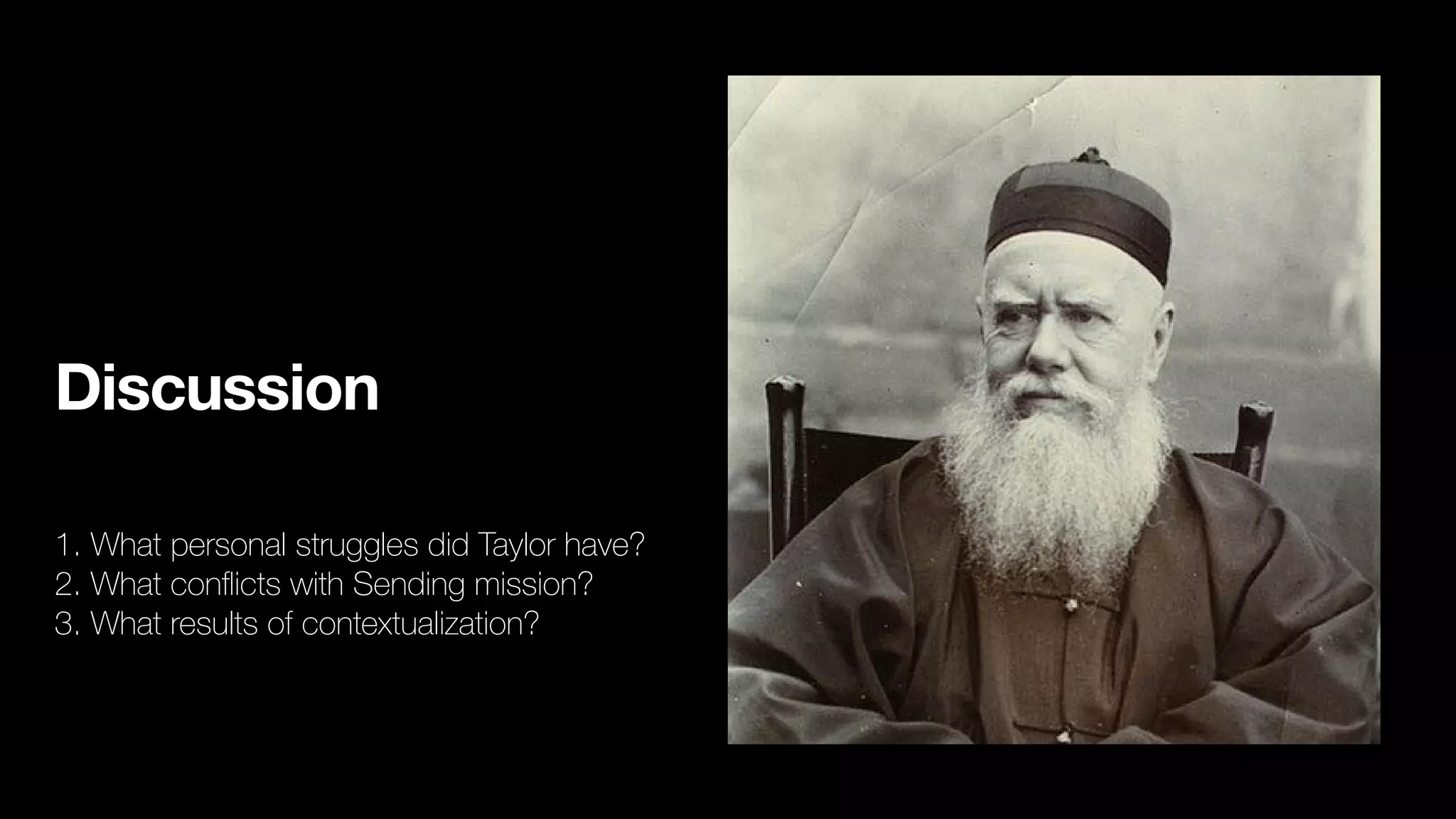
Discussion
1. What personal struggles did Taylor have?


2. What con
fl
icts with Sending mission?


3. What results of contextualization?
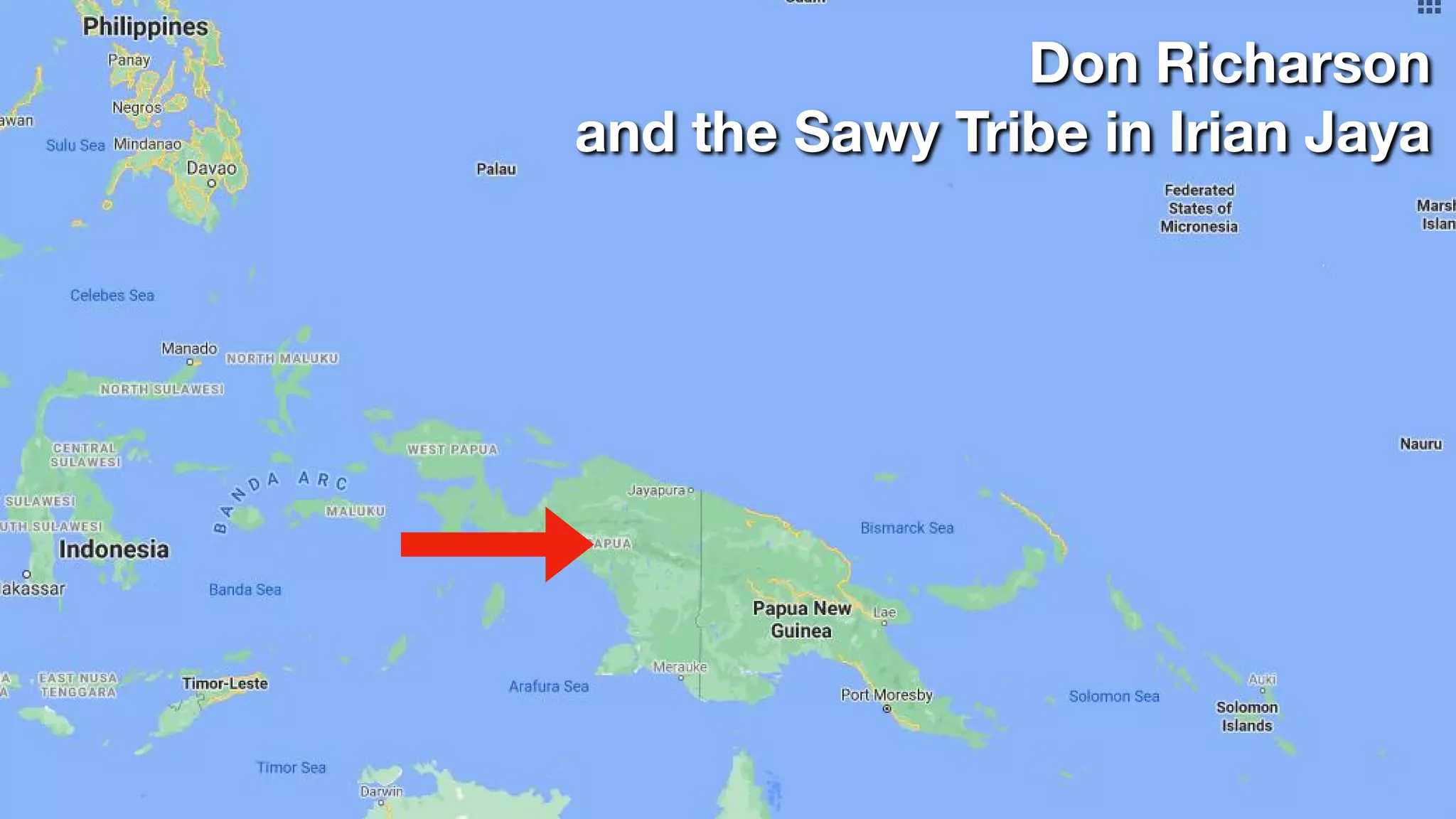
Don Richarson
and the Sawy Tribe in Irian Jaya
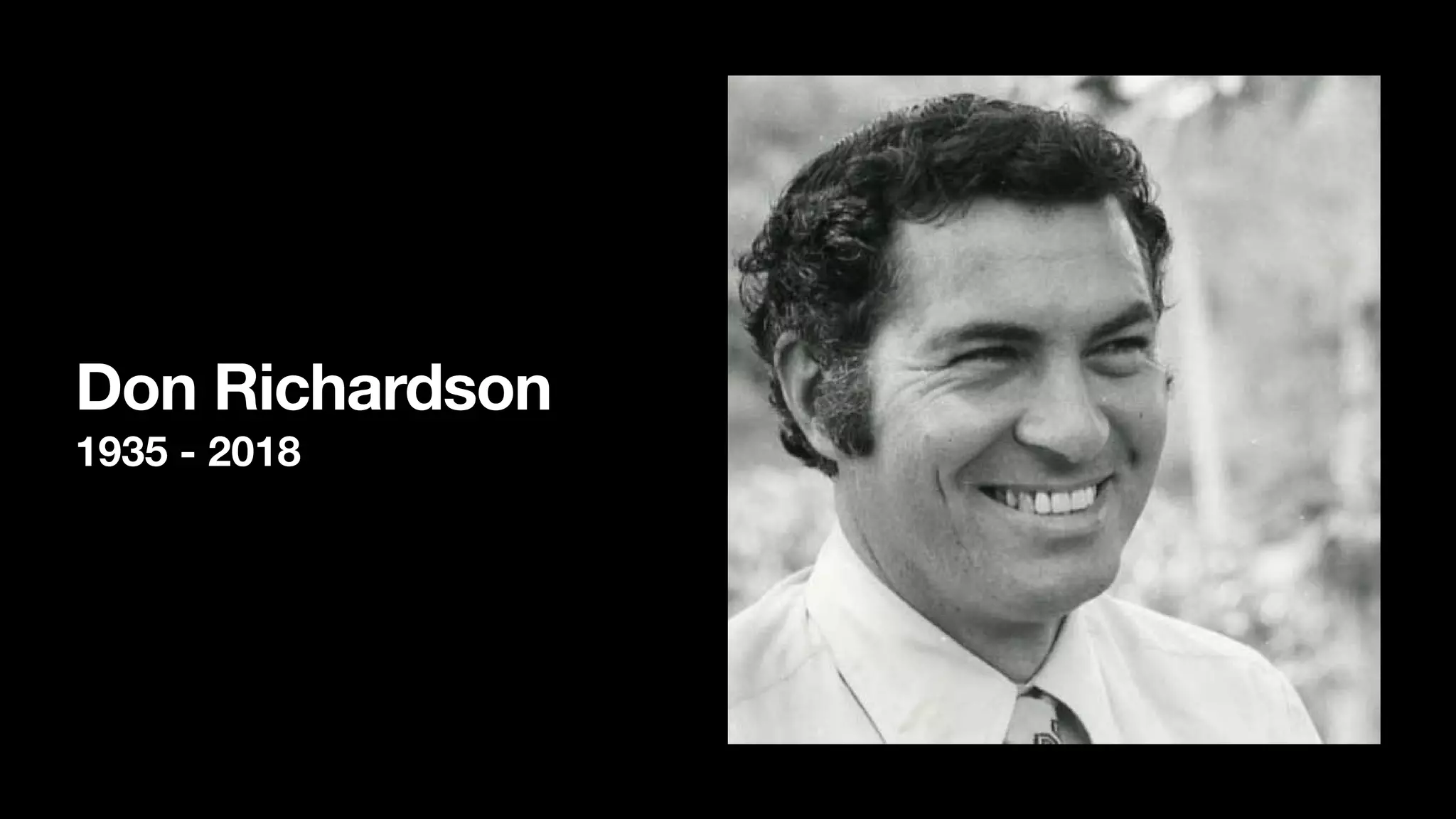
Don Richardson
1935 - 2018
Peace Child

INT-460 Topic 1 Day 2: Contextualizing the Gospel

  • 1.
    Topic 1 •Day 2 INT-460 Christianity & Culture
  • 2.
    What movie mosttransformed the way you think about something? What about it was it transformative?
  • 4.
    Discussion questions Mulan, 2020 •What were the two Chinese concepts in con fl ict? • Why does the fi lmmaker want to explain these concepts? • What is the fi lmmaker saying to a Western audience? • What can we a ffi rm about the fi lmmaker’s message? • What might we disagree with from a Biblical perspective?
  • 5.
  • 6.
  • 7.
    Original cultural contextof Gospels • Jesus’ name was Yeshua • Preached in Israel • Preached in Hebrew & Aramaic • Preached in the synagogues • Proclaimed himself as Messiah of Israel • Venues were Jewish festivals like Passover • Parables used Jewish images
  • 8.
  • 9.
    Now when theyhad passed through Amphipolis and Apollonia, they came to Thessalonica, where there was a synagogue of the Jews. And Paul went in, as was his custom, and on three Sabbath days he reasoned with them from the Scriptures, explaining and proving that it was necessary for the Christ to suffer and to rise from the dead, and saying, “This Yeshua, whom I proclaim to you, is the Messiah.” (Acts 17:1–3 ESV)
  • 10.
    Some of themwere persuaded and joined Paul and Silas, as did a great many of the devout Greeks and not a few of the leading women. But the Jews were jealous, and taking some wicked men of the rabble, they formed a mob, set the city in an uproar, and attacked the house of Jason, seeking to bring them out to the crowd. (Acts 17:4–5 ESV)
  • 11.
  • 12.
    What was specificto Jewish culture? Acts 17:1-5
  • 13.
    What was specificto Jewish culture? Acts 17:1-5 •Venue was a synagogue •Occasion was the Shabbat Derash (sermon) •Presented Jesus as the Messiah •Appealed to Old Testament to texts •Used to Hebrew critical reasoning
  • 14.
  • 15.
  • 16.
    While Paul waswaiting for them at Athens, his spirit was provoked within him as he saw that the city was full of idols. So he reasoned in the synagogue with the Jews and the devout persons, and in the marketplace every day with those who happened to be there. Some of the Epicurean and Stoic philosophers also conversed with him. And some said, “What does this babbler wish to say?” Others said, “He seems to be a preacher of foreign divinities”— because he was preaching Jesus and the resurrection. (Acts 17:16–18 ESV)
  • 17.
    They took himand brought him to the Areopagus, saying, “May we know what this new teaching is that you are presenting? For you bring some strange things to our ears. We wish to know therefore what these things mean.” Now all the Athenians and the foreigners who lived there would spend their time in nothing except telling or hearing something new. (Acts 17:19–21 ESV)
  • 18.
    Paul, standing inthe midst of the Areopagus, said: “Men of Athens, I perceive that in every way you are very religious. For as I passed along and observed the objects of your worship, I found also an altar with this inscription: ‘To the unknown god.’ What therefore you worship as unknown, this I proclaim to you. (Acts 17:22–23 ESV)
  • 19.
    The God whomade the world and everything in it, being Lord of heaven and earth, does not live in temples made by man, nor is he served by human hands, as though he needed anything, since he himself gives to all mankind life and breath and everything. And he made from one man every nation of mankind to live on all the face of the earth, having determined allotted periods and the boundaries of their dwelling place, that they should seek God, and perhaps feel their way toward him and find him. (Acts 17:24–27 ESV)
  • 20.
    Yet he isactually not far from each one of us, for “‘In him we live and move and have our being’; as even some of your own poets have said, “‘For we are indeed his offspring.’ Being then God’s offspring, we ought not to think that the divine being is like gold or silver or stone, an image formed by the art and imagination of man. (Acts 17:27–30 ESV)
  • 21.
    The times ofignorance God overlooked, but now he commands all people everywhere to repent, because he has fixed a day on which he will judge the world in righteousness by a man whom he has appointed; and of this he has given assurance to all by raising him from the dead.” (Acts 17:30–31 ESV)
  • 22.
    When they heardof the resurrection of the dead, some mocked. But others said, “We will hear you again about this.” So Paul went out from their midst. But some men joined him and believed, among whom also were Dionysius the Areopagite and a woman named Damaris and others with them. After this Paul left Athens and went to Corinth. (Acts 17:32–18:1 ESV)
  • 23.
    Discussion: List fiveways Paul engaged the Athenians in a culturally specific way.
  • 24.
    What was specificto Athenian culture? Acts 17:16-32 1. Paul found something to affirm 2. Paul found a cultural connection or bridge 3. Paul used a philosophical venue 4. Paul structured it as a philosophical treatise 5. Paul cited Greek literature 6. Paul engaged with contemporary issues (ex. Temple made by hands)
  • 25.
  • 26.
  • 27.
    What was specificto Athenian culture? Acts 17:16-32 7. Paul avoided Jewish cultural reference!
  • 28.
    Paul made himself astudent of culture
  • 29.
    To the JewsI became as a Jew, in order to win Jews…To those outside the law I became as one outside the law (not being outside the law of God but under the law of Messiah) that I might win those outside the law…I have become all things to all people, that by all means I might save some. I do it all for the sake of the gospel, that I may share with them in its blessings. (1 Cor 9:20–23 ESV)
  • 30.
    1. Paul affirmedhis audience Men of Athens, I perceive that in every way you are very religious. For as I passed along and observed the objects of your worship
  • 31.
    2. Paul identifieda bridge to the gospel As I passed along and observed the objects of your worship, I found also an altar with this inscription: ‘To the unknown god.’ What therefore you worship as unknown, this I proclaim to you.
  • 33.
    3. Paul beganwith agreed beliefs The God who made the world and everything in it, being Lord of heaven and earth, does not live in temples made by man, nor is he served by human hands, as though he needed anything, since he himself gives to all mankind life and breath and everything.
  • 34.
    4. Paul madeuse of audience’s literature Yet he is actually not far from each one of us, for “‘In him we live and move and have our being’; as even some of your own poets have said, “‘For we are indeed his offspring.’ (Acts 17:27–28 ESV)
  • 35.
  • 36.
    5. Paul explainedALL the gospel He has fi xed a day on which he will judge the world in righteousness by a man whom he has appointed; and of this he has given assurance to all by raising him from the dead. (Acts 17:31 ESV)
  • 37.
    6. Paul avoidedthings that alienate • Paul did NOT talk about the Jewishness of Jesus • Paul did NOT highlight his own Jewishness • Paul did NOT insult Greek religion
  • 38.
    6. Paul avoidedthings that alienate What are ways Christians offend & alienate seeker?
  • 39.
  • 40.
    OT Writer Hebrew Culture Old Testament HebrewInterpret Missionary Enculturate Preacher contextualizes message in Audience’s culture
  • 41.
  • 42.
    What’s involved incontextualizing gospel? 1. Hermeneutics: Interpreting from Biblical culture (What meant to them)
  • 43.
    What’s involved incontextualizing gospel? 1. Hermeneutics: Interpreting from Biblical culture (What meant to them) 2. Re fl ection: Re fl ect on God’s Word within our own cultural context. (What it means to me)
  • 44.
    What’s involved incontextualizing gospel? 1. Hermeneutics: Interpreting from Biblical culture (What meant to them) 2. Re fl ection: Re fl ect on God’s Word within our own cultural context. (What it means to me) 3. Contextualization: God’s word into the audience’s culture. (What should mean to them)
  • 45.
    What’s involved incontextualizing gospel? 1. Hermeneutics: Interpreting from Biblical culture (What meant to them) 2. Re fl ection: Re fl ect on God’s Word within our own cultural context. (What it means to me) 3. Contextualization: God’s word into the audience’s culture. (What should mean to them) 4. Feedback: Learning from the audience how message was understand
  • 46.
    What’s involved incontextualizing gospel? 1. Hermeneutics: Interpreting from Biblical culture (What meant to them) 2. Re fl ection: Re fl ect on God’s Word within our own cultural context. (What it means to me) 3. Contextualization: God’s word into the audience’s culture. (What should mean to them) 4. Feedback: Learning from the audience how message was understand 5. Re fl ection: Process how to contextualize the message
  • 47.
    What’s involved incontextualizing gospel? 1. Hermeneutics: Interpreting from Biblical culture (What meant to them) 2. Re fl ection: Re fl ect on God’s Word within our own cultural context. (What it means to me) 3. Contextualization: God’s word into the audience’s culture. (What should mean to them) 4. Feedback: Learning from the audience how message was understand 5. Re fl ection: Process how to contextualize the message 1A. Repeat:
  • 48.
    2. Re fl ection Audience’s Culture 1.Biblical Herm eneutics 3. Contextualization 4. Feedback
  • 49.
    Biblical Culture Audience’s Culture 5.Re fl ection, Re-interpretation REPEAT 4. Feedback
  • 50.
    1. Interpretation 2. Re fl ection 3.Contextualization 4. Feedback 5. Re fl ection 1a. Re-interpret 2a. Re fl ection 3a. Contextualization 4a. Feedback THE HERMENEUTICAL SPIRAL
  • 51.
  • 52.
    Hudson Taylor 1832 -1905 China Inland Mission
  • 53.
  • 54.
    Europeans only allowedin Treaty Ports
  • 55.
    Discussion 1. What personalstruggles did Taylor have? 2. What con fl icts with Sending mission? 3. What results of contextualization?
  • 56.
    Don Richarson and theSawy Tribe in Irian Jaya
  • 57.
  • 58.