Who is Jesus?
Introduction
Biblical Christology
Conciliar Christology
Contemporary
Christology
 The Question of
Relevance: Why Important?
Jesus is God’s response to
our deepest human
longings.
1. Christology “From Above”
An approach which begins with the
pre-existent Word who is in
heaven/from eternity, and who
descends into human history,
becoming incarnate in Jesus
Focal point: Incarnation
Starting point: Church’s dogma
2. Christology “From Below”
An approach which begins with the
human Jesus of Nazareth, and traces
his story from birth to mission,
culminating on his death and
resurrection
Focal point: Resurrection
Starting point: Jesus of history (esp. as
contained in biblical accounts
 over/exclusive emphasis on “From
Above” may result to a denial of Christ’s
humanity (e.g. docetism – physicality,
crucifixion, death were all illusion)
 over/exclusive emphasis on “From
Below” may result on a rejection of Jesus’
divinity (Arianism – Jesus as the highest
creature, subordinate to the Father)
Preference for the “From Below”
Approach: Why?
- Helps us appreciate the full humanity
of Jesus and hence his solidarity with
us
- Inspires discipleship in the context of
a world which identifies more with
stories rather than dogmas
 The Gospels As Principal Source for the Life and
Teaching of Jesus
 Other historical sources are scarce and
authenticity is suspect
 Mark: between 60 – 70 AD
 Matthew, Luke (Acts): 80 AD
 John (Revelation): 90 AD
 Synoptic Gospels – Gk syn + optic meaning “seen
together”; taken from same source(s)
 The Nature of the Gospels: Are they strictly
historical accounts?
 “testimonies of faith” = historical basis + faith
interpretation
 not histories or biography in the modern sense
 stages in the development of the Gospel
tradition: words and deeds of Jesus → the
preaching of the apostles → writing of the
gospels
“basileia tou theou”
 best translated as “reign of God”: dynamic, not
static; a situation/event, not a place
 “a situation wherein the will of God is perfectly
upheld”
 eschatological tension: both present and future
(“already but not yet”)
 It is present in the person and ministry of Jesus
but its definitive form is yet to come.
Problem: How to understand the meaning of the
parables (which are many and varied)?
John Dominic Crossan
 suggests a basic and helpful framework to
approach the study of the parables
 three-fold pattern in most, if not, all of the
parables: advent, reversal, and action
 two parables in Matthew as paradigmatic of
this pattern: hidden treasure, pearl of great
price (Mt 13:44-46)
 Advent - the Reign of God is coming as a gift;
something unprecedented, something beyond
expectations is coming or is found which is a
cause of great joy
 Reversal - the encounter with the Reign of God
turns the values of the world upside down;
change in outlook and priorities
 Action - the Reign of God is not a mere
information; calling for a
response/transformative action
o Mt 13:44-46
44 "The kingdom of heaven is like treasure
hidden in a field, which a man found and
covered up; then in his joy he goes and sells all
that he has and buys that field. 45 "Again, the
kingdom of heaven is like a merchant in search
of fine pearls, 46 who, on finding one pearl of
great value, went and sold all that he had and
bought it.
 In some parables, the element of
advent/discovery is the focus: e.g. lost sheep,
lost coin
 In other parables, the element of
reversal/change is the focus: e.g. rich man
and Lazarus (sin as omission), prodigal son
(mercy and forgiveness)
 Still in others, the emphasis is on the element
of action/new praxis: talents, unmerciful
servant
 sickness or infirmity was attributed to
demonic power and sin
 healings show that the power of evil over
human beings is broken
 The miracles may be understood as
symbolic anticipations and foretastes of
what the fulfillment of the Reign of God
will bring to the lives of people: holiness,
healing, liberation, reconciliation, a new
unity and integration of life or wholeness.
 importance of meals in the ministry of Jesus;
frequency
 Cf. Mt 11: 18-19
18 For John came neither eating nor drinking,
and they say, 'He has a demon'; 19 the Son of
Man came eating and drinking, and they say,
'Look, a glutton and a drunkard, a friend of
tax collectors and sinners!' Yet wisdom is
vindicated by her deeds.
 in the Middle Eastern culture even today, to
share a meal is a sign of communion
 in Judaism of Jesus’ day, it signified fellowship
with God
 a proclamation of forgiveness of sins in deeds;
in God’s reign everyone is welcome; we are all
brothers and sisters in the family of God
 cf. Ben Meyer, The Aims of Jesus (London: SCM Press,
1979), 159-161
Jesus’ openness to sinners did not mean that he
submitted passively to or tolerated sin. He
reversed the normal pattern – conversion then
communion. His offer of communion with
sinners triggered repentance – “conversion
flowered from communion”.
The Death of Jesus
 The meaning of the cross
Today, no longer seen as a scandal, as
instrument of torture and humiliation
More an article of jewelry, a fashion
accessory, mark of episcopal authority, an
ornament
Sometimes misunderstood as promoting
passive acceptance of suffering and
injustice
The Death of Jesus
1. Cross as salvific - (scholastics) by the
cross Jesus has redeemed the world
2. Cross as sign of misinterpretation –
(Bultmann) Jesus’ religious message was
misinterpreted as a threat to Roman rule;
Jesus’ purposes were misunderstood
3. Cross as not salvific or redemptive –
(Schillebeeckx) a rejection of Jesus; not
willed but permitted by God; death as
negativity that God overcomes by the
resurrection
The Death of Jesus
 International Theological Commission 1979:
“A death undergone in a purely passive
manner could not be a ‘Christological’
saving event. It must be… the willed
consequence of the obedience and love of
Jesus…”
 What is salvific is the entire Christ-event,
the perfect life of obedience of Jesus which
culminated in the cross and vindicated in
the resurrection.
The Resurrection of Jesus
 Importance and centrality
1. CCC 638: the crowing truth of our faith,
regarded as central truth by first Christian
communities
2. 1 Cor 15:14-17: without the resurrection,
in vain is our preaching and faith
3. Source of hope for us; our own promise of
eternal life
 Origin/Basis: empty tomb tradition +
resurrection appearances
 Transition in Language: From Stories to
Concepts (hypostasis, substantia,
homoousios, phusis, prosopon, persona)
 Challenge when church expanded: how to
express the faith in a manner understandable
to a new audience
 From biblical to philosophical language:
difficult but necessary
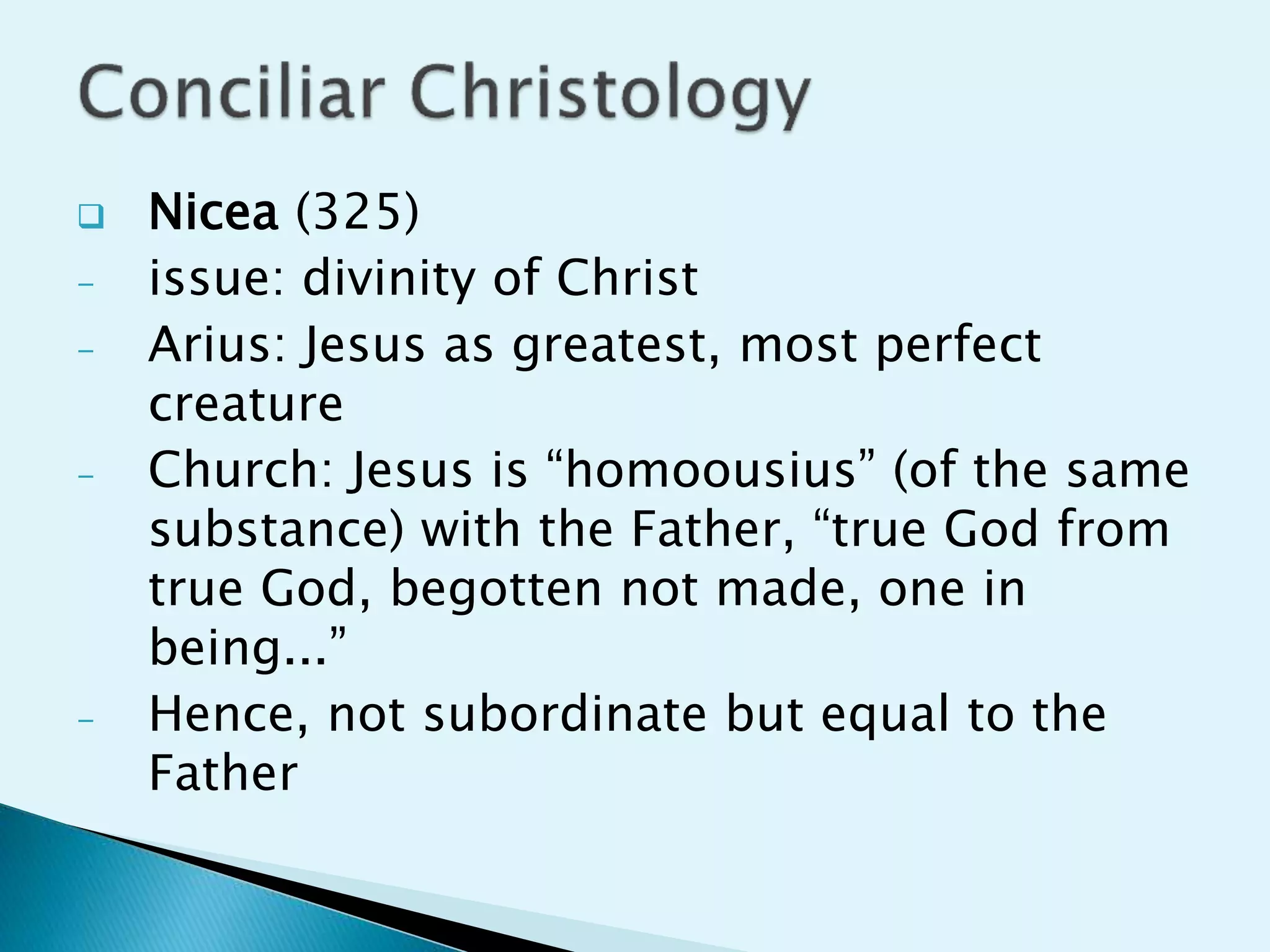
 Nicea (325)
- issue: divinity of Christ
- Arius: Jesus as greatest, most perfect
creature
- Church: Jesus is “homoousius” (of the same
substance) with the Father, “true God from
true God, begotten not made, one in
being...”
- Hence, not subordinate but equal to the
Father
 Constantinople (381)
- issue: full humanity of Christ
- Appolinarius of Laodicea: Logos took the
place of the rational soul in Christ hence
Christ is not fully human because he does
not have a rational soul
- Church: Jesus had a human soul
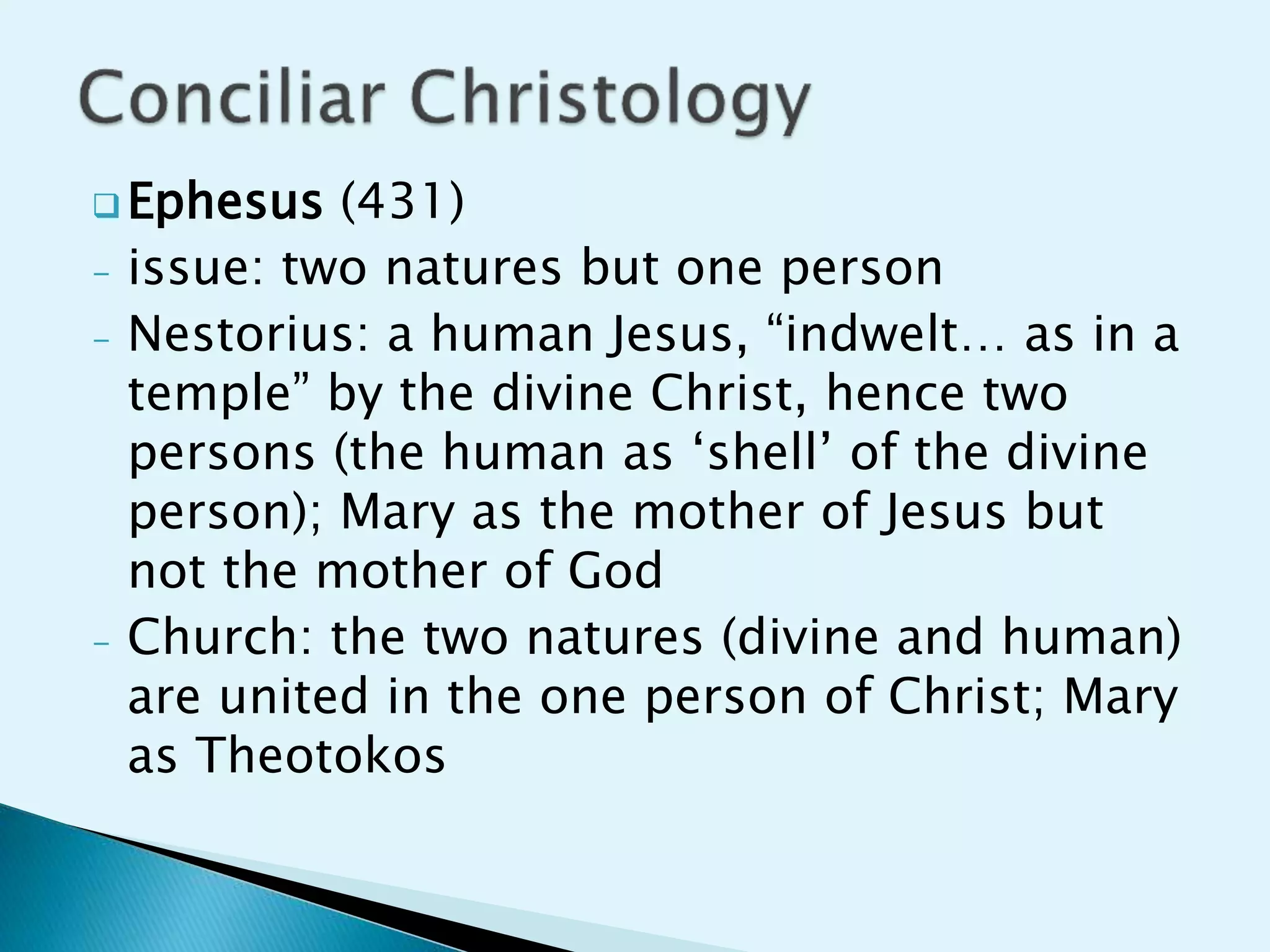
 Ephesus (431)
- issue: two natures but one person
- Nestorius: a human Jesus, “indwelt… as in a
temple” by the divine Christ, hence two
persons (the human as ‘shell’ of the divine
person); Mary as the mother of Jesus but
not the mother of God
- Church: the two natures (divine and human)
are united in the one person of Christ; Mary
as Theotokos
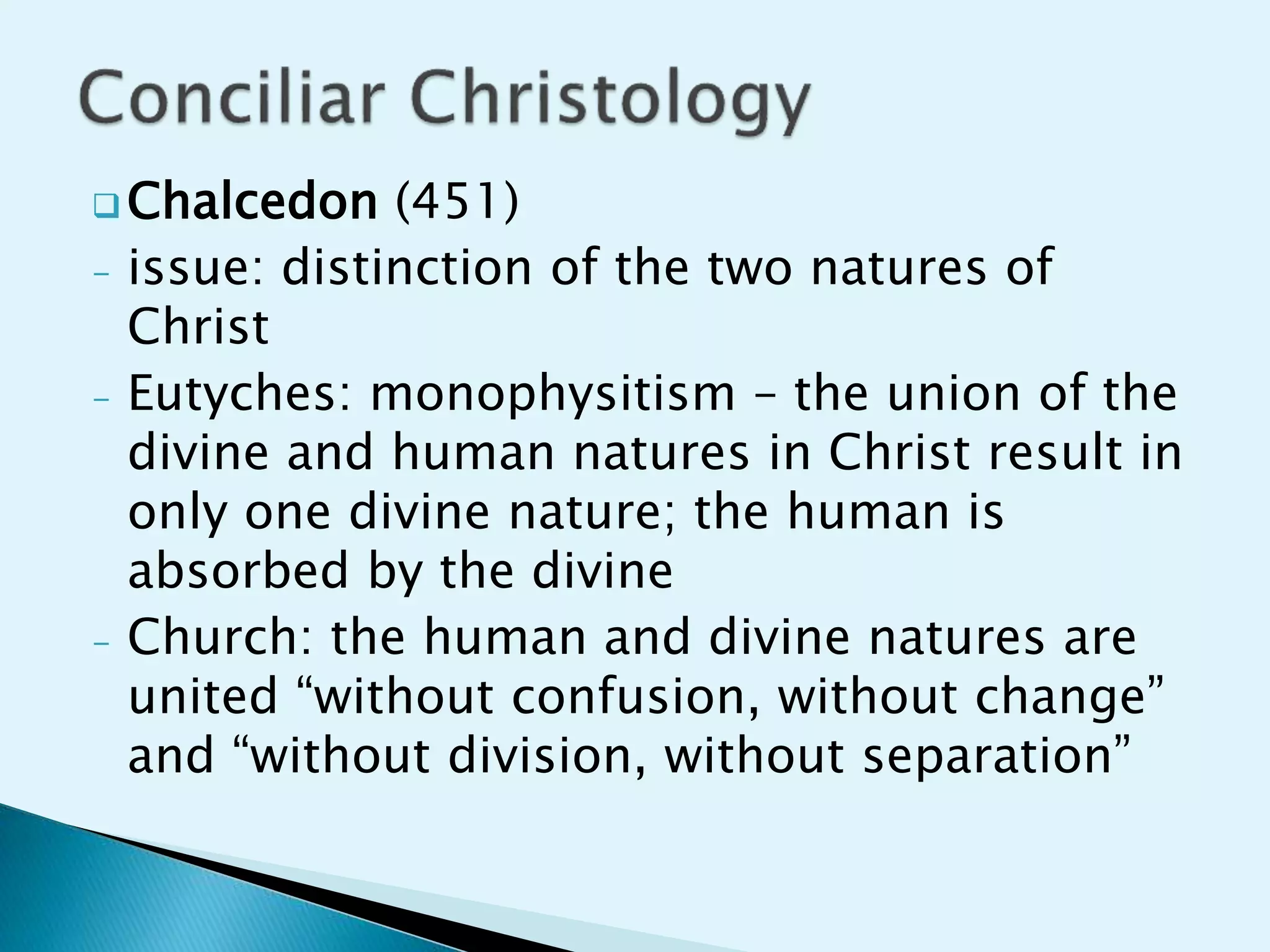
 Chalcedon (451)
- issue: distinction of the two natures of
Christ
- Eutyches: monophysitism – the union of the
divine and human natures in Christ result in
only one divine nature; the human is
absorbed by the divine
- Church: the human and divine natures are
united “without confusion, without change”
and “without division, without separation”
Some Christological issues today:
 Humanity and Knowledge: What sort of
knowledge did Jesus possess?
 Humanity and Sinlessness: Without
concupiscence, what was it like for Jesus to
be tempted?
 Ecological Crisis: What does our faith in the
incarnation and resurrection say about
environmental issues?
 World Religions: Is Jesus the savior of non-
Christians as well?

Christology

  • 1.
  • 2.
  • 3.
     The Questionof Relevance: Why Important? Jesus is God’s response to our deepest human longings.
  • 4.
    1. Christology “FromAbove” An approach which begins with the pre-existent Word who is in heaven/from eternity, and who descends into human history, becoming incarnate in Jesus Focal point: Incarnation Starting point: Church’s dogma
  • 5.
    2. Christology “FromBelow” An approach which begins with the human Jesus of Nazareth, and traces his story from birth to mission, culminating on his death and resurrection Focal point: Resurrection Starting point: Jesus of history (esp. as contained in biblical accounts
  • 6.
     over/exclusive emphasison “From Above” may result to a denial of Christ’s humanity (e.g. docetism – physicality, crucifixion, death were all illusion)  over/exclusive emphasis on “From Below” may result on a rejection of Jesus’ divinity (Arianism – Jesus as the highest creature, subordinate to the Father)
  • 7.
    Preference for the“From Below” Approach: Why? - Helps us appreciate the full humanity of Jesus and hence his solidarity with us - Inspires discipleship in the context of a world which identifies more with stories rather than dogmas
  • 8.
     The GospelsAs Principal Source for the Life and Teaching of Jesus  Other historical sources are scarce and authenticity is suspect  Mark: between 60 – 70 AD  Matthew, Luke (Acts): 80 AD  John (Revelation): 90 AD  Synoptic Gospels – Gk syn + optic meaning “seen together”; taken from same source(s)
  • 9.
     The Natureof the Gospels: Are they strictly historical accounts?  “testimonies of faith” = historical basis + faith interpretation  not histories or biography in the modern sense  stages in the development of the Gospel tradition: words and deeds of Jesus → the preaching of the apostles → writing of the gospels
  • 10.
    “basileia tou theou” best translated as “reign of God”: dynamic, not static; a situation/event, not a place  “a situation wherein the will of God is perfectly upheld”  eschatological tension: both present and future (“already but not yet”)  It is present in the person and ministry of Jesus but its definitive form is yet to come.
  • 11.
    Problem: How tounderstand the meaning of the parables (which are many and varied)? John Dominic Crossan  suggests a basic and helpful framework to approach the study of the parables  three-fold pattern in most, if not, all of the parables: advent, reversal, and action  two parables in Matthew as paradigmatic of this pattern: hidden treasure, pearl of great price (Mt 13:44-46)
  • 12.
     Advent -the Reign of God is coming as a gift; something unprecedented, something beyond expectations is coming or is found which is a cause of great joy  Reversal - the encounter with the Reign of God turns the values of the world upside down; change in outlook and priorities  Action - the Reign of God is not a mere information; calling for a response/transformative action
  • 13.
    o Mt 13:44-46 44"The kingdom of heaven is like treasure hidden in a field, which a man found and covered up; then in his joy he goes and sells all that he has and buys that field. 45 "Again, the kingdom of heaven is like a merchant in search of fine pearls, 46 who, on finding one pearl of great value, went and sold all that he had and bought it.
  • 14.
     In someparables, the element of advent/discovery is the focus: e.g. lost sheep, lost coin  In other parables, the element of reversal/change is the focus: e.g. rich man and Lazarus (sin as omission), prodigal son (mercy and forgiveness)  Still in others, the emphasis is on the element of action/new praxis: talents, unmerciful servant
  • 15.
     sickness orinfirmity was attributed to demonic power and sin  healings show that the power of evil over human beings is broken  The miracles may be understood as symbolic anticipations and foretastes of what the fulfillment of the Reign of God will bring to the lives of people: holiness, healing, liberation, reconciliation, a new unity and integration of life or wholeness.
  • 16.
     importance ofmeals in the ministry of Jesus; frequency  Cf. Mt 11: 18-19 18 For John came neither eating nor drinking, and they say, 'He has a demon'; 19 the Son of Man came eating and drinking, and they say, 'Look, a glutton and a drunkard, a friend of tax collectors and sinners!' Yet wisdom is vindicated by her deeds.
  • 17.
     in theMiddle Eastern culture even today, to share a meal is a sign of communion  in Judaism of Jesus’ day, it signified fellowship with God  a proclamation of forgiveness of sins in deeds; in God’s reign everyone is welcome; we are all brothers and sisters in the family of God
  • 18.
     cf. BenMeyer, The Aims of Jesus (London: SCM Press, 1979), 159-161 Jesus’ openness to sinners did not mean that he submitted passively to or tolerated sin. He reversed the normal pattern – conversion then communion. His offer of communion with sinners triggered repentance – “conversion flowered from communion”.
  • 19.
    The Death ofJesus  The meaning of the cross Today, no longer seen as a scandal, as instrument of torture and humiliation More an article of jewelry, a fashion accessory, mark of episcopal authority, an ornament Sometimes misunderstood as promoting passive acceptance of suffering and injustice
  • 20.
    The Death ofJesus 1. Cross as salvific - (scholastics) by the cross Jesus has redeemed the world 2. Cross as sign of misinterpretation – (Bultmann) Jesus’ religious message was misinterpreted as a threat to Roman rule; Jesus’ purposes were misunderstood 3. Cross as not salvific or redemptive – (Schillebeeckx) a rejection of Jesus; not willed but permitted by God; death as negativity that God overcomes by the resurrection
  • 21.
    The Death ofJesus  International Theological Commission 1979: “A death undergone in a purely passive manner could not be a ‘Christological’ saving event. It must be… the willed consequence of the obedience and love of Jesus…”  What is salvific is the entire Christ-event, the perfect life of obedience of Jesus which culminated in the cross and vindicated in the resurrection.
  • 22.
    The Resurrection ofJesus  Importance and centrality 1. CCC 638: the crowing truth of our faith, regarded as central truth by first Christian communities 2. 1 Cor 15:14-17: without the resurrection, in vain is our preaching and faith 3. Source of hope for us; our own promise of eternal life  Origin/Basis: empty tomb tradition + resurrection appearances
  • 23.
     Transition inLanguage: From Stories to Concepts (hypostasis, substantia, homoousios, phusis, prosopon, persona)  Challenge when church expanded: how to express the faith in a manner understandable to a new audience  From biblical to philosophical language: difficult but necessary
  • 24.
     Nicea (325) -issue: divinity of Christ - Arius: Jesus as greatest, most perfect creature - Church: Jesus is “homoousius” (of the same substance) with the Father, “true God from true God, begotten not made, one in being...” - Hence, not subordinate but equal to the Father
  • 25.
     Constantinople (381) -issue: full humanity of Christ - Appolinarius of Laodicea: Logos took the place of the rational soul in Christ hence Christ is not fully human because he does not have a rational soul - Church: Jesus had a human soul
  • 26.
     Ephesus (431) -issue: two natures but one person - Nestorius: a human Jesus, “indwelt… as in a temple” by the divine Christ, hence two persons (the human as ‘shell’ of the divine person); Mary as the mother of Jesus but not the mother of God - Church: the two natures (divine and human) are united in the one person of Christ; Mary as Theotokos
  • 27.
     Chalcedon (451) -issue: distinction of the two natures of Christ - Eutyches: monophysitism – the union of the divine and human natures in Christ result in only one divine nature; the human is absorbed by the divine - Church: the human and divine natures are united “without confusion, without change” and “without division, without separation”
  • 28.
    Some Christological issuestoday:  Humanity and Knowledge: What sort of knowledge did Jesus possess?  Humanity and Sinlessness: Without concupiscence, what was it like for Jesus to be tempted?  Ecological Crisis: What does our faith in the incarnation and resurrection say about environmental issues?  World Religions: Is Jesus the savior of non- Christians as well?