Insulin & its
Analogues
in DM
By
Mohammed Muneebullah
PharmD VIth Year
16111T0014
Shadan College of Pharmacy
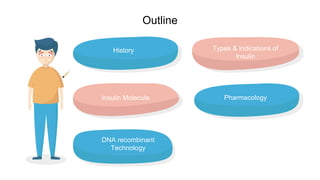
Outline
History
Insulin Molecule
DNA recombinant
Technology
Types & Indications of
Insulin
Pharmacology
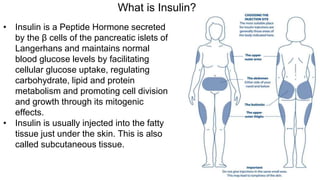
What is Insulin?
• Insulin is a Peptide Hormone secreted
by the β cells of the pancreatic islets of
Langerhans and maintains normal
blood glucose levels by facilitating
cellular glucose uptake, regulating
carbohydrate, lipid and protein
metabolism and promoting cell division
and growth through its mitogenic
effects.
• Insulin is usually injected into the fatty
tissue just under the skin. This is also
called subcutaneous tissue.
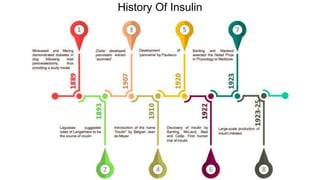
History Of Insulin
• Eli Lilly began producing insulin from animal pancreas but fell short of the demand, and the
potency varied up to 25% per lot . The development of an Isoelectric precipitation method led
to a purer and more potent animal insulin, decreasing the variation between lots to 10%.
• Because the insulin preparation required several injections daily, investigators worked to find
ways to prolong its duration of action. In the 1930s, H.C. Hagedorn, a chemist in Denmark,
prolonged the action of insulin by adding Protamine.
• In Toronto, Scott and Fisher prolonged insulin action further by adding zinc. These discoveries
led to the introduction of longer-acting animal insulins in the market.
• Protamine zinc insulin lasted 24–36 hours.
• Isophane neutral protamine Hagedorn lasted 24 hours and could be mixed with regular insulin.
The pharmacokinetics and effects of such insulin depended on the proportion of zinc.
• Insulin from cattle and pigs was used for many years to treat diabetes and saved millions of
lives, but it wasn’t perfect, as it caused allergic reactions in many patients.
• In 1978, the first recombinant DNA human insulin was prepared by David Goeddel and his
colleagues (of Genentech) by utilizing and combining the insulin A- and B- chains expressed
in Escherichia coli. Thereafter, Genentech and Lilly signed an agreement to commercialize
rDNA insulin. In 1982, the first insulin utilizing rDNA technology, Humulin R (rapid) and N (NPH,
intermediate-acting), were marketed.
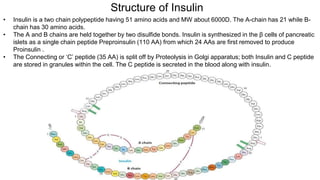
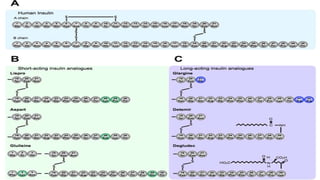
• Insulin is a two chain polypeptide having 51 amino acids and MW about 6000D. The A-chain has 21 while B-
chain has 30 amino acids.
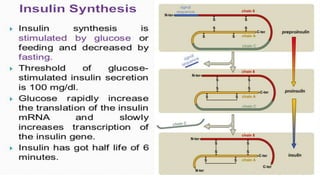
• The A and B chains are held together by two disulfide bonds. Insulin is synthesized in the β cells of pancreatic
islets as a single chain peptide Preproinsulin (110 AA) from which 24 AAs are first removed to produce
Proinsulin .
• The Connecting or ‘C’ peptide (35 AA) is split off by Proteolysis in Golgi apparatus; both Insulin and C peptide
are stored in granules within the cell. The C peptide is secreted in the blood along with insulin.
Structure of Insulin
Categorization of Insulin
Insulins are categorized by differences in:
• Onset (how quickly they act)
• Peak (how long it takes to achieve maximum impact)
• Duration (how long they last before they wear off)
• Concentration (Insulins sold in the U.S. have a concentration of 100
units per ml or U100. In other countries, additional concentrations are
available).
• Route of delivery (whether they are injected under the skin or given
intravenously)
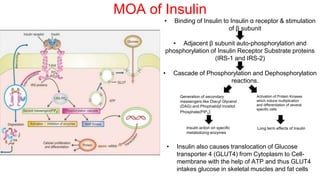
MOA of Insulin
• Binding of Insulin to Insulin α receptor & stimulation
of β subunit
• Adjacent β subunit auto-phosphorylation and
phosphorylation of Insulin Receptor Substrate proteins
(IRS-1 and IRS-2)
• Cascade of Phosphorylation and Dephosphorylation
reactions.
Activation of Protein Kinases
which induce multiplication
and differentiation of several
specific cells
Generation of secondary
messengers like Diacyl Glycerol
(DAG) and Phophatidyl Inositol
Phosphate(PIP3)
Insulin action on specific
metabolizing enzymes
Long term effects of Insulin
• Insulin also causes translocation of Glucose
transporter 4 (GLUT4) from Cytoplasm to Cell-
membrane with the help of ATP and thus GLUT4
intakes glucose in skeletal muscles and fat cells
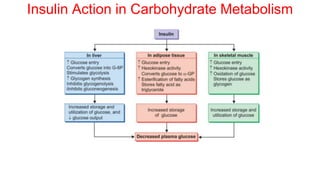
Insulin Action in Carbohydrate Metabolism
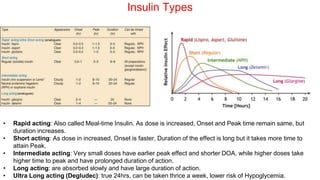
Insulin Types
/Ultra Short acting (analogues)
(analogues)
• Rapid acting: Also called Meal-time Insulin. As dose is increased, Onset and Peak time remain same, but
duration increases.
• Short acting: As dose in increased, Onset is faster, Duration of the effect is long but it takes more time to
attain Peak.
• Intermediate acting: Very small doses have earlier peak effect and shorter DOA, while higher doses take
higher time to peak and have prolonged duration of action.
• Long acting: are absorbed slowly and have large duration of action.
• Ultra Long acting (Degludec): true 24hrs, can be taken thrice a week, lower risk of Hypoglycemia.
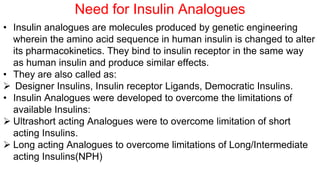
• Insulin analogues are molecules produced by genetic engineering
wherein the amino acid sequence in human insulin is changed to alter
its pharmacokinetics. They bind to insulin receptor in the same way
as human insulin and produce similar effects.
• They are also called as:
 Designer Insulins, Insulin receptor Ligands, Democratic Insulins.
• Insulin Analogues were developed to overcome the limitations of
available Insulins:
 Ultrashort acting Analogues were to overcome limitation of short
acting Insulins.
 Long acting Analogues to overcome limitations of Long/Intermediate
acting Insulins(NPH)
Need for Insulin Analogues
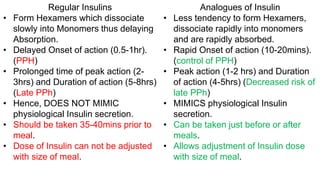
Regular Insulins
• Form Hexamers which dissociate
slowly into Monomers thus delaying
Absorption.
• Delayed Onset of action (0.5-1hr).
(PPH)
• Prolonged time of peak action (2-
3hrs) and Duration of action (5-8hrs)
(Late PPh)
• Hence, DOES NOT MIMIC
physiological Insulin secretion.
• Should be taken 35-40mins prior to
meal.
• Dose of Insulin can not be adjusted
with size of meal.
Analogues of Insulin
• Less tendency to form Hexamers,
dissociate rapidly into monomers
and are rapidly absorbed.
• Rapid Onset of action (10-20mins).
(control of PPH)
• Peak action (1-2 hrs) and Duration
of action (4-5hrs) (Decreased risk of
late PPh)
• MIMICS physiological Insulin
secretion.
• Can be taken just before or after
meals.
• Allows adjustment of Insulin dose
with size of meal.
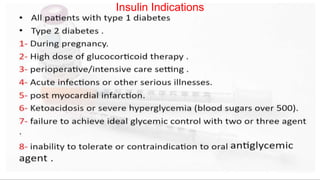
Insulin Indications
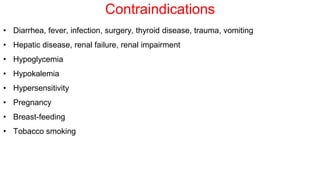
Contraindications
• Diarrhea, fever, infection, surgery, thyroid disease, trauma, vomiting
• Hepatic disease, renal failure, renal impairment
• Hypoglycemia
• Hypokalemia
• Hypersensitivity
• Pregnancy
• Breast-feeding
• Tobacco smoking
Insulin and its Analogues.pptx

Insulin and its Analogues.pptx

  • 1.
    Insulin & its Analogues inDM By Mohammed Muneebullah PharmD VIth Year 16111T0014 Shadan College of Pharmacy
  • 2.
  • 3.
    What is Insulin? •Insulin is a Peptide Hormone secreted by the β cells of the pancreatic islets of Langerhans and maintains normal blood glucose levels by facilitating cellular glucose uptake, regulating carbohydrate, lipid and protein metabolism and promoting cell division and growth through its mitogenic effects. • Insulin is usually injected into the fatty tissue just under the skin. This is also called subcutaneous tissue.
  • 4.
  • 5.
    • Eli Lillybegan producing insulin from animal pancreas but fell short of the demand, and the potency varied up to 25% per lot . The development of an Isoelectric precipitation method led to a purer and more potent animal insulin, decreasing the variation between lots to 10%. • Because the insulin preparation required several injections daily, investigators worked to find ways to prolong its duration of action. In the 1930s, H.C. Hagedorn, a chemist in Denmark, prolonged the action of insulin by adding Protamine. • In Toronto, Scott and Fisher prolonged insulin action further by adding zinc. These discoveries led to the introduction of longer-acting animal insulins in the market. • Protamine zinc insulin lasted 24–36 hours. • Isophane neutral protamine Hagedorn lasted 24 hours and could be mixed with regular insulin. The pharmacokinetics and effects of such insulin depended on the proportion of zinc. • Insulin from cattle and pigs was used for many years to treat diabetes and saved millions of lives, but it wasn’t perfect, as it caused allergic reactions in many patients. • In 1978, the first recombinant DNA human insulin was prepared by David Goeddel and his colleagues (of Genentech) by utilizing and combining the insulin A- and B- chains expressed in Escherichia coli. Thereafter, Genentech and Lilly signed an agreement to commercialize rDNA insulin. In 1982, the first insulin utilizing rDNA technology, Humulin R (rapid) and N (NPH, intermediate-acting), were marketed.
  • 6.
    • Insulin isa two chain polypeptide having 51 amino acids and MW about 6000D. The A-chain has 21 while B- chain has 30 amino acids. • The A and B chains are held together by two disulfide bonds. Insulin is synthesized in the β cells of pancreatic islets as a single chain peptide Preproinsulin (110 AA) from which 24 AAs are first removed to produce Proinsulin . • The Connecting or ‘C’ peptide (35 AA) is split off by Proteolysis in Golgi apparatus; both Insulin and C peptide are stored in granules within the cell. The C peptide is secreted in the blood along with insulin. Structure of Insulin
  • 8.
    Categorization of Insulin Insulinsare categorized by differences in: • Onset (how quickly they act) • Peak (how long it takes to achieve maximum impact) • Duration (how long they last before they wear off) • Concentration (Insulins sold in the U.S. have a concentration of 100 units per ml or U100. In other countries, additional concentrations are available). • Route of delivery (whether they are injected under the skin or given intravenously)
  • 9.
    MOA of Insulin •Binding of Insulin to Insulin α receptor & stimulation of β subunit • Adjacent β subunit auto-phosphorylation and phosphorylation of Insulin Receptor Substrate proteins (IRS-1 and IRS-2) • Cascade of Phosphorylation and Dephosphorylation reactions. Activation of Protein Kinases which induce multiplication and differentiation of several specific cells Generation of secondary messengers like Diacyl Glycerol (DAG) and Phophatidyl Inositol Phosphate(PIP3) Insulin action on specific metabolizing enzymes Long term effects of Insulin • Insulin also causes translocation of Glucose transporter 4 (GLUT4) from Cytoplasm to Cell- membrane with the help of ATP and thus GLUT4 intakes glucose in skeletal muscles and fat cells
  • 10.
    Insulin Action inCarbohydrate Metabolism
  • 11.
    Insulin Types /Ultra Shortacting (analogues) (analogues) • Rapid acting: Also called Meal-time Insulin. As dose is increased, Onset and Peak time remain same, but duration increases. • Short acting: As dose in increased, Onset is faster, Duration of the effect is long but it takes more time to attain Peak. • Intermediate acting: Very small doses have earlier peak effect and shorter DOA, while higher doses take higher time to peak and have prolonged duration of action. • Long acting: are absorbed slowly and have large duration of action. • Ultra Long acting (Degludec): true 24hrs, can be taken thrice a week, lower risk of Hypoglycemia.
  • 13.
    • Insulin analoguesare molecules produced by genetic engineering wherein the amino acid sequence in human insulin is changed to alter its pharmacokinetics. They bind to insulin receptor in the same way as human insulin and produce similar effects. • They are also called as:  Designer Insulins, Insulin receptor Ligands, Democratic Insulins. • Insulin Analogues were developed to overcome the limitations of available Insulins:  Ultrashort acting Analogues were to overcome limitation of short acting Insulins.  Long acting Analogues to overcome limitations of Long/Intermediate acting Insulins(NPH) Need for Insulin Analogues
  • 14.
    Regular Insulins • FormHexamers which dissociate slowly into Monomers thus delaying Absorption. • Delayed Onset of action (0.5-1hr). (PPH) • Prolonged time of peak action (2- 3hrs) and Duration of action (5-8hrs) (Late PPh) • Hence, DOES NOT MIMIC physiological Insulin secretion. • Should be taken 35-40mins prior to meal. • Dose of Insulin can not be adjusted with size of meal. Analogues of Insulin • Less tendency to form Hexamers, dissociate rapidly into monomers and are rapidly absorbed. • Rapid Onset of action (10-20mins). (control of PPH) • Peak action (1-2 hrs) and Duration of action (4-5hrs) (Decreased risk of late PPh) • MIMICS physiological Insulin secretion. • Can be taken just before or after meals. • Allows adjustment of Insulin dose with size of meal.
  • 15.
  • 16.
    Contraindications • Diarrhea, fever,infection, surgery, thyroid disease, trauma, vomiting • Hepatic disease, renal failure, renal impairment • Hypoglycemia • Hypokalemia • Hypersensitivity • Pregnancy • Breast-feeding • Tobacco smoking