UNIVERSITY INSTITUTE OF SCIENCES
DIVISION-CHEMISTRY
Masters Of Sciences (Chemistry)
INSTRUMENTATION AND SAMPLE
HANDLING
22SHT-603
SUBMITTED TO:
SUBMITTED BY:
Topic :–
Instrumentation
and Sample
handling
What is Instrumentation?
Instrument is the general term that researchers use
for a measurement
(survey, test, questionnaire, etc.).
To help distinguish between instrument and
instrumentation,
consider that the instrument is the device and
instrumentation is the course of action
(the process of developing, testing, and using the
device).
Characteristics of a Good
Research Instrument
Valid and reliable
 Based on the researcher's understanding of
how the particular variables in the study
connect with each other
Must gather data suitable for and relevant
to the research topic
 Able to test hypothesis and answer
proposed research questions under
investigation
Contains clear and definite instructions to
use the instrument
What is Sample
Handling?
The term describes the ways in which the sample is
transported and handled, both on the way to the laboratory as
well as during the processing stages.
For example,
Some metallic samples can be stored for several months, while
microbial samples such as COVID-19 swabs are only reliable for
a maximum of 72 hours.
Why are
samples used
in research?
 Samples are used to
make inferences
about populations.
 Samples are easier to
collect data because
they are practical, cost-
effective, convenient,
and manageable.
 A sample may be more
accurate.
 A carefully obtained
sample can provide
reliable information.
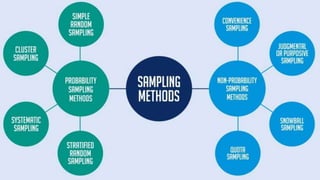
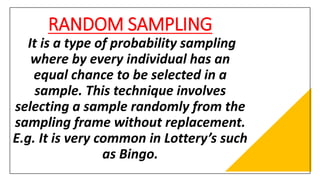
RANDOM SAMPLING
It is a type of probability sampling
where by every individual has an
equal chance to be selected in a
sample. This technique involves
selecting a sample randomly from the
sampling frame without replacement.
E.g. It is very common in Lottery’s such
as Bingo.
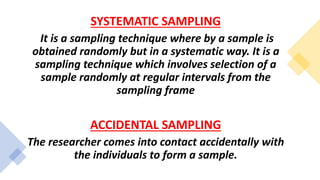
SYSTEMATIC SAMPLING
It is a sampling technique where by a sample is
obtained randomly but in a systematic way. It is a
sampling technique which involves selection of a
sample randomly at regular intervals from the
sampling frame
ACCIDENTAL SAMPLING
The researcher comes into contact accidentally with
the individuals to form a sample.
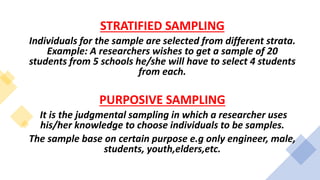
STRATIFIED SAMPLING
Individuals for the sample are selected from different strata.
Example: A researchers wishes to get a sample of 20
students from 5 schools he/she will have to select 4 students
from each.
PURPOSIVE SAMPLING
It is the judgmental sampling in which a researcher uses
his/her knowledge to choose individuals to be samples.
The sample base on certain purpose e.g only engineer, male,
students, youth,elders,etc.
SNOW BALL SAMPLING
The researcher begins with the few individuals
available, then those individual recommend
others.
Snowball sampling, also known as chain-referral
sampling, is a non-random sampling method used
when test quantities are hard to find.
In snowball sampling, people involved in your
study nominate other potential sources you can
use in your research.
The sampling error is caused by observing a sample
instead of the whole population.
The sampling error is the difference between a
sample statistic used to estimate a population
parameter and the actual but unknown value of the
parameter.
THANK
YOU!
This Photo by Unknown author is licensed under CC BY-NC.

Instrumentation & Sample Handling.pptx

  • 1.
    UNIVERSITY INSTITUTE OFSCIENCES DIVISION-CHEMISTRY Masters Of Sciences (Chemistry) INSTRUMENTATION AND SAMPLE HANDLING 22SHT-603 SUBMITTED TO: SUBMITTED BY:
  • 2.
  • 3.
    What is Instrumentation? Instrumentis the general term that researchers use for a measurement (survey, test, questionnaire, etc.). To help distinguish between instrument and instrumentation, consider that the instrument is the device and instrumentation is the course of action (the process of developing, testing, and using the device).
  • 4.
    Characteristics of aGood Research Instrument Valid and reliable  Based on the researcher's understanding of how the particular variables in the study connect with each other Must gather data suitable for and relevant to the research topic  Able to test hypothesis and answer proposed research questions under investigation Contains clear and definite instructions to use the instrument
  • 5.
    What is Sample Handling? Theterm describes the ways in which the sample is transported and handled, both on the way to the laboratory as well as during the processing stages. For example, Some metallic samples can be stored for several months, while microbial samples such as COVID-19 swabs are only reliable for a maximum of 72 hours.
  • 6.
    Why are samples used inresearch?  Samples are used to make inferences about populations.  Samples are easier to collect data because they are practical, cost- effective, convenient, and manageable.  A sample may be more accurate.  A carefully obtained sample can provide reliable information.
  • 8.
    RANDOM SAMPLING It isa type of probability sampling where by every individual has an equal chance to be selected in a sample. This technique involves selecting a sample randomly from the sampling frame without replacement. E.g. It is very common in Lottery’s such as Bingo.
  • 9.
    SYSTEMATIC SAMPLING It isa sampling technique where by a sample is obtained randomly but in a systematic way. It is a sampling technique which involves selection of a sample randomly at regular intervals from the sampling frame ACCIDENTAL SAMPLING The researcher comes into contact accidentally with the individuals to form a sample.
  • 10.
    STRATIFIED SAMPLING Individuals forthe sample are selected from different strata. Example: A researchers wishes to get a sample of 20 students from 5 schools he/she will have to select 4 students from each. PURPOSIVE SAMPLING It is the judgmental sampling in which a researcher uses his/her knowledge to choose individuals to be samples. The sample base on certain purpose e.g only engineer, male, students, youth,elders,etc.
  • 11.
    SNOW BALL SAMPLING Theresearcher begins with the few individuals available, then those individual recommend others. Snowball sampling, also known as chain-referral sampling, is a non-random sampling method used when test quantities are hard to find. In snowball sampling, people involved in your study nominate other potential sources you can use in your research.
  • 12.
    The sampling erroris caused by observing a sample instead of the whole population. The sampling error is the difference between a sample statistic used to estimate a population parameter and the actual but unknown value of the parameter.
  • 13.
    THANK YOU! This Photo byUnknown author is licensed under CC BY-NC.