
Guided By :- Present By:
Dr. Priti J. Mehta Himanshu Rajpurohit
HOD, Pharmaceutical Analysis m pharm pharmaceutical Analysis
Institute of Pharmacy, Institute of Pharmacy
Nirma University. Nirma University
Introduction
 Green approach in chemical processes is a recent issue
arising from the scientists’ concern for human health,
environment protection and sustainability
 “Green Chemistry” can be defined as “the design of
chemical products and processes that are more
environmentally benign”,
 which fulfill requirements for the reduction of negative
health and environmental impacts
 Some of the Green Chemistry principles can directly
be adapted to the analytical chemistry
 We pay special attention to the strategies and the tools
available to make sample-pretreatment and analytical
methods greener
 We consider that the main principles are to replace
toxic reagents to miniaturize and to automate
methods, making it possible to reduce dramatically
the amounts of reagents consumed and wastes
generated, so reducing or avoiding side effects of
analytical methods.
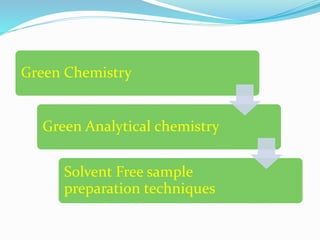
Green Chemistry
Green Analytical chemistry
Solvent Free sample
preparation techniques
The adverse environmental impact of analytical
methodologies has been reduced in three different ways:
 i) reduction of the amount of solvents required in sample
pre-treatment
 ii) reduction in the amount and the toxicity of solvents and
reagents employed in the measurement step, especially by
automation and miniaturization
 iii) development of alternative direct analytical
methodologies not requiring solvents or reagents
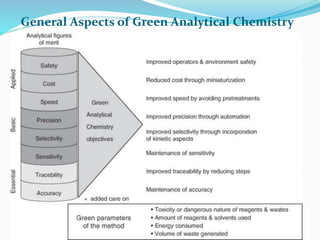
General Aspects of Green Analytical Chemistry
The twelve principles of Green Analytical
Chemistry that include:
 1. Direct analysis avoiding sample preparation.
 2. Reduced sample size.
 3. In situ analysis.
 4. Use of integrated processes in order to save energy
and prevent spending high amounts of reagents
Automation and miniaturization.
 6. Less or no derivatization.
 7. Reduced waste.
 8. Developments of methods for the simultaneous
analysis of multiple analyses.
 9. Reduction of energy consumption.
 10. Use of renewable sources.
 11. Replacement of toxic reagents or reduction of their
use.
 12. Great concern for the safety of analytical operator.
Green Analytical Techniques
 some analytical techniques are considered to be greener
than others, as for example
 Flow Injection Analysis (FIA) compared to the
conventional High Performance Liquid Chromatography
 Sequential Injection Analysis (SIA), Capillary
Electrophoresis (CE)
 Capillary Electro chromatography (CEC) have been also
suggested as the greener approach in analytical chemistry
replacing the organic solvent consuming analytical
techniques
 Miniaturization of chromatographic equipment
required pumps of new optimized technology
 Micro, Nano, Capillary HPLC or Ultra high
performance liquid chromatography are the green
version of the “old fashioned” HPLC
 Further technological advances like in-field direct
analysis of untreated samples
 the use of sensors, or solvent-less techniques were
implemented in analytical methodologies according to
what green chemistry dictates
 Capillary HPLC: is based on decreasing the size of packed
HPLC columns in the capillary range, where column ID is
100–500 um and flow rates are 0.4– 100 uL/min, It improves
the speed and the mass sensitivity of a separation.
 Improvement in mass sensitivity achieved with capillary
HPLC is perhaps the most understandable advantage of the
technique – for the same size of injection, a 300-um
capillary format offers sensitivity 235 times greater than a
column with an ID of 4.6 mm.
 Three major additional advantages of capillary HPLC over
traditional HPLC are faster column equilibration, smaller
solvent volumes and lower back-pressures
Greener sample pretreatments
 The public concern over protecting the environment
has induced chemists to look for new sample
preparation techniques that could reduce the adverse
environmental impact of organic solvents
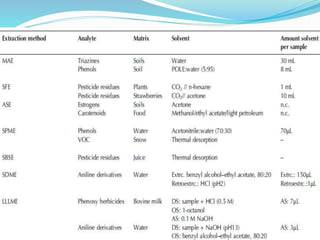
 Microwave-assisted extraction (MAE): has been
applied to the extraction of organic compounds from
very different types of matrix
 It employs less organic solvent and a shorter extraction
time than traditional extraction methods
 MAE can be used together with a micellar system to
extract organic compounds from soils
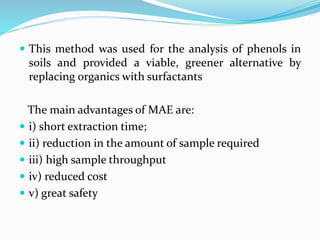
 This method was used for the analysis of phenols in
soils and provided a viable, greener alternative by
replacing organics with surfactants
The main advantages of MAE are:
 i) short extraction time;
 ii) reduction in the amount of sample required
 iii) high sample throughput
 iv) reduced cost
 v) great safety
SFE(SUPERCRITICAL FLUID EXTRACTION)
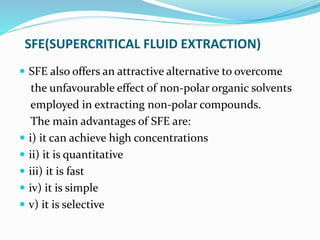
 SFE also offers an attractive alternative to overcome
the unfavourable effect of non-polar organic solvents
employed in extracting non-polar compounds.
The main advantages of SFE are:
 i) it can achieve high concentrations
 ii) it is quantitative
 iii) it is fast
 iv) it is simple
 v) it is selective
Accelerated solvent extraction (ASE)
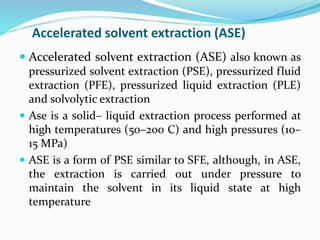
 Accelerated solvent extraction (ASE) also known as
pressurized solvent extraction (PSE), pressurized fluid
extraction (PFE), pressurized liquid extraction (PLE)
and solvolytic extraction
 Ase is a solid– liquid extraction process performed at
high temperatures (50–200 C) and high pressures (10–
15 MPa)
 ASE is a form of PSE similar to SFE, although, in ASE,
the extraction is carried out under pressure to
maintain the solvent in its liquid state at high
temperature
Solid-phase microextraction
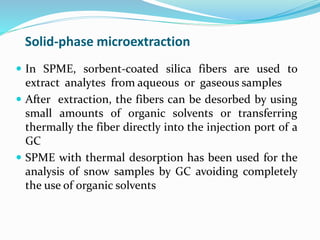
 In SPME, sorbent-coated silica fibers are used to
extract analytes from aqueous or gaseous samples
 After extraction, the fibers can be desorbed by using
small amounts of organic solvents or transferring
thermally the fiber directly into the injection port of a
GC
 SPME with thermal desorption has been used for the
analysis of snow samples by GC avoiding completely
the use of organic solvents
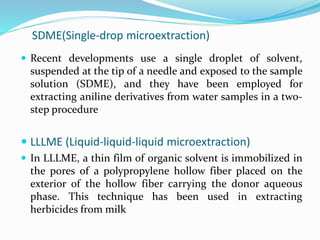
SDME(Single-drop microextraction)
 Recent developments use a single droplet of solvent,
suspended at the tip of a needle and exposed to the sample
solution (SDME), and they have been employed for
extracting aniline derivatives from water samples in a two-
step procedure
 LLLME (Liquid-liquid-liquid microextraction)
 In LLLME, a thin film of organic solvent is immobilized in
the pores of a polypropylene hollow fiber placed on the
exterior of the hollow fiber carrying the donor aqueous
phase. This technique has been used in extracting
herbicides from milk
Green analytical methodologies
 Screening methodologies:
 the aims of the GAC is to reduce the number of
samples to be analyzed by classical, non
environmentally friendly methodologies and also to
reduce the waste generated as a result
 this reduction in the number of samples for analysis
should be done in a safe, controlled way. It can be
achieved by using the so-called ‘‘screening methods’’
 it is interesting to mention immunoassays (IAs), which
were first developed for monitoring insulin in blood in
1960
 Enzyme-linked immunosorbent assay (ELISA) is the
most common IA technique employed.
 The main advantages of those biology-based
analytical-screening techniques is the complete
replacement of organic solvents by aqueous media and
the consequent reduction of toxic wastes
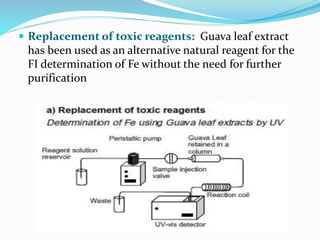
 Replacement of toxic reagents: Guava leaf extract
has been used as an alternative natural reagent for the
FI determination of Fe without the need for further
purification
 The use of vapour-phase generation with Fourier
transform infrared (FT-IR) spectroscopy provided a
green alternative for ethanol determination in
mouthwashes
 Without pre-treatment, 2 uL of samples were injected
inside a reactor heated at 70 C, and the vapour phase
generated was transported to the FTIR spectrometer
using carrier flow of nitrogen
 The proposed procedure is a simple, fast,
environmentally-friendly alternative, which avoids
using reagents and chlorinated organic solvents
commonly used for this determination
 Minimization of wastes: The substitution of all
toxic reagents employed in chemical analysis is not
easy, so reduction of the amounts employed should be
also considered
 In this sense, multicommutation has the advantages of
minimizing both reagent consumption and waste
generation
 Multicommutation has been applied for Hg
determination in milk by hydride generation atomic
fluorescence spectrometry (HG-AFS)
 The method dramatically reduces reagent
consumption a factor and effluent generation
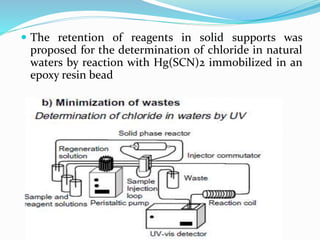
 The retention of reagents in solid supports was
proposed for the determination of chloride in natural
waters by reaction with Hg(SCN)2 immobilized in an
epoxy resin bead
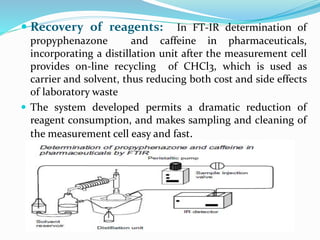
 Recovery of reagents: In FT-IR determination of
propyphenazone and caffeine in pharmaceuticals,
incorporating a distillation unit after the measurement cell
provides on-line recycling of CHCl3, which is used as
carrier and solvent, thus reducing both cost and side effects
of laboratory waste
 The system developed permits a dramatic reduction of
reagent consumption, and makes sampling and cleaning of
the measurement cell easy and fast.
 On-line decontamination of wastes:
 Basically, on-line treatment of waste involves adding a
decontamination step after analytical measurement to
obtain clean waste
 A detoxification step based on in-line TiO2-catalyzed
photodegradation reduces the toxicity of wastes.
 It has been applied for the determination of
formetanate in waters using their reaction with p-
aminophenol
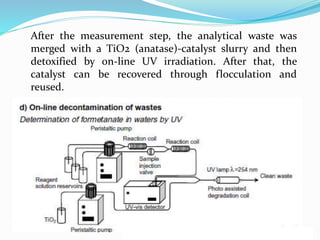
After the measurement step, the analytical waste was
merged with a TiO2 (anatase)-catalyst slurry and then
detoxified by on-line UV irradiation. After that, the
catalyst can be recovered through flocculation and
reused.
 Reagent-free methodologies: Methods based on
direct measurements of untreated samples can be the best
options to make analytical determinations greener
 FT-Raman spectrometry has been used as a reagent free
methodology
 The quantitative determination of different analytes
performed directly on the sample, solid or liquid, using
standard glass vials as sample cells, eliminates reagent
consumption and avoids waste generation, also reducing
the need for sample handling and the contact of the
operator with potentially toxic substances.
 This technique has been used for the determination of
iprodione in solid-pesticide formulations
Conclusions
 It is important to develop green methods or make greener
the already existing ones.
 As already mentioned most of the issues related to green
analysis require reduction in sample number, reagents,
energy, waste, risk and hazard. Downsizing in sample and
reagents volume results also in the reduction of analysis
time.
 It is not always necessary to start from the beginning and
build completely new analytical methods. By thinking
greener all existing analytical methods can be modified so
that they fulfill green chemistry requirements.
Green analytical techniques used in pharmaceutical analysis

Green analytical techniques used in pharmaceutical analysis

  • 1.
    Guided By :-Present By: Dr. Priti J. Mehta Himanshu Rajpurohit HOD, Pharmaceutical Analysis m pharm pharmaceutical Analysis Institute of Pharmacy, Institute of Pharmacy Nirma University. Nirma University
  • 2.
    Introduction  Green approachin chemical processes is a recent issue arising from the scientists’ concern for human health, environment protection and sustainability  “Green Chemistry” can be defined as “the design of chemical products and processes that are more environmentally benign”,  which fulfill requirements for the reduction of negative health and environmental impacts
  • 3.
     Some ofthe Green Chemistry principles can directly be adapted to the analytical chemistry  We pay special attention to the strategies and the tools available to make sample-pretreatment and analytical methods greener  We consider that the main principles are to replace toxic reagents to miniaturize and to automate methods, making it possible to reduce dramatically the amounts of reagents consumed and wastes generated, so reducing or avoiding side effects of analytical methods.
  • 4.
    Green Chemistry Green Analyticalchemistry Solvent Free sample preparation techniques
  • 5.
    The adverse environmentalimpact of analytical methodologies has been reduced in three different ways:  i) reduction of the amount of solvents required in sample pre-treatment  ii) reduction in the amount and the toxicity of solvents and reagents employed in the measurement step, especially by automation and miniaturization  iii) development of alternative direct analytical methodologies not requiring solvents or reagents
  • 6.
    General Aspects ofGreen Analytical Chemistry
  • 7.
    The twelve principlesof Green Analytical Chemistry that include:  1. Direct analysis avoiding sample preparation.  2. Reduced sample size.  3. In situ analysis.  4. Use of integrated processes in order to save energy and prevent spending high amounts of reagents Automation and miniaturization.  6. Less or no derivatization.
  • 8.
     7. Reducedwaste.  8. Developments of methods for the simultaneous analysis of multiple analyses.  9. Reduction of energy consumption.  10. Use of renewable sources.  11. Replacement of toxic reagents or reduction of their use.  12. Great concern for the safety of analytical operator.
  • 9.
    Green Analytical Techniques some analytical techniques are considered to be greener than others, as for example  Flow Injection Analysis (FIA) compared to the conventional High Performance Liquid Chromatography  Sequential Injection Analysis (SIA), Capillary Electrophoresis (CE)  Capillary Electro chromatography (CEC) have been also suggested as the greener approach in analytical chemistry replacing the organic solvent consuming analytical techniques
  • 10.
     Miniaturization ofchromatographic equipment required pumps of new optimized technology  Micro, Nano, Capillary HPLC or Ultra high performance liquid chromatography are the green version of the “old fashioned” HPLC  Further technological advances like in-field direct analysis of untreated samples  the use of sensors, or solvent-less techniques were implemented in analytical methodologies according to what green chemistry dictates
  • 11.
     Capillary HPLC:is based on decreasing the size of packed HPLC columns in the capillary range, where column ID is 100–500 um and flow rates are 0.4– 100 uL/min, It improves the speed and the mass sensitivity of a separation.  Improvement in mass sensitivity achieved with capillary HPLC is perhaps the most understandable advantage of the technique – for the same size of injection, a 300-um capillary format offers sensitivity 235 times greater than a column with an ID of 4.6 mm.  Three major additional advantages of capillary HPLC over traditional HPLC are faster column equilibration, smaller solvent volumes and lower back-pressures
  • 12.
    Greener sample pretreatments The public concern over protecting the environment has induced chemists to look for new sample preparation techniques that could reduce the adverse environmental impact of organic solvents  Microwave-assisted extraction (MAE): has been applied to the extraction of organic compounds from very different types of matrix  It employs less organic solvent and a shorter extraction time than traditional extraction methods  MAE can be used together with a micellar system to extract organic compounds from soils
  • 13.
     This methodwas used for the analysis of phenols in soils and provided a viable, greener alternative by replacing organics with surfactants The main advantages of MAE are:  i) short extraction time;  ii) reduction in the amount of sample required  iii) high sample throughput  iv) reduced cost  v) great safety
  • 14.
    SFE(SUPERCRITICAL FLUID EXTRACTION) SFE also offers an attractive alternative to overcome the unfavourable effect of non-polar organic solvents employed in extracting non-polar compounds. The main advantages of SFE are:  i) it can achieve high concentrations  ii) it is quantitative  iii) it is fast  iv) it is simple  v) it is selective
  • 15.
    Accelerated solvent extraction(ASE)  Accelerated solvent extraction (ASE) also known as pressurized solvent extraction (PSE), pressurized fluid extraction (PFE), pressurized liquid extraction (PLE) and solvolytic extraction  Ase is a solid– liquid extraction process performed at high temperatures (50–200 C) and high pressures (10– 15 MPa)  ASE is a form of PSE similar to SFE, although, in ASE, the extraction is carried out under pressure to maintain the solvent in its liquid state at high temperature
  • 16.
    Solid-phase microextraction  InSPME, sorbent-coated silica fibers are used to extract analytes from aqueous or gaseous samples  After extraction, the fibers can be desorbed by using small amounts of organic solvents or transferring thermally the fiber directly into the injection port of a GC  SPME with thermal desorption has been used for the analysis of snow samples by GC avoiding completely the use of organic solvents
  • 17.
    SDME(Single-drop microextraction)  Recentdevelopments use a single droplet of solvent, suspended at the tip of a needle and exposed to the sample solution (SDME), and they have been employed for extracting aniline derivatives from water samples in a two- step procedure  LLLME (Liquid-liquid-liquid microextraction)  In LLLME, a thin film of organic solvent is immobilized in the pores of a polypropylene hollow fiber placed on the exterior of the hollow fiber carrying the donor aqueous phase. This technique has been used in extracting herbicides from milk
  • 19.
    Green analytical methodologies Screening methodologies:  the aims of the GAC is to reduce the number of samples to be analyzed by classical, non environmentally friendly methodologies and also to reduce the waste generated as a result  this reduction in the number of samples for analysis should be done in a safe, controlled way. It can be achieved by using the so-called ‘‘screening methods’’
  • 20.
     it isinteresting to mention immunoassays (IAs), which were first developed for monitoring insulin in blood in 1960  Enzyme-linked immunosorbent assay (ELISA) is the most common IA technique employed.  The main advantages of those biology-based analytical-screening techniques is the complete replacement of organic solvents by aqueous media and the consequent reduction of toxic wastes
  • 21.
     Replacement oftoxic reagents: Guava leaf extract has been used as an alternative natural reagent for the FI determination of Fe without the need for further purification
  • 22.
     The useof vapour-phase generation with Fourier transform infrared (FT-IR) spectroscopy provided a green alternative for ethanol determination in mouthwashes  Without pre-treatment, 2 uL of samples were injected inside a reactor heated at 70 C, and the vapour phase generated was transported to the FTIR spectrometer using carrier flow of nitrogen  The proposed procedure is a simple, fast, environmentally-friendly alternative, which avoids using reagents and chlorinated organic solvents commonly used for this determination
  • 23.
     Minimization ofwastes: The substitution of all toxic reagents employed in chemical analysis is not easy, so reduction of the amounts employed should be also considered  In this sense, multicommutation has the advantages of minimizing both reagent consumption and waste generation  Multicommutation has been applied for Hg determination in milk by hydride generation atomic fluorescence spectrometry (HG-AFS)  The method dramatically reduces reagent consumption a factor and effluent generation
  • 24.
     The retentionof reagents in solid supports was proposed for the determination of chloride in natural waters by reaction with Hg(SCN)2 immobilized in an epoxy resin bead
  • 25.
     Recovery ofreagents: In FT-IR determination of propyphenazone and caffeine in pharmaceuticals, incorporating a distillation unit after the measurement cell provides on-line recycling of CHCl3, which is used as carrier and solvent, thus reducing both cost and side effects of laboratory waste  The system developed permits a dramatic reduction of reagent consumption, and makes sampling and cleaning of the measurement cell easy and fast.
  • 26.
     On-line decontaminationof wastes:  Basically, on-line treatment of waste involves adding a decontamination step after analytical measurement to obtain clean waste  A detoxification step based on in-line TiO2-catalyzed photodegradation reduces the toxicity of wastes.  It has been applied for the determination of formetanate in waters using their reaction with p- aminophenol
  • 27.
    After the measurementstep, the analytical waste was merged with a TiO2 (anatase)-catalyst slurry and then detoxified by on-line UV irradiation. After that, the catalyst can be recovered through flocculation and reused.
  • 28.
     Reagent-free methodologies:Methods based on direct measurements of untreated samples can be the best options to make analytical determinations greener  FT-Raman spectrometry has been used as a reagent free methodology  The quantitative determination of different analytes performed directly on the sample, solid or liquid, using standard glass vials as sample cells, eliminates reagent consumption and avoids waste generation, also reducing the need for sample handling and the contact of the operator with potentially toxic substances.  This technique has been used for the determination of iprodione in solid-pesticide formulations
  • 29.
    Conclusions  It isimportant to develop green methods or make greener the already existing ones.  As already mentioned most of the issues related to green analysis require reduction in sample number, reagents, energy, waste, risk and hazard. Downsizing in sample and reagents volume results also in the reduction of analysis time.  It is not always necessary to start from the beginning and build completely new analytical methods. By thinking greener all existing analytical methods can be modified so that they fulfill green chemistry requirements.