Dick & Carey
Systems Approach Model
for Designing Instruction
     Design Group 6:
  Amanda Duvall, Katie Turner,
  Martina Henke, Missy Corbat
              EDAE A637:

       Design of E-Learning
        February 9, 2009
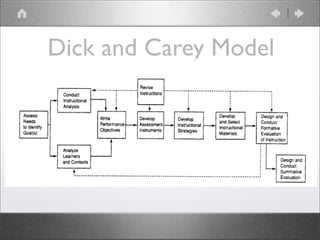
Dick and Carey Model
What is it?
•   Based on a behaviorist perspective and inter-
    related systems approach to learning

•   The goal is to improve instruction by improving
    the instructor

•   Can be thought of as 10 components that are part
    of 6 main phases.
Six Main Phases...
•Design
•Analysis
•Development
•Formative Assessment
•Revision
•Summative Evaluation
The first 2 phases:
Design & Analysis

               Amanda Duvall
Assess Needs to Identify Goal(s)
•    Decide what students will be able to do when they leave the
     course

•    This goal can be derived from

     –   needs assessment

     –   a list of smaller goals

     –   practical experience with learning

     –   analysis of job performance

     –   new requirements imposed on workers
Learning Real World Math
What would the instructional goal be if you wanted your
students to help determine the area of the classroom?
  a) students will measure the room
  b) students will share a ruler
  c) student will use real world problem solving
     to apply measurement and area
  d) students will teach others about area and
     measuring
Conduct Instructional Analysis
•   Identify what is required for a
    student to achieve the instructional
    goals

•   What step by step skills do
    students need to achieve
    instructional goal?

•   What is the least amount people
    must be able to do to be able to
    learn what is in the class?
What are some entry
 behaviors students will
         need?

Please write your ideas on the next screen
Analyze Learners and Contexts
•   Simultaneously analyze
    –   the instructional goals of the learners
    –   the contexts in which they will learn the skills
    –   where they will use the knowledge
•   Look for
    –   learners’ current skills

    –   current preferences
    –   current attitudes
    –   determine instructional setting
What might you find?
•A:
•B:
•C:
•D:
The next phase:
 Development

              Katie Turner
Write Performance Objectives
•    Based on the instructional analysis and the entry behaviors of learners
•    Describe what learners will be able to do
•    There are 3 components: 
     •   Describe the skill or behavior
     •   Describe the conditions that prevail while carrying out task
     •   Describe the criteria used to evaluate performance
•    Each will have subordinate skills that should be identified
Performance Objectives: Example
•   Terminal Objective:

   
        Given the appropriate tools, students will measure
    the area of a room to determine the amount of 
       carpet
    necessary to cover the floor from wall to wall.

•   Subordinate objectives: (Skill or behavior from instructional analysis)
      •   Accurately measure perimeter of the room

      •   Diagram the floor plan proportionately from measurements

      •   Calculate the area using appropriate geometric formulas
Performance Objectives (cont.)
Conditions that prevail while carrying out task

•   
   students will use a measuring tape

•   
   students will translate measurements to a drawing

•   
   students will use equations for determining area based on the shape of the room

Criteria used to evaluate performance

•   
   linear measurements are accurate to within 2"

•   
   angles are accurately accounted for in the drawing

•   
   calculations have been made using the appropriate formulas

•   
   area calculated is within 1 square foot of the actual room size
Develop Assessment Instruments
Instruments are based on the objectives and measure
   students’ ability to perform what is described in
   the objectives:

•   emphasis: relating the kind of behavior described
    to what the assessment requires
Example:

•   Student performance rubric for measuring the
    area of a room

•   Given any variety of room dimensions and
    configurations, students calculate area
Development cont.

               Missy Corbat
Instructional Strategy
•   Plan for presenting the instruction to the learner to
    achieve terminal objective

    •   Based on analysis of what is to be taught
        (previous 5 steps)

•   Decide best method for delivering the instruction

    •   Teacher Led, Group Led, Student Paced

    •   Analysis of learner and skills
Instructional Strategy
Preparation of Instructional Materials
•   Design and selection of materials
    appropriate for learning activity.

    •   Teaching guides, transparencies,
        tests, computer applications,
        student modules, supplemental
        video, web pages.
•   Decision based on the availability of
    existing materials and the learner.
The Final Phases:
Formative Assessment,
      Revision,
                         Martina Henke
Formative Evaluation
•   Goal is to collect data to identify how to
    improve instruction

    ✴one-to-one evaluation
    ✴small-group evaluation
    ✴field evaluation
•   Not assessment of the learner, but of the
    instruction
Formative Evaluation
The methods mentioned can be difficult in
  day to day instructional settings.


What might be some ways an instructor can
 gather the formative data needed?
Revise Instruction
Revise Instruction
•   Data from formative evaluation is analyzed to:

    •   identify difficulties learners had in achieving
        objectives

    •   relate these difficulties to specific deficiencies in
        instruction

    •   re-examine validity of instructional analysis and
        assumptions about learner characteristics
Summative Evaluation
•   Culminating evaluation of the effectiveness of
    instruction

    •   generally outside the design process

    •   evaluates absolute value or worth of the instruction
        after it mets the standards of the designer

    •   usually an independent evaluator
Dick and Carey Model
Sources
•   http://edutechwiki.unige.ch/en/Systematic_Design_of_Instruction

•   http://www.umich.edu/~ed626/Dick_Carey/dc.html

•   http://www.gse.pku.edu.cn/jxsj/materials2/Dick%20&%20Carey.htm

•   Dick, Walter O. ,Carey, Lou, and Carey, Jamoes O. The Systematic Design of Instruction. Boston:Allyn &
    Bacon, 2004.

•   uhaweb.hartford.edu/ACOX/edt666_assignments/assignments/ISD_Model_project_Dick_Carey_final.doc
Image Sources
•   http://www.edutopia.org/images/graphics/001359_20.jpg

•   www.buczek.us/Services/StrategicPlanning.lsp

•   http://www.personalbrandingblog.wordpress.com

•   http://hdbizblog.com/blog/wp-content/uploads/2008/01/clipboard.gif

Dick Carey Key

  • 1.
    Dick & Carey SystemsApproach Model for Designing Instruction Design Group 6: Amanda Duvall, Katie Turner, Martina Henke, Missy Corbat EDAE A637: Design of E-Learning February 9, 2009
  • 2.
  • 3.
    What is it? • Based on a behaviorist perspective and inter- related systems approach to learning • The goal is to improve instruction by improving the instructor • Can be thought of as 10 components that are part of 6 main phases.
  • 4.
    Six Main Phases... •Design •Analysis •Development •FormativeAssessment •Revision •Summative Evaluation
  • 5.
    The first 2phases: Design & Analysis Amanda Duvall
  • 6.
    Assess Needs toIdentify Goal(s)
  • 7.
    Assess Needs toIdentify Goal(s) • Decide what students will be able to do when they leave the course • This goal can be derived from – needs assessment – a list of smaller goals – practical experience with learning – analysis of job performance – new requirements imposed on workers
  • 8.
    Learning Real WorldMath What would the instructional goal be if you wanted your students to help determine the area of the classroom? a) students will measure the room b) students will share a ruler c) student will use real world problem solving to apply measurement and area d) students will teach others about area and measuring
  • 9.
  • 10.
    Conduct Instructional Analysis • Identify what is required for a student to achieve the instructional goals • What step by step skills do students need to achieve instructional goal? • What is the least amount people must be able to do to be able to learn what is in the class?
  • 11.
    What are someentry behaviors students will need? Please write your ideas on the next screen
  • 12.
  • 13.
    Analyze Learners andContexts • Simultaneously analyze – the instructional goals of the learners – the contexts in which they will learn the skills – where they will use the knowledge • Look for – learners’ current skills – current preferences – current attitudes – determine instructional setting
  • 14.
    What might youfind? •A: •B: •C: •D:
  • 15.
    The next phase: Development Katie Turner
  • 16.
  • 17.
    Write Performance Objectives • Based on the instructional analysis and the entry behaviors of learners • Describe what learners will be able to do • There are 3 components: • Describe the skill or behavior • Describe the conditions that prevail while carrying out task • Describe the criteria used to evaluate performance • Each will have subordinate skills that should be identified
  • 18.
    Performance Objectives: Example • Terminal Objective: Given the appropriate tools, students will measure the area of a room to determine the amount of carpet necessary to cover the floor from wall to wall. • Subordinate objectives: (Skill or behavior from instructional analysis) • Accurately measure perimeter of the room • Diagram the floor plan proportionately from measurements • Calculate the area using appropriate geometric formulas
  • 19.
    Performance Objectives (cont.) Conditionsthat prevail while carrying out task • students will use a measuring tape • students will translate measurements to a drawing • students will use equations for determining area based on the shape of the room Criteria used to evaluate performance • linear measurements are accurate to within 2" • angles are accurately accounted for in the drawing • calculations have been made using the appropriate formulas • area calculated is within 1 square foot of the actual room size
  • 20.
  • 21.
    Develop Assessment Instruments Instrumentsare based on the objectives and measure students’ ability to perform what is described in the objectives: • emphasis: relating the kind of behavior described to what the assessment requires Example: • Student performance rubric for measuring the area of a room • Given any variety of room dimensions and configurations, students calculate area
  • 22.
    Development cont. Missy Corbat
  • 23.
  • 24.
    Instructional Strategy • Plan for presenting the instruction to the learner to achieve terminal objective • Based on analysis of what is to be taught (previous 5 steps) • Decide best method for delivering the instruction • Teacher Led, Group Led, Student Paced • Analysis of learner and skills
  • 25.
  • 26.
  • 27.
    Preparation of InstructionalMaterials • Design and selection of materials appropriate for learning activity. • Teaching guides, transparencies, tests, computer applications, student modules, supplemental video, web pages. • Decision based on the availability of existing materials and the learner.
  • 28.
    The Final Phases: FormativeAssessment, Revision, Martina Henke
  • 29.
  • 30.
    Formative Evaluation • Goal is to collect data to identify how to improve instruction ✴one-to-one evaluation ✴small-group evaluation ✴field evaluation • Not assessment of the learner, but of the instruction
  • 31.
    Formative Evaluation The methodsmentioned can be difficult in day to day instructional settings. What might be some ways an instructor can gather the formative data needed?
  • 32.
  • 33.
    Revise Instruction • Data from formative evaluation is analyzed to: • identify difficulties learners had in achieving objectives • relate these difficulties to specific deficiencies in instruction • re-examine validity of instructional analysis and assumptions about learner characteristics
  • 34.
  • 35.
    Summative Evaluation • Culminating evaluation of the effectiveness of instruction • generally outside the design process • evaluates absolute value or worth of the instruction after it mets the standards of the designer • usually an independent evaluator
  • 36.
  • 37.
    Sources • http://edutechwiki.unige.ch/en/Systematic_Design_of_Instruction • http://www.umich.edu/~ed626/Dick_Carey/dc.html • http://www.gse.pku.edu.cn/jxsj/materials2/Dick%20&%20Carey.htm • Dick, Walter O. ,Carey, Lou, and Carey, Jamoes O. The Systematic Design of Instruction. Boston:Allyn & Bacon, 2004. • uhaweb.hartford.edu/ACOX/edt666_assignments/assignments/ISD_Model_project_Dick_Carey_final.doc
  • 38.
    Image Sources • http://www.edutopia.org/images/graphics/001359_20.jpg • www.buczek.us/Services/StrategicPlanning.lsp • http://www.personalbrandingblog.wordpress.com • http://hdbizblog.com/blog/wp-content/uploads/2008/01/clipboard.gif