





INSTRUCTIONAL DEVELOPMENT MODELS
WHAT IS INSTRUCTIONAL DEVELOPMENT MODELS ?
 Instructional development models specifically address challenges that are often called upon to produce materials and strategies to supportteaching and learning within environments that would seem to defy the probability of a successfuloutcome.
These are models that  convey graphically, sometimes with extensive supporting text, the complex process by which educators develop instructional solutions.Models, as applied in thecontext of instructional design, can be used by to educators to convey between individuals meaning ofcomplex concepts, relationships, and processes, and facilitate study and research
A. THE TEACHING LEARNING CYCLE
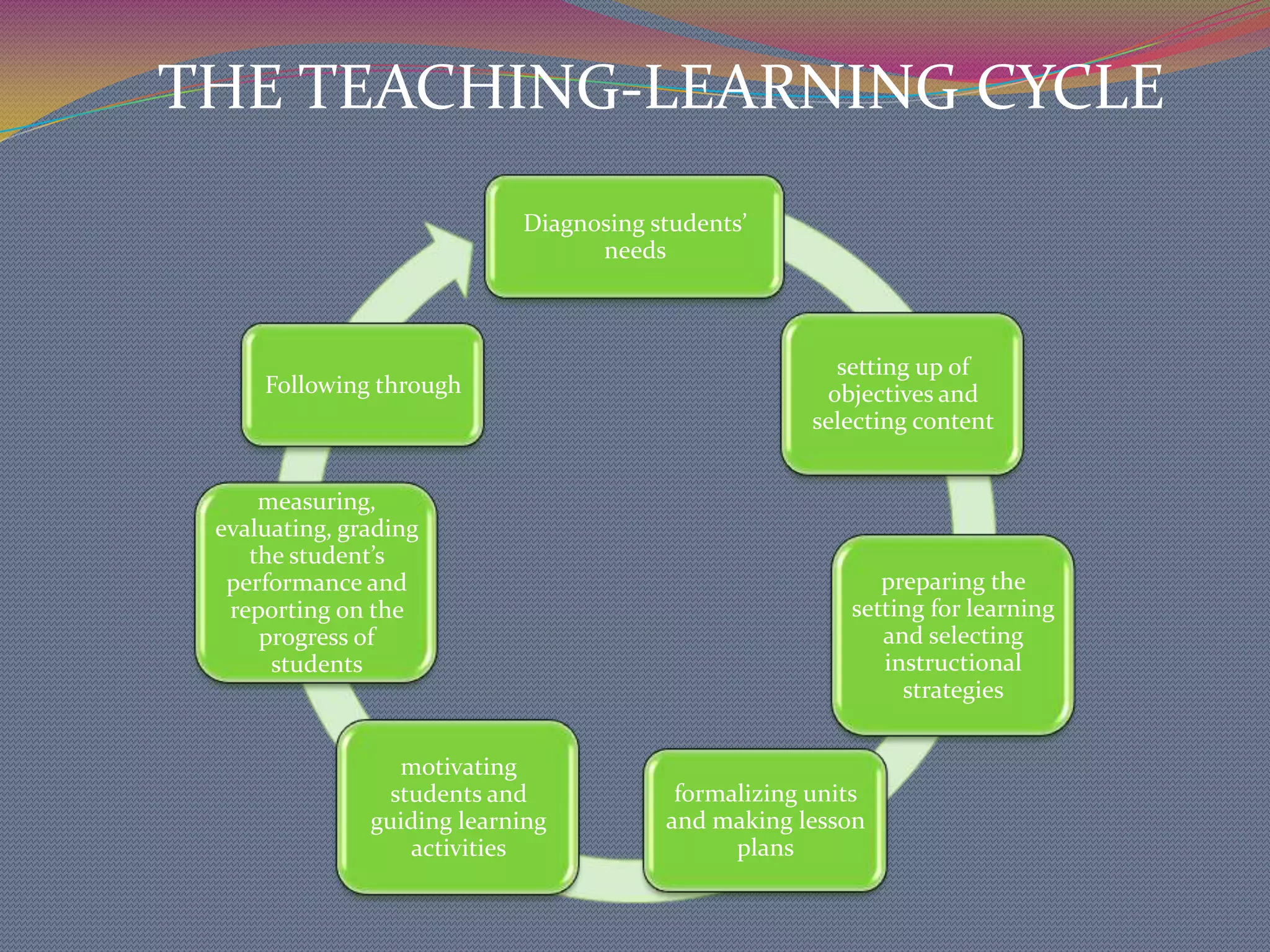
THE TEACHING-LEARNING CYCLE
DIAGNOSING STUDENT’S NEEDS, ABILITIES AND INTERESTS
SYSTEMATIC TECHNIQUES USED FOR DIAGNOSING Work Sample ConferenceAnecdotal RecordsChecklistInterest Inventory Teacher Test Cloze Test Records like Form 137, permanent records, test results
Home visits or contacts with parents
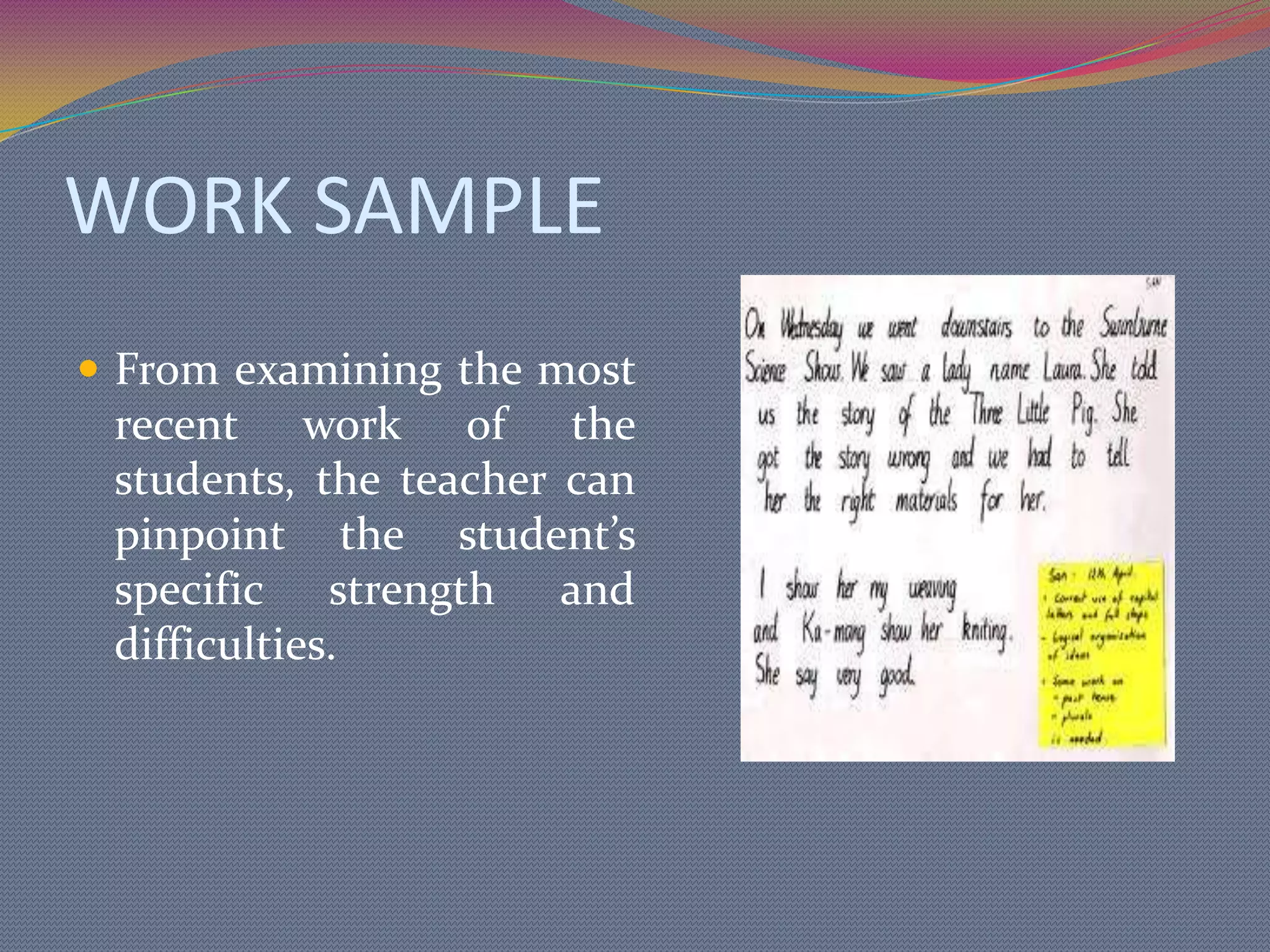
Direct contacts such as observationsWORK SAMPLEFrom examining the most recent work of the students, the teacher can pinpoint the student’s specific strength and difficulties.
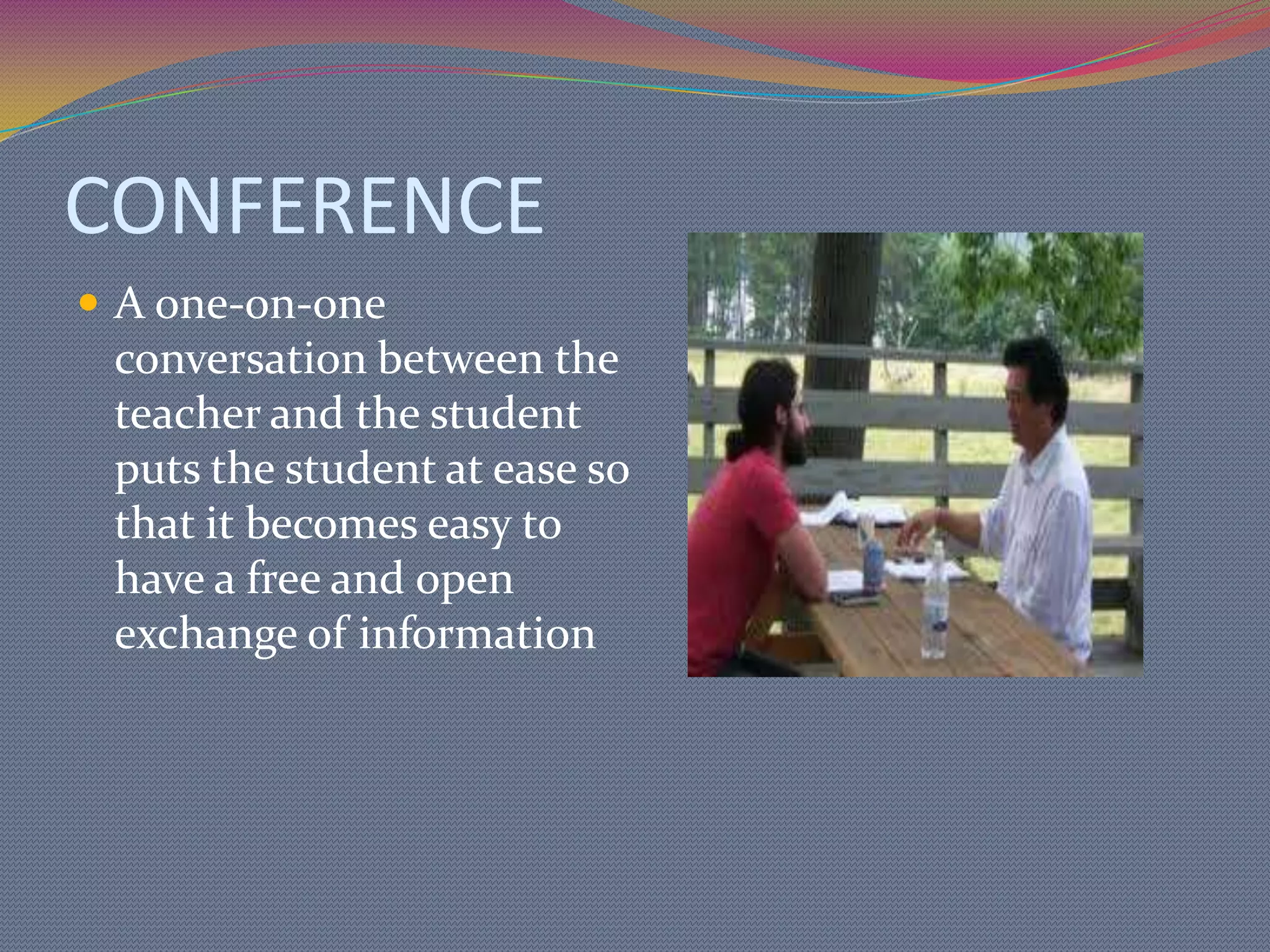
CONFERENCEA one-on-one conversation between the teacher and the student puts the student at ease so that it becomes easy to have a free and open exchange of information
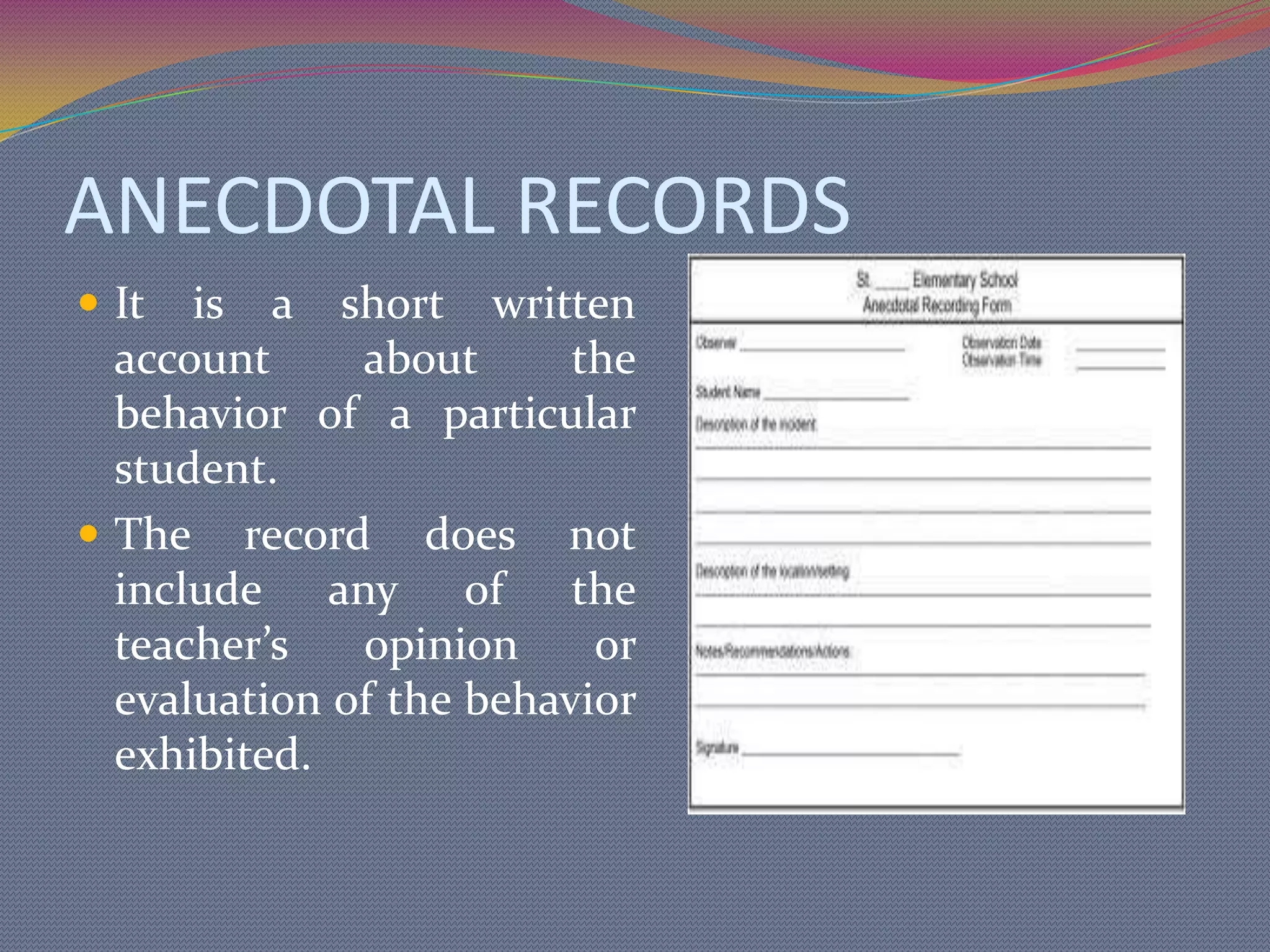
ANECDOTAL RECORDSIt is a short written account about the behavior of a particular student.The record does not include any of the teacher’s opinion or evaluation of the behavior exhibited.
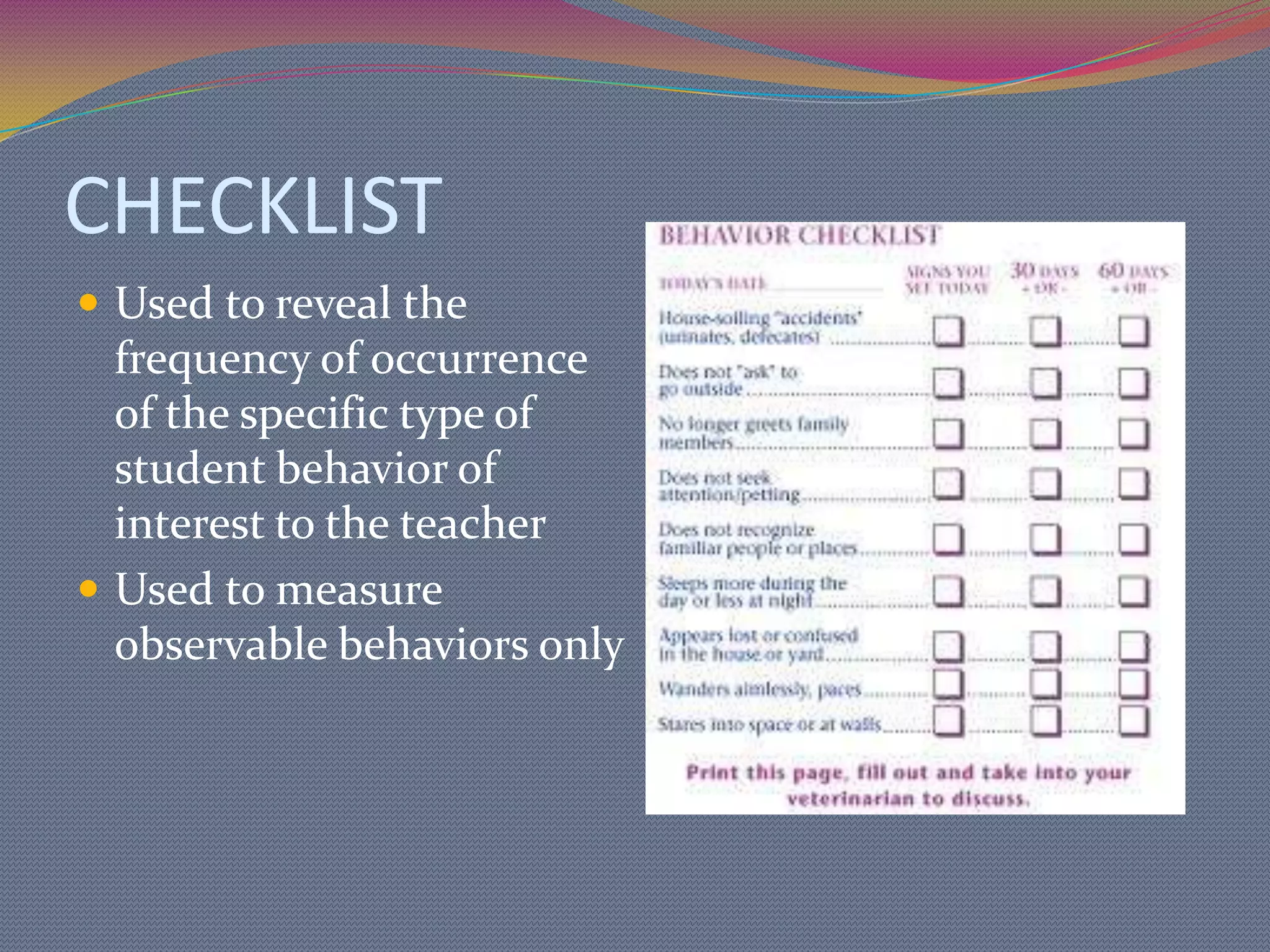
CHECKLISTUsed to reveal the frequency of occurrence of the specific type of student behavior of interest to the teacherUsed to measure observable behaviors only
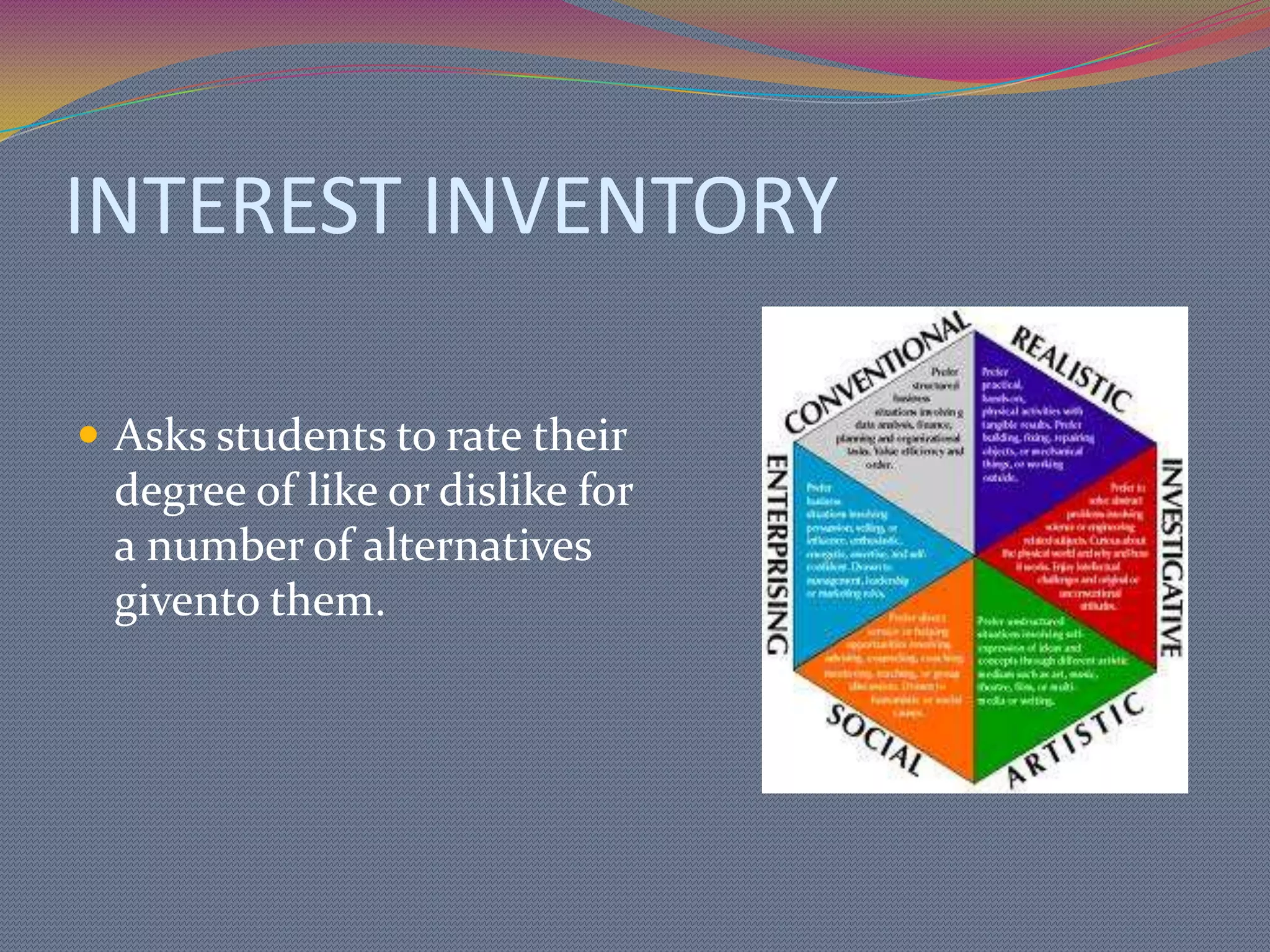
INTEREST INVENTORYAsks students to rate their degree of like or dislike for a number of alternatives givento them.
TEACHER TESTTwo types:Regular test – given over preciously taught content
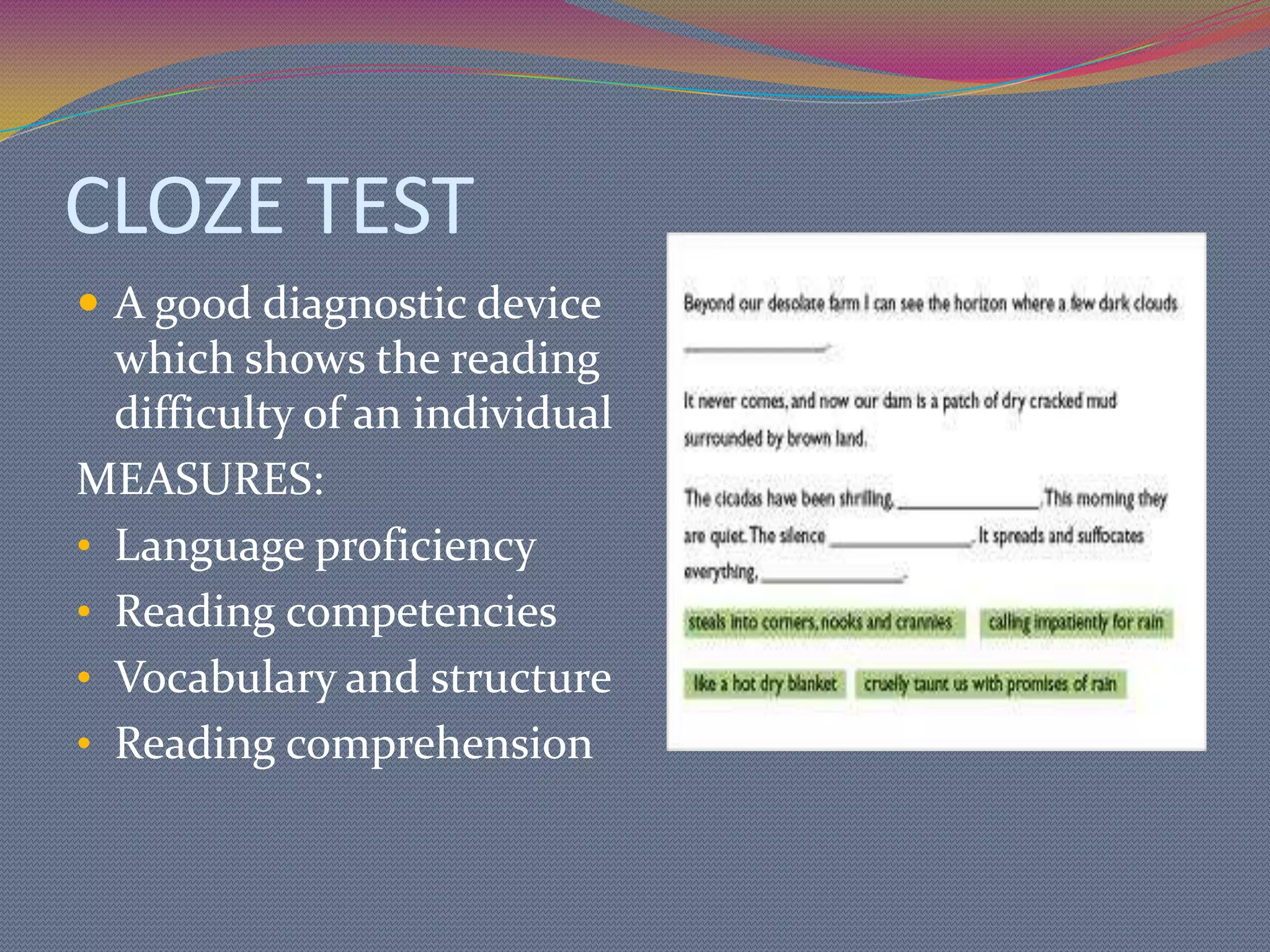
Specially prepared diagnostic test – has little to do with the content to which students have been previosly exposedCLOZE TESTA good diagnostic device which shows the reading difficulty of an individualMEASURES:Language proficiency
Reading competencies
Vocabulary and structure
Reading comprehensionSETTING UP OF OBJECTIVES AND SELECTING CONTENT
SELECTING CONTENTSome schools provide teachers with curriculum guides, syllabi or course outlines to ease the problem of determining the scope and sequence of the subject-matter content to be taught.
3 STEPS TO CONSIDER:First Step. Identification of the topi		Topic areas are broad aspects of the content 	within a subject area.Second Step. Identifying major Goals of Instructor	Goals refer to broad and general statements.Third Step. Generalization	Generalizations are very specific that it gives the teacher a definite subject-matter to be discussed
SETTING UP OF OBJECTIVESInstructional objectives describe the learning products or what the students are to expected to be able to do after being taught by the teacher.Objectives should be expressed in beahavioral terms to facilitate accurate evaluation of the learner’s performance.
Preparing the Setting for Learning and Selecting Instructional Strategies
PREPARING THE SETTING FOR LEARNINGGood classroom management is a term generally used to describe the maintenance of a healthy learning environment
Formalizing Units and Making Lesson Plans
INSTRUCTIONAL UNITSIt is a planned sequence of learning activities or lesson covering a period of several weeks and centered around some major concepts, themes or topicsIt may be made-up of series of mainly content-orientedlessons or semi-individualized laboraroty-oriented, experience-centered unit assigments or any variety of combinations
DEVELOPING INSTRUCTIONAL UNITSChoosing the topic of theme.Selecting instructional goals or objectives organized into general and specific objectives.Preparing an outline of subject-matter content.Planning the learning activitiesOrganizing the activities into a plan.Securing and preparing the materials needed for the activitiesPlanning and preparing the evaluation materials and exercise
CHOOSING THE TOPIC OR THEMETeaching guides or syllabiusually provides teachers with an organozed and logically-arranged sets of topics to be taken up.
SELECTING INSTRUCTIONAL GOALSTwo Types:General Objectives – These are general statements of what the teacher hopes to accomplish through the study of the unit. It is usually the bird’s eye view of the unit.Specific Objectives – may be prepared in behavioral terms. It will be helpful to put these objectives under the appropriate headings: cognitive, psychomotor, and affective.
PREPARING AN OUTLINE OF SUBJECT-MATTER CONTENTThis will help in making clear the subject-matter content to be covered by the different learning activities and in visualizing the organizations of the unit.
PLANNING THE LEARNING ACTIVITESThese activities should be planed very carefully because on them depends the success of the accomplishment of the objectives.Two Types:basic activities for students- serves as provisions for the students who may not be academically inclinedoptional related activities – designed for students who may accomplish basic activities within a short period of time
ORGANIZING ACTIVITES INTO PLANThree Phases:Initiation or Introduction Phase – sometimes called as the approach and is designed to:Stimulate interest and curiosity of the students in the unitsIntroduce what the unit is all aboutShow relationship of the present unit with the previousElicit suggestions from the learners for possible activities to undertake.
Development Phase – activities and strategies that the teacher plans to develop key ideas in the unit. This stage gives opportunity for learners to take the basic and optional activities as  planned by the teacher with possible modifications based in the suggestions of the students.Culminating Phase – Summarizes the various parts of the unit. It is during this phase that major or key ideas of the unit are highlighted, reviewed, and integrated.
SECURING AND PREPARING THE MATERIALSIncludes list of reading material, pamphlets and newspapers, collection of audio-visual material and bibliography of books to be used. These materials are sure to provide students:with source when they forget their assignmentsTotal picture of what to expect that they doDefinite assignments so that students do not need to wait for the teacher for new assignmentsDefinite directions to eliminate misinterpretations
PREPARING FOR EVALUATIONChecklists, rating scales, role-playing situations and group discussions can serve as evaluation exercises as well as unit tests.
LESSON PLANSThis refers to a more specific plans for a given period.It describes in details what the teacher and students will do on a day to implement the unit objectives.
THE LESSON PLAN FORMATObjectives or TargetsContent or Subject- matter and materialsProcedure or strategyEvaluations or applicationAssignment or agreement and special reminders
Objectives or targets – definite statements of what to are to be learned in the lesson. To formulate instrucitonal objectives, in behavioral terms, the teacher has to use verbs indicating observable behavior.Content or Subject-Matter and Materials – indicates the subject-matter that the teacher believes will help attain his objectives as well as materials and illustrations he may need.Procedure or Strategy – Documents the occurrence of activites that the teacher and his students are going to do during the  period.Assignments or Agreement and special Reminders     - the effectiveness of assignments will determine the success of the new lesson the next day.
Motivating Students And Guiding the Learning Activities
MOTIVATIONMotivation is defined as something that stimulates, energizes, directs and sustain behavior or anything that arouses and sustains people to do whatever it is they do . It underlies the student’s behavior. It is usually responsible for the discipline and control of problems and consequently lack of effective learning in the classroom.
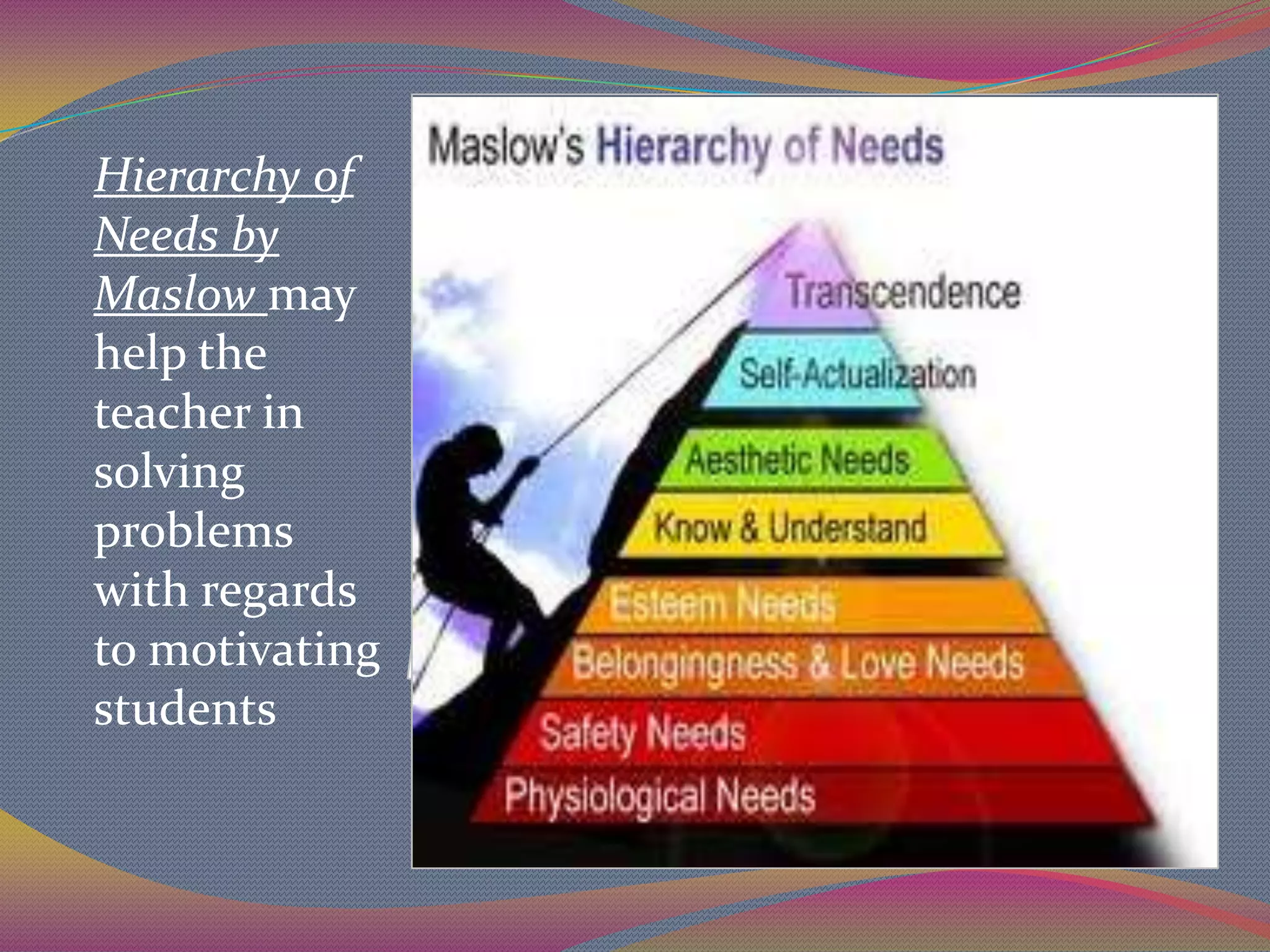
Hierarchy of Needs by Maslow may help the teacher in solving problems with regards to motivating students
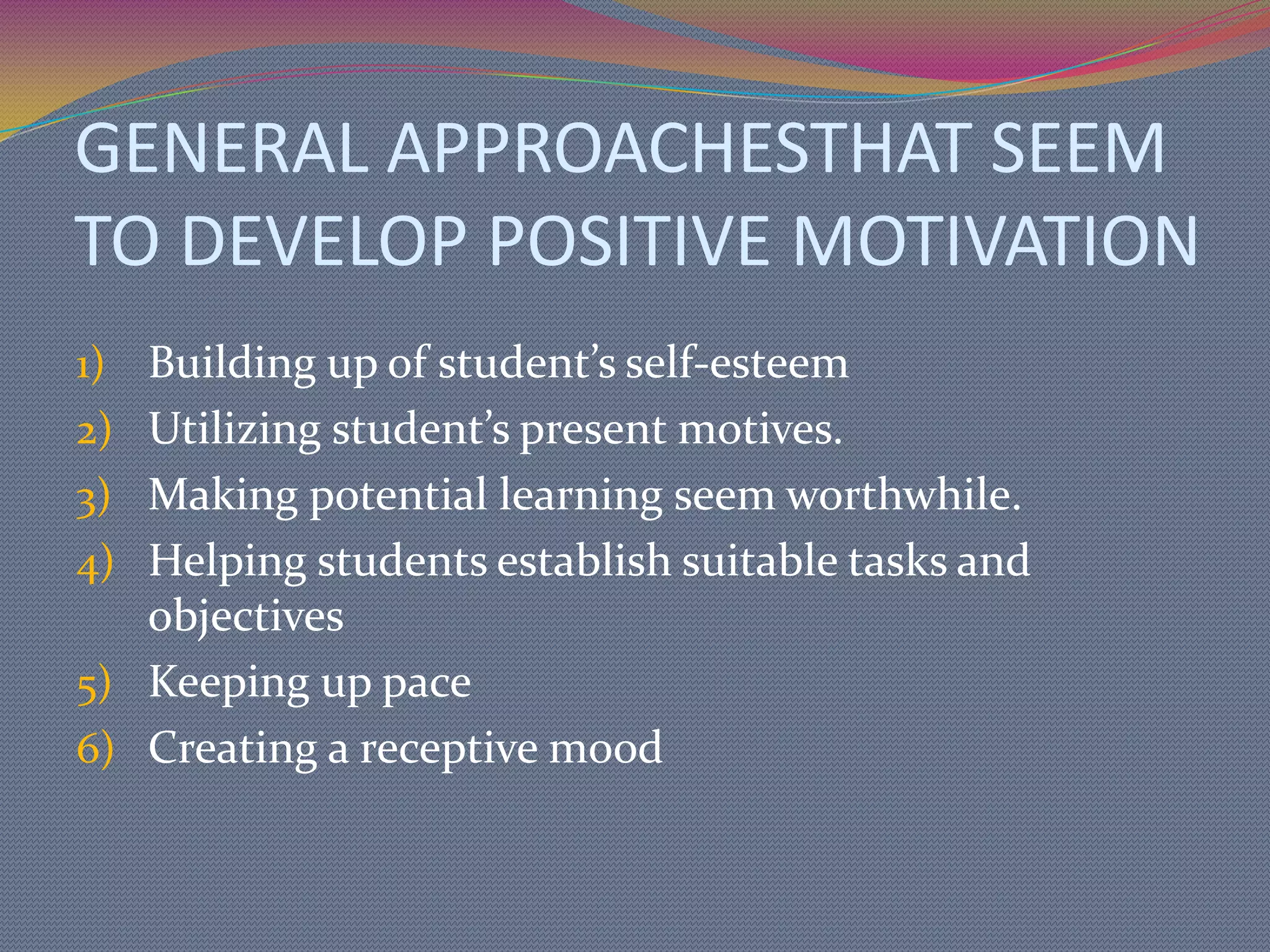
GENERAL APPROACHESTHAT SEEM TO DEVELOP POSITIVE MOTIVATIONBuilding up of student’s self-esteemUtilizing student’s present motives.Making potential learning seem worthwhile.Helping students establish suitable tasks and objectivesKeeping up paceCreating a receptive mood
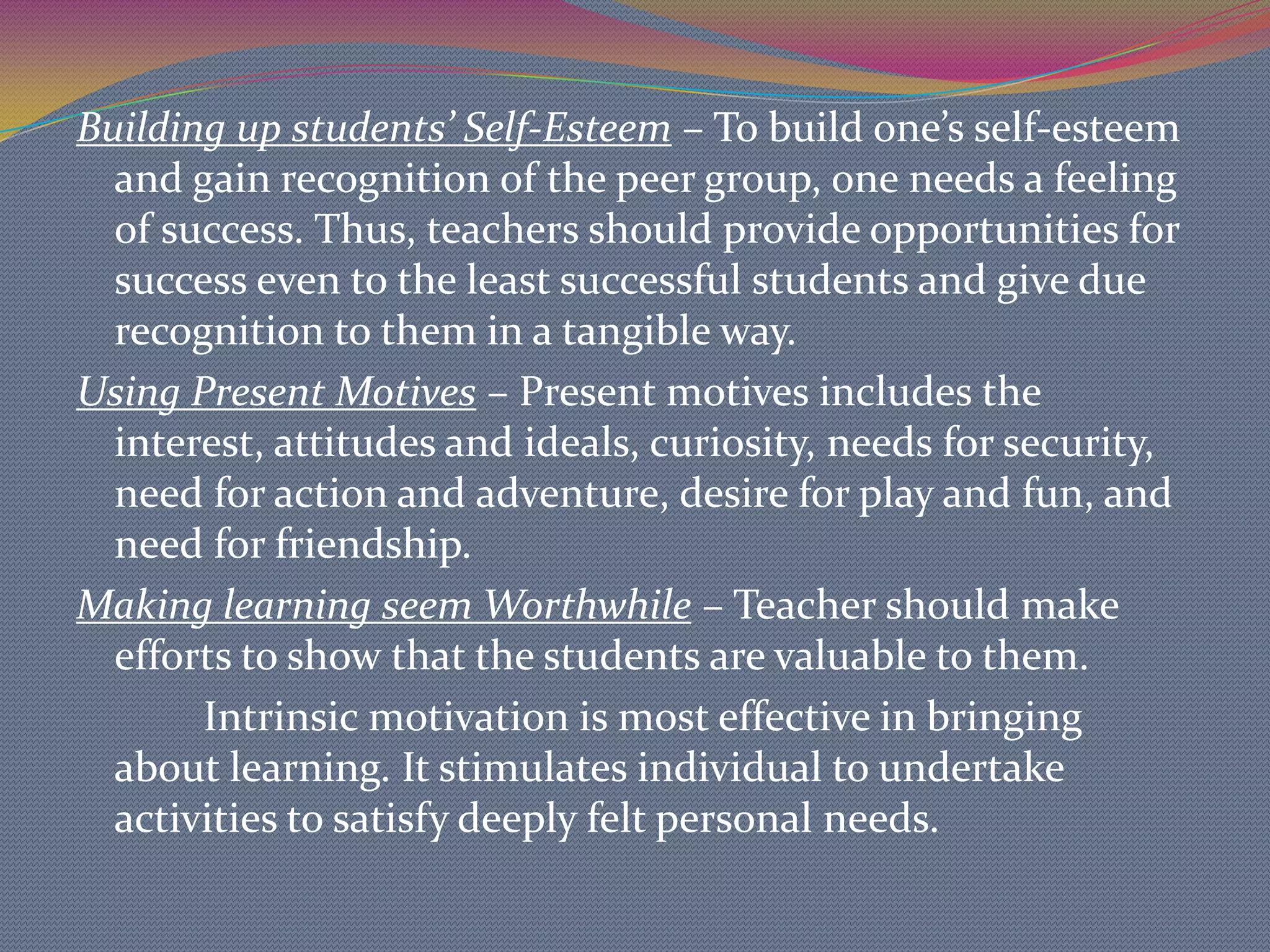
Building up students’ Self-Esteem – To build one’s self-esteem and gain recognition of the peer group, one needs a feeling of success. Thus, teachers should provide opportunities for success even to the least successful students and give due recognition to them in a tangible way.Using Present Motives – Present motives includes the interest, attitudes and ideals, curiosity, needs for security, need for action and adventure, desire for play and fun, and need for friendship.Making learning seem Worthwhile – Teacher should make efforts to show that the students are valuable to them. 		Intrinsic motivation is most effective in bringing about learning. It stimulates individual to undertake activities to satisfy deeply felt personal needs.
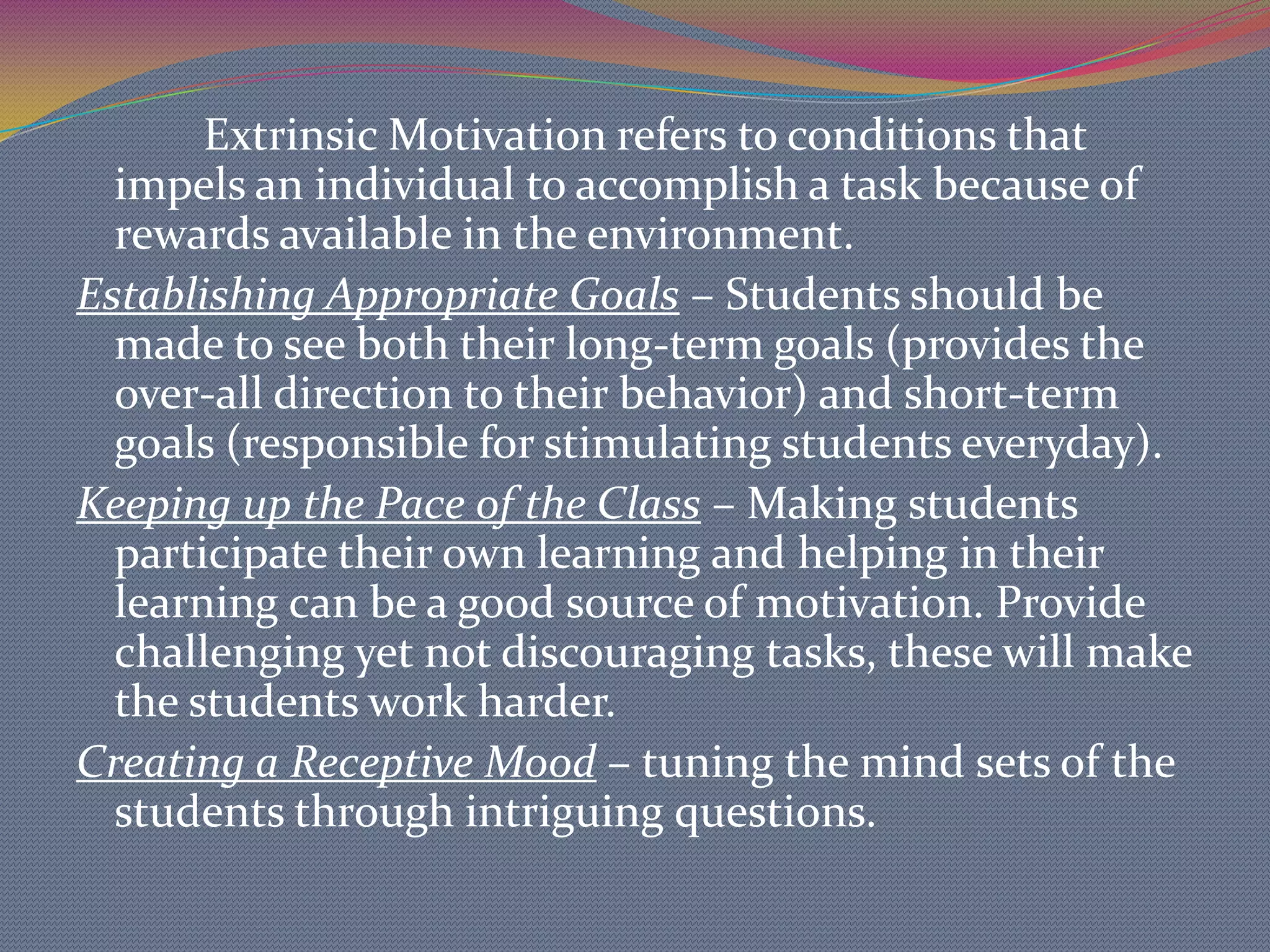
		Extrinsic Motivation refers to conditions that impels an individual to accomplish a task because of rewards available in the environment.Establishing Appropriate Goals – Students should be made to see both their long-term goals (provides the over-all direction to their behavior) and short-term goals (responsible for stimulating students everyday).Keeping up the Pace of the Class – Making students participate their own learning and helping in their learning can be a good source of motivation. Provide challenging yet not discouraging tasks, these will make the students work harder.Creating a Receptive Mood – tuning the mind sets of the students through intriguing questions.
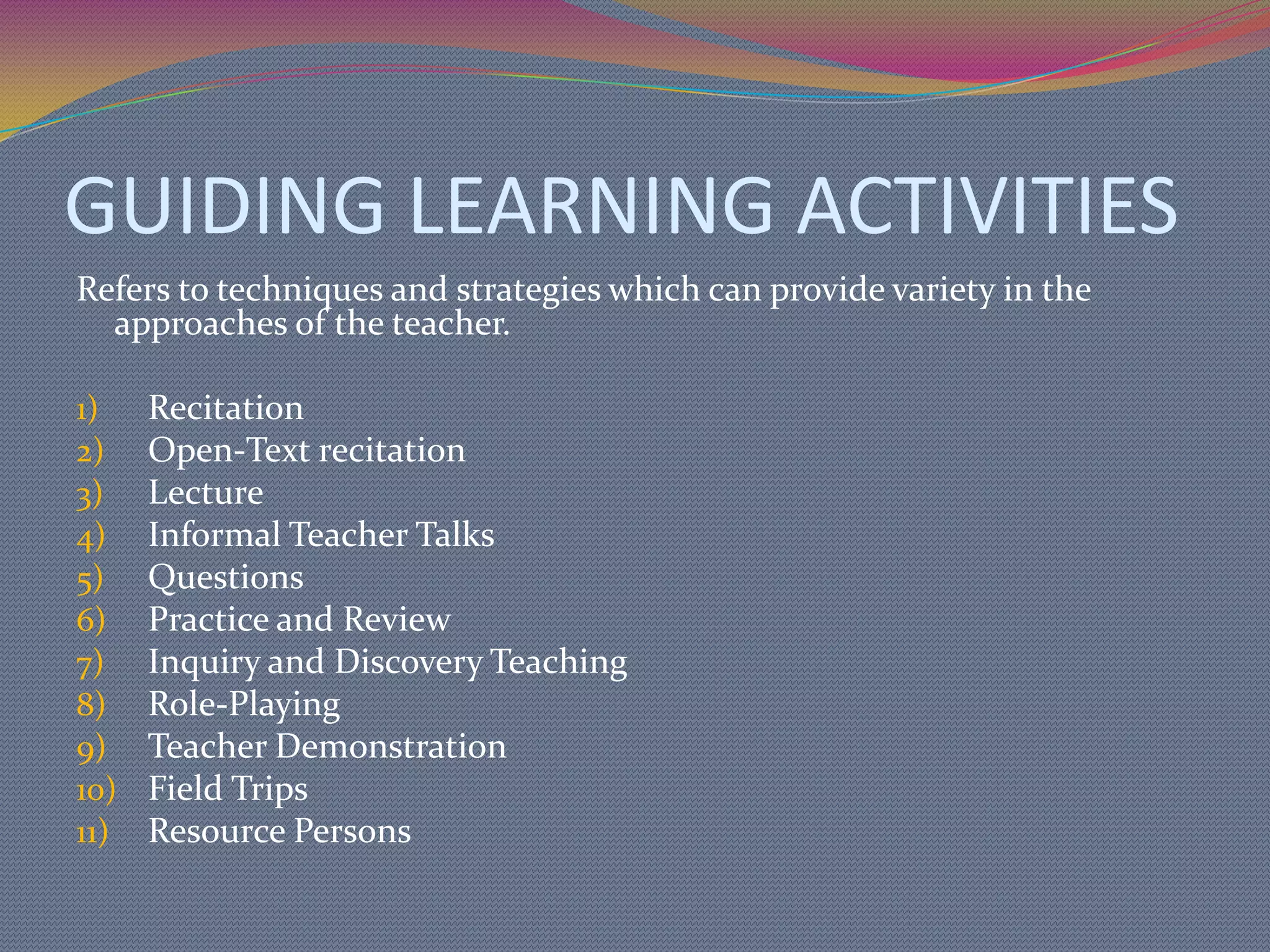
GUIDING LEARNING ACTIVITIESRefers to techniques and strategies which can provide variety in the approaches of the teacher.Recitation			Open-Text recitationLectureInformal Teacher TalksQuestionsPractice and ReviewInquiry and Discovery TeachingRole-PlayingTeacher DemonstrationField Trips Resource Persons
Measuring and Teaching Results
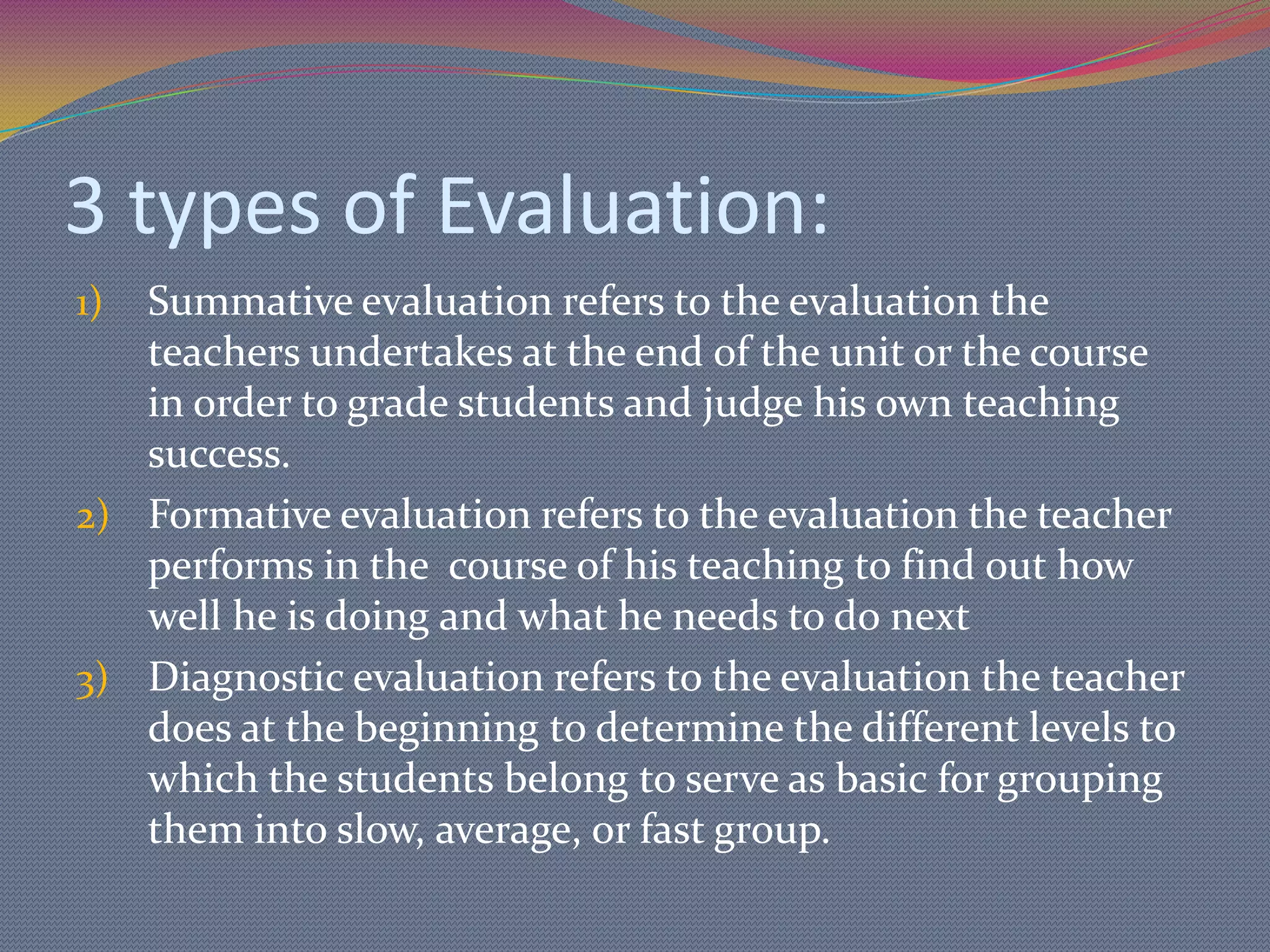
3 types of Evaluation:Summative evaluation refers to the evaluation the teachers undertakes at the end of the unit or the course in order to grade students and judge his own teaching success.Formative evaluation refers to the evaluation the teacher performs in the  course of his teaching to find out how well he is doing and what he needs to do nextDiagnostic evaluation refers to the evaluation the teacher does at the beginning to determine the different levels to which the students belong to serve as basic for grouping them into slow, average, or fast group.
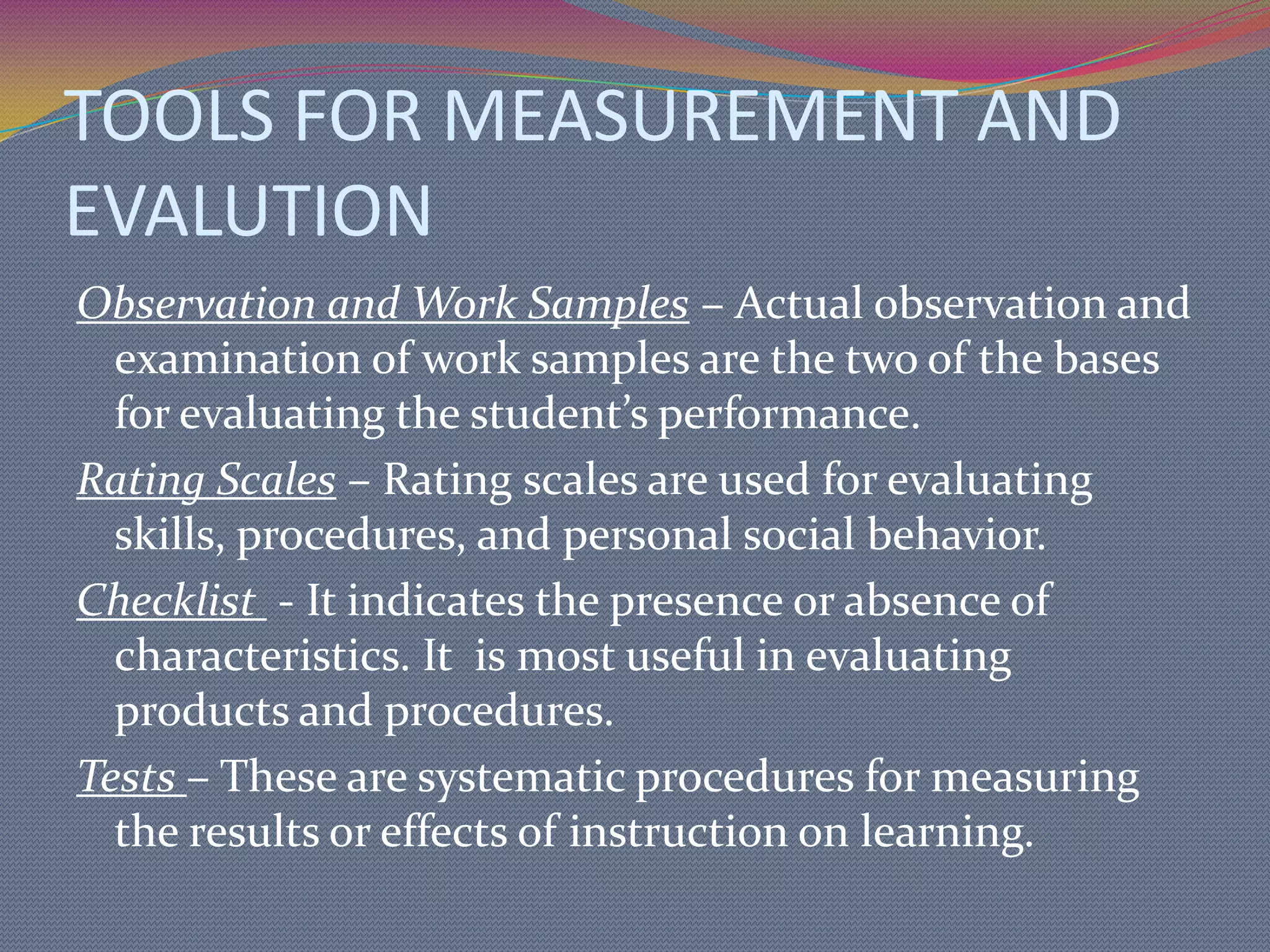
TOOLS FOR MEASUREMENT AND EVALUTIONObservation and Work Samples – Actual observation and examination of work samples are the two of the bases for evaluating the student’s performance.Rating Scales – Rating scales are used for evaluating skills, procedures, and personal social behavior.Checklist  - It indicates the presence or absence of characteristics. It  is most useful in evaluating products and procedures.Tests – These are systematic procedures for measuring the results or effects of instruction on learning.
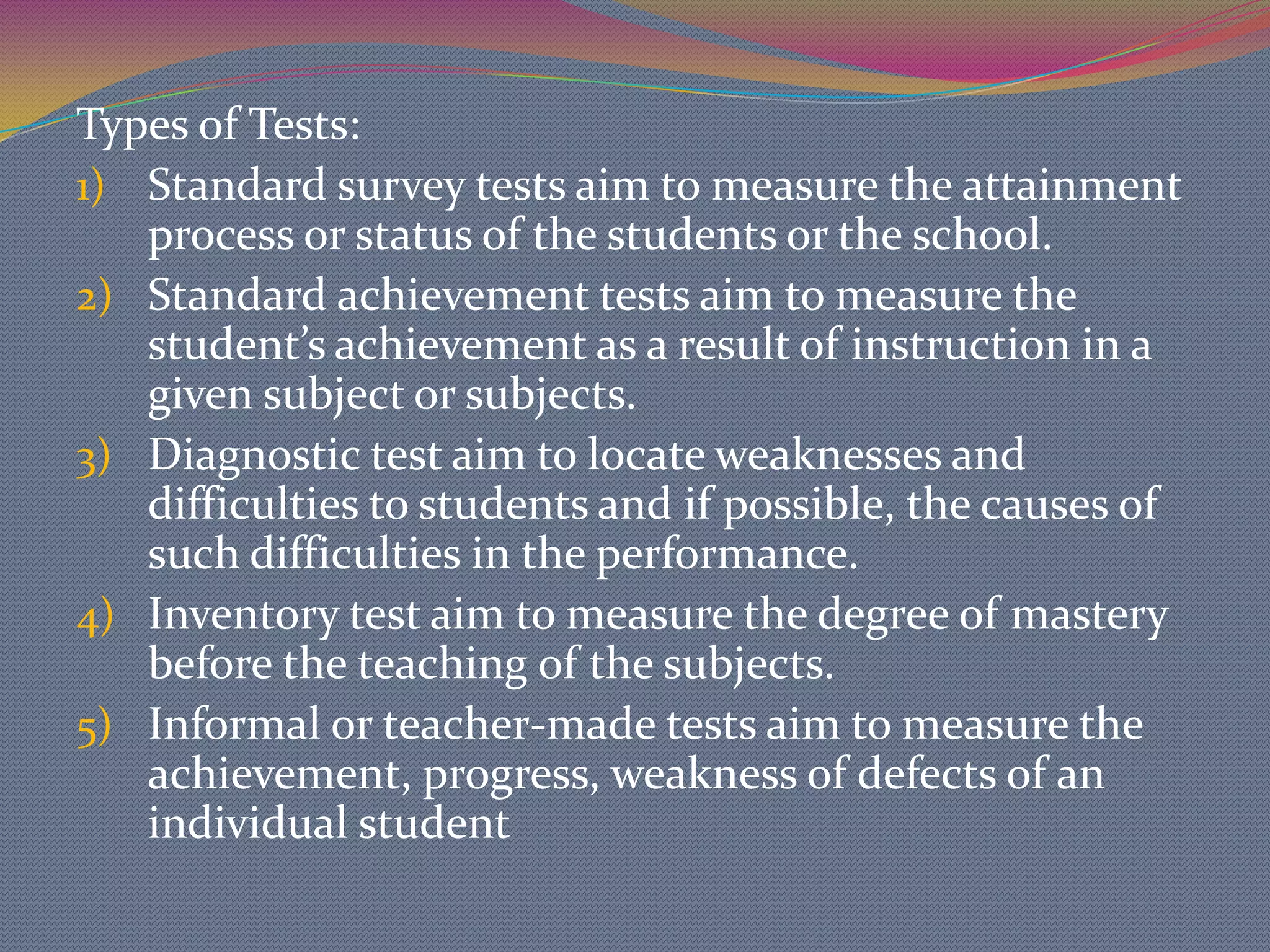
Types of Tests:Standard survey tests aim to measure the attainment process or status of the students or the school.Standard achievement tests aim to measure the student’s achievement as a result of instruction in a given subject or subjects.Diagnostic test aim to locate weaknesses and difficulties to students and if possible, the causes of such difficulties in the performance.Inventory test aim to measure the degree of mastery before the teaching of the subjects.Informal or teacher-made tests aim to measure the achievement, progress, weakness of defects of an individual student
OBJECTIVE TYPE TESTS:Completion Items most useful in assessing student thinking at the lower cognitive levels of knowledge and comprehension.Matching items are also used to measure student’s thinking at the levels of knowledge and comprehension.Multiple-choice Items have the capacity to test not only for knowledge and comprehension but also for some higher-level thinking abilities.True-False Items are generally used yo assess knowledge level thinking. They can be prepared and graded relatively.
GRADING AND REPORTING STUDENTRecognized and accepted as one of the most difficult responsibilities of the teacher is grading and reporting the progress of students in their school work.The most important purpose that should be kept in mind is that reports should facilitate the educational development o each student in relation to his ability.
DETERMINING PROMOTION AND RETENTIONHelp each child become the best person  he is capable o being, considering his natural abilities and regardless his socio-economic background.
MOTIVATING PUPILSOne o the most popular techniques used by teachers to stimulate students to learn is the school mark or grade.	MANNERS IN WHICH STUDENTS MOTIVATION ARE AEECTED BY GRADES:The standard his performance is compared toParents’ and friends attitudes towards gradesThe teacher’s emphasis on grades
PLANNING CURRENT SCHOOLWORKThe grades they receive every grading period can serve as basis or  current planning schoolwork because the grades reflect the areas wherein the students are weak or strong.
B. MODELS FOR FACILITATING LEARNING
Establishing effective learning outcomes first will guide every decision you make regarding the content, activities, and tools you use to achieve those outcomes.There are two kinds of learning outcomes:
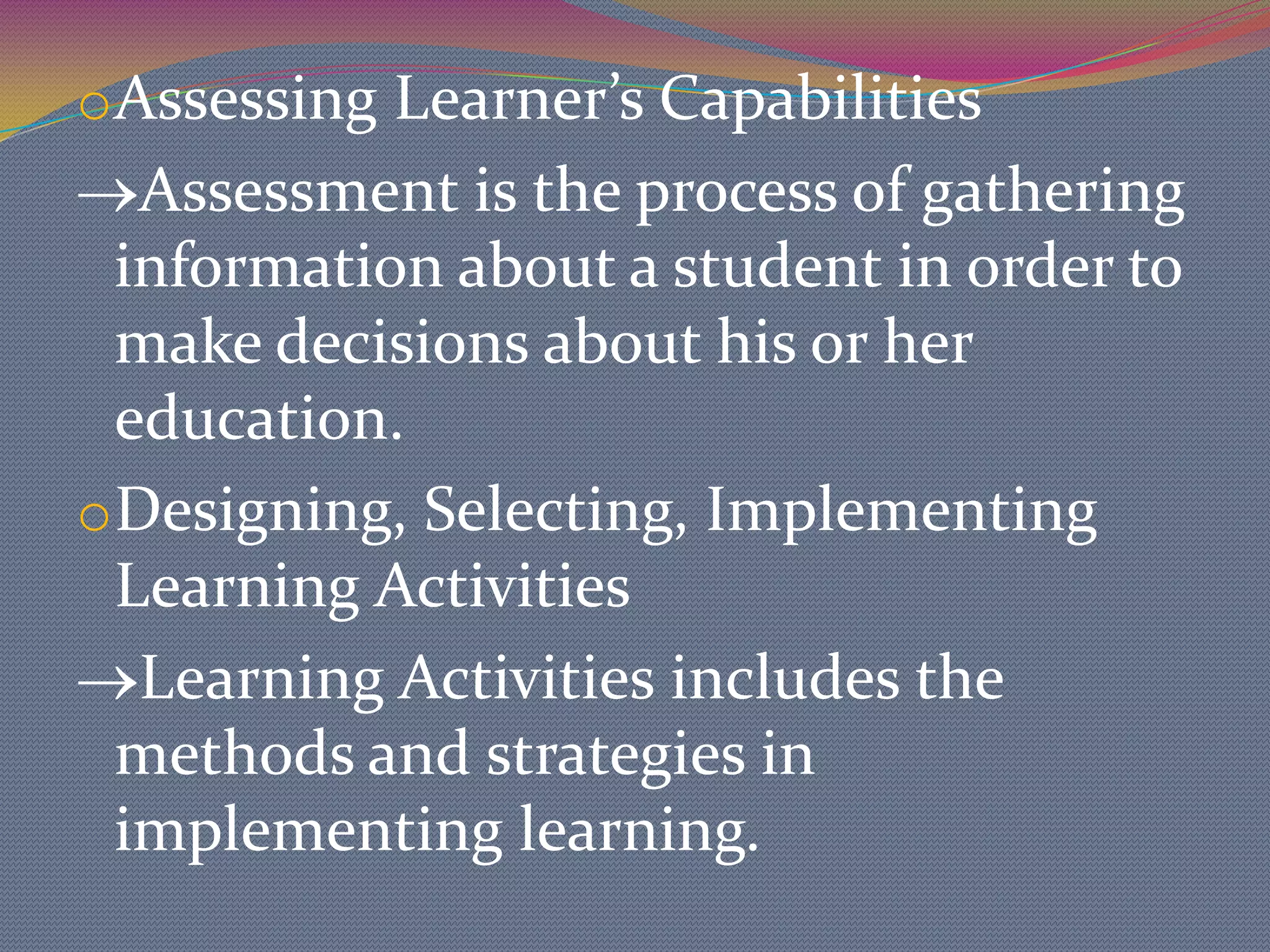
Assessing Learner’s CapabilitiesAssessment is the process of gathering information about a student in order to make decisions about his or her education.Designing, Selecting, Implementing  Learning ActivitiesLearning Activities includes the methods and strategies in implementing learning.
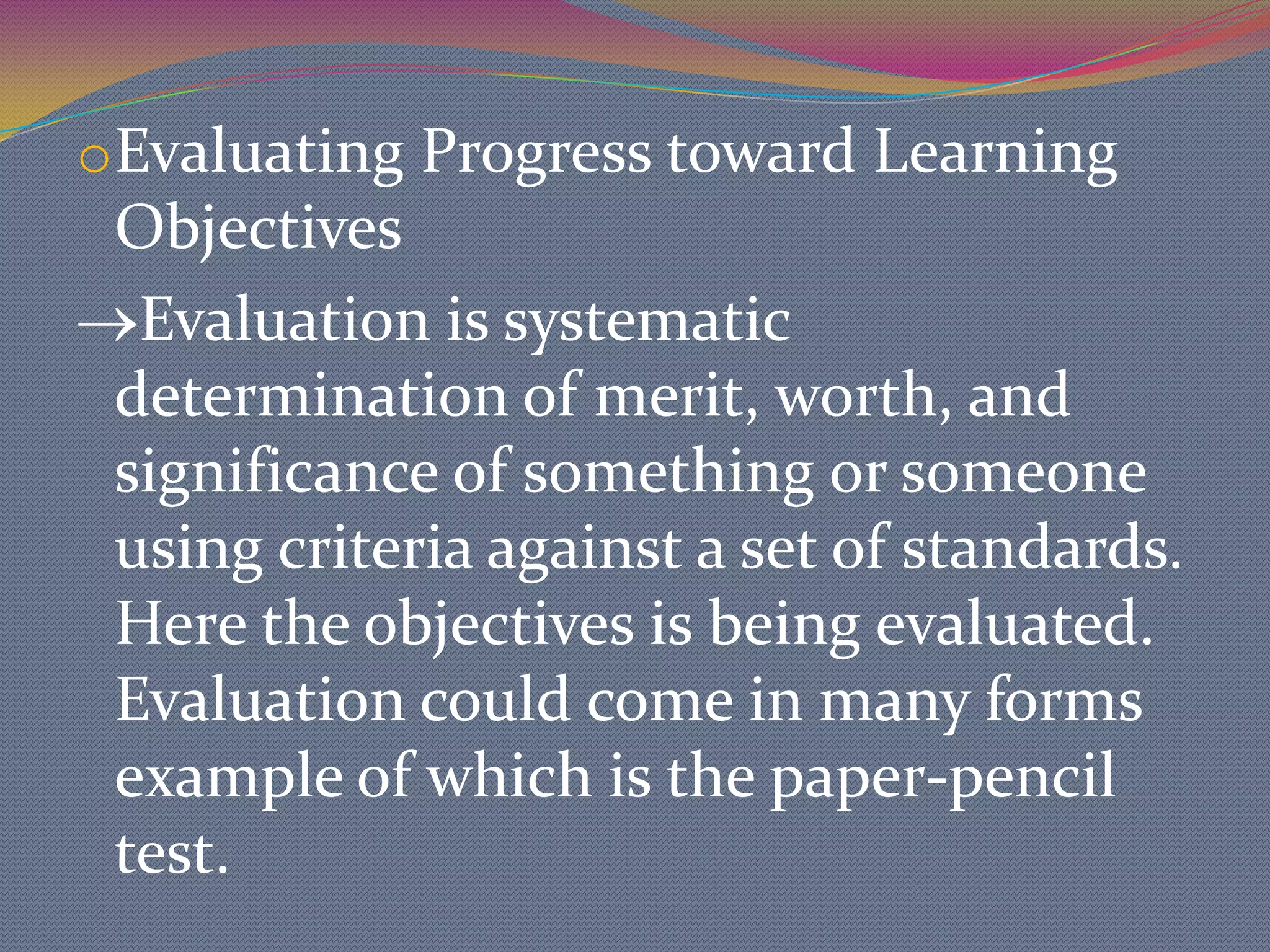
Evaluating Progress toward Learning Objectivesď‚®Evaluation is systematic determination of merit, worth, and significance of something or someone using criteria against a set of standards. Here the objectives is being evaluated. Evaluation could come in many forms example of which is the paper-pencil test.
C. THE ASSURE MODEL
What is Assure Model?A procedural guide for planning and delivering instruction that integrates technology and media into the teaching process.A systematic approach to writing lesson plans.
A plan used to help teachers organize instructional procedures. A model that can be used by all presentersA plan used to help teachers do an authentic assessment of student learning.
The six major steps:ANALYZE LEARNERSď‚®General characteristics:		This is a description of a class as a whole. This includes such information as the number of students, grade or age level, gender, socio-economic factors, exceptionalities and cultural or ethnic or other types of diversity.
ď‚®Entry Competencies:		This is a description of the types of knowledge expected of the learners. ď‚®Learning Styles:		This is a description of the learning stylistic preferences of the individual members of the class.
STATE OBJECTIVESď‚®Statements describing what the learner will do as a result of instruction. ď‚®Things to keep in mind as you write your objectives are:
Focus on the learner not the teacher.
Use behaviors that reflect real world concerns.
Objectives are descriptions of the learning outcomes and are written using the ABCD format.The ABCD format:AUDIENCE. Who is the audience? BEHAVIOR. What do you want them to do?
CONDITION. Under what circumstances or conditions are the learners to demonstrate the skill being taught? DEGREE. How well do you want them to demonstrate their mastery?
	ď‚®Use the following questions to assess objectives:Does the objective will allow you to do the following with your lesson?1. Identify what the expectations are for the learner
2. Identify the necessary requirements for the learning environment3. Assess learning4. Determine needs for appropriate media or materials
How would you classify your objective? Is the learning outcome primarily:1. Cognitive?2. Affective? 3. Psychomotor /motor skill?4. Interpersonal?5. Intrapersonal?
SELECT, MODIFY, DESIGN METHODS, MEDIA, AND MATERIALSď‚®This is the step  where the instructor will build a bridge between the audience and the objectives.
	You need to decide what method you will primarily use: a lecture, group work, a field trip, etc. What media you will use: photos, multimedia, video, a computer?Media Selection:1.  Media should be selected on the basis of student need.
2. We must consider the total learning situation.3.  Should follow learning objectives.	   4. Must be appropriate for the 	teaching format.5. Should be consistent with the 	students’ capabilities and learning 	styles.
	6. Should be chosen objectively.	7. Should be selected in order to best meet the learning outcomes.	8. No single medium is the total solution.	9. Does it match the curriculum?	10. Is it accurate and current?
11. Does it contain clear and concise language?12. Will it motivate and maintain interest?13. Does it provide for learner participation?14. Is it of good technical quality?
15. Is there evidence of its effectiveness?16. Is it free from objectionable bias and advertising?17. Is a user guide or other documentation included?
UTILIZE METHODS, MEDIA, AND MATERIALSď‚®Plan of how you are going to implement your media and materials.	    ď‚®In order to utilize materials 	correctly there 	are several steps 	to create good student-	centered 	instruction:
1. Preview the material2. Prepare the material3. Prepare the environment4. Prepare the learners5. Provide the learning experience
REQUIRE LEARNER PARTICIPATIONDescribe how you are going to get each learner “actively and individually” involved in the lesson. Example, games, group work, presentations, skit, etc.
EVALUATE AND REVISEDescribe how you will measure whether or not the lesson objectives were met. Were the media and instruction effective?
	Evaluate the student 	performance:How will you determine whether or not they met the lesson’s objective?The evaluation should match the objective. Some objectives can be adequately assessed with a pen and a paper test.
ď‚®Evaluate media components:How will you determine the media effectiveness?ď‚®Evaluate Instructor performance:How will you determine whether or not your own performance as instructor/facilitator was effective?
D. THE CONCRETE-ABSTRACT CONTINUUM MODEL
ď‚®The greatest amount of information can be presented in the least amount of time through printed or spoken words.
ď‚®But if students do not have the requisite background experience and knowledge to handle verbal symbols, the time saved in presentation will be the time lost in learning.
The teacher therefore should know if instructional methods and materials match learner’s background.
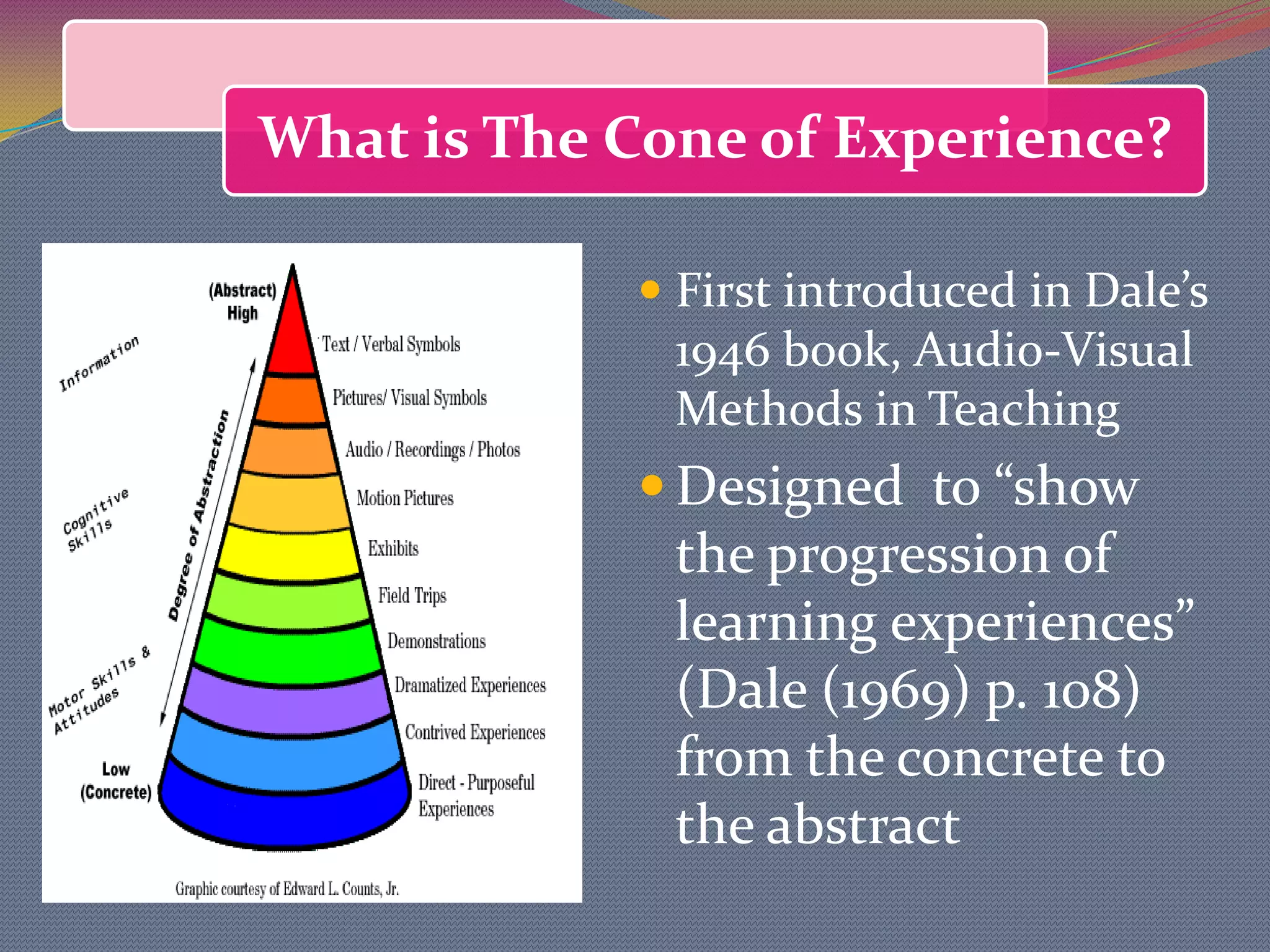
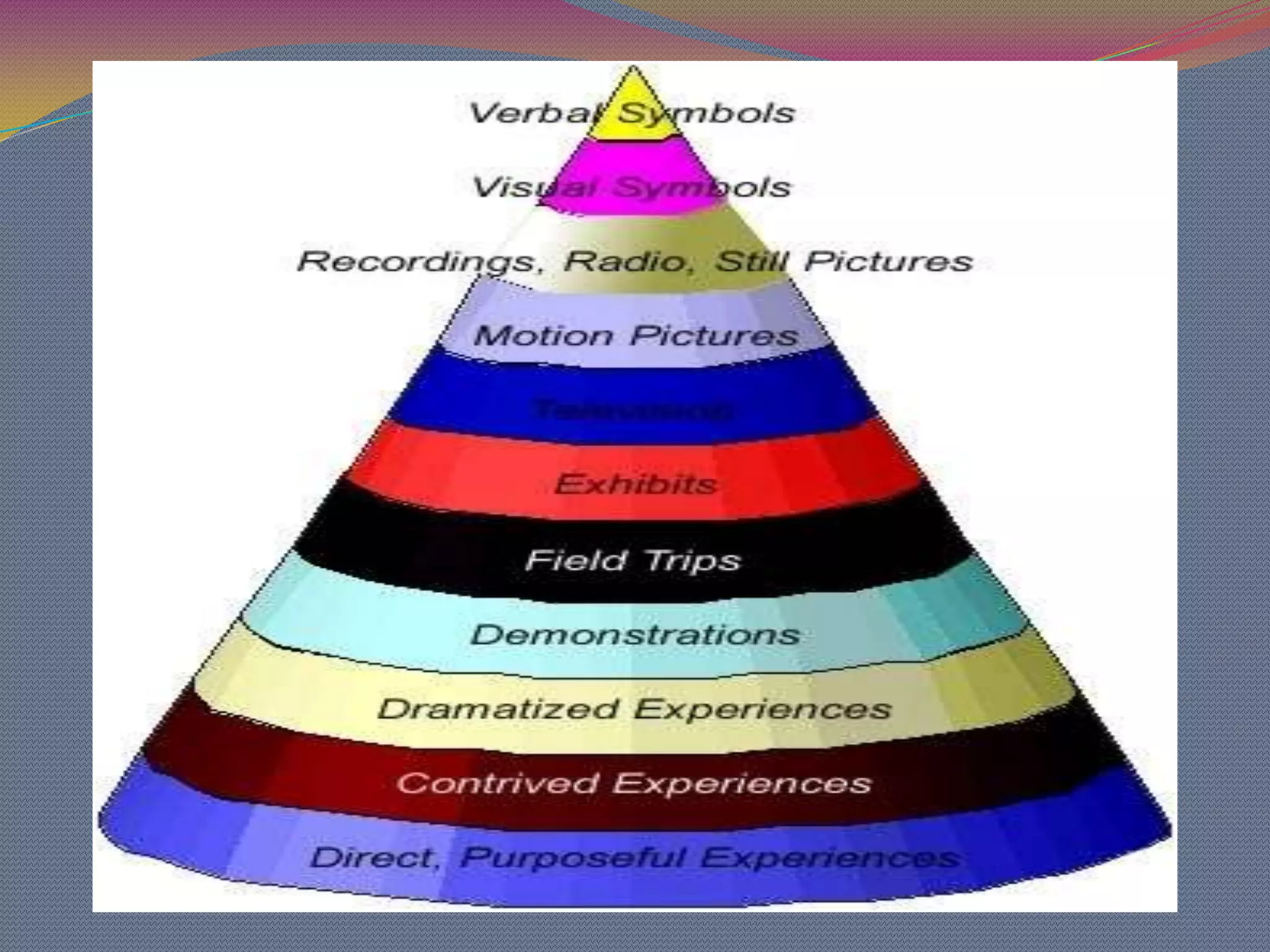
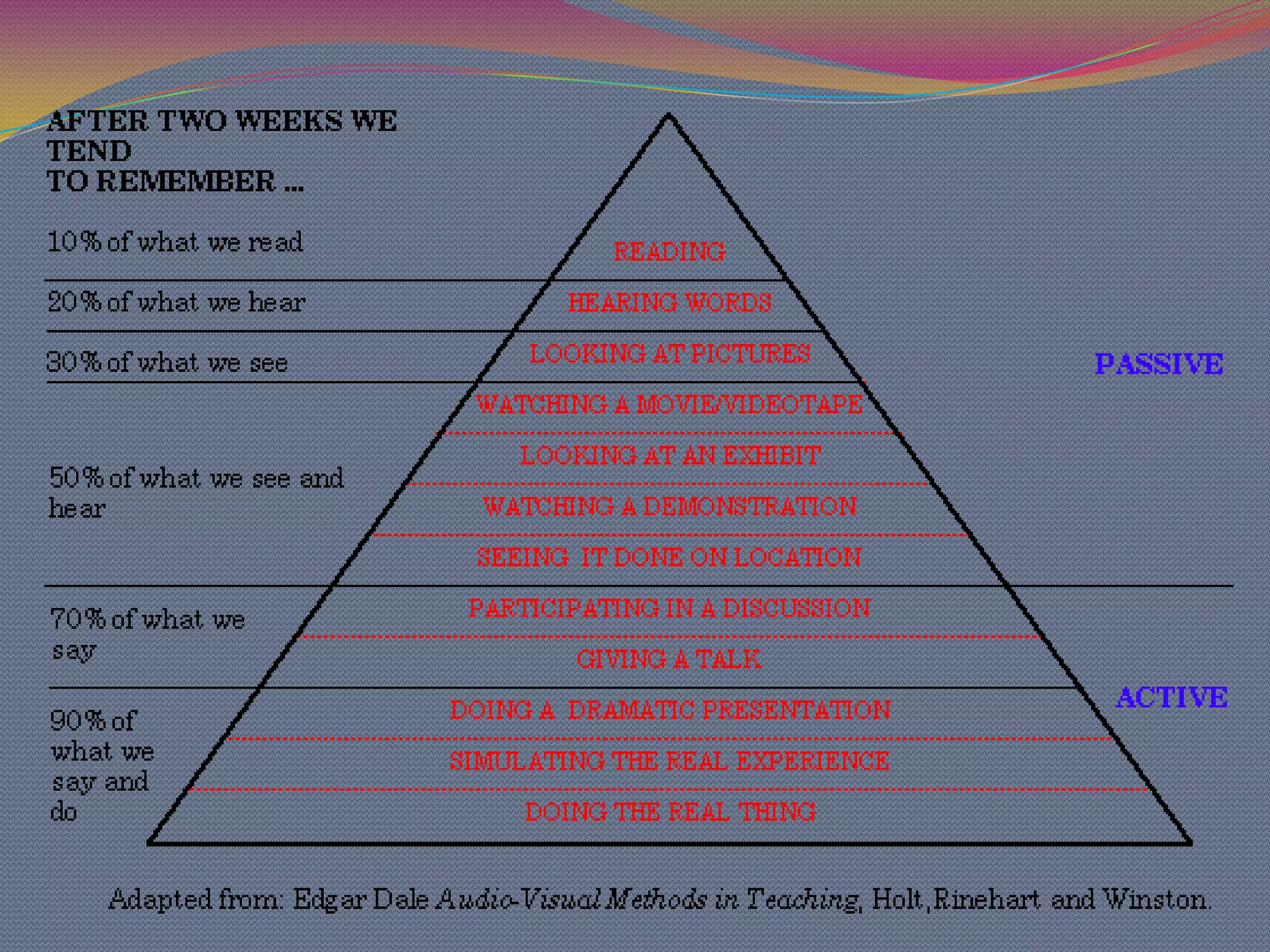
CONE OF EXPERIENCE Proponent of this is Edgar Dale  (1946) explained inter-relations of the several audio-visual materials and their positions in learning processesFirst introduced in Dale’s 1946 book, Audio-Visual Methods in Teaching
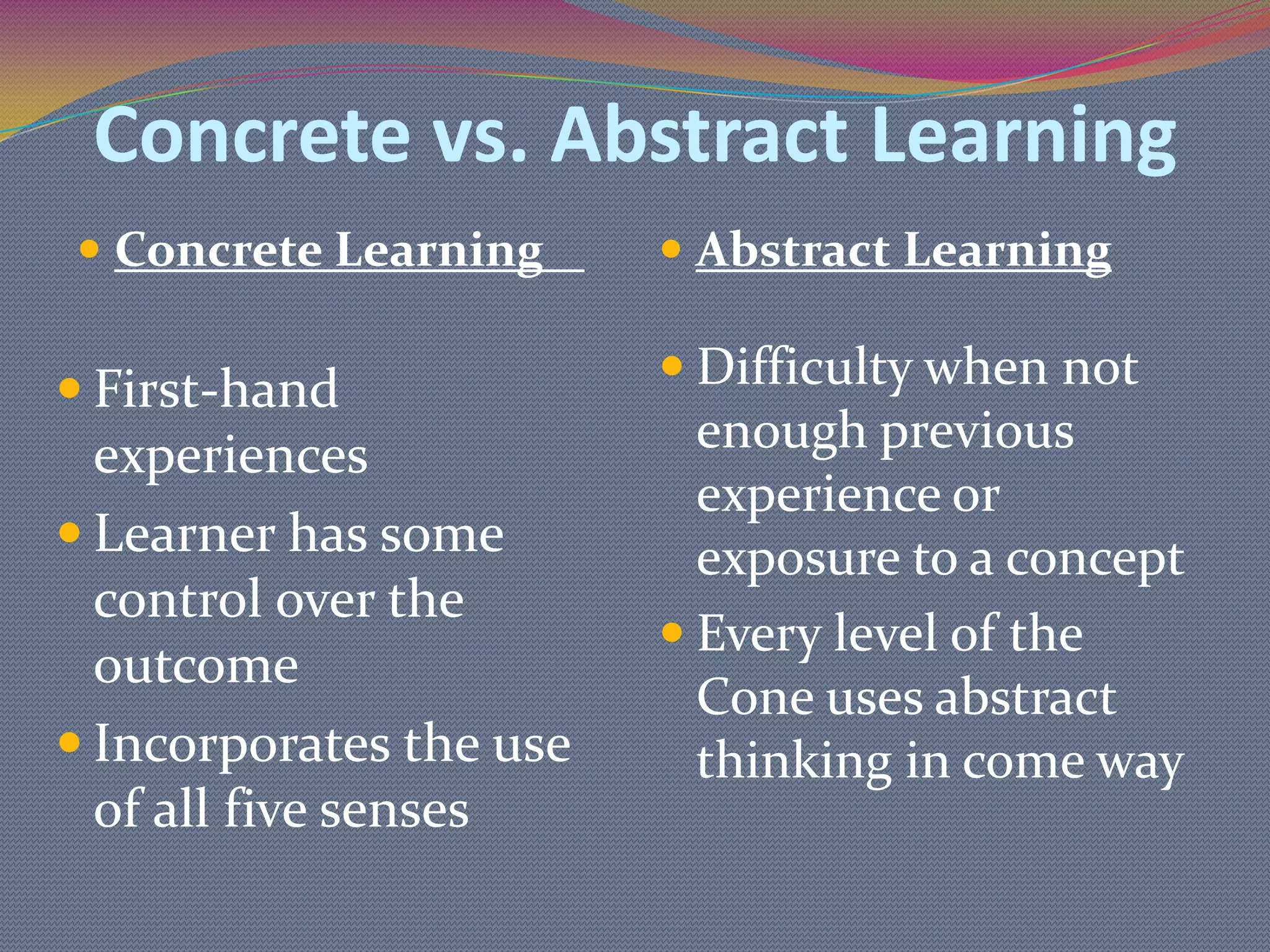
Designed  to “show the progression of learning experiences” (Dale (1969) p. 108)   from the concrete to the abstractConcrete vs. Abstract LearningConcrete Learning
AbstractLearning
Difficulty when not enough previous experience or exposure to a concept
Every level of the Cone uses abstract thinking in come way
First-hand experiences
Learner has some control over the outcome
Incorporates the use of all five sensesDale (1969) wrote that
May lead to a more useful way of thinking about audio visual materials and their application in the classroom
The levels of the Cone are interactive
As one moves up the Cone there is not necessarily an increase in difficulty but rather an increase in abstract thoughtIntentions of the Cone of Experience
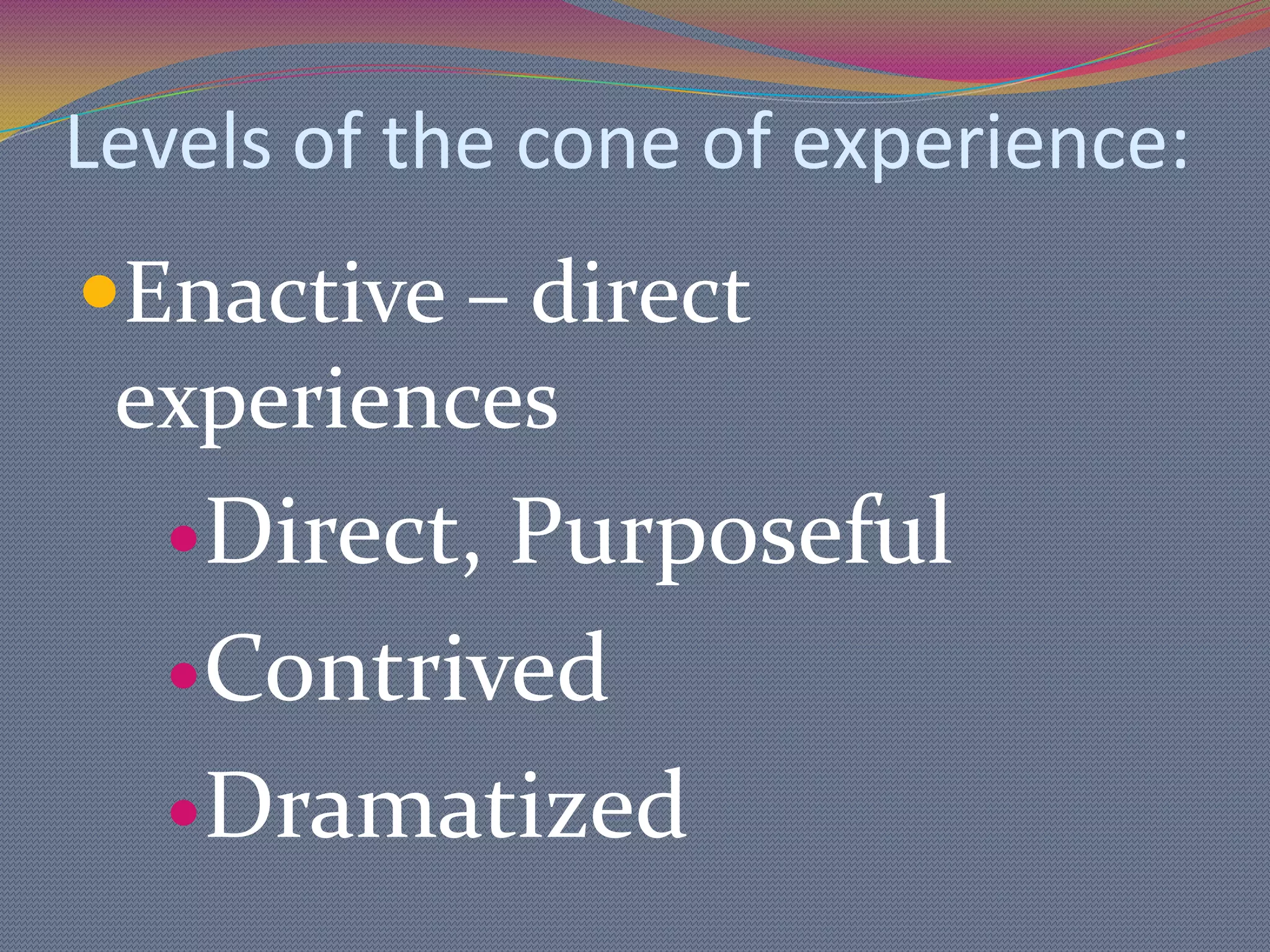
Levels of the cone of experience:Enactive – direct experiencesDirect, Purposeful ContrivedDramatized
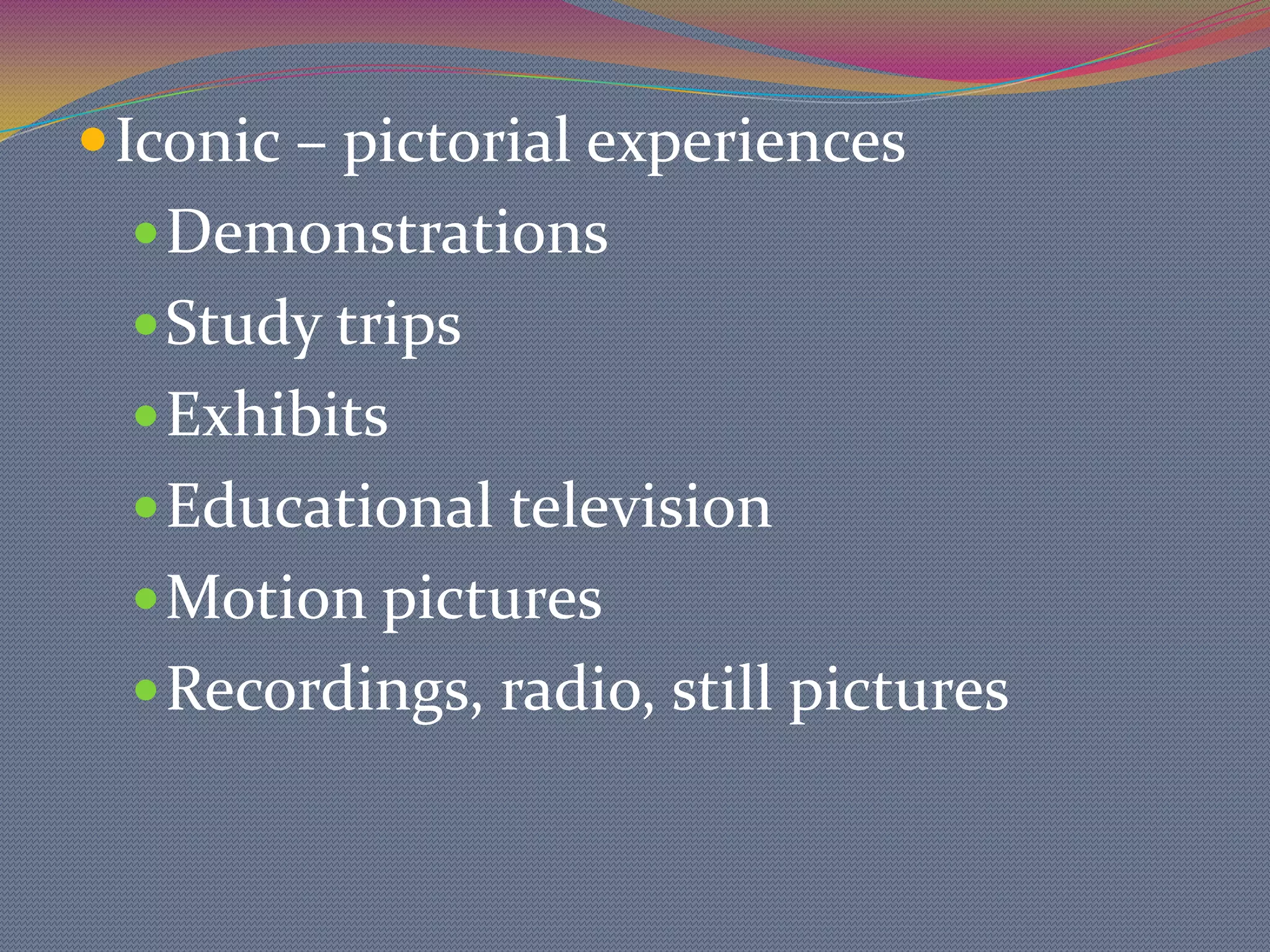
Iconic – pictorial experiencesDemonstrationsStudy tripsExhibitsEducational televisionMotion picturesRecordings, radio, still pictures
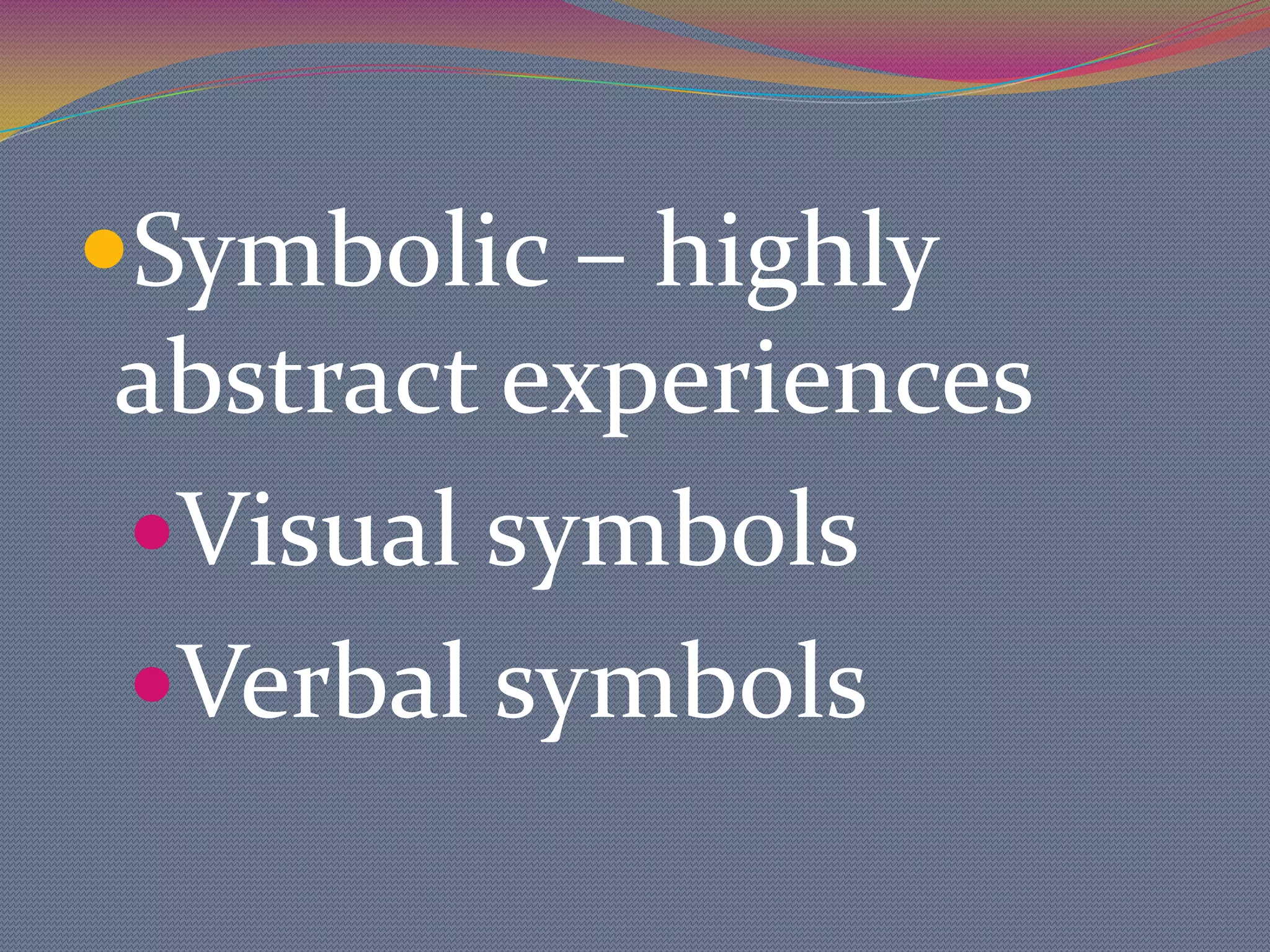
Symbolic – highly abstract experiencesVisual symbolsVerbal symbols
Direct and Purposeful ExperiencesDirect, first hand experiencesHave direct participation in the outcomeUse of all our sensesExamples:Working in a homeless shelterTutoring younger children
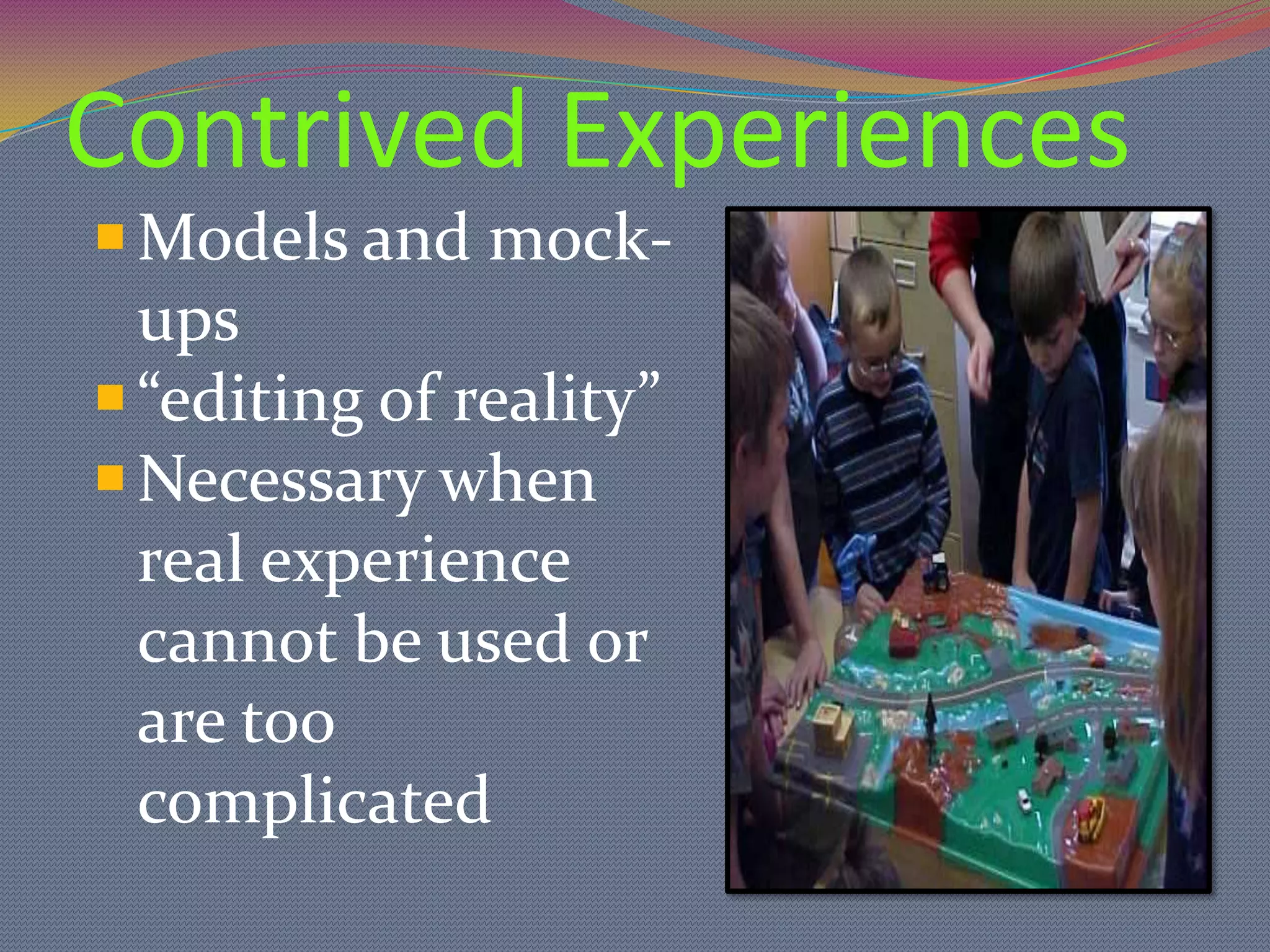
Contrived ExperiencesModels and mock-ups
“editing of reality”
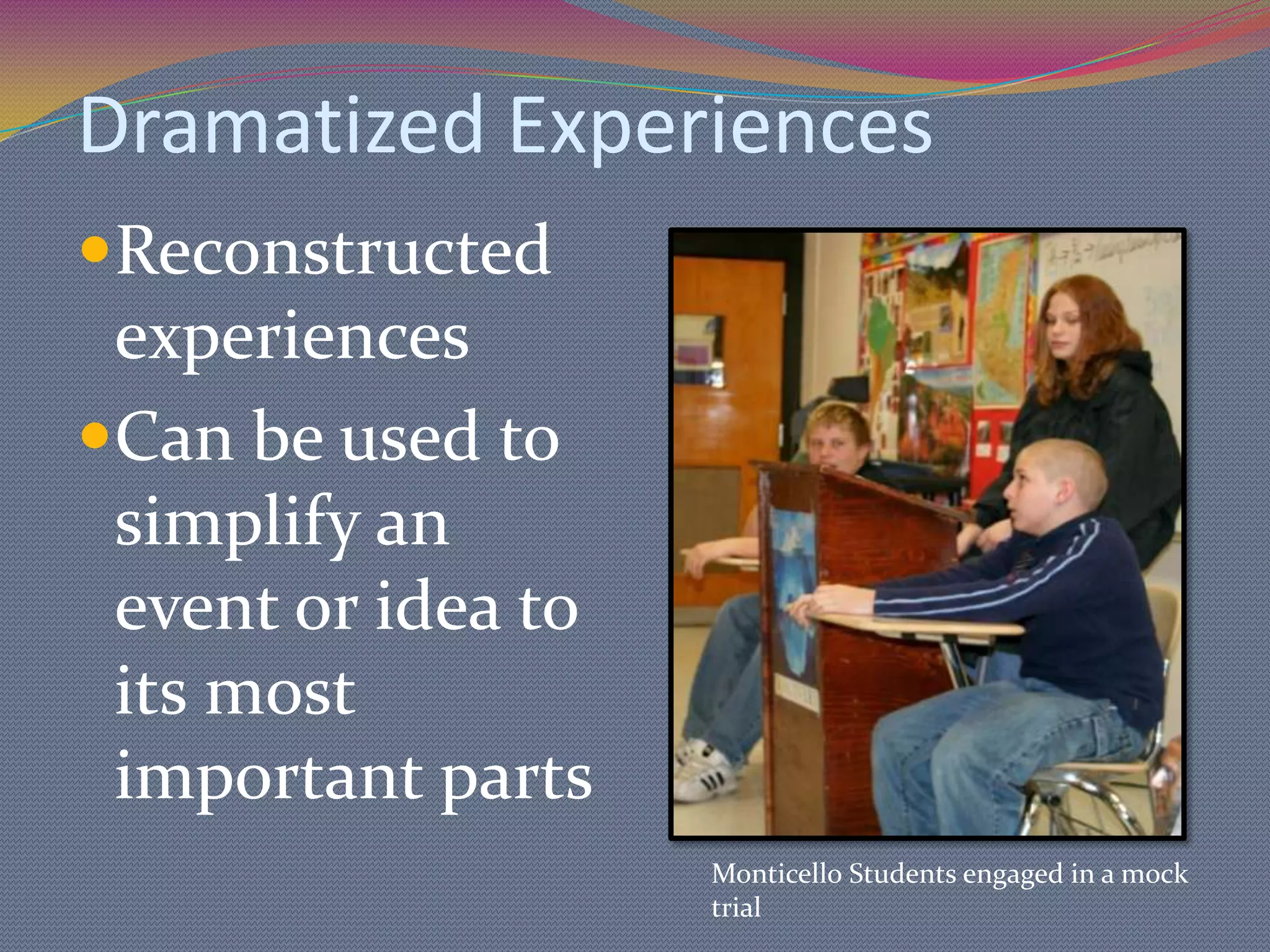
Necessary when real experience cannot be used or are too complicatedDramatized ExperiencesReconstructed experiences
Can be used to simplify an event or idea to its most important partsMonticello Students engaged in a mock trial
Divided into two categories
Acting – actual participation (more concrete)
Observing – watching a dramatization take place (more abstract)Iconic Experiences on the ConeProgressively moving toward greater use of imagination
Successful use in a classroom depends on how much imaginative involvement the method can illicit from studentsInvolves:
Demonstrations
Study trips
Exhibits
Motion pictures
Educational television
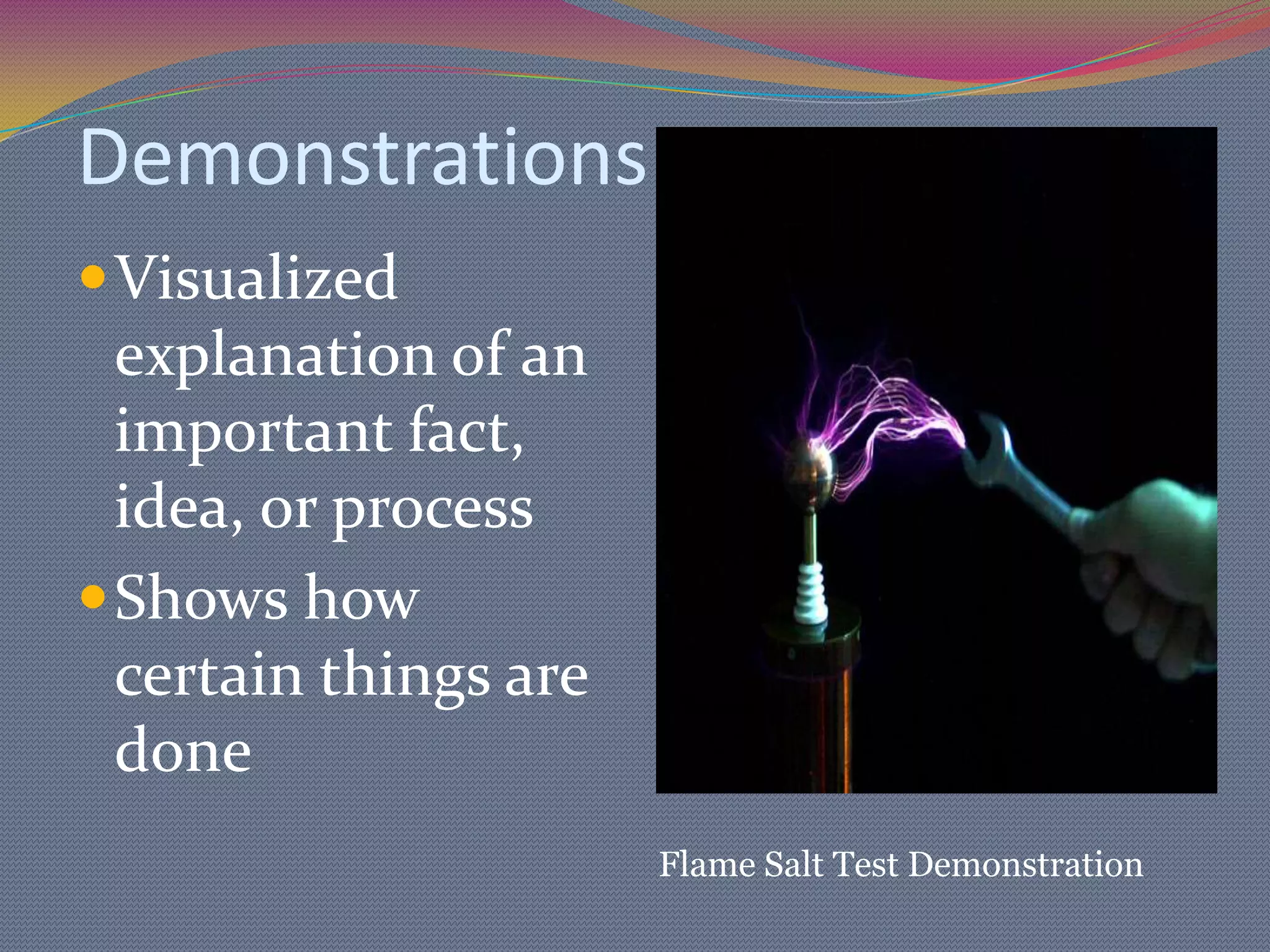
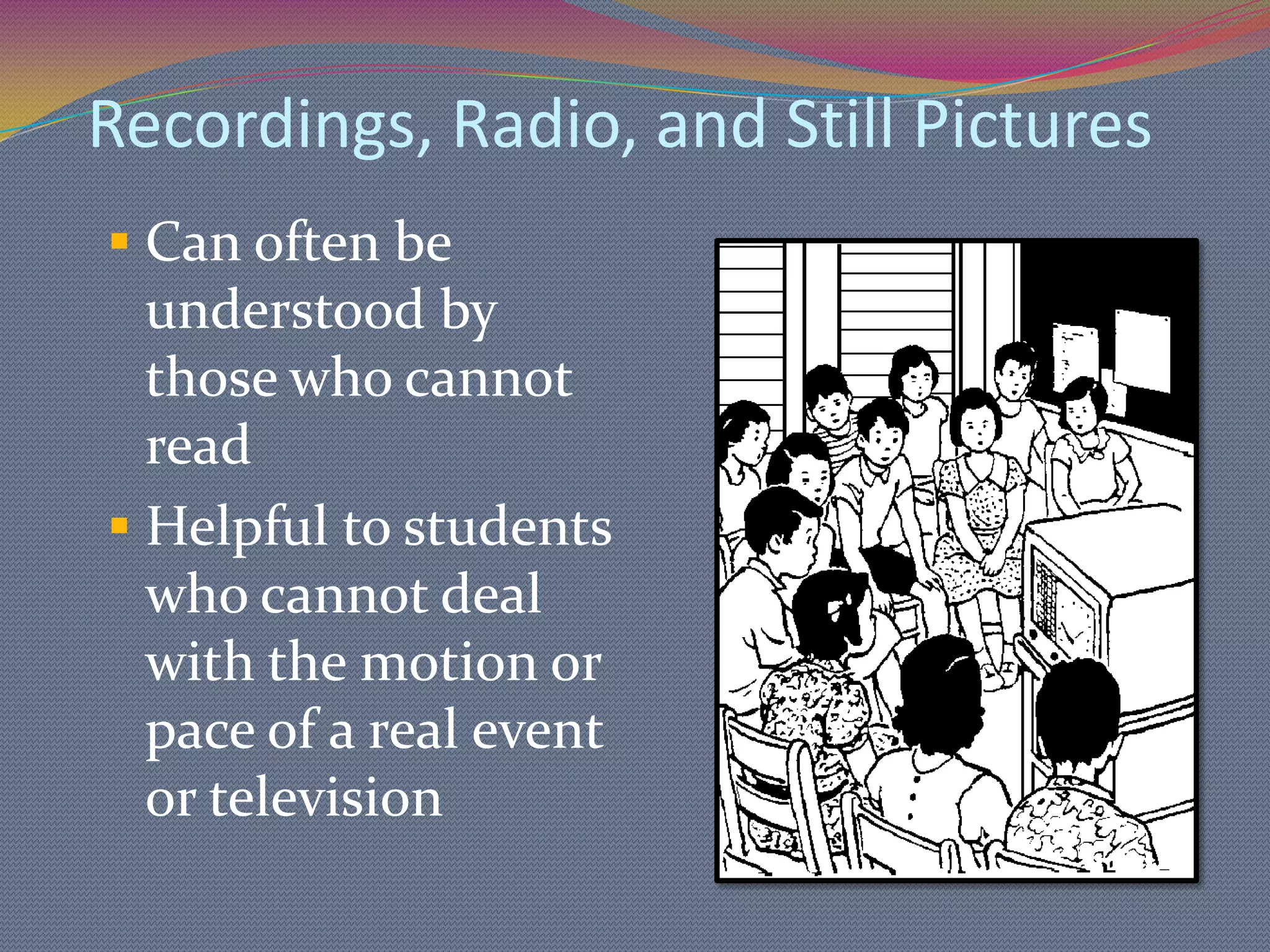
Radio, recordings, and still picturesDemonstrationsVisualized explanation of an important fact, idea, or process
Shows how certain things are doneFlame Salt Test Demonstration
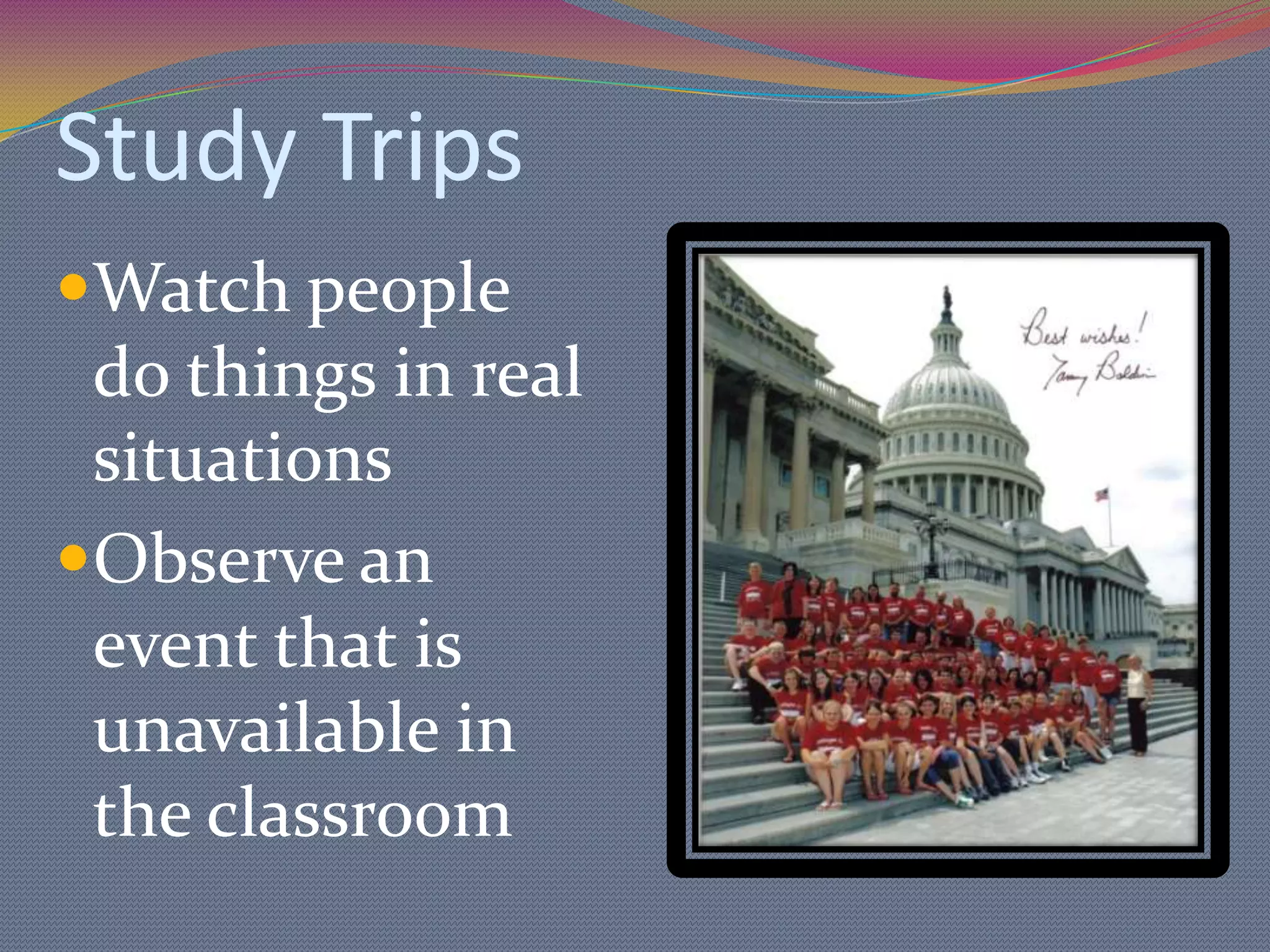
Study TripsWatch people do things in real situations
Observe an event that is unavailable in the classroomExhibitsSomething seen by a spectator
Two types
Ready made
Museum
Career fair
Home-made
Classroom project
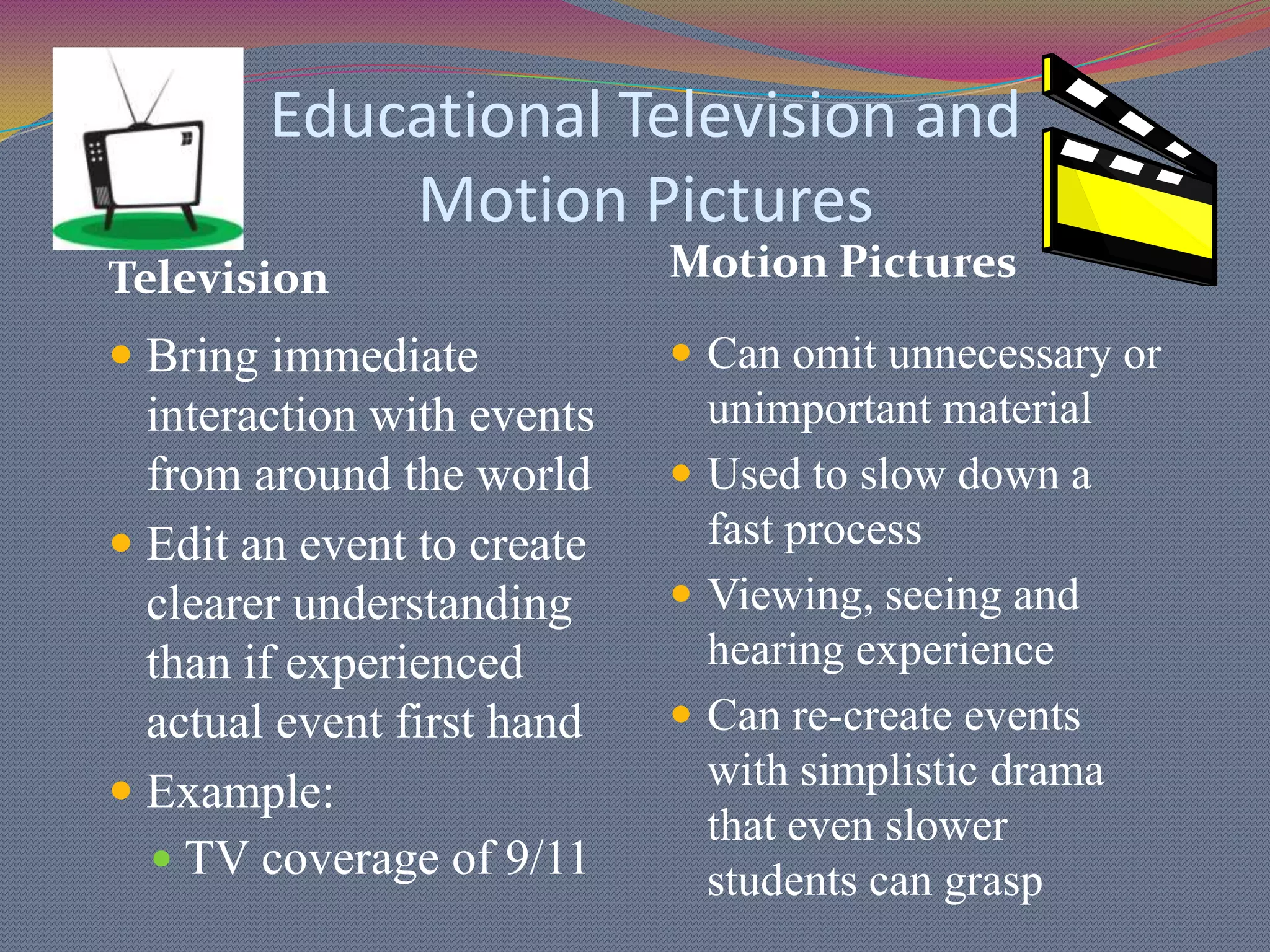
National History Day competitionEducational Television and Motion PicturesMotion PicturesTelevisionBring immediate interaction with events from around the world
Edit an event to create clearer understanding than if experienced actual event first hand
Example:

Instructional Development Models

  • 1.
  • 2.
    WHAT IS INSTRUCTIONALDEVELOPMENT MODELS ?
  • 3.
    Instructional developmentmodels specifically address challenges that are often called upon to produce materials and strategies to supportteaching and learning within environments that would seem to defy the probability of a successfuloutcome.
  • 4.
    These are modelsthat convey graphically, sometimes with extensive supporting text, the complex process by which educators develop instructional solutions.Models, as applied in thecontext of instructional design, can be used by to educators to convey between individuals meaning ofcomplex concepts, relationships, and processes, and facilitate study and research
  • 5.
    A. THE TEACHINGLEARNING CYCLE
  • 6.
  • 7.
    DIAGNOSING STUDENT’S NEEDS,ABILITIES AND INTERESTS
  • 8.
    SYSTEMATIC TECHNIQUES USEDFOR DIAGNOSING Work Sample ConferenceAnecdotal RecordsChecklistInterest Inventory Teacher Test Cloze Test Records like Form 137, permanent records, test results
  • 9.
    Home visits orcontacts with parents
  • 10.
    Direct contacts suchas observationsWORK SAMPLEFrom examining the most recent work of the students, the teacher can pinpoint the student’s specific strength and difficulties.
  • 11.
    CONFERENCEA one-on-one conversationbetween the teacher and the student puts the student at ease so that it becomes easy to have a free and open exchange of information
  • 12.
    ANECDOTAL RECORDSIt isa short written account about the behavior of a particular student.The record does not include any of the teacher’s opinion or evaluation of the behavior exhibited.
  • 13.
    CHECKLISTUsed to revealthe frequency of occurrence of the specific type of student behavior of interest to the teacherUsed to measure observable behaviors only
  • 14.
    INTEREST INVENTORYAsks studentsto rate their degree of like or dislike for a number of alternatives givento them.
  • 15.
    TEACHER TESTTwo types:Regulartest – given over preciously taught content
  • 16.
    Specially prepared diagnostictest – has little to do with the content to which students have been previosly exposedCLOZE TESTA good diagnostic device which shows the reading difficulty of an individualMEASURES:Language proficiency
  • 17.
  • 18.
  • 19.
    Reading comprehensionSETTING UPOF OBJECTIVES AND SELECTING CONTENT
  • 20.
    SELECTING CONTENTSome schoolsprovide teachers with curriculum guides, syllabi or course outlines to ease the problem of determining the scope and sequence of the subject-matter content to be taught.
  • 21.
    3 STEPS TOCONSIDER:First Step. Identification of the topi Topic areas are broad aspects of the content within a subject area.Second Step. Identifying major Goals of Instructor Goals refer to broad and general statements.Third Step. Generalization Generalizations are very specific that it gives the teacher a definite subject-matter to be discussed
  • 22.
    SETTING UP OFOBJECTIVESInstructional objectives describe the learning products or what the students are to expected to be able to do after being taught by the teacher.Objectives should be expressed in beahavioral terms to facilitate accurate evaluation of the learner’s performance.
  • 23.
    Preparing the Settingfor Learning and Selecting Instructional Strategies
  • 24.
    PREPARING THE SETTINGFOR LEARNINGGood classroom management is a term generally used to describe the maintenance of a healthy learning environment
  • 25.
    Formalizing Units andMaking Lesson Plans
  • 26.
    INSTRUCTIONAL UNITSIt isa planned sequence of learning activities or lesson covering a period of several weeks and centered around some major concepts, themes or topicsIt may be made-up of series of mainly content-orientedlessons or semi-individualized laboraroty-oriented, experience-centered unit assigments or any variety of combinations
  • 27.
    DEVELOPING INSTRUCTIONAL UNITSChoosingthe topic of theme.Selecting instructional goals or objectives organized into general and specific objectives.Preparing an outline of subject-matter content.Planning the learning activitiesOrganizing the activities into a plan.Securing and preparing the materials needed for the activitiesPlanning and preparing the evaluation materials and exercise
  • 28.
    CHOOSING THE TOPICOR THEMETeaching guides or syllabiusually provides teachers with an organozed and logically-arranged sets of topics to be taken up.
  • 29.
    SELECTING INSTRUCTIONAL GOALSTwoTypes:General Objectives – These are general statements of what the teacher hopes to accomplish through the study of the unit. It is usually the bird’s eye view of the unit.Specific Objectives – may be prepared in behavioral terms. It will be helpful to put these objectives under the appropriate headings: cognitive, psychomotor, and affective.
  • 30.
    PREPARING AN OUTLINEOF SUBJECT-MATTER CONTENTThis will help in making clear the subject-matter content to be covered by the different learning activities and in visualizing the organizations of the unit.
  • 31.
    PLANNING THE LEARNINGACTIVITESThese activities should be planed very carefully because on them depends the success of the accomplishment of the objectives.Two Types:basic activities for students- serves as provisions for the students who may not be academically inclinedoptional related activities – designed for students who may accomplish basic activities within a short period of time
  • 32.
    ORGANIZING ACTIVITES INTOPLANThree Phases:Initiation or Introduction Phase – sometimes called as the approach and is designed to:Stimulate interest and curiosity of the students in the unitsIntroduce what the unit is all aboutShow relationship of the present unit with the previousElicit suggestions from the learners for possible activities to undertake.
  • 33.
    Development Phase –activities and strategies that the teacher plans to develop key ideas in the unit. This stage gives opportunity for learners to take the basic and optional activities as planned by the teacher with possible modifications based in the suggestions of the students.Culminating Phase – Summarizes the various parts of the unit. It is during this phase that major or key ideas of the unit are highlighted, reviewed, and integrated.
  • 34.
    SECURING AND PREPARINGTHE MATERIALSIncludes list of reading material, pamphlets and newspapers, collection of audio-visual material and bibliography of books to be used. These materials are sure to provide students:with source when they forget their assignmentsTotal picture of what to expect that they doDefinite assignments so that students do not need to wait for the teacher for new assignmentsDefinite directions to eliminate misinterpretations
  • 35.
    PREPARING FOR EVALUATIONChecklists,rating scales, role-playing situations and group discussions can serve as evaluation exercises as well as unit tests.
  • 36.
    LESSON PLANSThis refersto a more specific plans for a given period.It describes in details what the teacher and students will do on a day to implement the unit objectives.
  • 37.
    THE LESSON PLANFORMATObjectives or TargetsContent or Subject- matter and materialsProcedure or strategyEvaluations or applicationAssignment or agreement and special reminders
  • 38.
    Objectives or targets– definite statements of what to are to be learned in the lesson. To formulate instrucitonal objectives, in behavioral terms, the teacher has to use verbs indicating observable behavior.Content or Subject-Matter and Materials – indicates the subject-matter that the teacher believes will help attain his objectives as well as materials and illustrations he may need.Procedure or Strategy – Documents the occurrence of activites that the teacher and his students are going to do during the period.Assignments or Agreement and special Reminders - the effectiveness of assignments will determine the success of the new lesson the next day.
  • 39.
    Motivating Students AndGuiding the Learning Activities
  • 40.
    MOTIVATIONMotivation is definedas something that stimulates, energizes, directs and sustain behavior or anything that arouses and sustains people to do whatever it is they do . It underlies the student’s behavior. It is usually responsible for the discipline and control of problems and consequently lack of effective learning in the classroom.
  • 41.
    Hierarchy of Needsby Maslow may help the teacher in solving problems with regards to motivating students
  • 42.
    GENERAL APPROACHESTHAT SEEMTO DEVELOP POSITIVE MOTIVATIONBuilding up of student’s self-esteemUtilizing student’s present motives.Making potential learning seem worthwhile.Helping students establish suitable tasks and objectivesKeeping up paceCreating a receptive mood
  • 43.
    Building up students’Self-Esteem – To build one’s self-esteem and gain recognition of the peer group, one needs a feeling of success. Thus, teachers should provide opportunities for success even to the least successful students and give due recognition to them in a tangible way.Using Present Motives – Present motives includes the interest, attitudes and ideals, curiosity, needs for security, need for action and adventure, desire for play and fun, and need for friendship.Making learning seem Worthwhile – Teacher should make efforts to show that the students are valuable to them. Intrinsic motivation is most effective in bringing about learning. It stimulates individual to undertake activities to satisfy deeply felt personal needs.
  • 44.
    Extrinsic Motivation refersto conditions that impels an individual to accomplish a task because of rewards available in the environment.Establishing Appropriate Goals – Students should be made to see both their long-term goals (provides the over-all direction to their behavior) and short-term goals (responsible for stimulating students everyday).Keeping up the Pace of the Class – Making students participate their own learning and helping in their learning can be a good source of motivation. Provide challenging yet not discouraging tasks, these will make the students work harder.Creating a Receptive Mood – tuning the mind sets of the students through intriguing questions.
  • 45.
    GUIDING LEARNING ACTIVITIESRefersto techniques and strategies which can provide variety in the approaches of the teacher.Recitation Open-Text recitationLectureInformal Teacher TalksQuestionsPractice and ReviewInquiry and Discovery TeachingRole-PlayingTeacher DemonstrationField Trips Resource Persons
  • 46.
  • 47.
    3 types ofEvaluation:Summative evaluation refers to the evaluation the teachers undertakes at the end of the unit or the course in order to grade students and judge his own teaching success.Formative evaluation refers to the evaluation the teacher performs in the course of his teaching to find out how well he is doing and what he needs to do nextDiagnostic evaluation refers to the evaluation the teacher does at the beginning to determine the different levels to which the students belong to serve as basic for grouping them into slow, average, or fast group.
  • 48.
    TOOLS FOR MEASUREMENTAND EVALUTIONObservation and Work Samples – Actual observation and examination of work samples are the two of the bases for evaluating the student’s performance.Rating Scales – Rating scales are used for evaluating skills, procedures, and personal social behavior.Checklist - It indicates the presence or absence of characteristics. It is most useful in evaluating products and procedures.Tests – These are systematic procedures for measuring the results or effects of instruction on learning.
  • 49.
    Types of Tests:Standardsurvey tests aim to measure the attainment process or status of the students or the school.Standard achievement tests aim to measure the student’s achievement as a result of instruction in a given subject or subjects.Diagnostic test aim to locate weaknesses and difficulties to students and if possible, the causes of such difficulties in the performance.Inventory test aim to measure the degree of mastery before the teaching of the subjects.Informal or teacher-made tests aim to measure the achievement, progress, weakness of defects of an individual student
  • 50.
    OBJECTIVE TYPE TESTS:CompletionItems most useful in assessing student thinking at the lower cognitive levels of knowledge and comprehension.Matching items are also used to measure student’s thinking at the levels of knowledge and comprehension.Multiple-choice Items have the capacity to test not only for knowledge and comprehension but also for some higher-level thinking abilities.True-False Items are generally used yo assess knowledge level thinking. They can be prepared and graded relatively.
  • 51.
    GRADING AND REPORTINGSTUDENTRecognized and accepted as one of the most difficult responsibilities of the teacher is grading and reporting the progress of students in their school work.The most important purpose that should be kept in mind is that reports should facilitate the educational development o each student in relation to his ability.
  • 52.
    DETERMINING PROMOTION ANDRETENTIONHelp each child become the best person he is capable o being, considering his natural abilities and regardless his socio-economic background.
  • 53.
    MOTIVATING PUPILSOne othe most popular techniques used by teachers to stimulate students to learn is the school mark or grade. MANNERS IN WHICH STUDENTS MOTIVATION ARE AEECTED BY GRADES:The standard his performance is compared toParents’ and friends attitudes towards gradesThe teacher’s emphasis on grades
  • 54.
    PLANNING CURRENT SCHOOLWORKThegrades they receive every grading period can serve as basis or current planning schoolwork because the grades reflect the areas wherein the students are weak or strong.
  • 55.
    B. MODELS FORFACILITATING LEARNING
  • 56.
    Establishing effective learningoutcomes first will guide every decision you make regarding the content, activities, and tools you use to achieve those outcomes.There are two kinds of learning outcomes:
  • 57.
    Assessing Learner’s CapabilitiesAssessmentis the process of gathering information about a student in order to make decisions about his or her education.Designing, Selecting, Implementing Learning ActivitiesLearning Activities includes the methods and strategies in implementing learning.
  • 58.
    Evaluating Progress towardLearning Objectivesď‚®Evaluation is systematic determination of merit, worth, and significance of something or someone using criteria against a set of standards. Here the objectives is being evaluated. Evaluation could come in many forms example of which is the paper-pencil test.
  • 59.
  • 60.
    What is AssureModel?A procedural guide for planning and delivering instruction that integrates technology and media into the teaching process.A systematic approach to writing lesson plans.
  • 61.
    A plan usedto help teachers organize instructional procedures. A model that can be used by all presentersA plan used to help teachers do an authentic assessment of student learning.
  • 62.
    The six majorsteps:ANALYZE LEARNERSď‚®General characteristics: This is a description of a class as a whole. This includes such information as the number of students, grade or age level, gender, socio-economic factors, exceptionalities and cultural or ethnic or other types of diversity.
  • 63.
    ď‚®Entry Competencies: This isa description of the types of knowledge expected of the learners. ď‚®Learning Styles: This is a description of the learning stylistic preferences of the individual members of the class.
  • 64.
    STATE OBJECTIVESď‚®Statements describingwhat the learner will do as a result of instruction. ď‚®Things to keep in mind as you write your objectives are:
  • 65.
    Focus on thelearner not the teacher.
  • 66.
    Use behaviors thatreflect real world concerns.
  • 67.
    Objectives are descriptionsof the learning outcomes and are written using the ABCD format.The ABCD format:AUDIENCE. Who is the audience? BEHAVIOR. What do you want them to do?
  • 68.
    CONDITION. Under whatcircumstances or conditions are the learners to demonstrate the skill being taught? DEGREE. How well do you want them to demonstrate their mastery?
  • 69.
    ď‚®Use the followingquestions to assess objectives:Does the objective will allow you to do the following with your lesson?1. Identify what the expectations are for the learner
  • 70.
    2. Identify thenecessary requirements for the learning environment3. Assess learning4. Determine needs for appropriate media or materials
  • 71.
    How would youclassify your objective? Is the learning outcome primarily:1. Cognitive?2. Affective? 3. Psychomotor /motor skill?4. Interpersonal?5. Intrapersonal?
  • 72.
    SELECT, MODIFY, DESIGNMETHODS, MEDIA, AND MATERIALSď‚®This is the step where the instructor will build a bridge between the audience and the objectives.
  • 73.
    You need todecide what method you will primarily use: a lecture, group work, a field trip, etc. What media you will use: photos, multimedia, video, a computer?Media Selection:1. Media should be selected on the basis of student need.
  • 74.
    2. We mustconsider the total learning situation.3. Should follow learning objectives. 4. Must be appropriate for the teaching format.5. Should be consistent with the students’ capabilities and learning styles.
  • 75.
    6. Should bechosen objectively. 7. Should be selected in order to best meet the learning outcomes. 8. No single medium is the total solution. 9. Does it match the curriculum? 10. Is it accurate and current?
  • 76.
    11. Does itcontain clear and concise language?12. Will it motivate and maintain interest?13. Does it provide for learner participation?14. Is it of good technical quality?
  • 77.
    15. Is thereevidence of its effectiveness?16. Is it free from objectionable bias and advertising?17. Is a user guide or other documentation included?
  • 78.
    UTILIZE METHODS, MEDIA,AND MATERIALSď‚®Plan of how you are going to implement your media and materials. ď‚®In order to utilize materials correctly there are several steps to create good student- centered instruction:
  • 79.
    1. Preview thematerial2. Prepare the material3. Prepare the environment4. Prepare the learners5. Provide the learning experience
  • 80.
    REQUIRE LEARNER PARTICIPATIONDescribehow you are going to get each learner “actively and individually” involved in the lesson. Example, games, group work, presentations, skit, etc.
  • 81.
    EVALUATE AND REVISEDescribehow you will measure whether or not the lesson objectives were met. Were the media and instruction effective?
  • 82.
    Evaluate the student performance:How will you determine whether or not they met the lesson’s objective?The evaluation should match the objective. Some objectives can be adequately assessed with a pen and a paper test.
  • 83.
    ď‚®Evaluate media components:Howwill you determine the media effectiveness?ď‚®Evaluate Instructor performance:How will you determine whether or not your own performance as instructor/facilitator was effective?
  • 84.
  • 85.
    ď‚®The greatest amountof information can be presented in the least amount of time through printed or spoken words.
  • 86.
    ď‚®But if studentsdo not have the requisite background experience and knowledge to handle verbal symbols, the time saved in presentation will be the time lost in learning.
  • 87.
    The teacher thereforeshould know if instructional methods and materials match learner’s background.
  • 88.
    CONE OF EXPERIENCEProponent of this is Edgar Dale (1946) explained inter-relations of the several audio-visual materials and their positions in learning processesFirst introduced in Dale’s 1946 book, Audio-Visual Methods in Teaching
  • 89.
    Designed to“show the progression of learning experiences” (Dale (1969) p. 108) from the concrete to the abstractConcrete vs. Abstract LearningConcrete Learning
  • 90.
  • 91.
    Difficulty when notenough previous experience or exposure to a concept
  • 92.
    Every level ofthe Cone uses abstract thinking in come way
  • 93.
  • 94.
    Learner has somecontrol over the outcome
  • 95.
    Incorporates the useof all five sensesDale (1969) wrote that
  • 96.
    May lead toa more useful way of thinking about audio visual materials and their application in the classroom
  • 97.
    The levels ofthe Cone are interactive
  • 98.
    As one movesup the Cone there is not necessarily an increase in difficulty but rather an increase in abstract thoughtIntentions of the Cone of Experience
  • 100.
    Levels of thecone of experience:Enactive – direct experiencesDirect, Purposeful ContrivedDramatized
  • 101.
    Iconic – pictorialexperiencesDemonstrationsStudy tripsExhibitsEducational televisionMotion picturesRecordings, radio, still pictures
  • 102.
    Symbolic – highlyabstract experiencesVisual symbolsVerbal symbols
  • 103.
    Direct and PurposefulExperiencesDirect, first hand experiencesHave direct participation in the outcomeUse of all our sensesExamples:Working in a homeless shelterTutoring younger children
  • 104.
  • 105.
  • 106.
    Necessary when realexperience cannot be used or are too complicatedDramatized ExperiencesReconstructed experiences
  • 107.
    Can be usedto simplify an event or idea to its most important partsMonticello Students engaged in a mock trial
  • 108.
  • 109.
    Acting – actualparticipation (more concrete)
  • 110.
    Observing – watchinga dramatization take place (more abstract)Iconic Experiences on the ConeProgressively moving toward greater use of imagination
  • 111.
    Successful use ina classroom depends on how much imaginative involvement the method can illicit from studentsInvolves:
  • 112.
  • 113.
  • 114.
  • 115.
  • 116.
  • 117.
    Radio, recordings, andstill picturesDemonstrationsVisualized explanation of an important fact, idea, or process
  • 118.
    Shows how certainthings are doneFlame Salt Test Demonstration
  • 119.
    Study TripsWatch peopledo things in real situations
  • 120.
    Observe an eventthat is unavailable in the classroomExhibitsSomething seen by a spectator
  • 121.
  • 122.
  • 123.
  • 124.
  • 125.
  • 126.
  • 127.
    National History DaycompetitionEducational Television and Motion PicturesMotion PicturesTelevisionBring immediate interaction with events from around the world
  • 128.
    Edit an eventto create clearer understanding than if experienced actual event first hand
  • 129.
  • 130.
  • 131.
    Can omit unnecessaryor unimportant material
  • 132.
    Used to slowdown a fast process
  • 133.
    Viewing, seeing andhearing experience
  • 134.
    Can re-create eventswith simplistic drama that even slower students can graspRecordings, Radio, and Still PicturesCan often be understood by those who cannot read
  • 135.
    Helpful to studentswho cannot deal with the motion or pace of a real event or televisionSymbolic ExperiencesVery little immediate physical action
  • 136.
    Difficult only ifone doesn’t have enough direct experience to support the symbol
  • 137.
    Used at alllevels of the Cone in varying importance
  • 138.
  • 139.
  • 140.
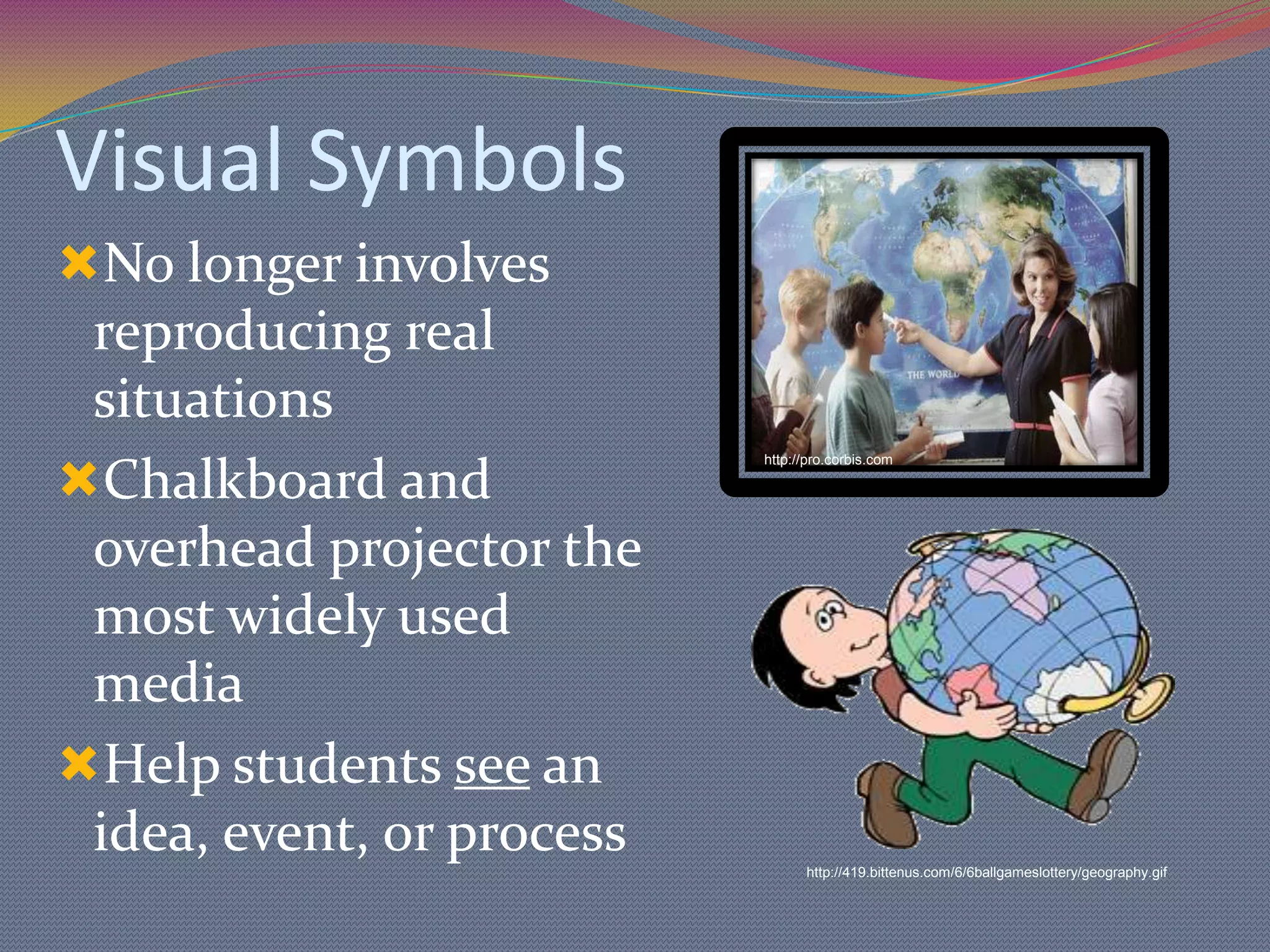
    Verbal symbolsVisual SymbolsNolonger involves reproducing real situations
  • 141.
    Chalkboard and overheadprojector the most widely used media
  • 142.
    Help students seean idea, event, or processhttp://pro.corbis.comhttp://419.bittenus.com/6/6ballgameslottery/geography.gif
  • 143.
  • 144.
  • 145.
  • 146.
  • 147.
  • 148.
    Explanation/lectureWhat does theCone mean for instruction?Dale (1938) taught teachers that they should help their students learn how the media effects us, and to critically evaluate it.Teachers must evaluate the benefit of the learning vs. the amount of time required in the lesson
  • 149.
    How to effectivelyuse instructional media to helping students move from concrete to abstract thought.Conclusion:The Cone of Experience is a visual device to aid teachers in the selection of instructional media
  • 150.
    The Cone isbased on the movement from concrete experiences to abstract experiencesThe literal interpretation of the Cone has resulted in misconceptions of its use
  • 151.
    The Cone haspractical applications in classroom instruction The Advent of Active Learning * Most of the time, in a typical classroom setting, students are involved only passively in learning, i.e., in listening to the instructor, looking at the occasional overhead or slide, and reading (when required) the text book.
  • 152.
    Active Learning:It isinvolving students directly and actively in the learning process itself. This means that instead of simply receiving information verbally and visually, students are receiving and participating and doing.
  • 153.
    The Cone ofLearning According to Ronald A. Berk in his book "Professors are from Mars. Students are from Snickers”, the only way to get 100% retention of information is by :hearing, seeing, doing, smelling, feeling, tasting, inhaling, injecting and purchasing on credit
  • 154.
    ADVANTAGES OF ACTIVELEARNING student-faculty interaction, student-student interaction, academic achievement (i.e., grades), communication skills,
  • 155.
    higher-level thinking skills,teamwork, attitude towards the subject and motivation to learn
  • 156.
    The reason whyit works is that: individual students may get stuck on a problem and give up, whereas groups of students tend to keep going,
  • 157.
    students become exposedto alternative problem-solving strategies, students are much less fearful of generating and answering questions among themselves than individually and directly to the instructor in class
  • 158.
    THE THREE-TIERED MODELOF LEARNING Jerome Bruner, a constructivist, proposed three systems of processing information by which people understand their world.
  • 159.
    He suggested thatpeople respond to the environment through action or patterned motor acts, through conventialized imagery and perception, and through language and reason.  These capabilities formed the basis for the three modes of representation:
  • 160.
    Enactive representation refersto a mode of representing past events through appropriate motor responses.
  • 161.
    Iconic representation enablesthe perceiver to summarize events by the select organization of percepts and images 
  • 162.
    Symbolic representation comesabout with the acquisition of a symbol system that represents things by design features that include remoteness and arbitrariness (language, musical notation, mathematical notation)
  • 163.
    Sequence and instruction Theenactive through iconic to symbolic sequence of intellectual development suggests appropriate sequences for instruction (obviously sequences in that manner). 
  • 164.
    In order todetermine the proper sequencing of material, the designer must know something about the learner's prior knowledge and dominant modes of thinking. 
  • 165.
    Are they capable,for example, of thinking symbolically?  Also, Bruner indicated that sequence cannot be determined in absence of knowing the criterion on which final learning will be judges (both of these are reminiscent of behavioral/cognitive goals of learner analysis and task analysis).
  • 166.
    IMPLICATIONS TO INSTRUCTION1.)instructionare to use manipulables and tactile instructional strategies with young children to teach concepts with which learners have no prior experience
  • 167.
    2.)instruction are toaccompany instruction with diagrams and other strategies that appeal to the imagination 3.) instruction are to use familiar symbol systems when teaching new concepts in a subject with the learner already has prior experience
  • 168.