1
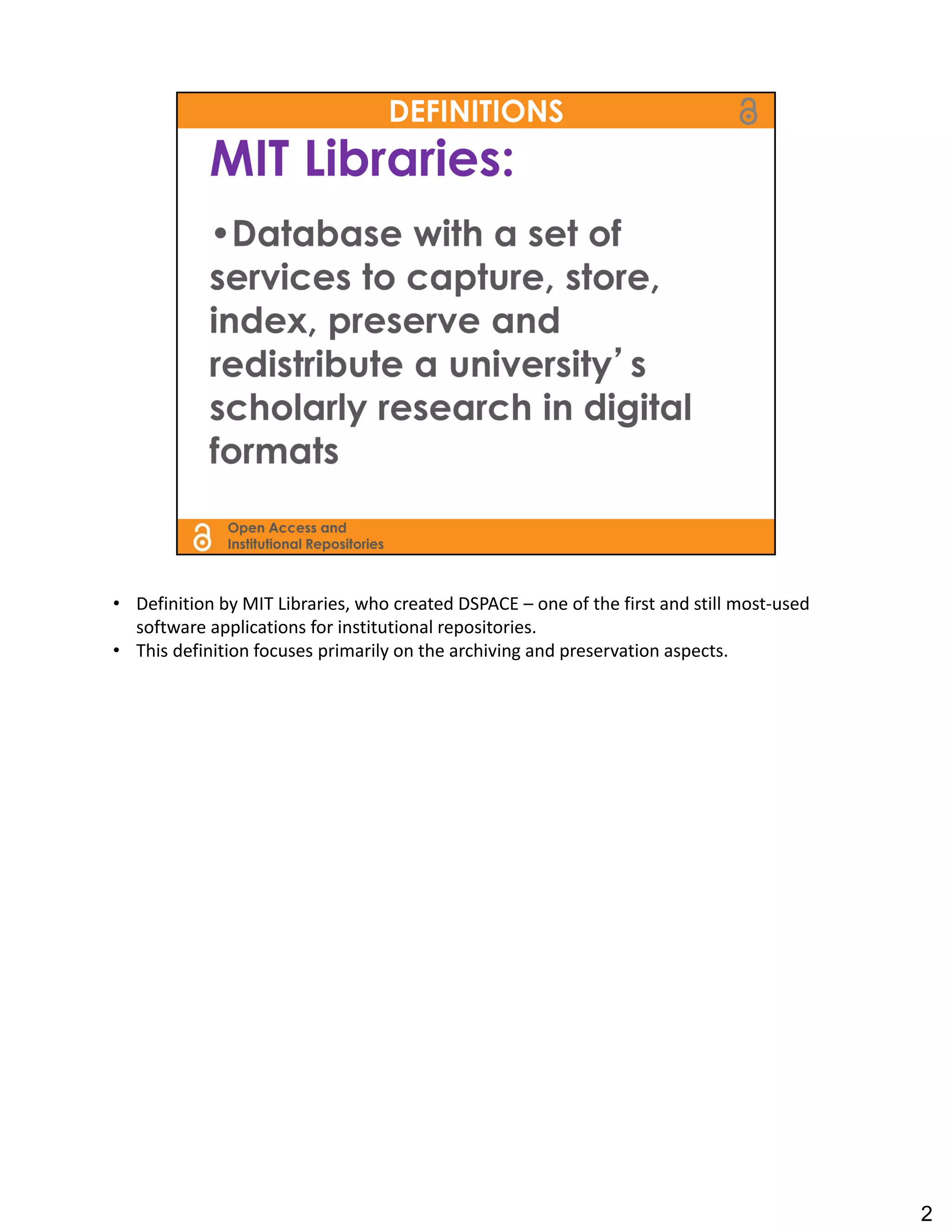
• Definition by MIT Libraries, who created DSPACE – one of the first and still most‐used 
  software applications for institutional repositories.
• This definition focuses primarily on the archiving and preservation aspects.


                                                                                            2
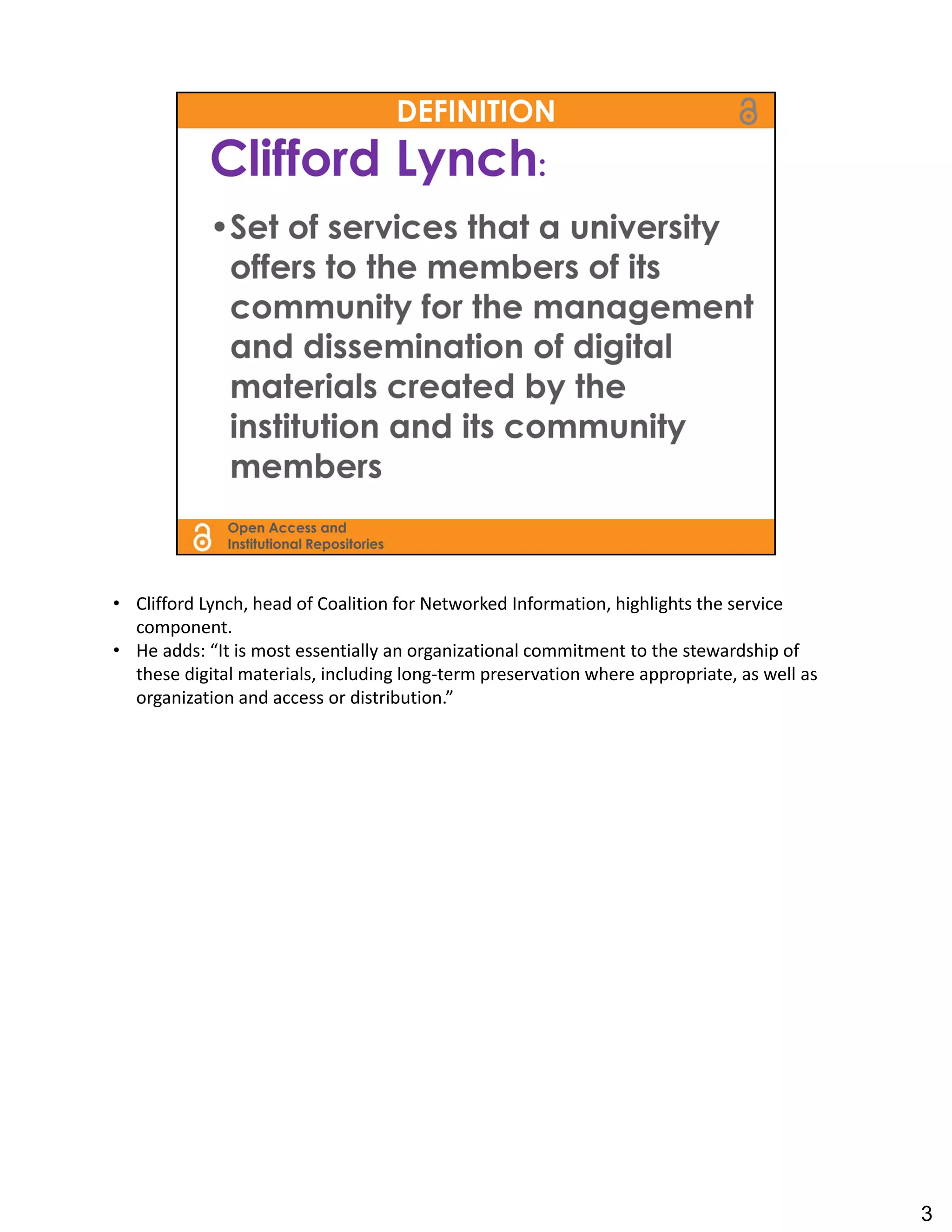
• Clifford Lynch, head of Coalition for Networked Information, highlights the service 
  component.
• He adds: “It is most essentially an organizational commitment to the stewardship of 
  these digital materials, including long‐term preservation where appropriate, as well as 
  organization and access or distribution.”


                                                                                             3
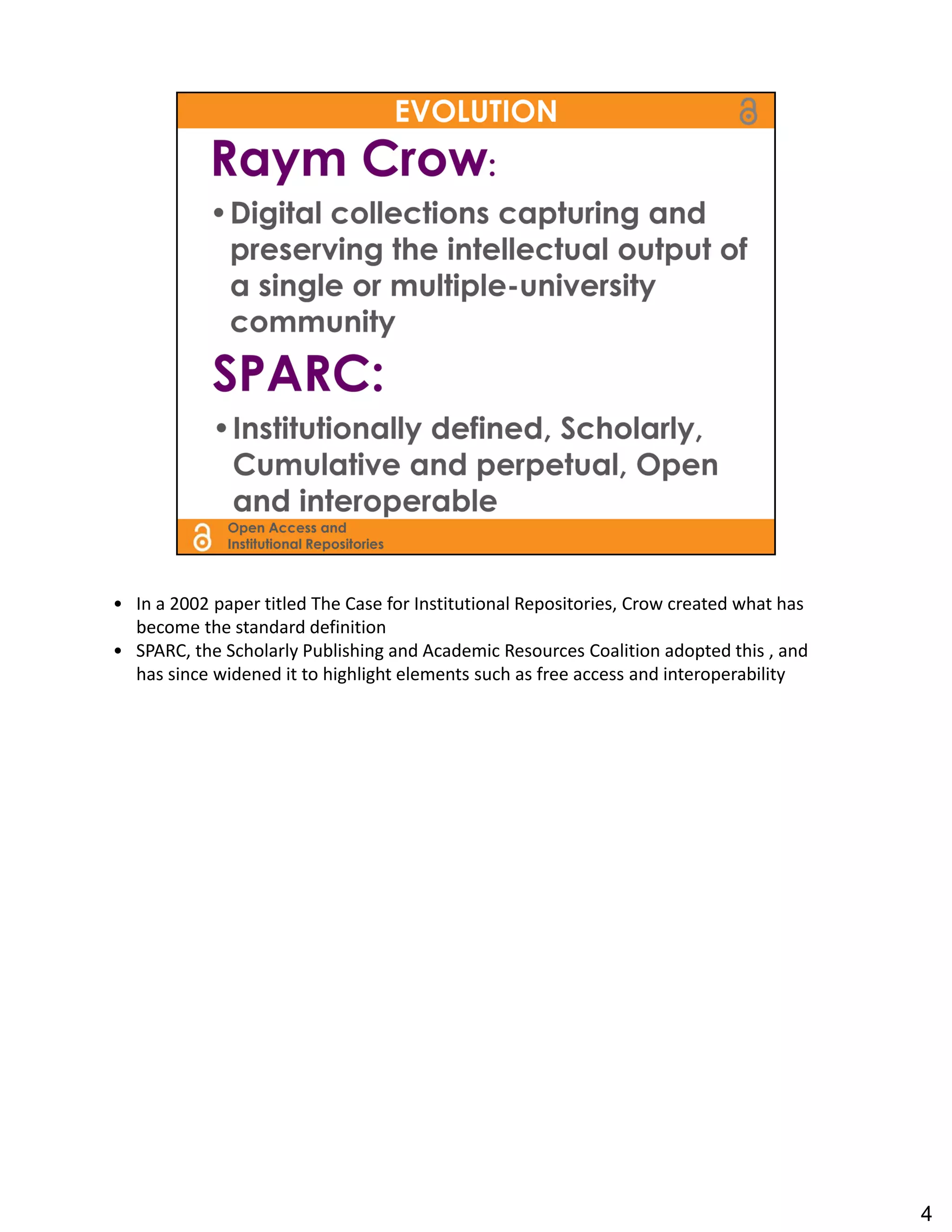
• In a 2002 paper titled The Case for Institutional Repositories, Crow created what has 
  become the standard definition
• SPARC, the Scholarly Publishing and Academic Resources Coalition adopted this , and 
  has since widened it to highlight elements such as free access and interoperability


                                                                                           4
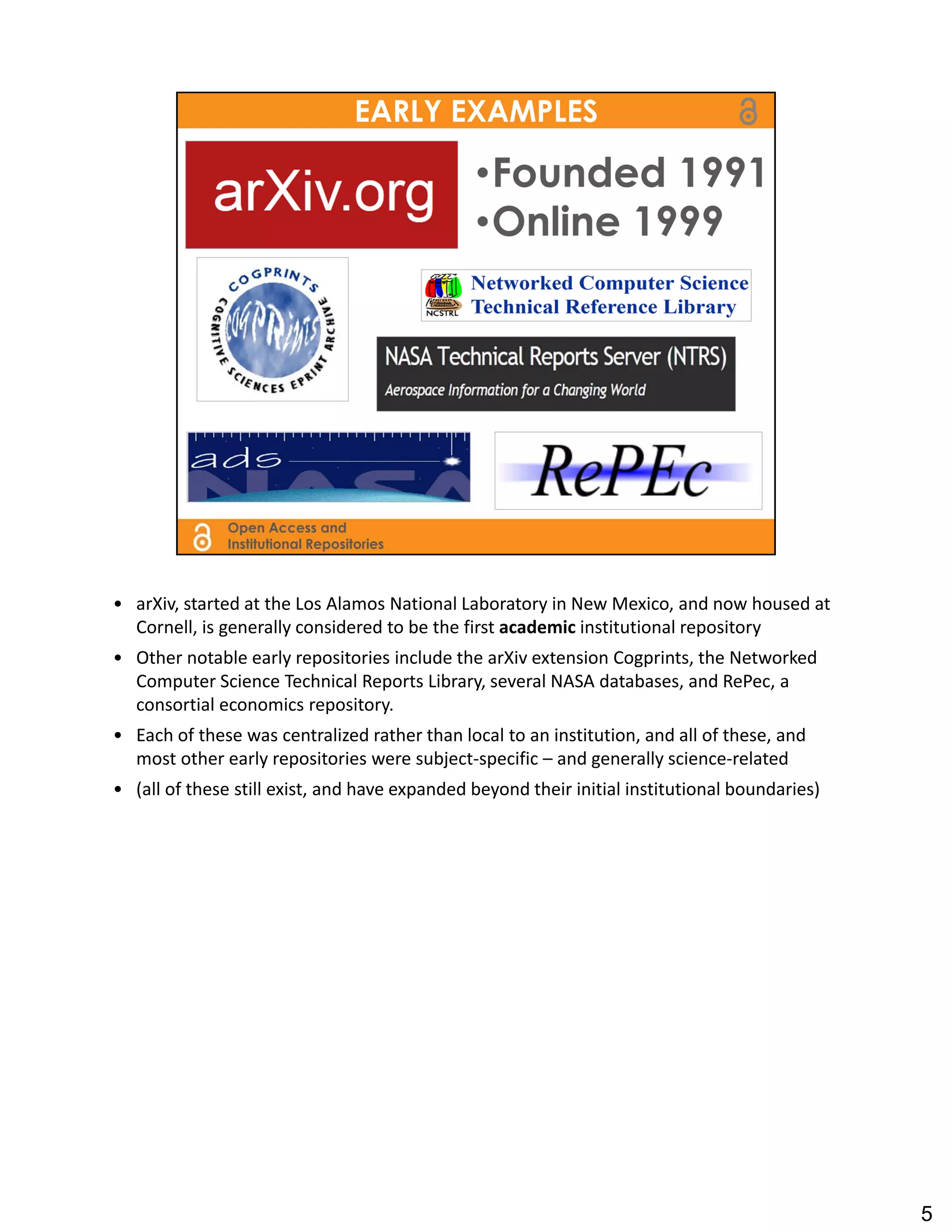
• arXiv, started at the Los Alamos National Laboratory in New Mexico, and now housed at 
  Cornell, is generally considered to be the first academic institutional repository
• Other notable early repositories include the arXiv extension Cogprints, the Networked 
  Computer Science Technical Reports Library, several NASA databases, and RePec, a 
  consortial economics repository.
• Each of these was centralized rather than local to an institution, and all of these, and 
  most other early repositories were subject‐specific – and generally science‐related
• (all of these still exist, and have expanded beyond their initial institutional boundaries)


                                                                                                5
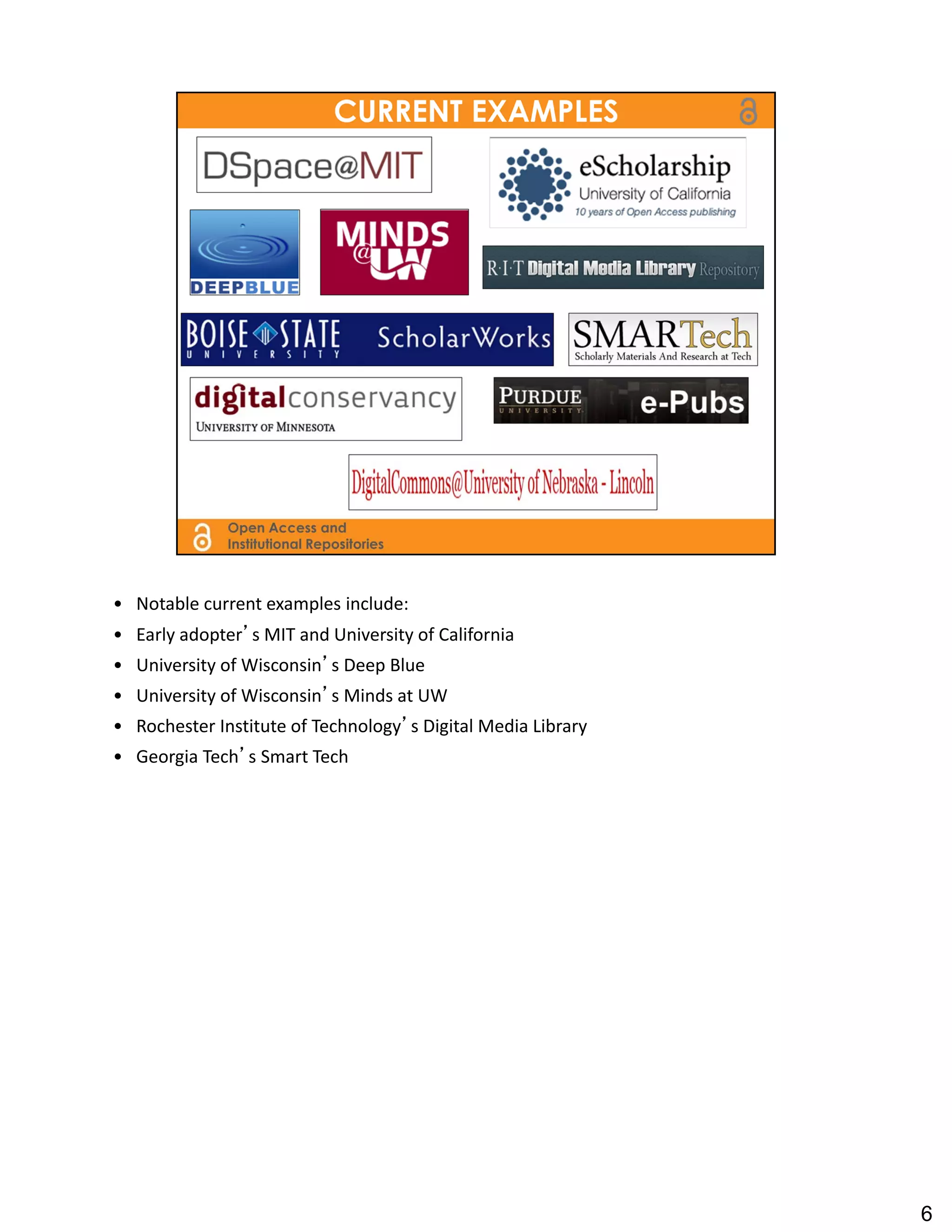
• Notable current examples include:
• Early adopter’s MIT and University of California
• University of Wisconsin’s Deep Blue
• University of Wisconsin’s Minds at UW
• Rochester Institute of Technology’s Digital Media Library
• Georgia Tech’s Smart Tech


                                                              6
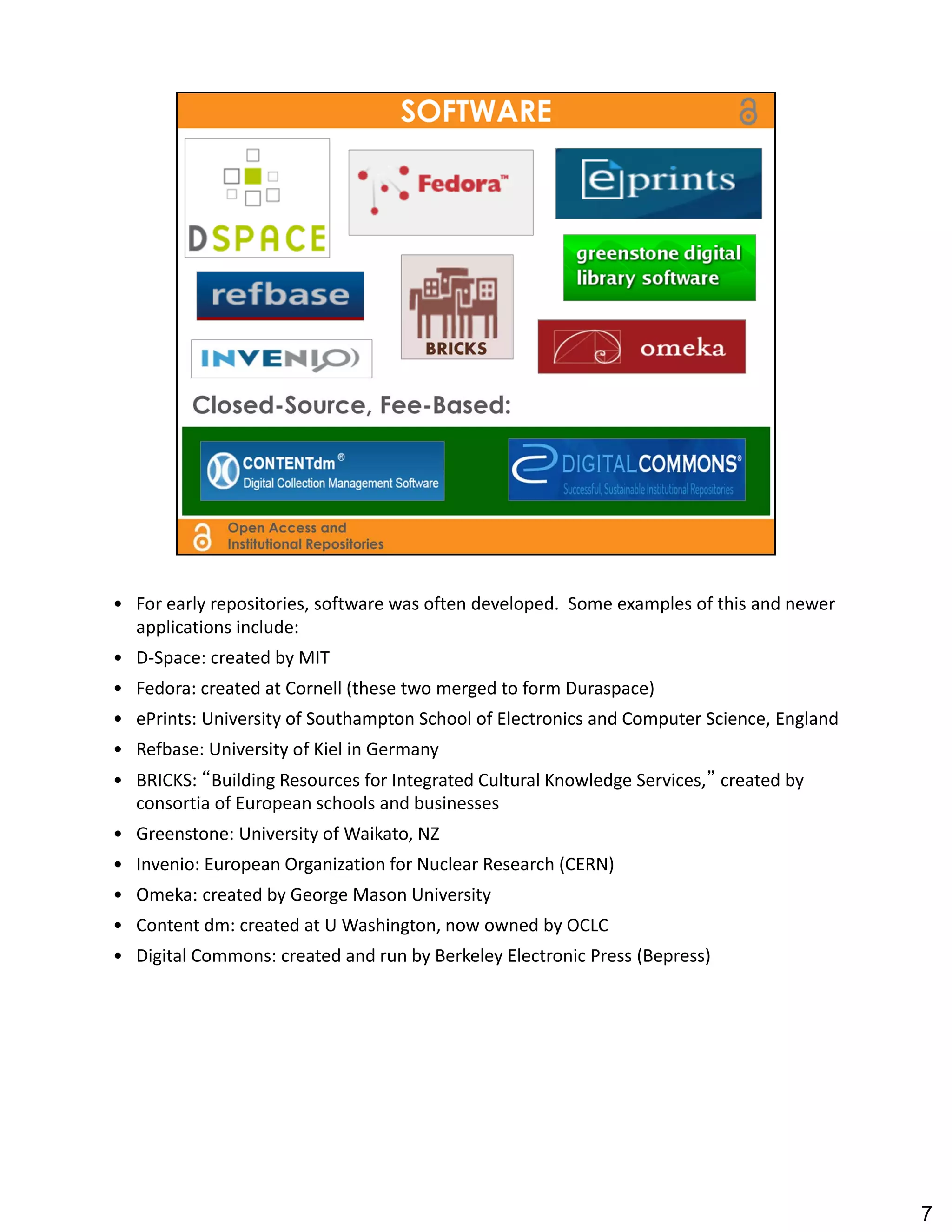
• For early repositories, software was often developed.  Some examples of this and newer 
  applications include:
• D‐Space: created by MIT
• Fedora: created at Cornell (these two merged to form Duraspace)
• ePrints: University of Southampton School of Electronics and Computer Science, England
• Refbase: University of Kiel in Germany
• BRICKS: “Building Resources for Integrated Cultural Knowledge Services,” created by 
  consortia of European schools and businesses
• Greenstone: University of Waikato, NZ
• Invenio: European Organization for Nuclear Research (CERN)
• Omeka: created by George Mason University
• Content dm: created at U Washington, now owned by OCLC
• Digital Commons: created and run by Berkeley Electronic Press (Bepress)


                                                                                            7
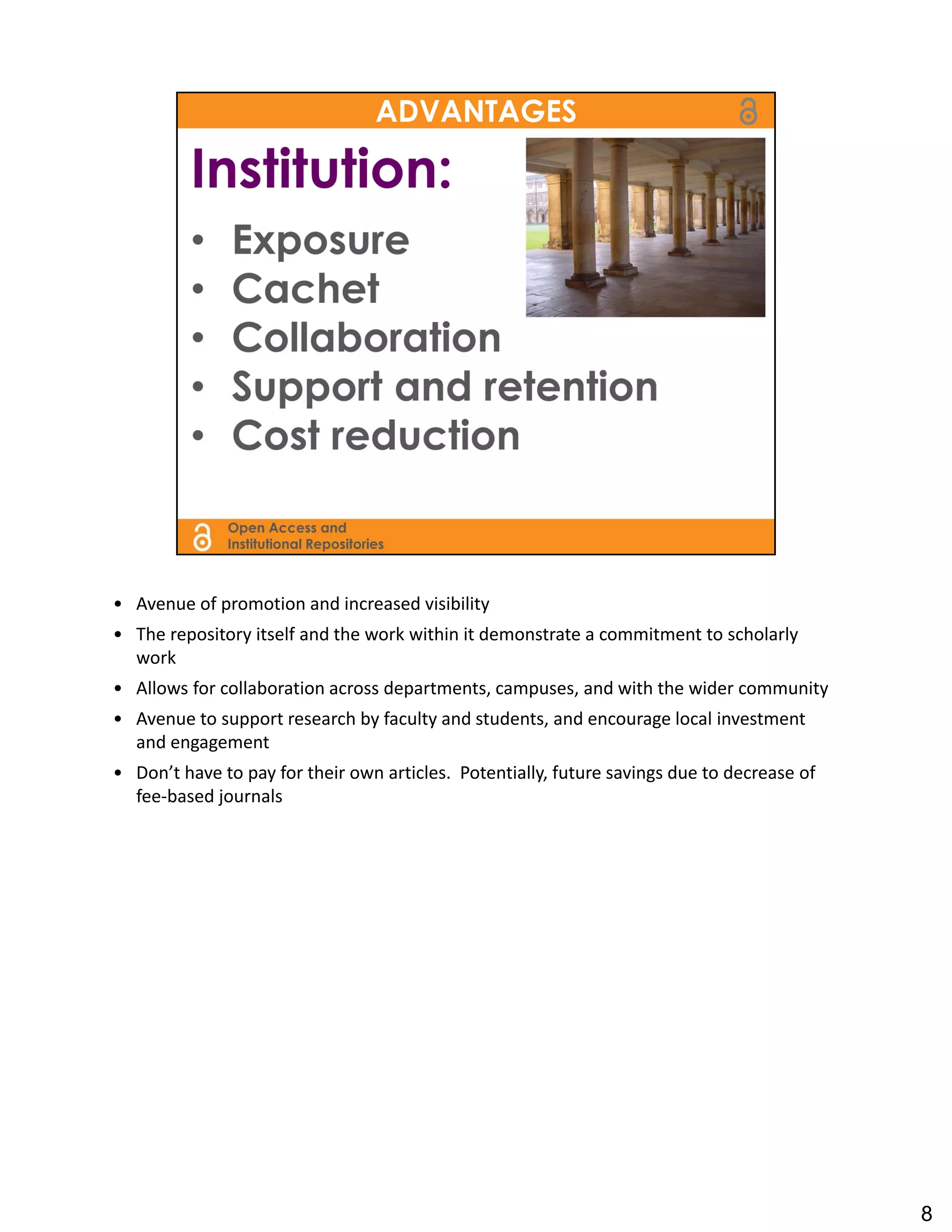
• Avenue of promotion and increased visibility
• The repository itself and the work within it demonstrate a commitment to scholarly 
  work
• Allows for collaboration across departments, campuses, and with the wider community
• Avenue to support research by faculty and students, and encourage local investment 
  and engagement
• Don’t have to pay for their own articles. Potentially, future savings due to decrease of
  fee‐based journals


                                                                                             8
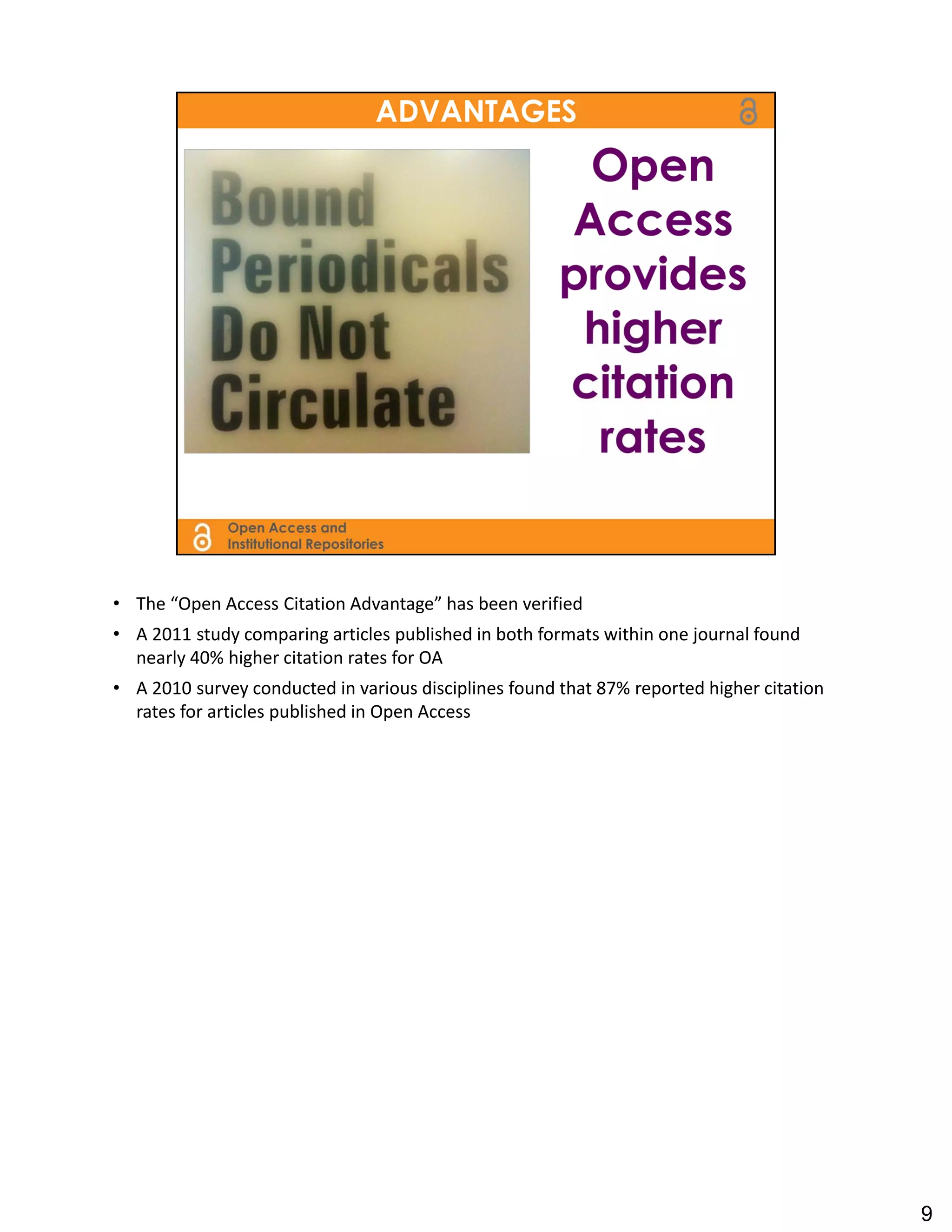
• The “Open Access Citation Advantage” has been verified
• A 2011 study comparing articles published in both formats within one journal found 
  nearly 40% higher citation rates for OA
• A 2010 survey conducted in various disciplines found that 87% reported higher citation 
  rates for articles published in Open Access


                                                                                            9
• Avenue of promotion and increased visibility
• Eliminate gap between submission and publication, as well as common online embargos
• Generally, authors retain rights and full access, and are free to republish elsewhere
• Multiple mediums can be submitted, as well as multiple document types – including raw 
  data
• Allow for collaboration across departments, campuses, and with the wider community


                                                                                           10
• Community, meaning both on‐campus and beyond:
• Community members are able to see what each other are doing
• This increases the speed of research. Richard Johnson, former executive director of 
  SPARC stated: 
  “The ability to locate and retrieve more relevant research more quickly and easily online 
  will improve scholarly communication and advance scholarly research”
• This also allows for collaboration, most notably across disciplines and between 
  unexpected partners
• And they provide access by the wider community


                                                                                               11
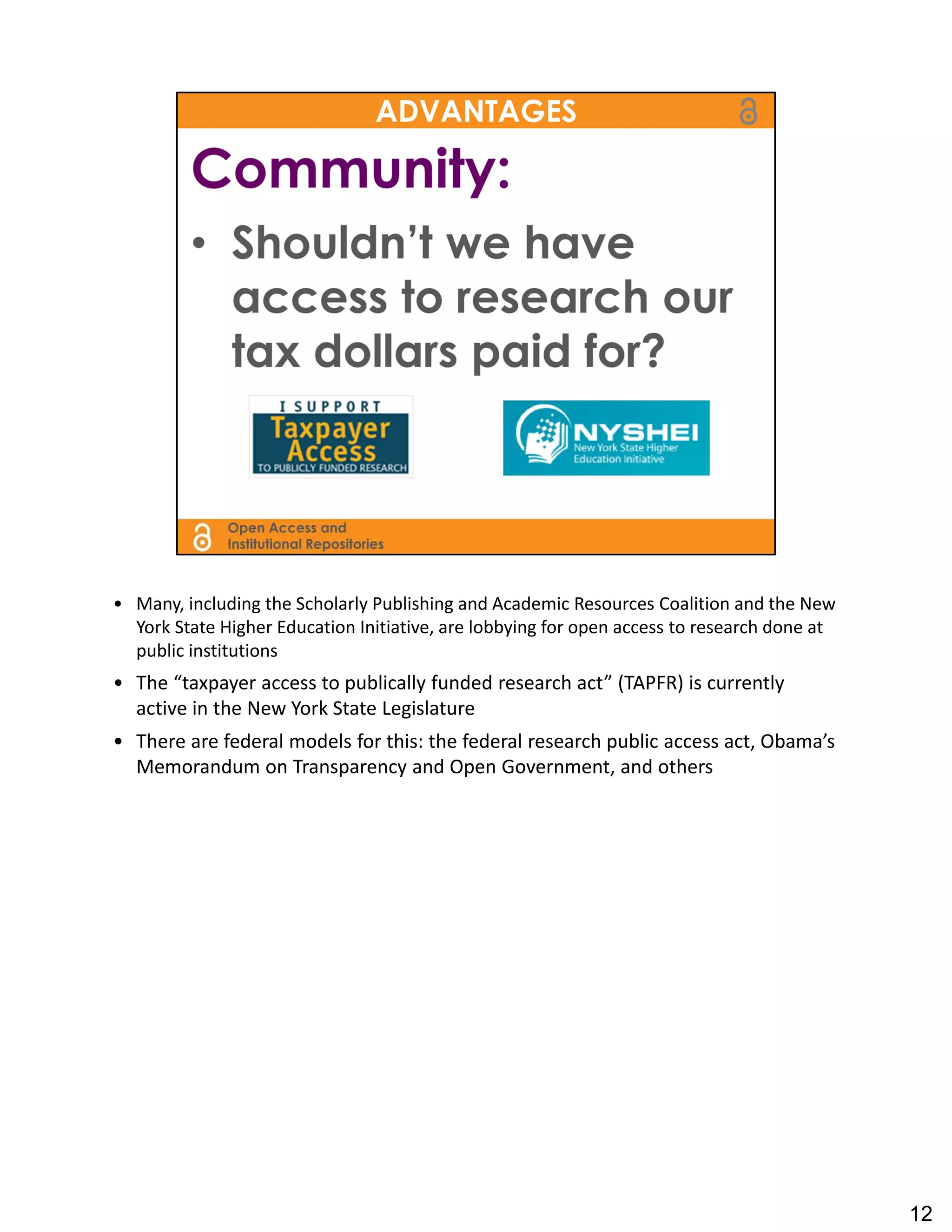
• Many, including the Scholarly Publishing and Academic Resources Coalition and the New 
  York State Higher Education Initiative, are lobbying for open access to research done at 
  public institutions
• The “taxpayer access to publically funded research act” (TAPFR) is currently 
  active in the New York State Legislature
• There are federal models for this: the federal research public access act, Obama’s 
  Memorandum on Transparency and Open Government, and others


                                                                                              12
• The SUNY system does have a repository, which has existed since 2005
• It currently houses 19 University at Albany items, all of which were posted by two
  faculty members in the same department


                                                                                       13
• There is often a fear of cost, both financial and relating to time required for creation of 
  an IR
• This extends to maintenance concerns, which also include financial and time 
  expenditures
• Current policies do not easily fit with the idea of an IR, and there are few well‐known 
  examples
• Most institutions are unaware of either the need or value of IRs


                                                                                                 14
• Most academic researchers feel they have no time to spare on formatting and 
  submitting articles
• Open Access journals don’t meet most institutions’ tenure requirements, causing fearful 
  associations that extend to IRs
• Some view IRs as non‐scholarly areas that lessen the esteem of their work
• Some fear the technical elements involved, ranging from digitization and formatting, 
  creating metadata, submitting, and future access


                                                                                             15
• Benefits should be explained in detail, first to administration and then to the wider 
  community
• Institutions should develop policy alongside a new repository, so the two complement 
  each other
• Following SPARC’s idea of institutional definition, an IR should be designed around local 
  needs and collections
• Partner with invested members, such as campus centers for research, copyright centers 
  and Interlibrary loan offices


                                                                                               16
• Many are unaware of the benefits of repositories (and open access) – educate them!  
  This includes explaining the citation advantage, and the fact that IRs offer 
   opportunities for advanced citation indexing.
• Further, for teaching faculty IRs provide spaces to share teaching materials in a 
  greatly expanded way
• Explain that there will be no loss of rights, and that submission is optional
• Differentiate between submission types such as preprints and peer‐reviewed articles
• Scan and upload articles for faculty – self‐submission is the most‐cited obstacle to the 
  success of IRs


                                                                                              17
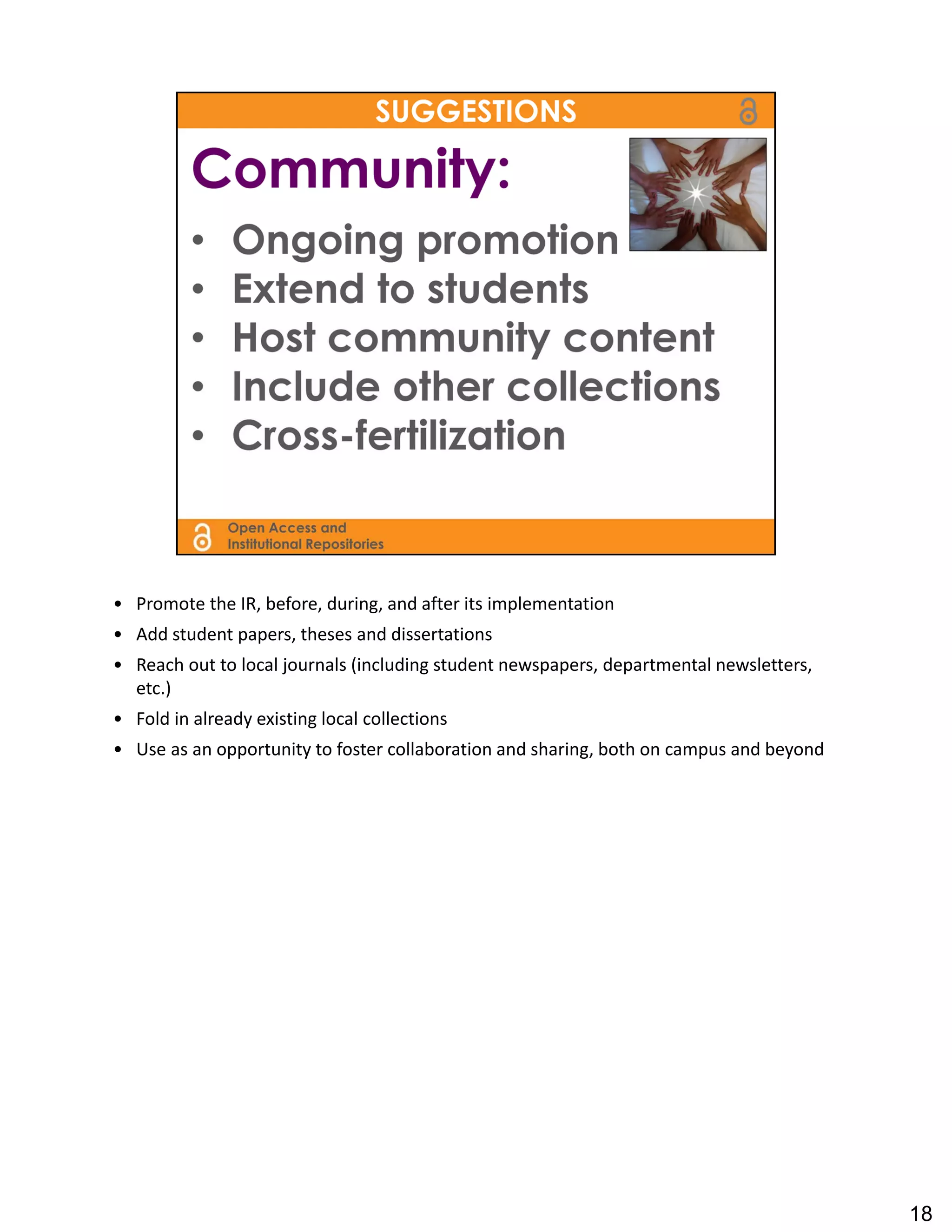
• Promote the IR, before, during, and after its implementation
• Add student papers, theses and dissertations
• Reach out to local journals (including student newspapers, departmental newsletters, 
  etc.)
• Fold in already existing local collections
• Use as an opportunity to foster collaboration and sharing, both on campus and beyond


                                                                                          18
19
20
21

Institutional repositories notes