Institutional repositories: an overview Lucy A. Tedd Lecturer, Department of Information Studies, Aberystwyth University, Wales Editor: Program: Electronic library and information systems February 2011
What is an institutional/digital/open access  repository? Clifford Lynch, Executive Director, Coalition for Networked Information,  stated “ In my view, a university-based institutional repository is a set of services that a university offers to the members of its community for the management and dissemination of digital materials created by the institution and its community members. It is most essentially an organizational commitment to the stewardship of these digital materials, including long-term preservation where appropriate, as well as organization and access or distribution .” ARL: A Bimonthly Report , no. 226 (February 2003) Institutional Repositories: Essential Infrastructure for Scholarship in the Digital Age    http://www.arl.org/resources/pubs/br/br226/br226ir.shtml
What is open access (OA)? Many definitions – a report from the Joint Information Systems Committee (JISC) in the UK of 2006 stated : The Open Access research literature is composed of free, online copies of peer-reviewed journal articles and conference papers as well as technical reports, theses and working papers. In most cases there are no licensing restrictions on their use by readers. They can therefore be used freely for research, teaching and other purposes. (http://www.jisc.ac.uk/publications/publications/pub_openaccess_v2.aspx)
What OA is not? There are various misunderstandings about Open Access. It is not self-publishing, nor a way to bypass peer-review and publication, nor is it a kind of second-class, cut-price publishing route. It is simply a means to make research results freely available online to the whole research community.  http://www.jisc.ac.uk/publications/briefingpapers/2006/pub_openaccess_v2.aspx

Gold and Green OA publishing Gold OA - uses a funding model that does not charge readers or their institutions for access e.g.  Ariadne, D-Lib Magazine  and  First Monday   Green OA - authors publish papers in one of the 25,000 or so refereed journals in all disciplines and then self-archive these papers in open access/digital/institutional repositories.
Scholarly publishing and OA One conclusion of  Oppenheim’s 2008 review: “ Libraries will increasingly switch to OA sources, leading to libraries gaining a more prominent role in scholarly publishing with activity in both the preservation and distribution of scholarly research. Libraries will need to move from being passive to active players in the scholarly communication chain.”   Oppenheim, Charles, Electronic scholarly publishing and open access.  Journal of Information Science , 2008, 34(4), p.577-590.
How does an IR differ from other digital collections? Content is deposited in a repository – by content creator, owner etc. Repository architecture manages the content and the metadata Repository software offers a minimum set of basic services – put, get, search Repository must be sustainable, trusted, well-supported and well-managed Heery, R. and Anderson S. (2005)  Digital Repositories Review . UKOLN and AHDS. Available at: http://www.jisc.ac.uk/uploaded_documents/digital-repositories-review-2005.pdf
What might be in an IR? Pre-prints of papers Post-prints of papers Doctoral theses  Masters dissertations Research reports Book chapters Conference papers Teaching materials Databanks of ‘raw’ data Multimedia objects   ++
Why? – university view An institutional repository is a tangible indicator of research output of a university – thus increasing its visibility, prestige and public value Repository content is readily searchable – both locally and globally Can be used as a marketing tool for the institution Allows an institution to manage its Intellectual Property Rights appropriately
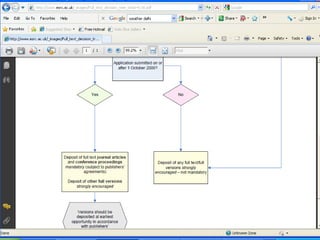
Why? – funder’s view Funders see improved access to, and wider dissemination of research For example, in the  UK  the eight research councils  have adopted policies mandating that  results from their tax-payer funded research  be ‘open’, available and accessible to all via IRs or similar subject repositories e.g. Economic and Social Research Council http://www.esrc.ac.uk/_images/Full_text_decision_tree_tcm8-4138.pdf/
 
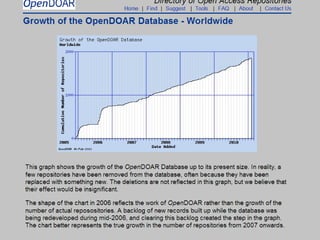
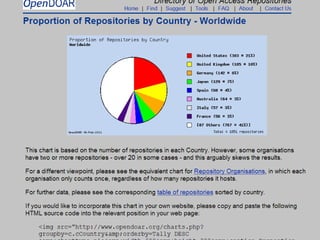
Open DOAR – Directory of Open Access Repositories The  Open DOAR service provides a quality-assured listing of open access repositories around the world.  Open DOAR staff harvest and assign metadata to allow categorisation and analysis to assist the wider use and exploitation of repositories. Each of the repositories has been visited by  Open DOAR staff to ensure a high degree of quality and consistency in the information provided:  Open DOAR is maintained by SHERPA consortium staff at the University of Nottingham, UK http://www.opendoar.org/about.html


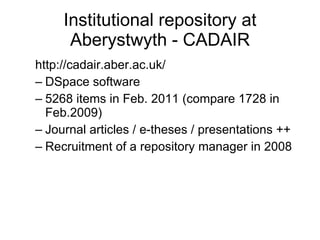
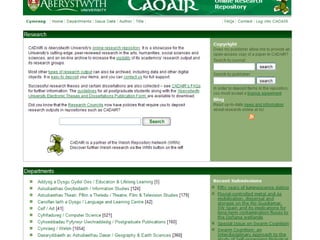
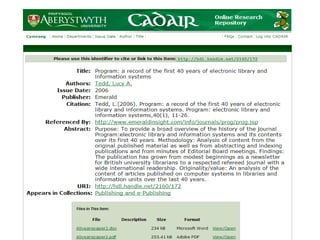
Institutional repository at Aberystwyth - CADAIR http://cadair.aber.ac.uk/ DSpace software 5268 items in Feb. 2011 (compare 1728 in Feb.2009) Journal articles / e-theses / presentations ++ Recruitment of a repository manager in 2008
 
Benefits in depositing material Increase in citations, impact and usage (useful for research evaluations such as the planned Research Evaluation Framework in UK in 2013) Increase in public research profile – both for the individual as well as the institution Preservation of research outputs from the institution


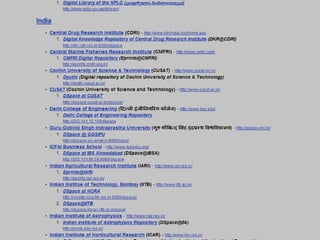
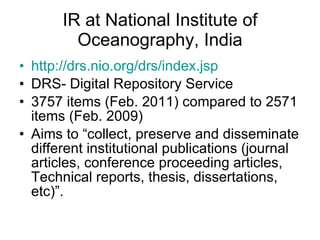
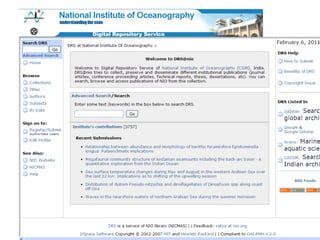
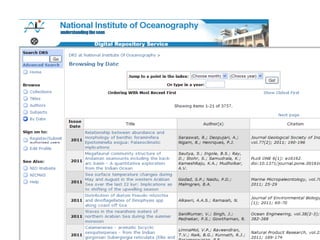
IR at National Institute of Oceanography, India http://drs.nio.org/drs/index.jsp DRS- Digital Repository Service 3757 items (Feb. 2011) compared to 2571 items (Feb. 2009) Aims to “collect, preserve and disseminate different institutional publications (journal articles, conference proceeding articles, Technical reports, thesis, dissertations, etc)”.
 
 
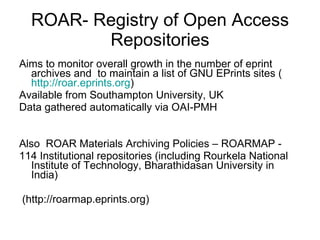
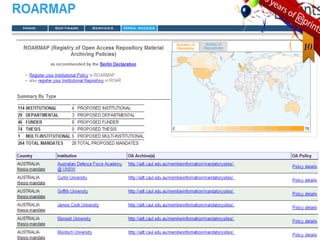
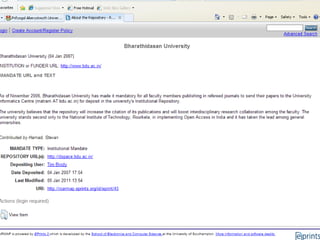
ROAR- Registry of Open Access Repositories Aims to monitor overall growth in the number of eprint archives and  to maintain a list of GNU EPrints sites ( http:// roar.eprints.org ) Available from Southampton University, UK Data gathered automatically via OAI-PMH Also  ROAR Materials Archiving Policies – ROARMAP -  114 Institutional repositories (including Rourkela National Institute of Technology, Bharathidasan University in India) (http://roarmap.eprints.org)
 
 
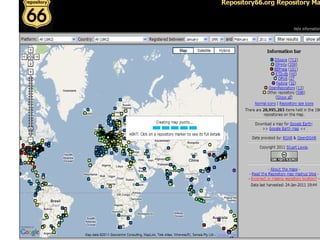
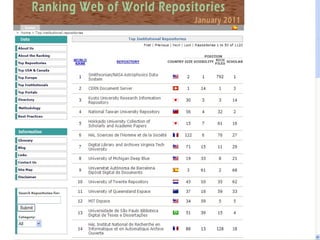
Other ‘overviews’ of IRs Repository66 – a mash-up by Stuart Lewis formerly of Aberystwyth, now at Auckland University, New Zealand based on OpenDOAR and ROAR ( http://maps.repository66.org/ ) World ranking of institutional repositories ( http:// repositories.webometrics.info/about_rank.html )
 
 
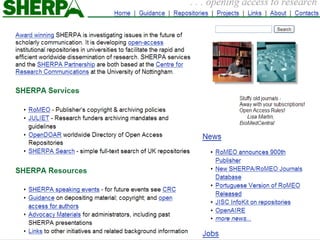
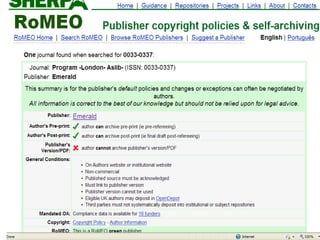
Support for IRs in the UK UK’s Joint information Systems Committee (JISC) has provided much funding in this area.  2002-5 Focus on Access to Institutional Repositories - Theses Alive!  Electronic Theses, ROMEO (Rights Metadata for Open Archiving) SHERPA (Securing a Hybrid Environment for Research Preservation and Access)  2005-7 Digital Repositories Programme - 20 specific projects e.g.openDOAR, EThoS, Repository Bridge 2006-9 Repository and Preservation Programme - su pporting digital repositories and preservation, including cross-searching facilities across repositories; funding for institutions to develop a critical mass of content, preservation solutions and advice for the development of repositories”   many separate projects (http://www.jisc.ac.uk/whatwedo/programmes/reppres.aspx)
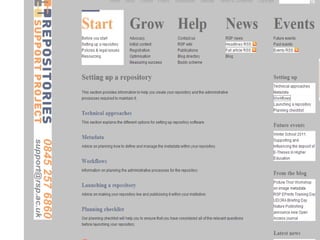
Repository Support Project (RSP) Consortium from SHERPA (Nottingham), ePrints Team (Southampton), Bath (UKOLN), Digital Curation Centre (Edinburgh) and Aberystwyth Funded by JISC  Aim “ co-ordinate and deliver good practice and practical advice to English and Welsh higher education institutions to enable the implementation, management and development of digital institutional repositories.  ”).   http://www.rsp.ac.uk
 
Welsh Repository Network (WRN) 2007- date Funded by JISC Run from  Aberystwyth University on behalf of Welsh Higher Education Libraries Forum aims  to put in place “ an essential building block for the development of an integrated network of institutional digital repositories in one region of the UK – the country of Wales ” 12 institutions – most use DSpace, one ePrints and one Digital Commons.
Advantages for academics in using IRs (from RSP) Increased visibility of research output and consequently the department and the institution  Potentially increased impact of  the research  Help in  managing and storing digital content connected with  the research, including the underlying research data  Help in managing the likely requirements of funding bodies for publications to be made available in a repository Provides the possibility to standardise institutional records  Allows the creation of personalised publications lists  Offers usage metrics to determine hit rates on specific papers.
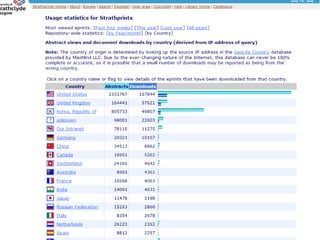
Emerging trends Research data: archiving this in addition to full-text of published papers. Either for funder mandate requirements (which are growing), or just for general good practice.  Using repositories for research management / metrics / bibliometrics etc.  Varying statistics of use made of IRs ( see recent flurry of e-mails on JISC-REPOSITORIES  e-mail list  https://www.jiscmail.ac.uk/cgi-bin/webadmin?A0=JISC-REPOSITORIES)
 
CADAIR repository manager – some challenges Cultural – move from paper to webpage Global – promotion of open access philosophy Institutional – raising awareness at high level. Implementation of mandate for deposit of research theses and taught masters theses gaining a distinction Departmental – assistance in depositing metadata and full-text Individual – assistance in gaining  permissions etc., academics have not kept copies of submitted papers
Thank you!

Institutional Repositories

  • 1.
    Institutional repositories: anoverview Lucy A. Tedd Lecturer, Department of Information Studies, Aberystwyth University, Wales Editor: Program: Electronic library and information systems February 2011
  • 2.
    What is aninstitutional/digital/open access repository? Clifford Lynch, Executive Director, Coalition for Networked Information, stated “ In my view, a university-based institutional repository is a set of services that a university offers to the members of its community for the management and dissemination of digital materials created by the institution and its community members. It is most essentially an organizational commitment to the stewardship of these digital materials, including long-term preservation where appropriate, as well as organization and access or distribution .” ARL: A Bimonthly Report , no. 226 (February 2003) Institutional Repositories: Essential Infrastructure for Scholarship in the Digital Age http://www.arl.org/resources/pubs/br/br226/br226ir.shtml
  • 3.
    What is openaccess (OA)? Many definitions – a report from the Joint Information Systems Committee (JISC) in the UK of 2006 stated : The Open Access research literature is composed of free, online copies of peer-reviewed journal articles and conference papers as well as technical reports, theses and working papers. In most cases there are no licensing restrictions on their use by readers. They can therefore be used freely for research, teaching and other purposes. (http://www.jisc.ac.uk/publications/publications/pub_openaccess_v2.aspx)
  • 4.
    What OA isnot? There are various misunderstandings about Open Access. It is not self-publishing, nor a way to bypass peer-review and publication, nor is it a kind of second-class, cut-price publishing route. It is simply a means to make research results freely available online to the whole research community. http://www.jisc.ac.uk/publications/briefingpapers/2006/pub_openaccess_v2.aspx
  • 5.
    Gold and GreenOA publishing Gold OA - uses a funding model that does not charge readers or their institutions for access e.g. Ariadne, D-Lib Magazine and First Monday Green OA - authors publish papers in one of the 25,000 or so refereed journals in all disciplines and then self-archive these papers in open access/digital/institutional repositories.
  • 6.
    Scholarly publishing andOA One conclusion of Oppenheim’s 2008 review: “ Libraries will increasingly switch to OA sources, leading to libraries gaining a more prominent role in scholarly publishing with activity in both the preservation and distribution of scholarly research. Libraries will need to move from being passive to active players in the scholarly communication chain.” Oppenheim, Charles, Electronic scholarly publishing and open access. Journal of Information Science , 2008, 34(4), p.577-590.
  • 7.
    How does anIR differ from other digital collections? Content is deposited in a repository – by content creator, owner etc. Repository architecture manages the content and the metadata Repository software offers a minimum set of basic services – put, get, search Repository must be sustainable, trusted, well-supported and well-managed Heery, R. and Anderson S. (2005) Digital Repositories Review . UKOLN and AHDS. Available at: http://www.jisc.ac.uk/uploaded_documents/digital-repositories-review-2005.pdf
  • 8.
    What might bein an IR? Pre-prints of papers Post-prints of papers Doctoral theses Masters dissertations Research reports Book chapters Conference papers Teaching materials Databanks of ‘raw’ data Multimedia objects ++
  • 9.
    Why? – universityview An institutional repository is a tangible indicator of research output of a university – thus increasing its visibility, prestige and public value Repository content is readily searchable – both locally and globally Can be used as a marketing tool for the institution Allows an institution to manage its Intellectual Property Rights appropriately
  • 10.
    Why? – funder’sview Funders see improved access to, and wider dissemination of research For example, in the UK the eight research councils have adopted policies mandating that results from their tax-payer funded research be ‘open’, available and accessible to all via IRs or similar subject repositories e.g. Economic and Social Research Council http://www.esrc.ac.uk/_images/Full_text_decision_tree_tcm8-4138.pdf/
  • 11.
  • 12.
    Open DOAR –Directory of Open Access Repositories The Open DOAR service provides a quality-assured listing of open access repositories around the world. Open DOAR staff harvest and assign metadata to allow categorisation and analysis to assist the wider use and exploitation of repositories. Each of the repositories has been visited by Open DOAR staff to ensure a high degree of quality and consistency in the information provided: Open DOAR is maintained by SHERPA consortium staff at the University of Nottingham, UK http://www.opendoar.org/about.html
  • 13.
  • 14.
  • 15.
  • 16.
    Institutional repository atAberystwyth - CADAIR http://cadair.aber.ac.uk/ DSpace software 5268 items in Feb. 2011 (compare 1728 in Feb.2009) Journal articles / e-theses / presentations ++ Recruitment of a repository manager in 2008
  • 17.
  • 18.
    Benefits in depositingmaterial Increase in citations, impact and usage (useful for research evaluations such as the planned Research Evaluation Framework in UK in 2013) Increase in public research profile – both for the individual as well as the institution Preservation of research outputs from the institution
  • 19.
  • 20.
  • 21.
  • 22.
    IR at NationalInstitute of Oceanography, India http://drs.nio.org/drs/index.jsp DRS- Digital Repository Service 3757 items (Feb. 2011) compared to 2571 items (Feb. 2009) Aims to “collect, preserve and disseminate different institutional publications (journal articles, conference proceeding articles, Technical reports, thesis, dissertations, etc)”.
  • 23.
  • 24.
  • 25.
    ROAR- Registry ofOpen Access Repositories Aims to monitor overall growth in the number of eprint archives and to maintain a list of GNU EPrints sites ( http:// roar.eprints.org ) Available from Southampton University, UK Data gathered automatically via OAI-PMH Also ROAR Materials Archiving Policies – ROARMAP - 114 Institutional repositories (including Rourkela National Institute of Technology, Bharathidasan University in India) (http://roarmap.eprints.org)
  • 26.
  • 27.
  • 28.
    Other ‘overviews’ ofIRs Repository66 – a mash-up by Stuart Lewis formerly of Aberystwyth, now at Auckland University, New Zealand based on OpenDOAR and ROAR ( http://maps.repository66.org/ ) World ranking of institutional repositories ( http:// repositories.webometrics.info/about_rank.html )
  • 29.
  • 30.
  • 31.
    Support for IRsin the UK UK’s Joint information Systems Committee (JISC) has provided much funding in this area. 2002-5 Focus on Access to Institutional Repositories - Theses Alive! Electronic Theses, ROMEO (Rights Metadata for Open Archiving) SHERPA (Securing a Hybrid Environment for Research Preservation and Access) 2005-7 Digital Repositories Programme - 20 specific projects e.g.openDOAR, EThoS, Repository Bridge 2006-9 Repository and Preservation Programme - su pporting digital repositories and preservation, including cross-searching facilities across repositories; funding for institutions to develop a critical mass of content, preservation solutions and advice for the development of repositories” many separate projects (http://www.jisc.ac.uk/whatwedo/programmes/reppres.aspx)
  • 32.
    Repository Support Project(RSP) Consortium from SHERPA (Nottingham), ePrints Team (Southampton), Bath (UKOLN), Digital Curation Centre (Edinburgh) and Aberystwyth Funded by JISC Aim “ co-ordinate and deliver good practice and practical advice to English and Welsh higher education institutions to enable the implementation, management and development of digital institutional repositories. ”).  http://www.rsp.ac.uk
  • 33.
  • 34.
    Welsh Repository Network(WRN) 2007- date Funded by JISC Run from Aberystwyth University on behalf of Welsh Higher Education Libraries Forum aims to put in place “ an essential building block for the development of an integrated network of institutional digital repositories in one region of the UK – the country of Wales ” 12 institutions – most use DSpace, one ePrints and one Digital Commons.
  • 35.
    Advantages for academicsin using IRs (from RSP) Increased visibility of research output and consequently the department and the institution Potentially increased impact of the research Help in managing and storing digital content connected with the research, including the underlying research data Help in managing the likely requirements of funding bodies for publications to be made available in a repository Provides the possibility to standardise institutional records Allows the creation of personalised publications lists Offers usage metrics to determine hit rates on specific papers.
  • 36.
    Emerging trends Researchdata: archiving this in addition to full-text of published papers. Either for funder mandate requirements (which are growing), or just for general good practice. Using repositories for research management / metrics / bibliometrics etc. Varying statistics of use made of IRs ( see recent flurry of e-mails on JISC-REPOSITORIES e-mail list https://www.jiscmail.ac.uk/cgi-bin/webadmin?A0=JISC-REPOSITORIES)
  • 37.
  • 38.
    CADAIR repository manager– some challenges Cultural – move from paper to webpage Global – promotion of open access philosophy Institutional – raising awareness at high level. Implementation of mandate for deposit of research theses and taught masters theses gaining a distinction Departmental – assistance in depositing metadata and full-text Individual – assistance in gaining permissions etc., academics have not kept copies of submitted papers
  • 39.