50,000 Transactions per Second
Apache Spark on Apache Cassandra
February 2017
Presenter
Ben Slater
Chief Product Officer
Instaclustr
ben.slater@instaclustr.com
@ slater_ben
2
Introduction
• Problem background
• Solution overview
• Implementation approach
• Writing data
• Rolling up data
• Presenting data
• Optimization
• What’s next?
3
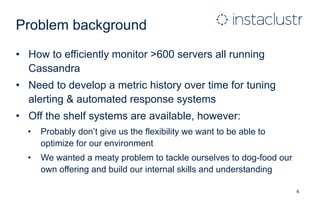
Problem background
• How to efficiently monitor >600 servers all running
Cassandra
• Need to develop a metric history over time for tuning
alerting & automated response systems
• Off the shelf systems are available, however:
• Probably don’t give us the flexibility we want to be able to
optimize for our environment
• We wanted a meaty problem to tackle ourselves to dog-food our
own offering and build our internal skills and understanding
4
Solution overview
5
Managed
Node
(AWS) x
many
Managed
Node
(Azure) x
many
Managed
Node
(SoftLayer) x
many
Cassandra
+ Spark
(x15)
Riemann
(x3)
RabbitMQ
(x2)
Console/
API
(x2)
Admin
Tools
500 nodes * ~2,000
metrics / 20 secs = 50k
metrics/sec
PagerDuty
Implementation approach
1. Writing Data
2. Rolling Up Data
3. Presenting Data
6
~ 9(!) months
(with quite a few detours
and distractions)
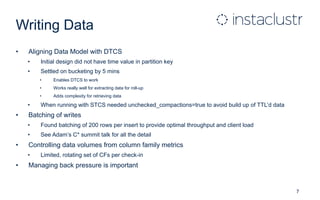
Writing Data
• Aligning Data Model with DTCS
• Initial design did not have time value in partition key
• Settled on bucketing by 5 mins
• Enables DTCS to work
• Works really well for extracting data for roll-up
• Adds complexity for retrieving data
• When running with STCS needed unchecked_compactions=true to avoid build up of TTL’d data
• Batching of writes
• Found batching of 200 rows per insert to provide optimal throughput and client load
• See Adam’s C* summit talk for all the detail
• Controlling data volumes from column family metrics
• Limited, rotating set of CFs per check-in
• Managing back pressure is important
7
Rolling Up Data
• Developing functional solution was easy,
• Getting to acceptable performance was hard and time consuming
• But all seemed easy once we’d solved it
• Keys to performance?
• Align raw data partition bucketing with roll-up timeframe (5 mins)
• Use joinWithCassandra table to extract the required data – 2-3x performance
improvement over alternate approaches
val RDDJoin = sc.cassandraTable[(String, String)]("instametrics" , "service_per_host")
.filter(a => broadcastListEventAll.value.map(r => a._2.matches(r)).foldLeft(false)(_ || _))
.map(a => (a._1, dateBucket, a._2))
.repartitionByCassandraReplica("instametrics", "events_raw_5m", 100)
.joinWithCassandraTable("instametrics", "events_raw_5m").cache()
• Write limiting
• cassandra.output.throughput_mb_per_sec not necessary as writes << reads
8
Presenting Data
• Generally just worked!
• Main challenge
• Dealing with how to find latest data in buckets when not all data is
reported in each data set
9
Optimization
• Upgraded to Cassandra 3.7 and change code to use Cassandra aggregates:
val RDDJoin = sc.cassandraTable[(String, String)]("instametrics" ,
"service_per_host")
.filter(a => broadcastListEventAll.value.map(r =>
a._2.matches(r)).foldLeft(false)(_ || _))
.map(a => (a._1, dateBucket, a._2))
.repartitionByCassandraReplica("instametrics", "events_raw_5m",
100)
.joinWithCassandraTable("instametrics", "events_raw_5m",
SomeColumns("time", "state", FunctionCallRef("avg",
Seq(Right("metric")), Some("avg")), FunctionCallRef("max",
Seq(Right("metric")), Some("max")), FunctionCallRef("min",
Seq(Right("metric")), Some("min")))).cache()
• 50% reduction in roll-up job runtime (from 5-6 mins to 2.5-3mins) with reduced CPU usage
10
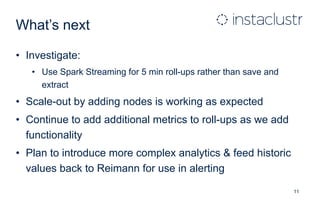
What’s next
• Investigate:
• Use Spark Streaming for 5 min roll-ups rather than save and
extract
• Scale-out by adding nodes is working as expected
• Continue to add additional metrics to roll-ups as we add
functionality
• Plan to introduce more complex analytics & feed historic
values back to Reimann for use in alerting
11
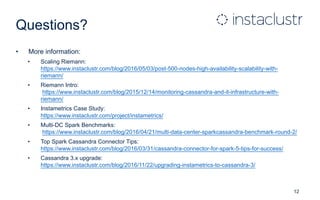
Questions?
• More information:
• Scaling Riemann:
https://www.instaclustr.com/blog/2016/05/03/post-500-nodes-high-availability-scalability-with-
riemann/
• Riemann Intro:
https://www.instaclustr.com/blog/2015/12/14/monitoring-cassandra-and-it-infrastructure-with-
riemann/
• Instametrics Case Study:
https://www.instaclustr.com/project/instametrics/
• Multi-DC Spark Benchmarks:
https://www.instaclustr.com/blog/2016/04/21/multi-data-center-sparkcassandra-benchmark-round-2/
• Top Spark Cassandra Connector Tips:
https://www.instaclustr.com/blog/2016/03/31/cassandra-connector-for-spark-5-tips-for-success/
• Cassandra 3.x upgrade:
https://www.instaclustr.com/blog/2016/11/22/upgrading-instametrics-to-cassandra-3/
12

Instaclustr Webinar 50,000 Transactions Per Second with Apache Spark on Apache Cassandra

  • 1.
    50,000 Transactions perSecond Apache Spark on Apache Cassandra February 2017
  • 2.
    Presenter Ben Slater Chief ProductOfficer Instaclustr ben.slater@instaclustr.com @ slater_ben 2
  • 3.
    Introduction • Problem background •Solution overview • Implementation approach • Writing data • Rolling up data • Presenting data • Optimization • What’s next? 3
  • 4.
    Problem background • Howto efficiently monitor >600 servers all running Cassandra • Need to develop a metric history over time for tuning alerting & automated response systems • Off the shelf systems are available, however: • Probably don’t give us the flexibility we want to be able to optimize for our environment • We wanted a meaty problem to tackle ourselves to dog-food our own offering and build our internal skills and understanding 4
  • 5.
    Solution overview 5 Managed Node (AWS) x many Managed Node (Azure)x many Managed Node (SoftLayer) x many Cassandra + Spark (x15) Riemann (x3) RabbitMQ (x2) Console/ API (x2) Admin Tools 500 nodes * ~2,000 metrics / 20 secs = 50k metrics/sec PagerDuty
  • 6.
    Implementation approach 1. WritingData 2. Rolling Up Data 3. Presenting Data 6 ~ 9(!) months (with quite a few detours and distractions)
  • 7.
    Writing Data • AligningData Model with DTCS • Initial design did not have time value in partition key • Settled on bucketing by 5 mins • Enables DTCS to work • Works really well for extracting data for roll-up • Adds complexity for retrieving data • When running with STCS needed unchecked_compactions=true to avoid build up of TTL’d data • Batching of writes • Found batching of 200 rows per insert to provide optimal throughput and client load • See Adam’s C* summit talk for all the detail • Controlling data volumes from column family metrics • Limited, rotating set of CFs per check-in • Managing back pressure is important 7
  • 8.
    Rolling Up Data •Developing functional solution was easy, • Getting to acceptable performance was hard and time consuming • But all seemed easy once we’d solved it • Keys to performance? • Align raw data partition bucketing with roll-up timeframe (5 mins) • Use joinWithCassandra table to extract the required data – 2-3x performance improvement over alternate approaches val RDDJoin = sc.cassandraTable[(String, String)]("instametrics" , "service_per_host") .filter(a => broadcastListEventAll.value.map(r => a._2.matches(r)).foldLeft(false)(_ || _)) .map(a => (a._1, dateBucket, a._2)) .repartitionByCassandraReplica("instametrics", "events_raw_5m", 100) .joinWithCassandraTable("instametrics", "events_raw_5m").cache() • Write limiting • cassandra.output.throughput_mb_per_sec not necessary as writes << reads 8
  • 9.
    Presenting Data • Generallyjust worked! • Main challenge • Dealing with how to find latest data in buckets when not all data is reported in each data set 9
  • 10.
    Optimization • Upgraded toCassandra 3.7 and change code to use Cassandra aggregates: val RDDJoin = sc.cassandraTable[(String, String)]("instametrics" , "service_per_host") .filter(a => broadcastListEventAll.value.map(r => a._2.matches(r)).foldLeft(false)(_ || _)) .map(a => (a._1, dateBucket, a._2)) .repartitionByCassandraReplica("instametrics", "events_raw_5m", 100) .joinWithCassandraTable("instametrics", "events_raw_5m", SomeColumns("time", "state", FunctionCallRef("avg", Seq(Right("metric")), Some("avg")), FunctionCallRef("max", Seq(Right("metric")), Some("max")), FunctionCallRef("min", Seq(Right("metric")), Some("min")))).cache() • 50% reduction in roll-up job runtime (from 5-6 mins to 2.5-3mins) with reduced CPU usage 10
  • 11.
    What’s next • Investigate: •Use Spark Streaming for 5 min roll-ups rather than save and extract • Scale-out by adding nodes is working as expected • Continue to add additional metrics to roll-ups as we add functionality • Plan to introduce more complex analytics & feed historic values back to Reimann for use in alerting 11
  • 12.
    Questions? • More information: •Scaling Riemann: https://www.instaclustr.com/blog/2016/05/03/post-500-nodes-high-availability-scalability-with- riemann/ • Riemann Intro: https://www.instaclustr.com/blog/2015/12/14/monitoring-cassandra-and-it-infrastructure-with- riemann/ • Instametrics Case Study: https://www.instaclustr.com/project/instametrics/ • Multi-DC Spark Benchmarks: https://www.instaclustr.com/blog/2016/04/21/multi-data-center-sparkcassandra-benchmark-round-2/ • Top Spark Cassandra Connector Tips: https://www.instaclustr.com/blog/2016/03/31/cassandra-connector-for-spark-5-tips-for-success/ • Cassandra 3.x upgrade: https://www.instaclustr.com/blog/2016/11/22/upgrading-instametrics-to-cassandra-3/ 12