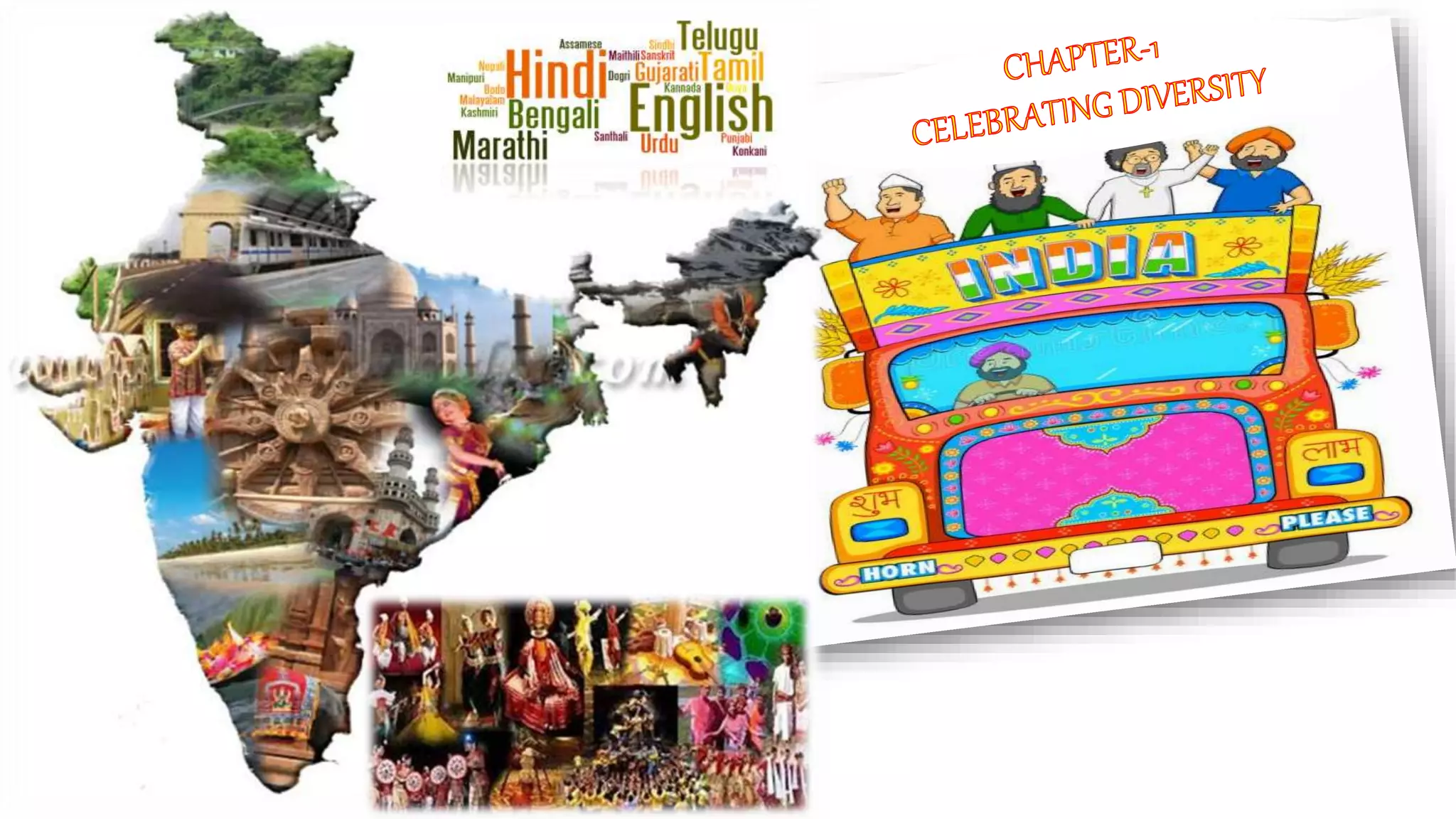

Chapter 1
Celebrating diversity
What is diversity?
Diversity in India
How India becomes a diverse?
Unity in diversity
Look around your class.
֎You will probably find students from every part of India.
֎Maybe some from other countries as well.
֎ Each of you are different from one another you speak
» Different languages.
» Different religions.
» Different foods.
» Different kinds of films.
» Different kinds of clothes.
You may excel in sports while your friend could be excellent in Mathematics.
These differences make you unique and special.
At the same time, all of you have one same thing in common. You study in the
same class of the same school.
The state of being different from one
another and of being unique is called
Diversity.
Diversity is a range of many people, or
things which are different from each
other.
Diversity brings variety
Can you imagine how boring it would be?
If there was only one species of plant or animal on earth.
If all of us looked exactly the same.
Every time you went shopping, every shop sold the same things?
It is because of the existence of diversity that we have so much variety in
our lives.
Imagine that you and your friends are celebrating a friend's birthday party
by eating out. Each one of you want to have something different. So, what
do you do? You order each one's favourite dish and enjoy the assorted
platter. This is possible only when the restaurant offers diverse options.
Thus, when there is diversity we have more options to choose from.
DIVERSITY IN INDIA
Our country is made up of people who belong to diverse backgrounds. India's
diversity has always been her strength. In spite of this diversity, there is a basic
unity which keeps us together. This unity is our heritage.
Our heritage is very old and unique. It has evolved over 1000’s of years and is
like a rich tapestry
۸ Social.
۸ Cultural.
۸ Economic.
۸ Political.
Developments have added vibrant and colourful threads to this tapestry.
How did India become diverse?
History tells us that many people have come from foreign lands and
settled in India.
Since, Ancient times. People travelled for different reasons. The
places they LIVED IN
۴ may have been very cold, where no crops could grow.
۴ Very little rainfall could have led to drought and famine.
۴ Others may have moved looking for work.
۴ Wars could have also forced people to move.
۴ Many people also came to India lured by its tremendous wealth.
Indian culture has been influenced by people coming from outside and their cultures.
 People from Persia.
 Central Asia.
 Greece.
 Afghanistan.
 Tibet.
 Myanmar have come and settled in our country.
They adopted certain elements of our culture while retaining some elements of their own
cultures and traditions as well. This inter-mingling' of cultures shaped the lives of people in
different ways.
 New languages.
 dance forms.
 schools of music.
 Painting.
 cuisines and religions emerged. Different cultures, thus, influenced one another and brought
about diversity.
There are different type of diversity
Physical diversity.
Religious diversity.
Linguistic diversity.
Regional diversity.
Physical diversity
The Northern Mountain Ranges.
The Vast Plains.
The Deccan Plateau.
The Arid Desert
The Coastal Plains are the diverse elements of the physical features of India.
Have you ever wondered how our country's physical features make us rely on each other for
our needs?
Our mountains are the source of our rivers, which provide water. Our plains grow food for the
nation. The coastal areas provide fish. The peninsular plateau is a storehouse of essential
minerals. No part of our country can flourish without the help and cooperation of the other
parts. Our need for food, fuel, forest resources, and water makes us interdependent on each
other.
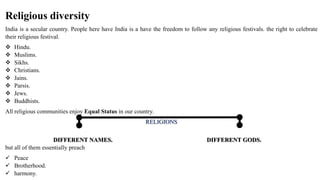
Religious diversity
India is a secular country. People here have India is a have the freedom to follow any religious festivals. the right to celebrate
their religious festival.
 Hindu.
 Muslims.
 Sikhs.
 Christians.
 Jains.
 Parsis.
 Jews.
 Buddhists.
All religious communities enjoy Equal Status in our country.
RELIGIONS
DIFFERENT NAMES. DIFFERENT GODS.
but all of them essentially preach
 Peace
 Brotherhood.
 harmony.
Linguistic Diversity
People of India speak in many different languages.
The Indian constitution recognises 22 official
languages. Hindi is the main official language while
English is the secondary official language. Some states
were also created on a linguistic basis. The
government encourages every state language and
culture.
Differences in physical features and climate have
created
Regional Diversity.
People living in the mountainous regions of the
north have a lifestyle different from people
living in the coastal plains of the south. The
intermingling of different kinds of diversity
creates a beautiful rainbow of languages and
cultures.
UNITY IN DIVERSITY
India, as we have seen, is a land of diversities. However, in spite of all the
differences, we are bound together by one common identity – We are Indians.
A beautiful example of unity in diversity can be found in our struggle for
freedom.
The British ruled India for nearly 200 years. The people of India, belonging to all
o Religions.
o Castes.
o Regions.
o Races and Ethnicities.
came together to fight against the British rule, and eventually Bravest to win
freedom
Some of our freedom fighters were women.
The freedom fighters were inspired by a single vision
“THAT OFA NEW AND UNITED INDIA”
When our country became free in 1947, the new leaders had just one
Goal in Mind:- To make every Indian
 From every state and religion.
 Young or old.
 Rich or poor.
FEEL PROUD OF BELONGING TO INDIA AND WORK
TIRELESSLY FOR ITS PROGRESS
Be a responsible Indian
To preserve our diverse heritage, we should be responsible towards our country and our fellow
Indians.
 A large section of our population lives in slums and shanties, without any basic amenities,
and at times, even without enough food. Their lives are very diverse from that of the others.
But this diversity in living conditions is something we cannot appreciate or enjoy. We must
strive to make their lives as comfortable as ours.
 Many of our schools are working towards this goal. Some schools provide free education to
underprivileged children. Others offer mid-day meals, uniforms, or stationery for them.
 Vocational training is given to needy students so that they can earn a living. Training in
carpentry, printing, tailoring, or weaving helps them to become self-reliant. We must strive to
make their lives as comfortable as ours.
It is only when each of us can contribute in a small way to making every Indian happy and
content that we can be called true Indians.
CLASS 6 CIVICS CHAPTER 1 CELEBRATING DIVERSITY

CLASS 6 CIVICS CHAPTER 1 CELEBRATING DIVERSITY

  • 2.
  • 3.
    What is diversity? Diversityin India How India becomes a diverse? Unity in diversity
  • 4.
    Look around yourclass. ֎You will probably find students from every part of India. ֎Maybe some from other countries as well. ֎ Each of you are different from one another you speak » Different languages. » Different religions. » Different foods. » Different kinds of films. » Different kinds of clothes. You may excel in sports while your friend could be excellent in Mathematics. These differences make you unique and special. At the same time, all of you have one same thing in common. You study in the same class of the same school.
  • 5.
    The state ofbeing different from one another and of being unique is called Diversity. Diversity is a range of many people, or things which are different from each other.
  • 6.
    Diversity brings variety Canyou imagine how boring it would be? If there was only one species of plant or animal on earth. If all of us looked exactly the same. Every time you went shopping, every shop sold the same things? It is because of the existence of diversity that we have so much variety in our lives. Imagine that you and your friends are celebrating a friend's birthday party by eating out. Each one of you want to have something different. So, what do you do? You order each one's favourite dish and enjoy the assorted platter. This is possible only when the restaurant offers diverse options. Thus, when there is diversity we have more options to choose from.
  • 7.
    DIVERSITY IN INDIA Ourcountry is made up of people who belong to diverse backgrounds. India's diversity has always been her strength. In spite of this diversity, there is a basic unity which keeps us together. This unity is our heritage. Our heritage is very old and unique. It has evolved over 1000’s of years and is like a rich tapestry ۸ Social. ۸ Cultural. ۸ Economic. ۸ Political. Developments have added vibrant and colourful threads to this tapestry.
  • 8.
    How did Indiabecome diverse? History tells us that many people have come from foreign lands and settled in India. Since, Ancient times. People travelled for different reasons. The places they LIVED IN ۴ may have been very cold, where no crops could grow. ۴ Very little rainfall could have led to drought and famine. ۴ Others may have moved looking for work. ۴ Wars could have also forced people to move. ۴ Many people also came to India lured by its tremendous wealth.
  • 9.
    Indian culture hasbeen influenced by people coming from outside and their cultures.  People from Persia.  Central Asia.  Greece.  Afghanistan.  Tibet.  Myanmar have come and settled in our country. They adopted certain elements of our culture while retaining some elements of their own cultures and traditions as well. This inter-mingling' of cultures shaped the lives of people in different ways.  New languages.  dance forms.  schools of music.  Painting.  cuisines and religions emerged. Different cultures, thus, influenced one another and brought about diversity.
  • 10.
    There are differenttype of diversity Physical diversity. Religious diversity. Linguistic diversity. Regional diversity.
  • 11.
    Physical diversity The NorthernMountain Ranges. The Vast Plains. The Deccan Plateau. The Arid Desert The Coastal Plains are the diverse elements of the physical features of India. Have you ever wondered how our country's physical features make us rely on each other for our needs? Our mountains are the source of our rivers, which provide water. Our plains grow food for the nation. The coastal areas provide fish. The peninsular plateau is a storehouse of essential minerals. No part of our country can flourish without the help and cooperation of the other parts. Our need for food, fuel, forest resources, and water makes us interdependent on each other.
  • 12.
    Religious diversity India isa secular country. People here have India is a have the freedom to follow any religious festivals. the right to celebrate their religious festival.  Hindu.  Muslims.  Sikhs.  Christians.  Jains.  Parsis.  Jews.  Buddhists. All religious communities enjoy Equal Status in our country. RELIGIONS DIFFERENT NAMES. DIFFERENT GODS. but all of them essentially preach  Peace  Brotherhood.  harmony.
  • 13.
    Linguistic Diversity People ofIndia speak in many different languages. The Indian constitution recognises 22 official languages. Hindi is the main official language while English is the secondary official language. Some states were also created on a linguistic basis. The government encourages every state language and culture. Differences in physical features and climate have created
  • 14.
    Regional Diversity. People livingin the mountainous regions of the north have a lifestyle different from people living in the coastal plains of the south. The intermingling of different kinds of diversity creates a beautiful rainbow of languages and cultures.
  • 15.
    UNITY IN DIVERSITY India,as we have seen, is a land of diversities. However, in spite of all the differences, we are bound together by one common identity – We are Indians. A beautiful example of unity in diversity can be found in our struggle for freedom. The British ruled India for nearly 200 years. The people of India, belonging to all o Religions. o Castes. o Regions. o Races and Ethnicities. came together to fight against the British rule, and eventually Bravest to win freedom
  • 16.
    Some of ourfreedom fighters were women. The freedom fighters were inspired by a single vision “THAT OFA NEW AND UNITED INDIA” When our country became free in 1947, the new leaders had just one Goal in Mind:- To make every Indian  From every state and religion.  Young or old.  Rich or poor. FEEL PROUD OF BELONGING TO INDIA AND WORK TIRELESSLY FOR ITS PROGRESS
  • 17.
    Be a responsibleIndian To preserve our diverse heritage, we should be responsible towards our country and our fellow Indians.  A large section of our population lives in slums and shanties, without any basic amenities, and at times, even without enough food. Their lives are very diverse from that of the others. But this diversity in living conditions is something we cannot appreciate or enjoy. We must strive to make their lives as comfortable as ours.  Many of our schools are working towards this goal. Some schools provide free education to underprivileged children. Others offer mid-day meals, uniforms, or stationery for them.  Vocational training is given to needy students so that they can earn a living. Training in carpentry, printing, tailoring, or weaving helps them to become self-reliant. We must strive to make their lives as comfortable as ours. It is only when each of us can contribute in a small way to making every Indian happy and content that we can be called true Indians.