Inside AOStA
an adaptively optimizing Smalltalk architecture
Paolo Bonzini—ESUG 2003, Bled
What is AOStA?                                               1


AOStA is an experimental project hoping to implement Self’s optimization
techniques in a Smalltalk virtual machine.

There are some similarities and some differences:
 √
   AOStA does use profiled execution to identify optimization techniques
   in a Smalltalk virtual machine.
 √
   AOStA will use dynamic deoptimization to allow source-level
   debugging of optimized code.
 x AOStA’s optimizer is written in Smalltalk.
 x AOStA compiles to optimized bytecode instead of native code.
Profiled execution                                            2


An AOStA enabled VM has two areas for JIT-compiled methods.
 √
   The optimized area works as usual
 √
   In the unoptimized area methods have a countdown for each send and
   backward branch
      When the counter trips, the optimizer is called back by the VM!
Collecting type information                                     3


An AOStA enabled VM has Polymorphic Inline Caches and allows
Smalltalk code to read them.
 √
   PICs are a natural way to find information about the types of the
   receivers.
 √
   Many virtual machines already implement them!
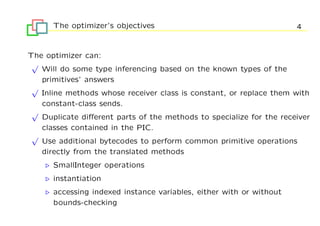
The optimizer’s objectives                                     4


The optimizer can:
 √
   Will do some type inferencing based on the known types of the
   primitives’ answers
 √
   Inline methods whose receiver class is constant, or replace them with
   constant-class sends.
 √
   Duplicate different parts of the methods to specialize for the receiver
   classes contained in the PIC.
 √
   Use additional bytecodes to perform common primitive operations
   directly from the translated methods
      SmallInteger operations
      instantiation
      accessing indexed instance variables, either with or without
      bounds-checking
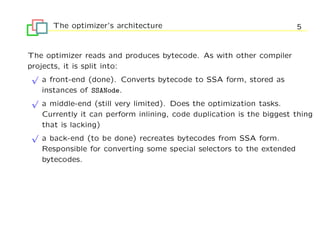
The optimizer’s architecture                                     5


The optimizer reads and produces bytecode. As with other compiler
projects, it is split into:
 √
    a front-end (done). Converts bytecode to SSA form, stored as
    instances of SSANode.
 √
    a middle-end (still very limited). Does the optimization tasks.
    Currently it can perform inlining, code duplication is the biggest thing
    that is lacking)
 √
    a back-end (to be done) recreates bytecodes from SSA form.
    Responsible for converting some special selectors to the extended
    bytecodes.
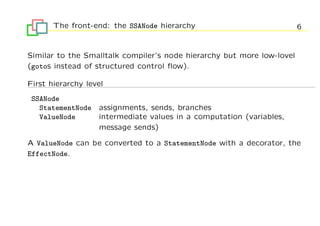
The front-end: the SSANode hierarchy                             6


Similar to the Smalltalk compiler’s node hierarchy but more low-lovel
(gotos instead of structured control flow).

First hierarchy level
 SSANode
   StatementNode   assignments, sends, branches
   ValueNode       intermediate values in a computation (variables,
                   message sends)

A ValueNode can be converted to a StatementNode with a decorator, the
EffectNode.
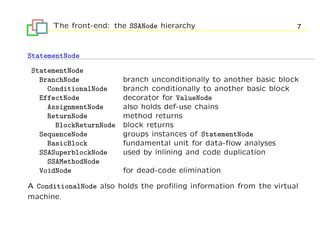
The front-end: the SSANode hierarchy                           7


StatementNode
StatementNode
  BranchNode            branch unconditionally to another basic block
    ConditionalNode     branch conditionally to another basic block
  EffectNode            decorator for ValueNode
    AssignmentNode      also holds def-use chains
    ReturnNode          method returns
      BlockReturnNode   block returns
  SequenceNode          groups instances of StatementNode
    BasicBlock          fundamental unit for data-flow analyses
  SSASuperblockNode     used by inlining and code duplication
    SSAMethodNode
  VoidNode              for dead-code elimination

A ConditionalNode also holds the profiling information from the virtual
machine.
The front-end: the SSANode hierarchy                            8


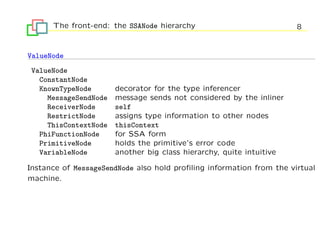
ValueNode
ValueNode
  ConstantNode
  KnownTypeNode       decorator for the type inferencer
    MessageSendNode   message sends not considered by the inliner
    ReceiverNode      self
    RestrictNode      assigns type information to other nodes
    ThisContextNode   thisContext
  PhiFunctionNode     for SSA form
  PrimitiveNode       holds the primitive’s error code
  VariableNode        another big class hierarchy, quite intuitive

Instance of MessageSendNode also hold profiling information from the virtual
machine.
The middle-end: using the SSANode hierarchy                     9


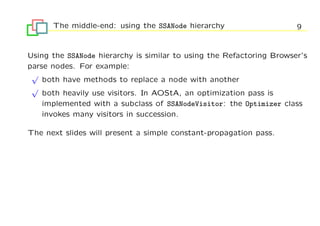
Using the SSANode hierarchy is similar to using the Refactoring Browser’s
parse nodes. For example:
 √
    both have methods to replace a node with another
 √
    both heavily use visitors. In AOStA, an optimization pass is
    implemented with a subclass of SSANodeVisitor: the Optimizer class
    invokes many visitors in succession.

The next slides will present a simple constant-propagation pass.
The middle-end: using the SSANode hierarchy                   10


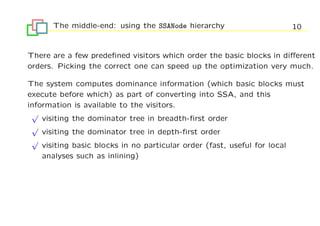
There are a few predefined visitors which order the basic blocks in different
orders. Picking the correct one can speed up the optimization very much.

The system computes dominance information (which basic blocks must
execute before which) as part of converting into SSA, and this
information is available to the visitors.
 √
    visiting the dominator tree in breadth-first order
 √
    visiting the dominator tree in depth-first order
 √
    visiting basic blocks in no particular order (fast, useful for local
    analyses such as inlining)
The middle-end: constant propagation                             11


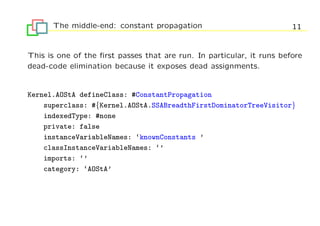
This is one of the first passes that are run. In particular, it runs before
dead-code elimination because it exposes dead assignments.


Kernel.AOStA defineClass: #ConstantPropagation
    superclass: #{Kernel.AOStA.SSABreadthFirstDominatorTreeVisitor}
    indexedType: #none
    private: false
    instanceVariableNames: ‘knownConstants ’
    classInstanceVariableNames: ‘’
    imports: ‘’
    category: ‘AOStA’
The middle-end: constant propagation                              12


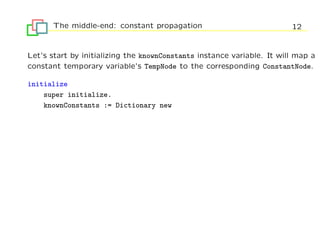
Let’s start by initializing the knownConstants instance variable. It will map a
constant temporary variable’s TempNode to the corresponding ConstantNode.

initialize
    super initialize.
    knownConstants := Dictionary new
The middle-end: constant propagation                       13


Then, whenever we find a TempNode with an entry in knownConstants, we
can replace it with the ConstantNode.

visitTempNode: aNode
    knownConstants at: aNode ifPresent: [ :constant |
        aNode replaceWith: constant ].
The middle-end: constant propagation                            14


The visitor method for AssignmentNode can optimize if the right-hand of
the assignment is a ConstantNode; if it is a φ-function, we can check if the
operands of the φ-function are all the same.

If the optimization succeeds, we propagate the constant into all the uses.
Even if it does not, we recurse by calling the superclass implementation,
in order to replace the temporaries in the right-hand.

visitAssignmentNode: aNode
    aNode isPhiFunctionAssignmentNode
        ifTrue: [
            self
                visitPhiFunctionNode: aNode value
                for: aNode variableNode].
    aNode value isConstantNode
         ifTrue: [self propagateConstantAssignmentNode: aNode]
         ifFalse: [super visitAssignmentNode: aNode]
The middle-end: constant propagation                       15


This method propagates the constant into all its uses.

propagateConstantAssignmentNode: aNode
    knownConstants at: aNode variableNode put: aNode value.
    aNode uses copy do:
         [:each |
         | statement |
         statement := each statement.
         statement isNil ifFalse: [self visitNode: statement]]
The middle-end: constant propagation                          16


If the right-hand of the assignment is a φ-function, this method is
invoked, which checks if the operands of the φ-function are all the same.

visitPhiFunctionNode: aNode for: aVariableNode
    | value seed constant |
    value := seed := Object new.
    constant := aNode inputs allSatisfy: [ :each || thisValue |
        thisValue := knownConstants at: each ifAbsent: [ ^self ].
        value == seed
            ifTrue: [ value := thisValue. true ]
            ifFalse: [ value = thisValue ]].

    constant ifTrue: [
        knownConstants at: aVariableNode put: value.
        aNode replaceWith: value ]
The middle-end: constant propagation                        17


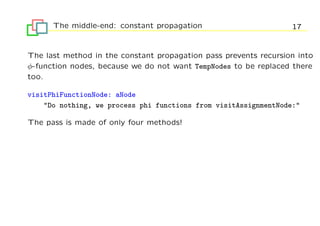
The last method in the constant propagation pass prevents recursion into
φ-function nodes, because we do not want TempNodes to be replaced there
too.

visitPhiFunctionNode: aNode
    "Do nothing, we process phi functions from visitAssignmentNode:"

The pass is made of only four methods!
Conclusion                                                       18


AOStA is:
 √
   fun: writing compiler code in Smalltalk is so much simpler!
 √
   relatively easy to support in a virtual machine, especially if it already
   supports Polymorphic Inline Caching.
 √
   relatively portable: the interface between AOStA-enabled virtual
   machines and the optimizer is well defined.

The architecture’s potential is very high—of course, as with most
experimental projects, the main problem is the implementors’ lack of free
time. You’re welcome!

Inside AOStA

  • 1.
    Inside AOStA an adaptivelyoptimizing Smalltalk architecture Paolo Bonzini—ESUG 2003, Bled
  • 2.
    What is AOStA? 1 AOStA is an experimental project hoping to implement Self’s optimization techniques in a Smalltalk virtual machine. There are some similarities and some differences: √ AOStA does use profiled execution to identify optimization techniques in a Smalltalk virtual machine. √ AOStA will use dynamic deoptimization to allow source-level debugging of optimized code. x AOStA’s optimizer is written in Smalltalk. x AOStA compiles to optimized bytecode instead of native code.
  • 3.
    Profiled execution 2 An AOStA enabled VM has two areas for JIT-compiled methods. √ The optimized area works as usual √ In the unoptimized area methods have a countdown for each send and backward branch When the counter trips, the optimizer is called back by the VM!
  • 4.
    Collecting type information 3 An AOStA enabled VM has Polymorphic Inline Caches and allows Smalltalk code to read them. √ PICs are a natural way to find information about the types of the receivers. √ Many virtual machines already implement them!
  • 5.
    The optimizer’s objectives 4 The optimizer can: √ Will do some type inferencing based on the known types of the primitives’ answers √ Inline methods whose receiver class is constant, or replace them with constant-class sends. √ Duplicate different parts of the methods to specialize for the receiver classes contained in the PIC. √ Use additional bytecodes to perform common primitive operations directly from the translated methods SmallInteger operations instantiation accessing indexed instance variables, either with or without bounds-checking
  • 6.
    The optimizer’s architecture 5 The optimizer reads and produces bytecode. As with other compiler projects, it is split into: √ a front-end (done). Converts bytecode to SSA form, stored as instances of SSANode. √ a middle-end (still very limited). Does the optimization tasks. Currently it can perform inlining, code duplication is the biggest thing that is lacking) √ a back-end (to be done) recreates bytecodes from SSA form. Responsible for converting some special selectors to the extended bytecodes.
  • 7.
    The front-end: theSSANode hierarchy 6 Similar to the Smalltalk compiler’s node hierarchy but more low-lovel (gotos instead of structured control flow). First hierarchy level SSANode StatementNode assignments, sends, branches ValueNode intermediate values in a computation (variables, message sends) A ValueNode can be converted to a StatementNode with a decorator, the EffectNode.
  • 8.
    The front-end: theSSANode hierarchy 7 StatementNode StatementNode BranchNode branch unconditionally to another basic block ConditionalNode branch conditionally to another basic block EffectNode decorator for ValueNode AssignmentNode also holds def-use chains ReturnNode method returns BlockReturnNode block returns SequenceNode groups instances of StatementNode BasicBlock fundamental unit for data-flow analyses SSASuperblockNode used by inlining and code duplication SSAMethodNode VoidNode for dead-code elimination A ConditionalNode also holds the profiling information from the virtual machine.
  • 9.
    The front-end: theSSANode hierarchy 8 ValueNode ValueNode ConstantNode KnownTypeNode decorator for the type inferencer MessageSendNode message sends not considered by the inliner ReceiverNode self RestrictNode assigns type information to other nodes ThisContextNode thisContext PhiFunctionNode for SSA form PrimitiveNode holds the primitive’s error code VariableNode another big class hierarchy, quite intuitive Instance of MessageSendNode also hold profiling information from the virtual machine.
  • 10.
    The middle-end: usingthe SSANode hierarchy 9 Using the SSANode hierarchy is similar to using the Refactoring Browser’s parse nodes. For example: √ both have methods to replace a node with another √ both heavily use visitors. In AOStA, an optimization pass is implemented with a subclass of SSANodeVisitor: the Optimizer class invokes many visitors in succession. The next slides will present a simple constant-propagation pass.
  • 11.
    The middle-end: usingthe SSANode hierarchy 10 There are a few predefined visitors which order the basic blocks in different orders. Picking the correct one can speed up the optimization very much. The system computes dominance information (which basic blocks must execute before which) as part of converting into SSA, and this information is available to the visitors. √ visiting the dominator tree in breadth-first order √ visiting the dominator tree in depth-first order √ visiting basic blocks in no particular order (fast, useful for local analyses such as inlining)
  • 12.
    The middle-end: constantpropagation 11 This is one of the first passes that are run. In particular, it runs before dead-code elimination because it exposes dead assignments. Kernel.AOStA defineClass: #ConstantPropagation superclass: #{Kernel.AOStA.SSABreadthFirstDominatorTreeVisitor} indexedType: #none private: false instanceVariableNames: ‘knownConstants ’ classInstanceVariableNames: ‘’ imports: ‘’ category: ‘AOStA’
  • 13.
    The middle-end: constantpropagation 12 Let’s start by initializing the knownConstants instance variable. It will map a constant temporary variable’s TempNode to the corresponding ConstantNode. initialize super initialize. knownConstants := Dictionary new
  • 14.
    The middle-end: constantpropagation 13 Then, whenever we find a TempNode with an entry in knownConstants, we can replace it with the ConstantNode. visitTempNode: aNode knownConstants at: aNode ifPresent: [ :constant | aNode replaceWith: constant ].
  • 15.
    The middle-end: constantpropagation 14 The visitor method for AssignmentNode can optimize if the right-hand of the assignment is a ConstantNode; if it is a φ-function, we can check if the operands of the φ-function are all the same. If the optimization succeeds, we propagate the constant into all the uses. Even if it does not, we recurse by calling the superclass implementation, in order to replace the temporaries in the right-hand. visitAssignmentNode: aNode aNode isPhiFunctionAssignmentNode ifTrue: [ self visitPhiFunctionNode: aNode value for: aNode variableNode]. aNode value isConstantNode ifTrue: [self propagateConstantAssignmentNode: aNode] ifFalse: [super visitAssignmentNode: aNode]
  • 16.
    The middle-end: constantpropagation 15 This method propagates the constant into all its uses. propagateConstantAssignmentNode: aNode knownConstants at: aNode variableNode put: aNode value. aNode uses copy do: [:each | | statement | statement := each statement. statement isNil ifFalse: [self visitNode: statement]]
  • 17.
    The middle-end: constantpropagation 16 If the right-hand of the assignment is a φ-function, this method is invoked, which checks if the operands of the φ-function are all the same. visitPhiFunctionNode: aNode for: aVariableNode | value seed constant | value := seed := Object new. constant := aNode inputs allSatisfy: [ :each || thisValue | thisValue := knownConstants at: each ifAbsent: [ ^self ]. value == seed ifTrue: [ value := thisValue. true ] ifFalse: [ value = thisValue ]]. constant ifTrue: [ knownConstants at: aVariableNode put: value. aNode replaceWith: value ]
  • 18.
    The middle-end: constantpropagation 17 The last method in the constant propagation pass prevents recursion into φ-function nodes, because we do not want TempNodes to be replaced there too. visitPhiFunctionNode: aNode "Do nothing, we process phi functions from visitAssignmentNode:" The pass is made of only four methods!
  • 19.
    Conclusion 18 AOStA is: √ fun: writing compiler code in Smalltalk is so much simpler! √ relatively easy to support in a virtual machine, especially if it already supports Polymorphic Inline Caching. √ relatively portable: the interface between AOStA-enabled virtual machines and the optimizer is well defined. The architecture’s potential is very high—of course, as with most experimental projects, the main problem is the implementors’ lack of free time. You’re welcome!