S.Ducasse 1
QuickTime™ and aTIFF (Uncompressed) decompressorare needed to see this picture.
Stéphane Ducasse
Stephane.Ducasse@inria.fr
http://stephane.ducasse.free.fr/
Reflective Programming
in Smalltalk
M. Denker and S. Ducasse - 2005
Introspection
Metaclasses
S.Ducasse 2
License: CC-Attribution-ShareAlike 2.0
http://creativecommons.org/licenses/by-sa/2.0/
S.Ducasse 3
Why...
“As a programming language becomes higher and higher
level, its implementation in terms of underlying machine
involves more and more tradeoffs, on the part of the
implementor, about what cases to optimize at the
expense of what other cases.... the ability to cleanly
integrate something outside of the language’s scope
becomes more and more limited” [Kiczales’92a]
S.Ducasse 4
Definition
“Reflection is the ability of a program to manipulate as data
something representing the state of the program during its
own execution.There are two aspects of such manipulation:
introspection and intercession.
Introspection is the ability for a program to observe and
therefore reason about its own state.
Intercessory is the ability for a program to modify its own
execution state or alter its own interpretation or meaning.
Both aspects require a mechanism for encoding execution
state as data: providing such an encoding is called reification.”
[Bobrow, Gabriel and White in Paepke‘92]
S.Ducasse 5
• A system having itself as application domain and that is
causally connected with this domain can be qualified as a
reflective system [Pattie Maes]
• A reflective system has an internal representation of itself.
• A reflective system is able to act on itself with the
ensurance that its representation will be causally
connected (up to date).
• A reflective system has some static capacity of self-
representation and dynamic self-modification in constant
synchronization
Consequences
S.Ducasse 6
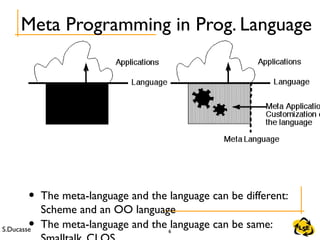
• The meta-language and the language can be different:
Scheme and an OO language
• The meta-language and the language can be same:
Meta Programming in Prog. Language
S.Ducasse 7
S.Ducasse 8
The Essence of a Class
• A format (number of instance variables and types)
• A superclass
• A method dictionary
S.Ducasse 9
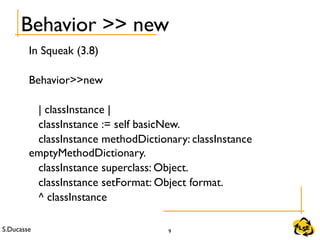
Behavior >> new
In Squeak (3.8)
Behavior>>new
| classInstance |
classInstance := self basicNew.
classInstance methodDictionary: classInstance
emptyMethodDictionary.
classInstance superclass: Object.
classInstance setFormat: Object format.
^ classInstance
S.Ducasse 10
The Essence of an Object
• class pointer
• values
• Can be special:
• the pointer pointing to the object is the object itself
• character, smallInteger (compact classes)
S.Ducasse 11
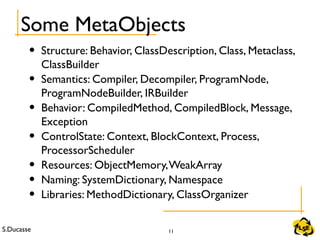
Some MetaObjects
• Structure: Behavior, ClassDescription, Class, Metaclass,
ClassBuilder
• Semantics: Compiler, Decompiler, ProgramNode,
ProgramNodeBuilder, IRBuilder
• Behavior: CompiledMethod, CompiledBlock, Message,
Exception
• ControlState: Context, BlockContext, Process,
ProcessorScheduler
• Resources: ObjectMemory,WeakArray
• Naming: SystemDictionary, Namespace
• Libraries: MethodDictionary, ClassOrganizer
S.Ducasse 12
Meta-Operations
• MetaOperations are operations that provide
information about an object as opposed to
information directly contained by the object ...They
permit things to be done that are not normally
possible [Inside Smalltalk]”
S.Ducasse 13
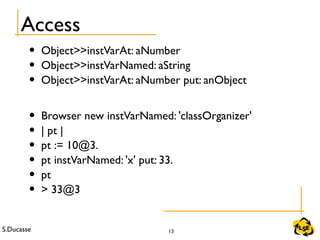
Access
• Object>>instVarAt: aNumber
• Object>>instVarNamed: aString
• Object>>instVarAt: aNumber put: anObject
• Browser new instVarNamed: 'classOrganizer'
• | pt |
• pt := 10@3.
• pt instVarNamed: 'x' put: 33.
• pt
• > 33@3
S.Ducasse 14
Access
• Object>>class
• Object>>identityHash
S.Ducasse 15
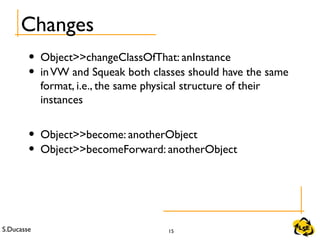
Changes
• Object>>changeClassOfThat: anInstance
• inVW and Squeak both classes should have the same
format, i.e., the same physical structure of their
instances
• Object>>become: anotherObject
• Object>>becomeForward: anotherObject
S.Ducasse 16
Implementing Instance Specific Methods
In Squeak 3.8
| behavior browser |
behavior := Behavior new.
behavior superclass: Browser.
behavior setFormat: Browser format.
browser := Browser new.
browser primitiveChangeClassTo: behavior new.
behavior compile: 'thisIsATest ^ 2'.
self assert: browser thisIsATest = 2.
self should: [Browser new thisIsATest] raise:
MessageNotUnderstood
S.Ducasse 17
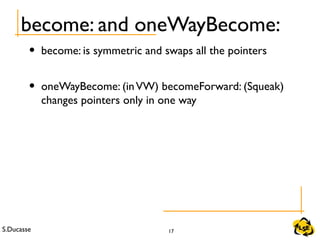
become: and oneWayBecome:
• become: is symmetric and swaps all the pointers
• oneWayBecome: (inVW) becomeForward: (Squeak)
changes pointers only in one way
S.Ducasse 18
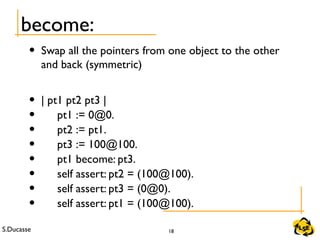
become:
• Swap all the pointers from one object to the other
and back (symmetric)
• | pt1 pt2 pt3 |
• pt1 := 0@0.
• pt2 := pt1.
• pt3 := 100@100.
• pt1 become: pt3.
• self assert: pt2 = (100@100).
• self assert: pt3 = (0@0).
• self assert: pt1 = (100@100).
S.Ducasse 19
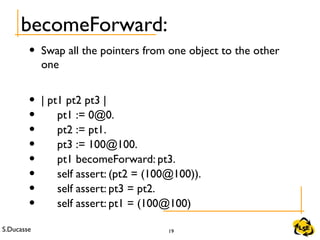
becomeForward:
• Swap all the pointers from one object to the other
one
• | pt1 pt2 pt3 |
• pt1 := 0@0.
• pt2 := pt1.
• pt3 := 100@100.
• pt1 becomeForward: pt3.
• self assert: (pt2 = (100@100)).
• self assert: pt3 = pt2.
• self assert: pt1 = (100@100)
S.Ducasse 20
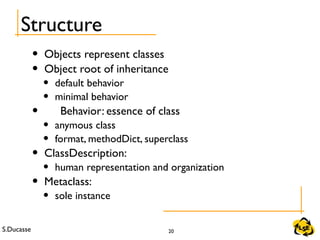
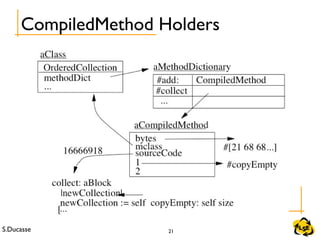
Structure
• Objects represent classes
• Object root of inheritance
• default behavior
• minimal behavior
• Behavior: essence of class
• anymous class
• format, methodDict, superclass
• ClassDescription:
• human representation and organization
• Metaclass:
• sole instance
S.Ducasse 21
CompiledMethod Holders
S.Ducasse 22
ClassBuilder
• Manages class creation
• unique instance
• format with superclass checking
• changes of existing instance when class structure
changes
S.Ducasse 23
Some Selected Protocols
• Illustrated by the tools of the IDE
• Class>>selectors
• Class>>superclass
• Class>>compiledMethodAt: aSymbol
• Class>>instVarNames
• Class>>compiler
S.Ducasse 24
The Smalltalk Compiler
S.Ducasse 25
Compiler
• Fully reified compilation process:
• Scanner/Parser (build with SmaCC)
• builds AST (from Refactoring Browser)
• Semantic Analysis: ASTChecker
• annotates the AST (e.g., var bindings)
• Translation to IR: ASTTranslator
• uses IRBuilder to build IR (Intermediate Representation)
• Bytecode generation: IRTranslator
• uses BytecodeBuilder to emit bytecodes
S.Ducasse 26
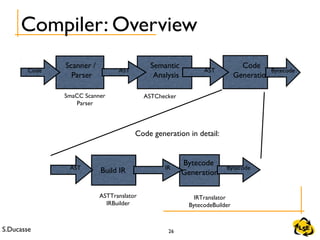
Compiler: Overview
Scanner /
Parser
Semantic
Analysis
Code
Generation
Build IR
SmaCC Scanner
Parser
ASTChecker
ASTTranslator
IRBuilder
IRTranslator
BytecodeBuilder
Bytecode
Generation
AST AST BytecodeCode
IRAST Bytecode
Code generation in detail:
S.Ducasse 27
Compiler: Syntax
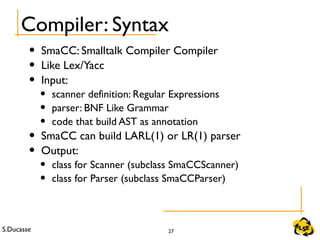
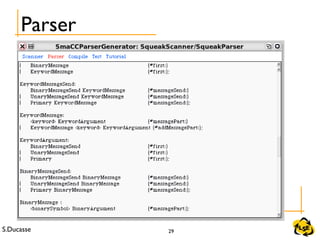
• SmaCC: Smalltalk Compiler Compiler
• Like Lex/Yacc
• Input:
• scanner definition: Regular Expressions
• parser: BNF Like Grammar
• code that build AST as annotation
• SmaCC can build LARL(1) or LR(1) parser
• Output:
• class for Scanner (subclass SmaCCScanner)
• class for Parser (subclass SmaCCParser)
S.Ducasse 28
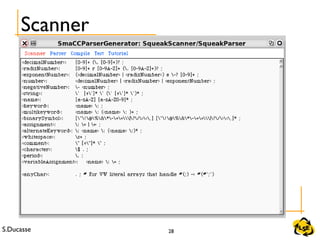
Scanner
S.Ducasse 29
Parser
S.Ducasse 30
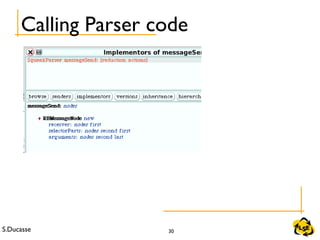
Calling Parser code
S.Ducasse 31
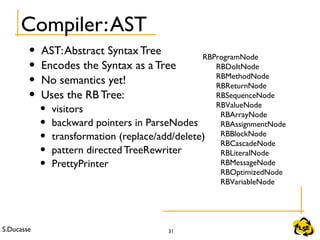
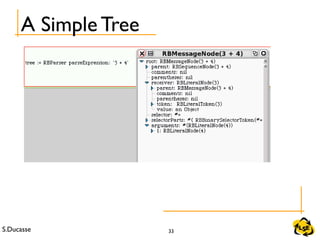
Compiler:AST
• AST:Abstract Syntax Tree
• Encodes the Syntax as a Tree
• No semantics yet!
• Uses the RB Tree:
• visitors
• backward pointers in ParseNodes
• transformation (replace/add/delete)
• pattern directed TreeRewriter
• PrettyPrinter
RBProgramNode
RBDoItNode
RBMethodNode
RBReturnNode
RBSequenceNode
RBValueNode
RBArrayNode
RBAssignmentNode
RBBlockNode
RBCascadeNode
RBLiteralNode
RBMessageNode
RBOptimizedNode
RBVariableNode
S.Ducasse 32
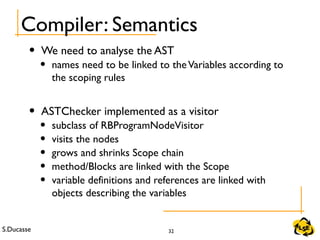
Compiler: Semantics
• We need to analyse the AST
• names need to be linked to theVariables according to
the scoping rules
• ASTChecker implemented as a visitor
• subclass of RBProgramNodeVisitor
• visits the nodes
• grows and shrinks Scope chain
• method/Blocks are linked with the Scope
• variable definitions and references are linked with
objects describing the variables
S.Ducasse 33
A Simple Tree
S.Ducasse 34
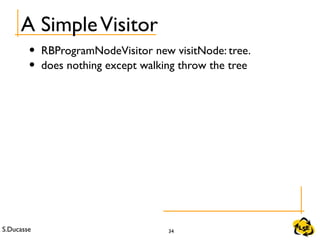
A SimpleVisitor
• RBProgramNodeVisitor new visitNode: tree.
• does nothing except walking throw the tree
S.Ducasse 35
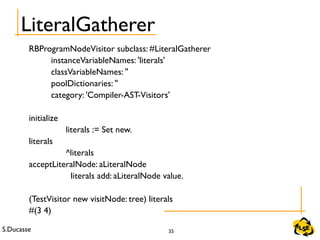
LiteralGatherer
RBProgramNodeVisitor subclass: #LiteralGatherer
instanceVariableNames: 'literals'
classVariableNames: ''
poolDictionaries: ''
category: 'Compiler-AST-Visitors'
initialize
literals := Set new.
literals
^literals
acceptLiteralNode: aLiteralNode
literals add: aLiteralNode value.
(TestVisitor new visitNode: tree) literals
#(3 4)
S.Ducasse 36
Compiler III: IR
• IR: Intermediate Representation
• semantic like Bytecode, but more abstract
• independent of the bytecode set
• IR is a tree
• IR nodes allow easy transformation
• decompilation to RB AST
• IR build from AST using ASTTranslator:
• ASTVisitor
• uses IRBuilder
S.Ducasse 37
Compiler 4: Bytecode
• IR needs to be converted to Bytecode
• IRTranslator:Visitor for IR tree
• Uses BytecodeBuilder to generate Bytecode
• Builds a compiledMethod
testReturn1
| iRMethod aCompiledMethod |
iRMethod := IRBuilder new
numRargs: 1;
addTemps: #(self); "receiver and args declarations"
pushLiteral: 1;
returnTop;
ir.
aCompiledMethod := iRMethod compiledMethod.
self should: [(aCompiledMethod valueWithReceiver: nil arguments: #() ) = 1].
S.Ducasse 38
Behavior
• Method Lookup
• Method Application
S.Ducasse 39
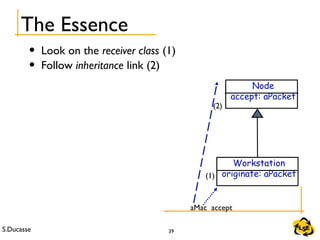
• Look on the receiver class (1)
• Follow inheritance link (2)
The Essence
Node
accept: aPacket
Workstation
originate: aPacket
aMac accept
(1)
(2)
S.Ducasse 40
doesNotUnderstand:
• When the lookup fails
• doesNotUnderstand: on the original message receiver
• reification of the message
• 2 zork
• leads to
• 2 doesNotUnderstand: aMessage
• aMessage selector -> #zork
S.Ducasse 41
Invoking a message from its name
• Object>>perform: aSymbol
• Object>>perform: aSymbol with: arg
• ...
• Asks an object to execute a message
• The method lookup is done!
• 5 factorial
• 5 perform: #factorial
S.Ducasse 42
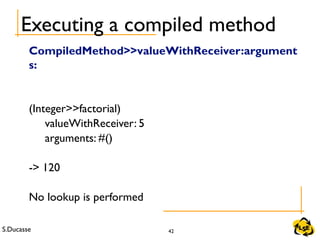
Executing a compiled method
CompiledMethod>>valueWithReceiver:argument
s:
(Integer>>factorial)
valueWithReceiver: 5
arguments: #()
-> 120
No lookup is performed
S.Ducasse 43
Other Reflective Entities
• Execution stack can be reified and manipulated on
demand
• thisContext is a pseudo variable which gives access to
the stack
S.Ducasse 44
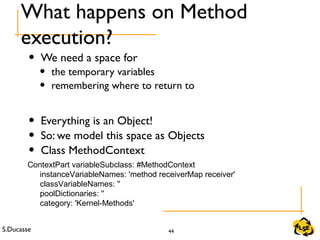
• We need a space for
• the temporary variables
• remembering where to return to
• Everything is an Object!
• So: we model this space as Objects
• Class MethodContext
What happens on Method
execution?
ContextPart variableSubclass: #MethodContext
instanceVariableNames: 'method receiverMap receiver'
classVariableNames: ''
poolDictionaries: ''
category: 'Kernel-Methods'
S.Ducasse 45
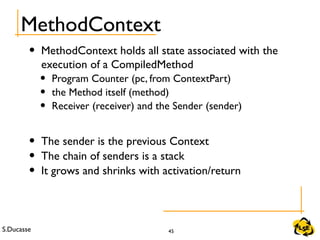
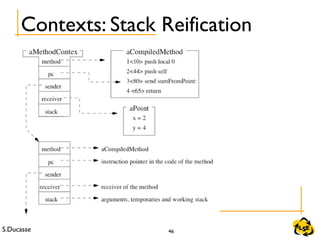
MethodContext
• MethodContext holds all state associated with the
execution of a CompiledMethod
• Program Counter (pc, from ContextPart)
• the Method itself (method)
• Receiver (receiver) and the Sender (sender)
• The sender is the previous Context
• The chain of senders is a stack
• It grows and shrinks with activation/return
S.Ducasse 46
Contexts: Stack Reification
S.Ducasse 47
Example: #haltIf:
• You can’t put a halt in methods that are called often
(e.g. OrderedCollection>>add:)
• Idea: only halt if called from a method with a certain
name
haltIf: aSelector
| cntxt |
cntxt := thisContext.
[cntxt sender isNil] whileFalse: [
cntxt := cntxt sender.
(cntxt selector = aSelector) ifTrue: [
Halt signal
].
].
S.Ducasse 48
Controling Messages
S.Ducasse 49
Approaches to Control Message
• Error Handling Specialization
• Minimal Objects + doesNotUnderstand:
• Using Method Lookup
• anonymous classes between instances and their classes
• Method Substitution
• wrapping methods
• Control: instance-based/class/group
• Granularity: all/unknown/specific
S.Ducasse 50
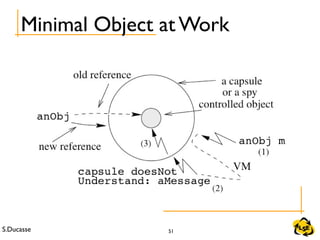
Error Handling Specialization
• Minimal Object
• do not understand too much
• redefine doesNotUnderstand:
• wrap normal object in a minimal object
• nil superclass or ProtoObject
• use becomeForward: to substitute the object to
control
S.Ducasse 51
Minimal Object atWork
S.Ducasse 52
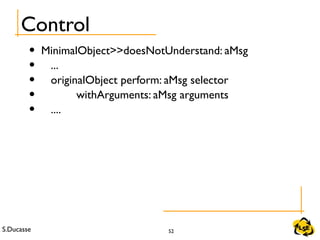
Control
• MinimalObject>>doesNotUnderstand: aMsg
• ...
• originalObject perform: aMsg selector
• withArguments: aMsg arguments
• ....
S.Ducasse 53
Minimal Behavior inVW
MinimalObject class>>initialize
superclass := nil.
#(doesNotUnderstand: error: isNil = ==̃ ̃
printString printOn: class inspect basicInspect
        basicAt: basicSize instVarAt: instVarAt:put:)
              do: [:selector |
self recompile: selector from: Object]
S.Ducasse 54
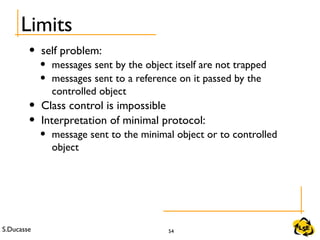
Limits
• self problem:
• messages sent by the object itself are not trapped
• messages sent to a reference on it passed by the
controlled object
• Class control is impossible
• Interpretation of minimal protocol:
• message sent to the minimal object or to controlled
object
S.Ducasse 55
Evaluation
• Simple
• In Squeak ProtoObject
• Some problems
• Instance-based
• All messages
S.Ducasse 56
Approaches to Control Message
• Error Handling Specialization
• Minimal Objects + doesNotUnderstand:
• Using Method Lookup
• anonymous classes between instances and their classes
• Method Substitution
• wrapping methods
S.Ducasse 57
UsingVM Lookup
• Creation of a controlling class that is interposed
between the instance and its class
• Definition of controlling methods
• Class change
• Hidding it from the developper/user using anonymous
class
S.Ducasse 58
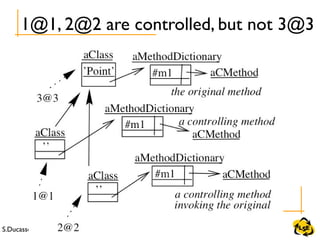
1@1, 2@2 are controlled, but not 3@3
S.Ducasse 59
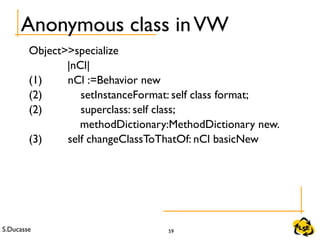
Anonymous class inVW
Object>>specialize
|nCl|
(1) nCl :=Behavior new
(2) setInstanceFormat: self class format;
(2) superclass: self class;
methodDictionary:MethodDictionary new.
(3) self changeClassToThatOf: nCl basicNew
S.Ducasse 60
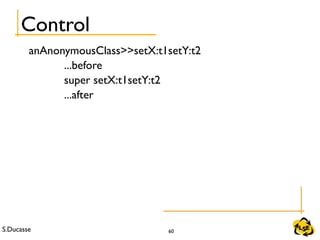
Control
anAnonymousClass>>setX:t1setY:t2
...before
super setX:t1setY:t2
...after
S.Ducasse 61
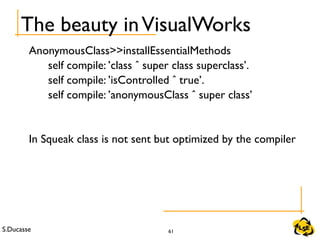
The beauty inVisualWorks
AnonymousClass>>installEssentialMethods
self compile: ’class ˆ super class superclass’.
self compile: ’isControlled ˆ true’.
self compile: ’anonymousClass ˆ super class’
In Squeak class is not sent but optimized by the compiler
S.Ducasse 62
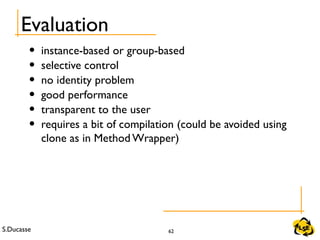
Evaluation
• instance-based or group-based
• selective control
• no identity problem
• good performance
• transparent to the user
• requires a bit of compilation (could be avoided using
clone as in Method Wrapper)
S.Ducasse 63
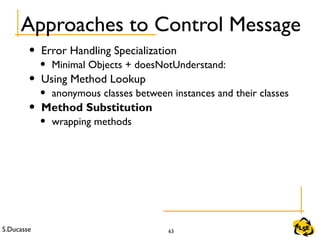
Approaches to Control Message
• Error Handling Specialization
• Minimal Objects + doesNotUnderstand:
• Using Method Lookup
• anonymous classes between instances and their classes
• Method Substitution
• wrapping methods
S.Ducasse 64
Method Substitution
• First approach: add methods with offucasted names
• but the user can see them
• Wrapping the methods without poluting the interface
S.Ducasse 65
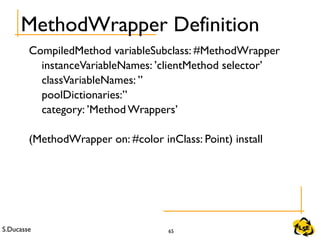
MethodWrapper Definition
CompiledMethod variableSubclass: #MethodWrapper
instanceVariableNames: ’clientMethod selector’
classVariableNames: ’’
poolDictionaries:’’
category: ’Method Wrappers’
(MethodWrapper on: #color inClass: Point) install
S.Ducasse 66
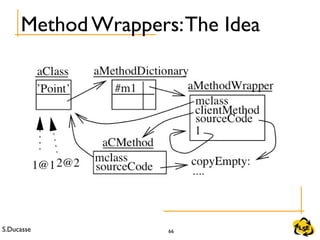
Method Wrappers:The Idea
S.Ducasse 67
Mechanics
WrapperMethod>>valueWithReceiver: anObject arguments: args
self beforeMethod.
ˆ [clientMethod
valueWithReceiver: object
arguments: args]
valueNowOrOnUnwindDo:
[self afterMethod]
aClass>>originalSelector: t1
|t2|
(t2 := Array new: 1) at: 1 put: t1.
ˆself valueWithReceiver: self arguments: t2
S.Ducasse 68
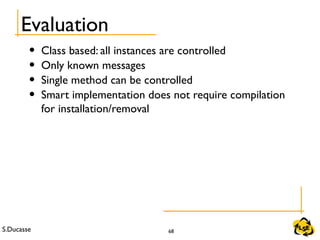
Evaluation
• Class based: all instances are controlled
• Only known messages
• Single method can be controlled
• Smart implementation does not require compilation
for installation/removal
S.Ducasse 69
Scaffolding Patterns
• How to prototype applications even faster?
• Based on K.Auer Patterns
S.Ducasse 70
Patterns
• Extensible Attributes
• Artificial Delegation
• How do you prepare for additional delegated
operations?
• Cached Extensibility
• Selector Synthesis
S.Ducasse 71
Extensible Attributes
Context:
multi person project + heavy version control
other designers will want to add attributes to your class
How do you minimize the effort required to add
additional attributes to the class?
Solution:
Add a dictionary attribute to your class
+ a dictionary access
S.Ducasse 72
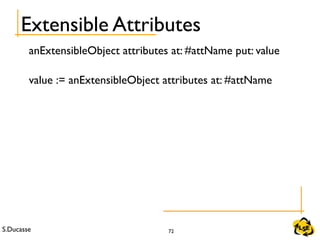
Extensible Attributes
anExtensibleObject attributes at: #attName put: value
value := anExtensibleObject attributes at: #attName
S.Ducasse 73
Artificial Accessors
Context: you applied Extensible Attributes
How do you make it easier for other classes to access
your extended attributes?
Solution: simulate the presence of accessor for the
attributes by specializing doesNotUnderstand:
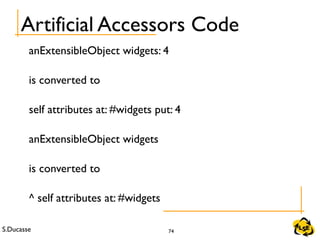
S.Ducasse 74
Artificial Accessors Code
anExtensibleObject widgets: 4
is converted to
self attributes at: #widgets put: 4
anExtensibleObject widgets
is converted to
^ self attributes at: #widgets
S.Ducasse 75
Consequences
Accessors do not exist therefore
browsing can be a problem
tracing also
reflective queries (allSelectors, canUnderstand:....) will not
work as with plain methods
S.Ducasse 76
Artificial Delegation
How do you make
^ self delegate anOperation
easier?
Solution: Override doesNotUnderstand: of the delegator
to iterate through its attribute looking for an attribute
that supports the method selector that was not
understood
S.Ducasse 77
Cached Extensibility
Context: you used the previous patterns
How do you know which artificial accessors or artificial
delegate have been used?
Solution: Specialize doesNotUnderstand: to create
methods as soon as artificial ones are invoked
S.Ducasse 78
Selector Synthesis
How can you implement a state-dependent object with a
minimal effort?
Solution: define state and event as symbols and given a
pair synthesise a method selector
selector := ‘handle’, anEvent aString,‘In’, aState asString.
self perform: selector asSymbol.
S.Ducasse 79
References
• [Ducasse’99] S. Ducasse,“Message Passing Control Techniques in Smalltalk”,
JOOP, 1999
• [Rivard’96] F. Rivard, Smalltalk : a Reflective Language, REFLECTION'96,1996
• [Bran’98] Wrappers To The Rescue, ECOOP’98, 1998
• [Auer] Scaffolding patterns, PLOD 3,Addison-Wesley,
(http://www.rolemodelsoftware.com/moreAboutUs/publications/articles/scaffol
d.php)
• Smalltalk the Language, Golberg Robson,Addison-Wesley
S.Ducasse 80
Smalltalk Reflective Capabilities
Both introspection and reflection
Powerful
Based on everything is an object approach

Stoop 305-reflective programming5

  • 1.
    S.Ducasse 1 QuickTime™ andaTIFF (Uncompressed) decompressorare needed to see this picture. Stéphane Ducasse Stephane.Ducasse@inria.fr http://stephane.ducasse.free.fr/ Reflective Programming in Smalltalk M. Denker and S. Ducasse - 2005 Introspection Metaclasses
  • 2.
    S.Ducasse 2 License: CC-Attribution-ShareAlike2.0 http://creativecommons.org/licenses/by-sa/2.0/
  • 3.
    S.Ducasse 3 Why... “As aprogramming language becomes higher and higher level, its implementation in terms of underlying machine involves more and more tradeoffs, on the part of the implementor, about what cases to optimize at the expense of what other cases.... the ability to cleanly integrate something outside of the language’s scope becomes more and more limited” [Kiczales’92a]
  • 4.
    S.Ducasse 4 Definition “Reflection isthe ability of a program to manipulate as data something representing the state of the program during its own execution.There are two aspects of such manipulation: introspection and intercession. Introspection is the ability for a program to observe and therefore reason about its own state. Intercessory is the ability for a program to modify its own execution state or alter its own interpretation or meaning. Both aspects require a mechanism for encoding execution state as data: providing such an encoding is called reification.” [Bobrow, Gabriel and White in Paepke‘92]
  • 5.
    S.Ducasse 5 • Asystem having itself as application domain and that is causally connected with this domain can be qualified as a reflective system [Pattie Maes] • A reflective system has an internal representation of itself. • A reflective system is able to act on itself with the ensurance that its representation will be causally connected (up to date). • A reflective system has some static capacity of self- representation and dynamic self-modification in constant synchronization Consequences
  • 6.
    S.Ducasse 6 • Themeta-language and the language can be different: Scheme and an OO language • The meta-language and the language can be same: Meta Programming in Prog. Language
  • 7.
  • 8.
    S.Ducasse 8 The Essenceof a Class • A format (number of instance variables and types) • A superclass • A method dictionary
  • 9.
    S.Ducasse 9 Behavior >>new In Squeak (3.8) Behavior>>new | classInstance | classInstance := self basicNew. classInstance methodDictionary: classInstance emptyMethodDictionary. classInstance superclass: Object. classInstance setFormat: Object format. ^ classInstance
  • 10.
    S.Ducasse 10 The Essenceof an Object • class pointer • values • Can be special: • the pointer pointing to the object is the object itself • character, smallInteger (compact classes)
  • 11.
    S.Ducasse 11 Some MetaObjects •Structure: Behavior, ClassDescription, Class, Metaclass, ClassBuilder • Semantics: Compiler, Decompiler, ProgramNode, ProgramNodeBuilder, IRBuilder • Behavior: CompiledMethod, CompiledBlock, Message, Exception • ControlState: Context, BlockContext, Process, ProcessorScheduler • Resources: ObjectMemory,WeakArray • Naming: SystemDictionary, Namespace • Libraries: MethodDictionary, ClassOrganizer
  • 12.
    S.Ducasse 12 Meta-Operations • MetaOperationsare operations that provide information about an object as opposed to information directly contained by the object ...They permit things to be done that are not normally possible [Inside Smalltalk]”
  • 13.
    S.Ducasse 13 Access • Object>>instVarAt:aNumber • Object>>instVarNamed: aString • Object>>instVarAt: aNumber put: anObject • Browser new instVarNamed: 'classOrganizer' • | pt | • pt := 10@3. • pt instVarNamed: 'x' put: 33. • pt • > 33@3
  • 14.
  • 15.
    S.Ducasse 15 Changes • Object>>changeClassOfThat:anInstance • inVW and Squeak both classes should have the same format, i.e., the same physical structure of their instances • Object>>become: anotherObject • Object>>becomeForward: anotherObject
  • 16.
    S.Ducasse 16 Implementing InstanceSpecific Methods In Squeak 3.8 | behavior browser | behavior := Behavior new. behavior superclass: Browser. behavior setFormat: Browser format. browser := Browser new. browser primitiveChangeClassTo: behavior new. behavior compile: 'thisIsATest ^ 2'. self assert: browser thisIsATest = 2. self should: [Browser new thisIsATest] raise: MessageNotUnderstood
  • 17.
    S.Ducasse 17 become: andoneWayBecome: • become: is symmetric and swaps all the pointers • oneWayBecome: (inVW) becomeForward: (Squeak) changes pointers only in one way
  • 18.
    S.Ducasse 18 become: • Swapall the pointers from one object to the other and back (symmetric) • | pt1 pt2 pt3 | • pt1 := 0@0. • pt2 := pt1. • pt3 := 100@100. • pt1 become: pt3. • self assert: pt2 = (100@100). • self assert: pt3 = (0@0). • self assert: pt1 = (100@100).
  • 19.
    S.Ducasse 19 becomeForward: • Swapall the pointers from one object to the other one • | pt1 pt2 pt3 | • pt1 := 0@0. • pt2 := pt1. • pt3 := 100@100. • pt1 becomeForward: pt3. • self assert: (pt2 = (100@100)). • self assert: pt3 = pt2. • self assert: pt1 = (100@100)
  • 20.
    S.Ducasse 20 Structure • Objectsrepresent classes • Object root of inheritance • default behavior • minimal behavior • Behavior: essence of class • anymous class • format, methodDict, superclass • ClassDescription: • human representation and organization • Metaclass: • sole instance
  • 21.
  • 22.
    S.Ducasse 22 ClassBuilder • Managesclass creation • unique instance • format with superclass checking • changes of existing instance when class structure changes
  • 23.
    S.Ducasse 23 Some SelectedProtocols • Illustrated by the tools of the IDE • Class>>selectors • Class>>superclass • Class>>compiledMethodAt: aSymbol • Class>>instVarNames • Class>>compiler
  • 24.
  • 25.
    S.Ducasse 25 Compiler • Fullyreified compilation process: • Scanner/Parser (build with SmaCC) • builds AST (from Refactoring Browser) • Semantic Analysis: ASTChecker • annotates the AST (e.g., var bindings) • Translation to IR: ASTTranslator • uses IRBuilder to build IR (Intermediate Representation) • Bytecode generation: IRTranslator • uses BytecodeBuilder to emit bytecodes
  • 26.
    S.Ducasse 26 Compiler: Overview Scanner/ Parser Semantic Analysis Code Generation Build IR SmaCC Scanner Parser ASTChecker ASTTranslator IRBuilder IRTranslator BytecodeBuilder Bytecode Generation AST AST BytecodeCode IRAST Bytecode Code generation in detail:
  • 27.
    S.Ducasse 27 Compiler: Syntax •SmaCC: Smalltalk Compiler Compiler • Like Lex/Yacc • Input: • scanner definition: Regular Expressions • parser: BNF Like Grammar • code that build AST as annotation • SmaCC can build LARL(1) or LR(1) parser • Output: • class for Scanner (subclass SmaCCScanner) • class for Parser (subclass SmaCCParser)
  • 28.
  • 29.
  • 30.
  • 31.
    S.Ducasse 31 Compiler:AST • AST:AbstractSyntax Tree • Encodes the Syntax as a Tree • No semantics yet! • Uses the RB Tree: • visitors • backward pointers in ParseNodes • transformation (replace/add/delete) • pattern directed TreeRewriter • PrettyPrinter RBProgramNode RBDoItNode RBMethodNode RBReturnNode RBSequenceNode RBValueNode RBArrayNode RBAssignmentNode RBBlockNode RBCascadeNode RBLiteralNode RBMessageNode RBOptimizedNode RBVariableNode
  • 32.
    S.Ducasse 32 Compiler: Semantics •We need to analyse the AST • names need to be linked to theVariables according to the scoping rules • ASTChecker implemented as a visitor • subclass of RBProgramNodeVisitor • visits the nodes • grows and shrinks Scope chain • method/Blocks are linked with the Scope • variable definitions and references are linked with objects describing the variables
  • 33.
  • 34.
    S.Ducasse 34 A SimpleVisitor •RBProgramNodeVisitor new visitNode: tree. • does nothing except walking throw the tree
  • 35.
    S.Ducasse 35 LiteralGatherer RBProgramNodeVisitor subclass:#LiteralGatherer instanceVariableNames: 'literals' classVariableNames: '' poolDictionaries: '' category: 'Compiler-AST-Visitors' initialize literals := Set new. literals ^literals acceptLiteralNode: aLiteralNode literals add: aLiteralNode value. (TestVisitor new visitNode: tree) literals #(3 4)
  • 36.
    S.Ducasse 36 Compiler III:IR • IR: Intermediate Representation • semantic like Bytecode, but more abstract • independent of the bytecode set • IR is a tree • IR nodes allow easy transformation • decompilation to RB AST • IR build from AST using ASTTranslator: • ASTVisitor • uses IRBuilder
  • 37.
    S.Ducasse 37 Compiler 4:Bytecode • IR needs to be converted to Bytecode • IRTranslator:Visitor for IR tree • Uses BytecodeBuilder to generate Bytecode • Builds a compiledMethod testReturn1 | iRMethod aCompiledMethod | iRMethod := IRBuilder new numRargs: 1; addTemps: #(self); "receiver and args declarations" pushLiteral: 1; returnTop; ir. aCompiledMethod := iRMethod compiledMethod. self should: [(aCompiledMethod valueWithReceiver: nil arguments: #() ) = 1].
  • 38.
    S.Ducasse 38 Behavior • MethodLookup • Method Application
  • 39.
    S.Ducasse 39 • Lookon the receiver class (1) • Follow inheritance link (2) The Essence Node accept: aPacket Workstation originate: aPacket aMac accept (1) (2)
  • 40.
    S.Ducasse 40 doesNotUnderstand: • Whenthe lookup fails • doesNotUnderstand: on the original message receiver • reification of the message • 2 zork • leads to • 2 doesNotUnderstand: aMessage • aMessage selector -> #zork
  • 41.
    S.Ducasse 41 Invoking amessage from its name • Object>>perform: aSymbol • Object>>perform: aSymbol with: arg • ... • Asks an object to execute a message • The method lookup is done! • 5 factorial • 5 perform: #factorial
  • 42.
    S.Ducasse 42 Executing acompiled method CompiledMethod>>valueWithReceiver:argument s: (Integer>>factorial) valueWithReceiver: 5 arguments: #() -> 120 No lookup is performed
  • 43.
    S.Ducasse 43 Other ReflectiveEntities • Execution stack can be reified and manipulated on demand • thisContext is a pseudo variable which gives access to the stack
  • 44.
    S.Ducasse 44 • Weneed a space for • the temporary variables • remembering where to return to • Everything is an Object! • So: we model this space as Objects • Class MethodContext What happens on Method execution? ContextPart variableSubclass: #MethodContext instanceVariableNames: 'method receiverMap receiver' classVariableNames: '' poolDictionaries: '' category: 'Kernel-Methods'
  • 45.
    S.Ducasse 45 MethodContext • MethodContextholds all state associated with the execution of a CompiledMethod • Program Counter (pc, from ContextPart) • the Method itself (method) • Receiver (receiver) and the Sender (sender) • The sender is the previous Context • The chain of senders is a stack • It grows and shrinks with activation/return
  • 46.
  • 47.
    S.Ducasse 47 Example: #haltIf: •You can’t put a halt in methods that are called often (e.g. OrderedCollection>>add:) • Idea: only halt if called from a method with a certain name haltIf: aSelector | cntxt | cntxt := thisContext. [cntxt sender isNil] whileFalse: [ cntxt := cntxt sender. (cntxt selector = aSelector) ifTrue: [ Halt signal ]. ].
  • 48.
  • 49.
    S.Ducasse 49 Approaches toControl Message • Error Handling Specialization • Minimal Objects + doesNotUnderstand: • Using Method Lookup • anonymous classes between instances and their classes • Method Substitution • wrapping methods • Control: instance-based/class/group • Granularity: all/unknown/specific
  • 50.
    S.Ducasse 50 Error HandlingSpecialization • Minimal Object • do not understand too much • redefine doesNotUnderstand: • wrap normal object in a minimal object • nil superclass or ProtoObject • use becomeForward: to substitute the object to control
  • 51.
  • 52.
    S.Ducasse 52 Control • MinimalObject>>doesNotUnderstand:aMsg • ... • originalObject perform: aMsg selector • withArguments: aMsg arguments • ....
  • 53.
    S.Ducasse 53 Minimal BehaviorinVW MinimalObject class>>initialize superclass := nil. #(doesNotUnderstand: error: isNil = ==̃ ̃ printString printOn: class inspect basicInspect         basicAt: basicSize instVarAt: instVarAt:put:)               do: [:selector | self recompile: selector from: Object]
  • 54.
    S.Ducasse 54 Limits • selfproblem: • messages sent by the object itself are not trapped • messages sent to a reference on it passed by the controlled object • Class control is impossible • Interpretation of minimal protocol: • message sent to the minimal object or to controlled object
  • 55.
    S.Ducasse 55 Evaluation • Simple •In Squeak ProtoObject • Some problems • Instance-based • All messages
  • 56.
    S.Ducasse 56 Approaches toControl Message • Error Handling Specialization • Minimal Objects + doesNotUnderstand: • Using Method Lookup • anonymous classes between instances and their classes • Method Substitution • wrapping methods
  • 57.
    S.Ducasse 57 UsingVM Lookup •Creation of a controlling class that is interposed between the instance and its class • Definition of controlling methods • Class change • Hidding it from the developper/user using anonymous class
  • 58.
    S.Ducasse 58 1@1, 2@2are controlled, but not 3@3
  • 59.
    S.Ducasse 59 Anonymous classinVW Object>>specialize |nCl| (1) nCl :=Behavior new (2) setInstanceFormat: self class format; (2) superclass: self class; methodDictionary:MethodDictionary new. (3) self changeClassToThatOf: nCl basicNew
  • 60.
  • 61.
    S.Ducasse 61 The beautyinVisualWorks AnonymousClass>>installEssentialMethods self compile: ’class ˆ super class superclass’. self compile: ’isControlled ˆ true’. self compile: ’anonymousClass ˆ super class’ In Squeak class is not sent but optimized by the compiler
  • 62.
    S.Ducasse 62 Evaluation • instance-basedor group-based • selective control • no identity problem • good performance • transparent to the user • requires a bit of compilation (could be avoided using clone as in Method Wrapper)
  • 63.
    S.Ducasse 63 Approaches toControl Message • Error Handling Specialization • Minimal Objects + doesNotUnderstand: • Using Method Lookup • anonymous classes between instances and their classes • Method Substitution • wrapping methods
  • 64.
    S.Ducasse 64 Method Substitution •First approach: add methods with offucasted names • but the user can see them • Wrapping the methods without poluting the interface
  • 65.
    S.Ducasse 65 MethodWrapper Definition CompiledMethodvariableSubclass: #MethodWrapper instanceVariableNames: ’clientMethod selector’ classVariableNames: ’’ poolDictionaries:’’ category: ’Method Wrappers’ (MethodWrapper on: #color inClass: Point) install
  • 66.
  • 67.
    S.Ducasse 67 Mechanics WrapperMethod>>valueWithReceiver: anObjectarguments: args self beforeMethod. ˆ [clientMethod valueWithReceiver: object arguments: args] valueNowOrOnUnwindDo: [self afterMethod] aClass>>originalSelector: t1 |t2| (t2 := Array new: 1) at: 1 put: t1. ˆself valueWithReceiver: self arguments: t2
  • 68.
    S.Ducasse 68 Evaluation • Classbased: all instances are controlled • Only known messages • Single method can be controlled • Smart implementation does not require compilation for installation/removal
  • 69.
    S.Ducasse 69 Scaffolding Patterns •How to prototype applications even faster? • Based on K.Auer Patterns
  • 70.
    S.Ducasse 70 Patterns • ExtensibleAttributes • Artificial Delegation • How do you prepare for additional delegated operations? • Cached Extensibility • Selector Synthesis
  • 71.
    S.Ducasse 71 Extensible Attributes Context: multiperson project + heavy version control other designers will want to add attributes to your class How do you minimize the effort required to add additional attributes to the class? Solution: Add a dictionary attribute to your class + a dictionary access
  • 72.
    S.Ducasse 72 Extensible Attributes anExtensibleObjectattributes at: #attName put: value value := anExtensibleObject attributes at: #attName
  • 73.
    S.Ducasse 73 Artificial Accessors Context:you applied Extensible Attributes How do you make it easier for other classes to access your extended attributes? Solution: simulate the presence of accessor for the attributes by specializing doesNotUnderstand:
  • 74.
    S.Ducasse 74 Artificial AccessorsCode anExtensibleObject widgets: 4 is converted to self attributes at: #widgets put: 4 anExtensibleObject widgets is converted to ^ self attributes at: #widgets
  • 75.
    S.Ducasse 75 Consequences Accessors donot exist therefore browsing can be a problem tracing also reflective queries (allSelectors, canUnderstand:....) will not work as with plain methods
  • 76.
    S.Ducasse 76 Artificial Delegation Howdo you make ^ self delegate anOperation easier? Solution: Override doesNotUnderstand: of the delegator to iterate through its attribute looking for an attribute that supports the method selector that was not understood
  • 77.
    S.Ducasse 77 Cached Extensibility Context:you used the previous patterns How do you know which artificial accessors or artificial delegate have been used? Solution: Specialize doesNotUnderstand: to create methods as soon as artificial ones are invoked
  • 78.
    S.Ducasse 78 Selector Synthesis Howcan you implement a state-dependent object with a minimal effort? Solution: define state and event as symbols and given a pair synthesise a method selector selector := ‘handle’, anEvent aString,‘In’, aState asString. self perform: selector asSymbol.
  • 79.
    S.Ducasse 79 References • [Ducasse’99]S. Ducasse,“Message Passing Control Techniques in Smalltalk”, JOOP, 1999 • [Rivard’96] F. Rivard, Smalltalk : a Reflective Language, REFLECTION'96,1996 • [Bran’98] Wrappers To The Rescue, ECOOP’98, 1998 • [Auer] Scaffolding patterns, PLOD 3,Addison-Wesley, (http://www.rolemodelsoftware.com/moreAboutUs/publications/articles/scaffol d.php) • Smalltalk the Language, Golberg Robson,Addison-Wesley
  • 80.
    S.Ducasse 80 Smalltalk ReflectiveCapabilities Both introspection and reflection Powerful Based on everything is an object approach