Opal Compiler


    Jorge Ressia
Roadmap


> The Pharo compiler
> Introduction to Smalltalk bytecode
> Generating bytecode with IRBuilder
> ByteSurgeon


                                       Original material by Marcus Denker


                                                                            2
Roadmap


>   The Pharo compiler
> Introduction to Smalltalk bytecode
> Generating bytecode with IRBuilder
>   ByteSurgeon


                                       3
The Pharo Compiler


>   Default compiler
    — very old design
    — quite hard to understand
    — hard to modify and extend


                                  4
What qualities are important in a compiler?


  >     Correct code
  >     Output runs fast
  >     Compiler runs fast
  >     Compile time proportional to program size
  >     Support for separate compilation
  >     Good diagnostics for syntax errors
  >     Works well with the debugger
  >     Good diagnostics forow anomalies
                             fl
  >     Consistent, predictable optimization

© Oscar Nierstrasz                                  5
Why do we care?


> ByteSurgeon — Runtime Bytecode Transformation for
  Smalltalk
> ChangeBoxes — Modeling Change as a first-class entity
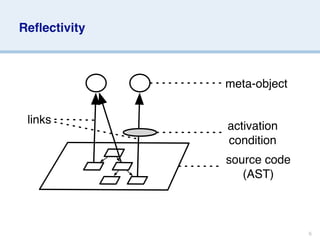
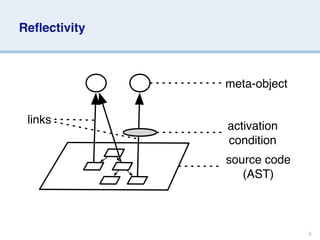
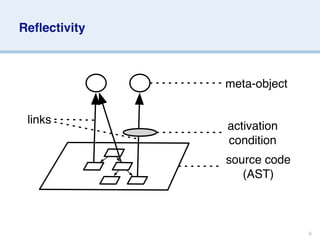
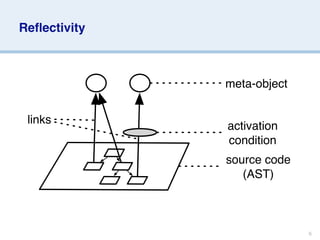
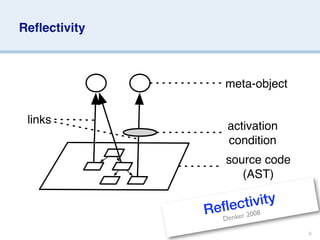
> Reflectivity — Persephone, Geppetto and the rest
> Helvetia — Context Specific Languages with
  Homogeneous Tool Integration
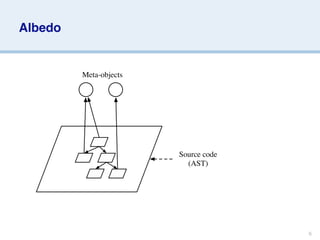
> Albedo — A unified approach to reflection.


                                                          6
Opal Compiler


>   Opal Compiler for Pharo
    — http://scg.unibe.ch/research/OpalCompiler


                                                  7
Opal Compiler


>   Fully reified compilation process:
    — Scanner/Parser (RBParser)
       –   builds AST (from Refactoring Browser)
    — Semantic Analysis: OCASTSemanticAnalyzer
       –   annotates the AST (e.g., var bindings)
    — Translation to IR: OCASTTranslator
       –   uses IRBuilder to build IR (Intermediate Representation)
    — Bytecode generation: IRTranslator
       –   uses OCBytecodeGenerator to emit bytecodes


                                                                      8
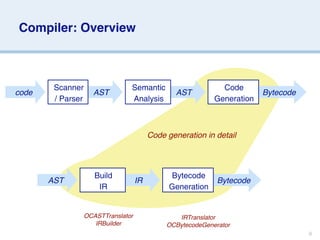
Compiler: Overview


        Scanner                  Semantic                      Code
code                 AST                          AST                     Bytecode
        / Parser                 Analysis                    Generation


                                          Code generation in detail


                      Build                      Bytecode
       AST                           IR                       Bytecode
                       IR                       Generation


                   OCASTTranslator                IRTranslator
                      IRBuilder                OCBytecodeGenerator
                                                                                     9
Compiler: Design Decisions


>   Every building block of the compiler is implemented as a
    visitor on the representation.

>   The AST is never changed


                                                               10
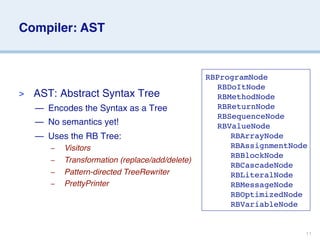
Compiler: AST


                                                 RBProgramNode
                                                 
 RBDoItNode
>   AST: Abstract Syntax Tree                    
 RBMethodNode
    — Encodes the Syntax as a Tree               
 RBReturnNode
                                                 
 RBSequenceNode
    — No semantics yet!                          
 RBValueNode
    — Uses the RB Tree:                          
 
 RBArrayNode
       –   Visitors                              
 
 RBAssignmentNode
                                                 
 
 RBBlockNode
       –   Transformation (replace/add/delete)
                                                 
 
 RBCascadeNode
       –   Pattern-directed TreeRewriter         
 
 RBLiteralNode
       –   PrettyPrinter                         
 
 RBMessageNode
                                                 
 
 RBOptimizedNode
                                                 
 
 RBVariableNode


                                                                    11
Compiler: Syntax


>   Before: SmaCC: Smalltalk Compiler Compiler
    — Similar to Lex/Yacc
    — SmaCC can build LARL(1) or LR(1) parser


>   Now: RBParser

>   Future: PetitParser


                                                 12
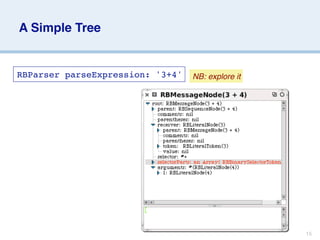
A Simple Tree


RBParser parseExpression: '3+4'   NB: explore it


                                                   15
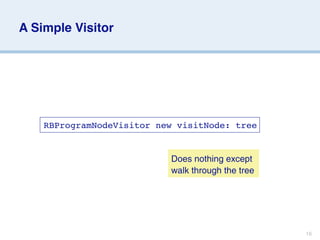
A Simple Visitor


    RBProgramNodeVisitor new visitNode: tree


                           Does nothing except
                           walk through the tree


                                                   16
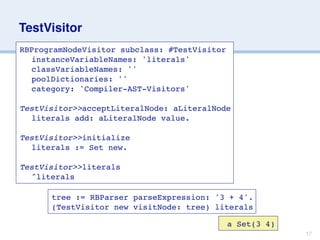
TestVisitor
RBProgramNodeVisitor subclass: #TestVisitor

 instanceVariableNames: 'literals'

 classVariableNames: ''

 poolDictionaries: ''

 category: 'Compiler-AST-Visitors'

TestVisitor>>acceptLiteralNode: aLiteralNode

 literals add: aLiteralNode value.

TestVisitor>>initialize

 literals := Set new.

TestVisitor>>literals

 ^literals

      tree := RBParser parseExpression: '3 + 4'.
      (TestVisitor new visitNode: tree) literals

                                              a Set(3 4)
                                                           17
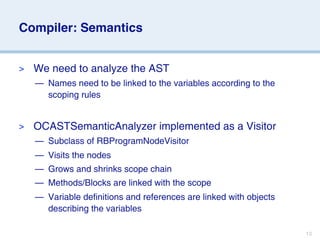
Compiler: Semantics


>   We need to analyze the AST
    — Names need to be linked to the variables according to the
      scoping rules


>   OCASTSemanticAnalyzer implemented as a Visitor
    — Subclass of RBProgramNodeVisitor
    — Visits the nodes
    — Grows and shrinks scope chain
    — Methods/Blocks are linked with the scope
    — Variable definitions and references are linked with objects
      describing the variables

                                                                    13
Scope Analysis


      testBlockTemp
      
 | block block1 block2 |
      
 block := [ :arg | [ arg ] ].
      
 block1 := block value: 1.
      
 block2 := block value: 2.


                                       17
Scope Analysis


      testBlockTemp
      
 | block block1 block2 |
      
 block := [ :arg | [ arg ] ].
      
 block1 := block value: 1.
      
 block2 := block value: 2.


           OCClassScope
             OCInstanceScope
               OCMethodScope 2
                 OCBlockScope 3
                   OCBlockScope 4

                                       17
Compiler: Semantics


>   OCASTClosureAnalyzer
    — Eliot’s Closure analysis: copying vs. tempvector


                                                         14
Closures


counterBlock
        | count |
        count := 0.
        ^[ count := count + 1].


                                  31
Closures


> Break the dependency between the block
  activation and its enclosing contexts for
  accessing locals


                                              32
Contexts


inject: thisValue into: binaryBlock

 | nextValue |
  nextValue := thisValue.
  self

 
 do: [:each |


 nextValue := binaryBlock


 value: nextValue value: each].
  ^nextValue


                                                 33
Contexts


inject: thisValue into: binaryBlock

| indirectTemps |
  indirectTemps := Array new: 1.
  indirectTemps at: 1 put: thisValue.
" was nextValue := thisValue."
  self do:


[:each |
       
indirectTemps
             at: 1
             put: (binaryBlock                   


 value: (indirectTemps at: 1)
                    value: each)].
 ^indirectTemps at: 1
                                               34
Contexts

inject: thisValue into: binaryBlock

| indirectTemps |
   indirectTemps := Array new: 1.
   indirectTemps at: 1 put: thisValue.
   self do: (thisContext
                 closureCopy:
                      [:each |


 binaryBlockCopy indirectTempsCopy |
                      indirectTempsCopy
                        at: 1
                        put: (binaryBlockCopy
                              value: (indirectTempsCopy at: 1)
                              value: each)]
                 copiedValues:


 (Array with: binaryBlock with: indirectTemps)).
 ^indirectTemps at: 1

                                                             35
Closures Analysis


 | a |
                
 a := 1.
                
 [ a ]


                            17
Closures Analysis


 | a |
                
 a := 1.
                
 [ a ]


                a is copied


                              17
Closures Analysis


   | index block collection |
     
   index := 0.
     
   block := [
     
   
 collection add: [ index ].
     
   
 index := index + 1 ].
     
   [ index < 5 ] whileTrue: block.


                                           17
Closures Analysis


   | index block collection |
     
   index := 0.
     
   block := [
     
   
 collection add: [ index ].
     
   
 index := index + 1 ].
     
   [ index < 5 ] whileTrue: block.


                 index is remote


                                           17
Compiler: Intermediate Representation


>   IR: Intermediate Representation
    — Semantic like Bytecode, but more abstract
    — Independent of the bytecode set
    — IR is a tree
    — IR nodes allow easy transformation
    — Decompilation to RB AST


>   IR is built from AST using OCASTTranslator:
    — AST Visitor
    — Uses IRBuilder


                                                  18
Compiler: Intermediate Representation

               
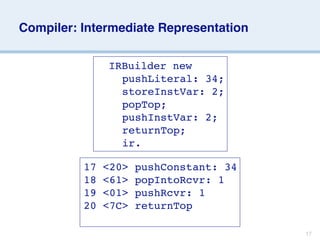
   IRBuilder new
               
   
 pushLiteral: 34;
               
   
 storeInstVar: 2;
               
   
 popTop;
               
   
 pushInstVar: 2;
               
   
 returnTop;
               
   
 ir.

          17       <20>   pushConstant: 34
          18       <61>   popIntoRcvr: 1
          19       <01>   pushRcvr: 1
          20       <7C>   returnTop

                                             17
Compiler: Bytecode Generation


 >   IR needs to be converted to Bytecode
     — IRTranslator: Visitor for IR tree
     — Uses OCBytecodeGenerator to generate Bytecode
     — Builds a compiledMethod
     — Details to follow next section
testReturn1

 | iRMethod aCompiledMethod |

 iRMethod := IRBuilder new

 
 pushLiteral: 1;


 returnTop;

 
 ir.
                         aCompiledMethod := iRMethod compiledMethod.
                         self should:
                         
 [(aCompiledMethod
                         
 
 valueWithReceiver: nil
                         
 
 arguments: #() ) = 1].

                                                                   19
Roadmap


> The Pharo compiler
> Introduction to Smalltalk bytecode
> Generating bytecode with IRBuilder
>   ByteSurgeon


                                       20
Reasons for working with Bytecode


>   Generating Bytecode
    — Implementing compilers for other languages
    — Experimentation with new language features


>   Parsing and Interpretation:
    — Analysis (e.g., self and super sends)
    — Decompilation (for systems without source)
    — Printing of bytecode
    — Interpretation: Debugger, Profiler


                                                   21
The Pharo Virtual Machine


>   Virtual machine provides a virtual processor
    — Bytecode: The “machine-code” of the virtual machine


>   Smalltalk (like Java): Stack machine
    — easy to implement interpreters for different processors
    — most hardware processors are register machines


>   Squeak VM: Implemented in Slang
    — Slang: Subset of Smalltalk. (“C with Smalltalk Syntax”)
    — Translated to C

                                                                22
Bytecode in the CompiledMethod


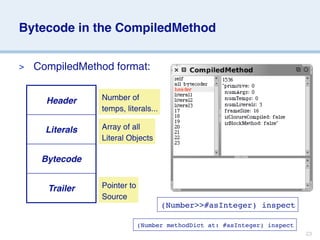
>   CompiledMethod format:


      Header     Number of
                 temps, literals...

      Literals   Array of all
                 Literal Objects

     Bytecode


      Trailer    Pointer to
                 Source
                                      (Number>>#asInteger) inspect

                              (Number methodDict at: #asInteger) inspect
                                                                           23
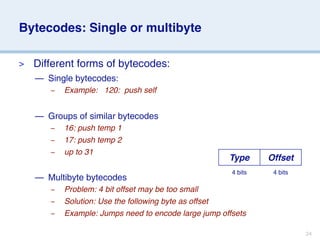
Bytecodes: Single or multibyte

>   Different forms of bytecodes:
    — Single bytecodes:
       –   Example: 120: push self


    — Groups of similar bytecodes
       –   16: push temp 1
       –   17: push temp 2
       –   up to 31
                                                      Type      Offset
                                                       4 bits    4 bits
    — Multibyte bytecodes
       –   Problem: 4 bit offset may be too small
       –   Solution: Use the following byte as offset
       –   Example: Jumps need to encode large jump offsets

                                                                          24
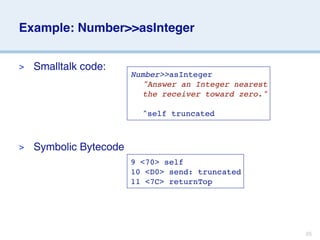
Example: Number>>asInteger


>   Smalltalk code:
                        Number>>asInteger
                        
 "Answer an Integer nearest
                        
 the receiver toward zero."

                        
 ^self truncated


>   Symbolic Bytecode
                        9 <70> self
                        10 <D0> send: truncated
                        11 <7C> returnTop


                                                       25
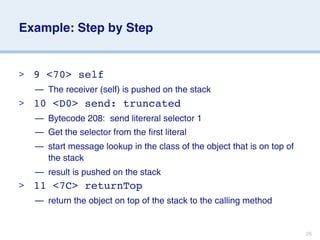
Example: Step by Step


>   9 <70> self
    — The receiver (self) is pushed on the stack
>   10 <D0> send: truncated
    — Bytecode 208: send litereral selector 1
    — Get the selector from the first literal
    — start message lookup in the class of the object that is on top of
      the stack
    — result is pushed on the stack
>   11 <7C> returnTop
    — return the object on top of the stack to the calling method


                                                                          26
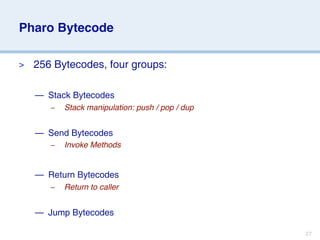
Pharo Bytecode

>   256 Bytecodes, four groups:

    — Stack Bytecodes
       –   Stack manipulation: push / pop / dup


    — Send Bytecodes
       –   Invoke Methods


    — Return Bytecodes
       –   Return to caller


    — Jump Bytecodes

                                                  27
Stack Bytecodes


>   Push values on the stack
    — e.g., temps, instVars, literals
    — e.g: 16 - 31: push instance variable
>   Push Constants
    — False/True/Nil/1/0/2/-1
> Push self, thisContext
> Duplicate top of stack
>   Pop


                                             28
Sends and Returns


>   Sends: receiver is on top of stack
    — Normal send
    — Super Sends
    — Hard-coded sends for efficiency, e.g. +, -


>   Returns
    — Return top of stack to the sender
    — Return from a block
    — Special bytecodes for return self, nil, true, false (for
      efficiency)


                                                                 29
Jump Bytecodes


>   Control Flow inside one method
    — Used to implement control-flow efficiently
    — Example:      ^ 1<2 ifTrue: ['true']


              9 <76> pushConstant: 1
              10 <77> pushConstant: 2
              11 <B2> send: <
              12 <99> jumpFalse: 15
              13 <20> pushConstant: 'true'
              14 <90> jumpTo: 16
              15 <73> pushConstant: nil
              16 <7C> returnTop


                                                   30
Closure Bytecode


>   138  Push (Array new: k)/Pop k into: (Array new: j)

>   140  Push Temp At k In Temp Vector At: j

>   141 Store Temp At k In Temp Vector At: j

>   142 Pop and Store Temp At k In Temp Vector At: j

>   143 Push Closure Num Copied l Num Args k BlockSize j


                                                           36
Roadmap


> The Pharo compiler
> Introduction to Smalltalk bytecode
> Generating bytecode with IRBuilder
>   ByteSurgeon


                                       37
Generating Bytecode


>   IRBuilder: A tool for generating bytecode
    — Part of the OpalCompiler


>   Like an Assembler for Pharo


                                                38
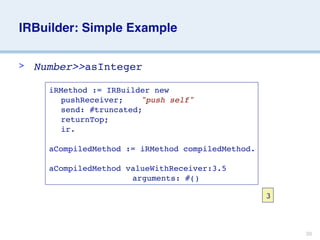
IRBuilder: Simple Example

>   Number>>asInteger

      iRMethod := IRBuilder new
      
 pushReceiver; 
 "push self"
      
 send: #truncated;
      
 returnTop;
      
 ir.

      aCompiledMethod := iRMethod compiledMethod.

      aCompiledMethod valueWithReceiver:3.5


      arguments: #()

                                                    3


                                                        39
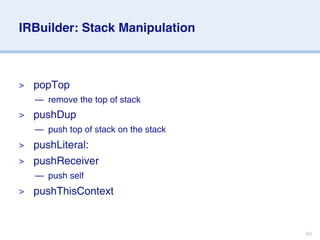
IRBuilder: Stack Manipulation


>   popTop
    — remove the top of stack
>   pushDup
    — push top of stack on the stack
> pushLiteral:
> pushReceiver
    — push self
>   pushThisContext


                                       40
IRBuilder: Symbolic Jumps


> Jump targets are resolved:
> Example: false ifTrue: [’true’]   ifFalse: [’false’]


    iRMethod := IRBuilder new
    
 pushLiteral: false;
    
 jumpAheadTo: #false if: false;
    
 pushLiteral: 'true';


 "ifTrue: ['true']"
    
 jumpAheadTo: #end;
    
 jumpAheadTarget: #false;
    
 pushLiteral: 'false';


 "ifFalse: ['false']"
    
 jumpAheadTarget: #end;
    
 returnTop;
    
 ir.


                                                         41
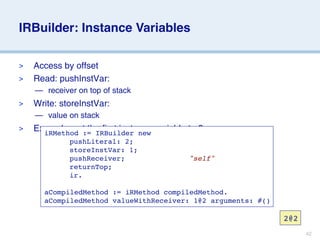
IRBuilder: Instance Variables

>   Access by offset
>   Read: pushInstVar:
    — receiver on top of stack
>   Write: storeInstVar:
    — value on stack
>   Example: set the first instance variable to 2
      iRMethod := IRBuilder new
      
 
 pushLiteral: 2;
      
 
 storeInstVar: 1;
      
 
 pushReceiver;                 "self"
      
 
 returnTop;
      
 
 ir.
      
 
      aCompiledMethod := iRMethod compiledMethod.
      aCompiledMethod valueWithReceiver: 1@2 arguments: #()

                                                              2@2
                                                                    42
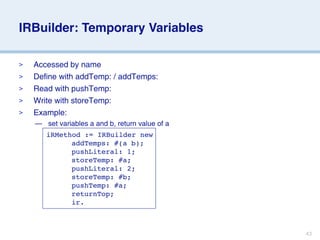
IRBuilder: Temporary Variables

>   Accessed by name
>   Define with addTemp: / addTemps:
>   Read with pushTemp:
>   Write with storeTemp:
>   Example:
    — set variables a and b, return value of a
       iRMethod := IRBuilder new
       
 
 addTemps: #(a b);
       
 
 pushLiteral: 1;
       
 
 storeTemp: #a;
       
 
 pushLiteral: 2;
       
 
 storeTemp: #b;
       
 
 pushTemp: #a;
       
 
 returnTop;
       
 
 ir.


                                                 43
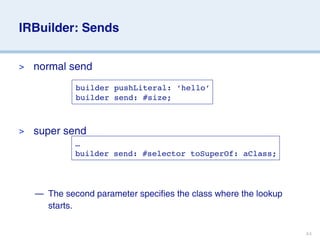
IRBuilder: Sends


>   normal send
             builder pushLiteral: ‘hello’
             builder send: #size;


>   super send
             …
             builder send: #selector toSuperOf: aClass;


    — The second parameter specifies the class where the lookup
      starts.


                                                                  44
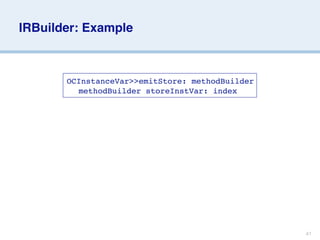
IRBuilder: Example


       OCInstanceVar>>emitStore: methodBuilder
       
 methodBuilder storeInstVar: index


                                                 41
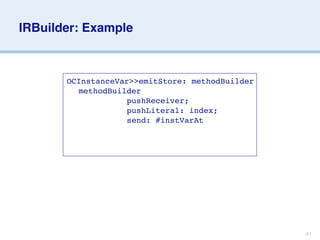
IRBuilder: Example


       OCInstanceVar>>emitStore: methodBuilder
       
 methodBuilder
                    pushReceiver;
                    pushLiteral: index;
                    send: #instVarAt


                                                 41
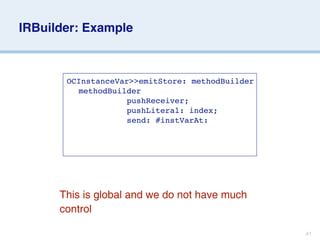
IRBuilder: Example


       OCInstanceVar>>emitStore: methodBuilder
       
 methodBuilder
                    pushReceiver;
                    pushLiteral: index;
                    send: #instVarAt:


      This is global and we do not have much
      control

                                                 41
Roadmap


> The Pharo compiler
> Introduction to Pharo bytecode
> Generating bytecode with IRBuilder
> ByteSurgeon


                                       45
ByteSurgeon


> Library for bytecode transformation in Smalltalk
> Full flexibility of Smalltalk Runtime
> Provides high-level API
> For Pharo, but portable


>   Runtime transformation needed for
    — Adaptation of running systems
    — Tracing / debugging
    — New language features (MOP, AOP)


                                                     46
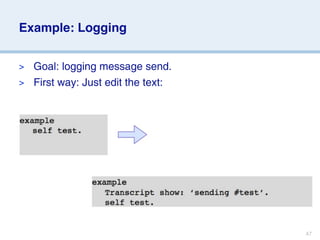
Example: Logging


> Goal: logging message send.
> First way: Just edit the text:


                                   47
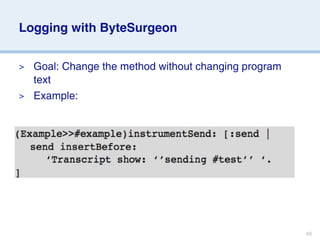
Logging with ByteSurgeon


> Goal: Change the method without changing program
  text
> Example:


                                                     48
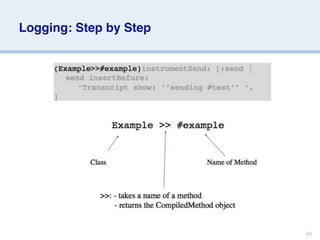
Logging: Step by Step


                        49
Logging: Step by Step


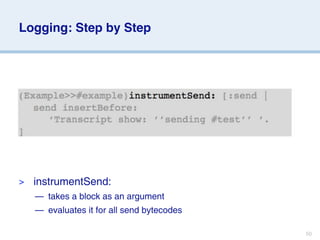
>   instrumentSend:
    — takes a block as an argument
    — evaluates it for all send bytecodes

                                            50
Logging: Step by Step


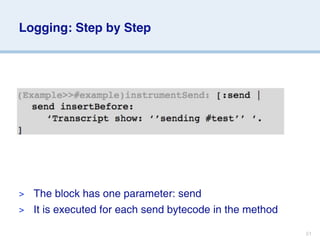
> The block has one parameter: send
> It is executed for each send bytecode in the method

                                                        51
Logging: Step by Step


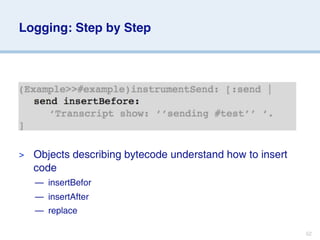
>   Objects describing bytecode understand how to insert
    code
    — insertBefor
    — insertAfter
    — replace

                                                           52
Logging: Step by Step


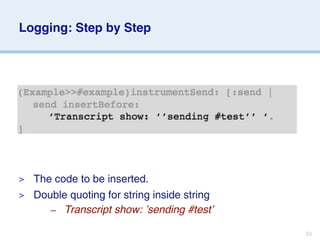
> The code to be inserted.
> Double quoting for string inside string
     – Transcript show: ʼsending #testʼ

                                            53
Inside ByteSurgeon


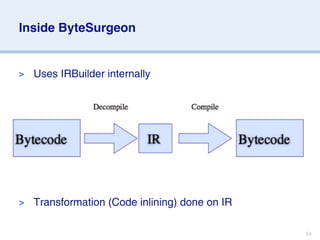
>   Uses IRBuilder internally


>   Transformation (Code inlining) done on IR
                                                54
ByteSurgeon Usage

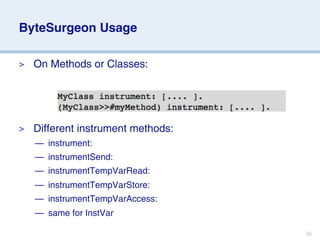
>   On Methods or Classes:


>   Different instrument methods:
    — instrument:
    — instrumentSend:
    — instrumentTempVarRead:
    — instrumentTempVarStore:
    — instrumentTempVarAccess:
    — same for InstVar

                                    55
Advanced ByteSurgeon


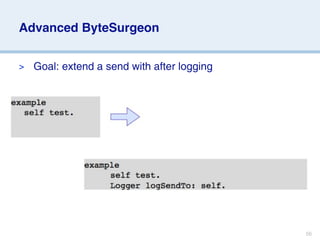
>   Goal: extend a send with after logging


                                             56
Advanced ByteSurgeon

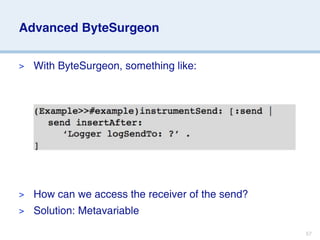
>   With ByteSurgeon, something like:


>   How can we access the receiver of the send?
>   Solution: Metavariable

                                                  57
Advanced ByteSurgeon


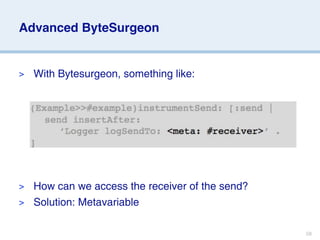
>   With Bytesurgeon, something like:


> How can we access the receiver of the send?
> Solution: Metavariable


                                                58
Implementation Metavariables

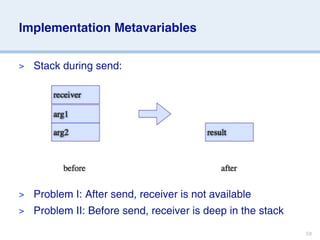
>   Stack during send:


>   Problem I: After send, receiver is not available
>   Problem II: Before send, receiver is deep in the stack

                                                             59
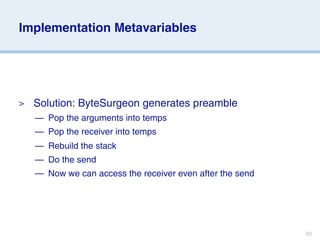
Implementation Metavariables


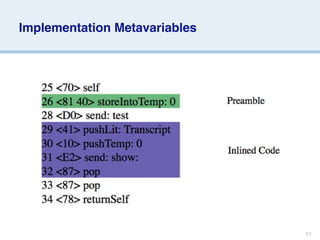
>   Solution: ByteSurgeon generates preamble
    — Pop the arguments into temps
    — Pop the receiver into temps
    — Rebuild the stack
    — Do the send
    — Now we can access the receiver even after the send


                                                           60
Implementation Metavariables


                               61
Why do we care?


>   Helvetia — Context Specific Languages with
    Homogeneous Tool Integration

>   Reflectivity — Unanticipated partial behavioral reflection.

>   Albedo — A unified approach to reflection.


                                                                  6
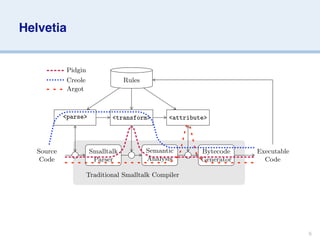
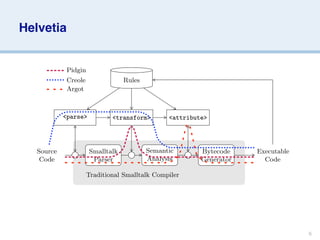
Helvetia


             Pidgin
             Creole               Rules
             Argot


            <parse>           <transform>       <attribute>


   Source             Smalltalk           Semantic       Bytecode    Executable
    Code               Parser             Analysis       Generator     Code

                      Traditional Smalltalk Compiler


                                                                                  6
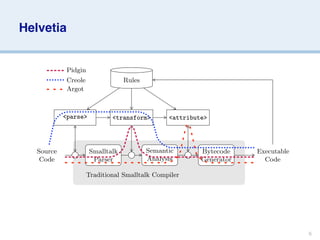
Helvetia


             Pidgin
             Creole               Rules
             Argot


            <parse>           <transform>       <attribute>


   Source             Smalltalk           Semantic       Bytecode    Executable
    Code               Parser             Analysis       Generator     Code

                      Traditional Smalltalk Compiler


                                                                                  6
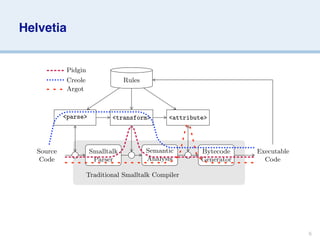
Helvetia


             Pidgin
             Creole               Rules
             Argot


            <parse>           <transform>       <attribute>


   Source             Smalltalk           Semantic       Bytecode    Executable
    Code               Parser             Analysis       Generator     Code

                      Traditional Smalltalk Compiler


                                                                                  6
Helvetia


             Pidgin
             Creole               Rules
             Argot


            <parse>           <transform>       <attribute>


   Source             Smalltalk           Semantic       Bytecode    Executable
    Code               Parser             Analysis       Generator     Code

                      Traditional Smalltalk Compiler


                                                                                  6
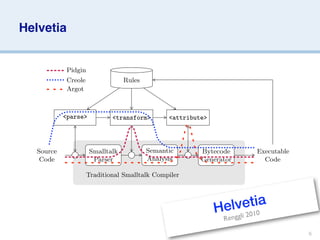
Helvetia


             Pidgin
             Creole               Rules
             Argot


            <parse>           <transform>       <attribute>


   Source             Smalltalk           Semantic       Bytecode        Executable
    Code               Parser             Analysis       Generator         Code

                      Traditional Smalltalk Compiler


                                                              H elvlie0t1i0a
                                                                     2
                                                                Rengg

                                                                                      6
Reflectivity


              meta-object


 links
              activation
              condition
              source code
                 (AST)


                            6
Reflectivity


              meta-object


 links
              activation
              condition
              source code
                 (AST)


                            6
Reflectivity


              meta-object


 links
              activation
              condition
              source code
                 (AST)


                            6
Reflectivity


              meta-object


 links
              activation
              condition
              source code
                 (AST)


                            6
Reflectivity


                 meta-object


 links
                  activation
                  condition
                 source code
                    (AST)

                   ctivity
              Refle 8   200
                 Denker

                               6
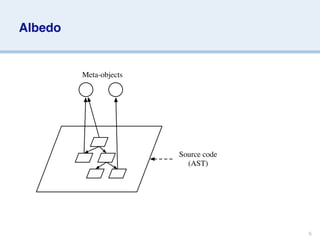
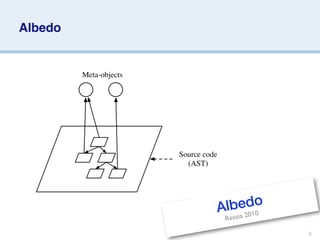
Albedo


         Meta-objects


                        Source code
                          (AST)


                                      6
Albedo


         Meta-objects


                        Source code
                          (AST)


                                      6
Albedo


         Meta-objects


                        Source code
                          (AST)


                                      6
Albedo


         Meta-objects


                        Source code
                          (AST)


                                      6
Albedo


         Meta-objects


                        Source code
                          (AST)


                                      A lbe2do
                                            010
                                       Ressia

                                                  6
Opal Compiler


http://scg.unibe.ch/research/OpalCompiler


                                            64

Opal compiler

  • 1.
    Opal Compiler Jorge Ressia
  • 2.
    Roadmap > The Pharocompiler > Introduction to Smalltalk bytecode > Generating bytecode with IRBuilder > ByteSurgeon Original material by Marcus Denker 2
  • 3.
    Roadmap > The Pharo compiler > Introduction to Smalltalk bytecode > Generating bytecode with IRBuilder > ByteSurgeon 3
  • 4.
    The Pharo Compiler > Default compiler — very old design — quite hard to understand — hard to modify and extend 4
  • 5.
    What qualities areimportant in a compiler? > Correct code > Output runs fast > Compiler runs fast > Compile time proportional to program size > Support for separate compilation > Good diagnostics for syntax errors > Works well with the debugger > Good diagnostics forow anomalies fl > Consistent, predictable optimization © Oscar Nierstrasz 5
  • 6.
    Why do wecare? > ByteSurgeon — Runtime Bytecode Transformation for Smalltalk > ChangeBoxes — Modeling Change as a first-class entity > Reflectivity — Persephone, Geppetto and the rest > Helvetia — Context Specific Languages with Homogeneous Tool Integration > Albedo — A unified approach to reflection. 6
  • 7.
    Opal Compiler > Opal Compiler for Pharo — http://scg.unibe.ch/research/OpalCompiler 7
  • 8.
    Opal Compiler > Fully reified compilation process: — Scanner/Parser (RBParser) – builds AST (from Refactoring Browser) — Semantic Analysis: OCASTSemanticAnalyzer – annotates the AST (e.g., var bindings) — Translation to IR: OCASTTranslator – uses IRBuilder to build IR (Intermediate Representation) — Bytecode generation: IRTranslator – uses OCBytecodeGenerator to emit bytecodes 8
  • 9.
    Compiler: Overview Scanner Semantic Code code AST AST Bytecode / Parser Analysis Generation Code generation in detail Build Bytecode AST IR Bytecode IR Generation OCASTTranslator IRTranslator IRBuilder OCBytecodeGenerator 9
  • 10.
    Compiler: Design Decisions > Every building block of the compiler is implemented as a visitor on the representation. > The AST is never changed 10
  • 11.
    Compiler: AST RBProgramNode RBDoItNode > AST: Abstract Syntax Tree RBMethodNode — Encodes the Syntax as a Tree RBReturnNode RBSequenceNode — No semantics yet! RBValueNode — Uses the RB Tree: RBArrayNode – Visitors RBAssignmentNode RBBlockNode – Transformation (replace/add/delete) RBCascadeNode – Pattern-directed TreeRewriter RBLiteralNode – PrettyPrinter RBMessageNode RBOptimizedNode RBVariableNode 11
  • 12.
    Compiler: Syntax > Before: SmaCC: Smalltalk Compiler Compiler — Similar to Lex/Yacc — SmaCC can build LARL(1) or LR(1) parser > Now: RBParser > Future: PetitParser 12
  • 13.
    A Simple Tree RBParserparseExpression: '3+4' NB: explore it 15
  • 14.
    A Simple Visitor RBProgramNodeVisitor new visitNode: tree Does nothing except walk through the tree 16
  • 15.
    TestVisitor RBProgramNodeVisitor subclass: #TestVisitor instanceVariableNames: 'literals' classVariableNames: '' poolDictionaries: '' category: 'Compiler-AST-Visitors' TestVisitor>>acceptLiteralNode: aLiteralNode literals add: aLiteralNode value. TestVisitor>>initialize literals := Set new. TestVisitor>>literals ^literals tree := RBParser parseExpression: '3 + 4'. (TestVisitor new visitNode: tree) literals a Set(3 4) 17
  • 16.
    Compiler: Semantics > We need to analyze the AST — Names need to be linked to the variables according to the scoping rules > OCASTSemanticAnalyzer implemented as a Visitor — Subclass of RBProgramNodeVisitor — Visits the nodes — Grows and shrinks scope chain — Methods/Blocks are linked with the scope — Variable definitions and references are linked with objects describing the variables 13
  • 17.
    Scope Analysis testBlockTemp | block block1 block2 | block := [ :arg | [ arg ] ]. block1 := block value: 1. block2 := block value: 2. 17
  • 18.
    Scope Analysis testBlockTemp | block block1 block2 | block := [ :arg | [ arg ] ]. block1 := block value: 1. block2 := block value: 2. OCClassScope OCInstanceScope OCMethodScope 2 OCBlockScope 3 OCBlockScope 4 17
  • 19.
    Compiler: Semantics > OCASTClosureAnalyzer — Eliot’s Closure analysis: copying vs. tempvector 14
  • 20.
    Closures counterBlock         | count |         count:= 0.         ^[ count := count + 1]. 31
  • 21.
    Closures > Break thedependency between the block activation and its enclosing contexts for accessing locals 32
  • 22.
    Contexts inject: thisValue into:binaryBlock | nextValue |   nextValue := thisValue.   self do: [:each | nextValue := binaryBlock value: nextValue value: each].   ^nextValue 33
  • 23.
    Contexts inject: thisValue into:binaryBlock | indirectTemps |   indirectTemps := Array new: 1.   indirectTemps at: 1 put: thisValue. " was nextValue := thisValue."   self do: [:each |         indirectTemps              at: 1              put: (binaryBlock                    value: (indirectTemps at: 1)                     value: each)].  ^indirectTemps at: 1 34
  • 24.
    Contexts inject: thisValue into:binaryBlock | indirectTemps |    indirectTemps := Array new: 1.    indirectTemps at: 1 put: thisValue.    self do: (thisContext                  closureCopy:                       [:each | binaryBlockCopy indirectTempsCopy |                       indirectTempsCopy                         at: 1                         put: (binaryBlockCopy                               value: (indirectTempsCopy at: 1)                               value: each)]                  copiedValues: (Array with: binaryBlock with: indirectTemps)).  ^indirectTemps at: 1 35
  • 25.
    Closures Analysis | a | a := 1. [ a ] 17
  • 26.
    Closures Analysis | a | a := 1. [ a ] a is copied 17
  • 27.
    Closures Analysis | index block collection | index := 0. block := [ collection add: [ index ]. index := index + 1 ]. [ index < 5 ] whileTrue: block. 17
  • 28.
    Closures Analysis | index block collection | index := 0. block := [ collection add: [ index ]. index := index + 1 ]. [ index < 5 ] whileTrue: block. index is remote 17
  • 29.
    Compiler: Intermediate Representation > IR: Intermediate Representation — Semantic like Bytecode, but more abstract — Independent of the bytecode set — IR is a tree — IR nodes allow easy transformation — Decompilation to RB AST > IR is built from AST using OCASTTranslator: — AST Visitor — Uses IRBuilder 18
  • 30.
    Compiler: Intermediate Representation IRBuilder new pushLiteral: 34; storeInstVar: 2; popTop; pushInstVar: 2; returnTop; ir. 17 <20> pushConstant: 34 18 <61> popIntoRcvr: 1 19 <01> pushRcvr: 1 20 <7C> returnTop 17
  • 31.
    Compiler: Bytecode Generation > IR needs to be converted to Bytecode — IRTranslator: Visitor for IR tree — Uses OCBytecodeGenerator to generate Bytecode — Builds a compiledMethod — Details to follow next section testReturn1 | iRMethod aCompiledMethod | iRMethod := IRBuilder new pushLiteral: 1; returnTop; ir. aCompiledMethod := iRMethod compiledMethod. self should: [(aCompiledMethod valueWithReceiver: nil arguments: #() ) = 1]. 19
  • 32.
    Roadmap > The Pharocompiler > Introduction to Smalltalk bytecode > Generating bytecode with IRBuilder > ByteSurgeon 20
  • 33.
    Reasons for workingwith Bytecode > Generating Bytecode — Implementing compilers for other languages — Experimentation with new language features > Parsing and Interpretation: — Analysis (e.g., self and super sends) — Decompilation (for systems without source) — Printing of bytecode — Interpretation: Debugger, Profiler 21
  • 34.
    The Pharo VirtualMachine > Virtual machine provides a virtual processor — Bytecode: The “machine-code” of the virtual machine > Smalltalk (like Java): Stack machine — easy to implement interpreters for different processors — most hardware processors are register machines > Squeak VM: Implemented in Slang — Slang: Subset of Smalltalk. (“C with Smalltalk Syntax”) — Translated to C 22
  • 35.
    Bytecode in theCompiledMethod > CompiledMethod format: Header Number of temps, literals... Literals Array of all Literal Objects Bytecode Trailer Pointer to Source (Number>>#asInteger) inspect (Number methodDict at: #asInteger) inspect 23
  • 36.
    Bytecodes: Single ormultibyte > Different forms of bytecodes: — Single bytecodes: – Example: 120: push self — Groups of similar bytecodes – 16: push temp 1 – 17: push temp 2 – up to 31 Type Offset 4 bits 4 bits — Multibyte bytecodes – Problem: 4 bit offset may be too small – Solution: Use the following byte as offset – Example: Jumps need to encode large jump offsets 24
  • 37.
    Example: Number>>asInteger > Smalltalk code: Number>>asInteger "Answer an Integer nearest the receiver toward zero." ^self truncated > Symbolic Bytecode 9 <70> self 10 <D0> send: truncated 11 <7C> returnTop 25
  • 38.
    Example: Step byStep > 9 <70> self — The receiver (self) is pushed on the stack > 10 <D0> send: truncated — Bytecode 208: send litereral selector 1 — Get the selector from the first literal — start message lookup in the class of the object that is on top of the stack — result is pushed on the stack > 11 <7C> returnTop — return the object on top of the stack to the calling method 26
  • 39.
    Pharo Bytecode > 256 Bytecodes, four groups: — Stack Bytecodes – Stack manipulation: push / pop / dup — Send Bytecodes – Invoke Methods — Return Bytecodes – Return to caller — Jump Bytecodes 27
  • 40.
    Stack Bytecodes > Push values on the stack — e.g., temps, instVars, literals — e.g: 16 - 31: push instance variable > Push Constants — False/True/Nil/1/0/2/-1 > Push self, thisContext > Duplicate top of stack > Pop 28
  • 41.
    Sends and Returns > Sends: receiver is on top of stack — Normal send — Super Sends — Hard-coded sends for efficiency, e.g. +, - > Returns — Return top of stack to the sender — Return from a block — Special bytecodes for return self, nil, true, false (for efficiency) 29
  • 42.
    Jump Bytecodes > Control Flow inside one method — Used to implement control-flow efficiently — Example: ^ 1<2 ifTrue: ['true'] 9 <76> pushConstant: 1 10 <77> pushConstant: 2 11 <B2> send: < 12 <99> jumpFalse: 15 13 <20> pushConstant: 'true' 14 <90> jumpTo: 16 15 <73> pushConstant: nil 16 <7C> returnTop 30
  • 43.
    Closure Bytecode > 138  Push (Array new: k)/Pop k into: (Array new: j) > 140  Push Temp At k In Temp Vector At: j > 141 Store Temp At k In Temp Vector At: j > 142 Pop and Store Temp At k In Temp Vector At: j > 143 Push Closure Num Copied l Num Args k BlockSize j 36
  • 44.
    Roadmap > The Pharocompiler > Introduction to Smalltalk bytecode > Generating bytecode with IRBuilder > ByteSurgeon 37
  • 45.
    Generating Bytecode > IRBuilder: A tool for generating bytecode — Part of the OpalCompiler > Like an Assembler for Pharo 38
  • 46.
    IRBuilder: Simple Example > Number>>asInteger iRMethod := IRBuilder new pushReceiver; "push self" send: #truncated; returnTop; ir. aCompiledMethod := iRMethod compiledMethod. aCompiledMethod valueWithReceiver:3.5 arguments: #() 3 39
  • 47.
    IRBuilder: Stack Manipulation > popTop — remove the top of stack > pushDup — push top of stack on the stack > pushLiteral: > pushReceiver — push self > pushThisContext 40
  • 48.
    IRBuilder: Symbolic Jumps >Jump targets are resolved: > Example: false ifTrue: [’true’] ifFalse: [’false’] iRMethod := IRBuilder new pushLiteral: false; jumpAheadTo: #false if: false; pushLiteral: 'true'; "ifTrue: ['true']" jumpAheadTo: #end; jumpAheadTarget: #false; pushLiteral: 'false'; "ifFalse: ['false']" jumpAheadTarget: #end; returnTop; ir. 41
  • 49.
    IRBuilder: Instance Variables > Access by offset > Read: pushInstVar: — receiver on top of stack > Write: storeInstVar: — value on stack > Example: set the first instance variable to 2 iRMethod := IRBuilder new pushLiteral: 2; storeInstVar: 1; pushReceiver; "self" returnTop; ir. aCompiledMethod := iRMethod compiledMethod. aCompiledMethod valueWithReceiver: 1@2 arguments: #() 2@2 42
  • 50.
    IRBuilder: Temporary Variables > Accessed by name > Define with addTemp: / addTemps: > Read with pushTemp: > Write with storeTemp: > Example: — set variables a and b, return value of a iRMethod := IRBuilder new addTemps: #(a b); pushLiteral: 1; storeTemp: #a; pushLiteral: 2; storeTemp: #b; pushTemp: #a; returnTop; ir. 43
  • 51.
    IRBuilder: Sends > normal send builder pushLiteral: ‘hello’ builder send: #size; > super send … builder send: #selector toSuperOf: aClass; — The second parameter specifies the class where the lookup starts. 44
  • 52.
    IRBuilder: Example OCInstanceVar>>emitStore: methodBuilder methodBuilder storeInstVar: index 41
  • 53.
    IRBuilder: Example OCInstanceVar>>emitStore: methodBuilder methodBuilder pushReceiver; pushLiteral: index; send: #instVarAt 41
  • 54.
    IRBuilder: Example OCInstanceVar>>emitStore: methodBuilder methodBuilder pushReceiver; pushLiteral: index; send: #instVarAt: This is global and we do not have much control 41
  • 55.
    Roadmap > The Pharocompiler > Introduction to Pharo bytecode > Generating bytecode with IRBuilder > ByteSurgeon 45
  • 56.
    ByteSurgeon > Library forbytecode transformation in Smalltalk > Full flexibility of Smalltalk Runtime > Provides high-level API > For Pharo, but portable > Runtime transformation needed for — Adaptation of running systems — Tracing / debugging — New language features (MOP, AOP) 46
  • 57.
    Example: Logging > Goal:logging message send. > First way: Just edit the text: 47
  • 58.
    Logging with ByteSurgeon >Goal: Change the method without changing program text > Example: 48
  • 59.
  • 60.
    Logging: Step byStep > instrumentSend: — takes a block as an argument — evaluates it for all send bytecodes 50
  • 61.
    Logging: Step byStep > The block has one parameter: send > It is executed for each send bytecode in the method 51
  • 62.
    Logging: Step byStep > Objects describing bytecode understand how to insert code — insertBefor — insertAfter — replace 52
  • 63.
    Logging: Step byStep > The code to be inserted. > Double quoting for string inside string – Transcript show: ʼsending #testʼ 53
  • 64.
    Inside ByteSurgeon > Uses IRBuilder internally > Transformation (Code inlining) done on IR 54
  • 65.
    ByteSurgeon Usage > On Methods or Classes: > Different instrument methods: — instrument: — instrumentSend: — instrumentTempVarRead: — instrumentTempVarStore: — instrumentTempVarAccess: — same for InstVar 55
  • 66.
    Advanced ByteSurgeon > Goal: extend a send with after logging 56
  • 67.
    Advanced ByteSurgeon > With ByteSurgeon, something like: > How can we access the receiver of the send? > Solution: Metavariable 57
  • 68.
    Advanced ByteSurgeon > With Bytesurgeon, something like: > How can we access the receiver of the send? > Solution: Metavariable 58
  • 69.
    Implementation Metavariables > Stack during send: > Problem I: After send, receiver is not available > Problem II: Before send, receiver is deep in the stack 59
  • 70.
    Implementation Metavariables > Solution: ByteSurgeon generates preamble — Pop the arguments into temps — Pop the receiver into temps — Rebuild the stack — Do the send — Now we can access the receiver even after the send 60
  • 71.
  • 72.
    Why do wecare? > Helvetia — Context Specific Languages with Homogeneous Tool Integration > Reflectivity — Unanticipated partial behavioral reflection. > Albedo — A unified approach to reflection. 6
  • 73.
    Helvetia Pidgin Creole Rules Argot <parse> <transform> <attribute> Source Smalltalk Semantic Bytecode Executable Code Parser Analysis Generator Code Traditional Smalltalk Compiler 6
  • 74.
    Helvetia Pidgin Creole Rules Argot <parse> <transform> <attribute> Source Smalltalk Semantic Bytecode Executable Code Parser Analysis Generator Code Traditional Smalltalk Compiler 6
  • 75.
    Helvetia Pidgin Creole Rules Argot <parse> <transform> <attribute> Source Smalltalk Semantic Bytecode Executable Code Parser Analysis Generator Code Traditional Smalltalk Compiler 6
  • 76.
    Helvetia Pidgin Creole Rules Argot <parse> <transform> <attribute> Source Smalltalk Semantic Bytecode Executable Code Parser Analysis Generator Code Traditional Smalltalk Compiler 6
  • 77.
    Helvetia Pidgin Creole Rules Argot <parse> <transform> <attribute> Source Smalltalk Semantic Bytecode Executable Code Parser Analysis Generator Code Traditional Smalltalk Compiler H elvlie0t1i0a 2 Rengg 6
  • 78.
    Reflectivity meta-object links activation condition source code (AST) 6
  • 79.
    Reflectivity meta-object links activation condition source code (AST) 6
  • 80.
    Reflectivity meta-object links activation condition source code (AST) 6
  • 81.
    Reflectivity meta-object links activation condition source code (AST) 6
  • 82.
    Reflectivity meta-object links activation condition source code (AST) ctivity Refle 8 200 Denker 6
  • 83.
    Albedo Meta-objects Source code (AST) 6
  • 84.
    Albedo Meta-objects Source code (AST) 6
  • 85.
    Albedo Meta-objects Source code (AST) 6
  • 86.
    Albedo Meta-objects Source code (AST) 6
  • 87.
    Albedo Meta-objects Source code (AST) A lbe2do 010 Ressia 6
  • 88.

Editor's Notes