Productivity Index and IPR
 A commonly used measure of the ability of the

well to produce is the Productivity Index.
 Defined by the symbol ‘J’.
 The productivity index is the ratio of the total
liquid flow rate to the pressure drawdown.
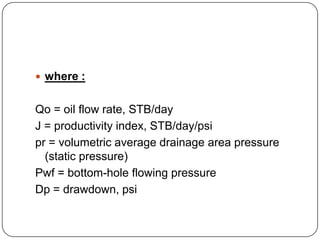
 For a water-free oil production, the productivity
index is given by:
 where :

Qo = oil flow rate, STB/day
J = productivity index, STB/day/psi
pr = volumetric average drainage area pressure
(static pressure)
Pwf = bottom-hole flowing pressure
Dp = drawdown, psi
 The following empirical methods that are

designed to generate the current and future inflow
performance relationships:
 Vogel’s Method.
 Standing’s Method.
 Fetkovich’s Method.
Vogel’s Method.
 Vogel (1968) used a computer model to generate

IPRs for several hypothetical saturated-oil
reservoirs that are producing under a wide range
of conditions.
 Vogel normalized the calculated IPRs and

expressed the relationships in a dimensionless
form.
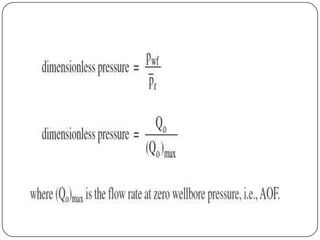
 He normalized the IPRs by introducing the

following dimensionless parameters:
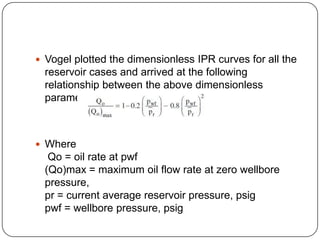
 Vogel plotted the dimensionless IPR curves for all the

reservoir cases and arrived at the following
relationship between the above dimensionless
parameters:

 Where

Qo = oil rate at pwf
(Qo)max = maximum oil flow rate at zero wellbore
pressure,
pr = current average reservoir pressure, psig
pwf = wellbore pressure, psig
Standing’s Method
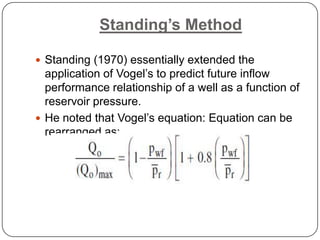
 Standing (1970) essentially extended the

application of Vogel’s to predict future inflow
performance relationship of a well as a function of
reservoir pressure.
 He noted that Vogel’s equation: Equation can be
rearranged as:
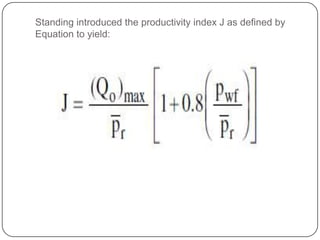
Standing introduced the productivity index J as defined by
Equation to yield:
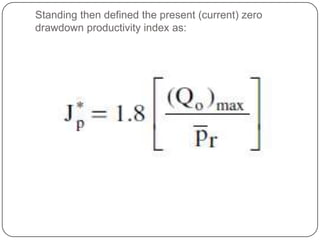
Standing then defined the present (current) zero
drawdown productivity index as:
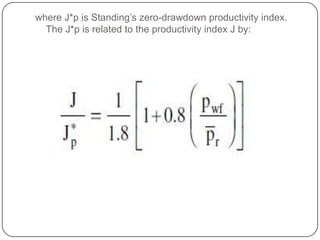
where J*p is Standing’s zero-drawdown productivity index.
The J*p is related to the productivity index J by:
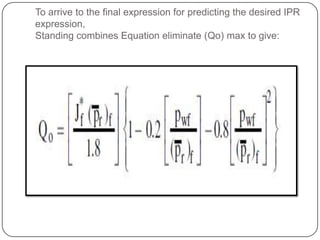
To arrive to the final expression for predicting the desired IPR
expression,
Standing combines Equation eliminate (Qo) max to give:
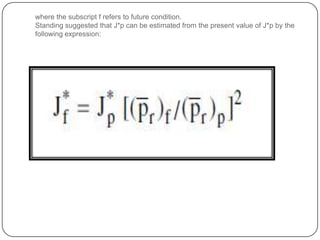
where the subscript f refers to future condition.
Standing suggested that J*p can be estimated from the present value of J*p by the
following expression:
COMPUTATIONAL STEPS
 Standing’s methodology for predicting a future

IPR is summarized in the following steps:
 Step 1. Using the current time condition and the

available flow test data, calculate (Qo)max from
Equation 7-9 or Equation 7-18.
 Step 2. Calculate J* at the present condition, i.e.,

J*p, by using Equation. Notice that other
combinations of Equations 7-18 through can be
used to estimate J*p.
 Step 3. Using fluid property, saturation and

relative permeability data, calculate both
(kro/moBo)p and (kro/moBo)f.
 Step 4. Calculate J*f by using Equation. Use

Equation if the oil relative permeability data is not
available.
 Step 5. Generate the future IPR by applying

Equation.
Fetkovich’s Method
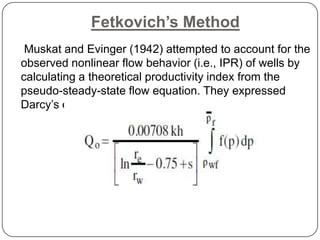
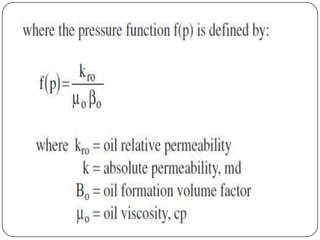
Muskat and Evinger (1942) attempted to account for the
observed nonlinear flow behavior (i.e., IPR) of wells by
calculating a theoretical productivity index from the
pseudo-steady-state flow equation. They expressed
Darcy’s equation as:
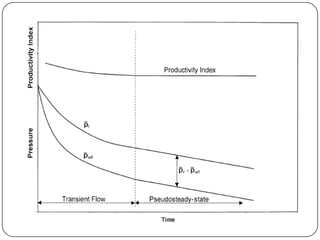
Productivity index

Productivity index

  • 2.
    Productivity Index andIPR  A commonly used measure of the ability of the well to produce is the Productivity Index.  Defined by the symbol ‘J’.  The productivity index is the ratio of the total liquid flow rate to the pressure drawdown.  For a water-free oil production, the productivity index is given by:
  • 3.
     where : Qo= oil flow rate, STB/day J = productivity index, STB/day/psi pr = volumetric average drainage area pressure (static pressure) Pwf = bottom-hole flowing pressure Dp = drawdown, psi
  • 5.
     The followingempirical methods that are designed to generate the current and future inflow performance relationships:  Vogel’s Method.  Standing’s Method.  Fetkovich’s Method.
  • 6.
    Vogel’s Method.  Vogel(1968) used a computer model to generate IPRs for several hypothetical saturated-oil reservoirs that are producing under a wide range of conditions.  Vogel normalized the calculated IPRs and expressed the relationships in a dimensionless form.  He normalized the IPRs by introducing the following dimensionless parameters:
  • 8.
     Vogel plottedthe dimensionless IPR curves for all the reservoir cases and arrived at the following relationship between the above dimensionless parameters:  Where Qo = oil rate at pwf (Qo)max = maximum oil flow rate at zero wellbore pressure, pr = current average reservoir pressure, psig pwf = wellbore pressure, psig
  • 9.
    Standing’s Method  Standing(1970) essentially extended the application of Vogel’s to predict future inflow performance relationship of a well as a function of reservoir pressure.  He noted that Vogel’s equation: Equation can be rearranged as:
  • 10.
    Standing introduced theproductivity index J as defined by Equation to yield:
  • 11.
    Standing then definedthe present (current) zero drawdown productivity index as:
  • 12.
    where J*p isStanding’s zero-drawdown productivity index. The J*p is related to the productivity index J by:
  • 13.
    To arrive tothe final expression for predicting the desired IPR expression, Standing combines Equation eliminate (Qo) max to give:
  • 14.
    where the subscriptf refers to future condition. Standing suggested that J*p can be estimated from the present value of J*p by the following expression:
  • 15.
    COMPUTATIONAL STEPS  Standing’smethodology for predicting a future IPR is summarized in the following steps:  Step 1. Using the current time condition and the available flow test data, calculate (Qo)max from Equation 7-9 or Equation 7-18.  Step 2. Calculate J* at the present condition, i.e., J*p, by using Equation. Notice that other combinations of Equations 7-18 through can be used to estimate J*p.
  • 16.
     Step 3.Using fluid property, saturation and relative permeability data, calculate both (kro/moBo)p and (kro/moBo)f.  Step 4. Calculate J*f by using Equation. Use Equation if the oil relative permeability data is not available.  Step 5. Generate the future IPR by applying Equation.
  • 17.
    Fetkovich’s Method Muskat andEvinger (1942) attempted to account for the observed nonlinear flow behavior (i.e., IPR) of wells by calculating a theoretical productivity index from the pseudo-steady-state flow equation. They expressed Darcy’s equation as: