Innovation processes and outcomes in different national contexts: preliminary findings of FAP meta-analysisSeife AyeleInternational Livestock Research Institute FAP Symposium on Feed in Smallholder Systems LuangPrabang, Laos, 18-19 November 2010
Livestock development, and fodder and feed sources and gaps Livestock roles: contribution to AGDP, pathway out of poverty, etc.Keepers use one or more sources of feed and fodder resources: e.g. natural pastures; dual-purpose crops; planted fodder of improved species.  Fodder and feed scarcity varies but is severe: in Syria in some places shortages range from 50-60% over December to February;Complex causes of scarcity: e.g. erratic rainfall, shrinking grazing lands, changing land use patterns favoring urbanization and settlement.Consequences:Feed and fodder shortages can severely reduce productivity and productionHigh production cost: in Syria feed cost was as high as 50% (in sheep fattening) (FAP Syria interview - 2010). Sometimes shortages can damage community relations, provoking conflict between communities over grazing lands.
Different biophysical, political and institutional landscapesInnovation processes happen in different (sometimes contrasting) contexts:Agro-ecology: Ethiopian highlands cover about 50% of the country (receive approx. 1300 – 1800 mm rainfall per year) Syria’s four of five agro-ecological zones covering > 85% of land receive less than 350 mm rain per year. Vietnam fits into different agro-ecological contexts. Socio-economics: countries are low to low-middle income categories but significant variation exists between livestock keepers.Institutional landscape: unlike Vietnam and Syria the ‘third’ section is fairly visible in EthiopiaEnabling environment and government policies:  livestock development is receiving increasing attention…Message: 	no universal solution seems to suit diverse contexts, hence interventions must be tailored to suit particular context and locale.
FAP Innovation processes in Ethiopia, Syria and VietnamFAP appear to be based on the understanding of contemporary thinking of innovation processesFAP interventions appear to suit particular contexts and locales.Ethiopia: teff-wheat-maize-livestock areas, barley-wheat-small ruminant areasSyria: semi-arid, small ruminants/barelyproduction systems. Vietnam: sub-humid, livestock/rice/sweet potato production system FAP innovation processes:identify key partners and learning sites initiate innovation networks, and farmer groups, around learning sites Participatory diagnosis; and developing fodder optionsjoint learning and evaluation (on-farm, in farmer groups and networks)fodder forum formations and exchange of experiencesFAP innovation structures:on-farm and framer group learning innovation networks: four in Ethiopia, three in Syria and two in Vietnam.steering committee (Syria) and platform (Ethiopia) formation
Developing innovation capacity in FAP networksNetworking started with ‘like-minded’ organizationsNetwork members drawn from public, private, non-governmental organizations; community associations, farmers groups and cooperatives, etc. Network composition and size varied in time and across learning sites (Syria and Vietnam have had fewer members)Networks of actors also regularly met and discussed fodder scarcity and its aspectsNetworking considerably improved interactions across all sitesNetworks helped the appreciation of nature and magnitude of fodder scarcity, knowledge and information flows, and increased demand for its use.
Fodder options implemented … cont. Options introduction processes: FAP, network participants and farmers diagnosed fodder problems and developed possible solutions (solutions fit farmers’ food-feed requirements, agro-ecology; etc. )Willing farmers took the options.FAP used different approaches to enhance the capacity of implementing actors: it organized ‘field clinics’, ‘field visits’ and on-farm experimentsOptions were largely technology-focused  Participating farmers were largely economically better off, and they were also largely ‘commercially oriented’.Message: an innovation systems perspective per se does not make an intervention pro-poor. To make an intervention pro-poor, it must be targeted at the poor.
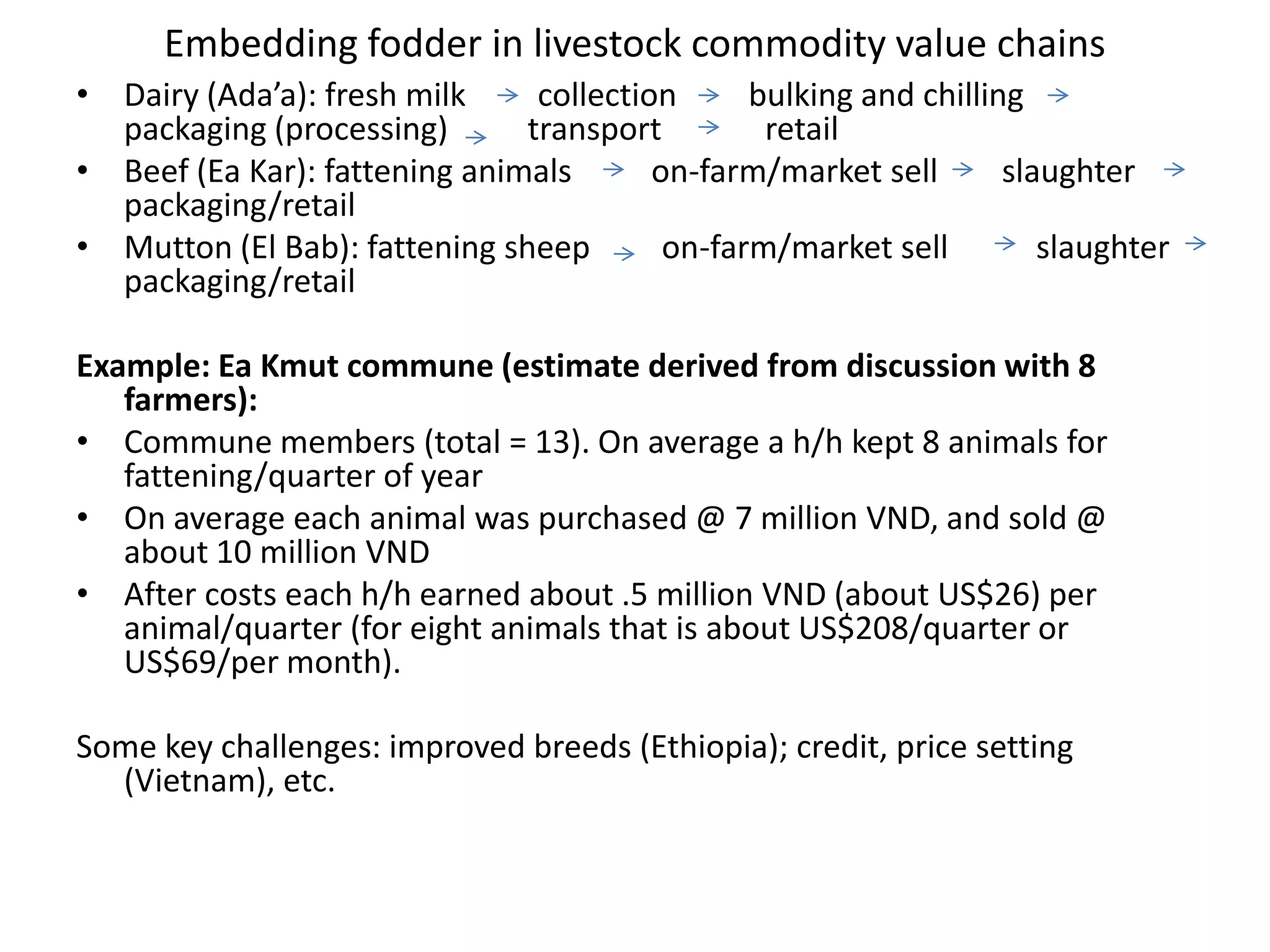
Embedding fodder in livestock commodity value chainsDairy (Ada’a): fresh milk         collection         bulking and chilling        packaging (processing)          transport             retailBeef (Ea Kar): fattening animals          on-farm/market sell        slaughter          packaging/retailMutton (El Bab): fattening sheep         on-farm/market sell           slaughter          packaging/retailExample: Ea Kmut commune (estimate derived from discussion with 8 farmers): Commune members (total = 13). On average a h/h kept 8 animals for fattening/quarter of yearOn average each animal was purchased @ 7 million VND, and sold @ about 10 million VNDAfter costs each h/h earned about .5 million VND (about US$26) per animal/quarter (for eight animals that is about US$208/quarter or US$69/per month).Some key challenges: improved breeds (Ethiopia); credit, price setting (Vietnam), etc.
Successes and more challenges …Why Dr Khan thinks the Ea Kar experiment is a rewarding and sustainable endeavour: 	… I see sustainability of an intervention in terms of meeting local needs and fitting to local context. … it is also important that an intervention is accepted by a local government to get political support and receive funds for development. The fodder species we have introduced meet those criteria and they have been increasingly taken up by the local network and farmers (Dr Khan, NTU). In El Bab (Syria) fodder technology adoption seems moving fast:	… now our own farmers are producing and distributing fodder seeds to other farmers. Last year a farmer [in El Bab] planted barley on one ha, this year [2009] on 10 ha and sold some of the seed to three farmers in the village. The technology is expanding like ‘wild fire’ (Farmer/School Principal, El Bab).Success is not everywhere and there still are more challenges … 	…yes we earn more money now from fattening than two or three years ago … but still raising capital … to buy an animal is a problem. We don’t get bank credit because of tight collateral conditions … (Mrs. Phan Thi Nguyet, Head of Farmer Group, Village 8).
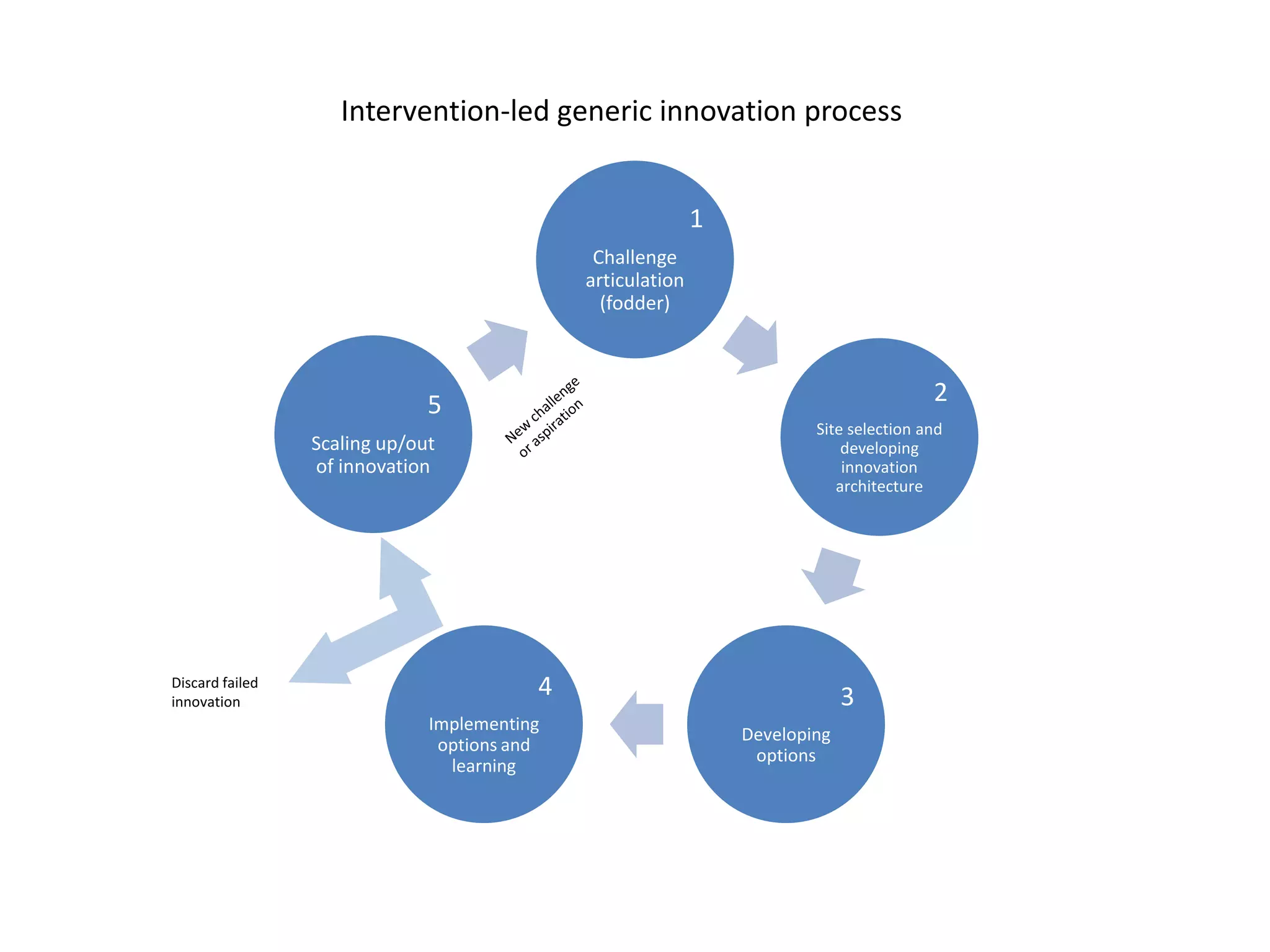
Intervention-led generic innovation process1 Challenge articulation (fodder)5Scaling up/out of innovation2Site selection and developing innovation architectureNew challenge or aspiration3Developing options4Implementing options and learningDiscard failed innovation
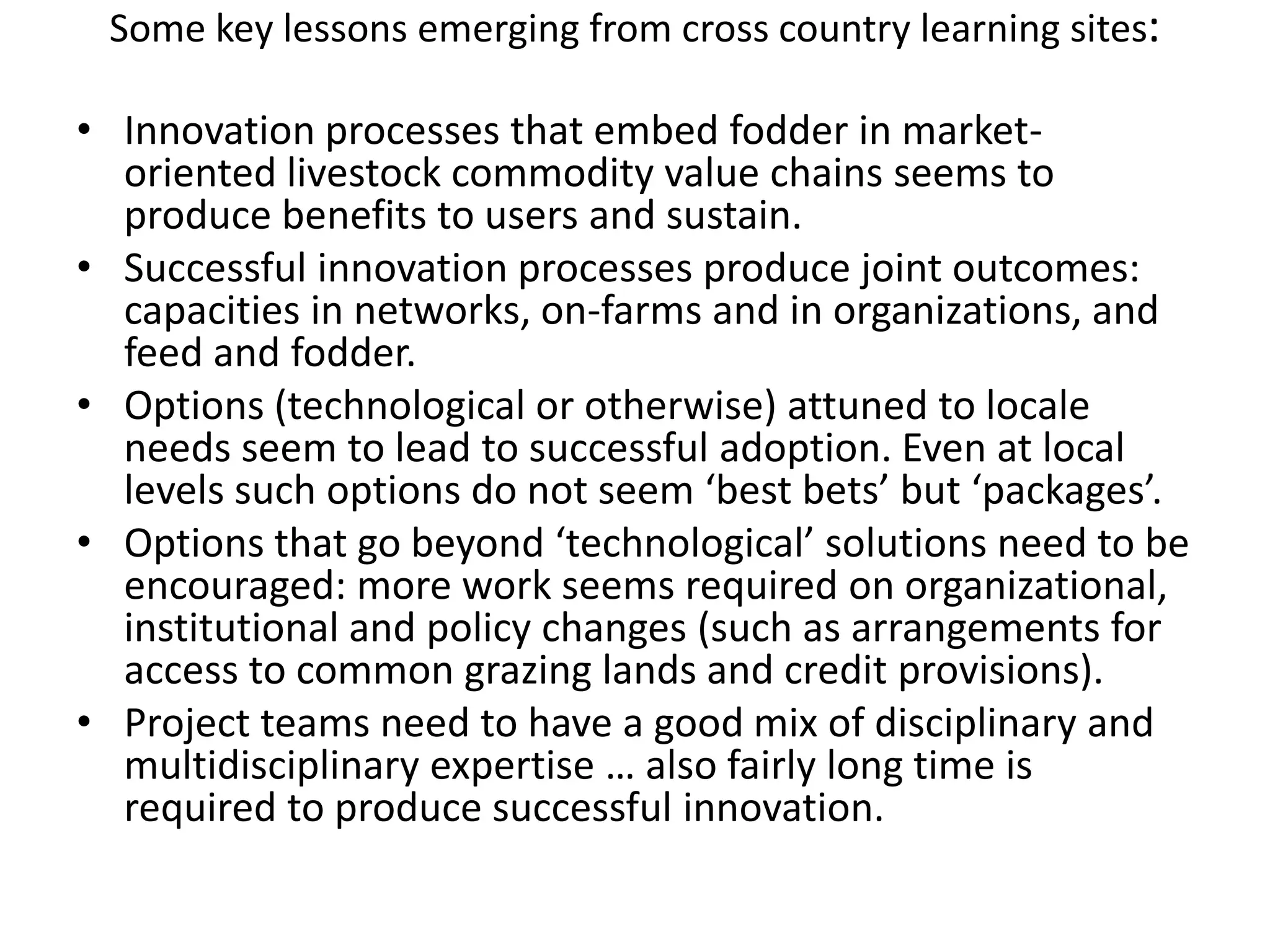
Some key lessons emerging from cross country learning sites:Innovation processes that embed fodder in market-oriented livestock commodity value chains seems to produce benefits to users and sustain.  Successful innovation processes produce joint outcomes: capacities in networks, on-farms and in organizations, and feed and fodder.  Options (technological or otherwise) attuned to locale needs seem to lead to successful adoption. Even at local levels such options do not seem ‘best bets’ but ‘packages’.Options that go beyond ‘technological’ solutions need to be encouraged: more work seems required on organizational, institutional and policy changes (such as arrangements for access to common grazing lands and credit provisions).  Project teams need to have a good mix of disciplinary and multidisciplinary expertise … also fairly long time is required to produce successful innovation.

Innovation processes and outcomes in different national contexts: preliminary findings of FAP meta-analysis

  • 1.
    Innovation processes andoutcomes in different national contexts: preliminary findings of FAP meta-analysisSeife AyeleInternational Livestock Research Institute FAP Symposium on Feed in Smallholder Systems LuangPrabang, Laos, 18-19 November 2010
  • 2.
    Livestock development, andfodder and feed sources and gaps Livestock roles: contribution to AGDP, pathway out of poverty, etc.Keepers use one or more sources of feed and fodder resources: e.g. natural pastures; dual-purpose crops; planted fodder of improved species. Fodder and feed scarcity varies but is severe: in Syria in some places shortages range from 50-60% over December to February;Complex causes of scarcity: e.g. erratic rainfall, shrinking grazing lands, changing land use patterns favoring urbanization and settlement.Consequences:Feed and fodder shortages can severely reduce productivity and productionHigh production cost: in Syria feed cost was as high as 50% (in sheep fattening) (FAP Syria interview - 2010). Sometimes shortages can damage community relations, provoking conflict between communities over grazing lands.
  • 3.
    Different biophysical, politicaland institutional landscapesInnovation processes happen in different (sometimes contrasting) contexts:Agro-ecology: Ethiopian highlands cover about 50% of the country (receive approx. 1300 – 1800 mm rainfall per year) Syria’s four of five agro-ecological zones covering > 85% of land receive less than 350 mm rain per year. Vietnam fits into different agro-ecological contexts. Socio-economics: countries are low to low-middle income categories but significant variation exists between livestock keepers.Institutional landscape: unlike Vietnam and Syria the ‘third’ section is fairly visible in EthiopiaEnabling environment and government policies: livestock development is receiving increasing attention…Message: no universal solution seems to suit diverse contexts, hence interventions must be tailored to suit particular context and locale.
  • 4.
    FAP Innovation processesin Ethiopia, Syria and VietnamFAP appear to be based on the understanding of contemporary thinking of innovation processesFAP interventions appear to suit particular contexts and locales.Ethiopia: teff-wheat-maize-livestock areas, barley-wheat-small ruminant areasSyria: semi-arid, small ruminants/barelyproduction systems. Vietnam: sub-humid, livestock/rice/sweet potato production system FAP innovation processes:identify key partners and learning sites initiate innovation networks, and farmer groups, around learning sites Participatory diagnosis; and developing fodder optionsjoint learning and evaluation (on-farm, in farmer groups and networks)fodder forum formations and exchange of experiencesFAP innovation structures:on-farm and framer group learning innovation networks: four in Ethiopia, three in Syria and two in Vietnam.steering committee (Syria) and platform (Ethiopia) formation
  • 5.
    Developing innovation capacityin FAP networksNetworking started with ‘like-minded’ organizationsNetwork members drawn from public, private, non-governmental organizations; community associations, farmers groups and cooperatives, etc. Network composition and size varied in time and across learning sites (Syria and Vietnam have had fewer members)Networks of actors also regularly met and discussed fodder scarcity and its aspectsNetworking considerably improved interactions across all sitesNetworks helped the appreciation of nature and magnitude of fodder scarcity, knowledge and information flows, and increased demand for its use.
  • 6.
    Fodder options implemented… cont. Options introduction processes: FAP, network participants and farmers diagnosed fodder problems and developed possible solutions (solutions fit farmers’ food-feed requirements, agro-ecology; etc. )Willing farmers took the options.FAP used different approaches to enhance the capacity of implementing actors: it organized ‘field clinics’, ‘field visits’ and on-farm experimentsOptions were largely technology-focused Participating farmers were largely economically better off, and they were also largely ‘commercially oriented’.Message: an innovation systems perspective per se does not make an intervention pro-poor. To make an intervention pro-poor, it must be targeted at the poor.
  • 7.
    Embedding fodder inlivestock commodity value chainsDairy (Ada’a): fresh milk collection bulking and chilling packaging (processing) transport retailBeef (Ea Kar): fattening animals on-farm/market sell slaughter packaging/retailMutton (El Bab): fattening sheep on-farm/market sell slaughter packaging/retailExample: Ea Kmut commune (estimate derived from discussion with 8 farmers): Commune members (total = 13). On average a h/h kept 8 animals for fattening/quarter of yearOn average each animal was purchased @ 7 million VND, and sold @ about 10 million VNDAfter costs each h/h earned about .5 million VND (about US$26) per animal/quarter (for eight animals that is about US$208/quarter or US$69/per month).Some key challenges: improved breeds (Ethiopia); credit, price setting (Vietnam), etc.
  • 8.
    Successes and morechallenges …Why Dr Khan thinks the Ea Kar experiment is a rewarding and sustainable endeavour: … I see sustainability of an intervention in terms of meeting local needs and fitting to local context. … it is also important that an intervention is accepted by a local government to get political support and receive funds for development. The fodder species we have introduced meet those criteria and they have been increasingly taken up by the local network and farmers (Dr Khan, NTU). In El Bab (Syria) fodder technology adoption seems moving fast: … now our own farmers are producing and distributing fodder seeds to other farmers. Last year a farmer [in El Bab] planted barley on one ha, this year [2009] on 10 ha and sold some of the seed to three farmers in the village. The technology is expanding like ‘wild fire’ (Farmer/School Principal, El Bab).Success is not everywhere and there still are more challenges … …yes we earn more money now from fattening than two or three years ago … but still raising capital … to buy an animal is a problem. We don’t get bank credit because of tight collateral conditions … (Mrs. Phan Thi Nguyet, Head of Farmer Group, Village 8).
  • 9.
    Intervention-led generic innovationprocess1 Challenge articulation (fodder)5Scaling up/out of innovation2Site selection and developing innovation architectureNew challenge or aspiration3Developing options4Implementing options and learningDiscard failed innovation
  • 10.
    Some key lessonsemerging from cross country learning sites:Innovation processes that embed fodder in market-oriented livestock commodity value chains seems to produce benefits to users and sustain. Successful innovation processes produce joint outcomes: capacities in networks, on-farms and in organizations, and feed and fodder. Options (technological or otherwise) attuned to locale needs seem to lead to successful adoption. Even at local levels such options do not seem ‘best bets’ but ‘packages’.Options that go beyond ‘technological’ solutions need to be encouraged: more work seems required on organizational, institutional and policy changes (such as arrangements for access to common grazing lands and credit provisions). Project teams need to have a good mix of disciplinary and multidisciplinary expertise … also fairly long time is required to produce successful innovation.