4. Enhancement in Food Production
4. Enhancement in food production
A Lecture deal by
Mr. Abhay Ishwar Bhansali
( B.Sc., M.Sc. (EVS), B.Ed. )
Cell no. -: +91-8888821956
Pacific Coaching Classes, Ner Parsopant
4. Enhancement in Food Production
1) With the help of suitable diagram, define bagging & Tagging of a flower? (O-13)
2) With the help of diagram describe emasculation and bugging? (M-14)
3) Which step would you followed to develop a new veriety of crop plant by selective
breeding? ( O-15)
4) Explain selective breeding. Give any two examples & their nutrients obtained by
selective breeding? (O-14)
5) What is tissue culture? Describe the methodology of tissue culture? (M-15)
6) Explain how suspension culture is prepared from callus? (M-13)
7) Describe any two application of tissue culture technique? (M-14)
8) Give advantage of Single cell protein? (O-13)
9) Give application of mutation breeding? (M-13)
10) Give reason: emasculation is done in a flower which is selected as a female plant?
(O-15)
11) Name high yielding semi dwarf variety of wheat selected and introduced in India in
1963 ? (M-15)
4. Enhancement in Food Production
4.1 - Plant Breeding
4.2 - Tissue Culture
4.3 - Single Cell Protein
What is plant breeding? Describe various steps involved in
classical breeding of plants ?
Or
Describe the five steps of plant breeding?
4. Enhancement in Food Production
Plant Breeding-:
Plant breeding is the process by which humans change the
characteristics of plants over time to make them better crops and more
nourishing food.
"Plant Breeding is the art and science of the genetic
improvement of plants." - Fehr, Principles of Cultivar Development: Theory
and Technique, 1987
"Plant Breeding is the art and science of changing the traits of
plants in order to product desired characteristics." - Sleper and
Poehlman, Breeding Field Crops, 1995
"Plant Breeding is the genetic improvement of plants for human
benefit." - Bernardo, Breeding for Quantitative Traits in Plants, 2010
Plant breeding, application of genetic principles to produce
plants that are more useful to humans.
4. Enhancement in Food Production
Plant Breeding-:
Five steps involved in plant breeding are
1) Collection of variability -:
2) Evaluation and selection of parents- :
3) Cross Hybridization among the selected parents -:
4) Selection and Selfing of Superior Recombinants-:
5) Testing, Release and Commercialization of new
Cultivars
4. Enhancement in Food Production
1) Collection of variability -:
Variation are the differences found among the offspring
with regard to their parents of same species.
Such genetic variation are heritable & are useful in
their selection.
In many crops, genetic variations are available due to
different wild varieties, Species & their close relatives.
The collection of different wild varieties, species & their
close relatives having all the diverse alleles for all genes in a
particular crop is called ‘Germplasm Collection’.
4. Enhancement in Food Production
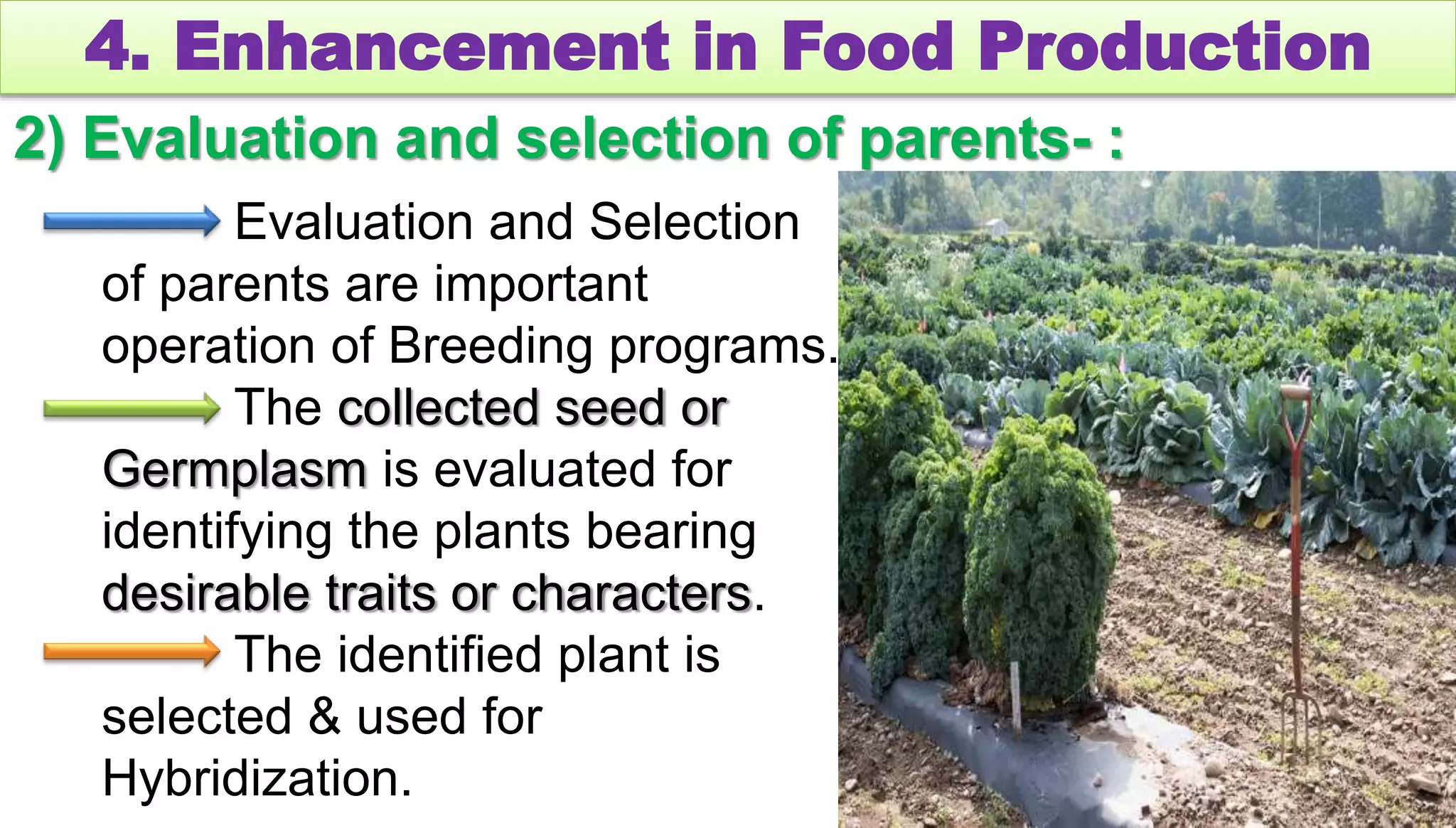
2) Evaluation and selection of parents- :
Evaluation and Selection
of parents are important
operation of Breeding programs.
The collected seed or
Germplasm is evaluated for
identifying the plants bearing
desirable traits or characters.
The identified plant is
selected & used for
Hybridization.
4. Enhancement in Food Production
3) Cross Hybridization among the selected parents -:
The selected parents are crossed hybridized.
Hybridization is the crossing of two selected
parents differing in one or more characters.
Hybridization makes the combination of useful
characters possible which are usually scattered in
different varieties of plants.
It is also useful in the exploitation & utilization of
hybrid vigor.
4. Enhancement in Food Production
Hybridization-: Hybridization is crossing of two selective plants differing in one
or more characters from each other.
1) Emasculation-:
The removal of anther from bisexual flower
of selected mother plant in early bud condition or
before maturation is called Emasculation.
It can be done with the help of forceps
method or hot water method. Emasculation is not
required for selected mother plants with unisexual
flower.
Steps of Hybridization-: 1) Emasculation
2) Bagging & Tagging
3) Dusting of desired pollen grain
4) Rebagging of female flower
4. Enhancement in Food Production
2) Bagging & Tagging -:
Emasculated flower is
covered with the help of bags
made by butter paper to avoid
interference of other pollen
grains called as ‘Bagging.’
The attachment of tag to
remind date of emasculation,
plant name etc is done, which
we called ‘Tagging’.
4. Enhancement in Food Production
Significance of Hybridization-:
1) Hybridization makes the combining of useful characters possible
which are usually scattered in different varieties or races of plant.
2) Hybridization is helpful in exploitation and utilization of hybrid vigour.
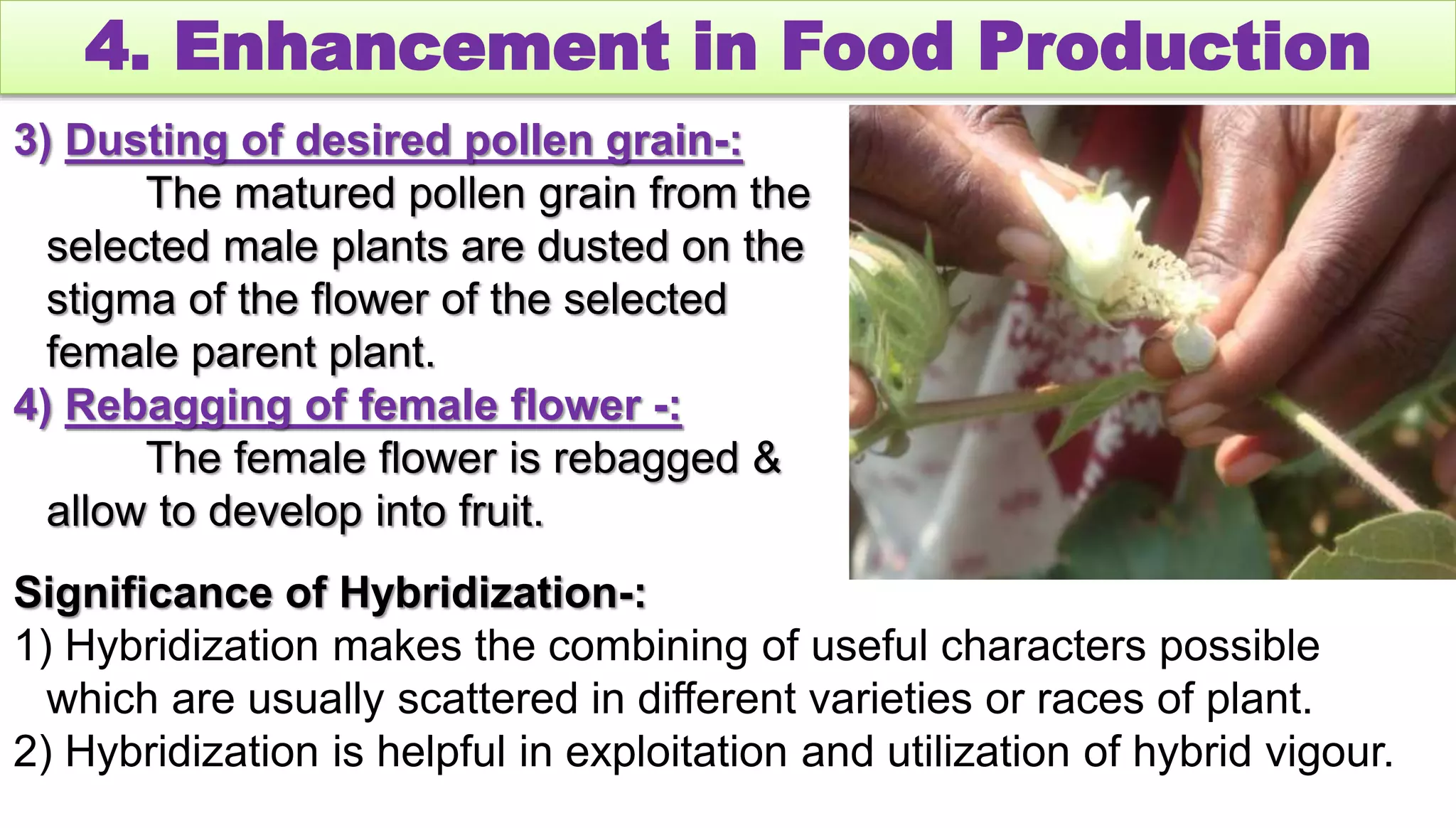
3) Dusting of desired pollen grain-:
The matured pollen grain from the
selected male plants are dusted on the
stigma of the flower of the selected
female parent plant.
4) Rebagging of female flower -:
The female flower is rebagged &
allow to develop into fruit.
4. Enhancement in Food Production
4) Selection and Selfing of Superior Recombinants-:
1) The progenies obtained after hybridization are observed for
desirable combination of characters.
2) These progenies are selected & observed carefully. They are
then evaluated scientifically for the success of breeding
objectives.
3) Plants that are superior to both the parents & show hybrid
vigour are selected & selfed for successive generation to obtain
Homozygosity.
4. Enhancement in Food Production
5) Testing, Release and Commercialization of new Cultivars -:
1) The selected plants evaluated for their productivity & other important agronomic
characteristics such as Quantity of crops, Disease resistance etc.
2) The evaluation is done by growing the plants in research fields under controlled
condition of fertilizer application, irrigation, crop management practices etc.
3) These plants are then grown in natural fields in different agro climatic zones of the
country for at least three growing seasons where the crop is usually cultivated.
They are then tested by agencies like IARI. (Indian Agriculture Research Institute )
4) The variety release committee, then recommends the release of the improved
variety under a new trade name with permission of government.
4. Enhancement in Food Production
Green Revolution-:
1) India have agriculture based economy. It account for 33% of total GDP. (Gross
Domestic Product)
2) The 60 % of total population choose their occupation based on agriculture.
3) The development of high yielding improved varieties of Wheat & Rice during
the era 1960 to 1970 helped to farmers to attained record agricultural
production.
4) The achievement of record agricultural production in our country was
popularly known as ‘GREEN REVOLUTION’.
5) The green revolution in India provides numerous job opportunity along with
strong Economy of country.
6) The green revolution in India helped to improve living standards of people.
7) The use of genetically improved verities of crop for cultivation, expansion of
farmland, cultivation of double crop in the same field & optimum use of fertilizers
are the basic element that are considered in GREEN REVOLUTION.
4. Enhancement in Food Production
High Yielding Varieties
Wheat
Rice
Sugarcane
Sonalika
Kalyansona
Sonora-64
Lerma Rojo-64
Safed Lerma
Sharbati Sonora
Jaya
Ratna
Vijaya
Padma
Kanti
Jayanti
CO-421
CO-419
CO-205
CO-453
CO-740
4. Enhancement in Food Production
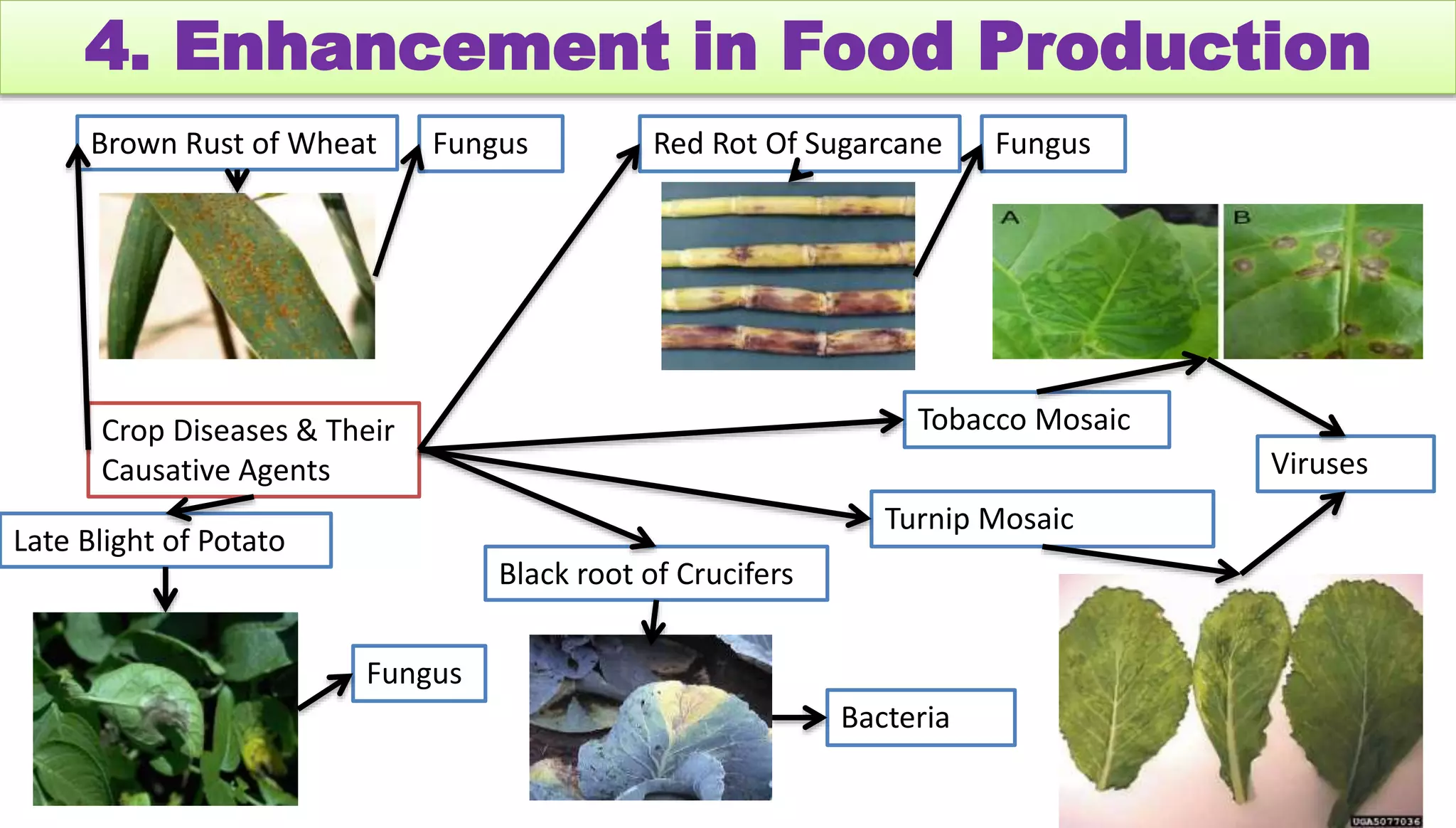
Crop Diseases & Their
Causative Agents
Brown Rust of Wheat Fungus Red Rot Of Sugarcane Fungus
Late Blight of Potato
Fungus
Black root of Crucifers
Bacteria
Tobacco Mosaic
Viruses
Turnip Mosaic
4. Enhancement in Food Production
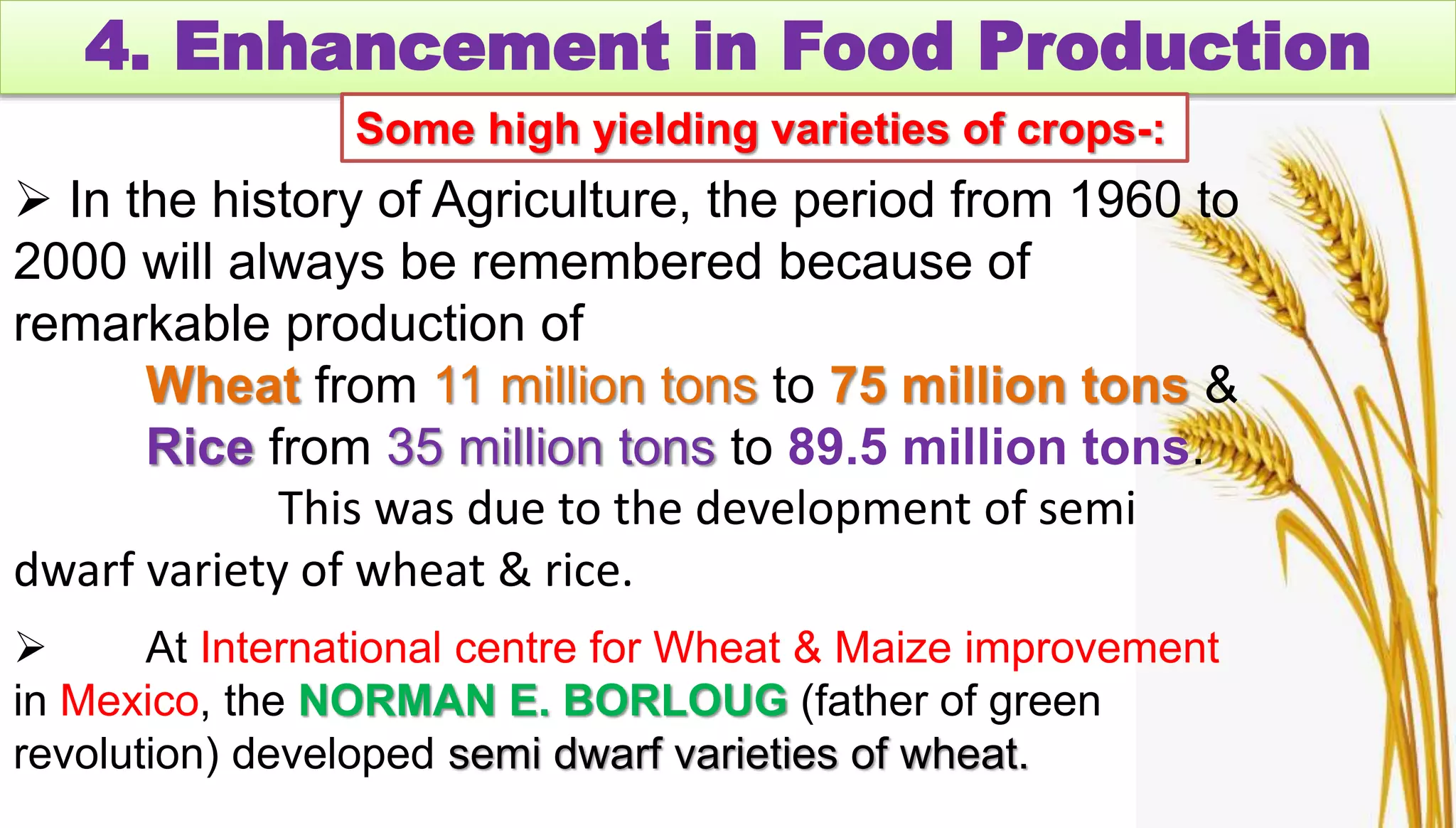
Some high yielding varieties of crops-:
 In the history of Agriculture, the period from 1960 to
2000 will always be remembered because of
remarkable production of
Wheat from 11 million tons to 75 million tons &
Rice from 35 million tons to 89.5 million tons.
This was due to the development of semi
dwarf variety of wheat & rice.
 At International centre for Wheat & Maize improvement
in Mexico, the NORMAN E. BORLOUG (father of green
revolution) developed semi dwarf varieties of wheat.
4. Enhancement in Food Production
 The high yielding & semi dwarf varieties like SONALIKA &
KALYANSONA were selected & introduced in different wheat
growing region of INDIA in 1963.
 Semi-Dwarf varieties of RICE were developed from IR-8
formed at International Rice Research Institute, Philippines
(IRRI) & Taichung Native – 1 (From Taiwan).
 The derivatives were introduced in India in 1966, & better
yield Semi-Dwarf varieties like Jaya & Ratna were developed
in India.
 Some other high yielding varieties of wheat are Sonora-64,
Lerma Rojo-64A, Safed lerma, Sharbati Sonora etc.
 Some other high yielding varieties of Rice are Vijaya,
Padma, Kanti, Jayanti.
4. Enhancement in Food Production
Some high yielding varieties of Sugarcane -:
 Sugarcane is cultivated as a primary source of Sugar in different
part of world.
 India is a one of the major sugar exporting country.
 Saccharum barberi was commonly cultivated in North India but
had poor yield & sugar content.
 Saccharum officinarum was commonly grown in South India &
have high sugar content and better yield but it did not grow in North
India because it not able to face all crop diseases.
4. Enhancement in Food Production
 The Hybrid varieties of these two species of
sugarcane have the desirable combination of
charecters like High Yielding, High Sugar & Resistant to
most of the crop diseases.
 These varieties are successfully grown in North
India.
 Some other varieties of sugar cane developed at
Sugarcane Breeding Institute, Coimbatore of India are
Co-421,
Co-419,
Co-205,
Co-453,
Co-740.
4. Enhancement in Food Production
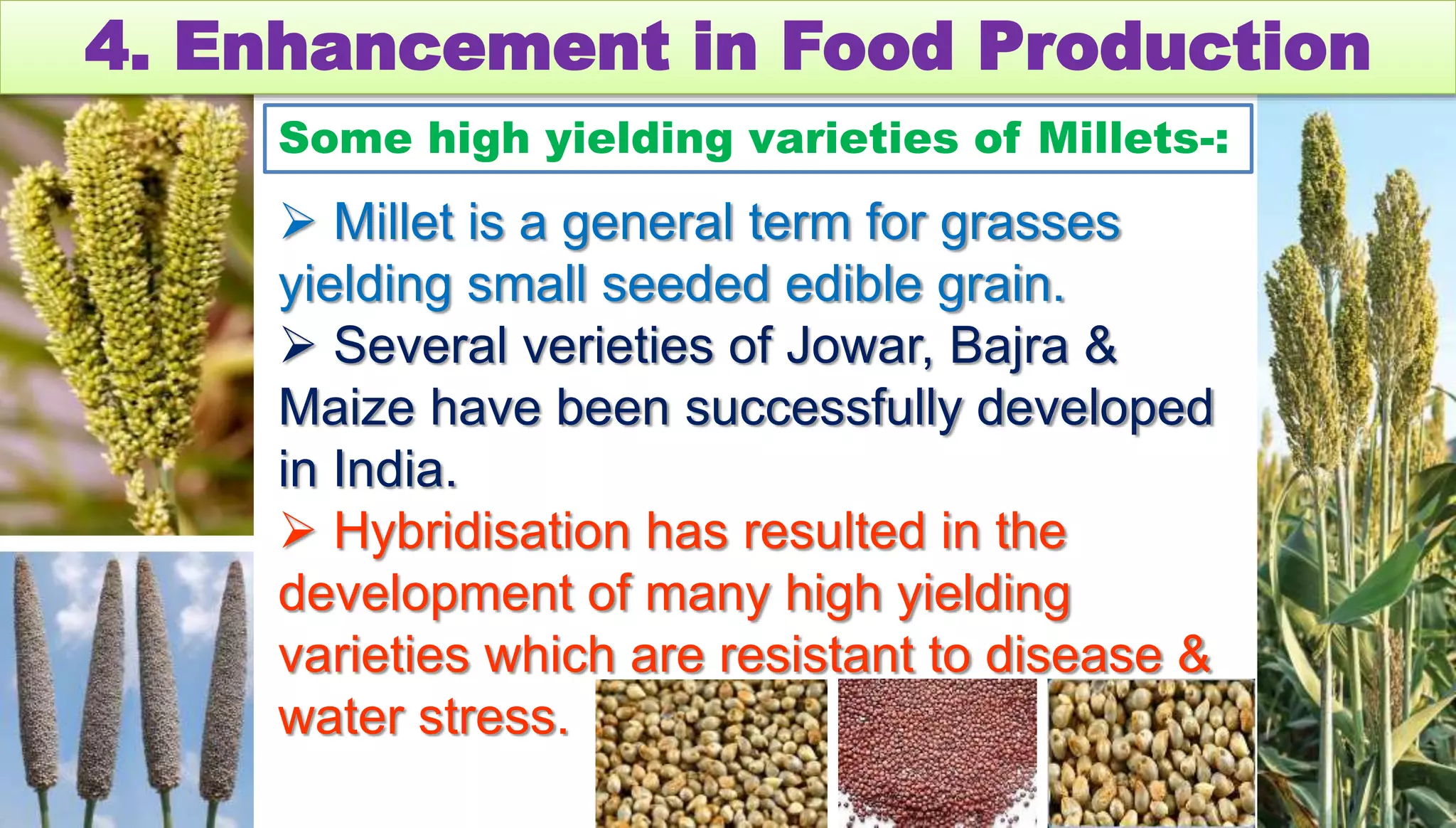
Some high yielding varieties of Millets-:
 Millet is a general term for grasses
yielding small seeded edible grain.
 Several verieties of Jowar, Bajra &
Maize have been successfully developed
in India.
 Hybridisation has resulted in the
development of many high yielding
varieties which are resistant to disease &
water stress.
4. Enhancement in Food Production
Definition-:
Plant breeding is the science of changing the traits of plants in
order to produce desired characteristics.
In tropical agricultural region, no. of pathogens like
Fungi, Bacteria & Viruses cause different disease to the crop
plants.
Such diseases can be controlled by various Physical,
Chemical & Biological methods.
The most effective, cheapest & convenient method is to
produce disease resistance varieties. This not only helps in
enhancing the food production but also helps to reduce
dependency on chemical fertilizers and pesticides.
4. Enhancement in Food Production
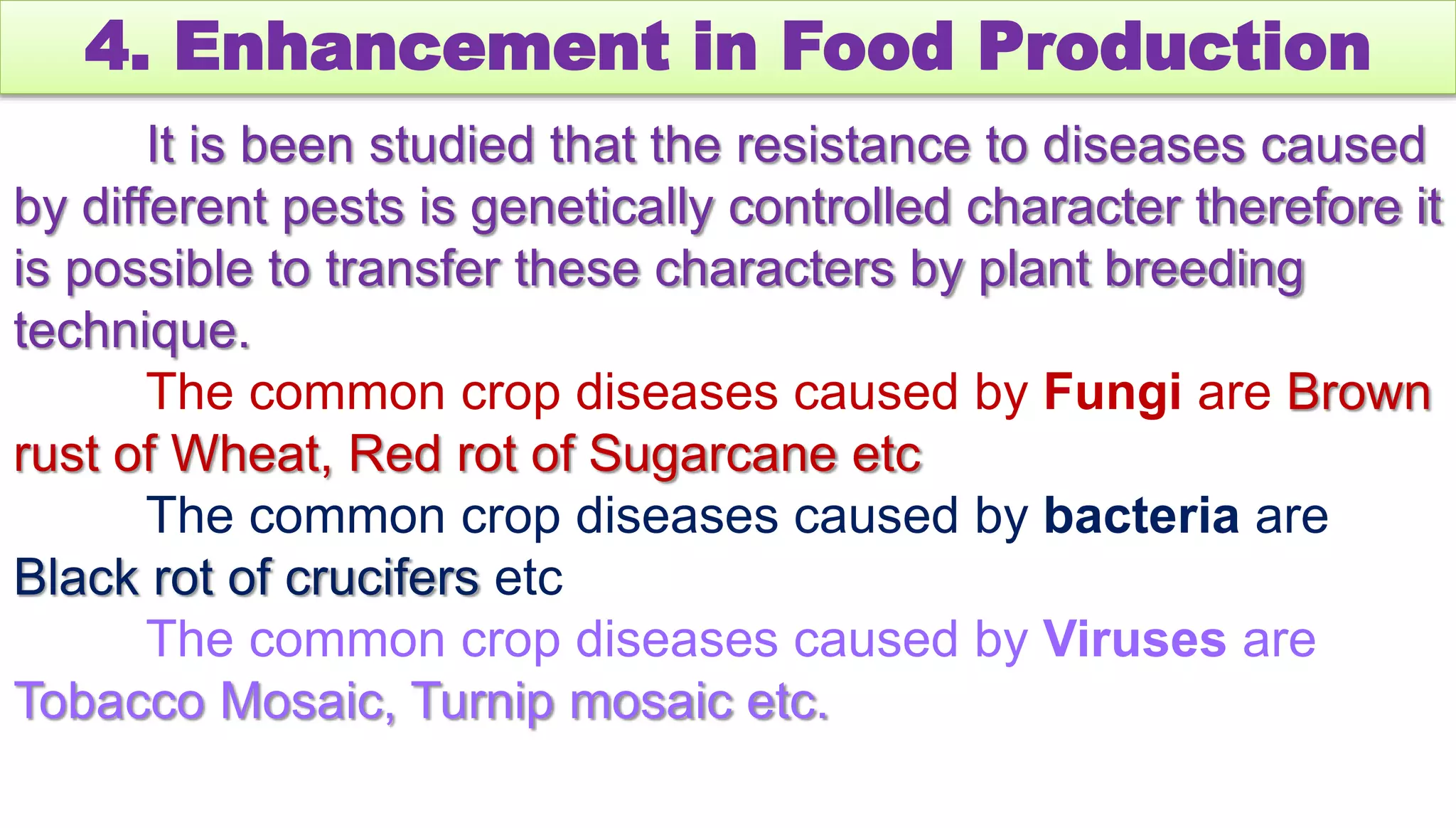
It is been studied that the resistance to diseases caused
by different pests is genetically controlled character therefore it
is possible to transfer these characters by plant breeding
technique.
The common crop diseases caused by Fungi are Brown
rust of Wheat, Red rot of Sugarcane etc
The common crop diseases caused by bacteria are
Black rot of crucifers etc
The common crop diseases caused by Viruses are
Tobacco Mosaic, Turnip mosaic etc.
4. Enhancement in Food Production
Plant Breeding
For Diseases
Resistance Varieties
For Insect / Pest
Resistance Verities
For Improved
Food Qualities
By Conventional breeding
technique of Hybridization
By Selection / Mutation
breeding technique
By Genetic Engineering
method
Bio-fortification
By Selective Breeding
By Genetic Modification
4. Enhancement in Food Production
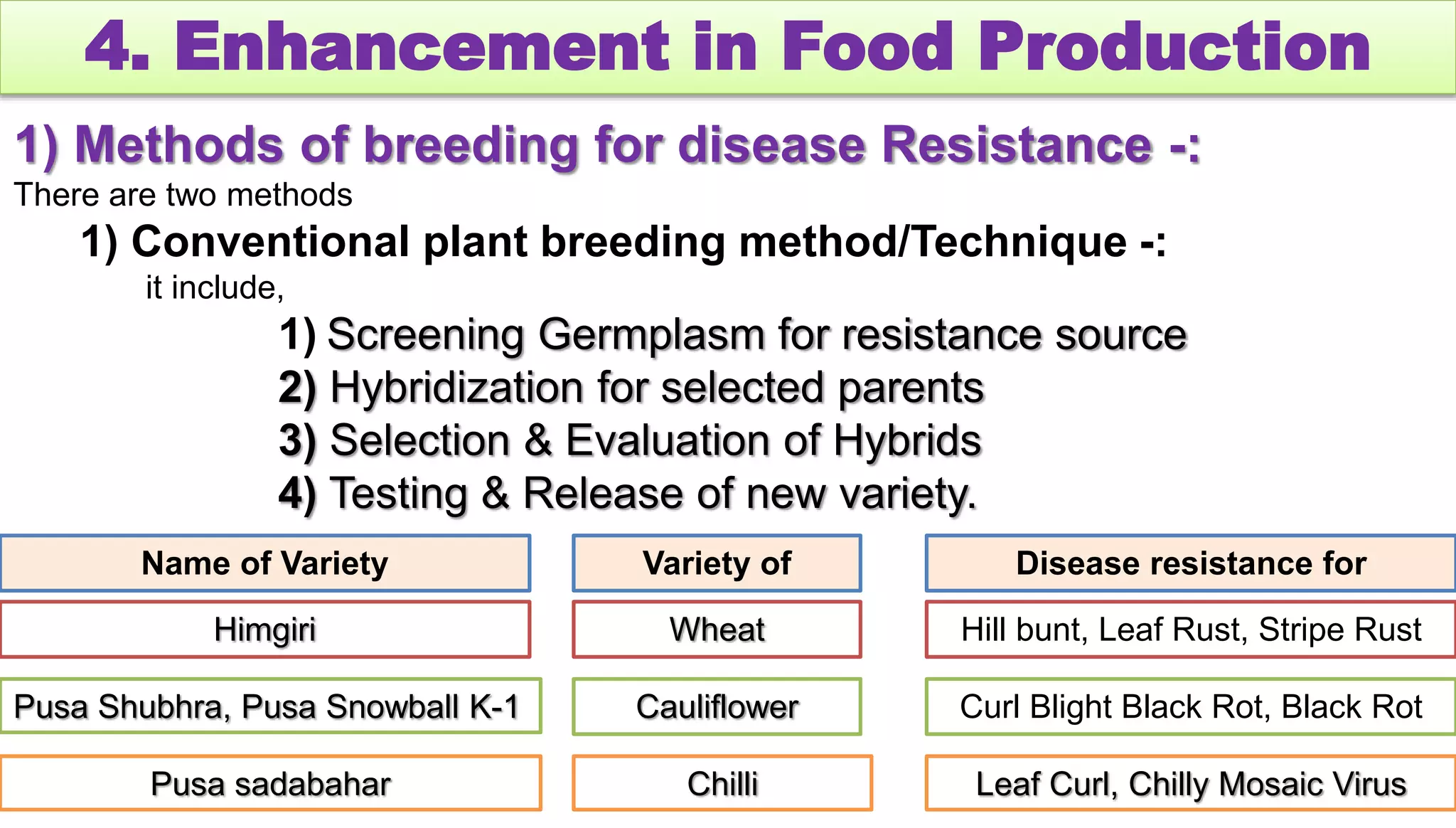
1) Methods of breeding for disease Resistance -:
There are two methods
1) Conventional plant breeding method/Technique -:
it include,
1) Screening Germplasm for resistance source
2) Hybridization for selected parents
3) Selection & Evaluation of Hybrids
4) Testing & Release of new variety.
Name of Variety Variety of Disease resistance for
Himgiri Wheat Hill bunt, Leaf Rust, Stripe Rust
Pusa Shubhra, Pusa Snowball K-1 Cauliflower Curl Blight Black Rot, Black Rot
Pusa sadabahar Chilli Leaf Curl, Chilly Mosaic Virus
4. Enhancement in Food Production
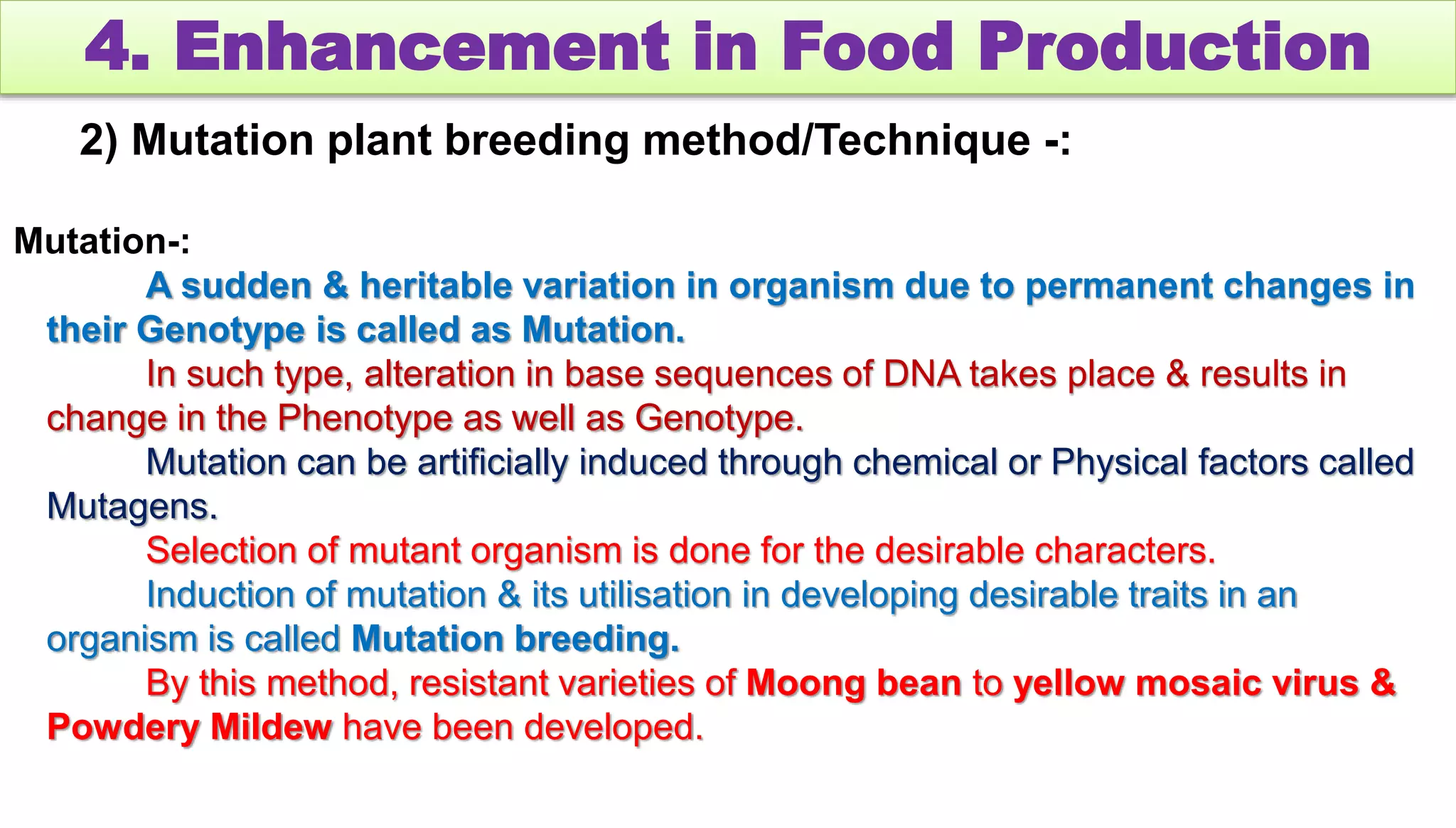
2) Mutation plant breeding method/Technique -:
Mutation-:
A sudden & heritable variation in organism due to permanent changes in
their Genotype is called as Mutation.
In such type, alteration in base sequences of DNA takes place & results in
change in the Phenotype as well as Genotype.
Mutation can be artificially induced through chemical or Physical factors called
Mutagens.
Selection of mutant organism is done for the desirable characters.
Induction of mutation & its utilisation in developing desirable traits in an
organism is called Mutation breeding.
By this method, resistant varieties of Moong bean to yellow mosaic virus &
Powdery Mildew have been developed.
4. Enhancement in Food Production
2) Methods of breeding for Insect / Pest Resistance -:
Insects and pest infestation are two major causes for large
destruction of crop plant and crop.
 Insect resistance in host crop plants is due to morphological,
biochemical or physiological characters.
 Hairy leaves of many plants are associated with resistance to
insect pests.
 E.g. Resistance to jassids in cotton and cereal leaf beetles in wheat.
 Solid stems in wheat lead to non-preference by the stem saw fly
and smooth leaved and nectar-less cotton varieties does not attract
bollworms.
 Low nitrogen, sugar and high aspartic acid in maize develops
resistance to maize stem borers.
4. Enhancement in Food Production
Breeding methods for insect pests resistance include the same
steps as for any other agronomic character like yield or quality as
described above.
Sources of resistance genes may be cultivated varieties,
germplasm collections of the crop or wild relatives of the crop.
4. Enhancement in Food Production
3) Methods of breeding for Improved Food Quality -:
 It is estimated that more than 840 million people in the world do not
have adequate food to meet their daily requirements.
 Three billion people suffer from protein, vitamins and micronutrient
deficiencies or ‘hidden hunger’ because these people cannot afford to
buy adequate vegetables, fruits, legumes, fish and meat.
 Their food does not contain essential micronutrients specially iron,
iodine, zinc and vitamin A.
 This increases the risk for disease, reduces mental abilities and life
span.
 Breeding of crops with higher levels of vitamins and minerals or
higher protein and healthier fats is called biofortification. This is the
most practical aspect to improve the health of the people.
4. Enhancement in Food Production
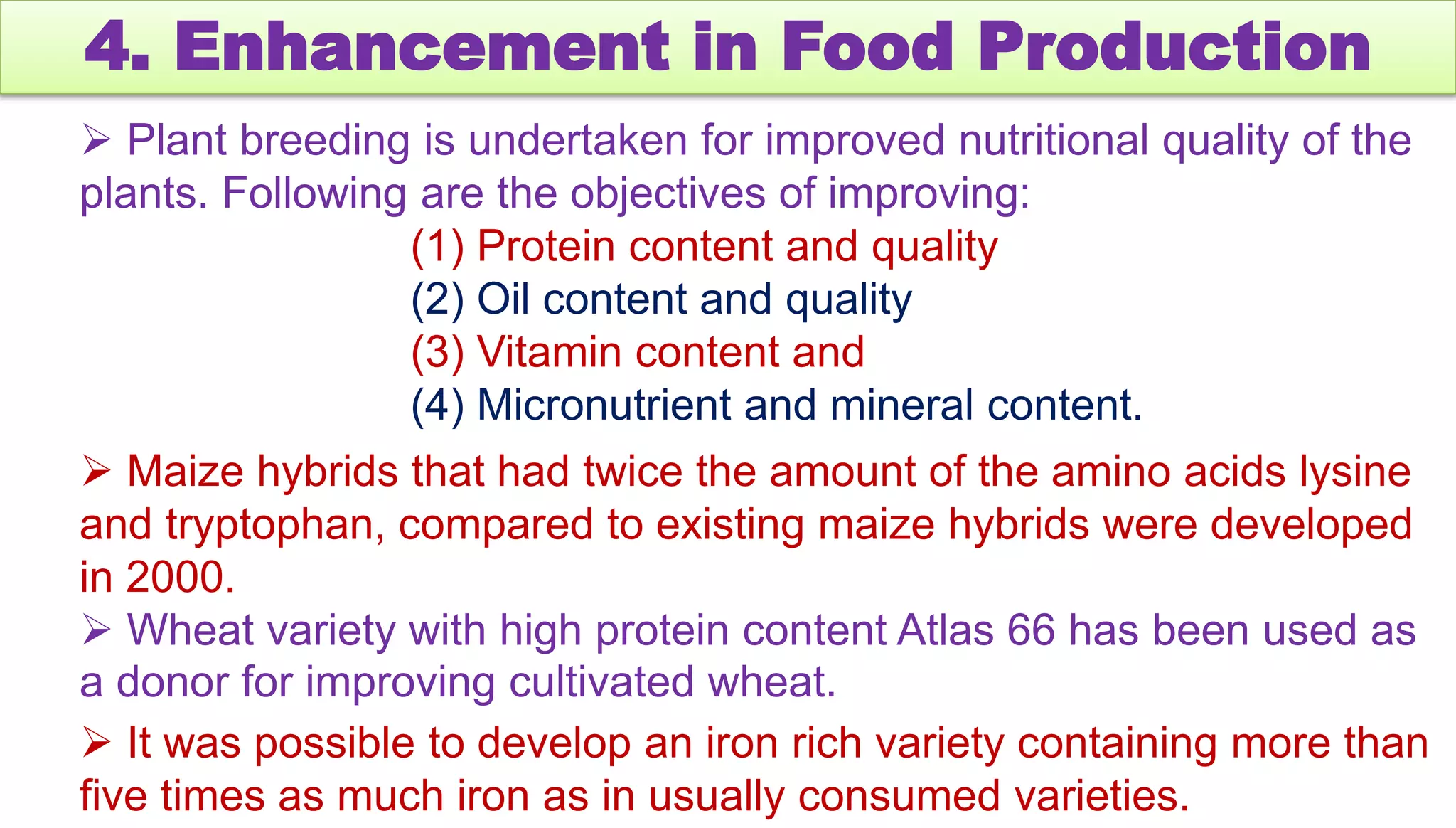
 Plant breeding is undertaken for improved nutritional quality of the
plants. Following are the objectives of improving:
(1) Protein content and quality
(2) Oil content and quality
(3) Vitamin content and
(4) Micronutrient and mineral content.
 Maize hybrids that had twice the amount of the amino acids lysine
and tryptophan, compared to existing maize hybrids were developed
in 2000.
 Wheat variety with high protein content Atlas 66 has been used as
a donor for improving cultivated wheat.
 It was possible to develop an iron rich variety containing more than
five times as much iron as in usually consumed varieties.
4. Enhancement in Food Production
Que-: Explain selective breeding? Give any two examples and their
nutrients obtained by selective breeding? O-14
Que-: Which step would you like to follow to develop a new variety of
crop by Selective breeding? O-15
1) Bio-fortification is a method of crop breeding to increase the nutritional
value of crops.
2) There are two methods of crop breeding for bio-fortification visually
Selective breeding & genetic modification.
Ans-:
4. Enhancement in Food Production
Selective Breeding-:
1) Selective breeding is a kind of breeding which involves the search
of seeds or Germplasm banks for existing varieties of crop that are
rich in nutrients.
2) These high nutrient varieties are then crossbred with high yielding
varieties of crop to obtained seeds with increased nutritional value
& high yields.
Two example with their nutrients obtained by selective breeding-:
1) Hybrid Maize -: double quantity of amino acids such as Tryptophan
& Lysine.
2) Atlas-66 (Variety of wheat) -: rich in protein.
3) Hybrid Carrot, Spinach, Pumpkin -: Rich in vitamin A.
4. Enhancement in Food Production
Genetic modification -:
The soil bacteria, Erwinia and Maize or Daffodil plants having desired
gene.
The desired gene get cut & introduced in rice variety.
The inserted desired gene is responsible for secretion of enzyme
necessory for synthesis of Beta-Carotene i.e. Provitamin A.
This beta carotene when introduced in human body then it get converted
in to Vitamin A.
 e.g. Golden Rice.
The rural poor people commonly consume staple food such as Rice,
Wheat & Maize which having low nutrients.
Increasing the nutrient levels in staple crop can help to prevent & reduce
the micro-nutrient deficiency.
Bio-fortification method is very costly. After research, the implementation
cost is nil or negligible.
4. Enhancement in Food Production
There are eight essential amino acids.
 When these amino acids are present in the protein of our diet in
sufficient amount, they constitute protein quality.
 Proteins of cereals and millets are deficient in two amino acids, i.e.,
lysine and tryptophan. Whereas pulses are deficient in methionine
and cysteine both are sulphur containing amino acids.
 Indian Agricultural Research Institute (IARI), New Delhi, has also
developed many vegetable crops that are rich in minerals and
vitamins.
E.g. Vitamin A enriched carrots, pumpkin, spinach,
Vitamin С enriched bitter gourd, Bathua, tomato, mustard,
calcium and Iron enriched spinach and bathua; and
Protein enriched beans (broad lablab, French and garden peas).
4. Enhancement in Food Production
TISSUE CULTURE-:
The ability to produce an entire plant from a
cell or a tissue is called ‘Tissue Culture’.
TISSUE CULTURE TECHNIQUE -:
The culturing or growing isolated protoplasts,
cell or tissue or an organ on a aseptic nutrient medium
to produce entire plant body or parts of a plant is called
tissue culture technique.
4. Enhancement in Food Production
Steps in Tissue Culture -:
the different steps involved in Tissue Culture Technique is as
1) Explant Culture -:
 Explants are removed from the plants.
 These are in the form of cell, tissue or some other parenchymatous plant
matter.
 Meristem is the most suitable tissue as an explant. Explant are sterilized
and grown on solid culture medium where they start cell division.
2) Callus formation and Culture -:
 Callus is unorganized mass of cell processing thin wall parenchymatous
cells.
 Explant proliferate and forms Callus.
 All the cell of callus are identical as they are produced by mitosis.
4. Enhancement in Food Production
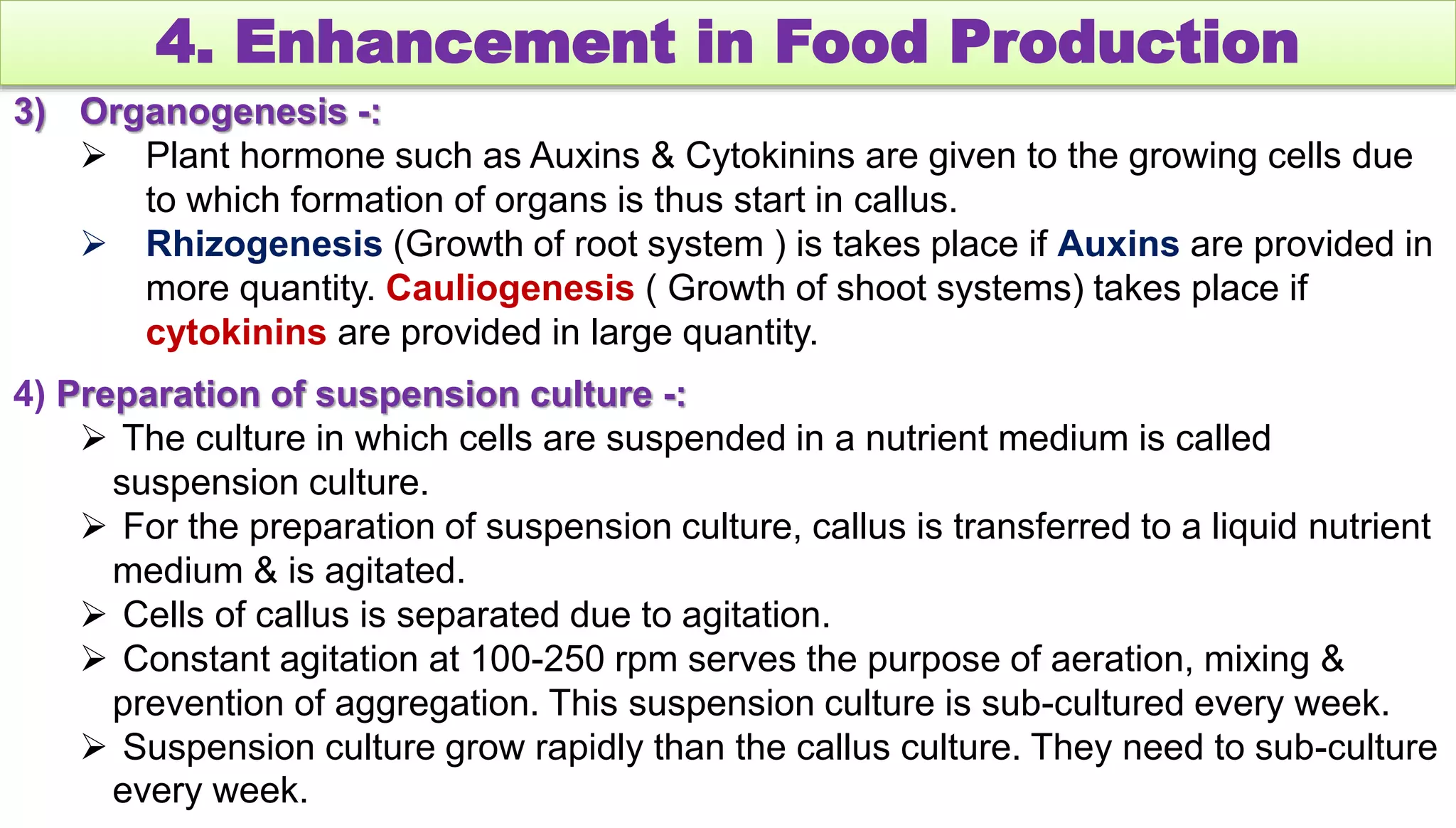
3) Organogenesis -:
 Plant hormone such as Auxins & Cytokinins are given to the growing cells due
to which formation of organs is thus start in callus.
 Rhizogenesis (Growth of root system ) is takes place if Auxins are provided in
more quantity. Cauliogenesis ( Growth of shoot systems) takes place if
cytokinins are provided in large quantity.
4) Preparation of suspension culture -:
 The culture in which cells are suspended in a nutrient medium is called
suspension culture.
 For the preparation of suspension culture, callus is transferred to a liquid nutrient
medium & is agitated.
 Cells of callus is separated due to agitation.
 Constant agitation at 100-250 rpm serves the purpose of aeration, mixing &
prevention of aggregation. This suspension culture is sub-cultured every week.
 Suspension culture grow rapidly than the callus culture. They need to sub-culture
every week.
4. Enhancement in Food Production
Single Cell Protein (SCP):
 As we know demand of food is increasing due to increase in human
and animal population, the shift from grain to meat diets does not solve
the problem as it takes 3-10 kg of grain to produce 1 kg of meat by
animal farming.
 More than 25 per cent of human population is suffering from hunger
and malnutrition.
 One of the alternate sources of proteins for animal and human
nutrition is single cell protein (SCP).
 Microorganisms are used for the preparation of fermented foods (e.g.,
cheese, butter, idlis, etc.).
 Some microorganisms (e.g., blue green algae- Spirulina and
mushrooms- fungi) are being used as human food.
4. Enhancement in Food Production
 Now efforts are being made to produce microbial biomass using low
cost substrates.
 Microbes like Spirulina can be grown on waste water from potato
processing plants (containing starch), straw, molases, animal manure
and even sewage, to produce food rich in proteins, minerals, fat,
carbohydrates and vitamins. This biomass is used as food by humans.
 The cells from microorganisms such as bacteria, yeasts, filamentous
algae, treated in various ways and used as food, are called single cell
protein (SCP).
 The term SCP does not indicate its actual meaning because the
biomass is not only obtained from unicellular microorganisms but also
from multicellular microorganisms.
4. Enhancement in Food Production
 Thus SCP is produced using bacteria, algae, fungi (yeasts, etc).
The substrates used for SCP production range from C02 (used by
algae) through industry effluents like whey (water of curd), etc. to
low-cost organic materials like saw dust and paddy straw.
 Commercial production of SCP is mostly based on yeasts and
some other fungi, e.g., Fusarium graminearum.
 In most cases, SCP has to be processed to remove the excess
of nucleic acids.
 SCP is rich in high quality protein and is poor in fats.
 Both high quality of protein and low quantity of fats constitute
good human food.
4. Enhancement in Food Production
 It has been estimated that a 250 kg cow produces 200 g of
protein per day.
 In the same period 250 g of a microorganism like
Methylophilus methylotrophus because of its high content of
biomass production and growth, can produce about 25 tonnes
of protein.
Some Common Microbes as SCP producers:
(i) Cyanobacteria – Spirulina
(ii) Bacteria – Methylophilus methylotrophus
(iii) Yeasts – Candida utilis
(iv) Filamentous fungi – Fusarium gramiearum
4. Enhancement in Food Production
Advantages of SCP:
(i) It is rich in high quality protein and poor
in fat content,
(ii) It reduces the pressure on agricultural
production systems for the supply of the required
proteins,
(iii) SCP production is based on industrial
effluents so it helps to minimise environmental
pollution,
(iv) SCP can be produced in laboratories
throughout the year.
4. Enhancement in Food Production
1) With the help of suitable diagram, define bagging & Tagging of a flower? (O-13)
2) With the help of diagram describe emasculation and bugging? (M-14)
3) Which step would you followed to develop a new variety of crop plant by
selective breeding? ( O-15)
4) Explain selective breeding. Give any two examples & their nutrients obtained
by selective breeding? (O-14)
5) What is tissue culture? Describe the methodology of tissue culture? (M-15)
Possible Questions
4. Enhancement in Food Production
7) Explain how suspension culture is prepared from callus? (M-13)
8) Describe any two application of tissue culture technique? (M-14)
9) Give advantage of Single cell protein? (O-13)
10) Give application of mutation breeding? (M-13)
11) Give reason: emasculation is done in a flower which is selected as a female
plant? (O-15)
12) Name high yielding semi dwarf variety of wheat selected and introduced in
India in 1963 ? (M-15)
4. Enhancement in Food Production

Enhancement in food production

  • 1.
    4. Enhancement inFood Production 4. Enhancement in food production A Lecture deal by Mr. Abhay Ishwar Bhansali ( B.Sc., M.Sc. (EVS), B.Ed. ) Cell no. -: +91-8888821956 Pacific Coaching Classes, Ner Parsopant
  • 2.
    4. Enhancement inFood Production 1) With the help of suitable diagram, define bagging & Tagging of a flower? (O-13) 2) With the help of diagram describe emasculation and bugging? (M-14) 3) Which step would you followed to develop a new veriety of crop plant by selective breeding? ( O-15) 4) Explain selective breeding. Give any two examples & their nutrients obtained by selective breeding? (O-14) 5) What is tissue culture? Describe the methodology of tissue culture? (M-15) 6) Explain how suspension culture is prepared from callus? (M-13) 7) Describe any two application of tissue culture technique? (M-14) 8) Give advantage of Single cell protein? (O-13) 9) Give application of mutation breeding? (M-13) 10) Give reason: emasculation is done in a flower which is selected as a female plant? (O-15) 11) Name high yielding semi dwarf variety of wheat selected and introduced in India in 1963 ? (M-15)
  • 3.
    4. Enhancement inFood Production 4.1 - Plant Breeding 4.2 - Tissue Culture 4.3 - Single Cell Protein What is plant breeding? Describe various steps involved in classical breeding of plants ? Or Describe the five steps of plant breeding?
  • 4.
    4. Enhancement inFood Production Plant Breeding-: Plant breeding is the process by which humans change the characteristics of plants over time to make them better crops and more nourishing food. "Plant Breeding is the art and science of the genetic improvement of plants." - Fehr, Principles of Cultivar Development: Theory and Technique, 1987 "Plant Breeding is the art and science of changing the traits of plants in order to product desired characteristics." - Sleper and Poehlman, Breeding Field Crops, 1995 "Plant Breeding is the genetic improvement of plants for human benefit." - Bernardo, Breeding for Quantitative Traits in Plants, 2010 Plant breeding, application of genetic principles to produce plants that are more useful to humans.
  • 5.
    4. Enhancement inFood Production Plant Breeding-: Five steps involved in plant breeding are 1) Collection of variability -: 2) Evaluation and selection of parents- : 3) Cross Hybridization among the selected parents -: 4) Selection and Selfing of Superior Recombinants-: 5) Testing, Release and Commercialization of new Cultivars
  • 6.
    4. Enhancement inFood Production 1) Collection of variability -: Variation are the differences found among the offspring with regard to their parents of same species. Such genetic variation are heritable & are useful in their selection. In many crops, genetic variations are available due to different wild varieties, Species & their close relatives. The collection of different wild varieties, species & their close relatives having all the diverse alleles for all genes in a particular crop is called ‘Germplasm Collection’.
  • 7.
    4. Enhancement inFood Production 2) Evaluation and selection of parents- : Evaluation and Selection of parents are important operation of Breeding programs. The collected seed or Germplasm is evaluated for identifying the plants bearing desirable traits or characters. The identified plant is selected & used for Hybridization.
  • 8.
    4. Enhancement inFood Production 3) Cross Hybridization among the selected parents -: The selected parents are crossed hybridized. Hybridization is the crossing of two selected parents differing in one or more characters. Hybridization makes the combination of useful characters possible which are usually scattered in different varieties of plants. It is also useful in the exploitation & utilization of hybrid vigor.
  • 9.
    4. Enhancement inFood Production Hybridization-: Hybridization is crossing of two selective plants differing in one or more characters from each other. 1) Emasculation-: The removal of anther from bisexual flower of selected mother plant in early bud condition or before maturation is called Emasculation. It can be done with the help of forceps method or hot water method. Emasculation is not required for selected mother plants with unisexual flower. Steps of Hybridization-: 1) Emasculation 2) Bagging & Tagging 3) Dusting of desired pollen grain 4) Rebagging of female flower
  • 10.
    4. Enhancement inFood Production 2) Bagging & Tagging -: Emasculated flower is covered with the help of bags made by butter paper to avoid interference of other pollen grains called as ‘Bagging.’ The attachment of tag to remind date of emasculation, plant name etc is done, which we called ‘Tagging’.
  • 11.
    4. Enhancement inFood Production Significance of Hybridization-: 1) Hybridization makes the combining of useful characters possible which are usually scattered in different varieties or races of plant. 2) Hybridization is helpful in exploitation and utilization of hybrid vigour. 3) Dusting of desired pollen grain-: The matured pollen grain from the selected male plants are dusted on the stigma of the flower of the selected female parent plant. 4) Rebagging of female flower -: The female flower is rebagged & allow to develop into fruit.
  • 12.
    4. Enhancement inFood Production 4) Selection and Selfing of Superior Recombinants-: 1) The progenies obtained after hybridization are observed for desirable combination of characters. 2) These progenies are selected & observed carefully. They are then evaluated scientifically for the success of breeding objectives. 3) Plants that are superior to both the parents & show hybrid vigour are selected & selfed for successive generation to obtain Homozygosity.
  • 13.
    4. Enhancement inFood Production 5) Testing, Release and Commercialization of new Cultivars -: 1) The selected plants evaluated for their productivity & other important agronomic characteristics such as Quantity of crops, Disease resistance etc. 2) The evaluation is done by growing the plants in research fields under controlled condition of fertilizer application, irrigation, crop management practices etc. 3) These plants are then grown in natural fields in different agro climatic zones of the country for at least three growing seasons where the crop is usually cultivated. They are then tested by agencies like IARI. (Indian Agriculture Research Institute ) 4) The variety release committee, then recommends the release of the improved variety under a new trade name with permission of government.
  • 14.
    4. Enhancement inFood Production Green Revolution-: 1) India have agriculture based economy. It account for 33% of total GDP. (Gross Domestic Product) 2) The 60 % of total population choose their occupation based on agriculture. 3) The development of high yielding improved varieties of Wheat & Rice during the era 1960 to 1970 helped to farmers to attained record agricultural production. 4) The achievement of record agricultural production in our country was popularly known as ‘GREEN REVOLUTION’. 5) The green revolution in India provides numerous job opportunity along with strong Economy of country. 6) The green revolution in India helped to improve living standards of people. 7) The use of genetically improved verities of crop for cultivation, expansion of farmland, cultivation of double crop in the same field & optimum use of fertilizers are the basic element that are considered in GREEN REVOLUTION.
  • 15.
    4. Enhancement inFood Production High Yielding Varieties Wheat Rice Sugarcane Sonalika Kalyansona Sonora-64 Lerma Rojo-64 Safed Lerma Sharbati Sonora Jaya Ratna Vijaya Padma Kanti Jayanti CO-421 CO-419 CO-205 CO-453 CO-740
  • 16.
    4. Enhancement inFood Production Crop Diseases & Their Causative Agents Brown Rust of Wheat Fungus Red Rot Of Sugarcane Fungus Late Blight of Potato Fungus Black root of Crucifers Bacteria Tobacco Mosaic Viruses Turnip Mosaic
  • 17.
    4. Enhancement inFood Production Some high yielding varieties of crops-:  In the history of Agriculture, the period from 1960 to 2000 will always be remembered because of remarkable production of Wheat from 11 million tons to 75 million tons & Rice from 35 million tons to 89.5 million tons. This was due to the development of semi dwarf variety of wheat & rice.  At International centre for Wheat & Maize improvement in Mexico, the NORMAN E. BORLOUG (father of green revolution) developed semi dwarf varieties of wheat.
  • 18.
    4. Enhancement inFood Production  The high yielding & semi dwarf varieties like SONALIKA & KALYANSONA were selected & introduced in different wheat growing region of INDIA in 1963.  Semi-Dwarf varieties of RICE were developed from IR-8 formed at International Rice Research Institute, Philippines (IRRI) & Taichung Native – 1 (From Taiwan).  The derivatives were introduced in India in 1966, & better yield Semi-Dwarf varieties like Jaya & Ratna were developed in India.  Some other high yielding varieties of wheat are Sonora-64, Lerma Rojo-64A, Safed lerma, Sharbati Sonora etc.  Some other high yielding varieties of Rice are Vijaya, Padma, Kanti, Jayanti.
  • 19.
    4. Enhancement inFood Production Some high yielding varieties of Sugarcane -:  Sugarcane is cultivated as a primary source of Sugar in different part of world.  India is a one of the major sugar exporting country.  Saccharum barberi was commonly cultivated in North India but had poor yield & sugar content.  Saccharum officinarum was commonly grown in South India & have high sugar content and better yield but it did not grow in North India because it not able to face all crop diseases.
  • 20.
    4. Enhancement inFood Production  The Hybrid varieties of these two species of sugarcane have the desirable combination of charecters like High Yielding, High Sugar & Resistant to most of the crop diseases.  These varieties are successfully grown in North India.  Some other varieties of sugar cane developed at Sugarcane Breeding Institute, Coimbatore of India are Co-421, Co-419, Co-205, Co-453, Co-740.
  • 21.
    4. Enhancement inFood Production Some high yielding varieties of Millets-:  Millet is a general term for grasses yielding small seeded edible grain.  Several verieties of Jowar, Bajra & Maize have been successfully developed in India.  Hybridisation has resulted in the development of many high yielding varieties which are resistant to disease & water stress.
  • 22.
    4. Enhancement inFood Production Definition-: Plant breeding is the science of changing the traits of plants in order to produce desired characteristics. In tropical agricultural region, no. of pathogens like Fungi, Bacteria & Viruses cause different disease to the crop plants. Such diseases can be controlled by various Physical, Chemical & Biological methods. The most effective, cheapest & convenient method is to produce disease resistance varieties. This not only helps in enhancing the food production but also helps to reduce dependency on chemical fertilizers and pesticides.
  • 23.
    4. Enhancement inFood Production It is been studied that the resistance to diseases caused by different pests is genetically controlled character therefore it is possible to transfer these characters by plant breeding technique. The common crop diseases caused by Fungi are Brown rust of Wheat, Red rot of Sugarcane etc The common crop diseases caused by bacteria are Black rot of crucifers etc The common crop diseases caused by Viruses are Tobacco Mosaic, Turnip mosaic etc.
  • 24.
    4. Enhancement inFood Production Plant Breeding For Diseases Resistance Varieties For Insect / Pest Resistance Verities For Improved Food Qualities By Conventional breeding technique of Hybridization By Selection / Mutation breeding technique By Genetic Engineering method Bio-fortification By Selective Breeding By Genetic Modification
  • 25.
    4. Enhancement inFood Production 1) Methods of breeding for disease Resistance -: There are two methods 1) Conventional plant breeding method/Technique -: it include, 1) Screening Germplasm for resistance source 2) Hybridization for selected parents 3) Selection & Evaluation of Hybrids 4) Testing & Release of new variety. Name of Variety Variety of Disease resistance for Himgiri Wheat Hill bunt, Leaf Rust, Stripe Rust Pusa Shubhra, Pusa Snowball K-1 Cauliflower Curl Blight Black Rot, Black Rot Pusa sadabahar Chilli Leaf Curl, Chilly Mosaic Virus
  • 26.
    4. Enhancement inFood Production 2) Mutation plant breeding method/Technique -: Mutation-: A sudden & heritable variation in organism due to permanent changes in their Genotype is called as Mutation. In such type, alteration in base sequences of DNA takes place & results in change in the Phenotype as well as Genotype. Mutation can be artificially induced through chemical or Physical factors called Mutagens. Selection of mutant organism is done for the desirable characters. Induction of mutation & its utilisation in developing desirable traits in an organism is called Mutation breeding. By this method, resistant varieties of Moong bean to yellow mosaic virus & Powdery Mildew have been developed.
  • 27.
    4. Enhancement inFood Production 2) Methods of breeding for Insect / Pest Resistance -: Insects and pest infestation are two major causes for large destruction of crop plant and crop.  Insect resistance in host crop plants is due to morphological, biochemical or physiological characters.  Hairy leaves of many plants are associated with resistance to insect pests.  E.g. Resistance to jassids in cotton and cereal leaf beetles in wheat.  Solid stems in wheat lead to non-preference by the stem saw fly and smooth leaved and nectar-less cotton varieties does not attract bollworms.  Low nitrogen, sugar and high aspartic acid in maize develops resistance to maize stem borers.
  • 28.
    4. Enhancement inFood Production Breeding methods for insect pests resistance include the same steps as for any other agronomic character like yield or quality as described above. Sources of resistance genes may be cultivated varieties, germplasm collections of the crop or wild relatives of the crop.
  • 29.
    4. Enhancement inFood Production 3) Methods of breeding for Improved Food Quality -:  It is estimated that more than 840 million people in the world do not have adequate food to meet their daily requirements.  Three billion people suffer from protein, vitamins and micronutrient deficiencies or ‘hidden hunger’ because these people cannot afford to buy adequate vegetables, fruits, legumes, fish and meat.  Their food does not contain essential micronutrients specially iron, iodine, zinc and vitamin A.  This increases the risk for disease, reduces mental abilities and life span.  Breeding of crops with higher levels of vitamins and minerals or higher protein and healthier fats is called biofortification. This is the most practical aspect to improve the health of the people.
  • 30.
    4. Enhancement inFood Production  Plant breeding is undertaken for improved nutritional quality of the plants. Following are the objectives of improving: (1) Protein content and quality (2) Oil content and quality (3) Vitamin content and (4) Micronutrient and mineral content.  Maize hybrids that had twice the amount of the amino acids lysine and tryptophan, compared to existing maize hybrids were developed in 2000.  Wheat variety with high protein content Atlas 66 has been used as a donor for improving cultivated wheat.  It was possible to develop an iron rich variety containing more than five times as much iron as in usually consumed varieties.
  • 31.
    4. Enhancement inFood Production Que-: Explain selective breeding? Give any two examples and their nutrients obtained by selective breeding? O-14 Que-: Which step would you like to follow to develop a new variety of crop by Selective breeding? O-15 1) Bio-fortification is a method of crop breeding to increase the nutritional value of crops. 2) There are two methods of crop breeding for bio-fortification visually Selective breeding & genetic modification. Ans-:
  • 32.
    4. Enhancement inFood Production Selective Breeding-: 1) Selective breeding is a kind of breeding which involves the search of seeds or Germplasm banks for existing varieties of crop that are rich in nutrients. 2) These high nutrient varieties are then crossbred with high yielding varieties of crop to obtained seeds with increased nutritional value & high yields. Two example with their nutrients obtained by selective breeding-: 1) Hybrid Maize -: double quantity of amino acids such as Tryptophan & Lysine. 2) Atlas-66 (Variety of wheat) -: rich in protein. 3) Hybrid Carrot, Spinach, Pumpkin -: Rich in vitamin A.
  • 33.
    4. Enhancement inFood Production Genetic modification -: The soil bacteria, Erwinia and Maize or Daffodil plants having desired gene. The desired gene get cut & introduced in rice variety. The inserted desired gene is responsible for secretion of enzyme necessory for synthesis of Beta-Carotene i.e. Provitamin A. This beta carotene when introduced in human body then it get converted in to Vitamin A.  e.g. Golden Rice. The rural poor people commonly consume staple food such as Rice, Wheat & Maize which having low nutrients. Increasing the nutrient levels in staple crop can help to prevent & reduce the micro-nutrient deficiency. Bio-fortification method is very costly. After research, the implementation cost is nil or negligible.
  • 34.
    4. Enhancement inFood Production There are eight essential amino acids.  When these amino acids are present in the protein of our diet in sufficient amount, they constitute protein quality.  Proteins of cereals and millets are deficient in two amino acids, i.e., lysine and tryptophan. Whereas pulses are deficient in methionine and cysteine both are sulphur containing amino acids.  Indian Agricultural Research Institute (IARI), New Delhi, has also developed many vegetable crops that are rich in minerals and vitamins. E.g. Vitamin A enriched carrots, pumpkin, spinach, Vitamin С enriched bitter gourd, Bathua, tomato, mustard, calcium and Iron enriched spinach and bathua; and Protein enriched beans (broad lablab, French and garden peas).
  • 35.
    4. Enhancement inFood Production TISSUE CULTURE-: The ability to produce an entire plant from a cell or a tissue is called ‘Tissue Culture’. TISSUE CULTURE TECHNIQUE -: The culturing or growing isolated protoplasts, cell or tissue or an organ on a aseptic nutrient medium to produce entire plant body or parts of a plant is called tissue culture technique.
  • 36.
    4. Enhancement inFood Production Steps in Tissue Culture -: the different steps involved in Tissue Culture Technique is as 1) Explant Culture -:  Explants are removed from the plants.  These are in the form of cell, tissue or some other parenchymatous plant matter.  Meristem is the most suitable tissue as an explant. Explant are sterilized and grown on solid culture medium where they start cell division. 2) Callus formation and Culture -:  Callus is unorganized mass of cell processing thin wall parenchymatous cells.  Explant proliferate and forms Callus.  All the cell of callus are identical as they are produced by mitosis.
  • 37.
    4. Enhancement inFood Production 3) Organogenesis -:  Plant hormone such as Auxins & Cytokinins are given to the growing cells due to which formation of organs is thus start in callus.  Rhizogenesis (Growth of root system ) is takes place if Auxins are provided in more quantity. Cauliogenesis ( Growth of shoot systems) takes place if cytokinins are provided in large quantity. 4) Preparation of suspension culture -:  The culture in which cells are suspended in a nutrient medium is called suspension culture.  For the preparation of suspension culture, callus is transferred to a liquid nutrient medium & is agitated.  Cells of callus is separated due to agitation.  Constant agitation at 100-250 rpm serves the purpose of aeration, mixing & prevention of aggregation. This suspension culture is sub-cultured every week.  Suspension culture grow rapidly than the callus culture. They need to sub-culture every week.
  • 38.
    4. Enhancement inFood Production Single Cell Protein (SCP):  As we know demand of food is increasing due to increase in human and animal population, the shift from grain to meat diets does not solve the problem as it takes 3-10 kg of grain to produce 1 kg of meat by animal farming.  More than 25 per cent of human population is suffering from hunger and malnutrition.  One of the alternate sources of proteins for animal and human nutrition is single cell protein (SCP).  Microorganisms are used for the preparation of fermented foods (e.g., cheese, butter, idlis, etc.).  Some microorganisms (e.g., blue green algae- Spirulina and mushrooms- fungi) are being used as human food.
  • 39.
    4. Enhancement inFood Production  Now efforts are being made to produce microbial biomass using low cost substrates.  Microbes like Spirulina can be grown on waste water from potato processing plants (containing starch), straw, molases, animal manure and even sewage, to produce food rich in proteins, minerals, fat, carbohydrates and vitamins. This biomass is used as food by humans.  The cells from microorganisms such as bacteria, yeasts, filamentous algae, treated in various ways and used as food, are called single cell protein (SCP).  The term SCP does not indicate its actual meaning because the biomass is not only obtained from unicellular microorganisms but also from multicellular microorganisms.
  • 40.
    4. Enhancement inFood Production  Thus SCP is produced using bacteria, algae, fungi (yeasts, etc). The substrates used for SCP production range from C02 (used by algae) through industry effluents like whey (water of curd), etc. to low-cost organic materials like saw dust and paddy straw.  Commercial production of SCP is mostly based on yeasts and some other fungi, e.g., Fusarium graminearum.  In most cases, SCP has to be processed to remove the excess of nucleic acids.  SCP is rich in high quality protein and is poor in fats.  Both high quality of protein and low quantity of fats constitute good human food.
  • 41.
    4. Enhancement inFood Production  It has been estimated that a 250 kg cow produces 200 g of protein per day.  In the same period 250 g of a microorganism like Methylophilus methylotrophus because of its high content of biomass production and growth, can produce about 25 tonnes of protein. Some Common Microbes as SCP producers: (i) Cyanobacteria – Spirulina (ii) Bacteria – Methylophilus methylotrophus (iii) Yeasts – Candida utilis (iv) Filamentous fungi – Fusarium gramiearum
  • 42.
    4. Enhancement inFood Production Advantages of SCP: (i) It is rich in high quality protein and poor in fat content, (ii) It reduces the pressure on agricultural production systems for the supply of the required proteins, (iii) SCP production is based on industrial effluents so it helps to minimise environmental pollution, (iv) SCP can be produced in laboratories throughout the year.
  • 43.
    4. Enhancement inFood Production 1) With the help of suitable diagram, define bagging & Tagging of a flower? (O-13) 2) With the help of diagram describe emasculation and bugging? (M-14) 3) Which step would you followed to develop a new variety of crop plant by selective breeding? ( O-15) 4) Explain selective breeding. Give any two examples & their nutrients obtained by selective breeding? (O-14) 5) What is tissue culture? Describe the methodology of tissue culture? (M-15) Possible Questions
  • 44.
    4. Enhancement inFood Production 7) Explain how suspension culture is prepared from callus? (M-13) 8) Describe any two application of tissue culture technique? (M-14) 9) Give advantage of Single cell protein? (O-13) 10) Give application of mutation breeding? (M-13) 11) Give reason: emasculation is done in a flower which is selected as a female plant? (O-15) 12) Name high yielding semi dwarf variety of wheat selected and introduced in India in 1963 ? (M-15)
  • 45.
    4. Enhancement inFood Production
  • 46.
    4. Enhancement inFood Production
  • 47.
    4. Enhancement inFood Production
  • 48.
    4. Enhancement inFood Production
  • 49.
    4. Enhancement inFood Production
  • 50.
    4. Enhancement inFood Production
  • 51.
    4. Enhancement inFood Production
  • 52.
    4. Enhancement inFood Production
  • 53.
    4. Enhancement inFood Production
  • 54.
    4. Enhancement inFood Production
  • 55.
    4. Enhancement inFood Production
  • 56.
    4. Enhancement inFood Production
  • 57.
    4. Enhancement inFood Production
  • 58.
    4. Enhancement inFood Production
  • 59.
    4. Enhancement inFood Production
  • 60.
    4. Enhancement inFood Production
  • 61.
    4. Enhancement inFood Production

Editor's Notes

  • #19 Some high yielding varieties of crops-:
  • #26 2) Mutational Breeding method/Technique
  • #53 With the help of suitable diagram, define bagging & Tagging of a flower? (O-13) With the help of diagram describe emasculation and bugging? (M-14) Which step would you followed to develop a new veriety of crop plant by selective breeding? ( O-15) Explain selective breeding. Give any two examples & their nutrients obtained by selective breeding? (O-14) What is tissue culture? Describe the methodology of tissue culture? (M-15) Explain how suspension culture is prepared from callus? (M-13) Describe any two application of tissue culture technique? (M-14) Give advantage of Single cell protein? (O-13) Give application of mutation breeding? (M-13) Give reason: emasculation is done in a flower which is selected as a female plant? (O-15) Name high yielding semi dwarf variety of wheat selected and introduced in India in 1963 ? (M-15)