CHAPTER 11
INHERITANCE
11.1
MONOHYBRID
INHERITANCE
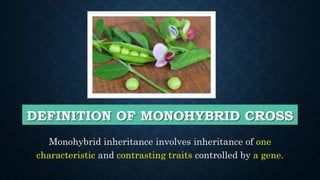
DEFINITION OF MONOHYBRID CROSS
Monohybrid inheritance involves inheritance of one
characteristic and contrasting traits controlled by a gene.
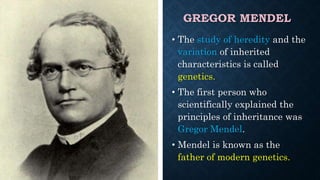
GREGOR MENDEL
• The study of heredity and the
variation of inherited
characteristics is called
genetics.
• The first person who
scientifically explained the
principles of inheritance was
Gregor Mendel.
• Mendel is known as the
father of modern genetics.
MENDEL
EXPERIMENTS
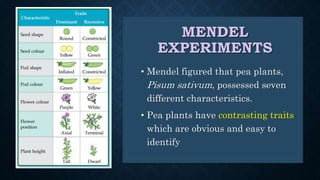
• Mendel figured that pea plants,
Pisum sativum, possessed seven
different characteristics.
• Pea plants have contrasting traits
which are obvious and easy to
identify
• Mendel suggested in his
theory that a
characteristic in a parent
plant is passed down to its
next generation through
male gametes and female
gametes.
• This shows that the nuclei
of the male and female
gametes carry genetic
materials of the inherited
characteristic.
• The inheritance factor
which determines a
characteristic is known as
a gene.
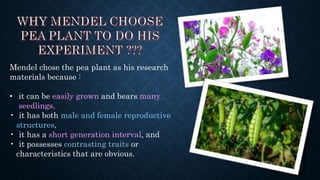
Mendel chose the pea plant as his research
materials because :
• it can be easily grown and bears many
seedlings,
• it has both male and female reproductive
structures,
• it has a short generation interval, and
• it possesses contrasting traits or
characteristics that are obvious.
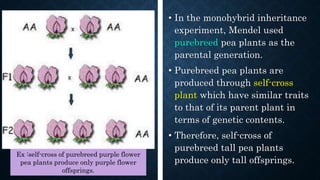
• In the monohybrid inheritance
experiment, Mendel used
purebreed pea plants as the
parental generation.
• Purebreed pea plants are
produced through self-cross
plant which have similar traits
to that of its parent plant in
terms of genetic contents.
• Therefore, self-cross of
purebreed tall pea plants
produce only tall offsprings.
Ex :self-cross of purebreed purple flower
pea plants produce only purple flower
offsprings.
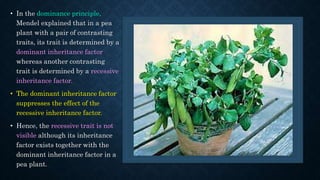
• In the dominance principle,
Mendel explained that in a pea
plant with a pair of contrasting
traits, its trait is determined by a
dominant inheritance factor
whereas another contrasting
trait is determined by a recessive
inheritance factor.
• The dominant inheritance factor
suppresses the effect of the
recessive inheritance factor.
• Hence, the recessive trait is not
visible although its inheritance
factor exists together with the
dominant inheritance factor in a
pea plant.
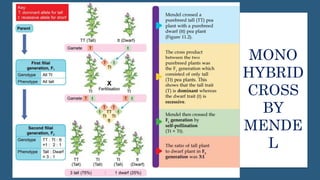
MONO
HYBRID
CROSS
BY
MENDE
L
TERMS RELATED TO
INHERITANCE
1. GENES AND ALLELES
2. CHARACTERISTICS AND
TRAITS
3. PHENOTYPES AND
GENOTYPES
4. DOMINANT ALLELES AND
RECESSIVE ALLELES
5. DOMINANT TRAITS AND
RECESSIVE TRAITS
6. HOMOZYGOTES AND
HETEROZYGOTES
7. PARENTAL GENERATIONS
AND FILIAL GENERATIONS
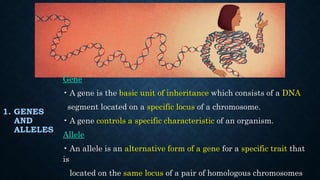
1. GENES
AND
ALLELES
Gene
• A gene is the basic unit of inheritance which consists of a DNA
segment located on a specific locus of a chromosome.
• A gene controls a specific characteristic of an organism.
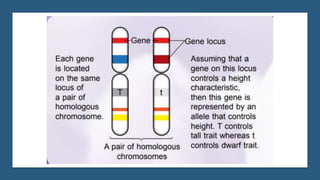
Allele
• An allele is an alternative form of a gene for a specific trait that
is
located on the same locus of a pair of homologous chromosomes
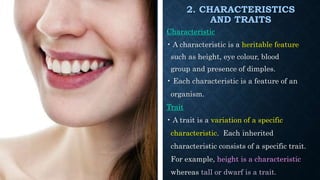
2. CHARACTERISTICS
AND TRAITS
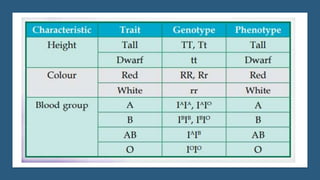
Characteristic
• A characteristic is a heritable feature
such as height, eye colour, blood
group and presence of dimples.
• Each characteristic is a feature of an
organism.
Trait
• A trait is a variation of a specific
characteristic. Each inherited
characteristic consists of a specific trait.
For example, height is a characteristic
whereas tall or dwarf is a trait.
3. PHENOTYPES AND
GENOTYPES
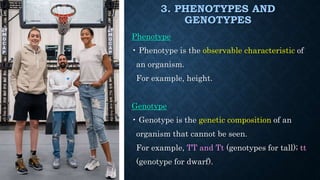
Phenotype
• Phenotype is the observable characteristic of
an organism.
For example, height.
Genotype
• Genotype is the genetic composition of an
organism that cannot be seen.
For example, TT and Tt (genotypes for tall); tt
(genotype for dwarf).
4. DOMINANT ALLELES
AND RECESSIVE ALLELES
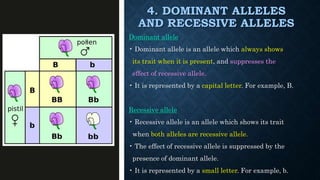
Dominant allele
• Dominant allele is an allele which always shows
its trait when it is present, and suppresses the
effect of recessive allele.
• It is represented by a capital letter. For example, B.
Recessive allele
• Recessive allele is an allele which shows its trait
when both alleles are recessive allele.
• The effect of recessive allele is suppressed by the
presence of dominant allele.
• It is represented by a small letter. For example, b.
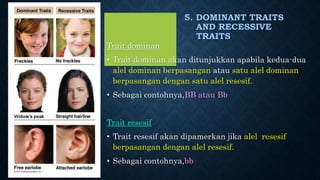
Trait dominan
• Trait dominan akan ditunjukkan apabila kedua-dua
alel dominan berpasangan atau satu alel dominan
berpasangan dengan satu alel resesif.
• Sebagai contohnya,BB atau Bb
Trait resesif
• Trait resesif akan dipamerkan jika alel resesif
berpasangan dengan alel resesif.
• Sebagai contohnya,bb
5. DOMINANT TRAITS
AND RECESSIVE
TRAITS
6. HOMOZYGOTES AND
HETEROZYGOTES
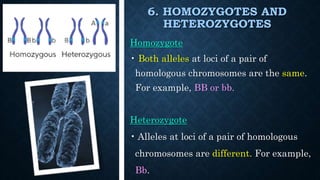
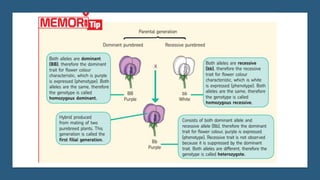
Homozygote
• Both alleles at loci of a pair of
homologous chromosomes are the same.
For example, BB or bb.
Heterozygote
• Alleles at loci of a pair of homologous
chromosomes are different. For example,
Bb.
7. PARENTAL GENERATIONS AND FILIAL
GENERATIONS
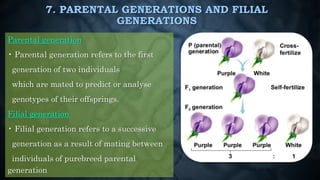
Parental generation
• Parental generation refers to the first
generation of two individuals
which are mated to predict or analyse
genotypes of their offsprings.
Filial generation
• Filial generation refers to a successive
generation as a result of mating between
individuals of purebreed parental
generation
8. PUREBREEDS AND
HYBRIDS
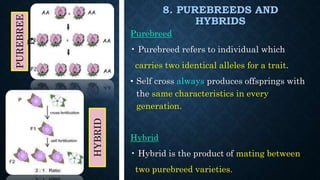
Purebreed
• Purebreed refers to individual which
carries two identical alleles for a trait.
• Self cross always produces offsprings with
the same characteristics in every
generation.
Hybrid
• Hybrid is the product of mating between
two purebreed varieties.
PUREBREE
D
HYBRID
INHERITANCE
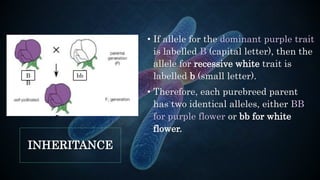
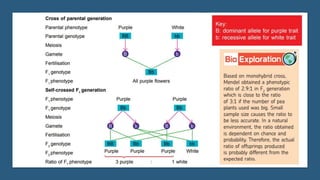
• If allele for the dominant purple trait
is labelled B (capital letter), then the
allele for recessive white trait is
labelled b (small letter).
• Therefore, each purebreed parent
has two identical alleles, either BB
for purple flower or bb for white
flower.
B
B
bb
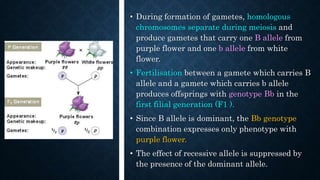
• During formation of gametes, homologous
chromosomes separate during meiosis and
produce gametes that carry one B allele from
purple flower and one b allele from white
flower.
• Fertilisation between a gamete which carries B
allele and a gamete which carries b allele
produces offsprings with genotype Bb in the
first filial generation (F1 ).
• Since B allele is dominant, the Bb genotype
combination expresses only phenotype with
purple flower.
• The effect of recessive allele is suppressed by
the presence of the dominant allele.
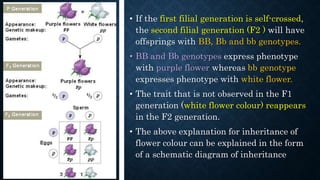
• If the first filial generation is self-crossed,
the second filial generation (F2 ) will have
offsprings with BB, Bb and bb genotypes.
• BB and Bb genotypes express phenotype
with purple flower whereas bb genotype
expresses phenotype with white flower.
• The trait that is not observed in the F1
generation (white flower colour) reappears
in the F2 generation.
• The above explanation for inheritance of
flower colour can be explained in the form
of a schematic diagram of inheritance
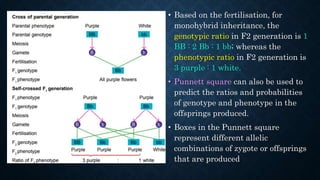
• Based on the fertilisation, for
monohybrid inheritance, the
genotypic ratio in F2 generation is 1
BB : 2 Bb : 1 bb; whereas the
phenotypic ratio in F2 generation is
3 purple : 1 white.
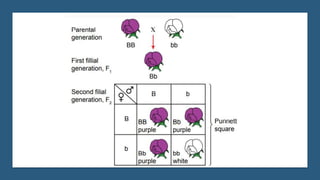
• Punnett square can also be used to
predict the ratios and probabilities
of genotype and phenotype in the
offsprings produced.
• Boxes in the Punnett square
represent different allelic
combinations of zygote or offsprings
that are produced
PHENOTYPIC RATIO
CALCULATION
• If the number of round bean
seed shape is 5474 and
constricted seed is 1850,
therefore the ratio is:
• Ratio number of round seed
: ratio number of constricted
seed = (5474 ÷ 1850) : (1850
÷ 1850) = 2.96 : 1
• The value can be rounded
up to 3 : 1
MENDEL’S FIRST LAW
• Also known as Law of
Segregation.
• The law state that …
“A characteristic of an organism
is controlled by a pair of alleles,
and only one of the allelic pair is
inherited in a gamete.”
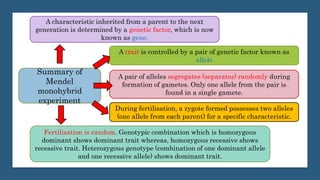
Summary of
Mendel
monohybrid
experiment
A characteristic inherited from a parent to the next
generation is determined by a genetic factor, which is now
known as gene.
A trait is controlled by a pair of genetic factor known as
allele
A pair of alleles segregates (separates) randomly during
formation of gametes. Only one allele from the pair is
found in a single gamete.
During fertilisation, a zygote formed possesses two alleles
(one allele from each parent) for a specific characteristic.
Fertilisation is random. Genotypic combination which is homozygous
dominant shows dominant trait whereas, homozygous recessive shows
recessive trait. Heterozygous genotype (combination of one dominant allele
and one recessive allele) shows dominant trait.
THE END

BIO 11.1 MONOHYBRID INHERITANCE.pptx

  • 1.
  • 2.
  • 3.
    DEFINITION OF MONOHYBRIDCROSS Monohybrid inheritance involves inheritance of one characteristic and contrasting traits controlled by a gene.
  • 4.
    GREGOR MENDEL • Thestudy of heredity and the variation of inherited characteristics is called genetics. • The first person who scientifically explained the principles of inheritance was Gregor Mendel. • Mendel is known as the father of modern genetics.
  • 5.
    MENDEL EXPERIMENTS • Mendel figuredthat pea plants, Pisum sativum, possessed seven different characteristics. • Pea plants have contrasting traits which are obvious and easy to identify
  • 6.
    • Mendel suggestedin his theory that a characteristic in a parent plant is passed down to its next generation through male gametes and female gametes. • This shows that the nuclei of the male and female gametes carry genetic materials of the inherited characteristic. • The inheritance factor which determines a characteristic is known as a gene.
  • 7.
    Mendel chose thepea plant as his research materials because : • it can be easily grown and bears many seedlings, • it has both male and female reproductive structures, • it has a short generation interval, and • it possesses contrasting traits or characteristics that are obvious.
  • 8.
    • In themonohybrid inheritance experiment, Mendel used purebreed pea plants as the parental generation. • Purebreed pea plants are produced through self-cross plant which have similar traits to that of its parent plant in terms of genetic contents. • Therefore, self-cross of purebreed tall pea plants produce only tall offsprings. Ex :self-cross of purebreed purple flower pea plants produce only purple flower offsprings.
  • 9.
    • In thedominance principle, Mendel explained that in a pea plant with a pair of contrasting traits, its trait is determined by a dominant inheritance factor whereas another contrasting trait is determined by a recessive inheritance factor. • The dominant inheritance factor suppresses the effect of the recessive inheritance factor. • Hence, the recessive trait is not visible although its inheritance factor exists together with the dominant inheritance factor in a pea plant.
  • 10.
  • 11.
    TERMS RELATED TO INHERITANCE 1.GENES AND ALLELES 2. CHARACTERISTICS AND TRAITS 3. PHENOTYPES AND GENOTYPES 4. DOMINANT ALLELES AND RECESSIVE ALLELES 5. DOMINANT TRAITS AND RECESSIVE TRAITS 6. HOMOZYGOTES AND HETEROZYGOTES 7. PARENTAL GENERATIONS AND FILIAL GENERATIONS
  • 12.
    1. GENES AND ALLELES Gene • Agene is the basic unit of inheritance which consists of a DNA segment located on a specific locus of a chromosome. • A gene controls a specific characteristic of an organism. Allele • An allele is an alternative form of a gene for a specific trait that is located on the same locus of a pair of homologous chromosomes
  • 14.
    2. CHARACTERISTICS AND TRAITS Characteristic •A characteristic is a heritable feature such as height, eye colour, blood group and presence of dimples. • Each characteristic is a feature of an organism. Trait • A trait is a variation of a specific characteristic. Each inherited characteristic consists of a specific trait. For example, height is a characteristic whereas tall or dwarf is a trait.
  • 16.
    3. PHENOTYPES AND GENOTYPES Phenotype •Phenotype is the observable characteristic of an organism. For example, height. Genotype • Genotype is the genetic composition of an organism that cannot be seen. For example, TT and Tt (genotypes for tall); tt (genotype for dwarf).
  • 17.
    4. DOMINANT ALLELES ANDRECESSIVE ALLELES Dominant allele • Dominant allele is an allele which always shows its trait when it is present, and suppresses the effect of recessive allele. • It is represented by a capital letter. For example, B. Recessive allele • Recessive allele is an allele which shows its trait when both alleles are recessive allele. • The effect of recessive allele is suppressed by the presence of dominant allele. • It is represented by a small letter. For example, b.
  • 18.
    Trait dominan • Traitdominan akan ditunjukkan apabila kedua-dua alel dominan berpasangan atau satu alel dominan berpasangan dengan satu alel resesif. • Sebagai contohnya,BB atau Bb Trait resesif • Trait resesif akan dipamerkan jika alel resesif berpasangan dengan alel resesif. • Sebagai contohnya,bb 5. DOMINANT TRAITS AND RECESSIVE TRAITS
  • 19.
    6. HOMOZYGOTES AND HETEROZYGOTES Homozygote •Both alleles at loci of a pair of homologous chromosomes are the same. For example, BB or bb. Heterozygote • Alleles at loci of a pair of homologous chromosomes are different. For example, Bb.
  • 20.
    7. PARENTAL GENERATIONSAND FILIAL GENERATIONS Parental generation • Parental generation refers to the first generation of two individuals which are mated to predict or analyse genotypes of their offsprings. Filial generation • Filial generation refers to a successive generation as a result of mating between individuals of purebreed parental generation
  • 21.
    8. PUREBREEDS AND HYBRIDS Purebreed •Purebreed refers to individual which carries two identical alleles for a trait. • Self cross always produces offsprings with the same characteristics in every generation. Hybrid • Hybrid is the product of mating between two purebreed varieties. PUREBREE D HYBRID
  • 23.
    INHERITANCE • If allelefor the dominant purple trait is labelled B (capital letter), then the allele for recessive white trait is labelled b (small letter). • Therefore, each purebreed parent has two identical alleles, either BB for purple flower or bb for white flower. B B bb
  • 24.
    • During formationof gametes, homologous chromosomes separate during meiosis and produce gametes that carry one B allele from purple flower and one b allele from white flower. • Fertilisation between a gamete which carries B allele and a gamete which carries b allele produces offsprings with genotype Bb in the first filial generation (F1 ). • Since B allele is dominant, the Bb genotype combination expresses only phenotype with purple flower. • The effect of recessive allele is suppressed by the presence of the dominant allele.
  • 25.
    • If thefirst filial generation is self-crossed, the second filial generation (F2 ) will have offsprings with BB, Bb and bb genotypes. • BB and Bb genotypes express phenotype with purple flower whereas bb genotype expresses phenotype with white flower. • The trait that is not observed in the F1 generation (white flower colour) reappears in the F2 generation. • The above explanation for inheritance of flower colour can be explained in the form of a schematic diagram of inheritance
  • 27.
    • Based onthe fertilisation, for monohybrid inheritance, the genotypic ratio in F2 generation is 1 BB : 2 Bb : 1 bb; whereas the phenotypic ratio in F2 generation is 3 purple : 1 white. • Punnett square can also be used to predict the ratios and probabilities of genotype and phenotype in the offsprings produced. • Boxes in the Punnett square represent different allelic combinations of zygote or offsprings that are produced
  • 29.
    PHENOTYPIC RATIO CALCULATION • Ifthe number of round bean seed shape is 5474 and constricted seed is 1850, therefore the ratio is: • Ratio number of round seed : ratio number of constricted seed = (5474 ÷ 1850) : (1850 ÷ 1850) = 2.96 : 1 • The value can be rounded up to 3 : 1
  • 30.
    MENDEL’S FIRST LAW •Also known as Law of Segregation. • The law state that … “A characteristic of an organism is controlled by a pair of alleles, and only one of the allelic pair is inherited in a gamete.”
  • 31.
    Summary of Mendel monohybrid experiment A characteristicinherited from a parent to the next generation is determined by a genetic factor, which is now known as gene. A trait is controlled by a pair of genetic factor known as allele A pair of alleles segregates (separates) randomly during formation of gametes. Only one allele from the pair is found in a single gamete. During fertilisation, a zygote formed possesses two alleles (one allele from each parent) for a specific characteristic. Fertilisation is random. Genotypic combination which is homozygous dominant shows dominant trait whereas, homozygous recessive shows recessive trait. Heterozygous genotype (combination of one dominant allele and one recessive allele) shows dominant trait.
  • 32.