Submitted by : Amanpreet Kaur 184432
Amritpal kaur 184426
Privatisation
Privatisation is the process of transferring
ownership of a business, enterprise,
agency, public service or public property
from the public sector to the private
sector
• To reduce government involvement in
commercially viable activities
• Increase efficiency in the delivery of
programs and services
• Provides competition in market place
which transfers the lower price and
greater choice for the consumers.
Privatization in India
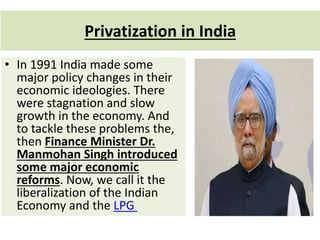
• In 1991 India made some
major policy changes in their
economic ideologies. There
were stagnation and slow
growth in the economy. And
to tackle these problems the,
then Finance Minister Dr.
Manmohan Singh introduced
some major economic
reforms. Now, we call it the
liberalization of the Indian
Economy and the LPG
Need For Privatisation
1. Inefficiency of public sector
2. Increase Burden of Public sector
3. Public sector were running into losses
4. Production of capacity remained underutilised
5. Reduce the financial burden on tax payers
Advantages Of Privatisation
1. Reduction In Monopoly of Public sector units
2. Efficient Management
3. Increase in Profitability
4. High Industrial Growth rate
5. Increase in efficiency of public sector
6. International Level
7. Encouragement to Innovation and Investment
8. Promotes Globalisation
Disadvantages of Privatisation
1. Private sector focuses more on profit
maximization
2. Increase in inequalities
3. Ignore Social Welfare
4. Problem of financing
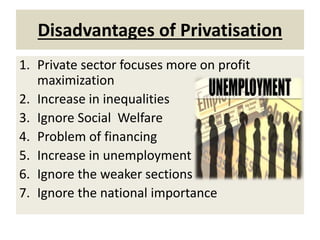
5. Increase in unemployment
6. Ignore the weaker sections
7. Ignore the national importance
Current Industrial Policy of
Government of India
• Under 1991 policy, only eight industries were
reserved for public sector. This number was
further brought down and current position is
that only Atomi and indian raliways
• Industrial Licensing was also abolished for all
except short list of 18 industries in New
Industrial Policy 1991. This number was
further pruned to six
Industries which are not reserved for
private sector
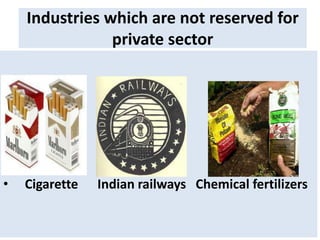
• Cigarette Indian railways Chemical fertilizers
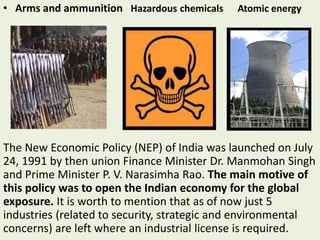
• Arms and ammunition Hazardous chemicals Atomic energy
The New Economic Policy (NEP) of India was launched on July
24, 1991 by then union Finance Minister Dr. Manmohan Singh
and Prime Minister P. V. Narasimha Rao. The main motive of
this policy was to open the Indian economy for the global
exposure. It is worth to mention that as of now just 5
industries (related to security, strategic and environmental
concerns) are left where an industrial license is required.
Measures of Privatisation
1. Ownership Measures
2. Organization Measures
3. Operational Measures
Measures Adopted for Privatisation
1. Construction of public sector
2. Sale of shares of public sector to private sector
3. Sick public sector units
4. Memorandum of understanding(MOU)
5. National Renewal funds
6. Increase in private sector investment in plans
7. Withdrawal of convertibility Clause of loans into
share
8. Setting up national investment fund
Privatisation 1991

Privatisation 1991

  • 1.
    Submitted by :Amanpreet Kaur 184432 Amritpal kaur 184426
  • 2.
    Privatisation Privatisation is theprocess of transferring ownership of a business, enterprise, agency, public service or public property from the public sector to the private sector • To reduce government involvement in commercially viable activities • Increase efficiency in the delivery of programs and services • Provides competition in market place which transfers the lower price and greater choice for the consumers.
  • 3.
    Privatization in India •In 1991 India made some major policy changes in their economic ideologies. There were stagnation and slow growth in the economy. And to tackle these problems the, then Finance Minister Dr. Manmohan Singh introduced some major economic reforms. Now, we call it the liberalization of the Indian Economy and the LPG
  • 4.
    Need For Privatisation 1.Inefficiency of public sector 2. Increase Burden of Public sector 3. Public sector were running into losses 4. Production of capacity remained underutilised 5. Reduce the financial burden on tax payers
  • 7.
    Advantages Of Privatisation 1.Reduction In Monopoly of Public sector units 2. Efficient Management 3. Increase in Profitability 4. High Industrial Growth rate 5. Increase in efficiency of public sector 6. International Level 7. Encouragement to Innovation and Investment 8. Promotes Globalisation
  • 8.
    Disadvantages of Privatisation 1.Private sector focuses more on profit maximization 2. Increase in inequalities 3. Ignore Social Welfare 4. Problem of financing 5. Increase in unemployment 6. Ignore the weaker sections 7. Ignore the national importance
  • 9.
    Current Industrial Policyof Government of India • Under 1991 policy, only eight industries were reserved for public sector. This number was further brought down and current position is that only Atomi and indian raliways • Industrial Licensing was also abolished for all except short list of 18 industries in New Industrial Policy 1991. This number was further pruned to six
  • 10.
    Industries which arenot reserved for private sector • Cigarette Indian railways Chemical fertilizers
  • 11.
    • Arms andammunition Hazardous chemicals Atomic energy The New Economic Policy (NEP) of India was launched on July 24, 1991 by then union Finance Minister Dr. Manmohan Singh and Prime Minister P. V. Narasimha Rao. The main motive of this policy was to open the Indian economy for the global exposure. It is worth to mention that as of now just 5 industries (related to security, strategic and environmental concerns) are left where an industrial license is required.
  • 12.
    Measures of Privatisation 1.Ownership Measures 2. Organization Measures 3. Operational Measures
  • 13.
    Measures Adopted forPrivatisation 1. Construction of public sector 2. Sale of shares of public sector to private sector 3. Sick public sector units 4. Memorandum of understanding(MOU) 5. National Renewal funds 6. Increase in private sector investment in plans 7. Withdrawal of convertibility Clause of loans into share 8. Setting up national investment fund