WE OFFER IT TO THEE
ASIAN
RENAISSANCE
RISE OF CHINA_ SUMANTH
INDIA RISING_ ASHISH
PROBLEMS OF India AND CHINA_ MARUTHI
IMPLICATION OF THE RENAISSANCE_ YOUGAL
RISE OF CHINA AS A GLOBAL
POWER
CHINESE ECONOMIC REVIEW
CHINESE ACHEIVEMENTS
 The Greatest economic success stories in Modern times.
 China’s real GDP grew at an average annual rate of nearly 10% for three
decades.
 679 million people in China were raised out of extreme poverty.
 The world’s largest manufacturer, merchandise exporter and importer, and
holder of foreign exchange reserves.
FACTORS FOR RISE OF CHINA
 High productivity in Manufacturing
 Export led Growth
 Infrastructural advancement
 Human resources
 Govt. initiatives
 Foreign Investment
HIGH PRODUCTIVITY IN
MANUFACTURING
 Manufacturing plays a considerably more important role.
 Reallocation of resources to more productive uses.
 Focused on low-cost, labor-intensive manufactures.
 Rise of market-oriented and more efficient non-state enterprises.
 Large-scale capital investment.
 Measures to boost exports and to promote and protect certain industries.
EXPORT LED GROWTH
 It is the largest trading partner for 130 countries.
 Active policy of boosting trade and investment ties.
 Abundance of low-cost labor has made it internationally competitive.
 Undervalued currency and subsidies given to domestic producers.
 Assembly into finished products.
 Seeks to capture Advanced technology exports market.
INFRASTRUCTURAL ADVANCEMENT
 Electricity production now doubles nearly every 10 years.
 Road network has more than tripled in length in the last two decades.
 Expansion of high speed railway and city wide metros.
 Establishment and expansion of coastal ports.
 Government stimulus investment programme.
HUMAN RESOURCES
• Human resources growing in scale.
• Remarkable improvement of education.
• Optimized employment structure.
• Good progress in talent development.
• Efforts have been mobilized to build up the public health system.
• Key player in transition to services led and consumption driven economy.
GOVT. INITIATIVES
 SOEs continue to dominate such as petroleum and mining,
telecommunications, utilities, transportation.
 Elevated markets to decisive role.
 Liberalization of foreign investment.
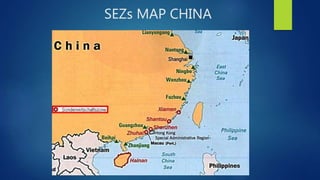
 Establishment of free trade zones.(SEZs)
 Response to 2008 crisis by sharply increasing spending on fixed
investment.
 China’s leaders initiated a new “go global” strategy.
SEZs MAP CHINA
FOREIGN INVESTMENT
 China is the world’s largest destination for FDI inflows.
 China’s trade and investment reforms and incentives.
 Major source of China’s productivity gains and rapid economic and trade
growth.
 FIEs in China dominate China’s high technology exports.
 The actual level of FDI in China may be overstated.
CONCLUSION
 Chinese growth fuelled by exploiting competitive advantage in areas of
Manufacturing, exports.
 Infrastructure is impressive but not up to full potential.
 Rapid growth rates no longer possible.
 Need for transition to services led and consumption driven economy.
 Need for more transparency in areas of Banking and transparency.
REFERENCES
 China’s Economic Rise: History, Trends, Challenges, and Implications
for the United States by Wayne M. Morrison.
 www.beijingreview.com.cn
 www.bloomberg.com
 www.globalresearch.org
 www.ft.com
 “Report for Selected Countries and Subjects”. IMF
 "Export Partners of People Republic of China". CIA World Factbook.
 "Labor force, total". World Bank.
INDIA RISING
18
RECENT GROWTH STORY
INDIA RISING
Even though there has been a phenomenal rise
in India as a global economic power, its growth
story is not new. In fact it started way back
in1991.
19
GDP Growth Rate
 India's GDP growth during January–March period of
2015 was at 7.5% compared to China's 7%, making it
the fastest growing economy.
 India's services sector grew by 10.1%, manufacturing
sector by 7.1% & agriculture by 0.2%.
 30% to 40% of GDP growth is due to the rising
productivity.
20
Source: CSO.
Agriculture
 India holds the second position worldwide in terms of farm output.
 It generates works for more than 60% of the total workforce.
 India exports many agro products like Rice, milk, tea and many others cash
crops.
22
Industrial Output
 India is 10th in the world in factory output.
 Manufacturing sector in addition to mining, quarrying, electricity and gas together
account for 27.6% of the GDP.
 India’s major exports are petro products, transport parts, electronics etc.
 It employs 17% of the total workforce.
23
Services
 India is a service sector led economy
 IT and Pharma are the biggest contributors
 This is because of the reforms that favoured growth faster in this sector than
any other sector.
 Quality of population: presence of large number of people educated in
engineering.
 India is 2nd in Services Output.
 ITES – BPO Sector has become a big source of employment for number of
youth.
24
LATEST UPDATE , JANUARY 2016 :
 India’s technology and BPM sector (including hardware) is estimated to have
generated US$ 146 billion in revenue during FY15 compared to US$ 118 billion in
FY14, implying a growth rate of 23.72 per cent.
 TCS is the market leader, accounting for about 10.1 per cent of India’s total IT &
ITeS sector revenue.
[Source: Nasscom ,TechSci Research]
25
REASONS FOR INDIA’S GROWTH
• Domestic Demand
• New Government Reforms
• Lower Crude oil Prices
• Lower External Vulnerabilities
• Better among EMs
DIRECT
CAUSES
• Investment in Infrastructure
• Human Resource
• Increase in Capital Inflows
• India’s growing trade
INDIRECT
CAUSES
26
Investment in Infrastructure
 The Indian power sector
 The Indian construction and real estate industry
 Transport industry.
27
HUMAN RESOURCE
 Working population will increase from 60.1% to 68.4% (age 15-64) from
2001-2026.
 Literacy rate at more than 75%
 Better Female Literacy rate
 Regional Imbalances narrowing down
 Population Growth Rate is slowing.
 Poverty is Declining.
28
Banking and Finance
 Role of banks in India
 India’s saving rate
 India’s investment rate
 Increase in no. of banks and its branches
 The Indian banks are also said to have clean, transparent and strong
balance sheets comparing to their Asian counterparts.
29
FOREIGN CAPITAL INFLOWS 30
GROWTH OF TRADING ACTIVITY
 India a trade deficit country
 Increase in volume
 Increased no. of trading partners
 Increase in no. of commodities
 Top exports: petro products, vehicles, machines, pharma etc
 Top imports: crude oil, gold, electronics etc
31
Export and Import Graph
0.0
100000.0
200000.0
300000.0
400000.0
500000.0
600000.0
Exports Imports
32
GOVERNMENT INITIATIVES
 Lowering tax rates for homegrown industries
 Subsidies
 SEZs
 Investment in social goods
 Initiatives by the new govt. like MAKE IN INDIA, skill India, MUDRA.
33
CONCLUSION
 India, today, has a vibrant economy and is recognized
as a leader among the emergent countries with a
huge potential for growth.
 India is now initiating the second generation reforms
intended for a faster integration of the Indian
economy with the world economy.
 In the present decade India has witnessed
unprecedented levels of economic expansion and
also seen healthy growth of trade.
34
REFERENCES
 India and Global Economy.
 India soars High – KPMG in India . February 2016.
What are the problems faced by
INDIA and CHINA IN
ECONOMIC GROWTH
1
2
PROBLEMS FACING INDIAN ECONOMY…..?
1. INFLATION 7-8%
2. Poor educational standards
3. Poor infrastructure
4. Inefficient agriculture
3Conti…..
5. High levels of debt
6. Large budget deficit
7. Rigid labour law
8. Inequality has risen
rather decreased
4
Problems of Chinese economic growth
1. pollution
2. Property boom
3. Growing income inequality
4. Inefficient banking sector
5Conti…..
5. Undervaluation of Yuan
6. Overheating economy
7. Huge balance of payments
surplus
IMPLICATIONS OF
THE RISE OF CHINA
AND INDIA
COMPARING INDIA AND CHINA
 Form of Govt.
 Purchasing power parity
 Growth path
 Infrastructural advancement
 Human resource
 Drivers of growth
IMPLICATIONS FOR THE FUTURE
 Increase in per capita income dramatically
 Well equipped armed forces + economic muscle
 This will lead to a multipolar world
 Environmental hazards
 Energy demands
ECONOMIC IMPACTS ON THE GIANTS
 Huge increase in GDP
 Increasing standard of living
 “knowledge intensive” trade
 Increase in trade in both volume and composition
 Trade to GDP ratio
LEAD ERODED
A. Production lead
B. Technological lead
C. Relative income lead
 Domination in international affairs eroded
Eg : Britain in 20th century
SCARCE RESOURCES
 Increase in demand for natural resources
 This will lead to increases in prices
 Loss of real income for advanced countries
GLOBAL KNOWLEDGE POOL
 More resources devoted to R&D
 Technology becomes cheaper in China and India
 Rest of the world will gain from import of these technologies
COMPARATIVE ADVANTAGE
 Rise in productivity
 Productivity higher in “ knowledge intensive” goods and services
 Educated v/s Uneducated workers
 Increase in prices of labour intensive products
 How it affects rich countries and LDCs ?
 The “Flying Geese Theory” (Ozawa 2005)
 Shift in TERMS OF TRADE a long term phenomenon
ABSOLUTE ADVANTAGE
 Productivity and wage lag. Eg china
 Abundance in labour supply and its impact
 Investment gets choked in advanced countries
“Round tripping”
CONCLUSION
 Expensive fuel, resources and labour intensive goods
 More investment on research and development
 Expanding market
 Investment shifts and its effects
 Structural changes
REFERENCE
 “Renaissance of China and India” _ Robert Rowthorn, Cambridge university
 WORLD IN 2050
 INDIA AND THE WORLD
 CRUX OF ASIA _ Ashley j. Tellis and Sean Mirski

Ugal collo

  • 2.
    WE OFFER ITTO THEE
  • 3.
  • 4.
    RISE OF CHINA_SUMANTH INDIA RISING_ ASHISH PROBLEMS OF India AND CHINA_ MARUTHI IMPLICATION OF THE RENAISSANCE_ YOUGAL
  • 5.
    RISE OF CHINAAS A GLOBAL POWER
  • 6.
  • 7.
    CHINESE ACHEIVEMENTS  TheGreatest economic success stories in Modern times.  China’s real GDP grew at an average annual rate of nearly 10% for three decades.  679 million people in China were raised out of extreme poverty.  The world’s largest manufacturer, merchandise exporter and importer, and holder of foreign exchange reserves.
  • 8.
    FACTORS FOR RISEOF CHINA  High productivity in Manufacturing  Export led Growth  Infrastructural advancement  Human resources  Govt. initiatives  Foreign Investment
  • 9.
    HIGH PRODUCTIVITY IN MANUFACTURING Manufacturing plays a considerably more important role.  Reallocation of resources to more productive uses.  Focused on low-cost, labor-intensive manufactures.  Rise of market-oriented and more efficient non-state enterprises.  Large-scale capital investment.  Measures to boost exports and to promote and protect certain industries.
  • 10.
    EXPORT LED GROWTH It is the largest trading partner for 130 countries.  Active policy of boosting trade and investment ties.  Abundance of low-cost labor has made it internationally competitive.  Undervalued currency and subsidies given to domestic producers.  Assembly into finished products.  Seeks to capture Advanced technology exports market.
  • 11.
    INFRASTRUCTURAL ADVANCEMENT  Electricityproduction now doubles nearly every 10 years.  Road network has more than tripled in length in the last two decades.  Expansion of high speed railway and city wide metros.  Establishment and expansion of coastal ports.  Government stimulus investment programme.
  • 12.
    HUMAN RESOURCES • Humanresources growing in scale. • Remarkable improvement of education. • Optimized employment structure. • Good progress in talent development. • Efforts have been mobilized to build up the public health system. • Key player in transition to services led and consumption driven economy.
  • 13.
    GOVT. INITIATIVES  SOEscontinue to dominate such as petroleum and mining, telecommunications, utilities, transportation.  Elevated markets to decisive role.  Liberalization of foreign investment.  Establishment of free trade zones.(SEZs)  Response to 2008 crisis by sharply increasing spending on fixed investment.  China’s leaders initiated a new “go global” strategy.
  • 14.
  • 15.
    FOREIGN INVESTMENT  Chinais the world’s largest destination for FDI inflows.  China’s trade and investment reforms and incentives.  Major source of China’s productivity gains and rapid economic and trade growth.  FIEs in China dominate China’s high technology exports.  The actual level of FDI in China may be overstated.
  • 16.
    CONCLUSION  Chinese growthfuelled by exploiting competitive advantage in areas of Manufacturing, exports.  Infrastructure is impressive but not up to full potential.  Rapid growth rates no longer possible.  Need for transition to services led and consumption driven economy.  Need for more transparency in areas of Banking and transparency.
  • 17.
    REFERENCES  China’s EconomicRise: History, Trends, Challenges, and Implications for the United States by Wayne M. Morrison.  www.beijingreview.com.cn  www.bloomberg.com  www.globalresearch.org  www.ft.com  “Report for Selected Countries and Subjects”. IMF  "Export Partners of People Republic of China". CIA World Factbook.  "Labor force, total". World Bank.
  • 18.
  • 19.
    Even though therehas been a phenomenal rise in India as a global economic power, its growth story is not new. In fact it started way back in1991. 19
  • 20.
    GDP Growth Rate India's GDP growth during January–March period of 2015 was at 7.5% compared to China's 7%, making it the fastest growing economy.  India's services sector grew by 10.1%, manufacturing sector by 7.1% & agriculture by 0.2%.  30% to 40% of GDP growth is due to the rising productivity. 20
  • 21.
  • 22.
    Agriculture  India holdsthe second position worldwide in terms of farm output.  It generates works for more than 60% of the total workforce.  India exports many agro products like Rice, milk, tea and many others cash crops. 22
  • 23.
    Industrial Output  Indiais 10th in the world in factory output.  Manufacturing sector in addition to mining, quarrying, electricity and gas together account for 27.6% of the GDP.  India’s major exports are petro products, transport parts, electronics etc.  It employs 17% of the total workforce. 23
  • 24.
    Services  India isa service sector led economy  IT and Pharma are the biggest contributors  This is because of the reforms that favoured growth faster in this sector than any other sector.  Quality of population: presence of large number of people educated in engineering.  India is 2nd in Services Output.  ITES – BPO Sector has become a big source of employment for number of youth. 24
  • 25.
    LATEST UPDATE ,JANUARY 2016 :  India’s technology and BPM sector (including hardware) is estimated to have generated US$ 146 billion in revenue during FY15 compared to US$ 118 billion in FY14, implying a growth rate of 23.72 per cent.  TCS is the market leader, accounting for about 10.1 per cent of India’s total IT & ITeS sector revenue. [Source: Nasscom ,TechSci Research] 25
  • 26.
    REASONS FOR INDIA’SGROWTH • Domestic Demand • New Government Reforms • Lower Crude oil Prices • Lower External Vulnerabilities • Better among EMs DIRECT CAUSES • Investment in Infrastructure • Human Resource • Increase in Capital Inflows • India’s growing trade INDIRECT CAUSES 26
  • 27.
    Investment in Infrastructure The Indian power sector  The Indian construction and real estate industry  Transport industry. 27
  • 28.
    HUMAN RESOURCE  Workingpopulation will increase from 60.1% to 68.4% (age 15-64) from 2001-2026.  Literacy rate at more than 75%  Better Female Literacy rate  Regional Imbalances narrowing down  Population Growth Rate is slowing.  Poverty is Declining. 28
  • 29.
    Banking and Finance Role of banks in India  India’s saving rate  India’s investment rate  Increase in no. of banks and its branches  The Indian banks are also said to have clean, transparent and strong balance sheets comparing to their Asian counterparts. 29
  • 30.
  • 31.
    GROWTH OF TRADINGACTIVITY  India a trade deficit country  Increase in volume  Increased no. of trading partners  Increase in no. of commodities  Top exports: petro products, vehicles, machines, pharma etc  Top imports: crude oil, gold, electronics etc 31
  • 32.
    Export and ImportGraph 0.0 100000.0 200000.0 300000.0 400000.0 500000.0 600000.0 Exports Imports 32
  • 33.
    GOVERNMENT INITIATIVES  Loweringtax rates for homegrown industries  Subsidies  SEZs  Investment in social goods  Initiatives by the new govt. like MAKE IN INDIA, skill India, MUDRA. 33
  • 34.
    CONCLUSION  India, today,has a vibrant economy and is recognized as a leader among the emergent countries with a huge potential for growth.  India is now initiating the second generation reforms intended for a faster integration of the Indian economy with the world economy.  In the present decade India has witnessed unprecedented levels of economic expansion and also seen healthy growth of trade. 34
  • 35.
    REFERENCES  India andGlobal Economy.  India soars High – KPMG in India . February 2016.
  • 36.
    What are theproblems faced by INDIA and CHINA IN ECONOMIC GROWTH 1
  • 37.
    2 PROBLEMS FACING INDIANECONOMY…..? 1. INFLATION 7-8% 2. Poor educational standards 3. Poor infrastructure 4. Inefficient agriculture
  • 38.
    3Conti….. 5. High levelsof debt 6. Large budget deficit 7. Rigid labour law 8. Inequality has risen rather decreased
  • 39.
    4 Problems of Chineseeconomic growth 1. pollution 2. Property boom 3. Growing income inequality 4. Inefficient banking sector
  • 40.
    5Conti….. 5. Undervaluation ofYuan 6. Overheating economy 7. Huge balance of payments surplus
  • 41.
    IMPLICATIONS OF THE RISEOF CHINA AND INDIA
  • 42.
    COMPARING INDIA ANDCHINA  Form of Govt.  Purchasing power parity  Growth path  Infrastructural advancement  Human resource  Drivers of growth
  • 43.
    IMPLICATIONS FOR THEFUTURE  Increase in per capita income dramatically  Well equipped armed forces + economic muscle  This will lead to a multipolar world  Environmental hazards  Energy demands
  • 44.
    ECONOMIC IMPACTS ONTHE GIANTS  Huge increase in GDP  Increasing standard of living  “knowledge intensive” trade  Increase in trade in both volume and composition  Trade to GDP ratio
  • 45.
    LEAD ERODED A. Productionlead B. Technological lead C. Relative income lead  Domination in international affairs eroded Eg : Britain in 20th century
  • 46.
    SCARCE RESOURCES  Increasein demand for natural resources  This will lead to increases in prices  Loss of real income for advanced countries
  • 47.
    GLOBAL KNOWLEDGE POOL More resources devoted to R&D  Technology becomes cheaper in China and India  Rest of the world will gain from import of these technologies
  • 48.
    COMPARATIVE ADVANTAGE  Risein productivity  Productivity higher in “ knowledge intensive” goods and services  Educated v/s Uneducated workers  Increase in prices of labour intensive products  How it affects rich countries and LDCs ?  The “Flying Geese Theory” (Ozawa 2005)  Shift in TERMS OF TRADE a long term phenomenon
  • 49.
    ABSOLUTE ADVANTAGE  Productivityand wage lag. Eg china  Abundance in labour supply and its impact  Investment gets choked in advanced countries “Round tripping”
  • 50.
    CONCLUSION  Expensive fuel,resources and labour intensive goods  More investment on research and development  Expanding market  Investment shifts and its effects  Structural changes
  • 51.
    REFERENCE  “Renaissance ofChina and India” _ Robert Rowthorn, Cambridge university  WORLD IN 2050  INDIA AND THE WORLD  CRUX OF ASIA _ Ashley j. Tellis and Sean Mirski