ECONOMIC REFORMS IN INDIA BY Shubham Goel
Period 1947- 1990 The historical discontinuity after independence The Plan strategy A nation building exercise The experiment with socialism
WHY ECONOMIC REFORMS A rate of growth of average 3.2 per cent High population growth denies a significant dent on poverty A huge public sector with minimum returns A protective private sector
WHO DID IT? These reforms (1990s) were brought in by a team led by Dr.Manmohan Singh, who was Finance Minister at the time, and is currently the Prime Minister.
Philosophy of Reforms To free the economy from the circumspection of socialist equity in the form of pervasive state control on production, low productivity, a distorted and dis-functional price system and a  complacent over-protective private sector. To establish the supremacy of individual and the role of economic freedom
Perspective: year 1990-91 International reserve came down to $ 1.3  billion, less than 1 month import bill, and India was on the verge of default in foreign obligations [ short term debt] Stagnant exports India’s ratings down High deficits in domestic budget Public sector banks having  large NPA PSU  incurring huge losses
International Scene USSR’s  disintegration… the currency trouble weakened  Overall confusion on the efficacy of command economy Some east European countries came out of socialist economic structure Loss of credibility of the ‘command economy’ as disturbing revelation came out on lower productivity and disinformation about  planning
Role of IMF The Washington consensus about the ‘transition economies’ Dismantle command economy structure Reduce the size of government Privatization of state undertakings Reduce  and remove budget deficit Make currency stable and current  account convertible
Mechanism Dismantling of the license and permit raj so that the rent-seeking system is abolished Minimize the role of the state in production except in some core and strategic areas Reform of the legal system to end monopoly of any group/ sector Financial sector reforms
Financial Sector Reforms Reforms---  change in the budgetary process makes the government accountable--- discipline in revenue-expenditure process Low inflation- low interest regime Changes in the banking sector – making the system of bank credit more transparent_ efficient appraisal system and accountability for decision taking
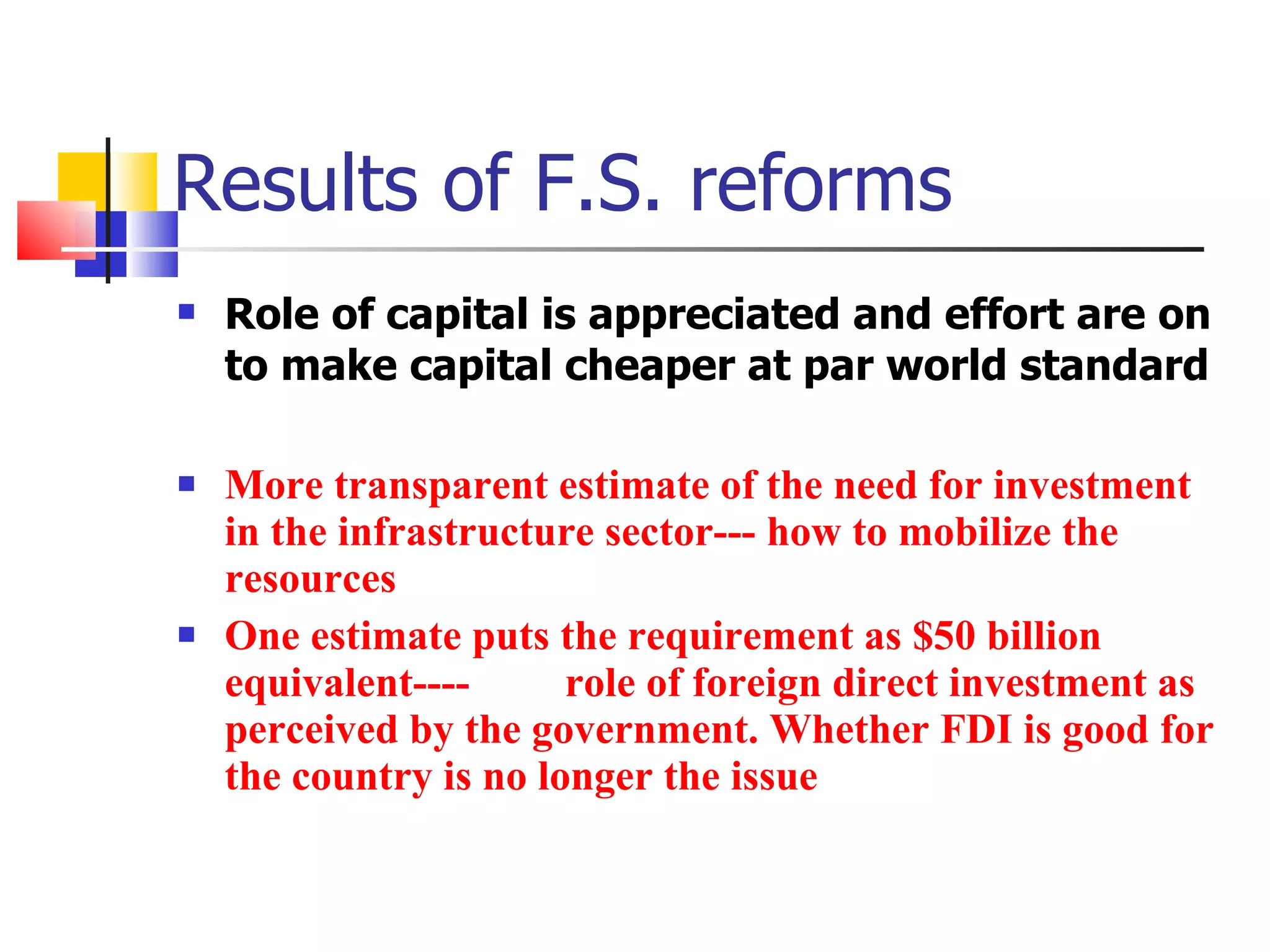
Results of F.S. reforms Role of capital is appreciated and effort are on to make capital cheaper at par world standard More transparent estimate of the need for investment in the infrastructure sector--- how to mobilize the resources One estimate puts the requirement as $50 billion equivalent----  role of foreign direct investment as perceived by the government. Whether FDI is good for the country is no longer the issue
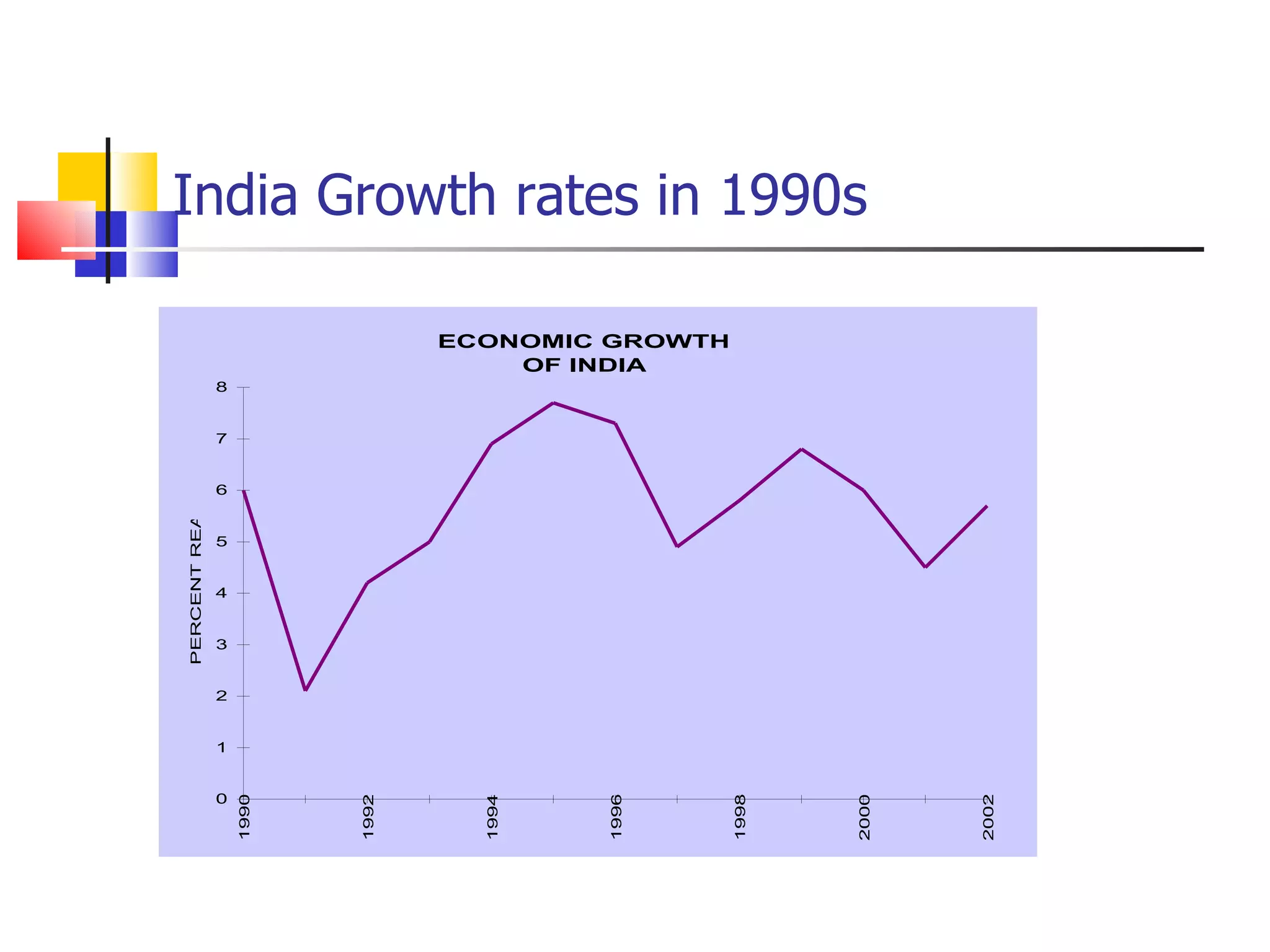
India Growth rates in 1990s
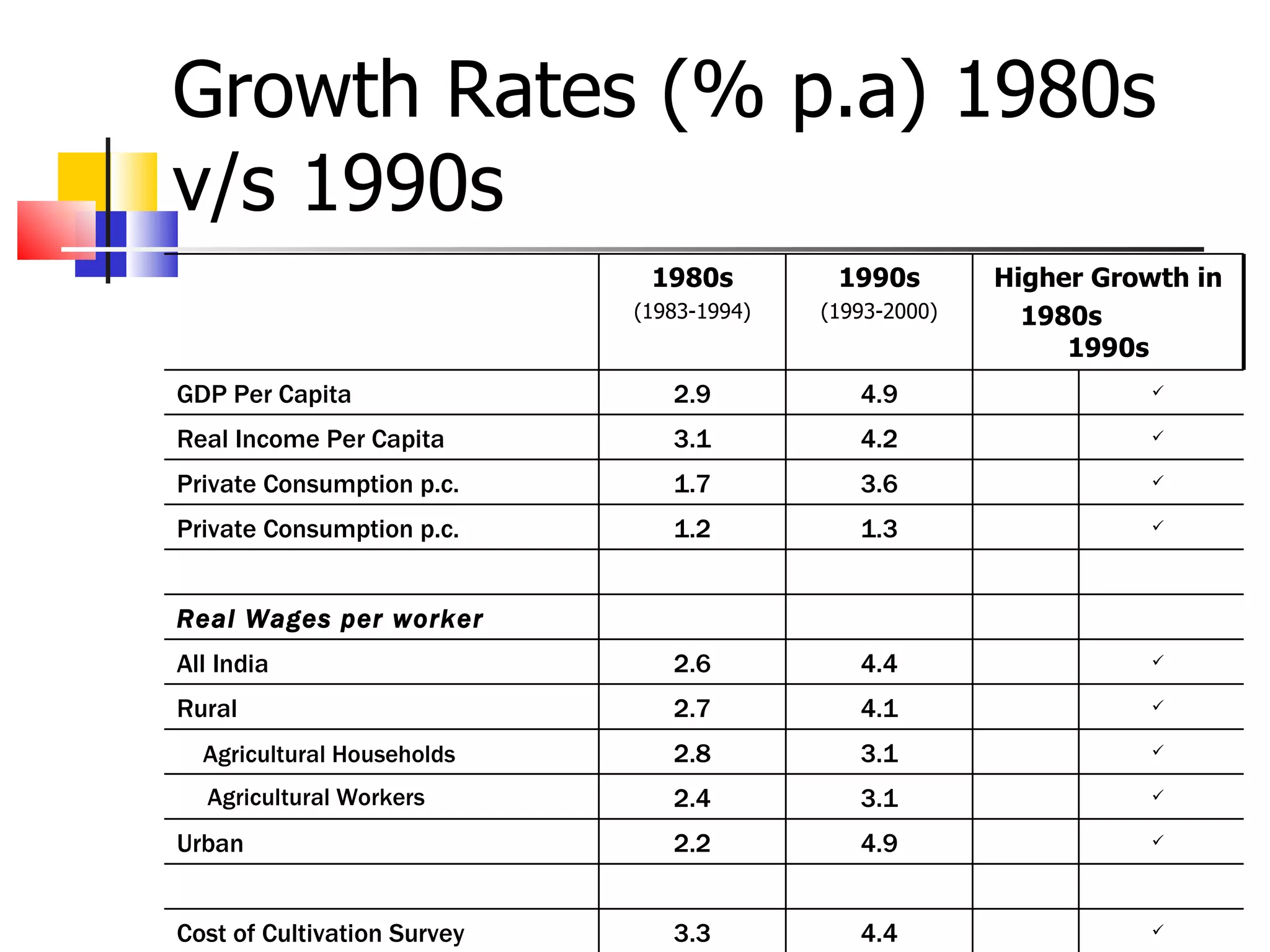
Growth Rates (% p.a) 1980s v/s 1990s 1980s (1983-1994) 1990s (1993-2000) Higher Growth in 1980s  1990s GDP Per Capita 2.9 4.9 Real Income Per Capita  3.1 4.2 Private Consumption p.c.  1.7 3.6 Private Consumption p.c.  1.2 1.3 Real Wages per worker All India  2.6 4.4 Rural  2.7 4.1 Agricultural Households  2.8 3.1 Agricultural Workers  2.4 3.1 Urban  2.2 4.9 Cost of Cultivation Survey 3.3 4.4
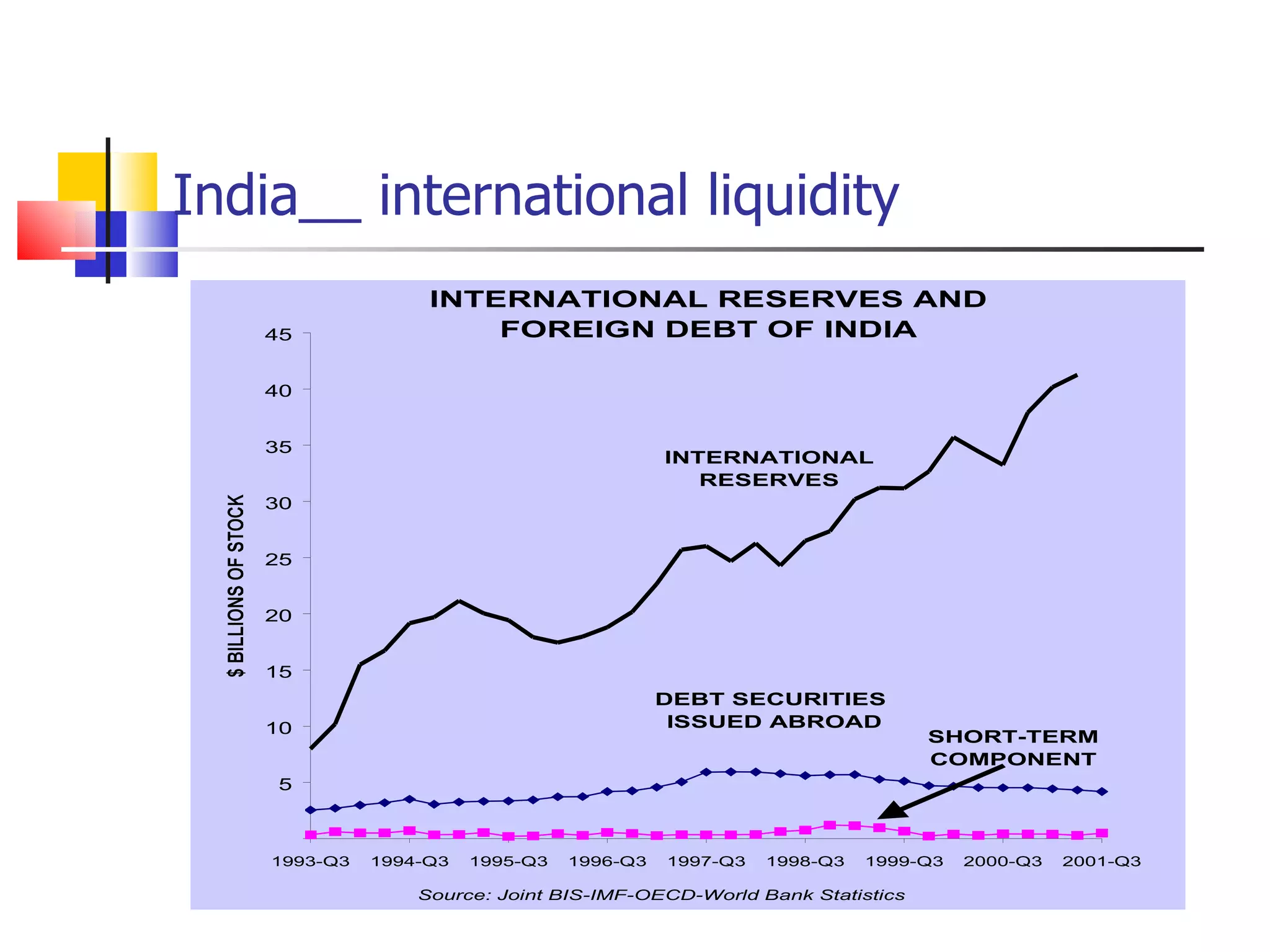
India__ international liquidity
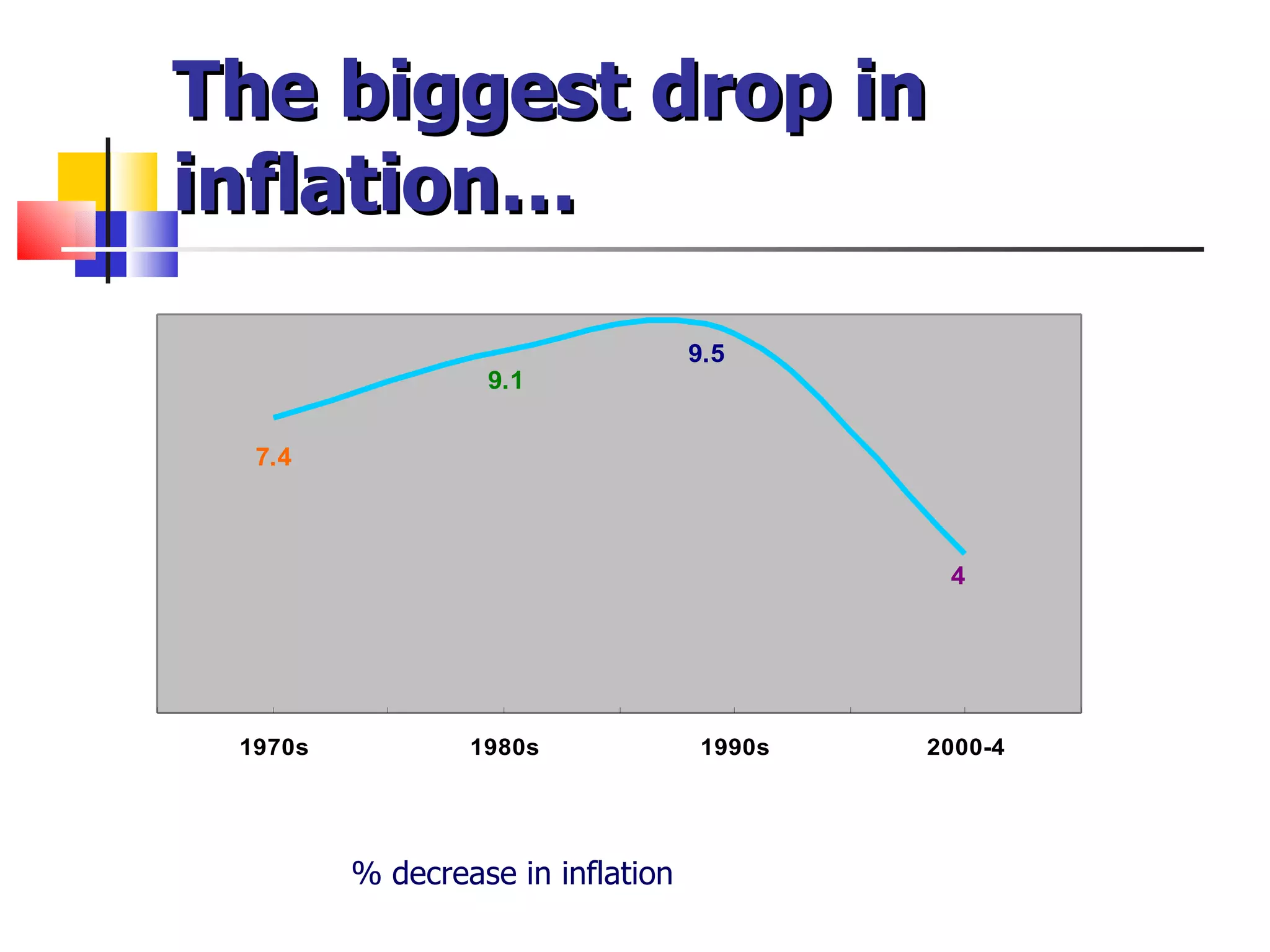
The biggest drop in inflation… % decrease in inflation
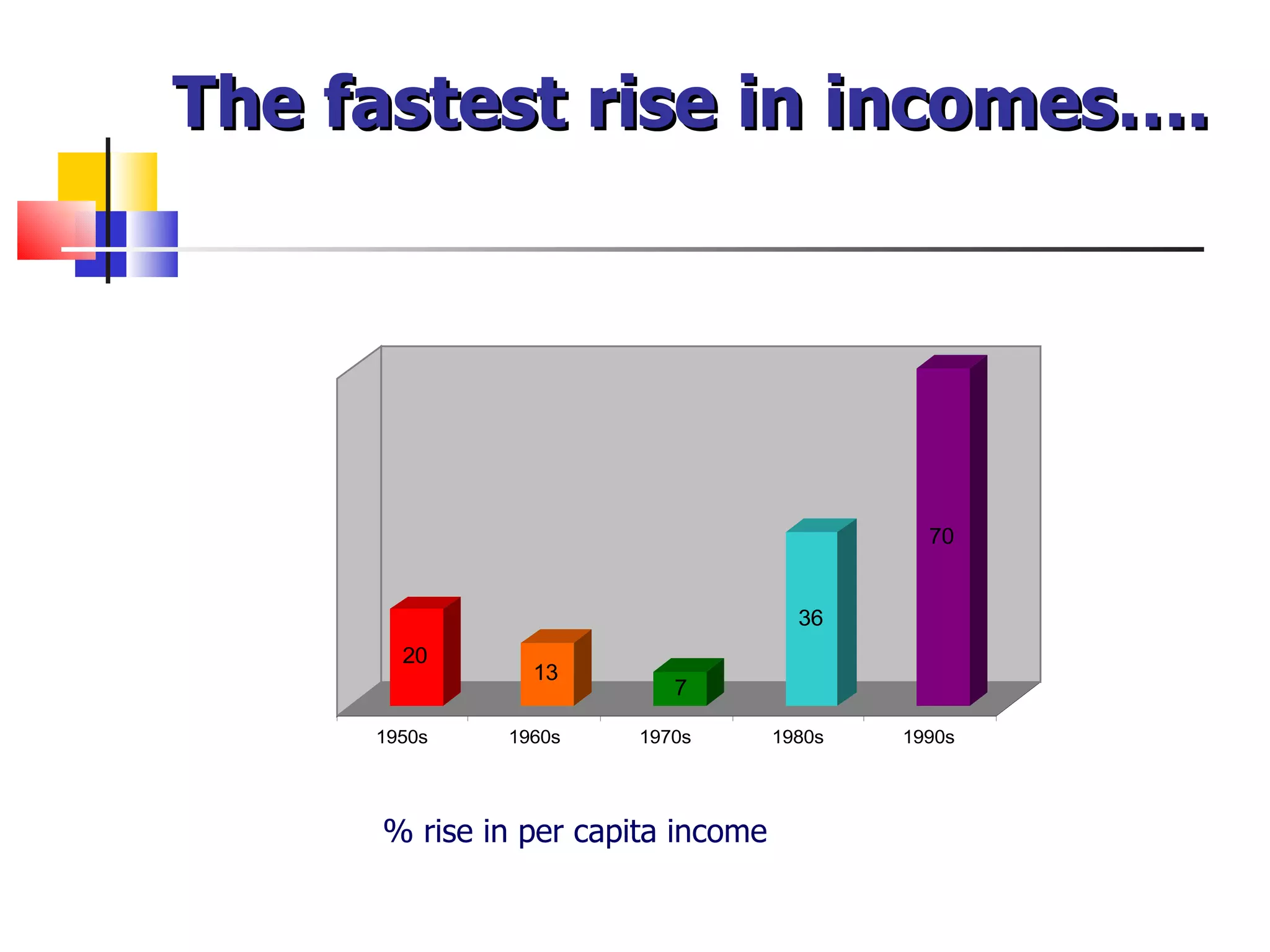
The fastest rise in incomes…. % rise in per capita income
Real GDP growth rates of selected countries during 1990--- 2000 [ per cent] China 10.3 Ireland  7.3 India  6.0 USA 3.5 Japan 1.3 Russia   -4.8 Ukraine   -9.3
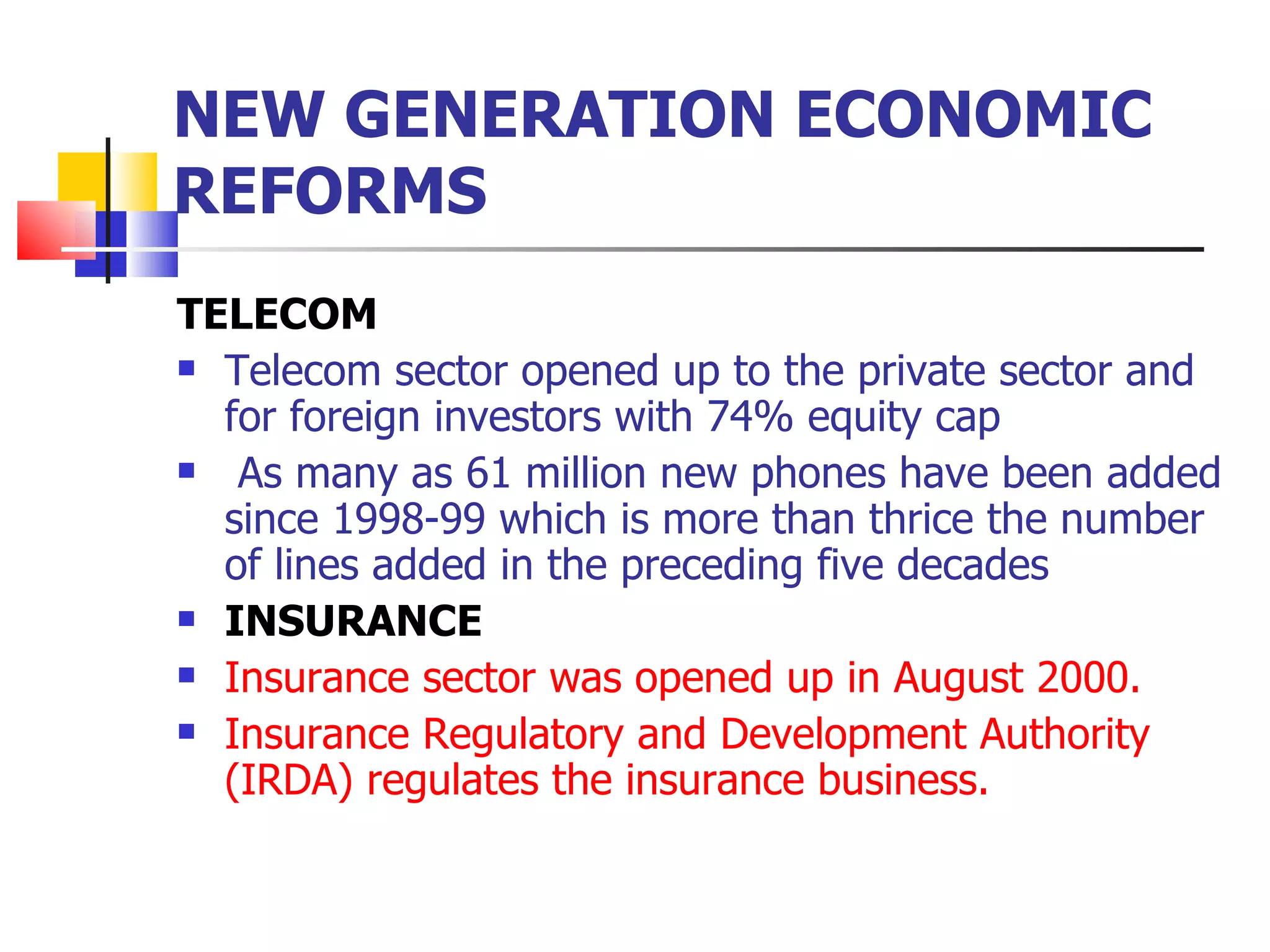
NEW GENERATION ECONOMIC REFORMS TELECOM Telecom sector opened up to the private sector and for foreign investors with 74% equity cap As many as 61 million new phones have been added since 1998-99 which is more than thrice the number of lines added in the preceding five decades INSURANCE Insurance sector was opened up in August 2000. Insurance Regulatory and Development Authority (IRDA) regulates the insurance business.
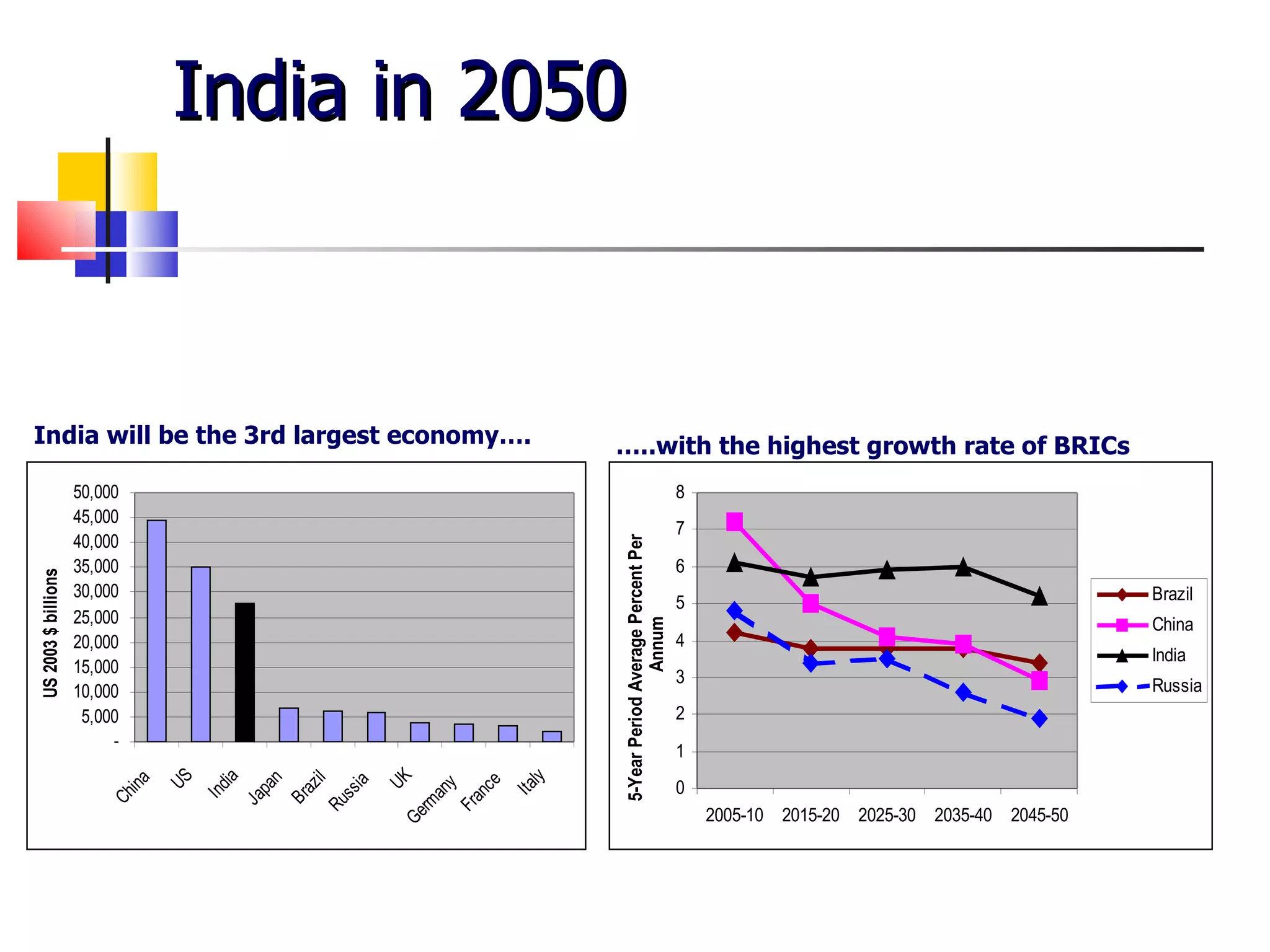
India in 2050 India will be the 3rd largest economy…. … ..with the highest growth rate of BRICs
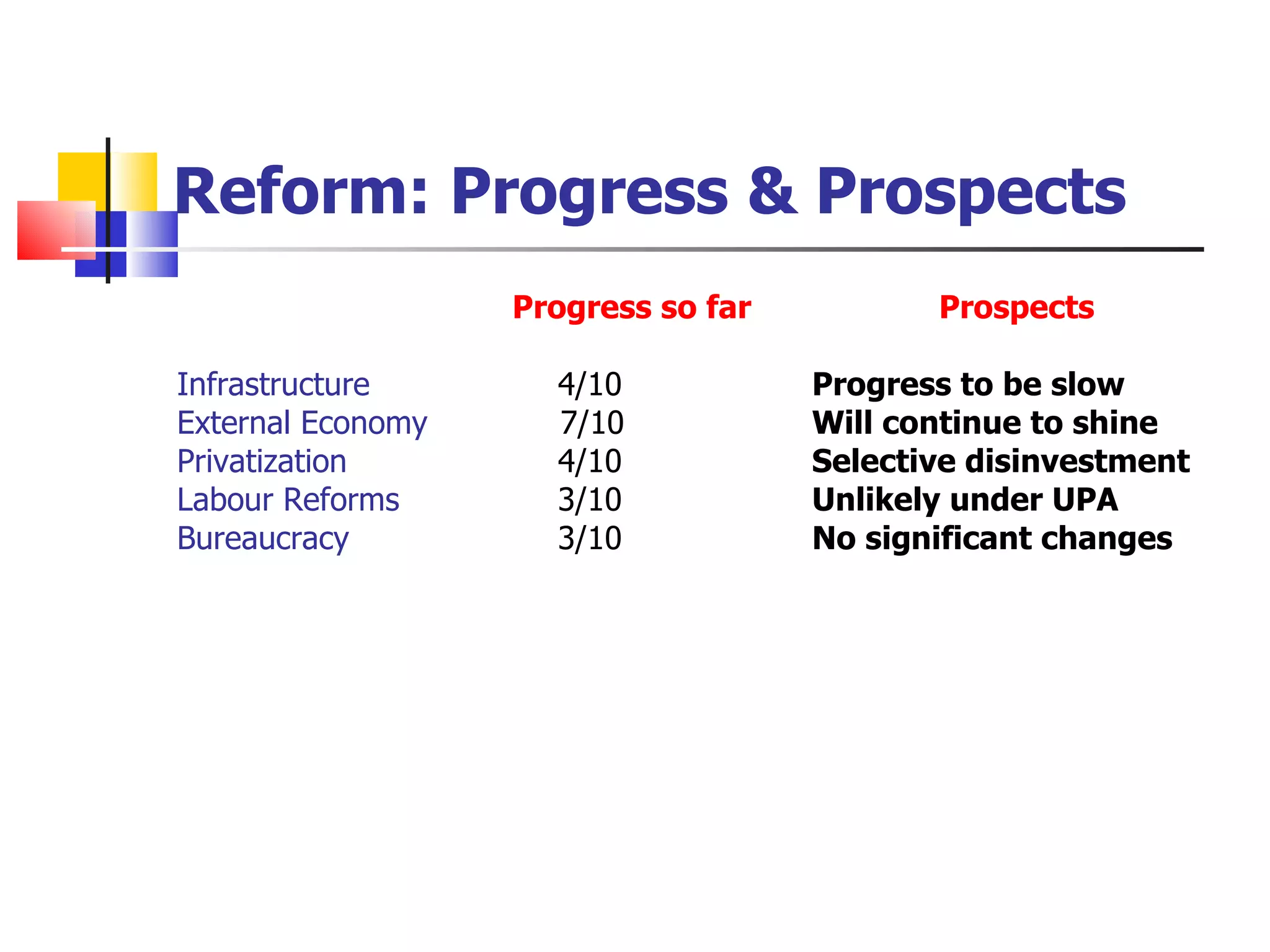
Reform: Progress & Prospects Progress so far Prospects Infrastructure 4/10 Progress to be slow External Economy   7/10 Will continue to shine Privatization 4/10 Selective disinvestment Labour Reforms 3/10 Unlikely under UPA  Bureaucracy  3/10 No significant changes
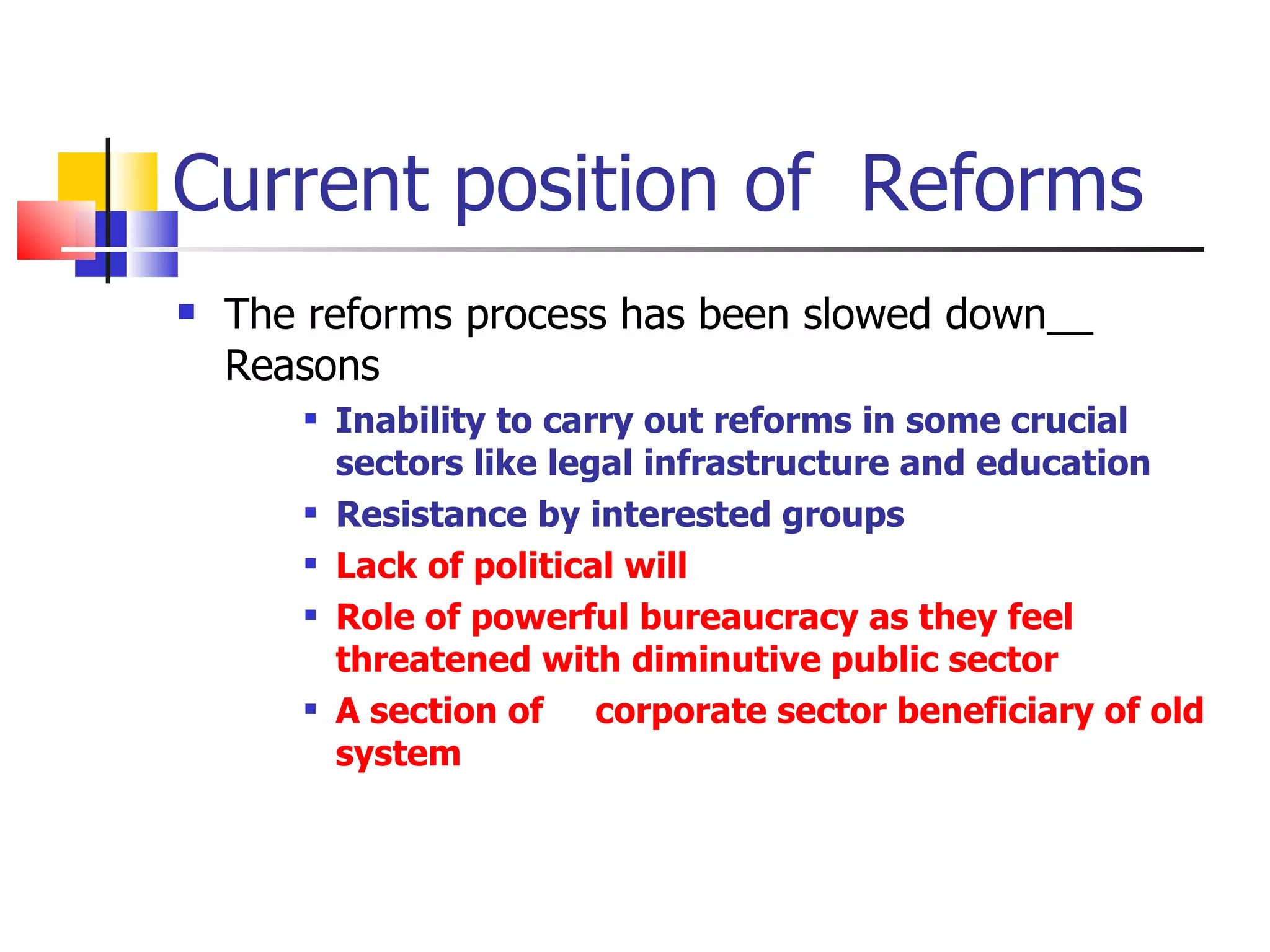
Current position of  Reforms The reforms process has been slowed down__ Reasons Inability to carry out reforms in some crucial sectors like legal infrastructure and education Resistance by interested groups Lack of political will Role of powerful bureaucracy as they feel threatened with diminutive public sector A section of  corporate sector beneficiary of old system
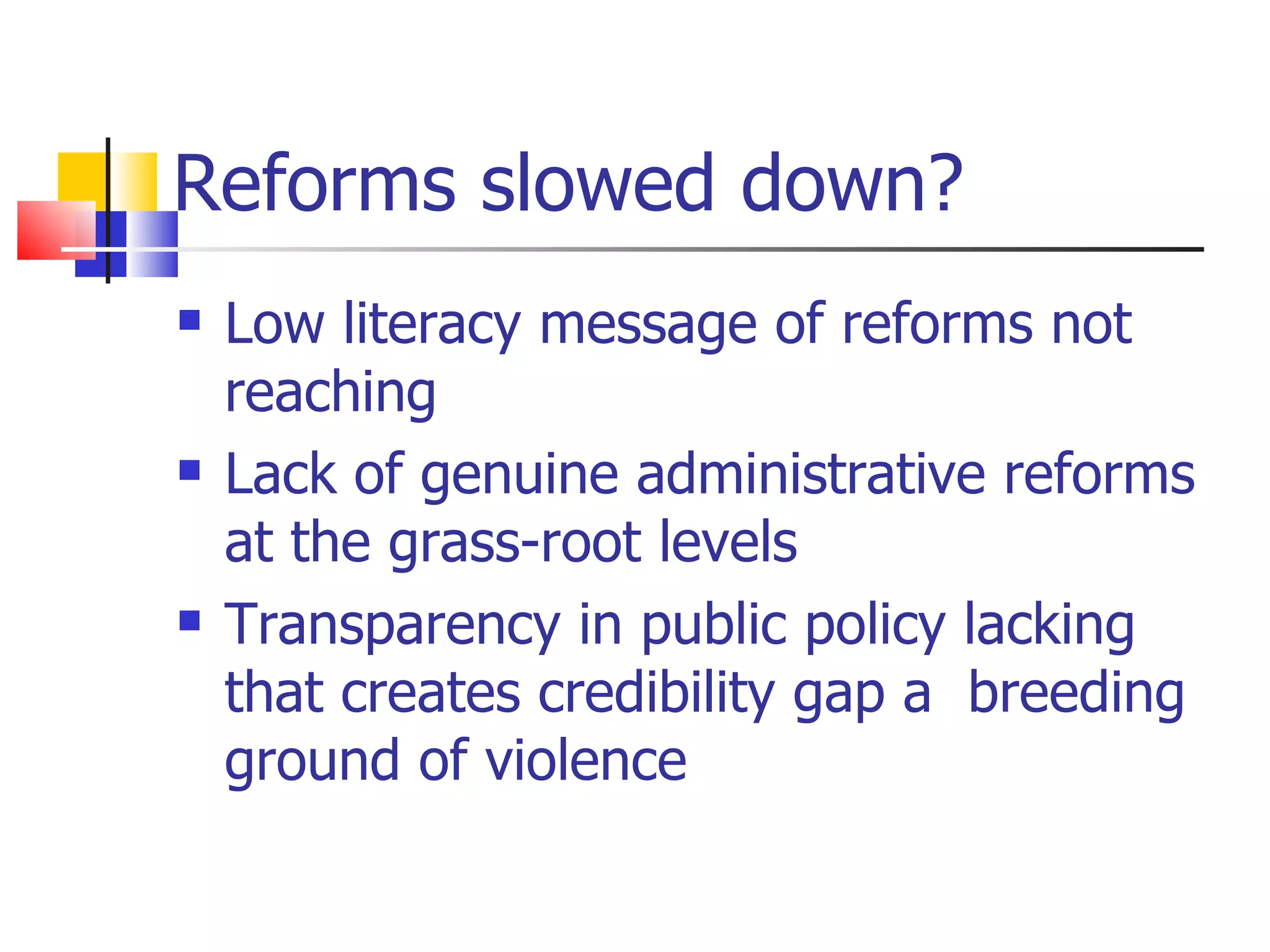
Reforms slowed down? Low literacy message of reforms not reaching Lack of genuine administrative reforms at the grass-root levels Transparency in public policy lacking that creates credibility gap a  breeding ground of violence
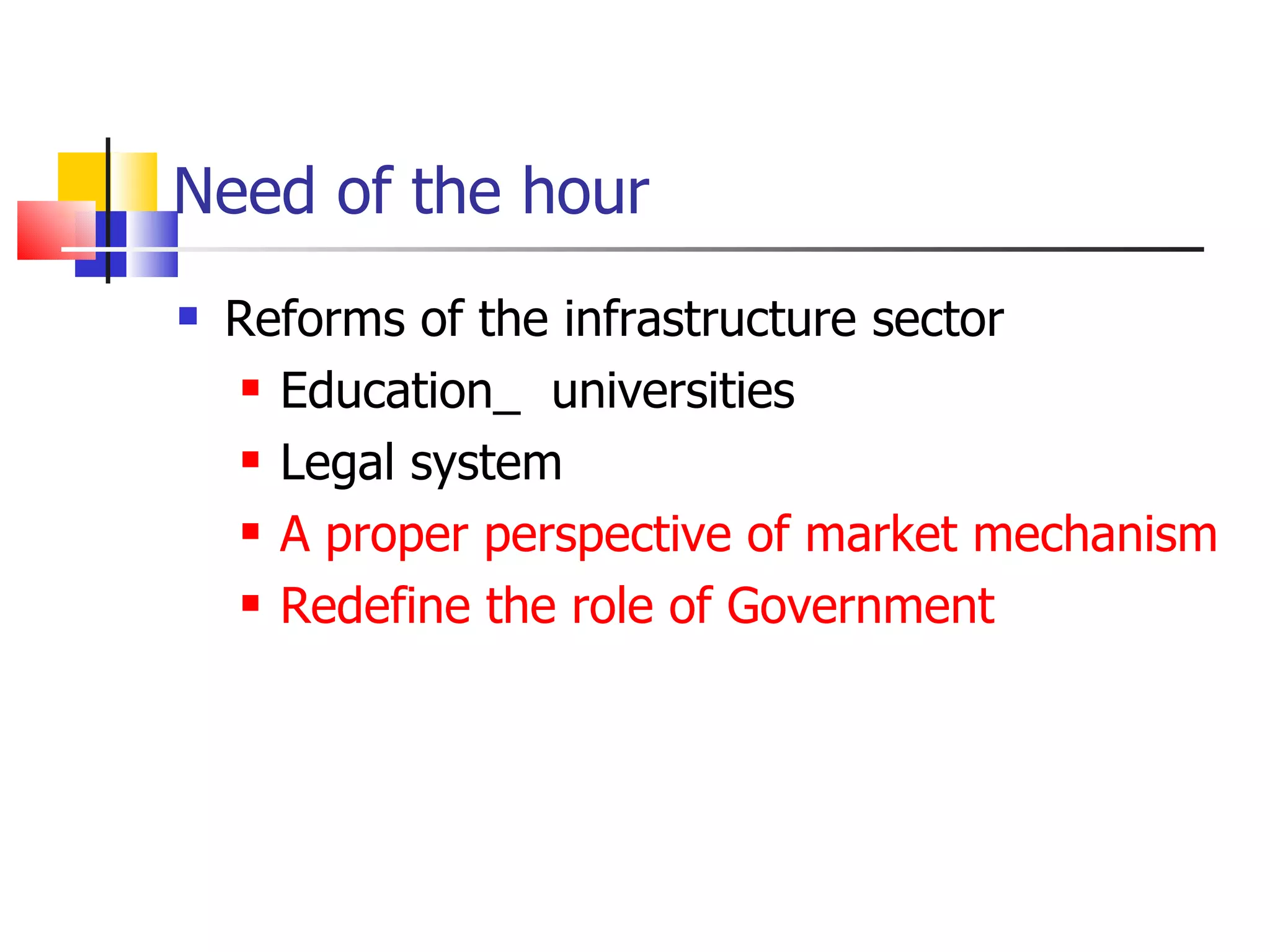
Need of the hour Reforms of the infrastructure sector Education_  universities Legal system A proper perspective of market mechanism Redefine the role of Government
Conclusion We are in the middle of the process of reforms….  Only expectations about the better future
End of discussion THANK YOU

Indian Economy reforms

  • 1.
    ECONOMIC REFORMS ININDIA BY Shubham Goel
  • 2.
    Period 1947- 1990The historical discontinuity after independence The Plan strategy A nation building exercise The experiment with socialism
  • 3.
    WHY ECONOMIC REFORMSA rate of growth of average 3.2 per cent High population growth denies a significant dent on poverty A huge public sector with minimum returns A protective private sector
  • 4.
    WHO DID IT?These reforms (1990s) were brought in by a team led by Dr.Manmohan Singh, who was Finance Minister at the time, and is currently the Prime Minister.
  • 5.
    Philosophy of ReformsTo free the economy from the circumspection of socialist equity in the form of pervasive state control on production, low productivity, a distorted and dis-functional price system and a complacent over-protective private sector. To establish the supremacy of individual and the role of economic freedom
  • 6.
    Perspective: year 1990-91International reserve came down to $ 1.3 billion, less than 1 month import bill, and India was on the verge of default in foreign obligations [ short term debt] Stagnant exports India’s ratings down High deficits in domestic budget Public sector banks having large NPA PSU incurring huge losses
  • 7.
    International Scene USSR’s disintegration… the currency trouble weakened Overall confusion on the efficacy of command economy Some east European countries came out of socialist economic structure Loss of credibility of the ‘command economy’ as disturbing revelation came out on lower productivity and disinformation about planning
  • 8.
    Role of IMFThe Washington consensus about the ‘transition economies’ Dismantle command economy structure Reduce the size of government Privatization of state undertakings Reduce and remove budget deficit Make currency stable and current account convertible
  • 9.
    Mechanism Dismantling ofthe license and permit raj so that the rent-seeking system is abolished Minimize the role of the state in production except in some core and strategic areas Reform of the legal system to end monopoly of any group/ sector Financial sector reforms
  • 10.
    Financial Sector ReformsReforms--- change in the budgetary process makes the government accountable--- discipline in revenue-expenditure process Low inflation- low interest regime Changes in the banking sector – making the system of bank credit more transparent_ efficient appraisal system and accountability for decision taking
  • 11.
    Results of F.S.reforms Role of capital is appreciated and effort are on to make capital cheaper at par world standard More transparent estimate of the need for investment in the infrastructure sector--- how to mobilize the resources One estimate puts the requirement as $50 billion equivalent---- role of foreign direct investment as perceived by the government. Whether FDI is good for the country is no longer the issue
  • 12.
  • 13.
    Growth Rates (%p.a) 1980s v/s 1990s 1980s (1983-1994) 1990s (1993-2000) Higher Growth in 1980s 1990s GDP Per Capita 2.9 4.9 Real Income Per Capita 3.1 4.2 Private Consumption p.c. 1.7 3.6 Private Consumption p.c. 1.2 1.3 Real Wages per worker All India 2.6 4.4 Rural 2.7 4.1 Agricultural Households 2.8 3.1 Agricultural Workers 2.4 3.1 Urban 2.2 4.9 Cost of Cultivation Survey 3.3 4.4
  • 14.
  • 15.
    The biggest dropin inflation… % decrease in inflation
  • 16.
    The fastest risein incomes…. % rise in per capita income
  • 17.
    Real GDP growthrates of selected countries during 1990--- 2000 [ per cent] China 10.3 Ireland 7.3 India 6.0 USA 3.5 Japan 1.3 Russia -4.8 Ukraine -9.3
  • 18.
    NEW GENERATION ECONOMICREFORMS TELECOM Telecom sector opened up to the private sector and for foreign investors with 74% equity cap As many as 61 million new phones have been added since 1998-99 which is more than thrice the number of lines added in the preceding five decades INSURANCE Insurance sector was opened up in August 2000. Insurance Regulatory and Development Authority (IRDA) regulates the insurance business.
  • 19.
    India in 2050India will be the 3rd largest economy…. … ..with the highest growth rate of BRICs
  • 20.
    Reform: Progress &Prospects Progress so far Prospects Infrastructure 4/10 Progress to be slow External Economy 7/10 Will continue to shine Privatization 4/10 Selective disinvestment Labour Reforms 3/10 Unlikely under UPA Bureaucracy 3/10 No significant changes
  • 21.
    Current position of Reforms The reforms process has been slowed down__ Reasons Inability to carry out reforms in some crucial sectors like legal infrastructure and education Resistance by interested groups Lack of political will Role of powerful bureaucracy as they feel threatened with diminutive public sector A section of corporate sector beneficiary of old system
  • 22.
    Reforms slowed down?Low literacy message of reforms not reaching Lack of genuine administrative reforms at the grass-root levels Transparency in public policy lacking that creates credibility gap a breeding ground of violence
  • 23.
    Need of thehour Reforms of the infrastructure sector Education_ universities Legal system A proper perspective of market mechanism Redefine the role of Government
  • 24.
    Conclusion We arein the middle of the process of reforms…. Only expectations about the better future
  • 25.