This document provides information on informative speeches. It explains that the goal is to help listeners understand and remember the content through organized presentation. The three main parts are the introduction, body, and conclusion. The introduction should gain attention and interest, while the body presents main points and evidence in an orderly structure. The conclusion emphasizes the key ideas and leaves the audience wanting more. Different types of informative speeches are also defined.
Overview of informative speeches, highlighting the importance of content delivery and live presentation.
Details the three main parts of a speech: introduction, body, and conclusion, with emphasis on audience engagement.Discusses strategies for organizing the body of a speech, including various patterns: chronological, topical, spatial, and more.
Highlights the goals of an effective conclusion in speeches including emphasizing key ideas and intensifying emotions.
Describes four types of informative speeches: definition, demonstration, explanatory, and descriptive.
No matter whatyou are informing your
audience of, CONTENT is important.
However, HOW the content is
delivered is just as important!
4.
Speeches are deliveredLIVE
Thus, you only have one chance to tell
and show the audience what you want
them to know/understand
They cannot rewind you/your speech
back or turn the page back to review
your presented information
gains the attentionand the goodwill
of the audience.
An introduction can be as short as a
few sentences and should usually be
no longer than 10 percent of the
speech.
INTRODUCTION
7.
1) GET THEATTENTION OF THE AUDIENCE
- (sustained interest) - you need to find a
way to focus the audience’s attention on
the subject matter of your speech, then,
when you get into the body of the
speech, your audience will continue to
listen.
AN INTRODUCTION SERVES THREE VERY
IMPORTANT PURPOSES. IT SHOULD:
8.
GAIN THE GOODWILLOF THE AUDIENCE -
(audience’s respect or positive feeling for the
speaker as a person) - What you say in your
opening remarks and the way in which you say it -
your tone, your inflection, and other nonverbal
signals are important. If your audience likes or
trusts you, they will likely be willing to listen to
what you have to say and to think about your
message.
AN INTRODUCTION SERVES THREE VERY
IMPORTANT PURPOSES. IT SHOULD:
9.
DEVELOP THE AUDIENCE’SINTEREST IN THE
TOPIC OF THE SPEECH - (involvement or
concern your audience shows about your
topic) - Include facts, examples, and other
information that will hold your audience’s
attention.
AN INTRODUCTION SERVES THREE VERY
IMPORTANT PURPOSES. IT SHOULD:
10.
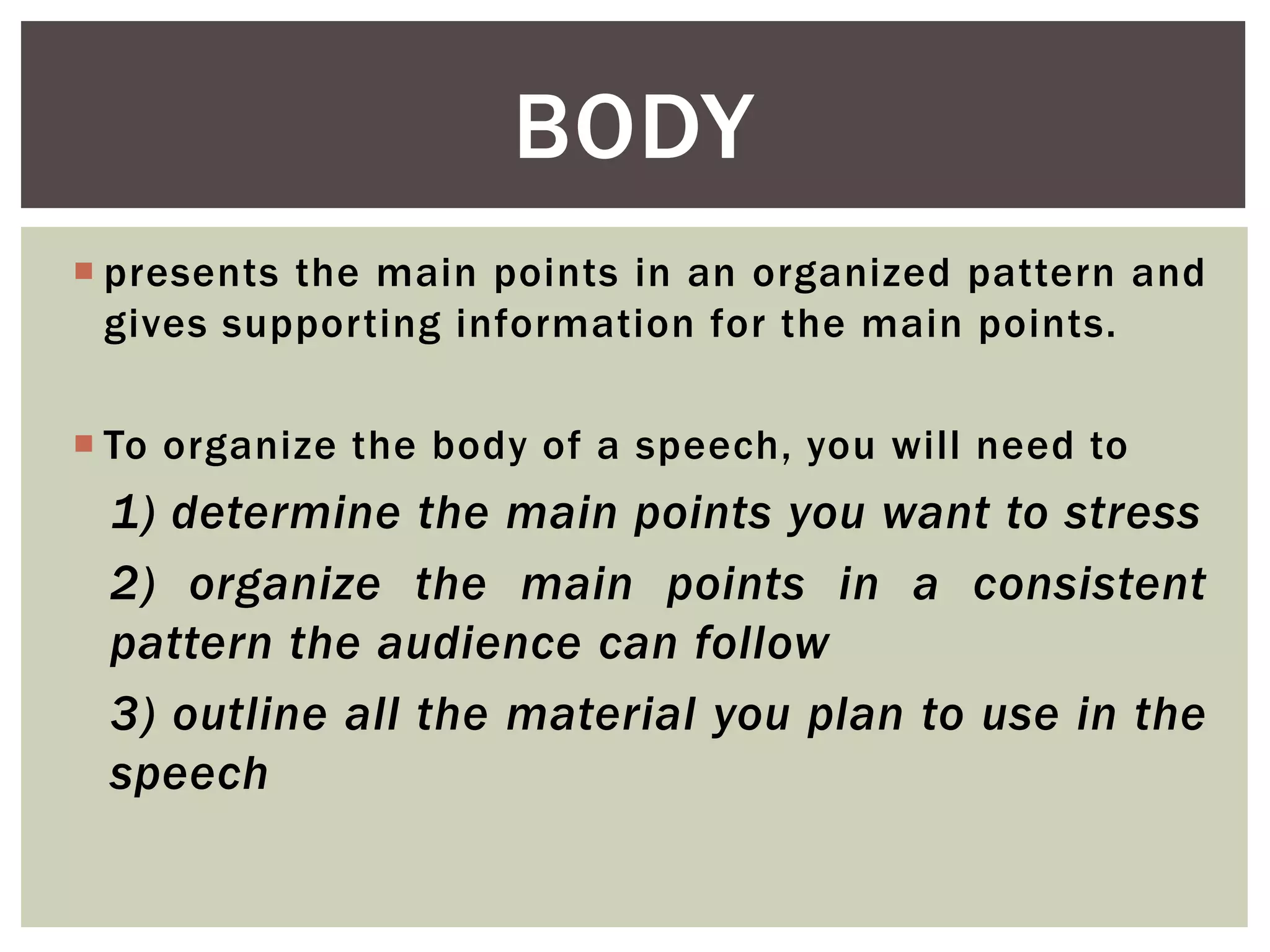
presents themain points in an organized pattern and
gives supporting information for the main points.
To organize the body of a speech, you will need to
1) determine the main points you want to stress
2) organize the main points in a consistent
pattern the audience can follow
3) outline all the material you plan to use in the
speech
BODY
11.
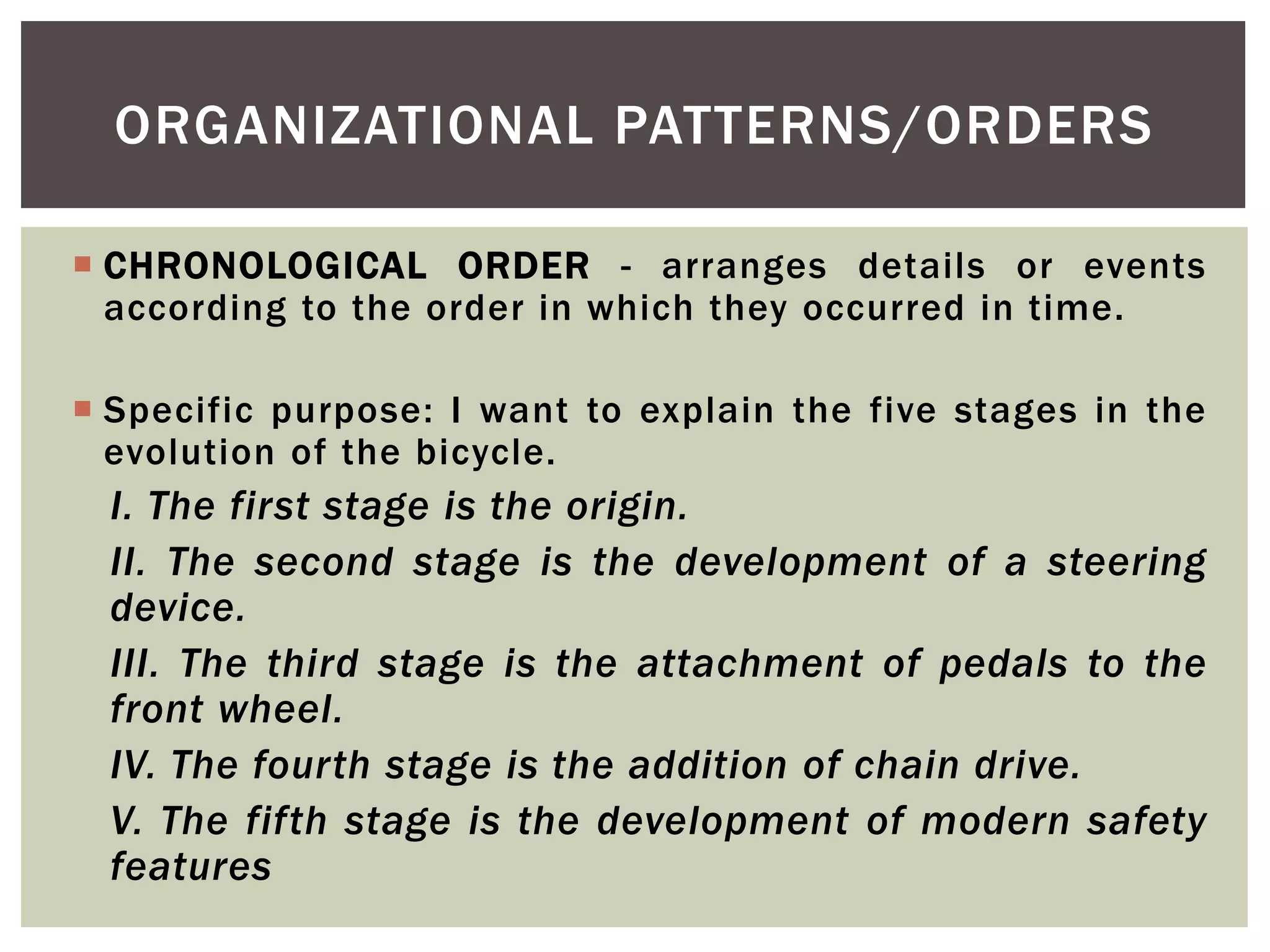
CHRONOLOGICAL ORDER- arranges details or events
according to the order in which they occurred in time.
Specific purpose: I want to explain the five stages in the
evolution of the bicycle.
I. The first stage is the origin.
II. The second stage is the development of a steering
device.
III. The third stage is the attachment of pedals to the
front wheel.
IV. The fourth stage is the addition of chain drive.
V. The fifth stage is the development of modern safety
features
ORGANIZATIONAL PATTERNS/ORDERS
12.
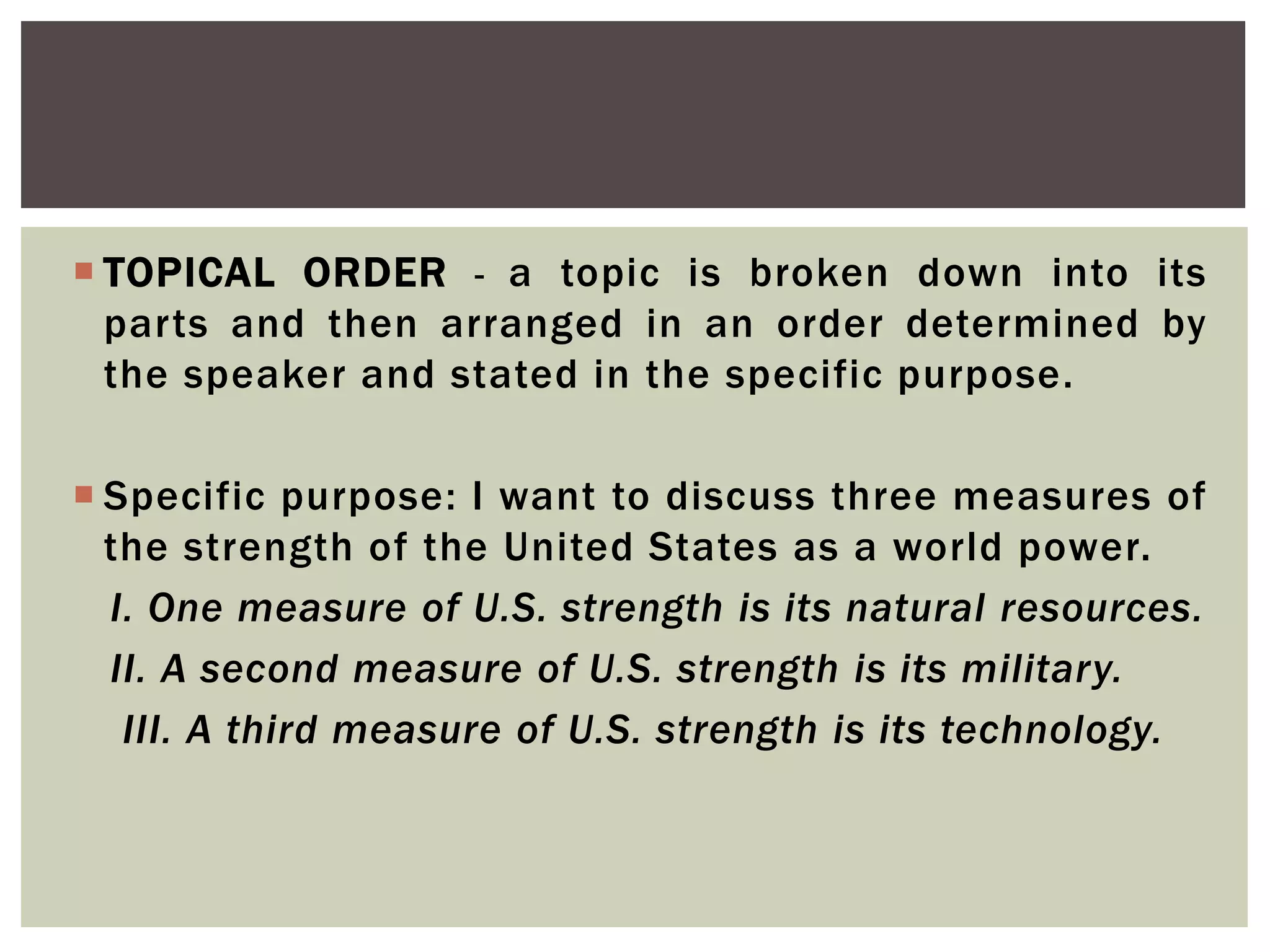
TOPICAL ORDER- a topic is broken down into its
parts and then arranged in an order determined by
the speaker and stated in the specific purpose.
Specific purpose: I want to discuss three measures of
the strength of the United States as a world power.
I. One measure of U.S. strength is its natural resources.
II. A second measure of U.S. strength is its military.
III. A third measure of U.S. strength is its technology.
13.
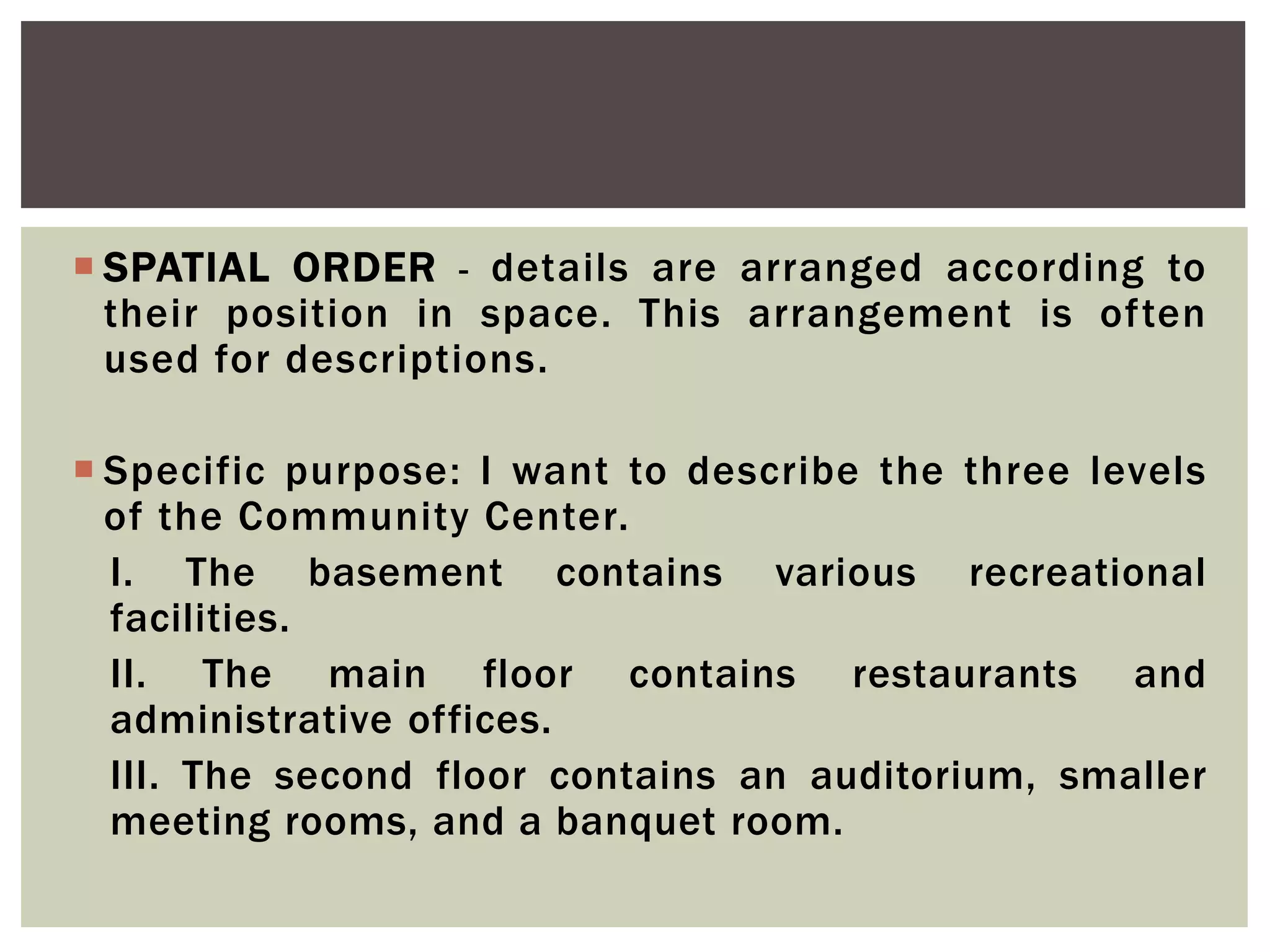
SPATIAL ORDER- details are arranged according to
their position in space. This arrangement is often
used for descriptions.
Specific purpose: I want to describe the three levels
of the Community Center.
I. The basement contains various recreational
facilities.
II. The main floor contains restaurants and
administrative offices.
III. The second floor contains an auditorium, smaller
meeting rooms, and a banquet room.
14.
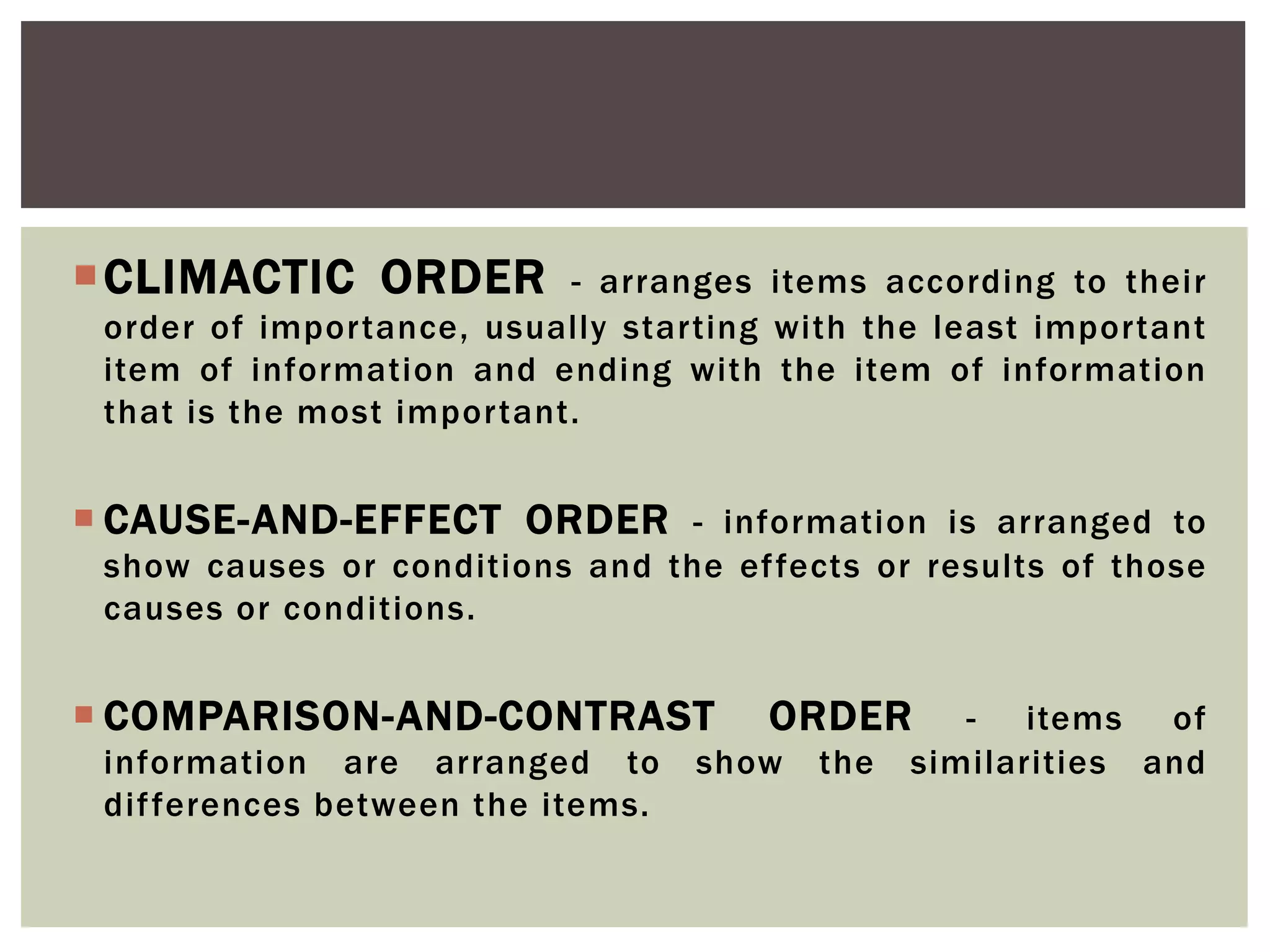
CLIMACTIC ORDER -arranges items according to their
order of importance, usually starting with the least important
item of information and ending with the item of information
that is the most important.
CAUSE-AND-EFFECT ORDER - information is arranged to
show causes or conditions and the effects or results of those
causes or conditions.
COMPARISON-AND-CONTRAST ORDER - items of
information are arranged to show the similarities and
differences between the items.
15.
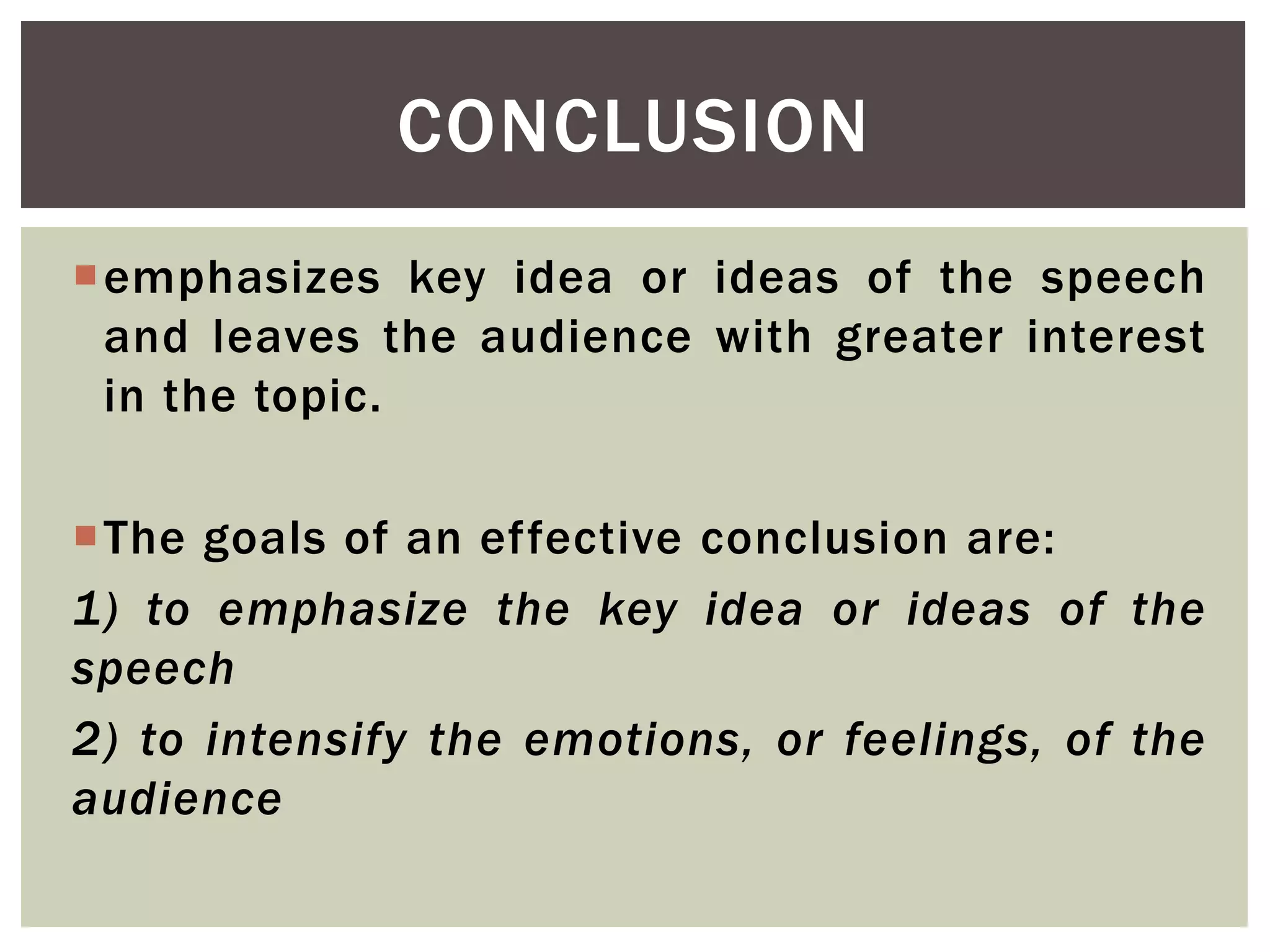
emphasizes key ideaor ideas of the speech
and leaves the audience with greater interest
in the topic.
The goals of an effective conclusion are:
1) to emphasize the key idea or ideas of the
speech
2) to intensify the emotions, or feelings, of the
audience
CONCLUSION
A definition speechexplains the
meaning, theory, or philosophy of a
specific topic that the audience
likely does not know much about.
DEFINITION SPEECH
An explanatory speechmight give a
description of the state of a given topic. As an
example, consider a speech that might be
given at a professional conference to inform
the audience about a particular part of an
industry. Often, these type of speeches will
include visual representations of the
particular data or statistics relating to
information contained in the speech.
EXPLANATORY SPEECH
20.
A descriptive speechuses vivid language
and visual images to create a
memorable picture in a person’s mind
regarding an object, person, animal, or
place.
DESCRIPTIVE SPEECH