Nouns
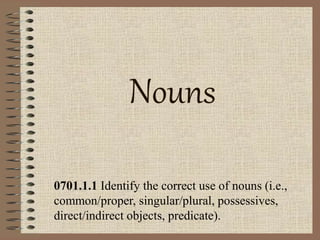
0701.1.1 Identify the correct use of nouns (i.e.,
common/proper, singular/plural, possessives,
direct/indirect objects, predicate).
Nouns
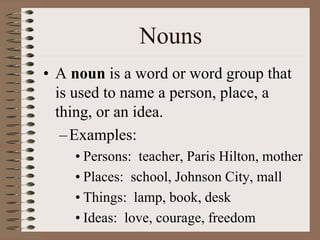
• A noun is a word or word group that
is used to name a person, place, a
thing, or an idea.
–Examples:
• Persons: teacher, Paris Hilton, mother
• Places: school, Johnson City, mall
• Things: lamp, book, desk
• Ideas: love, courage, freedom
Types of Nouns
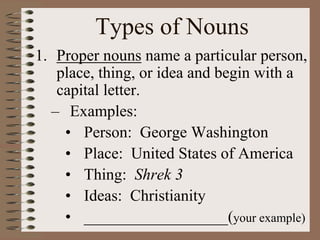
1. Proper nouns name a particular person,
place, thing, or idea and begin with a
capital letter.
– Examples:
• Person: George Washington
• Place: United States of America
• Thing: Shrek 3
• Ideas: Christianity
• __________________(your example)
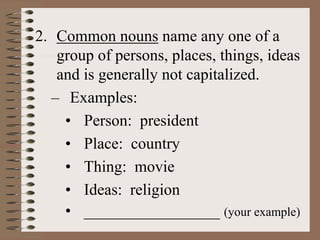
2. Common nouns name any one of a
group of persons, places, things, ideas
and is generally not capitalized.
– Examples:
• Person: president
• Place: country
• Thing: movie
• Ideas: religion
• _________________ (your example)
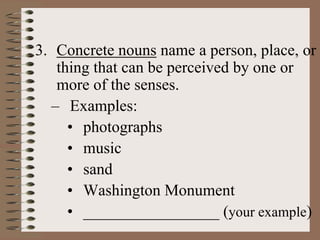
3. Concrete nouns name a person, place, or
thing that can be perceived by one or
more of the senses.
– Examples:
• photographs
• music
• sand
• Washington Monument
• _________________ (your example)
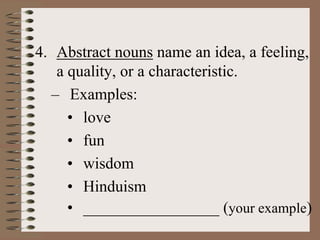
4. Abstract nouns name an idea, a feeling,
a quality, or a characteristic.
– Examples:
• love
• fun
• wisdom
• Hinduism
• _________________ (your example)
5. A collective noun is a word that names a
group.
– Examples:
• alumni
• faculty
• committee
• team
• _________________ (your example)
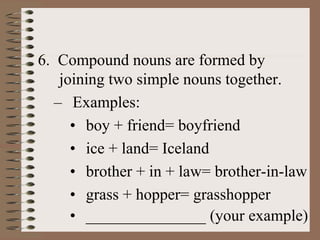
6. Compound nouns are formed by
joining two simple nouns together.
– Examples:
• boy + friend= boyfriend
• ice + land= Iceland
• brother + in + law= brother-in-law
• grass + hopper= grasshopper
• _______________ (your example)
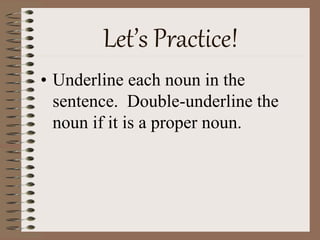
Let’s Practice!
• Underline each noun in the
sentence. Double-underline the
noun if it is a proper noun.
Let’s Practice!
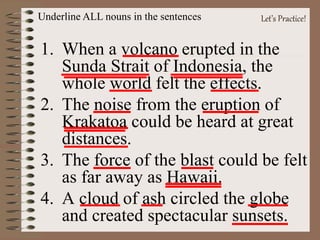
1. When a volcano erupted in the
Sunda Strait of Indonesia, the
whole world felt the effects.
2. The noise from the eruption of
Krakatoa could be heard at great
distances.
3. The force of the blast could be felt
as far away as Hawaii.
4. A cloud of ash circled the globe
and created spectacular sunsets.
Underline ALL nouns in the sentences
Singular and Plural Nouns
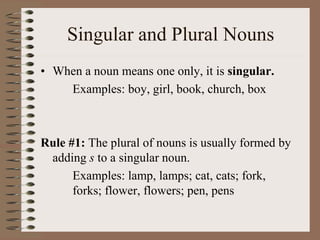
• When a noun means one only, it is singular.
Examples: boy, girl, book, church, box
Rule #1: The plural of nouns is usually formed by
adding s to a singular noun.
Examples: lamp, lamps; cat, cats; fork,
forks; flower, flowers; pen, pens
Singular and Plural Nouns
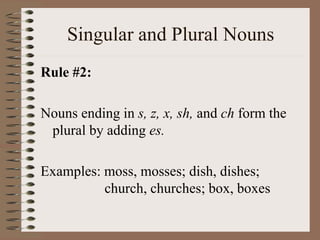
Rule #2:
Nouns ending in s, z, x, sh, and ch form the
plural by adding es.
Examples: moss, mosses; dish, dishes;
church, churches; box, boxes
Singular and Plural Nouns
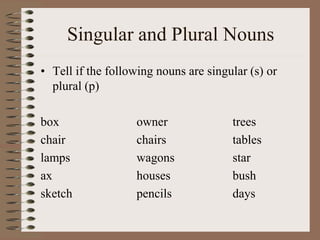
• Tell if the following nouns are singular (s) or
plural (p)
box owner trees
chair chairs tables
lamps wagons star
ax houses bush
sketch pencils days
Singular and Plural Nouns
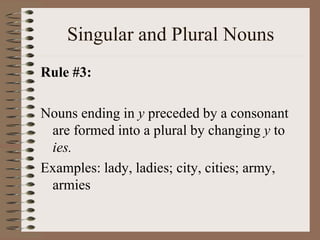
Rule #3:
Nouns ending in y preceded by a consonant
are formed into a plural by changing y to
ies.
Examples: lady, ladies; city, cities; army,
armies
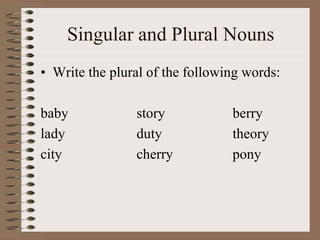
Singular and Plural Nouns
• Write the plural of the following words:
baby story berry
lady duty theory
city cherry pony
Singular and Plural Nouns
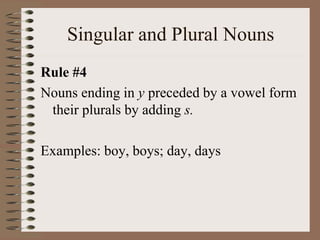
Rule #4
Nouns ending in y preceded by a vowel form
their plurals by adding s.
Examples: boy, boys; day, days
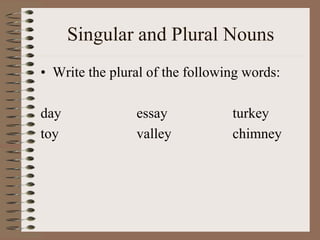
Singular and Plural Nouns
• Write the plural of the following words:
day essay turkey
toy valley chimney
Singular and Plural Nouns
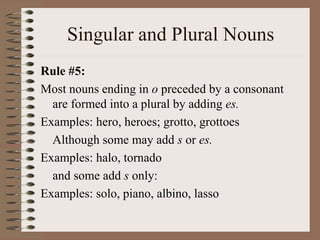
Rule #5:
Most nouns ending in o preceded by a consonant
are formed into a plural by adding es.
Examples: hero, heroes; grotto, grottoes
Although some may add s or es.
Examples: halo, tornado
and some add s only:
Examples: solo, piano, albino, lasso
Singular and Plural Nouns
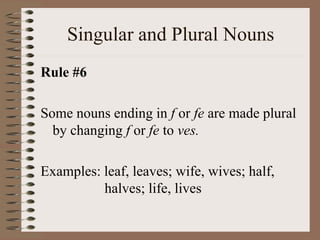
Rule #6
Some nouns ending in f or fe are made plural
by changing f or fe to ves.
Examples: leaf, leaves; wife, wives; half,
halves; life, lives
Singular and Plural Nouns
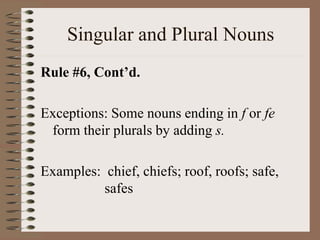
Rule #6, Cont’d.
Exceptions: Some nouns ending in f or fe
form their plurals by adding s.
Examples: chief, chiefs; roof, roofs; safe,
safes
Singular and Plural Nouns
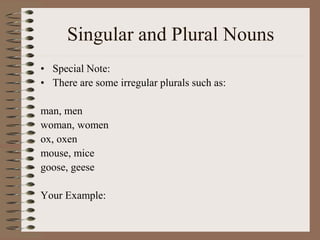
• Special Note:
• There are some irregular plurals such as:
man, men
woman, women
ox, oxen
mouse, mice
goose, geese
Your Example:
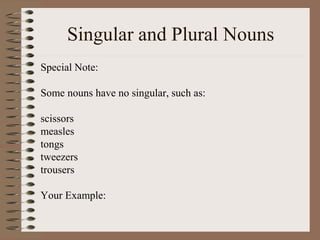
Singular and Plural Nouns
Special Note:
Some nouns have no singular, such as:
scissors
measles
tongs
tweezers
trousers
Your Example:
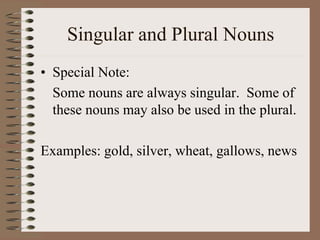
Singular and Plural Nouns
• Special Note:
Some nouns are always singular. Some of
these nouns may also be used in the plural.
Examples: gold, silver, wheat, gallows, news
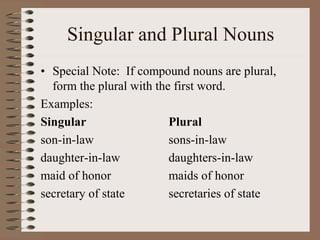
Singular and Plural Nouns
• Special Note: If compound nouns are plural,
form the plural with the first word.
Examples:
Singular Plural
son-in-law sons-in-law
daughter-in-law daughters-in-law
maid of honor maids of honor
secretary of state secretaries of state

Click-here-for-NOUNS-PowerPoint.ppt

  • 1.
    Nouns 0701.1.1 Identify thecorrect use of nouns (i.e., common/proper, singular/plural, possessives, direct/indirect objects, predicate).
  • 2.
    Nouns • A nounis a word or word group that is used to name a person, place, a thing, or an idea. –Examples: • Persons: teacher, Paris Hilton, mother • Places: school, Johnson City, mall • Things: lamp, book, desk • Ideas: love, courage, freedom
  • 3.
    Types of Nouns 1.Proper nouns name a particular person, place, thing, or idea and begin with a capital letter. – Examples: • Person: George Washington • Place: United States of America • Thing: Shrek 3 • Ideas: Christianity • __________________(your example)
  • 4.
    2. Common nounsname any one of a group of persons, places, things, ideas and is generally not capitalized. – Examples: • Person: president • Place: country • Thing: movie • Ideas: religion • _________________ (your example)
  • 5.
    3. Concrete nounsname a person, place, or thing that can be perceived by one or more of the senses. – Examples: • photographs • music • sand • Washington Monument • _________________ (your example)
  • 6.
    4. Abstract nounsname an idea, a feeling, a quality, or a characteristic. – Examples: • love • fun • wisdom • Hinduism • _________________ (your example)
  • 7.
    5. A collectivenoun is a word that names a group. – Examples: • alumni • faculty • committee • team • _________________ (your example)
  • 8.
    6. Compound nounsare formed by joining two simple nouns together. – Examples: • boy + friend= boyfriend • ice + land= Iceland • brother + in + law= brother-in-law • grass + hopper= grasshopper • _______________ (your example)
  • 9.
    Let’s Practice! • Underlineeach noun in the sentence. Double-underline the noun if it is a proper noun.
  • 10.
    Let’s Practice! 1. Whena volcano erupted in the Sunda Strait of Indonesia, the whole world felt the effects. 2. The noise from the eruption of Krakatoa could be heard at great distances. 3. The force of the blast could be felt as far away as Hawaii. 4. A cloud of ash circled the globe and created spectacular sunsets. Underline ALL nouns in the sentences
  • 11.
    Singular and PluralNouns • When a noun means one only, it is singular. Examples: boy, girl, book, church, box Rule #1: The plural of nouns is usually formed by adding s to a singular noun. Examples: lamp, lamps; cat, cats; fork, forks; flower, flowers; pen, pens
  • 12.
    Singular and PluralNouns Rule #2: Nouns ending in s, z, x, sh, and ch form the plural by adding es. Examples: moss, mosses; dish, dishes; church, churches; box, boxes
  • 13.
    Singular and PluralNouns • Tell if the following nouns are singular (s) or plural (p) box owner trees chair chairs tables lamps wagons star ax houses bush sketch pencils days
  • 14.
    Singular and PluralNouns Rule #3: Nouns ending in y preceded by a consonant are formed into a plural by changing y to ies. Examples: lady, ladies; city, cities; army, armies
  • 15.
    Singular and PluralNouns • Write the plural of the following words: baby story berry lady duty theory city cherry pony
  • 16.
    Singular and PluralNouns Rule #4 Nouns ending in y preceded by a vowel form their plurals by adding s. Examples: boy, boys; day, days
  • 17.
    Singular and PluralNouns • Write the plural of the following words: day essay turkey toy valley chimney
  • 18.
    Singular and PluralNouns Rule #5: Most nouns ending in o preceded by a consonant are formed into a plural by adding es. Examples: hero, heroes; grotto, grottoes Although some may add s or es. Examples: halo, tornado and some add s only: Examples: solo, piano, albino, lasso
  • 19.
    Singular and PluralNouns Rule #6 Some nouns ending in f or fe are made plural by changing f or fe to ves. Examples: leaf, leaves; wife, wives; half, halves; life, lives
  • 20.
    Singular and PluralNouns Rule #6, Cont’d. Exceptions: Some nouns ending in f or fe form their plurals by adding s. Examples: chief, chiefs; roof, roofs; safe, safes
  • 21.
    Singular and PluralNouns • Special Note: • There are some irregular plurals such as: man, men woman, women ox, oxen mouse, mice goose, geese Your Example:
  • 22.
    Singular and PluralNouns Special Note: Some nouns have no singular, such as: scissors measles tongs tweezers trousers Your Example:
  • 23.
    Singular and PluralNouns • Special Note: Some nouns are always singular. Some of these nouns may also be used in the plural. Examples: gold, silver, wheat, gallows, news
  • 24.
    Singular and PluralNouns • Special Note: If compound nouns are plural, form the plural with the first word. Examples: Singular Plural son-in-law sons-in-law daughter-in-law daughters-in-law maid of honor maids of honor secretary of state secretaries of state