IMPROMPTU
SPEECH
What is impromptu
speech?
Impromptu speeches are
delivered with little or no
time preparation.
Strategies in
organizing and
delivering an
impromptu speech
1. Past, Present, Future
Site a experience in your past and in
your current condition in delivering a
impromptu speech. And also how you
see yourself in the future as you
deliver a impromptu speech.
2. Point-Reason-Example/
Explanation-Point
POINT- The topic you want to talk about.
REASONS- Why do you like the topic?
EXPLANATION- Elaborate your reasons
about the topic.
POINT- Leave a conclusion or lessons.
3. Opening, Rule of
three, Clincher
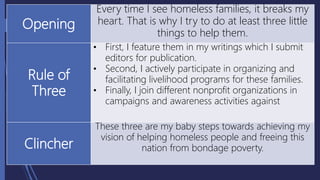
Opening
Every time I see homeless families, it breaks my
heart. That is why I try to do at least three little
things to help them.
Rule of
Three
• First, I feature them in my writings which I submit
editors for publication.
• Second, I actively participate in organizing and
facilitating livelihood programs for these families.
• Finally, I join different nonprofit organizations in
campaigns and awareness activities against
Clincher
These three are my baby steps towards achieving my
vision of helping homeless people and freeing this
nation from bondage poverty.
Bridging
This entails building a
connection between what
you do know and what you
do not know.
Refraining
This means rephrasing or
redefining the topic into
something that you want to
talk about.
Playing devil’s advocate
This refers to you standing
on the opposite side.
Some Useful Tips In
Effective Impromptu
Speech Delivery
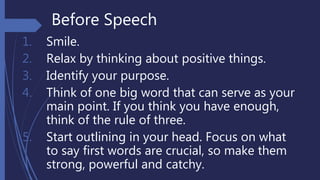
Before Speech
1. Smile.
2. Relax by thinking about positive things.
3. Identify your purpose.
4. Think of one big word that can serve as your
main point. If you think you have enough,
think of the rule of three.
5. Start outlining in your head. Focus on what
to say first words are crucial, so make them
strong, powerful and catchy.
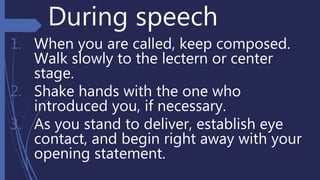
During speech
1. When you are called, keep composed.
Walk slowly to the lectern or center
stage.
2. Shake hands with the one who
introduced you, if necessary.
3. As you stand to deliver, establish eye
contact, and begin right away with your
opening statement.
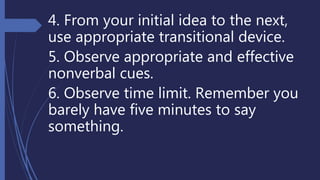
4. From your initial idea to the next,
use appropriate transitional device.
5. Observe appropriate and effective
nonverbal cues.
6. Observe time limit. Remember you
barely have five minutes to say
something.
After the speech
1. Say thank you.
2. Return to your place
comfortably.

Impromptu speech

  • 1.
  • 2.
    What is impromptu speech? Impromptuspeeches are delivered with little or no time preparation.
  • 3.
  • 4.
    1. Past, Present,Future Site a experience in your past and in your current condition in delivering a impromptu speech. And also how you see yourself in the future as you deliver a impromptu speech.
  • 5.
    2. Point-Reason-Example/ Explanation-Point POINT- Thetopic you want to talk about. REASONS- Why do you like the topic? EXPLANATION- Elaborate your reasons about the topic. POINT- Leave a conclusion or lessons.
  • 6.
    3. Opening, Ruleof three, Clincher
  • 7.
    Opening Every time Isee homeless families, it breaks my heart. That is why I try to do at least three little things to help them. Rule of Three • First, I feature them in my writings which I submit editors for publication. • Second, I actively participate in organizing and facilitating livelihood programs for these families. • Finally, I join different nonprofit organizations in campaigns and awareness activities against Clincher These three are my baby steps towards achieving my vision of helping homeless people and freeing this nation from bondage poverty.
  • 8.
    Bridging This entails buildinga connection between what you do know and what you do not know.
  • 9.
    Refraining This means rephrasingor redefining the topic into something that you want to talk about.
  • 10.
    Playing devil’s advocate Thisrefers to you standing on the opposite side.
  • 11.
    Some Useful TipsIn Effective Impromptu Speech Delivery
  • 12.
    Before Speech 1. Smile. 2.Relax by thinking about positive things. 3. Identify your purpose. 4. Think of one big word that can serve as your main point. If you think you have enough, think of the rule of three. 5. Start outlining in your head. Focus on what to say first words are crucial, so make them strong, powerful and catchy.
  • 13.
    During speech 1. Whenyou are called, keep composed. Walk slowly to the lectern or center stage. 2. Shake hands with the one who introduced you, if necessary. 3. As you stand to deliver, establish eye contact, and begin right away with your opening statement.
  • 14.
    4. From yourinitial idea to the next, use appropriate transitional device. 5. Observe appropriate and effective nonverbal cues. 6. Observe time limit. Remember you barely have five minutes to say something.
  • 15.
    After the speech 1.Say thank you. 2. Return to your place comfortably.

Editor's Notes

  • #3 In most, instances you are called to speak at the spur of the moment because you are supposed to be knowledgeable about the subject.