Information updated and conveyed  by the  neural network systems  Algis Garliauskas Institute of Mathematics and Informatics,Laboratory of Neuroinformatics,Akademijos 4, LT-8663, Vilnius, Lithuania
Abstract .In this paper, the information theory interpreted  as  the neural network systems of the brain is considered for information  conveying and storing.  Using the probability theory and specific properties of the neural systems,  some foundations are presented. The  neural network model proposed and computational experiments allow us  to draw  a conclusion that such an approach can be applied in  storing, coding, and transmission of information.   
Introduction Amount of information by Hartley in 1828 ; Information theory: Claude Shannon in 1948 ;  Abramson (1990), Hamming (1990), and  Ricke et al. (1993)  .
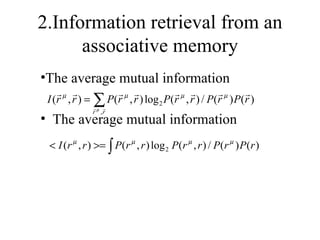
2.Information retrieval from an associative memory T he average mutual information    T he average mutual information
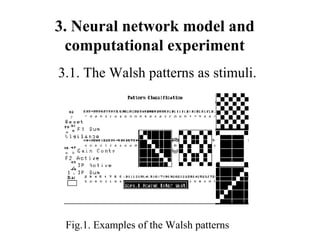
3. Neural network model and computational experiment 3.1. The Walsh patterns as stimuli. Fig.1. Examples of the Walsh patterns
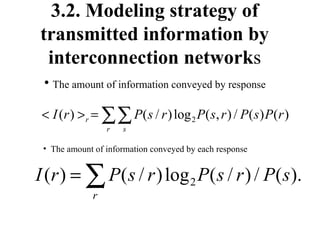
3.2. Modeling strategy of transmitted information by interconnection network s The amount of information conveyed by response   The amount of information conveyed by each response
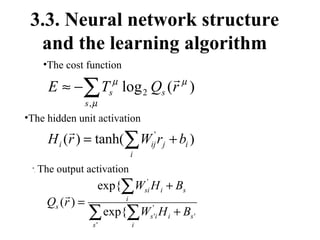
3.3. Neural network structure and the learning algorithm The cost function The hidden unit activation  .  The output activation
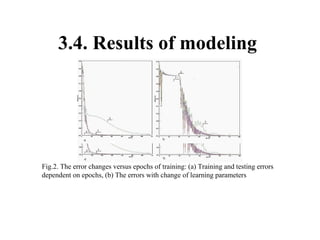
3.4. Results of modeling   Fig.2. The error changes versus epochs of training: (a) Training and testing errors dependent on epochs, (b) The errors with change of learning parameters   
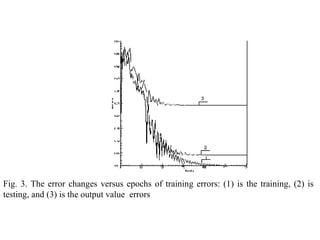
Fig. 3. The error changes versus epochs of training errors: (1) is the training, (2) is  testing, and (3) is the output value  errors  
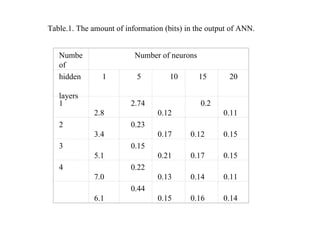
Table.1. The amount of information (bits) in the output of ANN.   Numbeof Number of neurons hidden  layers 1 5 10 15 20 1 2.8 2.74 0.12 0.2 0.11 2 3.4 0.23 0.17 0.12 0.15 3 5.1 0.15 0.21 0.17 0.15 4 7.0 0.22 0.13 0.14 0.11 6.1 0.44 0.15 0.16 0.14
4. Conclusions The analysis of  information theory applied to the neural network systems of the brain allows us to create some theoretical foundations, based on the probability theory for the convey of information in similar artificial systems. The neural network model proposed  provides a kind of its  realization,  using the Walsh patterns as stimuli of the testing being. The computational experiments have showed the possibilities of coding and decoding  information by implementing the artificial neural network. Naturally, we have to take into consideration that investigations in this progressive area should  be continued and under circumstances used in the practical sphere of  communication systems.
References   Abramson, N. 1963. Information Theory and Coding. MCGraw-Hill, New York. Hamming, R.W.  1990. Coding and Information Theory. Prentice-Hall, Englewood Cliffs, New Jersey. Hartley, R.V.  1928,  Transmission of Information. Bell System Tech. J., 7, pp.535-564. Garliauskas, A. 2004. Conceptions and Modeling for  Transmitted Information Evaluation by ANN. Informatica, vol.15, 4. Klimashauskas, C.,  Guiver J.and  Pelton G. 1989. Neural Computing,  1. Ricke, F., Warland D. and W. Bialek W. 1993. Coding efficiency anf information rates in sensory neurons. Europhysics Letters, 22}, pp.151-156. Shannon, C.E. 1948. A mathematical theory of communication. Bell System Tech. J., pp.379-423, pp.623-656  

Information updated and conveyed by the neural network systems

  • 1.
    Information updated andconveyed by the neural network systems Algis Garliauskas Institute of Mathematics and Informatics,Laboratory of Neuroinformatics,Akademijos 4, LT-8663, Vilnius, Lithuania
  • 2.
    Abstract .In thispaper, the information theory interpreted as the neural network systems of the brain is considered for information conveying and storing. Using the probability theory and specific properties of the neural systems, some foundations are presented. The neural network model proposed and computational experiments allow us to draw a conclusion that such an approach can be applied in storing, coding, and transmission of information.  
  • 3.
    Introduction Amount ofinformation by Hartley in 1828 ; Information theory: Claude Shannon in 1948 ; Abramson (1990), Hamming (1990), and Ricke et al. (1993) .
  • 4.
    2.Information retrieval froman associative memory T he average mutual information   T he average mutual information
  • 5.
    3. Neural networkmodel and computational experiment 3.1. The Walsh patterns as stimuli. Fig.1. Examples of the Walsh patterns
  • 6.
    3.2. Modeling strategyof transmitted information by interconnection network s The amount of information conveyed by response The amount of information conveyed by each response
  • 7.
    3.3. Neural networkstructure and the learning algorithm The cost function The hidden unit activation . The output activation
  • 8.
    3.4. Results ofmodeling Fig.2. The error changes versus epochs of training: (a) Training and testing errors dependent on epochs, (b) The errors with change of learning parameters  
  • 9.
    Fig. 3. Theerror changes versus epochs of training errors: (1) is the training, (2) is testing, and (3) is the output value errors  
  • 10.
    Table.1. The amountof information (bits) in the output of ANN.   Numbeof Number of neurons hidden layers 1 5 10 15 20 1 2.8 2.74 0.12 0.2 0.11 2 3.4 0.23 0.17 0.12 0.15 3 5.1 0.15 0.21 0.17 0.15 4 7.0 0.22 0.13 0.14 0.11 6.1 0.44 0.15 0.16 0.14
  • 11.
    4. Conclusions Theanalysis of information theory applied to the neural network systems of the brain allows us to create some theoretical foundations, based on the probability theory for the convey of information in similar artificial systems. The neural network model proposed provides a kind of its realization, using the Walsh patterns as stimuli of the testing being. The computational experiments have showed the possibilities of coding and decoding information by implementing the artificial neural network. Naturally, we have to take into consideration that investigations in this progressive area should be continued and under circumstances used in the practical sphere of communication systems.
  • 12.
    References Abramson, N. 1963. Information Theory and Coding. MCGraw-Hill, New York. Hamming, R.W. 1990. Coding and Information Theory. Prentice-Hall, Englewood Cliffs, New Jersey. Hartley, R.V. 1928, Transmission of Information. Bell System Tech. J., 7, pp.535-564. Garliauskas, A. 2004. Conceptions and Modeling for Transmitted Information Evaluation by ANN. Informatica, vol.15, 4. Klimashauskas, C., Guiver J.and Pelton G. 1989. Neural Computing, 1. Ricke, F., Warland D. and W. Bialek W. 1993. Coding efficiency anf information rates in sensory neurons. Europhysics Letters, 22}, pp.151-156. Shannon, C.E. 1948. A mathematical theory of communication. Bell System Tech. J., pp.379-423, pp.623-656