Journal of Theoretical and Applied Information Technology
15th
August 2017. Vol.95. No.15
© 2005 - Ongoing JATIT & LLS
ISSN: 1992-8645 www.jatit.org E-ISSN: 1817-3195
3604
APPLICATION OF CLONAL SELECTION IMMUNE SYSTEM
METHOD FOR OPTIMIZATION OF DISTRIBUTION
NETWORK
1
RAMADONI SYAHPUTRA, 2
SLAMET SURIPTO, 3
SOEDIBYO, 4
INDAH SOESANTI
1,2
Department of Electrical Engineering, Faculty of Engineering,
Universitas Muhammadiyah Yogyakarta
Jl. Ringroad Barat Tamantirto, Kasihan, Yogyakarta
INDONESIA 55183
3
Department of Electrical Engineering, Faculty of Electrical Technology,
Institut Teknologi Sepuluh Nopember
Kampus ITS Keputih, Sukolilo, Surabaya
INDONESIA 60111
4
Department of Electrical Engineering and Information Technology, Faculty of Engineering,
Universitas Gadjah Mada
Jl. Grafika 2, Kampus UGM, Yogyakarta
INDONESIA 55281
e-mail: ramadoni@umy.ac.id; slametsuripto@yahoo.com; indah@mti.ugm.ac.id
ABSTRACT
This paper proposes an application of clonal selection immune system method for optimization of
distribution network. The distribution network with high-performance is a network that has a low power
loss, better voltage profile, and loading balance among feeders. The task for improving the performance of
the distribution network is optimization of network configuration. The optimization has become a necessary
study with the presence of DG in entire networks. In this work, optimization of network configuration is
based on an AIS algorithm. The methodology has been tested in a model of 33 bus IEEE radial distribution
networks with and without DG integration. The results have been showed that the optimal configuration of
the distribution network is able to reduce power loss and to improve the voltage profile of the distribution
network significantly.
Keywords: Artificial Intelligence; Artificial Immune System; Distribution Network; Distributed Generator.
1. INTRODUCTION
The effort to reduce the active power losses of
distribution system has become an important issue
in the last decade [1]–[3]. For all of the components
of the electric power system, the distribution system
is a component that has the greatest power losses
[4]-[8]. For example, based on an energy audit by
2008, the total energy loss of electric utility in
Indonesia was 16.84% [9]. By the total loss of the
electrical energy, distribution system losses have
recorded the biggest loss that is 14.47%, while the
loss of the transmission system is only 2.37%.
Therefore, in this study are discussed the efforts to
reduce the power losses of electrical energy in the
distribution system. The motivation of this research
is the existence of high power losses in the
distribution network, as described above.
Basically, in addition to the reconfiguration of
the distribution network, there are several ways to
minimize the loss of electrical power distribution
systems, namely the installation of capacitors, load
balancing, and increasing the voltage level [10]-
[14]. Installation capacitors and load balancing
usually have difficulty because the load distribution
system is very dynamic. Thus, the value of
capacitance of the capacitor must always change
Journal of Theoretical and Applied Information Technology
15th
August 2017. Vol.95. No.15
© 2005 - Ongoing JATIT & LLS
ISSN: 1992-8645 www.jatit.org E-ISSN: 1817-3195
3605
from time to time [15]-[17]. While minimizing
losses by increasing the voltage level requires a
high cost because all equipment is connected with
this system must be able to work on a new voltage,
while the result is not necessarily satisfactory [18]-
[21]. Therefore, in this study focused on how the
reconfiguration of power distribution network with
the integration of distributed energy resources to
obtain the optimal configuration of power
distribution network.
In order to obtain an optimal network
configuration, the previous researchers have used
several methods that are classified as conventional
reconfiguration methods and reconfiguration
method based on artificial intelligence [22]-[28].
Conventional reconfiguration method is a method
that uses a heuristic approach and classic
optimization techniques [3], while the artificial
intelligence based methods are simulated annealing,
tabu search, artificial neural network, plant growth
simulation algorithm, genetic algorithms, ant
colony optimization algorithm, harmony search
algorithm, particle swarm optimization algorithm,
an algorithm based on fuzzy logic multi-objective,
and artificial immune system algorithm [29]-[35].
The objective of this research is to optimize the
configuration of distribution network using clonal
selection of artificial immune system algorithm.
The algorithm of artificial immune system (AIS) is
a new computational algorithms inspired from the
vertebrate immune system. The algorithm is able to
provide the optimal solution at the end of
optimization and suboptimal solutions are awake
during the optimization process [3]. Methods of
algorithm-based artificial immune system has the
advantage of achieving the convergence of
relatively rapid and computational load is low, so in
this study used the clonal selection type of artificial
immune system algorithm for multi-objective
optimization. This study deals only with reducing
network losses using configuration optimization
methods. The objective functions considered are
power losses and voltage profiles.
2. CLONAL SELECTION IMMUNE
SYSTEM METHOD
2.1 Theory of Clonal Selection Immune System
Artificial immune system theory is used to
explain the basic response of the immune system by
being adaptive to antigen stimulation, as described
in Figure 1. This theory states that the only cells
able to recognize antigens that will proliferate,
while other cells are ignored. Clonal selection
operates on B cells and T cells in cell B, when the
antibody binds to the antigen then activated and
differentiated into plasma cells or memory cells.
Prior to this process, B cell clones are produced and
undergo somatic hyper-mutation. The result
obtained diversity in the population of B cells to
plasma cells produce antibodies antigen-specific
works against antigens. Memory cells remain with
host antigens and promote secondary response
quickly.
The main features of the clonal selection of
artificial immune system theory are:
a. new cells are duplicates of those parents
(clone) which is charged with the rapid
mutation mechanism height (somatic hyper-
mutation),
b. elimination of the new different lymphocyte
making it the self-reactive receptors,
c. proliferation and differentiation takes place
through contact adult cells with antigen, and
d. the persistence of illegal clones, resistant to
early elimination by self-antigen, as the basis
of the auto-immune disease.
Figure 1. The General Principle Of Artificial Immune
System
The analogy with natural selection fit the reality
that is the strongest candidate into most cells
recognizes antigens, or in other words, into cells
most triggered. To workings of this algorithm,
population or repertoire of receptors should be
diverse enough to recognize any form of foreign
cells. A mammalian immune system contains a
heterogeneous repertoire of about 1012
lymphocytes
in humans, and the rest of B cells (stimulated) can
display about 105
-107
identical like-antibody
receptor. Repertoire has been believed complete
means that he can recognize the shape of any cell.
Journal of Theoretical and Applied Information Technology
15th
August 2017. Vol.95. No.15
© 2005 - Ongoing JATIT & LLS
ISSN: 1992-8645 www.jatit.org E-ISSN: 1817-3195
3606
In [11], they have proposed the clonal selection
algorithm named ClonalG for learning and
optimization. They discussed the main features of
the theory of clonal selection and develop
algorithms include the maintenance of a set of
specific memory, selection and cloning antibodies
are most stimulated, death antibody non-excitatory,
maturation affinity and selection of re clones are
balanced against affinity antigen, and the
generation and maintenance of a set of antibodies.
The main steps of clonal selection of artificial
immune system method are described in the
following algorithm.
Input: Ab, gen, n, d, L, β;
Output: Ab, f
1. for t = 1 to gen,
1.1 f := decode (Ab); vector f
contains all affinity
antibodies that bind to the
antigen
1.2 Abn := select (Ab, f, n);
1.3 C := clone (Abn, β, f);
1.4 C* := hypermut (C, f);
1.5 f := decode (C*);
1.6 Abn := select (C*, f, n);
1.7 Ab := insert (Ab, Abn);
1.8 Abd := generate ( d, L );
randomly generate antibody d
along L
1.9 Ab := replace (Ab, Abd, f);
end;
2. f := decode (Ab); Decode
functions are supposed to
encode Ab and evaluation for
values decode.
Affinity between antibody and antigen can be
defined using different techniques such as matching
rules and a measure of distance. One common
technique used is the Euclidean distance, which is
suitable when using a real-valued vector
representation. To explain how ClonalG work using
Euclidean distance, suppose Ag = {Ag1, Ag2, ...,
AgN}, and Ab = {Ab1, Ab2, ..., AbN} show the
antigen and antibody sets respectively, N is the
support of the order. Then, the degree of match
between Ag and Ab d can be calculated based on
the Euclidean distance:
 

N
i
ii AbAgd
1
2
(1)
Furthermore, d compared with the threshold λ,
and a matching error E is obtained using the
equation:
E = d – λ (2)
If E > 0, it is considered that the two vectors do
not match, so that these antigens are not recognized
by the antibody. If E <= 0, concluded that Ag Ab
match, then the antigen recognized by the antibody.
General range for calculation of affinity is varying
between 0 and 1.
For affinity maturation, ClonalG algorithm
assumes that the n highest affinity antibody is
sorted rise, and the number of clones that are raised
for all n selected antibodies are given by:






 

n
i i
N
roundNc
1
 (3)
with N is the total number of clones for each
antigen, β are the cloned factor determining the
scale factor for the number of clones for antibodies
elected and β common value is  (0,1], N is the
total amount of antibodies and round() is operators
who rotate argument to the nearest integer. Every
part of this amount corresponds to the size of clones
of each antibody chosen, for example, for N = 100
and β = 1, antibodies highest affinity (i = 1) will
produce 100 clones, while the antibody affinity the
second highest yield of 50 clones, and thus further
[11].
2.2 Clonal Selection Immune System for
Reconfiguring the Distribution Network
Artificial Immune System is a computational
intelligence approach that is inspired by the
vertebrate immune system and has become a
popular method in solving various problems in
optimization. In the artificial immune system
algorithm, one important variable used is the
population (x), and the mutation of the population
is implemented in the following equation:
Xi+mj = Xy + N (0, β) (Xjmax – Xjmin) (f1/fmax) (4)
Stages of completion of optimization problems
using artificial immune system algorithm are based
on the following steps:
Step 1. Initialize population
For the purpose of minimization of power losses,
then the combination tie switches of distribution
network to the condition prior to the
reconfiguration should be determined in advance.
Determination of the combination tie switches is
done randomly. Number of tie switches is
determined based on the amount of tie switches
Journal of Theoretical and Applied Information Technology
15th
August 2017. Vol.95. No.15
© 2005 - Ongoing JATIT & LLS
ISSN: 1992-8645 www.jatit.org E-ISSN: 1817-3195
3607
contained in the distribution network.
Step 2. Evaluate the fitness value of each
population
In order to minimize the power losses, fitness of
artificial immune system is considered as a total
loss in the distribution system. Total losses were
evaluated by solving the power flow program.
This is done by calling the power flow program
into the artificial immune system as the main
program. Optimizations also pay attention to the
constraints of the voltage in the distribution
system so that the minimum voltage and the
maximum are not exceeded.
Step 3. Clone
In this process, a combination of tie switches and
total power losses in the distribution network is
carried out the cloning.
Step 4. The process of mutation
In this process, the value of cloning is mutated by
implementing mutation carriers. Mutations only
on the operator variations are used to generate
offspring from each parent. Fitness of the
offspring is calculated by calling the power flow
program.
Step 5. Selection process
The selection process is done by applying
selection strategies based on priority.
Step 6. Test the convergence
The test procedure is done to determine the
convergence criteria optimization termination.
Convergence criteria specified by the difference
between the maximum and the minimum fitness
of less than 0.0001. If the convergence condition
is not met, then the process will be repeated until
a convergence condition is achieved.
maximumfitness – minimumfitness ≤ 0,0001 (5)
3. RESULTS AND DISCUSSION
In this study, the optimization distribution
network configuration of the 33 bus IEEE model
distribution network using Clonal Selection
Immune System algorithm is described. The
procedure of optimization is implemented on the
IEEE model of 33 bus, 12.66 kV radial distribution
network in two conditions, i.e. both in without DG
integration and with DG integration. The
distribution network has 33 buses and 32 sections,
as shown in Figure 2. The sectionalizing switches
are switches that are in closed under normal
conditions while the tie switches are switches that
are in open under normal conditions. Data which
are loaded on 33-bus IEEE distribution network can
be seen in [10]. The total load of the IEEE
distribution network is 3715 kW. The base of the
system is V=12.66 kV and S=10 MVA. In initial
configuration, the IEEE distribution system has
been set at five tie switches, i.e. switches of 33, 34,
35, 36 and 37, respectively, as can be seen in Figure
2. It also can be seen in Figure 2 that the IEEE
distribution network model is consist of one feeder
from a substation.
Figure 2. Initial Configuration Of A 33-Bus IEEE
Distribution Network
Journal of Theoretical and Applied Information Technology
15th
August 2017. Vol.95. No.15
© 2005 - Ongoing JATIT & LLS
ISSN: 1992-8645 www.jatit.org E-ISSN: 1817-3195
3608
Table 1. DG Location And Capacity Of IEEE 33-Bus
System
Name
Bus
Number
Active
Power
(MW)
Power
Factor
Reactive
Power
(MVAr)
DG1 18 1.92 0.9 0.93
DG2 22 1.75 1 0
DG3 33 1.68 0.9 0.81
Total 5.35 - 1.74
In IEEE 33-bus distribution network, there are
installed as many as three DGs on buses of 18, 22,
and 33. The capacities of these three DGs are 1.92
MW, 1.75 MW, and 1.68 MW, respectively, as
shown in Table 1. The installation of these DGs is
intended to see the impact of DG on distribution
network performances.
Figure 3. Integration Of Three Dgs On 33-Bus IEEE
Distribution Network
The DG models that have used in our study
consist of both wind farms and solar photovoltaics.
We have assumed that power factor of all DG wind
farms are 0.9 lagging while solar photovoltaics are
unity. Integration of the three DGs on 33-bus IEEE
distribution network is shown in Figure 3. Then, the
optimization of configuration of the radial
distribution network model with DG integration
using AIS algorithm is performed. The results of
the optimization are shown in Figure 4, Figure 5,
Figure 6, and Figure 7.
Figure 4. Phase Of Power Loss To Iteration During
Optimization Process
Figure 5. The Optimal Configuration Of 33-Bus IEEE
Distribution Network With DG Integration
Figure 4 shows phase of power loss to iteration
during optimization process of IEEE 33-bus radial
Journal of Theoretical and Applied Information Technology
15th
August 2017. Vol.95. No.15
© 2005 - Ongoing JATIT & LLS
ISSN: 1992-8645 www.jatit.org E-ISSN: 1817-3195
3609
distribution network with integration of three DGs.
The various iterations are applied to see the
performance of AIS algorithm in optimization of
distribution network configuration. Using the
iterations, it is expected to be obtained information
that the lowest number of iterations to get the best
configuration and the lowest computation time.
Optimization results show that there are as many as
9 power losses phases due to changes in iteration
numbers, i.e. 5, 10, 30, 50, 100, 200, 300, 400 and
500, respectively, as can be seen in Figure 4. The
optimal configuration is obtained on the iteration of
500, in computing time of 393.91 seconds. The
positions of tie switches for this configuration are 8,
19, 27, 34 and 36, respectively.
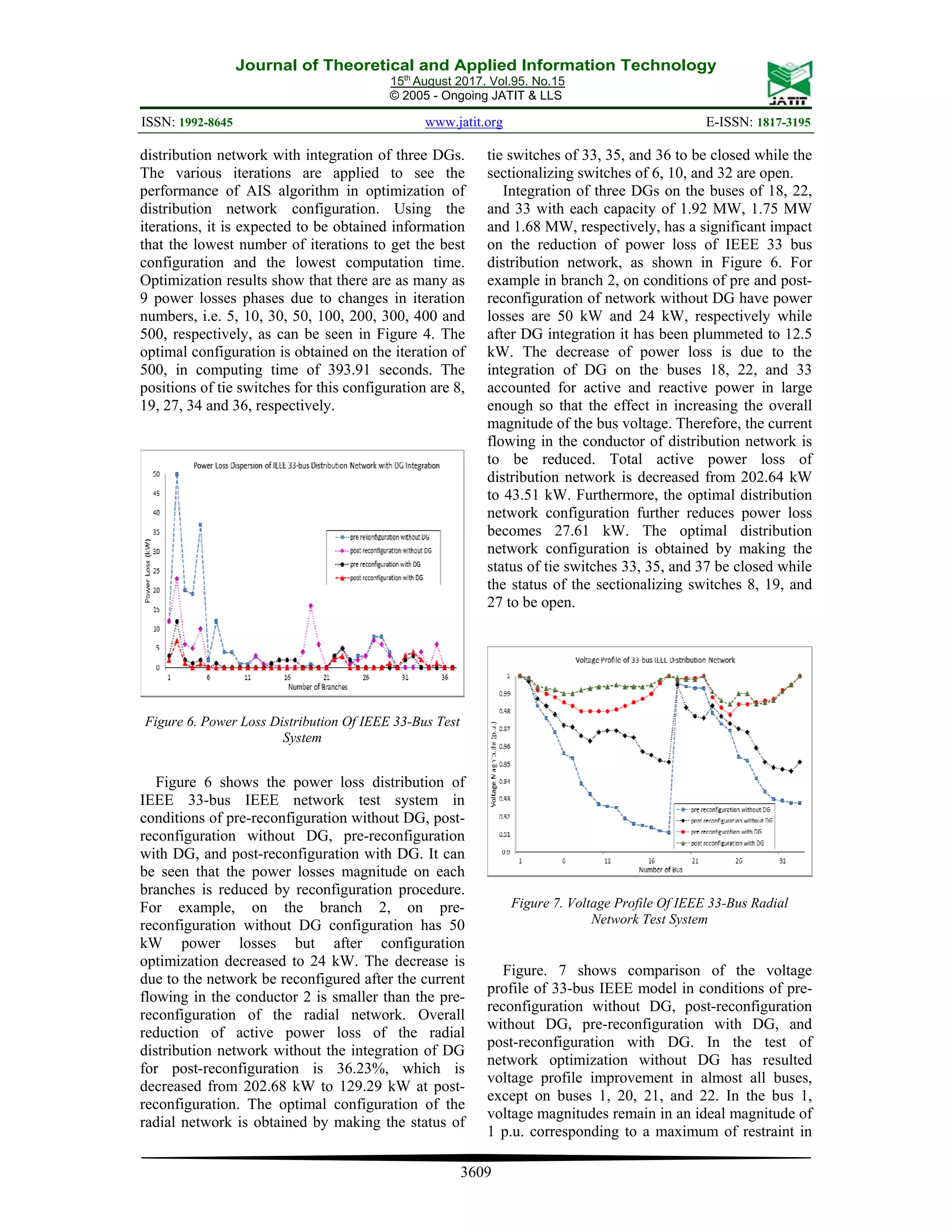
Figure 6. Power Loss Distribution Of IEEE 33-Bus Test
System
Figure 6 shows the power loss distribution of
IEEE 33-bus IEEE network test system in
conditions of pre-reconfiguration without DG, post-
reconfiguration without DG, pre-reconfiguration
with DG, and post-reconfiguration with DG. It can
be seen that the power losses magnitude on each
branches is reduced by reconfiguration procedure.
For example, on the branch 2, on pre-
reconfiguration without DG configuration has 50
kW power losses but after configuration
optimization decreased to 24 kW. The decrease is
due to the network be reconfigured after the current
flowing in the conductor 2 is smaller than the pre-
reconfiguration of the radial network. Overall
reduction of active power loss of the radial
distribution network without the integration of DG
for post-reconfiguration is 36.23%, which is
decreased from 202.68 kW to 129.29 kW at post-
reconfiguration. The optimal configuration of the
radial network is obtained by making the status of
tie switches of 33, 35, and 36 to be closed while the
sectionalizing switches of 6, 10, and 32 are open.
Integration of three DGs on the buses of 18, 22,
and 33 with each capacity of 1.92 MW, 1.75 MW
and 1.68 MW, respectively, has a significant impact
on the reduction of power loss of IEEE 33 bus
distribution network, as shown in Figure 6. For
example in branch 2, on conditions of pre and post-
reconfiguration of network without DG have power
losses are 50 kW and 24 kW, respectively while
after DG integration it has been plummeted to 12.5
kW. The decrease of power loss is due to the
integration of DG on the buses 18, 22, and 33
accounted for active and reactive power in large
enough so that the effect in increasing the overall
magnitude of the bus voltage. Therefore, the current
flowing in the conductor of distribution network is
to be reduced. Total active power loss of
distribution network is decreased from 202.64 kW
to 43.51 kW. Furthermore, the optimal distribution
network configuration further reduces power loss
becomes 27.61 kW. The optimal distribution
network configuration is obtained by making the
status of tie switches 33, 35, and 37 be closed while
the status of the sectionalizing switches 8, 19, and
27 to be open.
Figure 7. Voltage Profile Of IEEE 33-Bus Radial
Network Test System
Figure. 7 shows comparison of the voltage
profile of 33-bus IEEE model in conditions of pre-
reconfiguration without DG, post-reconfiguration
without DG, pre-reconfiguration with DG, and
post-reconfiguration with DG. In the test of
network optimization without DG has resulted
voltage profile improvement in almost all buses,
except on buses 1, 20, 21, and 22. In the bus 1,
voltage magnitudes remain in an ideal magnitude of
1 p.u. corresponding to a maximum of restraint in
Journal of Theoretical and Applied Information Technology
15th
August 2017. Vol.95. No.15
© 2005 - Ongoing JATIT & LLS
ISSN: 1992-8645 www.jatit.org E-ISSN: 1817-3195
3610
this optimization. On buses of 20, 21, and 22, there
were a slight decrease in voltage magnitude as a
consequence of changes in the status of the current
configuration switches. As can be seen in the
results of configuration optimization in Figure 7,
the buses of 20, 21, and 22 are connected to more
buses, so they are resulting in a slight voltage drop.
In overall, the voltage profile of post-
reconfiguration condition is better than pre
reconfiguration condition. The lowest voltage
magnitude of pre-reconfiguration is 0.913 p.u. on
bus of 18 while the lowest voltage magnitude of
post-reconfiguration is 0.949 p.u. on the same bus,
as shown in Figure 7.
Integration of three DGs on IEEE 33-bus
distribution network model has a significant impact
on bus voltage profile improvement. Figure 7
shows that the voltage magnitude for entire bus
increases except bus 1 which has reached 1 p.u. The
improved voltage profile can be seen from the
increasing in magnitude of the lowest voltage
magnitude. In condition without DG, the lowest
voltage magnitude is 0.915 p.u. on bus of 18 while
in condition with DG integration is 0.978 p.u. on
bus 25 for the same network configuration, as
shown in Figure 7. The increase is due to the
integration of DG on the buses 18, 22, and 33 so the
active and reactive power is large enough.
Therefore, the impact increasing the overall
magnitude of the bus voltage is obtained. In
particular, it can be observed especially on the bus
of 18. The voltage magnitude on bus of 18 is the
lowest voltage in IEEE 33 bus power distribution
network on the initial conditions, i.e. 0.914 p.u.
Integration of DG1 with a capacity of 1.92 MW on
bus 18 is adequate to increase the magnitude of the
voltage to 1 p.u. Likewise with integration of DG3
with a capacity of 1.68 MW on bus 33 is adequate
to raise the voltage magnitude from 0.929 to 1 p.u.
5. CONCLUSION
In this study, the clonal selection immune
system algorithm was tested on an IEEE 33-bus
distribution network. Based on the results, it was
shown that the algorithm is effective in enhancing
efficiency of the two test distribution systems.
Efficiencies of the IEEE 33-bus distribution
network in the pre reconfiguration without DG is
94.81%, post reconfiguration without DG is
96.61%, pre reconfiguration with DG is 98.82%,
and post reconfiguration with DG is 99.23%. In
order to see the performance of AIS algorithm, it
has also been tested on the voltage profile for the
IEEE 33-bus distribution network. The result of the
optimization is that the integration of DG in the test
networks has obtained in improved voltage quality.
The voltage quality is to be improved further by
reconfiguring the distribution network.
ACKNOWLEDGEMENTS
The research team would like to thank profusely
to the Ministry of Research, Technology and
Higher Education for funding this research.
Hopefully this good cooperation can be continued
so as to contribute to the research development and
strengthening of national innovation system.
REFRENCES:
[1] Farahani, V., B. Vahidi, and H.A. Abyaneh,
Reconfiguration and Capacitor Placement
Simultaneously for Energy Loss Reduction
Based on an Improved Reconfiguration
Method, IEEE Trans. on Power Systems, Vol.
27, No. 22, 2012, pp. 587-595.
[2] Syahputra, R., Robandi, I., Ashari, M. (2015).
Reconfiguration of Distribution Network with
DER Integration Using PSO Algorithm.
TELKOMNIKA, 13(3). pp. 759-766.
[3] Syahputra, R., Soesanti, I., Ashari, M. (2016).
Performance Enhancement of Distribution
Network with DG Integration Using Modified
PSO Algorithm. Journal of Electrical Systems
(JES), 12(1), pp. 1-19.
[4] Syahputra, R., Robandi, I., Ashari, M. (2015).
PSO Based Multi-objective Optimization for
Reconfiguration of Radial Distribution
Network. International Journal of Applied
Engineering Research (IJAER), 10(6), pp.
14573-14586.
[5] Merlin, A., and H. Back, “Search for a
minimal-loss operating spanning tree
configuration in an urban power distribution
system”, Proc. 5th PSCC Conference, 1975,
pp.1–18, Cambridge, U.K.
[6] Syahputra, R., (2012), “Distributed Generation:
State of the Arts dalam Penyediaan Energi
Listrik”, LP3M UMY, Yogyakarta, 2012.
[7] Syahputra, R. (2010). Fault Distance
Estimation of Two-Terminal Transmission
Lines. Proceedings of International Seminar on
Applied Technology, Science, and Arts (2nd
APTECS), Surabaya, 21-22 Dec. 2010, pp.
419-423.
[8] Jamal, A., Suripto, S., Syahputra, R. (2017).
Power Flow Optimization Using UPFC Based
on Neuro-Fuzzy Method for Multi-machine
Power System Stability. International Journal
Journal of Theoretical and Applied Information Technology
15th
August 2017. Vol.95. No.15
© 2005 - Ongoing JATIT & LLS
ISSN: 1992-8645 www.jatit.org E-ISSN: 1817-3195
3611
of Applied Engineering Research (IJAER),
12(6), pp. 898-907.
[9] Jamal, A., Suripto, S., Syahputra, R. (2016).
Performance Evaluation of Wind Turbine with
Doubly-Fed Induction Generator. International
Journal of Applied Engineering Research
(IJAER), 11(7), pp. 4999-5004.
[10]Syahputra, R., Robandi, I., Ashari, M. (2015).
Performance Improvement of Radial
Distribution Network with Distributed
Generation Integration Using Extended Particle
Swarm Optimization Algorithm. International
Review of Electrical Engineering (IREE),
10(2). pp. 293-304.
[11]Syahputra, R., Robandi, I., Ashari, M. (2014).
Optimization of Distribution Network
Configuration with Integration of Distributed
Energy Resources Using Extended Fuzzy
Multi-objective Method. International Review
of Electrical Engineering (IREE), 9(3), pp.
629-639.
[12]Syahputra, R., Robandi, I., Ashari, M., (2013),
“Distribution Network Efficiency Improvement
Based on Fuzzy Multi-objective Method”.
International Seminar on Applied Technology,
Science and Arts (APTECS). 2013; pp. 224-
229.
[13]Jamal, A., Syahputra, R. (2013). UPFC Based
on Adaptive Neuro-Fuzzy for Power Flow
Control of Multimachine Power Systems.
International Journal of Engineering Science
Invention (IJESI), 2(10), pp. 05-14.
[14]Syahputra, R., (2012), “Fuzzy Multi-Objective
Approach for the Improvement of Distribution
Network Efficiency by Considering DG”,
IJCSIT, Vol. 4, No. 2, pp. 57-68.
[15]Syahputra, R., Robandi, I., Ashari, M. (2014).
“Optimal Distribution Network
Reconfiguration with Penetration of
Distributed Energy Resources”, Proceeding of
2014 1st International Conference on
Information Technology, Computer, and
Electrical Engineering (ICITACEE) 2014,
UNDIP Semarang, pp. 388 - 393.
[16]Syahputra, R., (2013), “A Neuro-Fuzzy
Approach For the Fault Location Estimation of
Unsynchronized Two-Terminal Transmission
Lines”, IJCSIT, Vol. 5, No. 1, pp. 23-37.
[17]Jamal, A., Syahputra, R. (2014). Power Flow
Control of Power Systems Using UPFC Based
on Adaptive Neuro Fuzzy. IPTEK Journal of
Proceedings Series. 2014; 1(1): pp. 218-223.
[18]Soedibyo, Ashari, M., Syahputra, R. (2014).
“Power loss reduction strategy of distribution
network with distributed generator
integration”, Proceeding of 2014 1st
International Conference on Information
Technology, Computer, and Electrical
Engineering (ICITACEE) 2014, UNDIP
Semarang, pp. 404 - 408.
[19]Syahputra, R., Soesanti, I. (2016). DFIG
Control Scheme of Wind Power Using ANFIS
Method in Electrical Power Grid System.
International Journal of Applied Engineering
Research (IJAER), 11(7), pp. 5256-5262.
[20]Syahputra, R., Robandi, I., Ashari, M., (2012),
“Reconfiguration of Distribution Network with
DG Using Fuzzy Multi-objective Method”,
International Conference on Innovation,
Management and Technology Research
(ICIMTR), May 21-22, 2012, Melacca,
Malaysia.
[21]Syahputra, R., Soesanti, I. (2015). Power
System Stabilizer model based on Fuzzy-PSO
for improving power system stability. 2015
International Conference on Advanced
Mechatronics, Intelligent Manufacture, and
Industrial Automation (ICAMIMIA),
Surabaya, 15-17 Oct. 2015 pp. 121 - 126.
[22]Soesanti, I., Syahputra, R. (2016). Batik
Production Process Optimization Using
Particle Swarm Optimization Method. Journal
of Theoretical and Applied Information
Technology, 86(2), pp. 272-278.
[23]Syahputra, R., Soesanti, I. (2016). Design of
Automatic Electric Batik Stove for Batik
Industry. Journal of Theoretical and Applied
Information Technology (JATIT), 87(1), pp.
167-175.
[24]Syahputra, R. (2016). Application of Neuro-
Fuzzy Method for Prediction of Vehicle Fuel
Consumption. Journal of Theoretical and
Applied Information Technology (JATIT),
86(1), pp. 138-149.
[25]Jamal, A., Suripto, S., Syahputra, R. (2015).
Multi-Band Power System Stabilizer Model for
Power Flow Optimization in Order to Improve
Power System Stability. Journal of Theoretical
and Applied Information Technology (JATIT),
80(1), pp. 116-123.
[26]Syahputra, R. (2017). Distribution Network
Optimization Based on Genetic Algorithm.
Jurnal Teknologi, Journal of Electrical
Technology UMY (JET-UMY), 1(1), pp. 1-9.
[27]Syahputra, R., Robandi, I., Ashari, M. (2014).
Performance Analysis of Wind Turbine as a
Distributed Generation Unit in Distribution
System. IJCSIT), Vol. 6, No. 3, pp. 39-56.
Journal of Theoretical and Applied Information Technology
15th
August 2017. Vol.95. No.15
© 2005 - Ongoing JATIT & LLS
ISSN: 1992-8645 www.jatit.org E-ISSN: 1817-3195
3612
[28]Syahputra, R., Robandi, I., Ashari, M., (2014),
“Distribution Network Efficiency Improvement
Based on Fuzzy Multi-objective Method”.
IPTEK Journal of Proceedings Series. 2014;
1(1): pp. 224-229.
[29]Syahputra, R., Soesanti, I. (2015). “Control of
Synchronous Generator in Wind Power
Systems Using Neuro-Fuzzy Approach”,
Proceeding of International Conference on
Vocational Education and Electrical
Engineering (ICVEE) 2015, UNESA Surabaya,
pp. 187-193.
[30]Syahputra, R., Wiyagi, R.O., Sudarisman.
(2017). Performance Analysis of a Wind
Turbine with Permanent Magnet Synchronous
Generator. Journal of Theoretical and Applied
Information Technology (JATIT), 95(9), pp.
1950-1957.
[31]Syahputra, R., Robandi, I., Ashari, M., (2011),
“Control of Doubly-Fed Induction Generator in
Distributed Generation Units Using Adaptive
Neuro-Fuzzy Approach”. International
Seminar on Applied Technology, Science and
Arts (APTECS). 2011; pp. 493-501.
[32]Jamal, A., Syahputra, R. (2016). Heat
Exchanger Control Based on Artificial
Intelligence Approach. International Journal of
Applied Engineering Research (IJAER),
11(16), pp. 9063-9069.
[33]Syahputra, R., Soesanti, I. (2016). An Optimal
Tuning of PSS Using AIS Algorithm for
Damping Oscillation of Multi-machine Power
System. Journal of Theoretical and Applied
Information Technology (JATIT), 94(2), pp.
312-326.
[34]Syahputra, R., Soesanti, I. (2016). Power
System Stabilizer Model Using Artificial
Immune System for Power System Controlling.
International Journal of Applied Engineering
Research (IJAER), 11(18), pp. 9269-9278.
[35]Syahputra, R., Soesanti, I. (2016). Application
of Green Energy for Batik Production Process.
Journal of Theoretical and Applied Information
Technology (JATIT), 91(2), pp. 249-256.

APPLICATION OF CLONAL SELECTION IMMUNE SYSTEM METHOD FOR OPTIMIZATION OF DISTRIBUTION NETWORK

  • 1.
    Journal of Theoreticaland Applied Information Technology 15th August 2017. Vol.95. No.15 © 2005 - Ongoing JATIT & LLS ISSN: 1992-8645 www.jatit.org E-ISSN: 1817-3195 3604 APPLICATION OF CLONAL SELECTION IMMUNE SYSTEM METHOD FOR OPTIMIZATION OF DISTRIBUTION NETWORK 1 RAMADONI SYAHPUTRA, 2 SLAMET SURIPTO, 3 SOEDIBYO, 4 INDAH SOESANTI 1,2 Department of Electrical Engineering, Faculty of Engineering, Universitas Muhammadiyah Yogyakarta Jl. Ringroad Barat Tamantirto, Kasihan, Yogyakarta INDONESIA 55183 3 Department of Electrical Engineering, Faculty of Electrical Technology, Institut Teknologi Sepuluh Nopember Kampus ITS Keputih, Sukolilo, Surabaya INDONESIA 60111 4 Department of Electrical Engineering and Information Technology, Faculty of Engineering, Universitas Gadjah Mada Jl. Grafika 2, Kampus UGM, Yogyakarta INDONESIA 55281 e-mail: ramadoni@umy.ac.id; slametsuripto@yahoo.com; indah@mti.ugm.ac.id ABSTRACT This paper proposes an application of clonal selection immune system method for optimization of distribution network. The distribution network with high-performance is a network that has a low power loss, better voltage profile, and loading balance among feeders. The task for improving the performance of the distribution network is optimization of network configuration. The optimization has become a necessary study with the presence of DG in entire networks. In this work, optimization of network configuration is based on an AIS algorithm. The methodology has been tested in a model of 33 bus IEEE radial distribution networks with and without DG integration. The results have been showed that the optimal configuration of the distribution network is able to reduce power loss and to improve the voltage profile of the distribution network significantly. Keywords: Artificial Intelligence; Artificial Immune System; Distribution Network; Distributed Generator. 1. INTRODUCTION The effort to reduce the active power losses of distribution system has become an important issue in the last decade [1]–[3]. For all of the components of the electric power system, the distribution system is a component that has the greatest power losses [4]-[8]. For example, based on an energy audit by 2008, the total energy loss of electric utility in Indonesia was 16.84% [9]. By the total loss of the electrical energy, distribution system losses have recorded the biggest loss that is 14.47%, while the loss of the transmission system is only 2.37%. Therefore, in this study are discussed the efforts to reduce the power losses of electrical energy in the distribution system. The motivation of this research is the existence of high power losses in the distribution network, as described above. Basically, in addition to the reconfiguration of the distribution network, there are several ways to minimize the loss of electrical power distribution systems, namely the installation of capacitors, load balancing, and increasing the voltage level [10]- [14]. Installation capacitors and load balancing usually have difficulty because the load distribution system is very dynamic. Thus, the value of capacitance of the capacitor must always change
  • 2.
    Journal of Theoreticaland Applied Information Technology 15th August 2017. Vol.95. No.15 © 2005 - Ongoing JATIT & LLS ISSN: 1992-8645 www.jatit.org E-ISSN: 1817-3195 3605 from time to time [15]-[17]. While minimizing losses by increasing the voltage level requires a high cost because all equipment is connected with this system must be able to work on a new voltage, while the result is not necessarily satisfactory [18]- [21]. Therefore, in this study focused on how the reconfiguration of power distribution network with the integration of distributed energy resources to obtain the optimal configuration of power distribution network. In order to obtain an optimal network configuration, the previous researchers have used several methods that are classified as conventional reconfiguration methods and reconfiguration method based on artificial intelligence [22]-[28]. Conventional reconfiguration method is a method that uses a heuristic approach and classic optimization techniques [3], while the artificial intelligence based methods are simulated annealing, tabu search, artificial neural network, plant growth simulation algorithm, genetic algorithms, ant colony optimization algorithm, harmony search algorithm, particle swarm optimization algorithm, an algorithm based on fuzzy logic multi-objective, and artificial immune system algorithm [29]-[35]. The objective of this research is to optimize the configuration of distribution network using clonal selection of artificial immune system algorithm. The algorithm of artificial immune system (AIS) is a new computational algorithms inspired from the vertebrate immune system. The algorithm is able to provide the optimal solution at the end of optimization and suboptimal solutions are awake during the optimization process [3]. Methods of algorithm-based artificial immune system has the advantage of achieving the convergence of relatively rapid and computational load is low, so in this study used the clonal selection type of artificial immune system algorithm for multi-objective optimization. This study deals only with reducing network losses using configuration optimization methods. The objective functions considered are power losses and voltage profiles. 2. CLONAL SELECTION IMMUNE SYSTEM METHOD 2.1 Theory of Clonal Selection Immune System Artificial immune system theory is used to explain the basic response of the immune system by being adaptive to antigen stimulation, as described in Figure 1. This theory states that the only cells able to recognize antigens that will proliferate, while other cells are ignored. Clonal selection operates on B cells and T cells in cell B, when the antibody binds to the antigen then activated and differentiated into plasma cells or memory cells. Prior to this process, B cell clones are produced and undergo somatic hyper-mutation. The result obtained diversity in the population of B cells to plasma cells produce antibodies antigen-specific works against antigens. Memory cells remain with host antigens and promote secondary response quickly. The main features of the clonal selection of artificial immune system theory are: a. new cells are duplicates of those parents (clone) which is charged with the rapid mutation mechanism height (somatic hyper- mutation), b. elimination of the new different lymphocyte making it the self-reactive receptors, c. proliferation and differentiation takes place through contact adult cells with antigen, and d. the persistence of illegal clones, resistant to early elimination by self-antigen, as the basis of the auto-immune disease. Figure 1. The General Principle Of Artificial Immune System The analogy with natural selection fit the reality that is the strongest candidate into most cells recognizes antigens, or in other words, into cells most triggered. To workings of this algorithm, population or repertoire of receptors should be diverse enough to recognize any form of foreign cells. A mammalian immune system contains a heterogeneous repertoire of about 1012 lymphocytes in humans, and the rest of B cells (stimulated) can display about 105 -107 identical like-antibody receptor. Repertoire has been believed complete means that he can recognize the shape of any cell.
  • 3.
    Journal of Theoreticaland Applied Information Technology 15th August 2017. Vol.95. No.15 © 2005 - Ongoing JATIT & LLS ISSN: 1992-8645 www.jatit.org E-ISSN: 1817-3195 3606 In [11], they have proposed the clonal selection algorithm named ClonalG for learning and optimization. They discussed the main features of the theory of clonal selection and develop algorithms include the maintenance of a set of specific memory, selection and cloning antibodies are most stimulated, death antibody non-excitatory, maturation affinity and selection of re clones are balanced against affinity antigen, and the generation and maintenance of a set of antibodies. The main steps of clonal selection of artificial immune system method are described in the following algorithm. Input: Ab, gen, n, d, L, β; Output: Ab, f 1. for t = 1 to gen, 1.1 f := decode (Ab); vector f contains all affinity antibodies that bind to the antigen 1.2 Abn := select (Ab, f, n); 1.3 C := clone (Abn, β, f); 1.4 C* := hypermut (C, f); 1.5 f := decode (C*); 1.6 Abn := select (C*, f, n); 1.7 Ab := insert (Ab, Abn); 1.8 Abd := generate ( d, L ); randomly generate antibody d along L 1.9 Ab := replace (Ab, Abd, f); end; 2. f := decode (Ab); Decode functions are supposed to encode Ab and evaluation for values decode. Affinity between antibody and antigen can be defined using different techniques such as matching rules and a measure of distance. One common technique used is the Euclidean distance, which is suitable when using a real-valued vector representation. To explain how ClonalG work using Euclidean distance, suppose Ag = {Ag1, Ag2, ..., AgN}, and Ab = {Ab1, Ab2, ..., AbN} show the antigen and antibody sets respectively, N is the support of the order. Then, the degree of match between Ag and Ab d can be calculated based on the Euclidean distance:    N i ii AbAgd 1 2 (1) Furthermore, d compared with the threshold λ, and a matching error E is obtained using the equation: E = d – λ (2) If E > 0, it is considered that the two vectors do not match, so that these antigens are not recognized by the antibody. If E <= 0, concluded that Ag Ab match, then the antigen recognized by the antibody. General range for calculation of affinity is varying between 0 and 1. For affinity maturation, ClonalG algorithm assumes that the n highest affinity antibody is sorted rise, and the number of clones that are raised for all n selected antibodies are given by:          n i i N roundNc 1  (3) with N is the total number of clones for each antigen, β are the cloned factor determining the scale factor for the number of clones for antibodies elected and β common value is  (0,1], N is the total amount of antibodies and round() is operators who rotate argument to the nearest integer. Every part of this amount corresponds to the size of clones of each antibody chosen, for example, for N = 100 and β = 1, antibodies highest affinity (i = 1) will produce 100 clones, while the antibody affinity the second highest yield of 50 clones, and thus further [11]. 2.2 Clonal Selection Immune System for Reconfiguring the Distribution Network Artificial Immune System is a computational intelligence approach that is inspired by the vertebrate immune system and has become a popular method in solving various problems in optimization. In the artificial immune system algorithm, one important variable used is the population (x), and the mutation of the population is implemented in the following equation: Xi+mj = Xy + N (0, β) (Xjmax – Xjmin) (f1/fmax) (4) Stages of completion of optimization problems using artificial immune system algorithm are based on the following steps: Step 1. Initialize population For the purpose of minimization of power losses, then the combination tie switches of distribution network to the condition prior to the reconfiguration should be determined in advance. Determination of the combination tie switches is done randomly. Number of tie switches is determined based on the amount of tie switches
  • 4.
    Journal of Theoreticaland Applied Information Technology 15th August 2017. Vol.95. No.15 © 2005 - Ongoing JATIT & LLS ISSN: 1992-8645 www.jatit.org E-ISSN: 1817-3195 3607 contained in the distribution network. Step 2. Evaluate the fitness value of each population In order to minimize the power losses, fitness of artificial immune system is considered as a total loss in the distribution system. Total losses were evaluated by solving the power flow program. This is done by calling the power flow program into the artificial immune system as the main program. Optimizations also pay attention to the constraints of the voltage in the distribution system so that the minimum voltage and the maximum are not exceeded. Step 3. Clone In this process, a combination of tie switches and total power losses in the distribution network is carried out the cloning. Step 4. The process of mutation In this process, the value of cloning is mutated by implementing mutation carriers. Mutations only on the operator variations are used to generate offspring from each parent. Fitness of the offspring is calculated by calling the power flow program. Step 5. Selection process The selection process is done by applying selection strategies based on priority. Step 6. Test the convergence The test procedure is done to determine the convergence criteria optimization termination. Convergence criteria specified by the difference between the maximum and the minimum fitness of less than 0.0001. If the convergence condition is not met, then the process will be repeated until a convergence condition is achieved. maximumfitness – minimumfitness ≤ 0,0001 (5) 3. RESULTS AND DISCUSSION In this study, the optimization distribution network configuration of the 33 bus IEEE model distribution network using Clonal Selection Immune System algorithm is described. The procedure of optimization is implemented on the IEEE model of 33 bus, 12.66 kV radial distribution network in two conditions, i.e. both in without DG integration and with DG integration. The distribution network has 33 buses and 32 sections, as shown in Figure 2. The sectionalizing switches are switches that are in closed under normal conditions while the tie switches are switches that are in open under normal conditions. Data which are loaded on 33-bus IEEE distribution network can be seen in [10]. The total load of the IEEE distribution network is 3715 kW. The base of the system is V=12.66 kV and S=10 MVA. In initial configuration, the IEEE distribution system has been set at five tie switches, i.e. switches of 33, 34, 35, 36 and 37, respectively, as can be seen in Figure 2. It also can be seen in Figure 2 that the IEEE distribution network model is consist of one feeder from a substation. Figure 2. Initial Configuration Of A 33-Bus IEEE Distribution Network
  • 5.
    Journal of Theoreticaland Applied Information Technology 15th August 2017. Vol.95. No.15 © 2005 - Ongoing JATIT & LLS ISSN: 1992-8645 www.jatit.org E-ISSN: 1817-3195 3608 Table 1. DG Location And Capacity Of IEEE 33-Bus System Name Bus Number Active Power (MW) Power Factor Reactive Power (MVAr) DG1 18 1.92 0.9 0.93 DG2 22 1.75 1 0 DG3 33 1.68 0.9 0.81 Total 5.35 - 1.74 In IEEE 33-bus distribution network, there are installed as many as three DGs on buses of 18, 22, and 33. The capacities of these three DGs are 1.92 MW, 1.75 MW, and 1.68 MW, respectively, as shown in Table 1. The installation of these DGs is intended to see the impact of DG on distribution network performances. Figure 3. Integration Of Three Dgs On 33-Bus IEEE Distribution Network The DG models that have used in our study consist of both wind farms and solar photovoltaics. We have assumed that power factor of all DG wind farms are 0.9 lagging while solar photovoltaics are unity. Integration of the three DGs on 33-bus IEEE distribution network is shown in Figure 3. Then, the optimization of configuration of the radial distribution network model with DG integration using AIS algorithm is performed. The results of the optimization are shown in Figure 4, Figure 5, Figure 6, and Figure 7. Figure 4. Phase Of Power Loss To Iteration During Optimization Process Figure 5. The Optimal Configuration Of 33-Bus IEEE Distribution Network With DG Integration Figure 4 shows phase of power loss to iteration during optimization process of IEEE 33-bus radial
  • 6.
    Journal of Theoreticaland Applied Information Technology 15th August 2017. Vol.95. No.15 © 2005 - Ongoing JATIT & LLS ISSN: 1992-8645 www.jatit.org E-ISSN: 1817-3195 3609 distribution network with integration of three DGs. The various iterations are applied to see the performance of AIS algorithm in optimization of distribution network configuration. Using the iterations, it is expected to be obtained information that the lowest number of iterations to get the best configuration and the lowest computation time. Optimization results show that there are as many as 9 power losses phases due to changes in iteration numbers, i.e. 5, 10, 30, 50, 100, 200, 300, 400 and 500, respectively, as can be seen in Figure 4. The optimal configuration is obtained on the iteration of 500, in computing time of 393.91 seconds. The positions of tie switches for this configuration are 8, 19, 27, 34 and 36, respectively. Figure 6. Power Loss Distribution Of IEEE 33-Bus Test System Figure 6 shows the power loss distribution of IEEE 33-bus IEEE network test system in conditions of pre-reconfiguration without DG, post- reconfiguration without DG, pre-reconfiguration with DG, and post-reconfiguration with DG. It can be seen that the power losses magnitude on each branches is reduced by reconfiguration procedure. For example, on the branch 2, on pre- reconfiguration without DG configuration has 50 kW power losses but after configuration optimization decreased to 24 kW. The decrease is due to the network be reconfigured after the current flowing in the conductor 2 is smaller than the pre- reconfiguration of the radial network. Overall reduction of active power loss of the radial distribution network without the integration of DG for post-reconfiguration is 36.23%, which is decreased from 202.68 kW to 129.29 kW at post- reconfiguration. The optimal configuration of the radial network is obtained by making the status of tie switches of 33, 35, and 36 to be closed while the sectionalizing switches of 6, 10, and 32 are open. Integration of three DGs on the buses of 18, 22, and 33 with each capacity of 1.92 MW, 1.75 MW and 1.68 MW, respectively, has a significant impact on the reduction of power loss of IEEE 33 bus distribution network, as shown in Figure 6. For example in branch 2, on conditions of pre and post- reconfiguration of network without DG have power losses are 50 kW and 24 kW, respectively while after DG integration it has been plummeted to 12.5 kW. The decrease of power loss is due to the integration of DG on the buses 18, 22, and 33 accounted for active and reactive power in large enough so that the effect in increasing the overall magnitude of the bus voltage. Therefore, the current flowing in the conductor of distribution network is to be reduced. Total active power loss of distribution network is decreased from 202.64 kW to 43.51 kW. Furthermore, the optimal distribution network configuration further reduces power loss becomes 27.61 kW. The optimal distribution network configuration is obtained by making the status of tie switches 33, 35, and 37 be closed while the status of the sectionalizing switches 8, 19, and 27 to be open. Figure 7. Voltage Profile Of IEEE 33-Bus Radial Network Test System Figure. 7 shows comparison of the voltage profile of 33-bus IEEE model in conditions of pre- reconfiguration without DG, post-reconfiguration without DG, pre-reconfiguration with DG, and post-reconfiguration with DG. In the test of network optimization without DG has resulted voltage profile improvement in almost all buses, except on buses 1, 20, 21, and 22. In the bus 1, voltage magnitudes remain in an ideal magnitude of 1 p.u. corresponding to a maximum of restraint in
  • 7.
    Journal of Theoreticaland Applied Information Technology 15th August 2017. Vol.95. No.15 © 2005 - Ongoing JATIT & LLS ISSN: 1992-8645 www.jatit.org E-ISSN: 1817-3195 3610 this optimization. On buses of 20, 21, and 22, there were a slight decrease in voltage magnitude as a consequence of changes in the status of the current configuration switches. As can be seen in the results of configuration optimization in Figure 7, the buses of 20, 21, and 22 are connected to more buses, so they are resulting in a slight voltage drop. In overall, the voltage profile of post- reconfiguration condition is better than pre reconfiguration condition. The lowest voltage magnitude of pre-reconfiguration is 0.913 p.u. on bus of 18 while the lowest voltage magnitude of post-reconfiguration is 0.949 p.u. on the same bus, as shown in Figure 7. Integration of three DGs on IEEE 33-bus distribution network model has a significant impact on bus voltage profile improvement. Figure 7 shows that the voltage magnitude for entire bus increases except bus 1 which has reached 1 p.u. The improved voltage profile can be seen from the increasing in magnitude of the lowest voltage magnitude. In condition without DG, the lowest voltage magnitude is 0.915 p.u. on bus of 18 while in condition with DG integration is 0.978 p.u. on bus 25 for the same network configuration, as shown in Figure 7. The increase is due to the integration of DG on the buses 18, 22, and 33 so the active and reactive power is large enough. Therefore, the impact increasing the overall magnitude of the bus voltage is obtained. In particular, it can be observed especially on the bus of 18. The voltage magnitude on bus of 18 is the lowest voltage in IEEE 33 bus power distribution network on the initial conditions, i.e. 0.914 p.u. Integration of DG1 with a capacity of 1.92 MW on bus 18 is adequate to increase the magnitude of the voltage to 1 p.u. Likewise with integration of DG3 with a capacity of 1.68 MW on bus 33 is adequate to raise the voltage magnitude from 0.929 to 1 p.u. 5. CONCLUSION In this study, the clonal selection immune system algorithm was tested on an IEEE 33-bus distribution network. Based on the results, it was shown that the algorithm is effective in enhancing efficiency of the two test distribution systems. Efficiencies of the IEEE 33-bus distribution network in the pre reconfiguration without DG is 94.81%, post reconfiguration without DG is 96.61%, pre reconfiguration with DG is 98.82%, and post reconfiguration with DG is 99.23%. In order to see the performance of AIS algorithm, it has also been tested on the voltage profile for the IEEE 33-bus distribution network. The result of the optimization is that the integration of DG in the test networks has obtained in improved voltage quality. The voltage quality is to be improved further by reconfiguring the distribution network. ACKNOWLEDGEMENTS The research team would like to thank profusely to the Ministry of Research, Technology and Higher Education for funding this research. Hopefully this good cooperation can be continued so as to contribute to the research development and strengthening of national innovation system. REFRENCES: [1] Farahani, V., B. Vahidi, and H.A. Abyaneh, Reconfiguration and Capacitor Placement Simultaneously for Energy Loss Reduction Based on an Improved Reconfiguration Method, IEEE Trans. on Power Systems, Vol. 27, No. 22, 2012, pp. 587-595. [2] Syahputra, R., Robandi, I., Ashari, M. (2015). Reconfiguration of Distribution Network with DER Integration Using PSO Algorithm. TELKOMNIKA, 13(3). pp. 759-766. [3] Syahputra, R., Soesanti, I., Ashari, M. (2016). Performance Enhancement of Distribution Network with DG Integration Using Modified PSO Algorithm. Journal of Electrical Systems (JES), 12(1), pp. 1-19. [4] Syahputra, R., Robandi, I., Ashari, M. (2015). PSO Based Multi-objective Optimization for Reconfiguration of Radial Distribution Network. International Journal of Applied Engineering Research (IJAER), 10(6), pp. 14573-14586. [5] Merlin, A., and H. Back, “Search for a minimal-loss operating spanning tree configuration in an urban power distribution system”, Proc. 5th PSCC Conference, 1975, pp.1–18, Cambridge, U.K. [6] Syahputra, R., (2012), “Distributed Generation: State of the Arts dalam Penyediaan Energi Listrik”, LP3M UMY, Yogyakarta, 2012. [7] Syahputra, R. (2010). Fault Distance Estimation of Two-Terminal Transmission Lines. Proceedings of International Seminar on Applied Technology, Science, and Arts (2nd APTECS), Surabaya, 21-22 Dec. 2010, pp. 419-423. [8] Jamal, A., Suripto, S., Syahputra, R. (2017). Power Flow Optimization Using UPFC Based on Neuro-Fuzzy Method for Multi-machine Power System Stability. International Journal
  • 8.
    Journal of Theoreticaland Applied Information Technology 15th August 2017. Vol.95. No.15 © 2005 - Ongoing JATIT & LLS ISSN: 1992-8645 www.jatit.org E-ISSN: 1817-3195 3611 of Applied Engineering Research (IJAER), 12(6), pp. 898-907. [9] Jamal, A., Suripto, S., Syahputra, R. (2016). Performance Evaluation of Wind Turbine with Doubly-Fed Induction Generator. International Journal of Applied Engineering Research (IJAER), 11(7), pp. 4999-5004. [10]Syahputra, R., Robandi, I., Ashari, M. (2015). Performance Improvement of Radial Distribution Network with Distributed Generation Integration Using Extended Particle Swarm Optimization Algorithm. International Review of Electrical Engineering (IREE), 10(2). pp. 293-304. [11]Syahputra, R., Robandi, I., Ashari, M. (2014). Optimization of Distribution Network Configuration with Integration of Distributed Energy Resources Using Extended Fuzzy Multi-objective Method. International Review of Electrical Engineering (IREE), 9(3), pp. 629-639. [12]Syahputra, R., Robandi, I., Ashari, M., (2013), “Distribution Network Efficiency Improvement Based on Fuzzy Multi-objective Method”. International Seminar on Applied Technology, Science and Arts (APTECS). 2013; pp. 224- 229. [13]Jamal, A., Syahputra, R. (2013). UPFC Based on Adaptive Neuro-Fuzzy for Power Flow Control of Multimachine Power Systems. International Journal of Engineering Science Invention (IJESI), 2(10), pp. 05-14. [14]Syahputra, R., (2012), “Fuzzy Multi-Objective Approach for the Improvement of Distribution Network Efficiency by Considering DG”, IJCSIT, Vol. 4, No. 2, pp. 57-68. [15]Syahputra, R., Robandi, I., Ashari, M. (2014). “Optimal Distribution Network Reconfiguration with Penetration of Distributed Energy Resources”, Proceeding of 2014 1st International Conference on Information Technology, Computer, and Electrical Engineering (ICITACEE) 2014, UNDIP Semarang, pp. 388 - 393. [16]Syahputra, R., (2013), “A Neuro-Fuzzy Approach For the Fault Location Estimation of Unsynchronized Two-Terminal Transmission Lines”, IJCSIT, Vol. 5, No. 1, pp. 23-37. [17]Jamal, A., Syahputra, R. (2014). Power Flow Control of Power Systems Using UPFC Based on Adaptive Neuro Fuzzy. IPTEK Journal of Proceedings Series. 2014; 1(1): pp. 218-223. [18]Soedibyo, Ashari, M., Syahputra, R. (2014). “Power loss reduction strategy of distribution network with distributed generator integration”, Proceeding of 2014 1st International Conference on Information Technology, Computer, and Electrical Engineering (ICITACEE) 2014, UNDIP Semarang, pp. 404 - 408. [19]Syahputra, R., Soesanti, I. (2016). DFIG Control Scheme of Wind Power Using ANFIS Method in Electrical Power Grid System. International Journal of Applied Engineering Research (IJAER), 11(7), pp. 5256-5262. [20]Syahputra, R., Robandi, I., Ashari, M., (2012), “Reconfiguration of Distribution Network with DG Using Fuzzy Multi-objective Method”, International Conference on Innovation, Management and Technology Research (ICIMTR), May 21-22, 2012, Melacca, Malaysia. [21]Syahputra, R., Soesanti, I. (2015). Power System Stabilizer model based on Fuzzy-PSO for improving power system stability. 2015 International Conference on Advanced Mechatronics, Intelligent Manufacture, and Industrial Automation (ICAMIMIA), Surabaya, 15-17 Oct. 2015 pp. 121 - 126. [22]Soesanti, I., Syahputra, R. (2016). Batik Production Process Optimization Using Particle Swarm Optimization Method. Journal of Theoretical and Applied Information Technology, 86(2), pp. 272-278. [23]Syahputra, R., Soesanti, I. (2016). Design of Automatic Electric Batik Stove for Batik Industry. Journal of Theoretical and Applied Information Technology (JATIT), 87(1), pp. 167-175. [24]Syahputra, R. (2016). Application of Neuro- Fuzzy Method for Prediction of Vehicle Fuel Consumption. Journal of Theoretical and Applied Information Technology (JATIT), 86(1), pp. 138-149. [25]Jamal, A., Suripto, S., Syahputra, R. (2015). Multi-Band Power System Stabilizer Model for Power Flow Optimization in Order to Improve Power System Stability. Journal of Theoretical and Applied Information Technology (JATIT), 80(1), pp. 116-123. [26]Syahputra, R. (2017). Distribution Network Optimization Based on Genetic Algorithm. Jurnal Teknologi, Journal of Electrical Technology UMY (JET-UMY), 1(1), pp. 1-9. [27]Syahputra, R., Robandi, I., Ashari, M. (2014). Performance Analysis of Wind Turbine as a Distributed Generation Unit in Distribution System. IJCSIT), Vol. 6, No. 3, pp. 39-56.
  • 9.
    Journal of Theoreticaland Applied Information Technology 15th August 2017. Vol.95. No.15 © 2005 - Ongoing JATIT & LLS ISSN: 1992-8645 www.jatit.org E-ISSN: 1817-3195 3612 [28]Syahputra, R., Robandi, I., Ashari, M., (2014), “Distribution Network Efficiency Improvement Based on Fuzzy Multi-objective Method”. IPTEK Journal of Proceedings Series. 2014; 1(1): pp. 224-229. [29]Syahputra, R., Soesanti, I. (2015). “Control of Synchronous Generator in Wind Power Systems Using Neuro-Fuzzy Approach”, Proceeding of International Conference on Vocational Education and Electrical Engineering (ICVEE) 2015, UNESA Surabaya, pp. 187-193. [30]Syahputra, R., Wiyagi, R.O., Sudarisman. (2017). Performance Analysis of a Wind Turbine with Permanent Magnet Synchronous Generator. Journal of Theoretical and Applied Information Technology (JATIT), 95(9), pp. 1950-1957. [31]Syahputra, R., Robandi, I., Ashari, M., (2011), “Control of Doubly-Fed Induction Generator in Distributed Generation Units Using Adaptive Neuro-Fuzzy Approach”. International Seminar on Applied Technology, Science and Arts (APTECS). 2011; pp. 493-501. [32]Jamal, A., Syahputra, R. (2016). Heat Exchanger Control Based on Artificial Intelligence Approach. International Journal of Applied Engineering Research (IJAER), 11(16), pp. 9063-9069. [33]Syahputra, R., Soesanti, I. (2016). An Optimal Tuning of PSS Using AIS Algorithm for Damping Oscillation of Multi-machine Power System. Journal of Theoretical and Applied Information Technology (JATIT), 94(2), pp. 312-326. [34]Syahputra, R., Soesanti, I. (2016). Power System Stabilizer Model Using Artificial Immune System for Power System Controlling. International Journal of Applied Engineering Research (IJAER), 11(18), pp. 9269-9278. [35]Syahputra, R., Soesanti, I. (2016). Application of Green Energy for Batik Production Process. Journal of Theoretical and Applied Information Technology (JATIT), 91(2), pp. 249-256.