Atif Zohaib Khan
Lecturer Computer Science
MCS from COMSATS
What is an E-Banking?
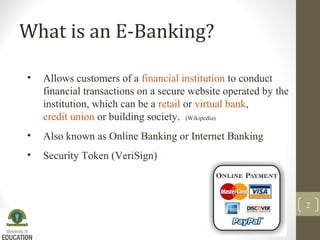
• Allows customers of a financial institution to conduct
financial transactions on a secure website operated by the
institution, which can be a retail or virtual bank,
credit union or building society. (Wikipedia)
• Also known as Online Banking or Internet Banking
• Security Token (VeriSign)
2
E-Banking – Common Features
3
The common features fall broadly into several categories.
Non-Transactional tasks including -
viewing account balances
viewing recent transactions
downloading bank statements, for example in PDF format
viewing images of paid cheques
ordering cheque books
download periodic account statements
Downloading applications for M-banking, E-banking etc.
E-Banking: Common Features
4
Transactional Tasks including -
• Funds transfers between the customer's linked accounts
• Paying third parties, including bill payments (see,
e.g., ebay.com)
• Loan applications and transactions, such as repayments
of enrollments
• Register utility bills and make bill payments (Auto Giro)
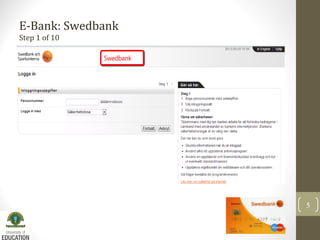
E-Bank: Swedbank
Step 1 of 10
5
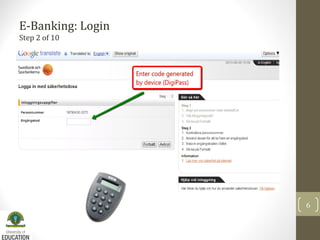
E-Banking: Login
Step 2 of 10
6
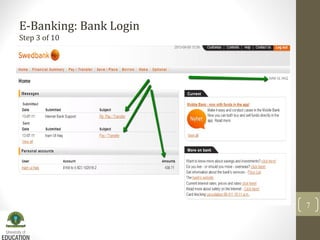
E-Banking: Bank Login
Step 3 of 10
7
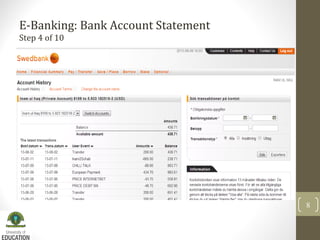
E-Banking: Bank Account Statement
Step 4 of 10
8
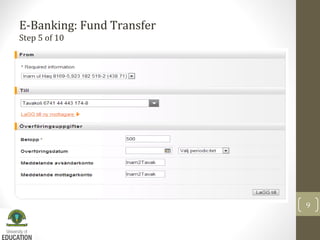
E-Banking: Fund Transfer
Step 5 of 10
9
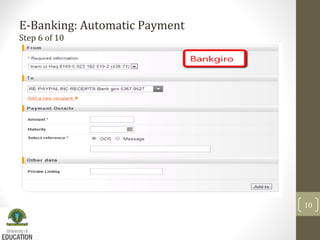
E-Banking: Automatic Payment
Step 6 of 10
10
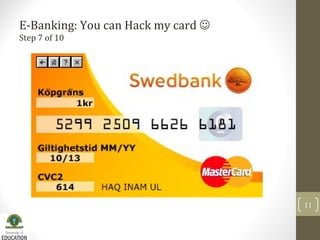
E-Banking: You can Hack my card 
Step 7 of 10
11
References:
12
• Wikipedi.org (accessed 9.9.2013)
• Swedbank.se (accessed 9.9.2013)
• Google.se (accessed 9.9.2013)

E banking