Information
Literacy
Star Reporter
• You are given an opportunity to write a feature article about a very important
person in your life, alive or dead. What details will you present?”
• On a small piece of paper, write as much information as you can about the
person. Make sure that these pieces of information will answer the Who,
What, When, Where, How, and Why questions
Jump Start
Choose a partner and share your features to each other.
Let’s answer these questions.
1. What were the most surprising and memorable details about the
information presented by your partner?
2. Was your partner able to give you a good background about the
person? Why or why not?
3. Did your partner answer all the questions you have in mind
about the person he or she chose? Why or why not?
4. Do you think the information your partner presented to you is
valid, correct, and true? How so?
 Information comes from the Latin word
“informare” which means, “formation of the
mind or teaching”.
 Indeed, information is vital in our everyday
communication and growth, just like how we
find the need to gather information in our
new environment, or how we would want to
feature our favorite person.
 The American Library Association has
defined information literacy as abilities that
enable a person to “recognize when
information is needed and have the ability to
locate, evaluate, and use effectively the
needed information.”
Sources and Information
Overload
 With the technology nowadays, people have this sense of ease
and comfortability to just search everything on the internet.
 But upon hitting that enter button, thousands to even a million
search results appear talking about the same topic you
indicated.
 You might even think of going into a library to make it simpler,
but again, you will stumble upon a number of books, articles,
and other published works that talk about your topic.
 The diversity and large quantity of information present in the
various media platforms like libraries, community resources,
different organizations, and the internet, gives you an
overwhelming sense of dilemma.
 These, sometimes, unfiltered and unchecked formats and data
often raise questions on its authenticity, validity, and reliability.
5
Multimedia Sources
 Another problem that might arise is the availability of
information through multiple media like graphical, in
picture form, aural, voice-over or recording, and
textual.
 This challenges a person to better comprehend and
analyze it.
 The questions posed earlier in the discussion can be
our basis for information literacy.
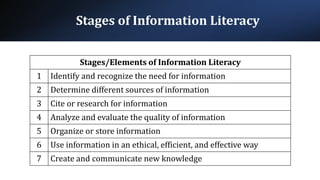
 These can be thought of as Elements or Stages of
Information Literacy.
 These ‘stages’ can also be seen as steps into becoming
more information literate.
Stages of Information Literacy
Stages/Elements of Information Literacy
1 Identify and recognize the need for information
2 Determine different sources of information
3 Cite or research for information
4 Analyze and evaluate the quality of information
5 Organize or store information
6 Use information in an ethical, efficient, and effective way
7 Create and communicate new knowledge
 There are various reasons why information literacy is a life skill.
 The need for information updates us with current events, trends,
and styles.
 This also helps us in learning new things in general.
 Information is also used to communicate new knowledge and help
us in decision-making.
 Sources for information can come from the internet, live and
recorded television, broadcast radio, library, newspapers, and
many more.
 With the information at hand, we have the option of writing it
down, printing it through a computer, reproducing it, or storing it
online.
 As such, the quality and accuracy of the information can be
determined by making sure that it comes from a trusted source and
was written by a credible writer.
 These gathered data can then be shared face-to-face, announced, or
posted online through social media.
“Information literacy forms the basis for lifelong
learning.”
 This skill is applicable to all disciplines, in all learning fields, and levels of
education.
 It helps us better grasp the content at hand and further analyze the
information.
 We can become more independent and responsible for our own learning.
Did you know?
In 2013, Time magazine published an online article stating that only “15% of
American adults do not use the Internet.”

Information Literacy.pptx

  • 1.
  • 2.
    Star Reporter • Youare given an opportunity to write a feature article about a very important person in your life, alive or dead. What details will you present?” • On a small piece of paper, write as much information as you can about the person. Make sure that these pieces of information will answer the Who, What, When, Where, How, and Why questions Jump Start Choose a partner and share your features to each other.
  • 3.
    Let’s answer thesequestions. 1. What were the most surprising and memorable details about the information presented by your partner? 2. Was your partner able to give you a good background about the person? Why or why not? 3. Did your partner answer all the questions you have in mind about the person he or she chose? Why or why not? 4. Do you think the information your partner presented to you is valid, correct, and true? How so?
  • 4.
     Information comesfrom the Latin word “informare” which means, “formation of the mind or teaching”.  Indeed, information is vital in our everyday communication and growth, just like how we find the need to gather information in our new environment, or how we would want to feature our favorite person.  The American Library Association has defined information literacy as abilities that enable a person to “recognize when information is needed and have the ability to locate, evaluate, and use effectively the needed information.”
  • 5.
    Sources and Information Overload With the technology nowadays, people have this sense of ease and comfortability to just search everything on the internet.  But upon hitting that enter button, thousands to even a million search results appear talking about the same topic you indicated.  You might even think of going into a library to make it simpler, but again, you will stumble upon a number of books, articles, and other published works that talk about your topic.  The diversity and large quantity of information present in the various media platforms like libraries, community resources, different organizations, and the internet, gives you an overwhelming sense of dilemma.  These, sometimes, unfiltered and unchecked formats and data often raise questions on its authenticity, validity, and reliability. 5
  • 6.
    Multimedia Sources  Anotherproblem that might arise is the availability of information through multiple media like graphical, in picture form, aural, voice-over or recording, and textual.  This challenges a person to better comprehend and analyze it.  The questions posed earlier in the discussion can be our basis for information literacy.  These can be thought of as Elements or Stages of Information Literacy.  These ‘stages’ can also be seen as steps into becoming more information literate.
  • 7.
    Stages of InformationLiteracy Stages/Elements of Information Literacy 1 Identify and recognize the need for information 2 Determine different sources of information 3 Cite or research for information 4 Analyze and evaluate the quality of information 5 Organize or store information 6 Use information in an ethical, efficient, and effective way 7 Create and communicate new knowledge
  • 8.
     There arevarious reasons why information literacy is a life skill.  The need for information updates us with current events, trends, and styles.  This also helps us in learning new things in general.  Information is also used to communicate new knowledge and help us in decision-making.  Sources for information can come from the internet, live and recorded television, broadcast radio, library, newspapers, and many more.  With the information at hand, we have the option of writing it down, printing it through a computer, reproducing it, or storing it online.  As such, the quality and accuracy of the information can be determined by making sure that it comes from a trusted source and was written by a credible writer.  These gathered data can then be shared face-to-face, announced, or posted online through social media.
  • 9.
    “Information literacy formsthe basis for lifelong learning.”  This skill is applicable to all disciplines, in all learning fields, and levels of education.  It helps us better grasp the content at hand and further analyze the information.  We can become more independent and responsible for our own learning. Did you know? In 2013, Time magazine published an online article stating that only “15% of American adults do not use the Internet.”