Open Systems Solutions. Now.
UNESCO WSIS+10 Review Paris February 26, 2013
                               Stephen Kovats, r0g_agency for open culture and critical transformation Berlin


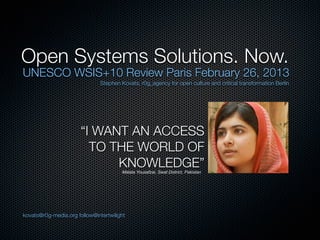
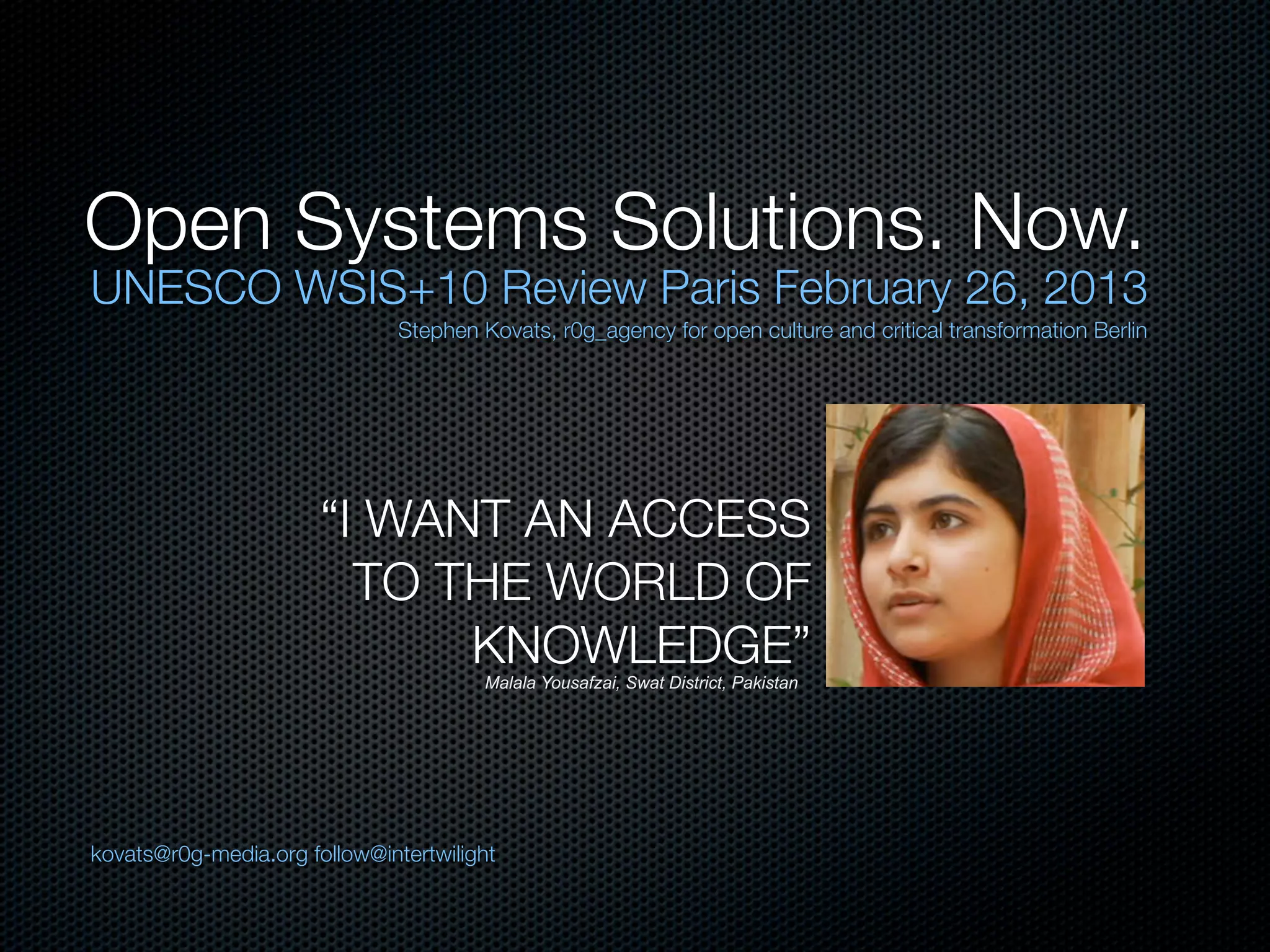
                       “I WANT AN ACCESS
                         TO THE WORLD OF
                             KNOWLEDGE” Malala Yousafzai, Swat District, Pakistan


kovats@r0g-media.org follow@intertwilight
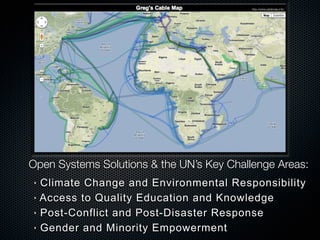
http://www.cablemap.info/


Open Systems Solutions & the UN’s Key Challenge Areas:
 ‣ Climate Change and Environmental Responsibility
 ‣ Access to Quality Education and Knowledge

 ‣ Post-Conflict and Post-Disaster Response

 ‣ Gender and Minority Empowerment
Open Source Models ...

• based on free & public domain tools, licences,
  information and methodologies

• enable opportunity - joining skills & experience

• are active nodes in lager global communities

• create 'space' for exchange, collaboration,
  sustainability

• allow for accountability, transparency and
  participation
Open Source to Open Systems Models,
in terms of methodology, depend on or require ...
• open input by all stakeholders and affected citizens,
  including outsiders with innovative ideas

• participatory governance and decision-making for
  the final outcome

• accumulated knowledge to be put in a knowledge
  commons for future use and remixing in other
  projects
              (in this case: based on the P2P Foundation’s requirements for open urbanism)
Open Systems incorporate and collate different types of
basic ‘open’ elements including, among others:
• Open Source Software (FOSS)
• Open Hardware / Appropriate Technology
• Open Data / Open Government
• Open Platforms / Crowdsourcing
• Open Access / creative commons (CC)
• Open Educational Resources (OER)
• Data Mobility / Device Journalism
• Open Innovation / Design / Urbanism
• iHubs, Fablabs & 'maker' spaces
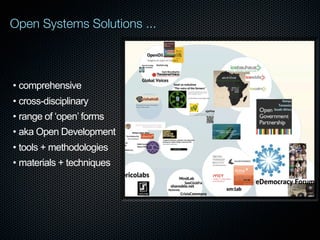
Open Systems Solutions ...


• comprehensive
• cross-disciplinary
• range of ‘open’ forms
• aka Open Development
• tools + methodologies
• materials + techniques
http://sautiyawakulima.net


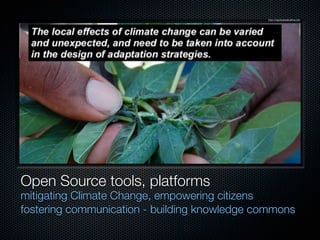
Open Source tools, platforms
mitigating Climate Change, empowering citizens
fostering communication - building knowledge commons
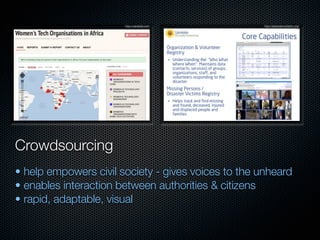
http://ushahidi.com/          http://sahanafoundation.org/


Crowdsourcing
• help empowers civil society - gives voices to the unheard
• enables interaction between authorities & citizens
• rapid, adaptable, visual
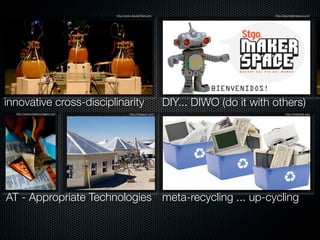
http://www.natural-fiber.com                              http://stgomakerspace.com/


innovative cross-disciplinarity                                     DIY... DIWO (do it with others)
  http://www.metareciclagem.org/             http://hexayurt.com/                                  http://metarede.org/


AT - Appropriate Technologies meta-recycling ... up-cycling
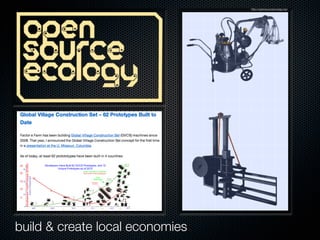
http://opensourceecology.org/


build & create local economies
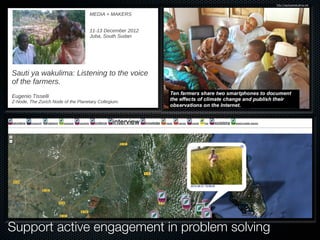
http://sautiyawakulima.net


                                     "#$%%'(


                                     )))*#+,-),
                                     .+
!


Support active engagement in problem solving
http://r0g-media.org/osjuba/


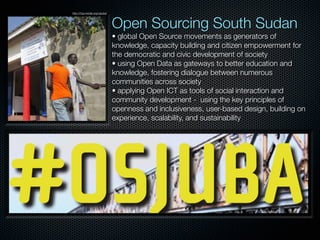
                               Open Sourcing South Sudan
                               • global Open Source movements as generators of
                               knowledge, capacity building and citizen empowerment for
                               the democratic and civic development of society
                               • using Open Data as gateways to better education and
                               knowledge, fostering dialogue between numerous
                               communities across society
                               • applying Open ICT as tools of social interaction and
                               community development - using the key principles of
                               openness and inclusiveness, user-based design, building on
                               experience, scalability, and sustainability
Essential UNESCO Open Systems Recommendations
1. Enable Access

       - public use and lowering barriers of access to technology.

2. Develop Open Systems criteria and vocabulary

       - better understanding  rapid implementation of comprehensive solutions.

3. Recognize Open Systems as long-term sustainability priorities

       - in the context of addressing UN's four key challenge areas.

4. Education of the Educators - about and via OER

       - including media literacy in elementary education into and through Open Systems.

5. Support small scale, independent or user defined ‘Open’ incubators

       - highlighting the interconnectivity, create comprehensive Open Systems Solutions.

6. Foster creation of Open Knowledge Commons

       - including FOSS, OER, Open Data, Open Hardware  related processes, methodologies

Open system panel_sm

  • 1.
    Open Systems Solutions.Now. UNESCO WSIS+10 Review Paris February 26, 2013 Stephen Kovats, r0g_agency for open culture and critical transformation Berlin “I WANT AN ACCESS TO THE WORLD OF KNOWLEDGE” Malala Yousafzai, Swat District, Pakistan kovats@r0g-media.org follow@intertwilight
  • 2.
    http://www.cablemap.info/ Open Systems Solutions& the UN’s Key Challenge Areas: ‣ Climate Change and Environmental Responsibility ‣ Access to Quality Education and Knowledge ‣ Post-Conflict and Post-Disaster Response ‣ Gender and Minority Empowerment
  • 3.
    Open Source Models... • based on free & public domain tools, licences, information and methodologies • enable opportunity - joining skills & experience • are active nodes in lager global communities • create 'space' for exchange, collaboration, sustainability • allow for accountability, transparency and participation
  • 4.
    Open Source toOpen Systems Models, in terms of methodology, depend on or require ... • open input by all stakeholders and affected citizens, including outsiders with innovative ideas • participatory governance and decision-making for the final outcome • accumulated knowledge to be put in a knowledge commons for future use and remixing in other projects (in this case: based on the P2P Foundation’s requirements for open urbanism)
  • 5.
    Open Systems incorporateand collate different types of basic ‘open’ elements including, among others: • Open Source Software (FOSS) • Open Hardware / Appropriate Technology • Open Data / Open Government • Open Platforms / Crowdsourcing • Open Access / creative commons (CC) • Open Educational Resources (OER) • Data Mobility / Device Journalism • Open Innovation / Design / Urbanism • iHubs, Fablabs & 'maker' spaces
  • 6.
    Open Systems Solutions... • comprehensive • cross-disciplinary • range of ‘open’ forms • aka Open Development • tools + methodologies • materials + techniques
  • 7.
    http://sautiyawakulima.net Open Source tools,platforms mitigating Climate Change, empowering citizens fostering communication - building knowledge commons
  • 8.
    http://ushahidi.com/ http://sahanafoundation.org/ Crowdsourcing • help empowers civil society - gives voices to the unheard • enables interaction between authorities & citizens • rapid, adaptable, visual
  • 9.
    http://www.natural-fiber.com http://stgomakerspace.com/ innovative cross-disciplinarity DIY... DIWO (do it with others) http://www.metareciclagem.org/ http://hexayurt.com/ http://metarede.org/ AT - Appropriate Technologies meta-recycling ... up-cycling
  • 10.
  • 11.
    http://sautiyawakulima.net "#$%%'( )))*#+,-), .+
  • 12.
    ! Support active engagement in problem solving
  • 13.
    http://r0g-media.org/osjuba/ Open Sourcing South Sudan • global Open Source movements as generators of knowledge, capacity building and citizen empowerment for the democratic and civic development of society • using Open Data as gateways to better education and knowledge, fostering dialogue between numerous communities across society • applying Open ICT as tools of social interaction and community development - using the key principles of openness and inclusiveness, user-based design, building on experience, scalability, and sustainability
  • 14.
    Essential UNESCO OpenSystems Recommendations 1. Enable Access - public use and lowering barriers of access to technology. 2. Develop Open Systems criteria and vocabulary - better understanding rapid implementation of comprehensive solutions. 3. Recognize Open Systems as long-term sustainability priorities - in the context of addressing UN's four key challenge areas. 4. Education of the Educators - about and via OER - including media literacy in elementary education into and through Open Systems. 5. Support small scale, independent or user defined ‘Open’ incubators - highlighting the interconnectivity, create comprehensive Open Systems Solutions. 6. Foster creation of Open Knowledge Commons - including FOSS, OER, Open Data, Open Hardware related processes, methodologies