Communicating Business Agenda
  to Investment Community
 Sahala Sianipar
 Managing Director, Corporate/Financial Practice, Asia Pacific
 Burson-Marsteller
 Twitter: @ssahala


 Singapore, 26 September 2011
Content

   Trends in financial communications

   Developing financial communications plan

   Discussion


                 BURSON-MARSTELLER ASIA-PACIFIC   EVIDENCE-BASED COMMUNICATIONS
Trends in Financial
  Communications
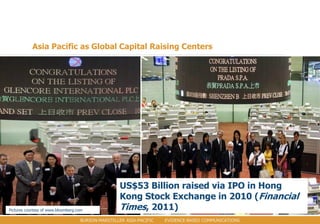
Asia Pacific as Global Capital Raising Centers


                                                    US$53 Billion raised via IPO in Hong
                                                    Kong Stock Exchange in 2010 (Financial
Pictures courtesy of www.bloomberg.com              Times, 2011)
                                    BURSON-MARSTELLER ASIA-PACIFIC   EVIDENCE-BASED COMMUNICATIONS
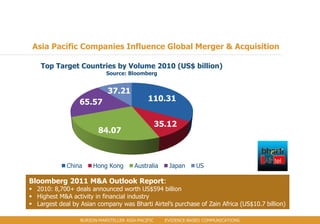
Asia Pacific Companies Influence Global Merger & Acquisition

    Top Target Countries by Volume 2010 (US$ billion)
                            Source: Bloomberg


                             37.21
                  65.57                      110.31


                                                   35.12
                         84.07


             China     Hong Kong        Australia     Japan      US

Bloomberg 2011 M&A Outlook Report:
 2010: 8,700+ deals announced worth US$594 billion
 Highest M&A activity in financial industry
 Largest deal by Asian company was Bharti Airtel’s purchase of Zain Africa (US$10.7 billion)

                  BURSON-MARSTELLER ASIA-PACIFIC     EVIDENCE-BASED COMMUNICATIONS
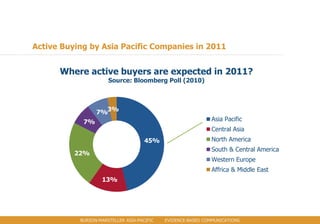
Active Buying by Asia Pacific Companies in 2011


      Where active buyers are expected in 2011?
                      Source: Bloomberg Poll (2010)


                 7%3%
            7%                                                Asia Pacific
                                                              Central Asia
                                     45%                      North America
                                                              South & Central America
          22%
                                                              Western Europe
                                                              Affrica & Middle East
                   13%


           BURSON-MARSTELLER ASIA-PACIFIC   EVIDENCE-BASED COMMUNICATIONS
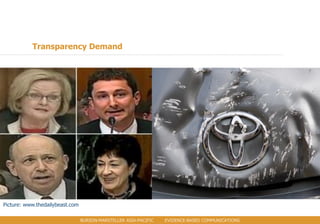
Transparency Demand


Picture: www.thedailybeast.com

                                 BURSON-MARSTELLER ASIA-PACIFIC   EVIDENCE-BASED COMMUNICATIONS
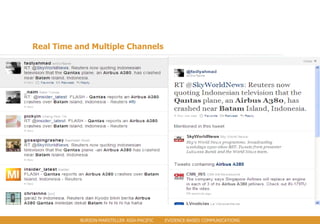
Real Time and Multiple Channels


           BURSON-MARSTELLER ASIA-PACIFIC   EVIDENCE-BASED COMMUNICATIONS
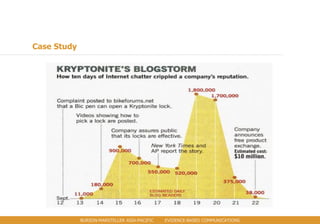
Case Study


             BURSON-MARSTELLER ASIA-PACIFIC   EVIDENCE-BASED COMMUNICATIONS
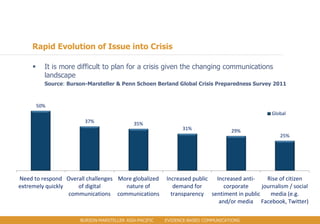
Rapid Evolution of Issue into Crisis

         It is more difficult to plan for a crisis given the changing communications
          landscape
          Source: Burson-Marsteller & Penn Schoen Berland Global Crisis Preparedness Survey 2011


        50%
                                                                                               Global
                        37%                35%
                                                             31%                29%
                                                                                                  25%


Need to respond Overall challenges More globalized     Increased public Increased anti-     Rise of citizen
extremely quickly    of digital      nature of            demand for       corporate      journalism / social
                  communications communications          transparency sentiment in public    media (e.g.
                                                                         and/or media Facebook, Twitter)

                      BURSON-MARSTELLER ASIA-PACIFIC   EVIDENCE-BASED COMMUNICATIONS
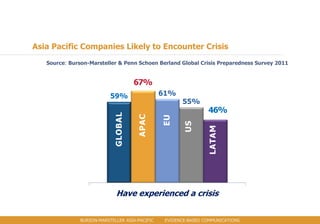
Asia Pacific Companies Likely to Encounter Crisis
   Source: Burson-Marsteller & Penn Schoen Berland Global Crisis Preparedness Survey 2011


                                     67%
                           59%                  61%
                                                       55%
                                                                 46%
                            GLOBAL

                                      APAC


                                                EU

                                                        US


                                                                 LATAM
                             Have experienced a crisis


               BURSON-MARSTELLER ASIA-PACIFIC    EVIDENCE-BASED COMMUNICATIONS
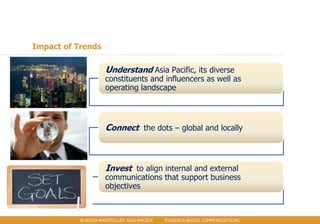
Impact of Trends

                     Understand Asia Pacific, its diverse
                     constituents and influencers as well as
                     operating landscape


                     Connect the dots – global and locally


                     Invest to align internal and external
                     communications that support business
                     objectives


           BURSON-MARSTELLER ASIA-PACIFIC   EVIDENCE-BASED COMMUNICATIONS
Developing Credible Financial
       Communications Plan
 “A corporation managed by responsible managers will be a
  responsible corporation; a corporation managed by
  irresponsible managers will be an irresponsible corporation.
  It is individuals who are responsible for what corporations
  do.”

                                                    Harold Burson
                               Founder Chairman, Burson-Marsteller
                                                     November 2008


            BURSON-MARSTELLER ASIA-PACIFIC   EVIDENCE-BASED COMMUNICATIONS
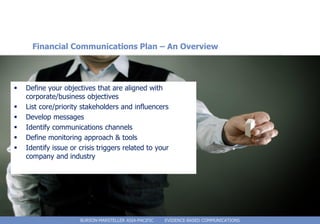
Financial Communications Plan – An Overview


   Define your objectives that are aligned with
    corporate/business objectives
   List core/priority stakeholders and influencers
   Develop messages
   Identify communications channels
   Define monitoring approach & tools
   Identify issue or crisis triggers related to your
    company and industry


                      BURSON-MARSTELLER ASIA-PACIFIC   EVIDENCE-BASED COMMUNICATIONS
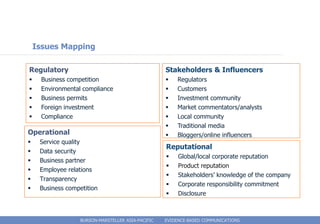
Issues Mapping

Regulatory                                          Stakeholders & Influencers
    Business competition                              Regulators
    Environmental compliance                          Customers
    Business permits                                  Investment community
    Foreign investment                                Market commentators/analysts
    Compliance                                        Local community
                                                       Traditional media
Operational                                            Bloggers/online influencers
    Service quality
                                                    Reputational
    Data security
                                                        Global/local corporate reputation
    Business partner
                                                        Product reputation
    Employee relations
                                                        Stakeholders’ knowledge of the company
    Transparency
                                                        Corporate responsibility commitment
    Business competition
                                                        Disclosure


                   BURSON-MARSTELLER ASIA-PACIFIC   EVIDENCE-BASED COMMUNICATIONS
Case Study

   Situation Analysis
     •   A state agency claimed that a major listed bank in Indonesia did not exercise
         prudent banking when it disbursed loans to several companies
           • Loans were fully collateralized and companies were affected by 1997/98
              financial crisis, which required debt restructuring
     •   The report by the state agency also claimed that the bank’s senior management
         never reported these loans to its shareholders
     •   The report was leaked to a couple of first-tier local media, which generated
         headlines even by Jakarta-based international media
     •   The government launched an investigation and subsequently criminal charges
         against senior management of the bank
     •   The bank’s institutional investors were concerned and rating agencies were
         about to issue updated ratings of the bank’s papers.


                BURSON-MARSTELLER ASIA-PACIFIC   EVIDENCE-BASED COMMUNICATIONS
Case Study – cont’d

   Integrated approach to investor and stakeholder communications
     • The bank quickly updated its institutional shareholders on the situation
          •   The bank pointed to its information memorandum prior to its listing that provided
              details of the bank’s exposure to the various companies mentioned in the report
          •   In other words, the bank had been transparent all along and the report did not
              provide any new information that investors had not known
     •   The bank assured its key customers of its financial and operational soundness
         as it had set aside sufficient and conservative provision for those loans
     •   The bank also reached out to its key controlling shareholders that in turn,
         provided public backing of the bank’s strategy and its ability to handle the
         situation
     •   The bank disseminated regular updates to media (domestic and international),
         which were tracked by the investment community
     •   Employees of the bank were regularly updated of the management’s action to
         address the situation.


                BURSON-MARSTELLER ASIA-PACIFIC   EVIDENCE-BASED COMMUNICATIONS
Case Study – cont’d

   Results
     • Whilst the bank’s stock price was down, no major institutional
       depositors/customers withdrew funds from the bank
     • S&P affirmed its ratings of the bank’s papers despite the public
       controversy in Indonesia
     • Institutional investors recognized there could be other motivations from
       the charges against the bank
     • Key shareholders of the bank also publicly spoke in support of the bank.


               BURSON-MARSTELLER ASIA-PACIFIC   EVIDENCE-BASED COMMUNICATIONS
Case Study (2)

   Situation Analysis
     •   A major Asian telecommunications company that is listed in the New York Stock
         Exchange was accused of committing irregular derivative transactions
     •   The allegation was raised by a politician in a parliamentarian hearing involving
         senior government ministers and chairperson of the capital market supervisory
         board
     •   First-tier national and international newswires immediately picked up the story,
         which became headlines
     •   Sell-side analysts called the company to seek clarification
     •   Institutional investors questioned the company’s transparency, risk management
         and good corporate governance practices
     •   At the same time, the politician threatened to file a criminal lawsuit against the
         company.


                 BURSON-MARSTELLER ASIA-PACIFIC   EVIDENCE-BASED COMMUNICATIONS
Case Study (2) – cont’d

   Rapid response and integrated approach to investor and stakeholder
    communications
     •   The objective of the communications program was to protect the level of
         stakeholders’ trust on the company
     •   Core stakeholders included regulators, business customers, shareholders & investors
         around the globe, and employees
     •   Company highlighted its disclosure compliance as required by the US Securities
         Exchange Commission in its regular filings
     •   Company’s executives reached out and briefed capital market supervisory board,
         industry regulators, investment community (sell and buy-side analysts, rating
         agencies), media (domestic and international) and influencers (e.g. think tanks)
         regarding the company’s derivative policy, which had been instituted and disclosed
         regularly
     •   At the same time, the Company issued regular statements via multiple channels
         (online, website, traditional media) to correct earlier media reports.


                BURSON-MARSTELLER ASIA-PACIFIC   EVIDENCE-BASED COMMUNICATIONS
Case Study (2) – cont’d

   Results
     •   Chairman of the capital market supervisory board issued a statement that
         cleared the company from the allegation; the chairman also spoke in front of
         members of the national parliament
     •   Investors were satisfied with the explanation that the share price did not suffer
         from major decline
     •   Third parties such as research analysts and industry commentators published
         articles in leading local media supportive of the company’s risk management,
         disclosure and good governance practices.


                 BURSON-MARSTELLER ASIA-PACIFIC   EVIDENCE-BASED COMMUNICATIONS
In Summary


              Asia Pacific companies are expected to be more active
               in regional and international trade & investment
              Stakeholders including investors will demand more on
               good corporate governance, disclosure, and
               transparency from companies
              U – Understand your financial communications goals
               and stakeholders in Asia Pacific
              C – Be able to connect the dots, globally and locally in
               today’s digital age
              I – Be prepared to invest in aligning internal and
               external communications capability including crisis
               preparedness and monitoring tools.
THANK
 YOU

Modern corporate communications

  • 1.
    Communicating Business Agenda to Investment Community Sahala Sianipar Managing Director, Corporate/Financial Practice, Asia Pacific Burson-Marsteller Twitter: @ssahala Singapore, 26 September 2011
  • 2.
    Content  Trends in financial communications  Developing financial communications plan  Discussion BURSON-MARSTELLER ASIA-PACIFIC EVIDENCE-BASED COMMUNICATIONS
  • 3.
    Trends in Financial Communications
  • 4.
    Asia Pacific asGlobal Capital Raising Centers US$53 Billion raised via IPO in Hong Kong Stock Exchange in 2010 (Financial Pictures courtesy of www.bloomberg.com Times, 2011) BURSON-MARSTELLER ASIA-PACIFIC EVIDENCE-BASED COMMUNICATIONS
  • 5.
    Asia Pacific CompaniesInfluence Global Merger & Acquisition Top Target Countries by Volume 2010 (US$ billion) Source: Bloomberg 37.21 65.57 110.31 35.12 84.07 China Hong Kong Australia Japan US Bloomberg 2011 M&A Outlook Report:  2010: 8,700+ deals announced worth US$594 billion  Highest M&A activity in financial industry  Largest deal by Asian company was Bharti Airtel’s purchase of Zain Africa (US$10.7 billion) BURSON-MARSTELLER ASIA-PACIFIC EVIDENCE-BASED COMMUNICATIONS
  • 6.
    Active Buying byAsia Pacific Companies in 2011 Where active buyers are expected in 2011? Source: Bloomberg Poll (2010) 7%3% 7% Asia Pacific Central Asia 45% North America South & Central America 22% Western Europe Affrica & Middle East 13% BURSON-MARSTELLER ASIA-PACIFIC EVIDENCE-BASED COMMUNICATIONS
  • 7.
    Transparency Demand Picture: www.thedailybeast.com BURSON-MARSTELLER ASIA-PACIFIC EVIDENCE-BASED COMMUNICATIONS
  • 8.
    Real Time andMultiple Channels BURSON-MARSTELLER ASIA-PACIFIC EVIDENCE-BASED COMMUNICATIONS
  • 9.
    Case Study BURSON-MARSTELLER ASIA-PACIFIC EVIDENCE-BASED COMMUNICATIONS
  • 10.
    Rapid Evolution ofIssue into Crisis  It is more difficult to plan for a crisis given the changing communications landscape Source: Burson-Marsteller & Penn Schoen Berland Global Crisis Preparedness Survey 2011 50% Global 37% 35% 31% 29% 25% Need to respond Overall challenges More globalized Increased public Increased anti- Rise of citizen extremely quickly of digital nature of demand for corporate journalism / social communications communications transparency sentiment in public media (e.g. and/or media Facebook, Twitter) BURSON-MARSTELLER ASIA-PACIFIC EVIDENCE-BASED COMMUNICATIONS
  • 11.
    Asia Pacific CompaniesLikely to Encounter Crisis Source: Burson-Marsteller & Penn Schoen Berland Global Crisis Preparedness Survey 2011 67% 59% 61% 55% 46% GLOBAL APAC EU US LATAM Have experienced a crisis BURSON-MARSTELLER ASIA-PACIFIC EVIDENCE-BASED COMMUNICATIONS
  • 12.
    Impact of Trends Understand Asia Pacific, its diverse constituents and influencers as well as operating landscape Connect the dots – global and locally Invest to align internal and external communications that support business objectives BURSON-MARSTELLER ASIA-PACIFIC EVIDENCE-BASED COMMUNICATIONS
  • 13.
    Developing Credible Financial Communications Plan
  • 14.
     “A corporationmanaged by responsible managers will be a responsible corporation; a corporation managed by irresponsible managers will be an irresponsible corporation. It is individuals who are responsible for what corporations do.” Harold Burson Founder Chairman, Burson-Marsteller November 2008 BURSON-MARSTELLER ASIA-PACIFIC EVIDENCE-BASED COMMUNICATIONS
  • 15.
    Financial Communications Plan– An Overview  Define your objectives that are aligned with corporate/business objectives  List core/priority stakeholders and influencers  Develop messages  Identify communications channels  Define monitoring approach & tools  Identify issue or crisis triggers related to your company and industry BURSON-MARSTELLER ASIA-PACIFIC EVIDENCE-BASED COMMUNICATIONS
  • 16.
    Issues Mapping Regulatory Stakeholders & Influencers  Business competition  Regulators  Environmental compliance  Customers  Business permits  Investment community  Foreign investment  Market commentators/analysts  Compliance  Local community  Traditional media Operational  Bloggers/online influencers  Service quality Reputational  Data security  Global/local corporate reputation  Business partner  Product reputation  Employee relations  Stakeholders’ knowledge of the company  Transparency  Corporate responsibility commitment  Business competition  Disclosure BURSON-MARSTELLER ASIA-PACIFIC EVIDENCE-BASED COMMUNICATIONS
  • 17.
    Case Study  Situation Analysis • A state agency claimed that a major listed bank in Indonesia did not exercise prudent banking when it disbursed loans to several companies • Loans were fully collateralized and companies were affected by 1997/98 financial crisis, which required debt restructuring • The report by the state agency also claimed that the bank’s senior management never reported these loans to its shareholders • The report was leaked to a couple of first-tier local media, which generated headlines even by Jakarta-based international media • The government launched an investigation and subsequently criminal charges against senior management of the bank • The bank’s institutional investors were concerned and rating agencies were about to issue updated ratings of the bank’s papers. BURSON-MARSTELLER ASIA-PACIFIC EVIDENCE-BASED COMMUNICATIONS
  • 18.
    Case Study –cont’d  Integrated approach to investor and stakeholder communications • The bank quickly updated its institutional shareholders on the situation • The bank pointed to its information memorandum prior to its listing that provided details of the bank’s exposure to the various companies mentioned in the report • In other words, the bank had been transparent all along and the report did not provide any new information that investors had not known • The bank assured its key customers of its financial and operational soundness as it had set aside sufficient and conservative provision for those loans • The bank also reached out to its key controlling shareholders that in turn, provided public backing of the bank’s strategy and its ability to handle the situation • The bank disseminated regular updates to media (domestic and international), which were tracked by the investment community • Employees of the bank were regularly updated of the management’s action to address the situation. BURSON-MARSTELLER ASIA-PACIFIC EVIDENCE-BASED COMMUNICATIONS
  • 19.
    Case Study –cont’d  Results • Whilst the bank’s stock price was down, no major institutional depositors/customers withdrew funds from the bank • S&P affirmed its ratings of the bank’s papers despite the public controversy in Indonesia • Institutional investors recognized there could be other motivations from the charges against the bank • Key shareholders of the bank also publicly spoke in support of the bank. BURSON-MARSTELLER ASIA-PACIFIC EVIDENCE-BASED COMMUNICATIONS
  • 20.
    Case Study (2)  Situation Analysis • A major Asian telecommunications company that is listed in the New York Stock Exchange was accused of committing irregular derivative transactions • The allegation was raised by a politician in a parliamentarian hearing involving senior government ministers and chairperson of the capital market supervisory board • First-tier national and international newswires immediately picked up the story, which became headlines • Sell-side analysts called the company to seek clarification • Institutional investors questioned the company’s transparency, risk management and good corporate governance practices • At the same time, the politician threatened to file a criminal lawsuit against the company. BURSON-MARSTELLER ASIA-PACIFIC EVIDENCE-BASED COMMUNICATIONS
  • 21.
    Case Study (2)– cont’d  Rapid response and integrated approach to investor and stakeholder communications • The objective of the communications program was to protect the level of stakeholders’ trust on the company • Core stakeholders included regulators, business customers, shareholders & investors around the globe, and employees • Company highlighted its disclosure compliance as required by the US Securities Exchange Commission in its regular filings • Company’s executives reached out and briefed capital market supervisory board, industry regulators, investment community (sell and buy-side analysts, rating agencies), media (domestic and international) and influencers (e.g. think tanks) regarding the company’s derivative policy, which had been instituted and disclosed regularly • At the same time, the Company issued regular statements via multiple channels (online, website, traditional media) to correct earlier media reports. BURSON-MARSTELLER ASIA-PACIFIC EVIDENCE-BASED COMMUNICATIONS
  • 22.
    Case Study (2)– cont’d  Results • Chairman of the capital market supervisory board issued a statement that cleared the company from the allegation; the chairman also spoke in front of members of the national parliament • Investors were satisfied with the explanation that the share price did not suffer from major decline • Third parties such as research analysts and industry commentators published articles in leading local media supportive of the company’s risk management, disclosure and good governance practices. BURSON-MARSTELLER ASIA-PACIFIC EVIDENCE-BASED COMMUNICATIONS
  • 23.
    In Summary  Asia Pacific companies are expected to be more active in regional and international trade & investment  Stakeholders including investors will demand more on good corporate governance, disclosure, and transparency from companies  U – Understand your financial communications goals and stakeholders in Asia Pacific  C – Be able to connect the dots, globally and locally in today’s digital age  I – Be prepared to invest in aligning internal and external communications capability including crisis preparedness and monitoring tools.
  • 24.