Pharmacy Informatics:From Bytes to Bedside
ObjectivesDescribe what pharmacy informatics encompasses Describe components necessary to implement key healthcare technologies Identify current technology used in the medication use cycle Discuss future potential applications of healthcare technology Implement methods to analyze how human interactions with technology may lead to failures
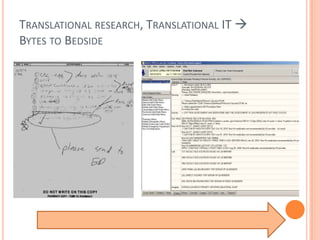
Translational research, Translational IT Bytes to Bedside
What does an informatics RPh do?Writes drug information papersImproves patient outcomes using technologyI don’t knowFixes the department’s printer
What does aninformatics RPhdo?Writes drug information papersImproves patient outcomes using technologyI don’t knowFixes the department’s printer
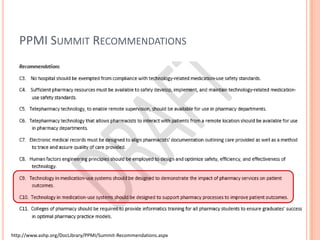
PPMI Summit Recommendationshttp://www.ashp.org/DocLibrary/PPMI/Summit-Recommendations.aspx
What is pharmacy informaticsEncompasses IT-enabled medication-related quality, efficacy, and safety initiativesShould be part of a single accountable process entity that makes decisions regarding the latterTraditional organizational structures for paper based systems did not account for the collaboration required for decisions to implement medicine within an electronic environment
What is pharmacy informatics?...[informatic] pharmacists must use their knowledge of information systems and the medication-use process to improve patient care by ensuring that new technologies lead to safer and more effective medication use."http://www.ashp.org/DocLibrary/BestPractices/AutoITStInformatics.aspxFlynn, A. The Current State of Pharmacy Informatics Education in ProfessionalPrograms at US Colleges of Pharmacy. American Journal of Pharmaceutical Education 2005; 69 (4) 66.
To Err is Human: Building a Safer Health SystemInstitute of Medicine (IOM) published a report in 20007,000 Americans die each year due to medication use errorsIOM recommends: to “implement proven medication safety practices”reduce reliance on memorystandardize terminologyutilize constraints, force functions, protocols, and checklists minimize data handoffs and entering data more than once by handKohn LT, Corrigan JM, Donaldson MS. To Err is Human: Building a Safer Health System. 1st ed. A report of the Institute of Medicine. Washington, DC: National Academy Press; 2000.
Who is a informatics pharmacistDual specializationPharmacotherapyTechnology to facilitate the latterPharmacy advocate to manage enterprise-wide deployment of systems that integrate medicine in an electronic environment
RoleMedication safetyProvide leadership and guidance with all technology initiatives that involve medication useCustomize and maintain systems to the changing needs of professional pharmacy practice
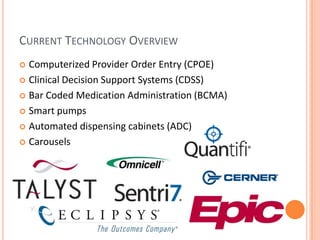
Current Technology OverviewComputerized Provider Order Entry (CPOE)Clinical Decision Support Systems (CDSS)Bar Coded Medication Administration (BCMA)Smart pumpsAutomated dispensing cabinets (ADC)Carousels
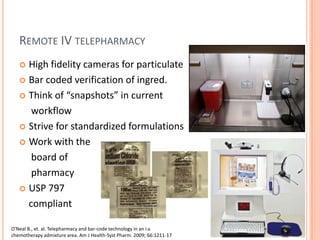
Remote IV telepharmacyHigh fidelity cameras for particulateBar coded verification of ingred.Think of “snapshots” in current      workflowStrive for standardized formulationsWork with the      board of      pharmacyUSP 797     compliantO'Neal B., et. al. Telepharmacy and bar-code technology in an i.v.chemotherapy admixture area. Am J Health-Syst Pharm. 2009; 66:1211-17
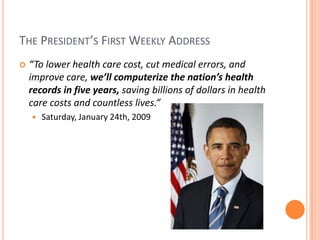
The President’s First Weekly Address“To lower health care cost, cut medical errors, and improve care, we’ll computerize the nation’s health records in five years, saving billions of dollars in health care costs and countless lives.”Saturday, January 24th, 2009
Question	According an ASHP's survey, what percentage of hospitals in 2007 were fully electronic? 1. <10%            2. 10-50% 3. >50% 4. >80%
Question	According an ASHP's survey, what percentage of hospitals in 2007 were fully electronic? 1. <10%            2. 10-50% 3. >50% 4. >80%Pedersen CA, Gumpper KF. ASHP national survey on informatics: Assessment of the adoption and use of pharmacy informatics in U.S. hospitals. American Journal of Health-System Pharmacy. 2008; 65 (23): 2244-2264.
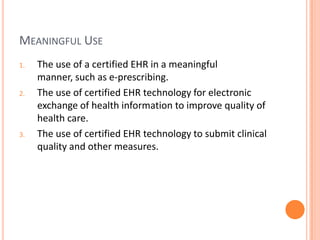
Meaningful UseThe use of a certified EHR in a meaningful manner, such as e-prescribing.The use of certified EHR technology for electronic exchange of health information to improve quality of health care.The use of certified EHR technology to submit clinical quality and other measures.
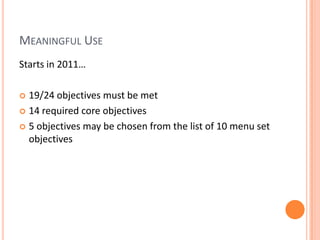
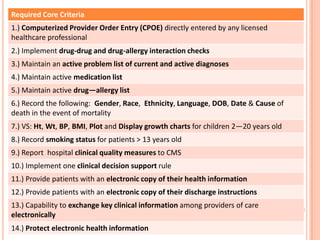
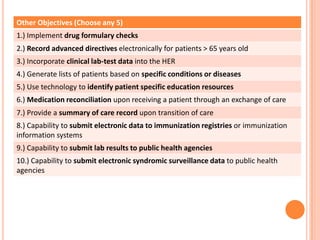
Meaningful UseStarts in 2011…19/24 objectives must be met14 required core objectives5 objectives may be chosen from the list of 10 menu set objectives
QuestionYou are the person in charge of implementing the foundations of an EHR at your hospital. Which do you implement first?CPOEBCMACDSeMAR
Computerized Provider Order Entry (CPOE)Physicians and other providers input orders directly into a computer, thereby eliminating problems with handwriting legibility and order transcriptionGuide the ordering provider to make good clinical decisions and appropriate choices based on an individual patient’s data in an electronic health record combined scientific medical evidence
Clinical Decision SupportBasicdrug-allergy checksbasic dosing guidance, formulary decision supportduplicate therapy checkingdrug–drug interactionsAdvancedosing support for renal insufficiency  and specific populations (eg., geriatric patients)guidance for medication-related laboratory testingdrug–disease contraindication checkingdrug–pregnancy checking
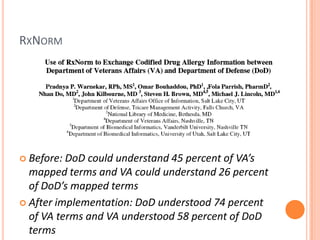
RxNormStandardized nomenclature for clinical drugs and drug delivery devicesProduced by the National Library of Medicine (NLM)Key to interoperability between two or more systems that do not “speak the same language”Why interoperability?Data mappingNDI vs. RxNorm
RxNormBefore: DoD could understand 45 percent of VA’s mapped terms and VA could understand 26 percent of DoD’s mapped termsAfter implementation: DoD understood 74 percent of VA terms and VA understood 58 percent of DoD terms
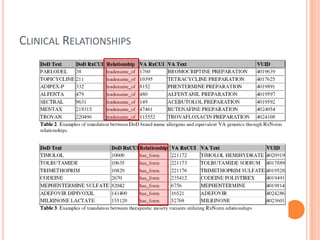
Clinical Relationships
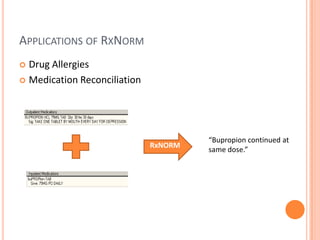
Applications of RxNormDrug AllergiesMedication Reconciliation“Bupropion continued at same dose.”RxNORM
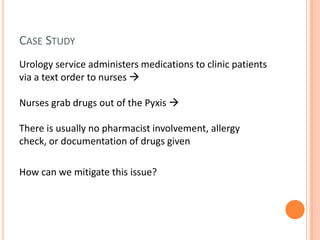
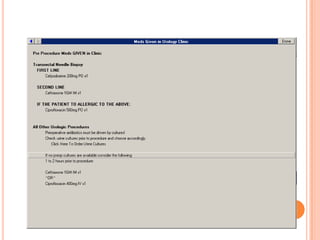
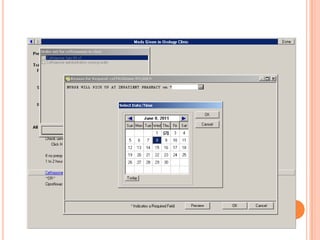
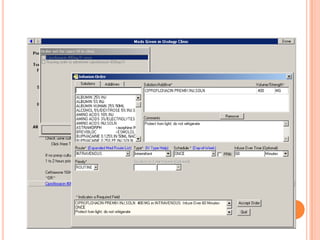
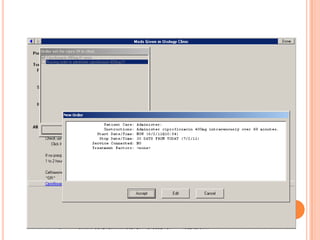
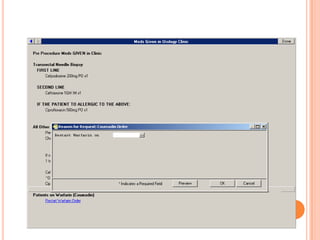
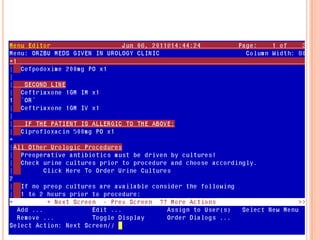
Case StudyUrology service administers medications to clinic patients via a text order to nurses Nurses grab drugs out of the PyxisThere is usually no pharmacist involvement, allergy check, or documentation of drugs given  How can we mitigate this issue?
Guidance on CDSWhat is the optimal method to present alerts to providers?How can you balance usefulness vs. annoyanceWhen does “alert fatigue” happen?Where there are multiple presentation modes, whichmode is most appropriate for any given alert?Which member of the health care team the best recipientof any kind of alert?Should physicians and pharmacists see the same drug related alerts
Nearly Universal Prospective Order ReviewOriginated from an era absent of technology
Mandated and strongly recommended by JCAHO and ASHP, respectively
Can systems automate the review of some medication orders without pharmacist review and still safely ensure effective outcomes?
Medication Order Review vs. Medication interventionsAmerican Society of Health-System Pharmacists. ASHP guidelines: minimum standards for pharmacies in hospitals. Am J Health-Syst Pharm. 1995; 52:2711-7.Mahoney CD, Berard-Collins CM, Coleman R et al. Effects of an integrated clinical information system on medicationsafety in a multi-hospital setting. Am J Health-Syst Pharm. 2007; 64:1969-77.
Nearly Universal Prospective Order Review“Most data onmost patients is mostly normal most ofthe time.” - Korpman R. The need for a computerized medical record, a sales seminar presentation on ULTICARE. 1986 Aug.
Opportunity Cost of NUPORStudy by Mahoney showed 0.07% of CPOE orders needed renal dosage adjustments and 0.019% of orders needed dosage adjustments for [serum drug] out of therapeutic rangeRisk based stratificationFlynn., Opportunity cost of pharmacists’ nearly universal prospective order review. Am J Health-Syst Pharm. 2009; 66:668-70
State of Informatics Education LimitedNew pharmacists entering practice will need to understand EHR  systems and how to utilize, query, and report dataMuch like the advent of the Pharm.D. degree and residency training, the use of potentially complex, technically sophisticated software tools will be the next milestone in the training of a contemporary clinical pharmacist
Resources and TrainingResidency TrainingVanderbilt University Medical CenterUniversity of Utah Hospitals and Clinics University of Michigan Hospitals and Health Centers Oregon Health and Science University Hospitals and ClinicsClarian Health Partners James A. Haley Veterans Hospital University of Louisville Health Care VA San Diego and Tampa Healthcare System The Johns Hopkins Hospital University of California San FranciscoOhio State Medical Center

Informatics Primer

  • 1.
  • 2.
    ObjectivesDescribe what pharmacyinformatics encompasses Describe components necessary to implement key healthcare technologies Identify current technology used in the medication use cycle Discuss future potential applications of healthcare technology Implement methods to analyze how human interactions with technology may lead to failures
  • 3.
  • 4.
    What does aninformatics RPh do?Writes drug information papersImproves patient outcomes using technologyI don’t knowFixes the department’s printer
  • 5.
    What does aninformaticsRPhdo?Writes drug information papersImproves patient outcomes using technologyI don’t knowFixes the department’s printer
  • 6.
  • 7.
    What is pharmacyinformaticsEncompasses IT-enabled medication-related quality, efficacy, and safety initiativesShould be part of a single accountable process entity that makes decisions regarding the latterTraditional organizational structures for paper based systems did not account for the collaboration required for decisions to implement medicine within an electronic environment
  • 8.
    What is pharmacyinformatics?...[informatic] pharmacists must use their knowledge of information systems and the medication-use process to improve patient care by ensuring that new technologies lead to safer and more effective medication use."http://www.ashp.org/DocLibrary/BestPractices/AutoITStInformatics.aspxFlynn, A. The Current State of Pharmacy Informatics Education in ProfessionalPrograms at US Colleges of Pharmacy. American Journal of Pharmaceutical Education 2005; 69 (4) 66.
  • 9.
    To Err isHuman: Building a Safer Health SystemInstitute of Medicine (IOM) published a report in 20007,000 Americans die each year due to medication use errorsIOM recommends: to “implement proven medication safety practices”reduce reliance on memorystandardize terminologyutilize constraints, force functions, protocols, and checklists minimize data handoffs and entering data more than once by handKohn LT, Corrigan JM, Donaldson MS. To Err is Human: Building a Safer Health System. 1st ed. A report of the Institute of Medicine. Washington, DC: National Academy Press; 2000.
  • 10.
    Who is ainformatics pharmacistDual specializationPharmacotherapyTechnology to facilitate the latterPharmacy advocate to manage enterprise-wide deployment of systems that integrate medicine in an electronic environment
  • 11.
    RoleMedication safetyProvide leadershipand guidance with all technology initiatives that involve medication useCustomize and maintain systems to the changing needs of professional pharmacy practice
  • 12.
    Current Technology OverviewComputerizedProvider Order Entry (CPOE)Clinical Decision Support Systems (CDSS)Bar Coded Medication Administration (BCMA)Smart pumpsAutomated dispensing cabinets (ADC)Carousels
  • 13.
    Remote IV telepharmacyHighfidelity cameras for particulateBar coded verification of ingred.Think of “snapshots” in current workflowStrive for standardized formulationsWork with the board of pharmacyUSP 797 compliantO'Neal B., et. al. Telepharmacy and bar-code technology in an i.v.chemotherapy admixture area. Am J Health-Syst Pharm. 2009; 66:1211-17
  • 14.
    The President’s FirstWeekly Address“To lower health care cost, cut medical errors, and improve care, we’ll computerize the nation’s health records in five years, saving billions of dollars in health care costs and countless lives.”Saturday, January 24th, 2009
  • 15.
    Question According an ASHP'ssurvey, what percentage of hospitals in 2007 were fully electronic? 1. <10%            2. 10-50% 3. >50% 4. >80%
  • 16.
    Question According an ASHP'ssurvey, what percentage of hospitals in 2007 were fully electronic? 1. <10%            2. 10-50% 3. >50% 4. >80%Pedersen CA, Gumpper KF. ASHP national survey on informatics: Assessment of the adoption and use of pharmacy informatics in U.S. hospitals. American Journal of Health-System Pharmacy. 2008; 65 (23): 2244-2264.
  • 17.
    Meaningful UseThe useof a certified EHR in a meaningful manner, such as e-prescribing.The use of certified EHR technology for electronic exchange of health information to improve quality of health care.The use of certified EHR technology to submit clinical quality and other measures.
  • 18.
    Meaningful UseStarts in2011…19/24 objectives must be met14 required core objectives5 objectives may be chosen from the list of 10 menu set objectives
  • 21.
    QuestionYou are theperson in charge of implementing the foundations of an EHR at your hospital. Which do you implement first?CPOEBCMACDSeMAR
  • 22.
    Computerized Provider OrderEntry (CPOE)Physicians and other providers input orders directly into a computer, thereby eliminating problems with handwriting legibility and order transcriptionGuide the ordering provider to make good clinical decisions and appropriate choices based on an individual patient’s data in an electronic health record combined scientific medical evidence
  • 23.
    Clinical Decision SupportBasicdrug-allergychecksbasic dosing guidance, formulary decision supportduplicate therapy checkingdrug–drug interactionsAdvancedosing support for renal insufficiency and specific populations (eg., geriatric patients)guidance for medication-related laboratory testingdrug–disease contraindication checkingdrug–pregnancy checking
  • 24.
    RxNormStandardized nomenclature forclinical drugs and drug delivery devicesProduced by the National Library of Medicine (NLM)Key to interoperability between two or more systems that do not “speak the same language”Why interoperability?Data mappingNDI vs. RxNorm
  • 25.
    RxNormBefore: DoD couldunderstand 45 percent of VA’s mapped terms and VA could understand 26 percent of DoD’s mapped termsAfter implementation: DoD understood 74 percent of VA terms and VA understood 58 percent of DoD terms
  • 26.
  • 27.
    Applications of RxNormDrugAllergiesMedication Reconciliation“Bupropion continued at same dose.”RxNORM
  • 28.
    Case StudyUrology serviceadministers medications to clinic patients via a text order to nurses Nurses grab drugs out of the PyxisThere is usually no pharmacist involvement, allergy check, or documentation of drugs given How can we mitigate this issue?
  • 35.
    Guidance on CDSWhatis the optimal method to present alerts to providers?How can you balance usefulness vs. annoyanceWhen does “alert fatigue” happen?Where there are multiple presentation modes, whichmode is most appropriate for any given alert?Which member of the health care team the best recipientof any kind of alert?Should physicians and pharmacists see the same drug related alerts
  • 36.
    Nearly Universal ProspectiveOrder ReviewOriginated from an era absent of technology
  • 37.
    Mandated and stronglyrecommended by JCAHO and ASHP, respectively
  • 38.
    Can systems automatethe review of some medication orders without pharmacist review and still safely ensure effective outcomes?
  • 39.
    Medication Order Reviewvs. Medication interventionsAmerican Society of Health-System Pharmacists. ASHP guidelines: minimum standards for pharmacies in hospitals. Am J Health-Syst Pharm. 1995; 52:2711-7.Mahoney CD, Berard-Collins CM, Coleman R et al. Effects of an integrated clinical information system on medicationsafety in a multi-hospital setting. Am J Health-Syst Pharm. 2007; 64:1969-77.
  • 40.
    Nearly Universal ProspectiveOrder Review“Most data onmost patients is mostly normal most ofthe time.” - Korpman R. The need for a computerized medical record, a sales seminar presentation on ULTICARE. 1986 Aug.
  • 41.
    Opportunity Cost ofNUPORStudy by Mahoney showed 0.07% of CPOE orders needed renal dosage adjustments and 0.019% of orders needed dosage adjustments for [serum drug] out of therapeutic rangeRisk based stratificationFlynn., Opportunity cost of pharmacists’ nearly universal prospective order review. Am J Health-Syst Pharm. 2009; 66:668-70
  • 42.
    State of InformaticsEducation LimitedNew pharmacists entering practice will need to understand EHR systems and how to utilize, query, and report dataMuch like the advent of the Pharm.D. degree and residency training, the use of potentially complex, technically sophisticated software tools will be the next milestone in the training of a contemporary clinical pharmacist
  • 43.
    Resources and TrainingResidencyTrainingVanderbilt University Medical CenterUniversity of Utah Hospitals and Clinics University of Michigan Hospitals and Health Centers Oregon Health and Science University Hospitals and ClinicsClarian Health Partners James A. Haley Veterans Hospital University of Louisville Health Care VA San Diego and Tampa Healthcare System The Johns Hopkins Hospital University of California San FranciscoOhio State Medical Center
  • 44.
  • 45.
    The Five RightsDistributiveRx: right drug, right patient, right dose, right frequency, and right timeInformation systems: right information, in the right format, at the right time, in the right handsWith pharmacists being as entrenched in the medication use process as they are…They have two options:1) Sit back and complain how unintuitive their workflow and IT systems are or… 2) Get involved with the implementation processTribble et. al. Whither Pharmacy Informatics. Am J Health-Syst Pharm. 2009; 66: 813-815.

Editor's Notes