Presented by Renae Foor
1. Define Computerized Physician Order Entry
System
2. Describe hardware/software
3. Review the information system
4. Assess nursing implications
5. Examine related legal/ethical issues
6. Advantages/Disadvantages from nursing
perspective
What is CPOE?
Computer
Physician Order
Entry is software
that allows
physicians to
directly enter
their medical
orders into a
hospital
information
system.
(Reider, 2003)
Medical orders include…
Medication
Laboratory tests
Radiological procedures
Surgical procedures
Dietary orders
Offers access to patient
records
Offers clinical decision
support
Eliminates illegible
handwriting
Real-time access to patient
records
Offers clinical decision
support
Avoids transcription errors
Speeds up response time
Improves accuracy and
completeness
(Zahn, Hicks, et al., 2006)
From a desktop computer
From a personal data
assistant
From other electronic
devices
(Zahn, Hicks, et al., 2006)
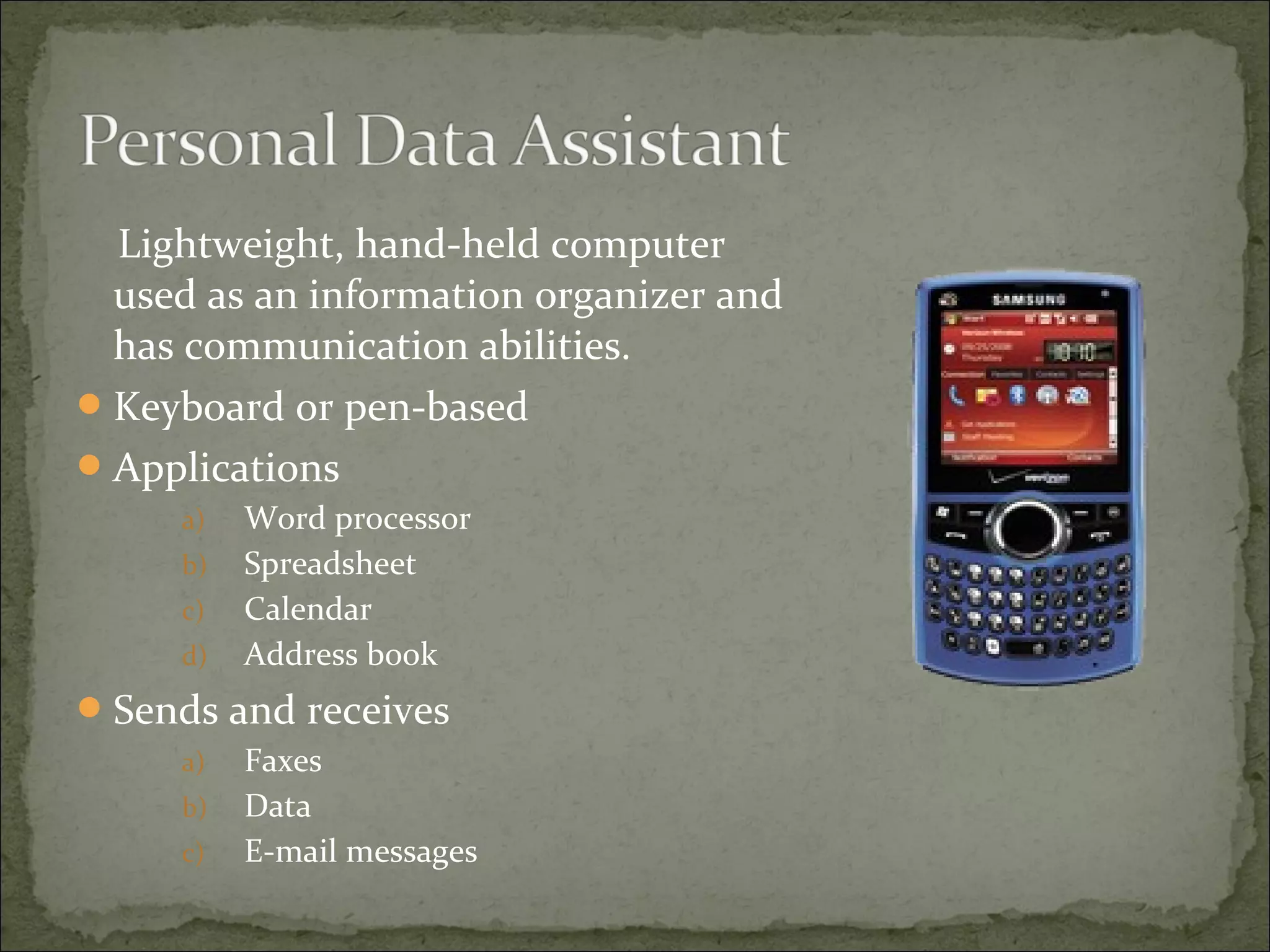
Lightweight, hand-held computer
used as an information organizer and
has communication abilities.
Keyboard or pen-based
Applications
a) Word processor
b) Spreadsheet
c) Calendar
d) Address book
Sends and receives
a) Faxes
b) Data
c) E-mail messages
Computer
Machine that stores and manipulates
data and programs.
• Hardware – physical body
• Software – application programs
a) Word processing
b) Spreadsheets
c) E-mail
d) Internet
e) Conferencing
(McGonigle & Mastrian, 2009)
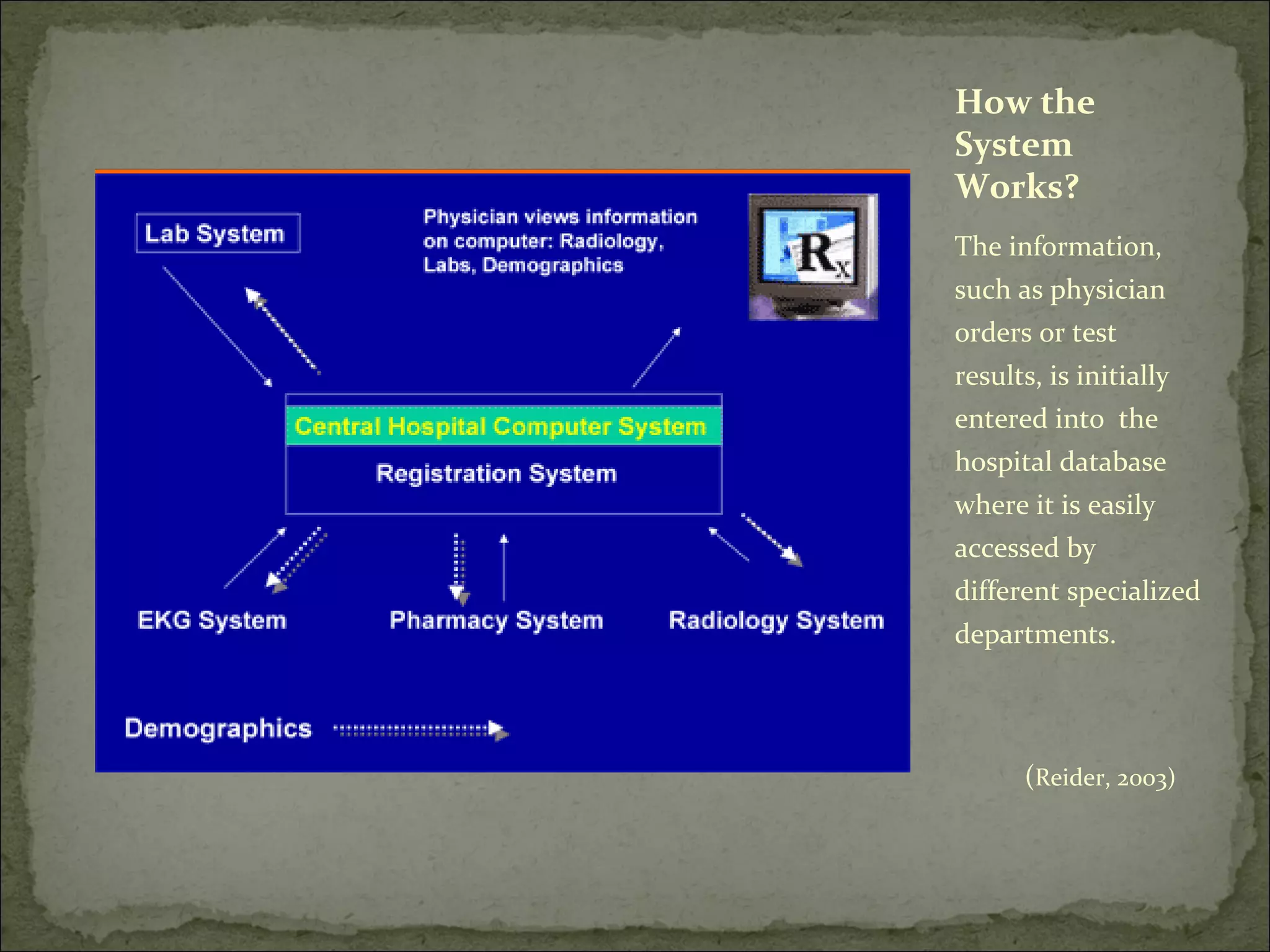
The information,
such as physician
orders or test
results, is initially
entered into the
hospital database
where it is easily
accessed by
different specialized
departments.
(Reider, 2003)
How the
System
Works?
Easily Accessible
Channels user through a
series of questions
Unproblematic for
experienced and
inexperienced nurses
Tasks are completed with
accuracy
Tasks are completed
quickly
(Staggers, 2003)
 CPOE systems must intersect with HIS systems
like:
 McKesson HIS
a. Booking & pre-admission
b. Admission & registration
c. Bed assignment, transfer, & discharge
d. Charging & claim submission
e. Management & follow-up
f. Customer service
(McKesson, 2008)
Allow professionals’ entry and access to data in real
time to enhance quality of patient care
User involvement in all steps of the implementation
of design and evaluation
Value of issues such as culture, advancement, and
leadership for successful implementation
(Oroviogoicoechea, Elliot, & Watson, 2008)
Legal Issues
I. Physicians coercing nurses to enter
orders for them
II. Physicians leaving the floor to call in
telephone orders
III. Patient privacy and security
IV. Physician overrides/Medical
malpractice
V. Poor implementation
VI. Improper Use
VII. Deficient ergonomics
Exceptions to CPOE
1. Phone orders if no computer access
2. Emergency orders
3. Protocol orders
4. Verbal orders given during
procedures
5. Orders during computer system
downtime
Advantages of CPOE
1. Provides drug screening information
2. Helps prevent adverse drug effects
3. Improves quality of patient care
4. Reduces drug expenses
5. Provides predefined orders
6. Speeds up medication ordering
7. Easy accessibility to patient’s medical orders
8. Eliminates handwriting/transcription errors
9. Increases productivity and workflow
10. Provides decision support
Disadvantages of CPOE
1. Too much information/over-alerting
2. Physician non-acceptance
3. Integration/staff training
4. Installation costs
5. Intrusion of physician decision-making
Nursing Competencies
Nurses utilizing CPOE will need to:
a. Use the database applications to enter and retrieve
patient data/orders
b. Demonstrate basic technology skills (typing &
printing)
c. Use applications for structured data entry
d. Use the application to plan care for patients
e. Use networks to navigate systems
f. Operate peripheral devices (PDAs)
Nursing Functions/Responsibilities
1. Enter admission/discharge orders
2. Place medication and non-
medication orders
3. Place ordersets
4. Update allergy information
5. Resolve orders conflicts
6. Discontinue orders
To Review……..
CPOE:
1) Offers quick access to patient medication orders
2) Offers clinical decision support
3) Provides drug screening information
4) Helps prevent adverse drug effects
5) Improves quality of patient care
6) Allows real-time access to patient records
7) Improves accuracy and completeness of physician
orders
References
McGonigle, D. & Mastrian, K. ( 2009). Nursing informatics and the foundation of
knowledge. Boston: Jones & Bartlett Publishers.
McKesson. (2007). HealthQuest, Retrieved December 14, 2008 from
http://www.mckesson.com/en_us/McKesson.com/For+Healthcare+Providers/
Hospitals
Oroviogoicoechea, C., Elliott, B., & Watson, R. (2008). Review: Evaluating
Information Systems in Nursing. Journal of Clinical Nursing 17, 567-575.
Reider, J. (2003). Computerized Physician Order Entry: Has the Time Come?
Medscape General Medicine, 5(2).
Stagger, N. (2003). Human Factors: Imperative Concepts for Critical Care. AACN
Clinical Issues, 14(3), 310-319.
Zahn, C., Hicks, R.W., Blanchette, C.M., Keyes, M.A., & Cousins, D.D. (2006).
Potential Benefits and Problems With Computerized Prescriber. American
Journal of Health System-Pharmacy, 63(4), 353-358.

Cpoe ppt

  • 1.
  • 2.
    1. Define ComputerizedPhysician Order Entry System 2. Describe hardware/software 3. Review the information system 4. Assess nursing implications 5. Examine related legal/ethical issues 6. Advantages/Disadvantages from nursing perspective
  • 3.
    What is CPOE? Computer PhysicianOrder Entry is software that allows physicians to directly enter their medical orders into a hospital information system. (Reider, 2003)
  • 4.
    Medical orders include… Medication Laboratorytests Radiological procedures Surgical procedures Dietary orders
  • 5.
    Offers access topatient records Offers clinical decision support
  • 6.
    Eliminates illegible handwriting Real-time accessto patient records Offers clinical decision support Avoids transcription errors Speeds up response time Improves accuracy and completeness (Zahn, Hicks, et al., 2006)
  • 7.
    From a desktopcomputer From a personal data assistant From other electronic devices (Zahn, Hicks, et al., 2006)
  • 8.
    Lightweight, hand-held computer usedas an information organizer and has communication abilities. Keyboard or pen-based Applications a) Word processor b) Spreadsheet c) Calendar d) Address book Sends and receives a) Faxes b) Data c) E-mail messages
  • 9.
    Computer Machine that storesand manipulates data and programs. • Hardware – physical body • Software – application programs a) Word processing b) Spreadsheets c) E-mail d) Internet e) Conferencing (McGonigle & Mastrian, 2009)
  • 10.
    The information, such asphysician orders or test results, is initially entered into the hospital database where it is easily accessed by different specialized departments. (Reider, 2003) How the System Works?
  • 11.
    Easily Accessible Channels userthrough a series of questions Unproblematic for experienced and inexperienced nurses Tasks are completed with accuracy Tasks are completed quickly (Staggers, 2003)
  • 12.
     CPOE systemsmust intersect with HIS systems like:  McKesson HIS a. Booking & pre-admission b. Admission & registration c. Bed assignment, transfer, & discharge d. Charging & claim submission e. Management & follow-up f. Customer service (McKesson, 2008)
  • 13.
    Allow professionals’ entryand access to data in real time to enhance quality of patient care User involvement in all steps of the implementation of design and evaluation Value of issues such as culture, advancement, and leadership for successful implementation (Oroviogoicoechea, Elliot, & Watson, 2008)
  • 14.
    Legal Issues I. Physicianscoercing nurses to enter orders for them II. Physicians leaving the floor to call in telephone orders III. Patient privacy and security IV. Physician overrides/Medical malpractice V. Poor implementation VI. Improper Use VII. Deficient ergonomics
  • 15.
    Exceptions to CPOE 1.Phone orders if no computer access 2. Emergency orders 3. Protocol orders 4. Verbal orders given during procedures 5. Orders during computer system downtime
  • 16.
    Advantages of CPOE 1.Provides drug screening information 2. Helps prevent adverse drug effects 3. Improves quality of patient care 4. Reduces drug expenses 5. Provides predefined orders 6. Speeds up medication ordering 7. Easy accessibility to patient’s medical orders 8. Eliminates handwriting/transcription errors 9. Increases productivity and workflow 10. Provides decision support
  • 17.
    Disadvantages of CPOE 1.Too much information/over-alerting 2. Physician non-acceptance 3. Integration/staff training 4. Installation costs 5. Intrusion of physician decision-making
  • 18.
    Nursing Competencies Nurses utilizingCPOE will need to: a. Use the database applications to enter and retrieve patient data/orders b. Demonstrate basic technology skills (typing & printing) c. Use applications for structured data entry d. Use the application to plan care for patients e. Use networks to navigate systems f. Operate peripheral devices (PDAs)
  • 19.
    Nursing Functions/Responsibilities 1. Enteradmission/discharge orders 2. Place medication and non- medication orders 3. Place ordersets 4. Update allergy information 5. Resolve orders conflicts 6. Discontinue orders
  • 20.
    To Review…….. CPOE: 1) Offersquick access to patient medication orders 2) Offers clinical decision support 3) Provides drug screening information 4) Helps prevent adverse drug effects 5) Improves quality of patient care 6) Allows real-time access to patient records 7) Improves accuracy and completeness of physician orders
  • 21.
    References McGonigle, D. &Mastrian, K. ( 2009). Nursing informatics and the foundation of knowledge. Boston: Jones & Bartlett Publishers. McKesson. (2007). HealthQuest, Retrieved December 14, 2008 from http://www.mckesson.com/en_us/McKesson.com/For+Healthcare+Providers/ Hospitals Oroviogoicoechea, C., Elliott, B., & Watson, R. (2008). Review: Evaluating Information Systems in Nursing. Journal of Clinical Nursing 17, 567-575. Reider, J. (2003). Computerized Physician Order Entry: Has the Time Come? Medscape General Medicine, 5(2). Stagger, N. (2003). Human Factors: Imperative Concepts for Critical Care. AACN Clinical Issues, 14(3), 310-319. Zahn, C., Hicks, R.W., Blanchette, C.M., Keyes, M.A., & Cousins, D.D. (2006). Potential Benefits and Problems With Computerized Prescriber. American Journal of Health System-Pharmacy, 63(4), 353-358.