Done By:
Alhanouf Fahad Altamimi
Atheer Saleh Alhamid
Fay Ahmad Almughaiseeb
Kholoud Abdullah Alshiha
Norah Fahad Alfayez
Zuhour Abdullah Alqahtani
Supervised by:
Dr.Abdullah Alrabeah
OBJECTIVES
1. Definition CPOE
2. Features of CPOE
3. Describe available hardware and
software for CPOE
4. Examine legal/ethical issues
5. Discuss the
advantages/disadvantages of CPOE
6. Discuss the patient safety role in
CPOE
7. Review the cost of CPOE
8. Areas of Exception in CPOE.
What we will be covering today:
DEFINITION
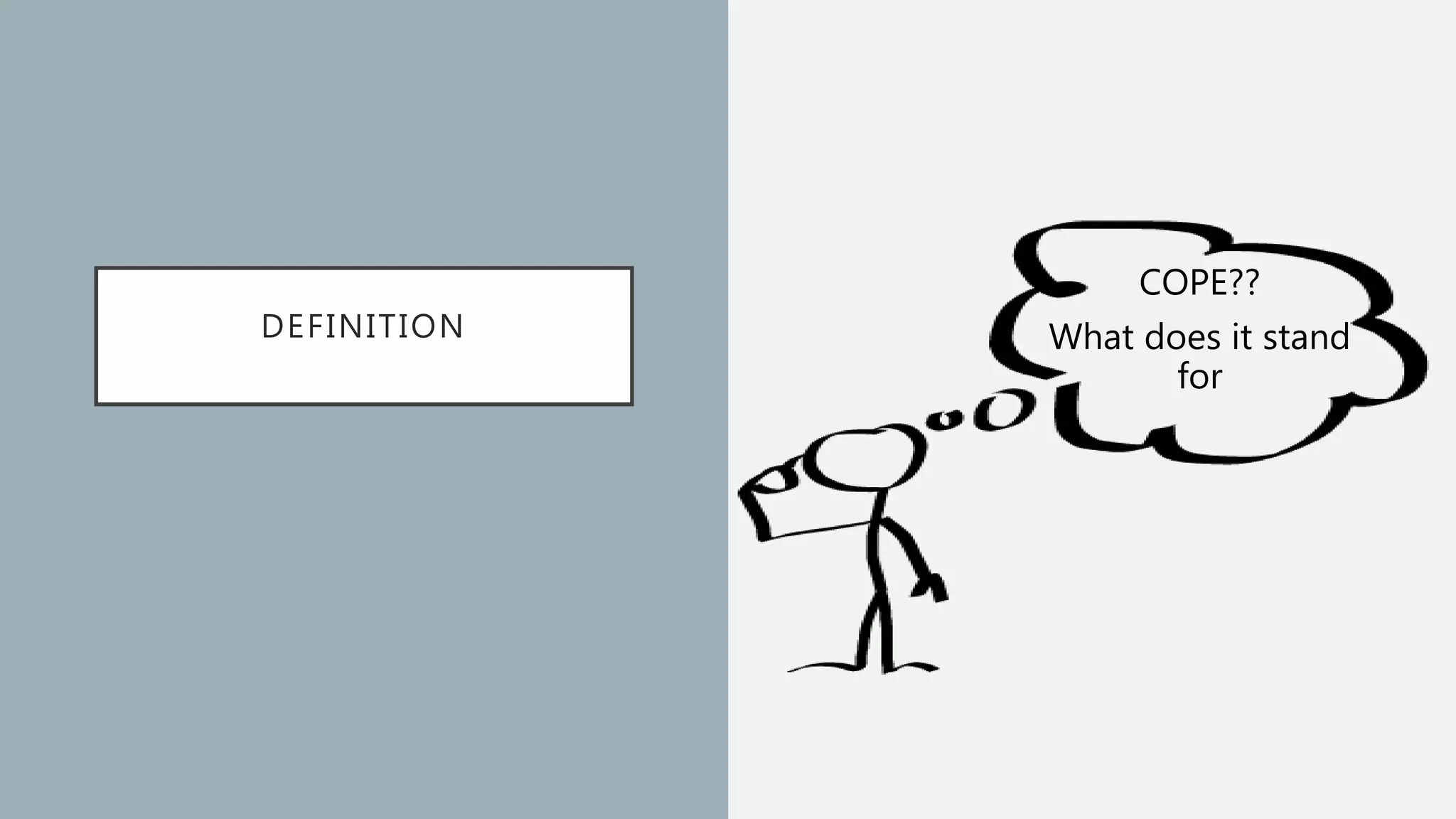
COPE??
What does it stand
for
ized
COMPUTERIZED PHYSICIAN
ORDER ENTRY
• “the process where a medical professional entering
orders or instructions electronically”
• is a solution to a current human system problems, that focuses on
achieving improved quality and safety for all patients
WHAT IS CPOE?
CPOE is a computer application that accepts physician orders
such as:
• Medication
• Laboratory Tests
• Diagnostic Studies
• Ancillary Support
• Nursing Orders
• Involves electronic communication of orders
• Consultation
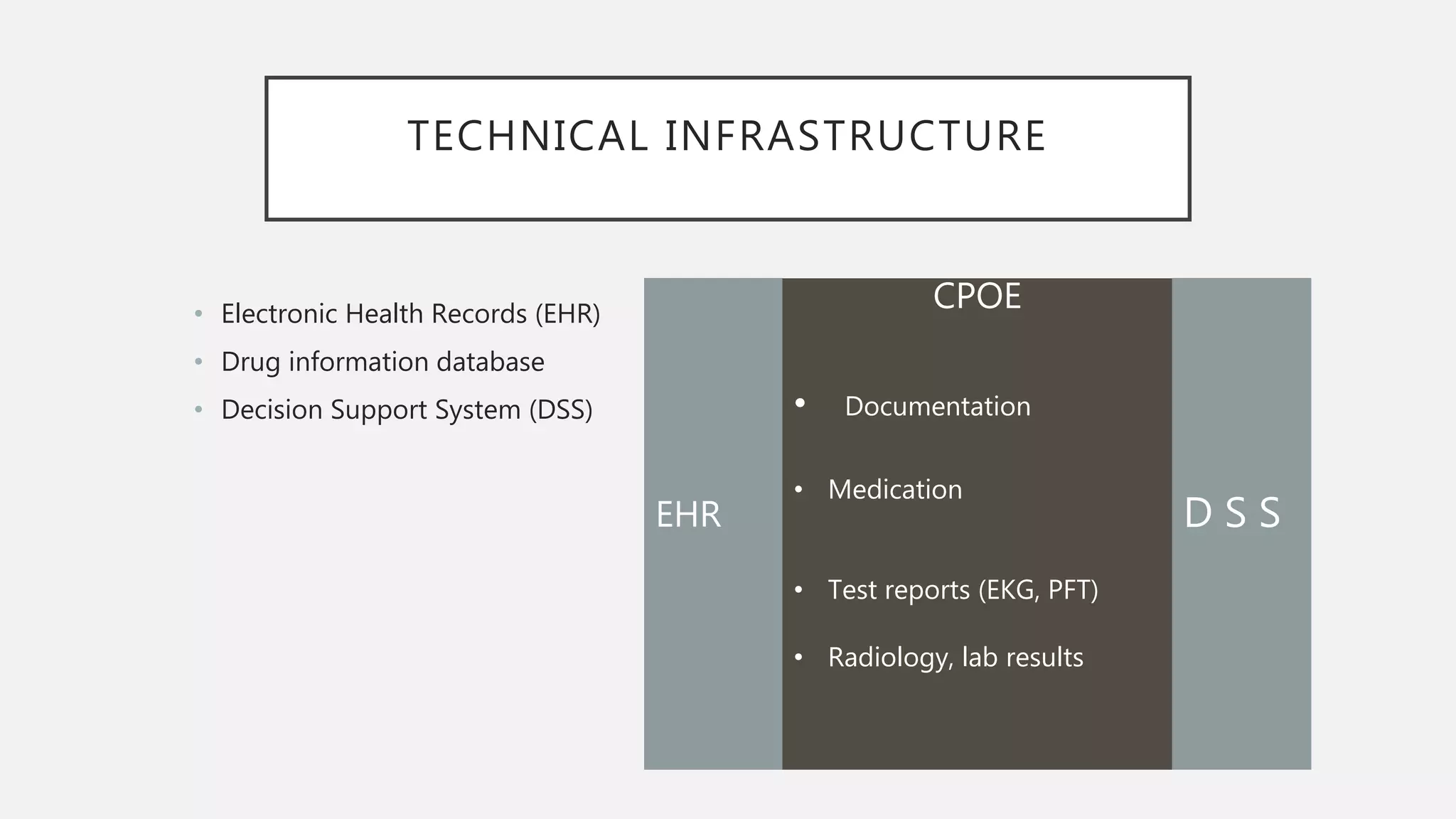
TECHNICAL INFRASTRUCTURE
• Electronic Health Records (EHR)
• Drug information database
• Decision Support System (DSS)
EHR
CPOE
D S S
• Documentation
• Medication
• Test reports (EKG, PFT)
• Radiology, lab results
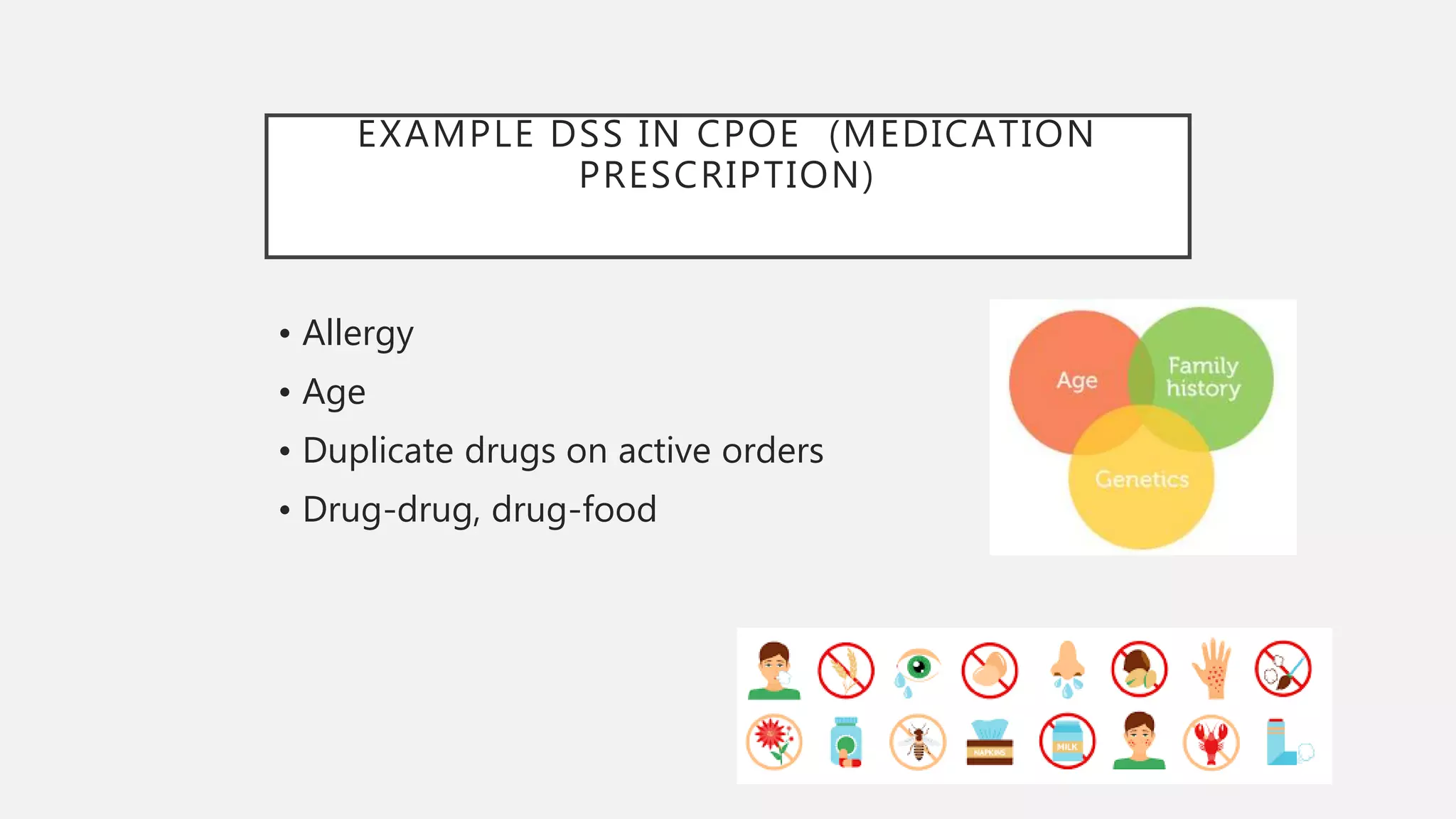
EXAMPLE DSS IN CPOE (MEDICATION
PRESCRIPTION)
• Allergy
• Age
• Duplicate drugs on active orders
• Drug-drug, drug-food
FEATURES OF CPOE
• Ordering
• Patient-centered decision support
• Patients safety features
• Intuitive human interface
• Security
• Portability
• Management
• Billing
1. ORDERING
• Orders are communicated to all departments,
improving response time and avoiding scheduling
problems and conflict with existing orders.
2. PATIENT-CENTERED DECISION SUPPORT
• The ordering process includes a display of the
patient's medical history and current results and
evidence-based clinical guidelines to support
treatment decisions.
3. PATIENTS SAFETY FEATURES
• Allows real-time patient identification, drug dose
recommendations, adverse drug reaction, also reviews
and checks on allergies and test or treatment
conflicts. Physicians and nurses can review orders
immediately for confirmation.
4. INTUITIVE HUMAN INTERFACE
• The order entry workflow corresponds to familiar
"paper-based" ordering to allow efficient use by new
or infrequent users.
5. SECURITY
• Access is secure, health profession can entering and
reviewing the data with there ID.
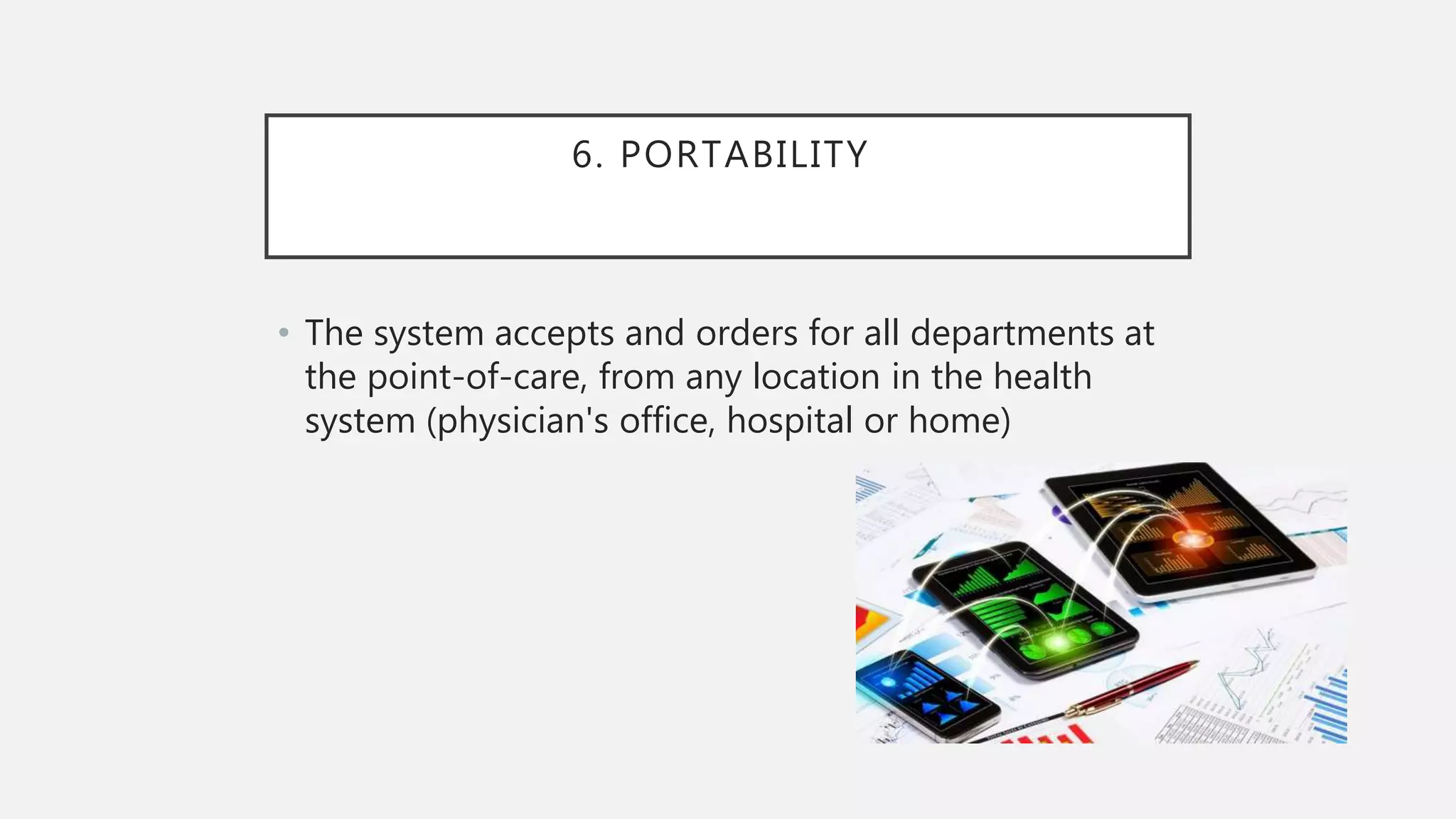
6. PORTABILITY
• The system accepts and orders for all departments at
the point-of-care, from any location in the health
system (physician's office, hospital or home)
• The system delivers statistical reports online so that
managers can analyze patient census and make
changes in staffing, replace inventory and audit
utilization and productivity throughout the
organization.
• Data is collected for training, planning, and root cause
analysis for patient safety events.
• Documentation is improved by linking diagnoses to
orders at the time of order entry to support
appropriate charges.
NOW LETS FIND
OUT ON WHAT
HARDWARES DOES
CPOE WORK:
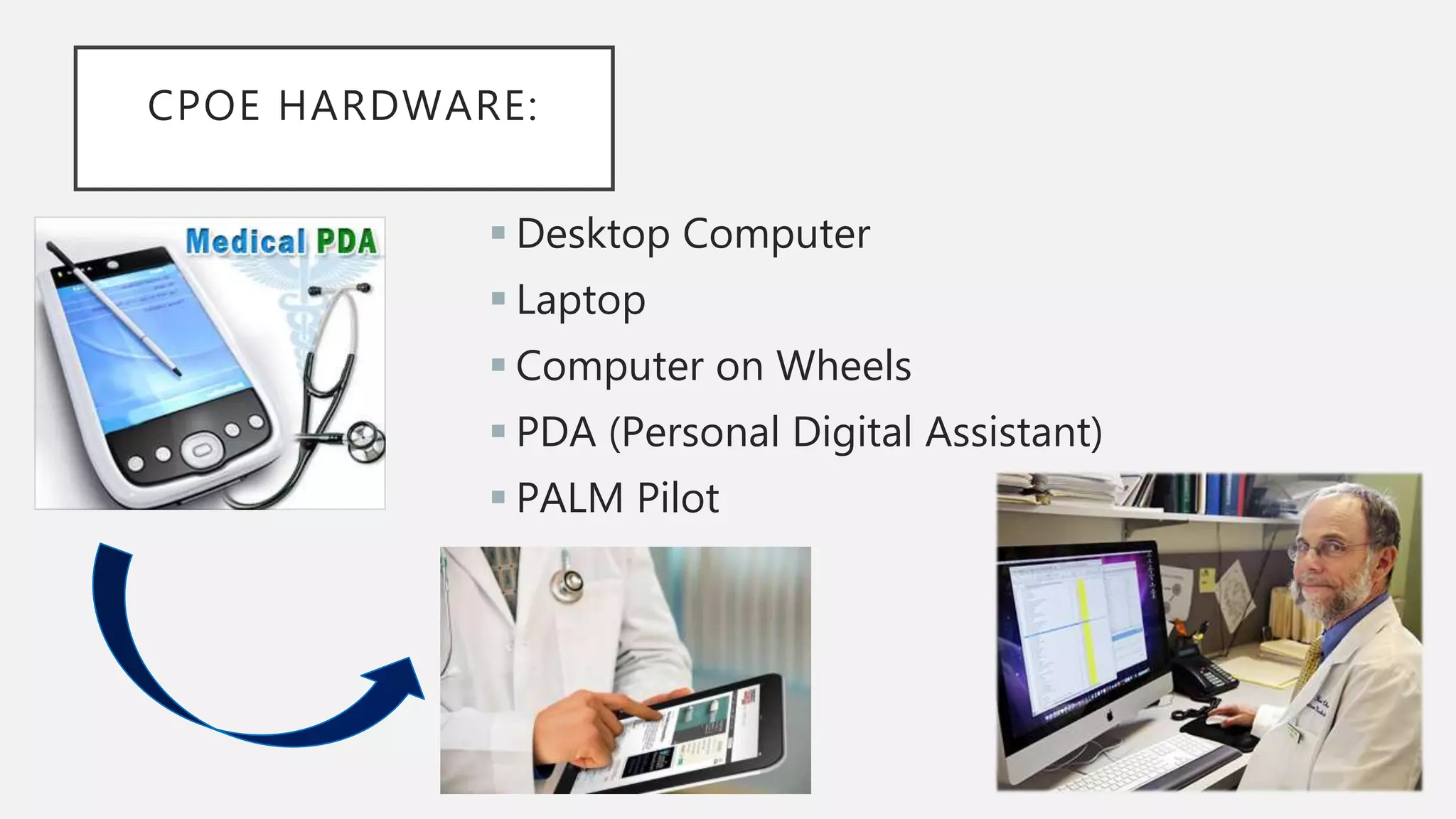
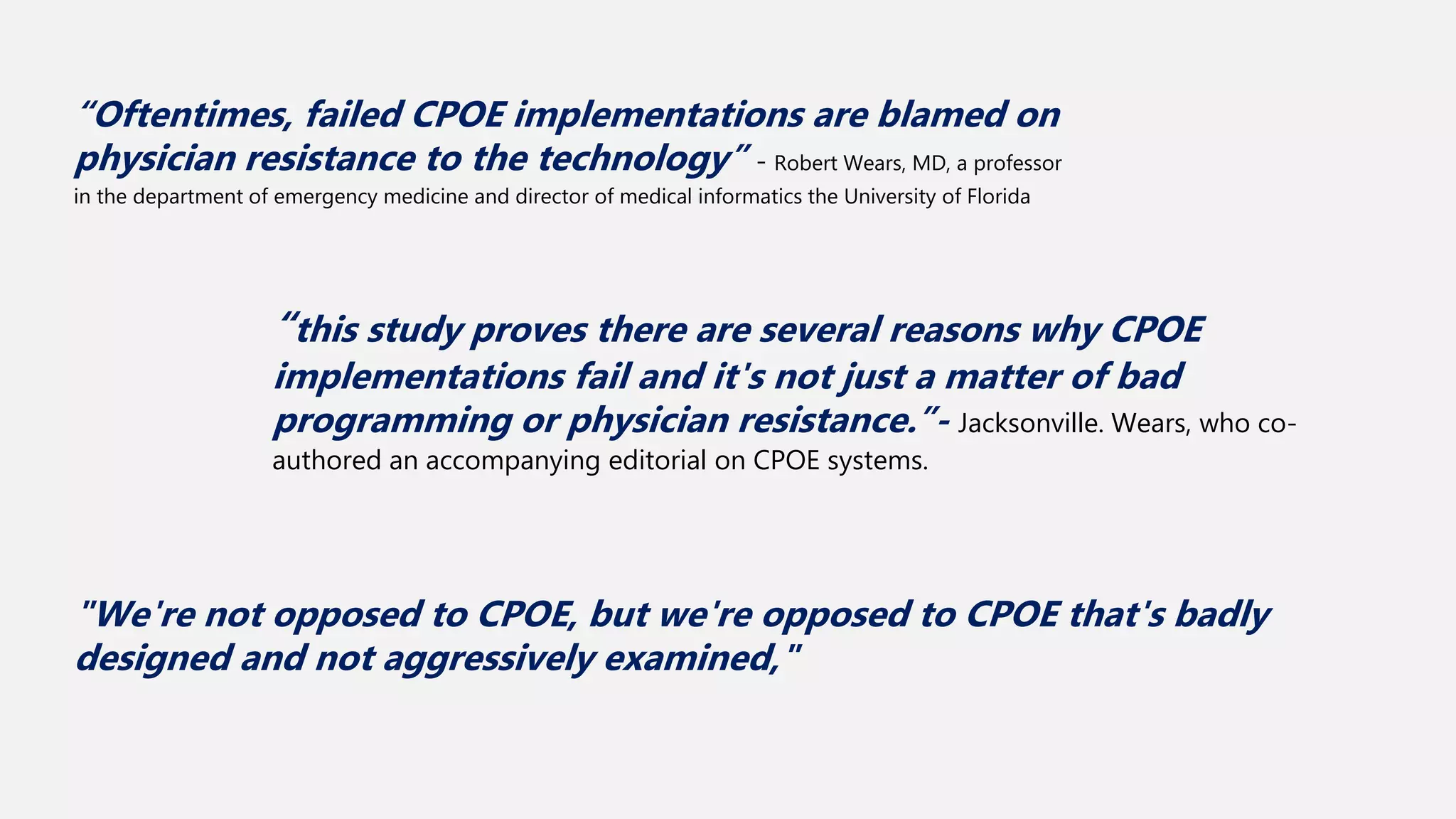
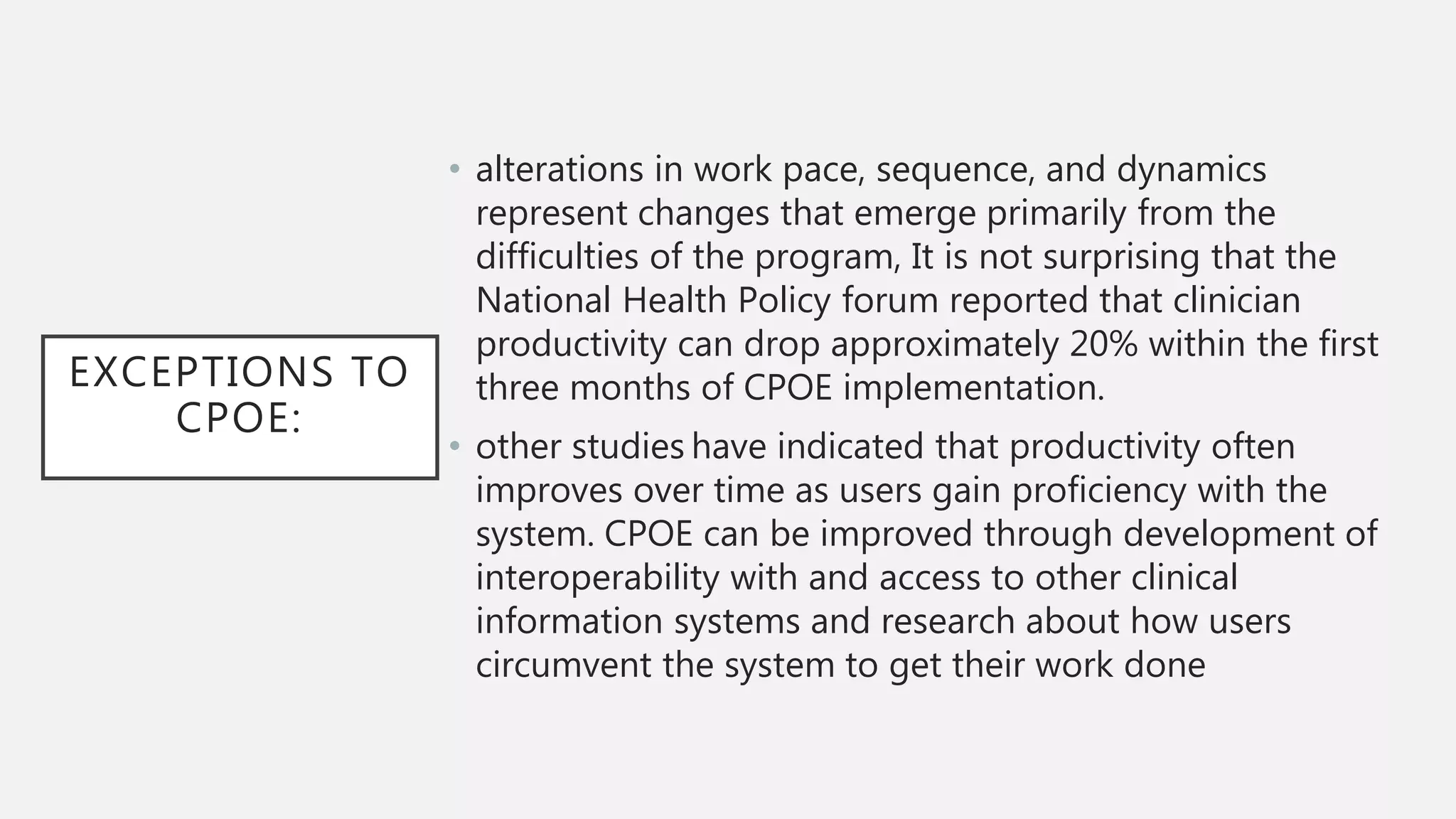
CPOE HARDWARE:
 Desktop Computer
 Laptop
 Computer on Wheels
 PDA (Personal Digital Assistant)
 PALM Pilot
WHAT CAN WE USE
ON THIS HARDWARE?
SOFTWARE!!
Cerner
McKes
son
Eclipsy
a
Sieme
ns
MediT
ech
CPOE HAS MANY BENEFITS
FOR BOTH PRACTICES AND
PATIENTS:
1. Patient charts are not
misplaced or misfiled
2. Comprehensive case
documentation and medical
history of patient
3. Improve patient care with
clinical decision support
systems
4. access to Drug specific
information that eliminates
confusion
CPOE HAS MANY BENEFITS FOR BOTH
PRACTICES AND PATIENTS:
1. Reduced healthcare costs due to
improved efficiencies
2. Improve communication between
various departments such as lab
assistants, doctors, nurses, specialists,
pharmacist etc
3. reduce errors related to poor
handwriting or transcription of
medication orders.
4. Patient Safety
DISADVANTAGES
• Despite the considerable benefits, only 8% of US hospitals have fully
implemented CPOE systems.(1) What are the challenges?
• The upfront cost of implementing CPOE is one chief obstacle for
hospitals. At Brigham and Women’s Hospital, the cost of developing
and implementing CPOE was approximately $1.9 million, with
$500,000 maintenance costs per year since.
• Installation of even “off the shelf” CPOE packages
requires a significant amount of customization for
each hospital and can be very expensive.(2)
• Integration with other systems, cost, time, technical
• Finally, there may be cultural obstacles to CPOE
implementation. For example, some physicians resist
utilizing computerized decision-support tools, relying
instead on practice experience.
DISADVANTAGES
PATIENT SAFETY
CPOE e-prescribing has an alerts system such as drug-allergy checking,
drug-drug interaction checking, patient-specific dosing, relevant
laboratory monitoring and drug-disease interaction checks.
A study was held to determine if handwritten prescriptions led to
clinical errors and whether an e-prescribing system would eliminate
them. they found that only 0.2 percent of the errors in Computerized
prescriptions actually led to patient harm.
PATIENT SAFETY
Other benefits that
contribute in Patient Safety:
• Reduction of adverse drug
effects (ADE)
• Dose limits based on age,
weight
• Standardization of
treatment protocols
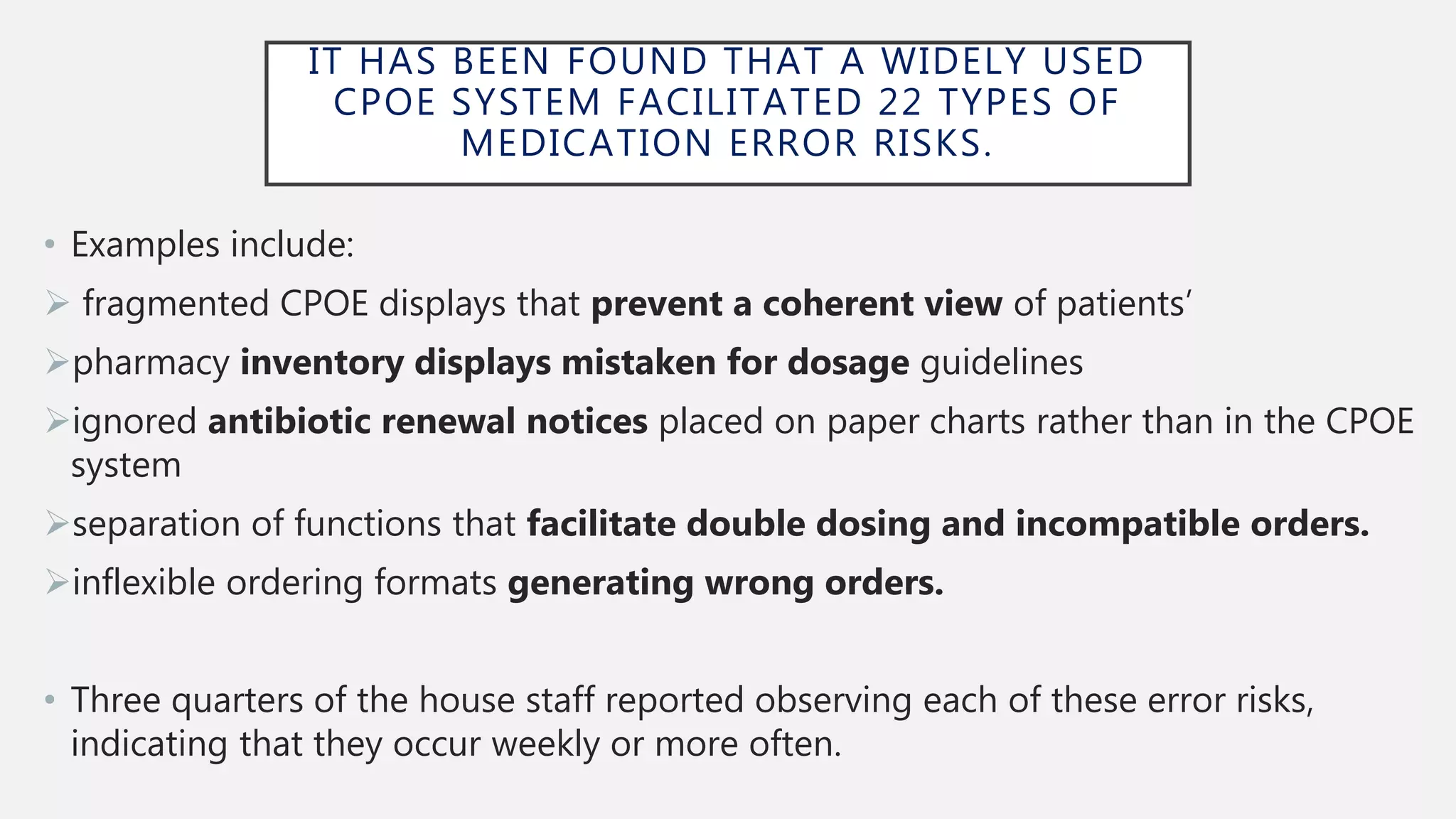
IT HAS BEEN FOUND THAT A WIDELY USED
CPOE SYSTEM FACILITATED 22 TYPES OF
MEDICATION ERROR RISKS.
• Examples include:
 fragmented CPOE displays that prevent a coherent view of patients’
pharmacy inventory displays mistaken for dosage guidelines
ignored antibiotic renewal notices placed on paper charts rather than in the CPOE
system
separation of functions that facilitate double dosing and incompatible orders.
inflexible ordering formats generating wrong orders.
• Three quarters of the house staff reported observing each of these error risks,
indicating that they occur weekly or more often.
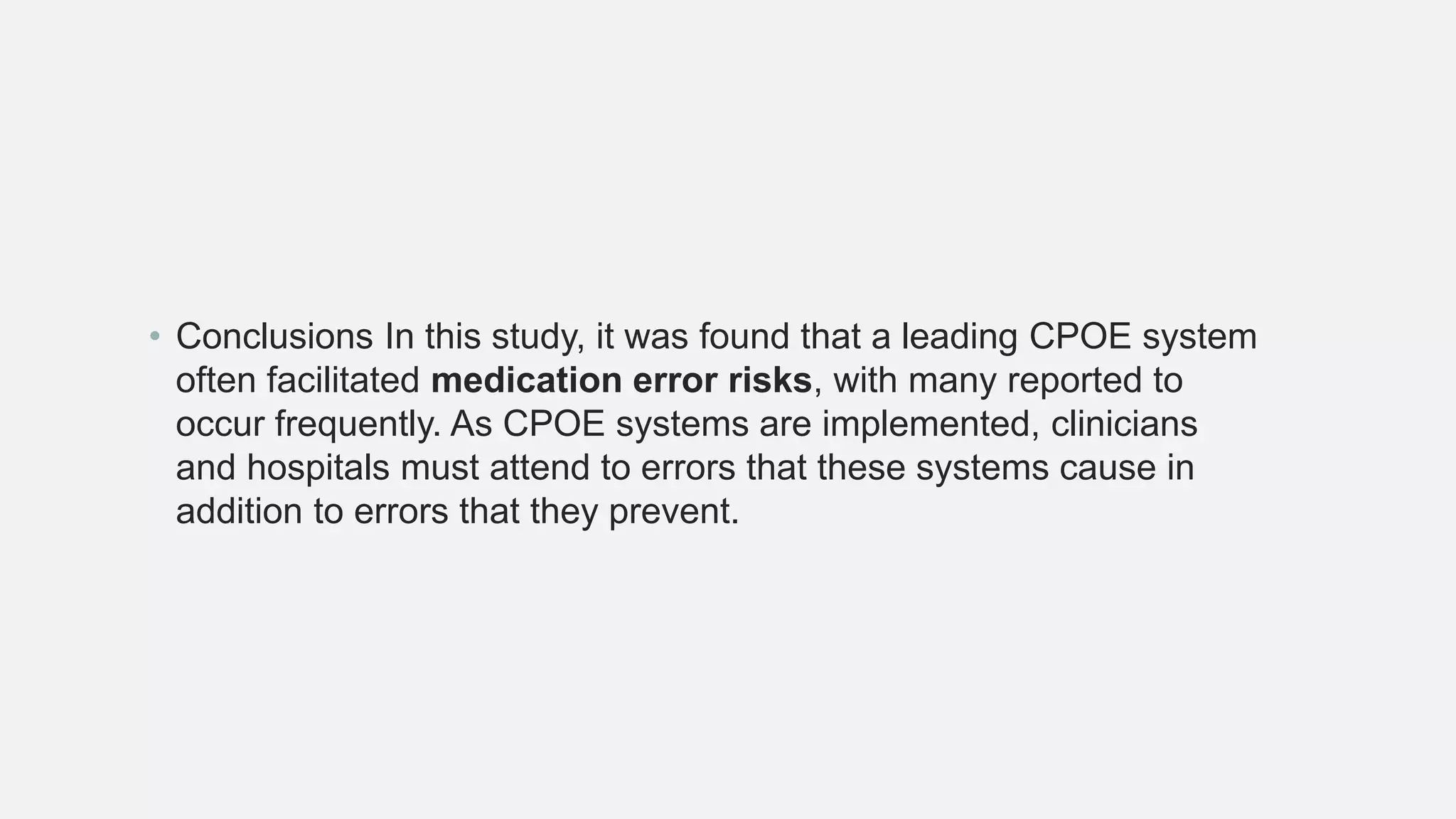
• Conclusions In this study, it was found that a leading CPOE system
often facilitated medication error risks, with many reported to
occur frequently. As CPOE systems are implemented, clinicians
and hospitals must attend to errors that these systems cause in
addition to errors that they prevent.
"We're not opposed to CPOE, but we're opposed to CPOE that's badly
designed and not aggressively examined,"
“Oftentimes, failed CPOE implementations are blamed on
physician resistance to the technology” - Robert Wears, MD, a professor
in the department of emergency medicine and director of medical informatics the University of Florida
“this study proves there are several reasons why CPOE
implementations fail and it's not just a matter of bad
programming or physician resistance.”- Jacksonville. Wears, who co-
authored an accompanying editorial on CPOE systems.
Wears and Koppel said:
“many CPOE systems don't take into account how physicians actually work in
a hospital and are created for an idealized setting where the doctor works in
a quiet environment and has time to carefully select orders.”
TO PREVENT SOME OF THESE MISTAKES,
RESEARCHERS MADE SEVERAL RECOMMENDATIONS
1. Focus on the organization of work, not on technology, to evaluate
whether CPOE can improve patient care;
2. Examine the technology in use and some of the problems that are
obscured when staff find workarounds of the system
3. Aggressively fix technology when it is counterproductive
4. Understand that there are multiple factors that contribute to errors
and that these reasons may have several layers of complexity; and
5. Plan for continuous revisions and improvements of the system while
recognizing that all changes can create new error risks.
• As with the CPOE, the incorporation of health informatics industry-wide is not a flawless
process, albeit a necessary one.
• The United States health care industry is transforming to answer demands for cost
savings, improved efficiencies, automated information accessible to provider and
consumer, and enhanced patient safety and confidentiality.
• Implementation of informatics to existing health care systems is a complex process
requiring time, input, and a willingness to change.
• The informatics specialist plays a vital role in executing this transformation and serves as
a liaison to gap the bridge between the medical and information technology sectors to
help bring the health care industry closer to achieving optimal health care delivery.
Eclipsys Chief Medical Information Officer Rick Mansour, MD, said in a written
response. :
"Healthcare providers should be continuously aware of the ongoing
innovations available to help marry information technology and clinical
decision making in today's complex healthcare environment. They must also
always be diligent in providing comprehensive training in the use of these
systems for all of those individuals who will be using them to support high-
quality patient care."
"A lot of the issues they [the researchers] identify as relating to the
technology are not related to the technology at all," Bates said. "It's hard to
blame the software." “Some of the problems, such as system down time, are
attributable to the hospital's underlying information system”.
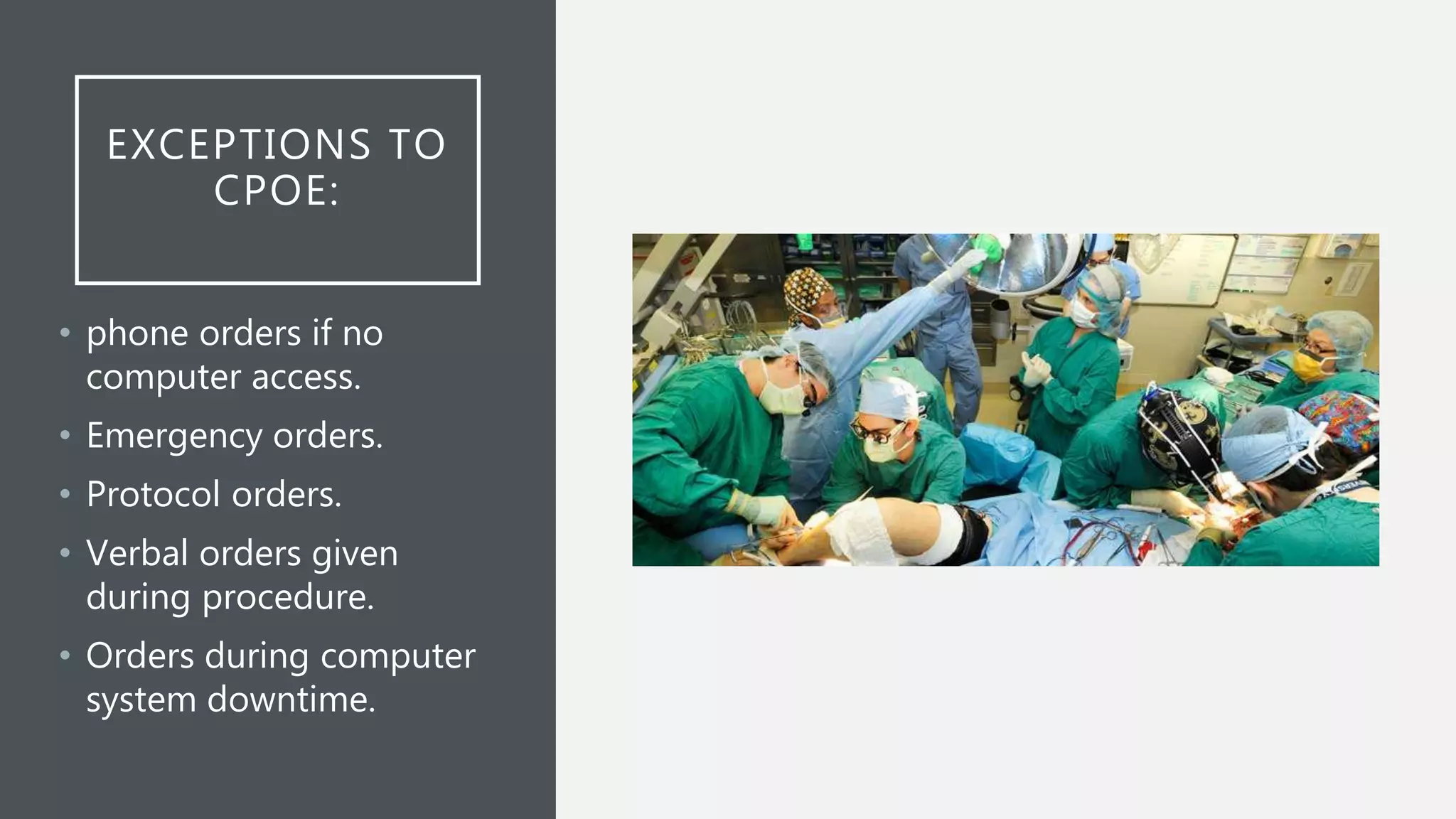
EXCEPTIONS TO
CPOE:
• alterations in work pace, sequence, and dynamics
represent changes that emerge primarily from the
difficulties of the program, It is not surprising that the
National Health Policy forum reported that clinician
productivity can drop approximately 20% within the first
three months of CPOE implementation.
• other studies have indicated that productivity often
improves over time as users gain proficiency with the
system. CPOE can be improved through development of
interoperability with and access to other clinical
information systems and research about how users
circumvent the system to get their work done
EXCEPTIONS TO
CPOE:
• phone orders if no
computer access.
• Emergency orders.
• Protocol orders.
• Verbal orders given
during procedure.
• Orders during computer
system downtime.
COST OF CPOE:
• Although the benefits of the
technology have been
demonstrated, there are also
barriers in the system that impedes
its implementation. One of the
major barriers to implementation is
cost.
• There is the Capital costs, One-
time operating and Annual
operating costs.
CONT.
Capital costs include: hardware; software;
computer networking equipment (including
wireless network capabilities); workstations,
printers, and handheld wireless devices.
 One-time operating costs include: leadership
resources to direct the project and ensure
physician participation; and information
systems analysts, physicians, and other
clinicians to design, configure, and install the
system.
 Annual operating costs include: the costs
associated with maintaining the hardware,
software, network equipment, computer
interfaces, and user devices (including
reviewing and updating all of the clinical rules
CONT.
• CPOE systems also achieve significant cost savings
through the reduction of medication errors and ADEs,
as well as through the use of decision support
capabilities that improve resource utilization and
lower hospital lengths of stay. Examples of this
include:
• ● Reduction in pharmacy charges of $500,000
through recommended dosage changes for a single
drug .
• ● Reduction in emergency department expenditures .
LEGAL AND ETHICAL ISSUES REGARDING
CPOE
Risk for medical malpractice claims.
 Likelihood of medical errors.
 Breaches, theft and unauthorized access to protected
health information.
Medical records mishandling
 Employees illegally accessing patient files
HIPAA (Health Insurance Portability and Accountability
Act of 1996) is United States legislation that provides data
privacy and security provisions for safeguarding medical
information.
CONCLUSION
* CPOE systems have the potential to be an effective solution for limiting
hospital medical errors experienced in the Saudi Arabia.
* CPOE adoption can facilitate the reduction of medical errors and ADEs
as well as creating cost savings in hospitals.
* CPOE also supplies providers with additional clinical knowledge and
patient-related information that is intelligently filtered and presented at
appropriate times. In which we think it will upgrade our patient-physician
experience
ANY QUESTIONS??
THANK YOU
REFERENCES:
• IS CPOE SAFE FOR PATIENTS?
• An early experience.
• Leah Brown MSN, RN and James Frye MBA
• http://www.iise.org/uploadedFiles/SHS_Community/Is%20CPOE%20Safe%20for%20Patients.pdf
• http://www.openclinical.org/cpoe.html
• Computerized Physician Order Entry
• Promise, Perils, and Experience
• Raman Khanna, MD, MAS1 and Tony Yen, MD2
• https://www.ncbi.nlm.nih.gov/pmc/articles/PMC3869307/
• https://healthit.ahrq.gov/key-topics/computerized-provider-order-entry
• http://www.healthcareitnews.com/news/cpoe-and-patient-safety
• What is HIPAA (Health Insurance Portability and Accountability Act ...
1. Yu F, Menachemi N, Berner E, Allison J, Weissman N, Houston T. Full implementation of computerized physician order entry and
medication-related quality outcomes: A study of 3364 hospitals. Am J Med Qual. 2009;24(4):278- 286.
2. Bates D, Leape L, Cullen D, et al. Effect of computerized physician order entry and a team intervention on 2016 Leapfrog Hospital
Survey prevention of serious medication errors. JAMA. 1998;280:1311-1316.

Computerized physician order entry (CPOE)

  • 1.
    Done By: Alhanouf FahadAltamimi Atheer Saleh Alhamid Fay Ahmad Almughaiseeb Kholoud Abdullah Alshiha Norah Fahad Alfayez Zuhour Abdullah Alqahtani Supervised by: Dr.Abdullah Alrabeah
  • 2.
    OBJECTIVES 1. Definition CPOE 2.Features of CPOE 3. Describe available hardware and software for CPOE 4. Examine legal/ethical issues 5. Discuss the advantages/disadvantages of CPOE 6. Discuss the patient safety role in CPOE 7. Review the cost of CPOE 8. Areas of Exception in CPOE. What we will be covering today:
  • 3.
  • 4.
  • 5.
    • “the processwhere a medical professional entering orders or instructions electronically” • is a solution to a current human system problems, that focuses on achieving improved quality and safety for all patients
  • 6.
    WHAT IS CPOE? CPOEis a computer application that accepts physician orders such as: • Medication • Laboratory Tests • Diagnostic Studies • Ancillary Support • Nursing Orders • Involves electronic communication of orders • Consultation
  • 7.
    TECHNICAL INFRASTRUCTURE • ElectronicHealth Records (EHR) • Drug information database • Decision Support System (DSS) EHR CPOE D S S • Documentation • Medication • Test reports (EKG, PFT) • Radiology, lab results
  • 8.
    EXAMPLE DSS INCPOE (MEDICATION PRESCRIPTION) • Allergy • Age • Duplicate drugs on active orders • Drug-drug, drug-food
  • 9.
    FEATURES OF CPOE •Ordering • Patient-centered decision support • Patients safety features • Intuitive human interface • Security • Portability • Management • Billing
  • 10.
    1. ORDERING • Ordersare communicated to all departments, improving response time and avoiding scheduling problems and conflict with existing orders.
  • 11.
    2. PATIENT-CENTERED DECISIONSUPPORT • The ordering process includes a display of the patient's medical history and current results and evidence-based clinical guidelines to support treatment decisions.
  • 12.
    3. PATIENTS SAFETYFEATURES • Allows real-time patient identification, drug dose recommendations, adverse drug reaction, also reviews and checks on allergies and test or treatment conflicts. Physicians and nurses can review orders immediately for confirmation.
  • 13.
    4. INTUITIVE HUMANINTERFACE • The order entry workflow corresponds to familiar "paper-based" ordering to allow efficient use by new or infrequent users.
  • 14.
    5. SECURITY • Accessis secure, health profession can entering and reviewing the data with there ID.
  • 15.
    6. PORTABILITY • Thesystem accepts and orders for all departments at the point-of-care, from any location in the health system (physician's office, hospital or home)
  • 16.
    • The systemdelivers statistical reports online so that managers can analyze patient census and make changes in staffing, replace inventory and audit utilization and productivity throughout the organization. • Data is collected for training, planning, and root cause analysis for patient safety events.
  • 17.
    • Documentation isimproved by linking diagnoses to orders at the time of order entry to support appropriate charges.
  • 18.
    NOW LETS FIND OUTON WHAT HARDWARES DOES CPOE WORK:
  • 19.
    CPOE HARDWARE:  DesktopComputer  Laptop  Computer on Wheels  PDA (Personal Digital Assistant)  PALM Pilot
  • 20.
    WHAT CAN WEUSE ON THIS HARDWARE? SOFTWARE!! Cerner McKes son Eclipsy a Sieme ns MediT ech
  • 22.
    CPOE HAS MANYBENEFITS FOR BOTH PRACTICES AND PATIENTS: 1. Patient charts are not misplaced or misfiled 2. Comprehensive case documentation and medical history of patient 3. Improve patient care with clinical decision support systems 4. access to Drug specific information that eliminates confusion
  • 23.
    CPOE HAS MANYBENEFITS FOR BOTH PRACTICES AND PATIENTS: 1. Reduced healthcare costs due to improved efficiencies 2. Improve communication between various departments such as lab assistants, doctors, nurses, specialists, pharmacist etc 3. reduce errors related to poor handwriting or transcription of medication orders. 4. Patient Safety
  • 24.
    DISADVANTAGES • Despite theconsiderable benefits, only 8% of US hospitals have fully implemented CPOE systems.(1) What are the challenges? • The upfront cost of implementing CPOE is one chief obstacle for hospitals. At Brigham and Women’s Hospital, the cost of developing and implementing CPOE was approximately $1.9 million, with $500,000 maintenance costs per year since.
  • 25.
    • Installation ofeven “off the shelf” CPOE packages requires a significant amount of customization for each hospital and can be very expensive.(2) • Integration with other systems, cost, time, technical • Finally, there may be cultural obstacles to CPOE implementation. For example, some physicians resist utilizing computerized decision-support tools, relying instead on practice experience. DISADVANTAGES
  • 26.
    PATIENT SAFETY CPOE e-prescribinghas an alerts system such as drug-allergy checking, drug-drug interaction checking, patient-specific dosing, relevant laboratory monitoring and drug-disease interaction checks. A study was held to determine if handwritten prescriptions led to clinical errors and whether an e-prescribing system would eliminate them. they found that only 0.2 percent of the errors in Computerized prescriptions actually led to patient harm.
  • 27.
    PATIENT SAFETY Other benefitsthat contribute in Patient Safety: • Reduction of adverse drug effects (ADE) • Dose limits based on age, weight • Standardization of treatment protocols
  • 28.
    IT HAS BEENFOUND THAT A WIDELY USED CPOE SYSTEM FACILITATED 22 TYPES OF MEDICATION ERROR RISKS. • Examples include:  fragmented CPOE displays that prevent a coherent view of patients’ pharmacy inventory displays mistaken for dosage guidelines ignored antibiotic renewal notices placed on paper charts rather than in the CPOE system separation of functions that facilitate double dosing and incompatible orders. inflexible ordering formats generating wrong orders. • Three quarters of the house staff reported observing each of these error risks, indicating that they occur weekly or more often.
  • 29.
    • Conclusions Inthis study, it was found that a leading CPOE system often facilitated medication error risks, with many reported to occur frequently. As CPOE systems are implemented, clinicians and hospitals must attend to errors that these systems cause in addition to errors that they prevent.
  • 30.
    "We're not opposedto CPOE, but we're opposed to CPOE that's badly designed and not aggressively examined," “Oftentimes, failed CPOE implementations are blamed on physician resistance to the technology” - Robert Wears, MD, a professor in the department of emergency medicine and director of medical informatics the University of Florida “this study proves there are several reasons why CPOE implementations fail and it's not just a matter of bad programming or physician resistance.”- Jacksonville. Wears, who co- authored an accompanying editorial on CPOE systems.
  • 31.
    Wears and Koppelsaid: “many CPOE systems don't take into account how physicians actually work in a hospital and are created for an idealized setting where the doctor works in a quiet environment and has time to carefully select orders.”
  • 32.
    TO PREVENT SOMEOF THESE MISTAKES, RESEARCHERS MADE SEVERAL RECOMMENDATIONS 1. Focus on the organization of work, not on technology, to evaluate whether CPOE can improve patient care; 2. Examine the technology in use and some of the problems that are obscured when staff find workarounds of the system 3. Aggressively fix technology when it is counterproductive 4. Understand that there are multiple factors that contribute to errors and that these reasons may have several layers of complexity; and 5. Plan for continuous revisions and improvements of the system while recognizing that all changes can create new error risks.
  • 33.
    • As withthe CPOE, the incorporation of health informatics industry-wide is not a flawless process, albeit a necessary one. • The United States health care industry is transforming to answer demands for cost savings, improved efficiencies, automated information accessible to provider and consumer, and enhanced patient safety and confidentiality. • Implementation of informatics to existing health care systems is a complex process requiring time, input, and a willingness to change. • The informatics specialist plays a vital role in executing this transformation and serves as a liaison to gap the bridge between the medical and information technology sectors to help bring the health care industry closer to achieving optimal health care delivery.
  • 34.
    Eclipsys Chief MedicalInformation Officer Rick Mansour, MD, said in a written response. : "Healthcare providers should be continuously aware of the ongoing innovations available to help marry information technology and clinical decision making in today's complex healthcare environment. They must also always be diligent in providing comprehensive training in the use of these systems for all of those individuals who will be using them to support high- quality patient care." "A lot of the issues they [the researchers] identify as relating to the technology are not related to the technology at all," Bates said. "It's hard to blame the software." “Some of the problems, such as system down time, are attributable to the hospital's underlying information system”.
  • 35.
    EXCEPTIONS TO CPOE: • alterationsin work pace, sequence, and dynamics represent changes that emerge primarily from the difficulties of the program, It is not surprising that the National Health Policy forum reported that clinician productivity can drop approximately 20% within the first three months of CPOE implementation. • other studies have indicated that productivity often improves over time as users gain proficiency with the system. CPOE can be improved through development of interoperability with and access to other clinical information systems and research about how users circumvent the system to get their work done
  • 36.
    EXCEPTIONS TO CPOE: • phoneorders if no computer access. • Emergency orders. • Protocol orders. • Verbal orders given during procedure. • Orders during computer system downtime.
  • 37.
    COST OF CPOE: •Although the benefits of the technology have been demonstrated, there are also barriers in the system that impedes its implementation. One of the major barriers to implementation is cost. • There is the Capital costs, One- time operating and Annual operating costs.
  • 38.
    CONT. Capital costs include:hardware; software; computer networking equipment (including wireless network capabilities); workstations, printers, and handheld wireless devices.  One-time operating costs include: leadership resources to direct the project and ensure physician participation; and information systems analysts, physicians, and other clinicians to design, configure, and install the system.  Annual operating costs include: the costs associated with maintaining the hardware, software, network equipment, computer interfaces, and user devices (including reviewing and updating all of the clinical rules
  • 39.
    CONT. • CPOE systemsalso achieve significant cost savings through the reduction of medication errors and ADEs, as well as through the use of decision support capabilities that improve resource utilization and lower hospital lengths of stay. Examples of this include: • ● Reduction in pharmacy charges of $500,000 through recommended dosage changes for a single drug . • ● Reduction in emergency department expenditures .
  • 40.
    LEGAL AND ETHICALISSUES REGARDING CPOE Risk for medical malpractice claims.  Likelihood of medical errors.  Breaches, theft and unauthorized access to protected health information. Medical records mishandling  Employees illegally accessing patient files HIPAA (Health Insurance Portability and Accountability Act of 1996) is United States legislation that provides data privacy and security provisions for safeguarding medical information.
  • 41.
    CONCLUSION * CPOE systemshave the potential to be an effective solution for limiting hospital medical errors experienced in the Saudi Arabia. * CPOE adoption can facilitate the reduction of medical errors and ADEs as well as creating cost savings in hospitals. * CPOE also supplies providers with additional clinical knowledge and patient-related information that is intelligently filtered and presented at appropriate times. In which we think it will upgrade our patient-physician experience
  • 42.
  • 43.
    REFERENCES: • IS CPOESAFE FOR PATIENTS? • An early experience. • Leah Brown MSN, RN and James Frye MBA • http://www.iise.org/uploadedFiles/SHS_Community/Is%20CPOE%20Safe%20for%20Patients.pdf • http://www.openclinical.org/cpoe.html • Computerized Physician Order Entry • Promise, Perils, and Experience • Raman Khanna, MD, MAS1 and Tony Yen, MD2 • https://www.ncbi.nlm.nih.gov/pmc/articles/PMC3869307/ • https://healthit.ahrq.gov/key-topics/computerized-provider-order-entry • http://www.healthcareitnews.com/news/cpoe-and-patient-safety • What is HIPAA (Health Insurance Portability and Accountability Act ... 1. Yu F, Menachemi N, Berner E, Allison J, Weissman N, Houston T. Full implementation of computerized physician order entry and medication-related quality outcomes: A study of 3364 hospitals. Am J Med Qual. 2009;24(4):278- 286. 2. Bates D, Leape L, Cullen D, et al. Effect of computerized physician order entry and a team intervention on 2016 Leapfrog Hospital Survey prevention of serious medication errors. JAMA. 1998;280:1311-1316.