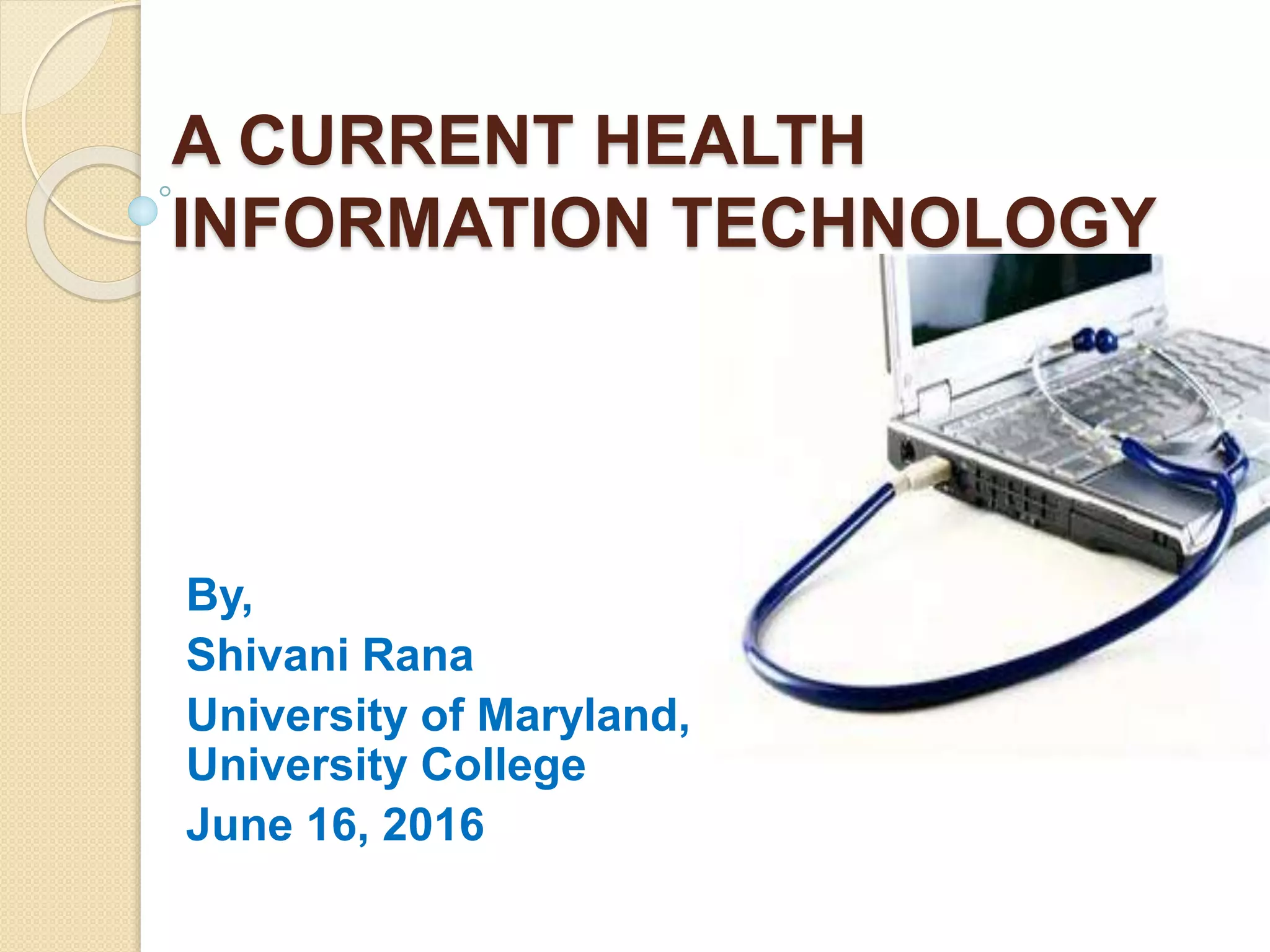
A CURRENT HEALTH
INFORMATION TECHNOLOGY
By,
Shivani Rana
University of Maryland,
University College
June 16, 2016
Health Information Technology:
Computerized Provider (Physician) Order
Entry (CPOE)
ď‚— It is a process of electronic entry of medical
practitioner instructions for the treatment of patients
(particularly hospitalized patients) under his or her
care.
ď‚— A 2006 report by the Institute of Medicine estimated
that a hospitalized patient is exposed to a
medication error each day of his or her stay. CPOE
can reduce total medication error rates by 80%,
and adverse (serious with harm to patient) errors
by 55%.
ď‚— In addition to electronic prescribing, a
standardized bar code system for dispensing drugs
could prevent a quarter of drug errors.
ď‚— Computerized provider order entry (CPOE)
refers to any system in which clinicians
directly enter medication orders (and,
increasingly, tests and procedures) into a
computer system, which then transmits the
order directly to the pharmacy.
ď‚— CPOE systems are often used in tandem
with e-prescribing systems, which alert
physicians and clinicians to a particular
patient's drug allergies and current
medications.
Improved Quality of Health Care
through CPOE
ď‚— CPOE is the information technology tools by which
healthcare organizations can provide improved and
better healthcare services than traditional one.
ď‚— A CPOE system, at a minimum, ensures
standardized, legible, and complete orders and thus
has the potential to greatly reduce errors at the
ordering and transcribing stages.
ď‚— With the help of CPOE, health care providers will
have accurate and complete information about a
patient's health and they can transport medication
orders precisely to the pharmacy. That way, providers
can give the best possible care.
CPOE: Advantages
ď‚— CPOE offers numerous advantages over
traditional paper-based order-writing systems.
These merits include averting problems with
handwriting, similar drug names, drug
interactions, and specification errors; integration
with electronic medical records, decision support
systems, and adverse drug event reporting
systems; faster transmission to the pharmacy;
and potential economic savings.
ď‚— With the help of CPOE, health care providers
will have to help diagnose health problems
sooner, reduce medical errors, and provide safer
care at lower costs.
Increased Access due to
CPOE
ď‚— Establishes missing communication channel
between pharmacy and hospital for better patient
care.
ď‚— CPOE systems can paired with Clinical Decision
Support System(CDSS), which suggests values for
drug doses and offer more sophisticates drug
safety features like drug-drug interactions,
checking for medicine allergies etc.
ď‚— CPOE can integrate with Electronic Health
Records(EHRs) , which easily can analyzed
patients’ medical history.
References
ď‚— https://psnet.ahrq.gov/primers/primer/6
ď‚— Walsh KE, Landrigan CP, Adams WG, Vinci RJ,
Chessare JB, Cooper MR, Hebert PM, Schainker
EG, McLaughlin TJ, Bauchner H. Pediatrics. 2008
Mar; 121(3):e421-7.
ď‚— Colpaert K, Decruyenaere J. Best Pract Res Clin
Anaesthesiol. 2009 Mar; 23(1):27-38.

CPOE

  • 1.
    A CURRENT HEALTH INFORMATIONTECHNOLOGY By, Shivani Rana University of Maryland, University College June 16, 2016
  • 2.
    Health Information Technology: ComputerizedProvider (Physician) Order Entry (CPOE) ď‚— It is a process of electronic entry of medical practitioner instructions for the treatment of patients (particularly hospitalized patients) under his or her care. ď‚— A 2006 report by the Institute of Medicine estimated that a hospitalized patient is exposed to a medication error each day of his or her stay. CPOE can reduce total medication error rates by 80%, and adverse (serious with harm to patient) errors by 55%. ď‚— In addition to electronic prescribing, a standardized bar code system for dispensing drugs could prevent a quarter of drug errors.
  • 3.
    ď‚— Computerized providerorder entry (CPOE) refers to any system in which clinicians directly enter medication orders (and, increasingly, tests and procedures) into a computer system, which then transmits the order directly to the pharmacy. ď‚— CPOE systems are often used in tandem with e-prescribing systems, which alert physicians and clinicians to a particular patient's drug allergies and current medications.
  • 4.
    Improved Quality ofHealth Care through CPOE ď‚— CPOE is the information technology tools by which healthcare organizations can provide improved and better healthcare services than traditional one. ď‚— A CPOE system, at a minimum, ensures standardized, legible, and complete orders and thus has the potential to greatly reduce errors at the ordering and transcribing stages. ď‚— With the help of CPOE, health care providers will have accurate and complete information about a patient's health and they can transport medication orders precisely to the pharmacy. That way, providers can give the best possible care.
  • 5.
    CPOE: Advantages ď‚— CPOEoffers numerous advantages over traditional paper-based order-writing systems. These merits include averting problems with handwriting, similar drug names, drug interactions, and specification errors; integration with electronic medical records, decision support systems, and adverse drug event reporting systems; faster transmission to the pharmacy; and potential economic savings. ď‚— With the help of CPOE, health care providers will have to help diagnose health problems sooner, reduce medical errors, and provide safer care at lower costs.
  • 6.
    Increased Access dueto CPOE  Establishes missing communication channel between pharmacy and hospital for better patient care.  CPOE systems can paired with Clinical Decision Support System(CDSS), which suggests values for drug doses and offer more sophisticates drug safety features like drug-drug interactions, checking for medicine allergies etc.  CPOE can integrate with Electronic Health Records(EHRs) , which easily can analyzed patients’ medical history.
  • 7.
    References ď‚— https://psnet.ahrq.gov/primers/primer/6 ď‚— WalshKE, Landrigan CP, Adams WG, Vinci RJ, Chessare JB, Cooper MR, Hebert PM, Schainker EG, McLaughlin TJ, Bauchner H. Pediatrics. 2008 Mar; 121(3):e421-7. ď‚— Colpaert K, Decruyenaere J. Best Pract Res Clin Anaesthesiol. 2009 Mar; 23(1):27-38.