Management
Investigation and
Dissertation
MID-RMS
MN6P00NI
Concept of Research Philosophy
MID-RMS
Research Philosophy
MID-RMS
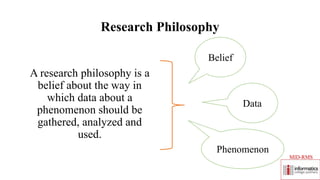
A research philosophy is a
belief about the way in
which data about a
phenomenon should be
gathered, analyzed and
used.
Belief
Data
Phenomenon
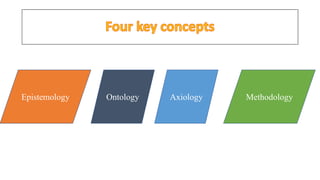
Epistemology Ontology Axiology Methodology
Epistemology
• Epistemology, the philosophical study of nature, origin, and limits
of human knowledge.
• The term is derived from the Greek episteme (“knowledge”) and
logos(“reason”), and accordingly the field is sometimes referred to as
the theory of knowledge.
• Basic assumptions about what we can know about reality, and about
the relationship between knowledge and reality.
MID-RMS
Ontology
• Ontology, the philosophical study of being in general, or of what
applies neutrally to everything that is real.
• Ontology is the theory of objects and their ties.
• It provides criteria for distinguishing different types of objects
(concrete and abstract, existent and nonexistent, real and ideal,
independent and dependent) and their ties (relations,
dependencies and predication).
• Basic assumptions about the nature of reality.
MID-RMS
Axiology
• It is the branch of practical philosophy which studies the nature of
value.
• Axiology, (from Greek axios, “worthy”; logos, “science”), also called
theory of value.
• The philosophical study of goodness, or value, in the widest sense.
• Axiology deals with the nature of value and captures the value
question of what is intrinsically worthwhile?
MID-RMS
Methodology
• The word methodology comprises two nouns: method and ology,
which means a branch of knowledge.
• Methodology is a branch of knowledge that deals with the general
principles or axioms of the generation of new knowledge.
• It refers to the rationale and the philosophical assumptions that
underlie any natural, social or human science study.
• Methods are the techniques and procedures followed to conduct
research, and are determined by the methodology.
MID-RMS
Ontology Metaphysics Epistemology
• Do souls exist?
Are they sort
the things that
obey physical
laws?
• Is there a God?
• What physical
laws would have to
be true in order for
souls to exist?
• What rules, if any,
govern God’s
actions?
• How can we
know whether
souls exist?
• Can human
beings ever
know whether
there is a God?
MID-RMS
Example
• Title : Factors affecting customer satisfaction on fashion boutique
in Kathmandu
• RQ: What are the most significant factors affecting the level of
customer satisfaction on fashion boutique in Kathmandu District ?
• Relational research design.
• Check the “ customer satisfaction”
• What is your belief: Does customer satisfaction be measured
externally ( i.e independent to human mind) ?
OR: Does customer satisfaction be measured internally from
human mind?
MID-RMS
How to write the philosophical stand in
research ?
Every research works has their own philosophical basis that shapes the
research process and provides the validity to the journey of exploration. In the
similar vein, this research study also followed certain philosophical
assumptions to shape and guide the research activities that generates
authenticated outcomes.
Since, this study assumed that the service quality factors and customer
satisfaction are observable phenomena (i.e. truth is independent to human
interpretation) and can be directly measurable through the predefined
tools. So it followed the objectivist ontological dimension, with positivist
epistemological stand. In addition, for the methodology aspects, deductive
approach with quantitative methods was used to test the SERVQUAL
model with regards to customer satisfaction.
MID-RMS
How to do literature review
?
MID-RMS
Step 1: Know
Your Topic
(KYT)
• What is my research problem ?
• What are the significances of researching this
problem ?
• Is it a novel topic in the study context?
• Is it relevant in my context ?
• How much I know about this topic?
• Does this topic is helpful in my current or
future professional career ?
• Whose study is actually I am doing under
this topic ?
MID-RMS
Step 2:
Identify the
exiting
definitions
• How have the researchers defined this
concept ?
• Which is the current definition?
• When did this concept emerge and who
coined it ?
• To what extent does the definition have been
changing ?
• Which is the relevant definition in my study
context?
• What are the key word/s in the chosen
definition?
MID-RMS
Step 3:
Identify the
underlying
theories
• What are the existing underlying theories of
the chosen definition?
• Do these theories works in my context?
• What theory meets my contextual
requirement ?
• How frequency the theories are progressed in
your study?
• What is my possible theoretical framework?
MID-RMS
Step 4:
Identifying
the
philosophical
stand
• What is the ontological stand of the
definition?
• What is the epistemological stand of the
definition?
• Am I clear about these philosophical stands?
• Does the chosen definition meet my study
requirements as per the philosophical stand?
MID-RMS
Step 5:
Determining
the variables
• What variables does the theory highlighted ?
• Do the variables meet my contextual
requirements?
• How relevant are those variables in current
scenario?
• What are my dependent and independent
variables?
• Are there any mediating, moderating,
confounding and control variables required
for the study ?
• What is my possible conceptual framework?
MID-RMS
Step 6:
Determining
the
indicators
• What are the reflective and formative
indicators explored by researchers in my
variables?
• Are a matched with my context?
• How should I operationalize my variables?
• Does the chosen philosophical stand match
my operationalization?
MID-RMS
Step 7:
Determining
the scale
• What scale is most common in my study?
• Do I know about nominal, ordinal, interval
and ratio level of measurement?
• What scaling technique is suitable for my
study?
MID-RMS
Step 8:
Developing
the
hypothesis
• Do my study need hypothesis?
• Do I need directional or non-directional
hypothesis?
• Do my hypotheses matched the objectives
determined?
• Do all the variables are addressed in the
hypotheses ?
MID-RMS
MID-RMS
Directional Or Non-directional Hypothesis
• A directional hypothesis is a hypothesis that predicts the direction of the
relationship between the variables. For example, a directional hypothesis
might state that "as the level of exercise increases, the amount of
weight loss will also increase". In this example, the hypothesis predicts
that the relationship between exercise and weight loss is positive,
meaning that as one variable increases, the other variable will also
increase.
• In contrast, a non-directional hypothesis is a hypothesis that predicts a
relationship between variables without specifying the direction of the
relationship. For example, a non-directional hypothesis might state
that "there is a relationship between exercise and weight loss". In this
example, the hypothesis predicts that there is a relationship between the
two variables, but does not specify whether the relationship is positive or
negative.
• . If previous research has suggested a specific direction of the relationship
between the variables, a directional hypothesis may be more appropriate. If
there is no clear direction or previous research to guide the hypothesis, a non-
directional hypothesis may be more appropriate.
How to integrate
theory/ies to my
research
Lecture- 17
MID-RMS
What is your topic ?
• Is it motivation or satisfaction or
perception or etc. ?
• Generally, the dependent variable/s
you determined will be your study
topic.
• Find the definition of that topic and
try to identify its developments and
changes.
MID-RMS
Theory
• It is a systematic explanation of underlying phenomena/behavior
• When you conduct a research, you must know under what theoretical
base your research study emerges.
• You should always step on theory, while conducting a research.

• It will frame your research process/work and put you in right track
towards a destination.
• Theory helps in drawing research questions and objectives.
• We can also compare our findings with the theory.
MID-RMS
In conclusion…
• Theories are not fact
• They are just the conjectures(guess) and predictions that tentatively
reflect the phenomenon.
• They show the causal relation between the variables.
• Supported by empirical evidence
• The theory which underpins a study is often viewed as a lens.
• Without underpinning theories, many articles, particularly those based
on qualitative data, look speculative or artificial.
MID-RMS
Theory
• E.g. Job satisfaction
List of theories
• Maslow’s need hierarchy theory
• Herzberg’s two factors theory
• Job characteristics model
• Dispositional approach ( Personality) etc…..
(Once you get the theory, then search for the articles, based on the
theory or theories.) MID-RMS
Herzberg’s two factors theory
• Herzberg's two-factor theory, also known as the motivation-hygiene theory, is a motivational
theory that proposes that there are two types of factors that affect job satisfaction and
motivation: hygiene factors and motivators.
• Hygiene factors are basic job conditions that must be met in order to prevent job
dissatisfaction. These include factors such as salary, job security, working conditions, company
policies, and relationships with supervisors and colleagues. If these factors are not met,
employees are likely to become dissatisfied and demotivated.
• Motivators are factors that increase job satisfaction and motivation. These include factors
such as achievement, recognition, responsibility, personal growth, and advancement.
Motivators are related to the work itself, and can lead to a sense of personal fulfillment and
achievement.
• The implication of this theory is that managers should focus on providing both hygiene factors
and motivators in the workplace to increase job satisfaction and motivation. Providing fair
compensation, a safe and healthy work environment, and positive relationships with
supervisors and colleagues can help prevent job dissatisfaction, while providing opportunities
for achievement, recognition, and personal growth can increase job satisfaction and
motivation.
Maslow's need hierarchy theory
• Maslow's need hierarchy theory, also known as Maslow's hierarchy of needs, is a
motivational theory that proposes that people have a set of basic needs that must
be satisfied in a hierarchical order. The theory is often presented as a pyramid with
five levels, starting with the most basic needs at the bottom and moving up to
higher needs as the lower ones are satisfied. The five levels are:
1.Physiological needs: These are the most basic needs, such as food, water, air, and
shelter. These needs must be met first, as they are necessary for survival.
2.Safety needs: Once physiological needs are met, people seek safety and security,
such as protection from harm, a stable living environment, and financial security.
3.Belongingness and love needs: Once safety needs are met, people seek social
interaction, affection, and a sense of belonging.
4.Esteem needs: After social needs are met, people seek recognition, respect, and a
sense of self-worth.
5.Self-actualization needs: At the top of the hierarchy, people seek to fulfill their full
potential and achieve personal growth and self-fulfillment.
Job Characteristics Model (JCM
Job Characteristics Model (JCM) is a theory of job design that seeks to explain how different aspects of a job
can influence employee motivation, satisfaction, and performance. The model proposes that jobs can be made
more motivating and satisfying by incorporating five core job characteristics:
1. Skill variety: the degree to which a job requires a variety of different skills and talents.
2. Task identity: the degree to which a job requires the completion of a whole and identifiable piece of work.
3. Task significance: the degree to which a job has a significant impact on the lives or work of others.
4. Autonomy: the degree to which a job provides freedom, independence, and discretion in making decisions.
5. Feedback: the degree to which a job provides clear and direct feedback on performance.
Student
Classroom
Engagement
MID-RMS
Let’s take the title/topic given below
Factors affecting
Student Engagement
in private colleges in Kathmandu Valley
MID-RMS
Theory
• E.g. Job satisfaction
List of theories
• Maslow’s need hierarchy theory
• Herzberg’s two factors theory
• Job characteristics model
• Dispositional approach ( Personality) etc…..
(Once you get the theory, then search for the
articles, based on the theory or theories.)
MID-RMS
Break the
Code
• Student- Who do you refer? Part time /full
time /level
• Classroom- Regular or optional ?
• Engagement- Engagement Theories/model ?
* Since your primary aim to explore the
student engagement so you need to be clear on
etymological meaning of engagement.
MID-RMS
Different
definition on
student
engagement
• “the amount of physical and psychological
energy that the student devotes to the academic
experience” (Astin, 1984).
• It includes “both the time and energy students
invest in educationally purposeful activities and
the effort institutions devote to using effective
educational performance”
(quoted in Axelson & Flick, 2010, p. 41)
• If there is daylight (difference) among the
definitions, it is largely over whether
engagement is more a matter of observable
behavior or interior attitude
(Axelson & Flick, 2010; Jimerson et al., 2003).
MID-RMS
Definition
cont…
• Student engagement cannot be directly
observed (Schlechty, 2002) and is
“…difficult to define operationally, but we
know it when we see it, and we know it when
it is missing (Newmann, 1986).”
• Kuh, (2009) simply states that engagement
refers to the quality of effort and
participation in authentic learning activities.
MID-RMS
Student
Engagement
Theories
• Flow theory ( Csikszentmihalyi,1990)
• Student Involvement theory ( Austin, 1985)
etc…
• Examine the theories..
MID-RMS
Flow
Theory-
Optimal
experience
• Flow is a state of deep absorption in an
activity that is intrinsically enjoyable, as
when artists or athletes are focused on their
play or performance.
(Csikszentmihalyi,1990)
• Individual in this state perceive their
performance to be pleasurable and successful
and the activity is perceived as worth doing
for its own sake, even if no further goal is
reached. ( Nakamura & Csikszentmihalyi,
2002)
MID-RMS
Flow Theory…
• Concentration, interest and
enjoyment in an activity must be
experienced simultaneously in
order for flow to occur
(Csikszentmihalyi,1990)
MID-RMS
MID-RMS
Engagement
Model
Fredricks et al. (2004) identify three types of engagement:
• Behavioral engagement, which includes students
observing community norms and participating in activities.
• Emotional engagement, which includes students’ feelings
of interest, boredom, happiness, sadness, and anxiety.
students’ emotional reactions to teachers, students,
learning, and school in general, including their
sense of belonging, value, and identity, as well as their
level of interest, boredom, happiness, sadness, anxiety, and
other emotions (Finn, 1989).
• Cognitive engagement, which is closely related to
motivation and involves students’ desire and ability to
engage in a variety of strategies to self-direct learning. MID-RMS
Components of student engagement
Behavioural Emotional Cognitive
Attendance Identification of
college
Perceived relevance
of college work
Participation on
classroom activities
Sense of belonging Value of learning
Punctuality Positive or negative
reaction to teacher
and friends
Focus on personal
goals
Autonomy
MID-RMS
Antecedents
of
Engagement
• College level factors ( rules,
infrastructure etc.)
• Classroom context (teacher support,
peers, classroom structure, Autonomy
support, Task characteristics)
• Individual needs (Need for relatedness,
Need for autonomy, Need for
competence)
• Research paper link:
https://journals.sagepub.com/doi/10.31
02/00346543074001059
MID-RMS
NOTE: (
Univariate
Descriptive
Statistics)
• A question that only encourages a descriptive
outcome does not required theoretical
underpinning.
• Eg. What is the proportion of average income
and expenditure of the people living in
Kathmandu Valley ?
• Which cuisine is mostly preferred by
bachelor students in their college canteen in
Biratnagar?
MID-RMS
Q&A

Informatics college week 2.pptx

  • 1.
  • 2.
    Concept of ResearchPhilosophy MID-RMS
  • 3.
    Research Philosophy MID-RMS A researchphilosophy is a belief about the way in which data about a phenomenon should be gathered, analyzed and used. Belief Data Phenomenon
  • 4.
  • 5.
    Epistemology • Epistemology, thephilosophical study of nature, origin, and limits of human knowledge. • The term is derived from the Greek episteme (“knowledge”) and logos(“reason”), and accordingly the field is sometimes referred to as the theory of knowledge. • Basic assumptions about what we can know about reality, and about the relationship between knowledge and reality. MID-RMS
  • 6.
    Ontology • Ontology, thephilosophical study of being in general, or of what applies neutrally to everything that is real. • Ontology is the theory of objects and their ties. • It provides criteria for distinguishing different types of objects (concrete and abstract, existent and nonexistent, real and ideal, independent and dependent) and their ties (relations, dependencies and predication). • Basic assumptions about the nature of reality. MID-RMS
  • 7.
    Axiology • It isthe branch of practical philosophy which studies the nature of value. • Axiology, (from Greek axios, “worthy”; logos, “science”), also called theory of value. • The philosophical study of goodness, or value, in the widest sense. • Axiology deals with the nature of value and captures the value question of what is intrinsically worthwhile? MID-RMS
  • 8.
    Methodology • The wordmethodology comprises two nouns: method and ology, which means a branch of knowledge. • Methodology is a branch of knowledge that deals with the general principles or axioms of the generation of new knowledge. • It refers to the rationale and the philosophical assumptions that underlie any natural, social or human science study. • Methods are the techniques and procedures followed to conduct research, and are determined by the methodology. MID-RMS
  • 9.
    Ontology Metaphysics Epistemology •Do souls exist? Are they sort the things that obey physical laws? • Is there a God? • What physical laws would have to be true in order for souls to exist? • What rules, if any, govern God’s actions? • How can we know whether souls exist? • Can human beings ever know whether there is a God? MID-RMS
  • 10.
    Example • Title :Factors affecting customer satisfaction on fashion boutique in Kathmandu • RQ: What are the most significant factors affecting the level of customer satisfaction on fashion boutique in Kathmandu District ? • Relational research design. • Check the “ customer satisfaction” • What is your belief: Does customer satisfaction be measured externally ( i.e independent to human mind) ? OR: Does customer satisfaction be measured internally from human mind? MID-RMS
  • 11.
    How to writethe philosophical stand in research ? Every research works has their own philosophical basis that shapes the research process and provides the validity to the journey of exploration. In the similar vein, this research study also followed certain philosophical assumptions to shape and guide the research activities that generates authenticated outcomes. Since, this study assumed that the service quality factors and customer satisfaction are observable phenomena (i.e. truth is independent to human interpretation) and can be directly measurable through the predefined tools. So it followed the objectivist ontological dimension, with positivist epistemological stand. In addition, for the methodology aspects, deductive approach with quantitative methods was used to test the SERVQUAL model with regards to customer satisfaction. MID-RMS
  • 12.
    How to doliterature review ? MID-RMS
  • 13.
    Step 1: Know YourTopic (KYT) • What is my research problem ? • What are the significances of researching this problem ? • Is it a novel topic in the study context? • Is it relevant in my context ? • How much I know about this topic? • Does this topic is helpful in my current or future professional career ? • Whose study is actually I am doing under this topic ? MID-RMS
  • 14.
    Step 2: Identify the exiting definitions •How have the researchers defined this concept ? • Which is the current definition? • When did this concept emerge and who coined it ? • To what extent does the definition have been changing ? • Which is the relevant definition in my study context? • What are the key word/s in the chosen definition? MID-RMS
  • 15.
    Step 3: Identify the underlying theories •What are the existing underlying theories of the chosen definition? • Do these theories works in my context? • What theory meets my contextual requirement ? • How frequency the theories are progressed in your study? • What is my possible theoretical framework? MID-RMS
  • 16.
    Step 4: Identifying the philosophical stand • Whatis the ontological stand of the definition? • What is the epistemological stand of the definition? • Am I clear about these philosophical stands? • Does the chosen definition meet my study requirements as per the philosophical stand? MID-RMS
  • 17.
    Step 5: Determining the variables •What variables does the theory highlighted ? • Do the variables meet my contextual requirements? • How relevant are those variables in current scenario? • What are my dependent and independent variables? • Are there any mediating, moderating, confounding and control variables required for the study ? • What is my possible conceptual framework? MID-RMS
  • 18.
    Step 6: Determining the indicators • Whatare the reflective and formative indicators explored by researchers in my variables? • Are a matched with my context? • How should I operationalize my variables? • Does the chosen philosophical stand match my operationalization? MID-RMS
  • 19.
    Step 7: Determining the scale •What scale is most common in my study? • Do I know about nominal, ordinal, interval and ratio level of measurement? • What scaling technique is suitable for my study? MID-RMS
  • 20.
    Step 8: Developing the hypothesis • Domy study need hypothesis? • Do I need directional or non-directional hypothesis? • Do my hypotheses matched the objectives determined? • Do all the variables are addressed in the hypotheses ? MID-RMS MID-RMS
  • 21.
    Directional Or Non-directionalHypothesis • A directional hypothesis is a hypothesis that predicts the direction of the relationship between the variables. For example, a directional hypothesis might state that "as the level of exercise increases, the amount of weight loss will also increase". In this example, the hypothesis predicts that the relationship between exercise and weight loss is positive, meaning that as one variable increases, the other variable will also increase. • In contrast, a non-directional hypothesis is a hypothesis that predicts a relationship between variables without specifying the direction of the relationship. For example, a non-directional hypothesis might state that "there is a relationship between exercise and weight loss". In this example, the hypothesis predicts that there is a relationship between the two variables, but does not specify whether the relationship is positive or negative. • . If previous research has suggested a specific direction of the relationship between the variables, a directional hypothesis may be more appropriate. If there is no clear direction or previous research to guide the hypothesis, a non- directional hypothesis may be more appropriate.
  • 22.
    How to integrate theory/iesto my research Lecture- 17 MID-RMS
  • 23.
    What is yourtopic ? • Is it motivation or satisfaction or perception or etc. ? • Generally, the dependent variable/s you determined will be your study topic. • Find the definition of that topic and try to identify its developments and changes. MID-RMS
  • 24.
    Theory • It isa systematic explanation of underlying phenomena/behavior • When you conduct a research, you must know under what theoretical base your research study emerges. • You should always step on theory, while conducting a research. • It will frame your research process/work and put you in right track towards a destination. • Theory helps in drawing research questions and objectives. • We can also compare our findings with the theory. MID-RMS
  • 25.
    In conclusion… • Theoriesare not fact • They are just the conjectures(guess) and predictions that tentatively reflect the phenomenon. • They show the causal relation between the variables. • Supported by empirical evidence • The theory which underpins a study is often viewed as a lens. • Without underpinning theories, many articles, particularly those based on qualitative data, look speculative or artificial. MID-RMS
  • 26.
    Theory • E.g. Jobsatisfaction List of theories • Maslow’s need hierarchy theory • Herzberg’s two factors theory • Job characteristics model • Dispositional approach ( Personality) etc….. (Once you get the theory, then search for the articles, based on the theory or theories.) MID-RMS
  • 27.
    Herzberg’s two factorstheory • Herzberg's two-factor theory, also known as the motivation-hygiene theory, is a motivational theory that proposes that there are two types of factors that affect job satisfaction and motivation: hygiene factors and motivators. • Hygiene factors are basic job conditions that must be met in order to prevent job dissatisfaction. These include factors such as salary, job security, working conditions, company policies, and relationships with supervisors and colleagues. If these factors are not met, employees are likely to become dissatisfied and demotivated. • Motivators are factors that increase job satisfaction and motivation. These include factors such as achievement, recognition, responsibility, personal growth, and advancement. Motivators are related to the work itself, and can lead to a sense of personal fulfillment and achievement. • The implication of this theory is that managers should focus on providing both hygiene factors and motivators in the workplace to increase job satisfaction and motivation. Providing fair compensation, a safe and healthy work environment, and positive relationships with supervisors and colleagues can help prevent job dissatisfaction, while providing opportunities for achievement, recognition, and personal growth can increase job satisfaction and motivation.
  • 28.
    Maslow's need hierarchytheory • Maslow's need hierarchy theory, also known as Maslow's hierarchy of needs, is a motivational theory that proposes that people have a set of basic needs that must be satisfied in a hierarchical order. The theory is often presented as a pyramid with five levels, starting with the most basic needs at the bottom and moving up to higher needs as the lower ones are satisfied. The five levels are: 1.Physiological needs: These are the most basic needs, such as food, water, air, and shelter. These needs must be met first, as they are necessary for survival. 2.Safety needs: Once physiological needs are met, people seek safety and security, such as protection from harm, a stable living environment, and financial security. 3.Belongingness and love needs: Once safety needs are met, people seek social interaction, affection, and a sense of belonging. 4.Esteem needs: After social needs are met, people seek recognition, respect, and a sense of self-worth. 5.Self-actualization needs: At the top of the hierarchy, people seek to fulfill their full potential and achieve personal growth and self-fulfillment.
  • 29.
    Job Characteristics Model(JCM Job Characteristics Model (JCM) is a theory of job design that seeks to explain how different aspects of a job can influence employee motivation, satisfaction, and performance. The model proposes that jobs can be made more motivating and satisfying by incorporating five core job characteristics: 1. Skill variety: the degree to which a job requires a variety of different skills and talents. 2. Task identity: the degree to which a job requires the completion of a whole and identifiable piece of work. 3. Task significance: the degree to which a job has a significant impact on the lives or work of others. 4. Autonomy: the degree to which a job provides freedom, independence, and discretion in making decisions. 5. Feedback: the degree to which a job provides clear and direct feedback on performance.
  • 30.
  • 31.
    Let’s take thetitle/topic given below Factors affecting Student Engagement in private colleges in Kathmandu Valley MID-RMS
  • 32.
    Theory • E.g. Jobsatisfaction List of theories • Maslow’s need hierarchy theory • Herzberg’s two factors theory • Job characteristics model • Dispositional approach ( Personality) etc….. (Once you get the theory, then search for the articles, based on the theory or theories.) MID-RMS
  • 33.
    Break the Code • Student-Who do you refer? Part time /full time /level • Classroom- Regular or optional ? • Engagement- Engagement Theories/model ? * Since your primary aim to explore the student engagement so you need to be clear on etymological meaning of engagement. MID-RMS
  • 34.
    Different definition on student engagement • “theamount of physical and psychological energy that the student devotes to the academic experience” (Astin, 1984). • It includes “both the time and energy students invest in educationally purposeful activities and the effort institutions devote to using effective educational performance” (quoted in Axelson & Flick, 2010, p. 41) • If there is daylight (difference) among the definitions, it is largely over whether engagement is more a matter of observable behavior or interior attitude (Axelson & Flick, 2010; Jimerson et al., 2003). MID-RMS
  • 35.
    Definition cont… • Student engagementcannot be directly observed (Schlechty, 2002) and is “…difficult to define operationally, but we know it when we see it, and we know it when it is missing (Newmann, 1986).” • Kuh, (2009) simply states that engagement refers to the quality of effort and participation in authentic learning activities. MID-RMS
  • 36.
    Student Engagement Theories • Flow theory( Csikszentmihalyi,1990) • Student Involvement theory ( Austin, 1985) etc… • Examine the theories.. MID-RMS
  • 37.
    Flow Theory- Optimal experience • Flow isa state of deep absorption in an activity that is intrinsically enjoyable, as when artists or athletes are focused on their play or performance. (Csikszentmihalyi,1990) • Individual in this state perceive their performance to be pleasurable and successful and the activity is perceived as worth doing for its own sake, even if no further goal is reached. ( Nakamura & Csikszentmihalyi, 2002) MID-RMS
  • 38.
    Flow Theory… • Concentration,interest and enjoyment in an activity must be experienced simultaneously in order for flow to occur (Csikszentmihalyi,1990) MID-RMS
  • 39.
  • 40.
    Engagement Model Fredricks et al.(2004) identify three types of engagement: • Behavioral engagement, which includes students observing community norms and participating in activities. • Emotional engagement, which includes students’ feelings of interest, boredom, happiness, sadness, and anxiety. students’ emotional reactions to teachers, students, learning, and school in general, including their sense of belonging, value, and identity, as well as their level of interest, boredom, happiness, sadness, anxiety, and other emotions (Finn, 1989). • Cognitive engagement, which is closely related to motivation and involves students’ desire and ability to engage in a variety of strategies to self-direct learning. MID-RMS
  • 41.
    Components of studentengagement Behavioural Emotional Cognitive Attendance Identification of college Perceived relevance of college work Participation on classroom activities Sense of belonging Value of learning Punctuality Positive or negative reaction to teacher and friends Focus on personal goals Autonomy MID-RMS
  • 42.
    Antecedents of Engagement • College levelfactors ( rules, infrastructure etc.) • Classroom context (teacher support, peers, classroom structure, Autonomy support, Task characteristics) • Individual needs (Need for relatedness, Need for autonomy, Need for competence) • Research paper link: https://journals.sagepub.com/doi/10.31 02/00346543074001059 MID-RMS
  • 43.
    NOTE: ( Univariate Descriptive Statistics) • Aquestion that only encourages a descriptive outcome does not required theoretical underpinning. • Eg. What is the proportion of average income and expenditure of the people living in Kathmandu Valley ? • Which cuisine is mostly preferred by bachelor students in their college canteen in Biratnagar? MID-RMS
  • 44.