PARUL INSTITUTE OF PHARMACY
Topic – Informed consent process
PRESENTED BY
SONALI JAIN
MPHARM(PHARMACOLOGY)
DEPARTMENT OF PHARMACY
GUIDED TO
SAGAR PATEL
ASSISTANT PROFESSOR
1
CONTENT
1. Introduction
2. Purpose of consent
3. Definition
4. What is informed consents
5. Basic principle
6. Elements of inform consents
7. Informed consent as a process
8. Documentation
9. Summary
10. reference
2
3
Introduction
•Millions of volunteers participate in government and
industry sponsored clinical trial each year.
•Prior to agreeing to participate, every volunteers has
right to know and understand what happen during
clinical trial .
• This is called as informed consent and this process that
can help to decide whether or not participating in a trial
is right for you
4
Purpose of Consent ?
• Prospective Subject Will ..
 Understand nature of research
 Be informed of purpose, risks, and benefits, and
alternative therapies
 Make a Voluntary Decision about Participation
5
Definition
• A process by which a subject voluntarily confirms
his or her willingness to participate in a particular
trial, after having been informed of all aspects of
the trial that are relevant to the subject’s decision
to participate.
• Informed consent is documented by means of a
written, signed and dated informed consent
form.
6
What is informed consents..???
• Informed consent is a communication process:
 Between the researcher and the participant.
 Starts before the research is initiated .
 Continues throughout the duration of the study .
 Providing all relevant information to the volunteer/
patient
 The patient/ volunteer understanding the
information provided Voluntarily agreeing to
participate
7
Informed Consent allows individuals
• To determine whether participating in research fits
with their values and interests.
• To decide whether to contribute to this specific
research project.
• To protect themselves from risks.
• To decide whether they can fulfill the requirements
necessary for the research
8
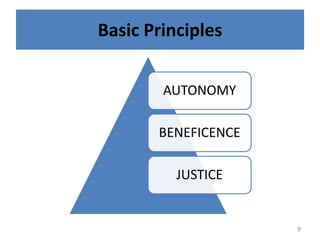
Basic Principles
AUTONOMY
BENEFICENCE
JUSTICE
9
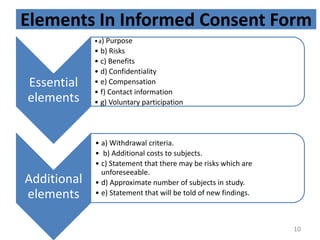
Elements In Informed Consent Form
Essential
elements
•a) Purpose
• b) Risks
• c) Benefits
• d) Confidentiality
• e) Compensation
• f) Contact information
• g) Voluntary participation
Additional
elements
• a) Withdrawal criteria.
• b) Additional costs to subjects.
• c) Statement that there may be risks which are
unforeseeable.
• d) Approximate number of subjects in study.
• e) Statement that will be told of new findings.
10
INFORMED CONSENT AS A PROCESS
• Informed consent is a communication process:
 between the researcher and the participant
 starts before the research is initiated
 continues throughout the duration of the study
11
Research Consent Document
Readability
• Language that is easily understood
• Language must be appropriate to the population being
studied
• Language translators should be qualified and IRB
authorized
• Consider comprehension as well as readability
• Limit medical terminology
• Avoid informal speech
12
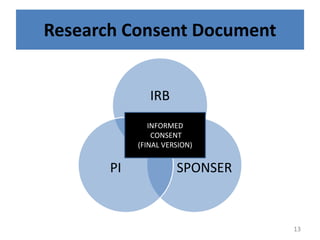
Research Consent Document
IRB
SPONSER
PI
INFORMED
CONSENT
(FINAL VERSION)
13
Research Consent Document
• When do you need a witness?
 When presenting the informed consent document
orally
 If required by the IRB
• Who can be the witness?
 A person who is independent of the trial, who
cannot be unfairly influenced by people involved in
the trial, who attends the informed consent
process… Research Consent Document
14
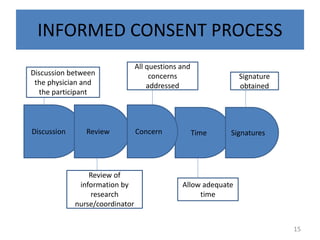
INFORMED CONSENT PROCESS
Discussion Review Time Signatures
Concern
Discussion between
the physician and
the participant
All questions and
concerns
addressed
Signature
obtained
Review of
information by
research
nurse/coordinator
Allow adequate
time
15
Informed Consent and Screening
Procedures
• Informed consent must be obtained prior to any
protocol specific testing being conducted.
• If protocol specific testing done the same day as
informed consent document signed, must be clear
documentation of the chronological order in the
medical record
16
How does informed consent apply
to children?
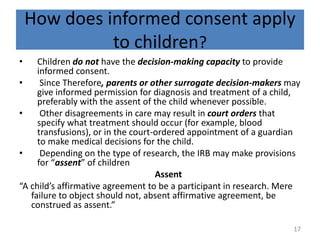
• Children do not have the decision-making capacity to provide
informed consent.
• Since Therefore, parents or other surrogate decision-makers may
give informed permission for diagnosis and treatment of a child,
preferably with the assent of the child whenever possible.
• Other disagreements in care may result in court orders that
specify what treatment should occur (for example, blood
transfusions), or in the court-ordered appointment of a guardian
to make medical decisions for the child.
• Depending on the type of research, the IRB may make provisions
for “assent” of children
Assent
“A child’s affirmative agreement to be a participant in research. Mere
failure to object should not, absent affirmative agreement, be
construed as assent.”
17
Informed Consent & Prisoners
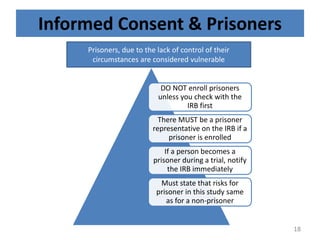
DO NOT enroll prisoners
unless you check with the
IRB first
There MUST be a prisoner
representative on the IRB if a
prisoner is enrolled
If a person becomes a
prisoner during a trial, notify
the IRB immediately
Must state that risks for
prisoner in this study same
as for a non-prisoner
Prisoners, due to the lack of control of their
circumstances are considered vulnerable
18
Informed Consent & Pregnant
Women
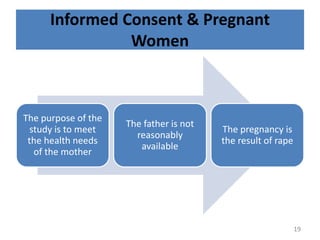
The purpose of the
study is to meet
the health needs
of the mother
The father is not
reasonably
available
The pregnancy is
the result of rape
19
Informed Consent & Cognitively
Impaired
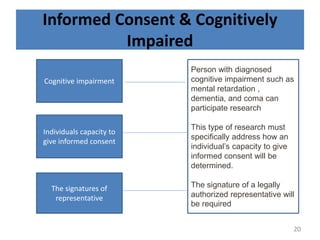
Cognitive impairment
Individuals capacity to
give informed consent
The signatures of
representative
Person with diagnosed
cognitive impairment such as
mental retardation ,
dementia, and coma can
participate research
This type of research must
specifically address how an
individual’s capacity to give
informed consent will be
determined.
The signature of a legally
authorized representative will
be required
20
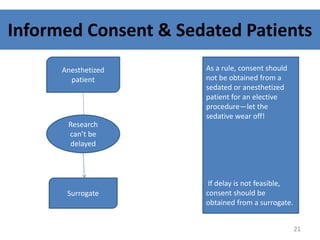
Informed Consent & Sedated Patients
Anesthetized
patient
Research
can’t be
delayed
Surrogate
As a rule, consent should
not be obtained from a
sedated or anesthetized
patient for an elective
procedure—let the
sedative wear off!
If delay is not feasible,
consent should be
obtained from a surrogate.
21
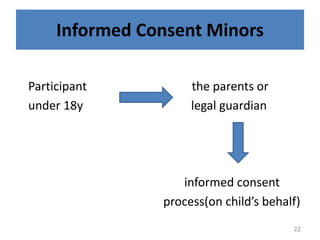
Informed Consent Minors
Participant the parents or
under 18y legal guardian
informed consent
process(on child’s behalf)
22
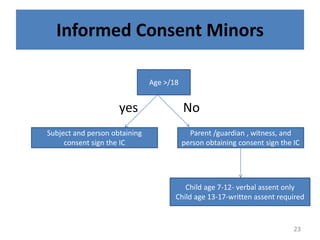
Informed Consent Minors
yes No
Age >/18
Subject and person obtaining
consent sign the IC
Parent /guardian , witness, and
person obtaining consent sign the IC
Child age 7-12- verbal assent only
Child age 13-17-written assent required
23
Waiver of Informed Consent
• Waiving (omitting) or altering some or all the basic
elements of informed consent, including the entire
informed consent process :
 Minimal risk
 Rights and welfare of participants protected
 Research not possible without a waiver
 Appropriate information provided
24
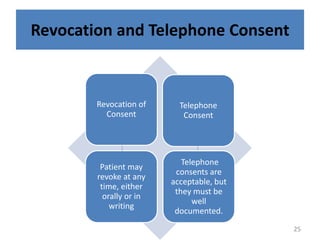
Revocation and Telephone Consent
Revocation of
Consent
Telephone
consents are
acceptable, but
they must be
well
documented.
Patient may
revoke at any
time, either
orally or in
writing
Telephone
Consent
25
Informed Consent in a Teaching
Situation
• Have the attending physician and house staff visit the
patient together, prior to the procedure. Clarify the
resident’s role in the procedure to the patient and his/her
family.
• Spell out the resident’s qualifications to reinforce patient
confidence.
• Clarify that the attending physician will be present at all
times in a directly supervisory capacity and that he/she is
the responsible doctor.
• Inform the patient of the identity of personnel in the
operating room.
• Prepare for some patients to insist on the attending
physician performing the procedure. Informed Consent in a
Teaching Situation
26
Informed consent guidelines
• ICMR (Indian Council of Medical Research) “Ethical
Guidelines for Biomedical Research on Human
Subjects” Published in 2000 and revised in 2006
• ICH Guidelines E6 section 4.8 under GLP (Good
Clinical Practice)
27
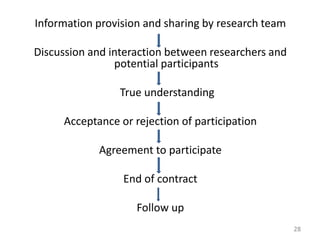
Information provision and sharing by research team
Discussion and interaction between researchers and
potential participants
True understanding
Acceptance or rejection of participation
Agreement to participate
End of contract
Follow up
28
SUMMARY
• An informed Consent Process should be performed and
documented in the manner that is :
 Clear
 Complete
 Accurate
29
30

SONALI CRP.pptx

  • 1.
    PARUL INSTITUTE OFPHARMACY Topic – Informed consent process PRESENTED BY SONALI JAIN MPHARM(PHARMACOLOGY) DEPARTMENT OF PHARMACY GUIDED TO SAGAR PATEL ASSISTANT PROFESSOR 1
  • 2.
    CONTENT 1. Introduction 2. Purposeof consent 3. Definition 4. What is informed consents 5. Basic principle 6. Elements of inform consents 7. Informed consent as a process 8. Documentation 9. Summary 10. reference 2
  • 3.
  • 4.
    Introduction •Millions of volunteersparticipate in government and industry sponsored clinical trial each year. •Prior to agreeing to participate, every volunteers has right to know and understand what happen during clinical trial . • This is called as informed consent and this process that can help to decide whether or not participating in a trial is right for you 4
  • 5.
    Purpose of Consent? • Prospective Subject Will ..  Understand nature of research  Be informed of purpose, risks, and benefits, and alternative therapies  Make a Voluntary Decision about Participation 5
  • 6.
    Definition • A processby which a subject voluntarily confirms his or her willingness to participate in a particular trial, after having been informed of all aspects of the trial that are relevant to the subject’s decision to participate. • Informed consent is documented by means of a written, signed and dated informed consent form. 6
  • 7.
    What is informedconsents..??? • Informed consent is a communication process:  Between the researcher and the participant.  Starts before the research is initiated .  Continues throughout the duration of the study .  Providing all relevant information to the volunteer/ patient  The patient/ volunteer understanding the information provided Voluntarily agreeing to participate 7
  • 8.
    Informed Consent allowsindividuals • To determine whether participating in research fits with their values and interests. • To decide whether to contribute to this specific research project. • To protect themselves from risks. • To decide whether they can fulfill the requirements necessary for the research 8
  • 9.
  • 10.
    Elements In InformedConsent Form Essential elements •a) Purpose • b) Risks • c) Benefits • d) Confidentiality • e) Compensation • f) Contact information • g) Voluntary participation Additional elements • a) Withdrawal criteria. • b) Additional costs to subjects. • c) Statement that there may be risks which are unforeseeable. • d) Approximate number of subjects in study. • e) Statement that will be told of new findings. 10
  • 11.
    INFORMED CONSENT ASA PROCESS • Informed consent is a communication process:  between the researcher and the participant  starts before the research is initiated  continues throughout the duration of the study 11
  • 12.
    Research Consent Document Readability •Language that is easily understood • Language must be appropriate to the population being studied • Language translators should be qualified and IRB authorized • Consider comprehension as well as readability • Limit medical terminology • Avoid informal speech 12
  • 13.
  • 14.
    Research Consent Document •When do you need a witness?  When presenting the informed consent document orally  If required by the IRB • Who can be the witness?  A person who is independent of the trial, who cannot be unfairly influenced by people involved in the trial, who attends the informed consent process… Research Consent Document 14
  • 15.
    INFORMED CONSENT PROCESS DiscussionReview Time Signatures Concern Discussion between the physician and the participant All questions and concerns addressed Signature obtained Review of information by research nurse/coordinator Allow adequate time 15
  • 16.
    Informed Consent andScreening Procedures • Informed consent must be obtained prior to any protocol specific testing being conducted. • If protocol specific testing done the same day as informed consent document signed, must be clear documentation of the chronological order in the medical record 16
  • 17.
    How does informedconsent apply to children? • Children do not have the decision-making capacity to provide informed consent. • Since Therefore, parents or other surrogate decision-makers may give informed permission for diagnosis and treatment of a child, preferably with the assent of the child whenever possible. • Other disagreements in care may result in court orders that specify what treatment should occur (for example, blood transfusions), or in the court-ordered appointment of a guardian to make medical decisions for the child. • Depending on the type of research, the IRB may make provisions for “assent” of children Assent “A child’s affirmative agreement to be a participant in research. Mere failure to object should not, absent affirmative agreement, be construed as assent.” 17
  • 18.
    Informed Consent &Prisoners DO NOT enroll prisoners unless you check with the IRB first There MUST be a prisoner representative on the IRB if a prisoner is enrolled If a person becomes a prisoner during a trial, notify the IRB immediately Must state that risks for prisoner in this study same as for a non-prisoner Prisoners, due to the lack of control of their circumstances are considered vulnerable 18
  • 19.
    Informed Consent &Pregnant Women The purpose of the study is to meet the health needs of the mother The father is not reasonably available The pregnancy is the result of rape 19
  • 20.
    Informed Consent &Cognitively Impaired Cognitive impairment Individuals capacity to give informed consent The signatures of representative Person with diagnosed cognitive impairment such as mental retardation , dementia, and coma can participate research This type of research must specifically address how an individual’s capacity to give informed consent will be determined. The signature of a legally authorized representative will be required 20
  • 21.
    Informed Consent &Sedated Patients Anesthetized patient Research can’t be delayed Surrogate As a rule, consent should not be obtained from a sedated or anesthetized patient for an elective procedure—let the sedative wear off! If delay is not feasible, consent should be obtained from a surrogate. 21
  • 22.
    Informed Consent Minors Participantthe parents or under 18y legal guardian informed consent process(on child’s behalf) 22
  • 23.
    Informed Consent Minors yesNo Age >/18 Subject and person obtaining consent sign the IC Parent /guardian , witness, and person obtaining consent sign the IC Child age 7-12- verbal assent only Child age 13-17-written assent required 23
  • 24.
    Waiver of InformedConsent • Waiving (omitting) or altering some or all the basic elements of informed consent, including the entire informed consent process :  Minimal risk  Rights and welfare of participants protected  Research not possible without a waiver  Appropriate information provided 24
  • 25.
    Revocation and TelephoneConsent Revocation of Consent Telephone consents are acceptable, but they must be well documented. Patient may revoke at any time, either orally or in writing Telephone Consent 25
  • 26.
    Informed Consent ina Teaching Situation • Have the attending physician and house staff visit the patient together, prior to the procedure. Clarify the resident’s role in the procedure to the patient and his/her family. • Spell out the resident’s qualifications to reinforce patient confidence. • Clarify that the attending physician will be present at all times in a directly supervisory capacity and that he/she is the responsible doctor. • Inform the patient of the identity of personnel in the operating room. • Prepare for some patients to insist on the attending physician performing the procedure. Informed Consent in a Teaching Situation 26
  • 27.
    Informed consent guidelines •ICMR (Indian Council of Medical Research) “Ethical Guidelines for Biomedical Research on Human Subjects” Published in 2000 and revised in 2006 • ICH Guidelines E6 section 4.8 under GLP (Good Clinical Practice) 27
  • 28.
    Information provision andsharing by research team Discussion and interaction between researchers and potential participants True understanding Acceptance or rejection of participation Agreement to participate End of contract Follow up 28
  • 29.
    SUMMARY • An informedConsent Process should be performed and documented in the manner that is :  Clear  Complete  Accurate 29
  • 30.