How to Plan for and Use  Endpoint Security Session E3 Ben Rothke, CISSP CISM Wednesday, March 21, 2007 11:30AM - 1:00 PM
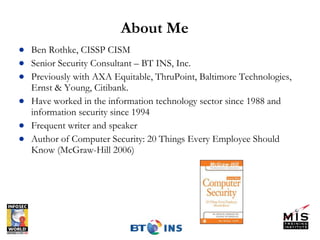
About Me Ben Rothke, CISSP CISM Senior Security Consultant – BT INS, Inc. Previously with AXA Equitable, ThruPoint, Baltimore Technologies, Ernst & Young, Citibank. Have worked in the information technology sector since 1988 and information security since 1994 Frequent writer and speaker Author of Computer Security: 20 Things Every Employee Should Know (McGraw-Hill 2006)
Agenda This session is: Why you need endpoint security Security risks of rogue devices Endpoint security solutions: The Big Three Universal product requirements This session is not: Product review A monologue  Feel free to ask a question, make a comment, etc.
Key Takeaway Points Endpoint security is a powerful technology Don’t underestimate the time and complexity it will take to deploy Define your specific needs and requirements
Times have changed A few years ago, when you called and spoke to someone in area code 212, you could reasonably assume that the person was indeed in New York City.  Today, when you call area code 212, the person  might  be in Manhattan; but can also be in Los Angeles, Moscow, Rio or anyplace in the world. Endpoints are clearly changing, both in the physical world and in the digital world.
Digital endpoint security Perimeter of old was simply a router or firewall Today, the endpoint is the perimeter In most organizations, with a laptop and DHCP, everyone gets in with zero validation. Old perimeter is dead Network perimeter weakness Remote access with 80% of enterprises using VPNs Web-based extranet and partner connectivity Some firewalls are so open, that all they do is simply slow down traffic. In some organizations, it’s hard to tell the difference between a firewall and a router.
Glass houses had no rogues In the mainframe era of glass houses and dumb terminals, there were simply no rogue devices Networks were private, leased and closed Everything around the IBM mainframes was proprietary and closed. Today networks are made to be open Today rogue devices are a bane And endpoint security is becoming a crucial aspect of an information security endeavor.
Security risks of rogue devices The inability to control network admission exposes significant risk to an organization Can be accidental or malicious in nature Often leads to network downtime or exposure of sensitive information Therefore, only allow authorized devices onto the network With endpoint security, non-compliant endpoints attempt connection, but are first quarantined After inspection and remediation, only then are they admitted Endpoints are now starting to be secure
Definition While there is no single universal definition for endpoint security, a general definition is: Process of securing a host through a combination of policy management, configuration management,  and desktop security software, such as anti-virus and anti-spyware. Sum total of the measures taken to implement security concerning endpoints. The use of a network access control system used to restrict network access only to systems that demonstrate adherence to a pre-defined corporate security policy
Endpoint security vs. NAC Endpoint security Securing the endpoint computing device NAC Prevents unauthorized access to network resources Eliminates intrusions onto the network via worms, spyware, viruses, malware, etc. Significant overlap between the two Industry and media are using them synonymously For the purposes of this talk, I will also
Why do we need endpoint security? Viruses and worms continue to disrupt business Zero-day attacks make reactive solutions less effective Point technologies preserve host rather than network availability and enterprise resiliency Non-compliant servers and desktops are difficult to detect and contain Locating and isolating infected systems takes significant time and is extremely resource intensive Users are often authenticated, but devices are not Non-compliant/unmanaged devices pose an unacceptable risk Often source of infection Rogue assets untracked, invisible Device compliance as important as user authentication
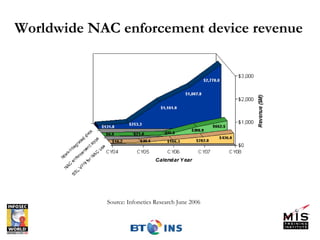
Worldwide NAC enforcement device revenue Source: Infonetics Research June 2006
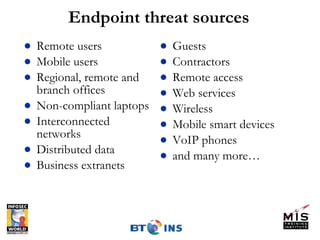
Endpoint threat sources Remote users Mobile users Regional, remote and branch offices Non-compliant laptops Interconnected networks Distributed data Business extranets Guests Contractors Remote access  Web services Wireless Mobile smart devices VoIP phones and many more…
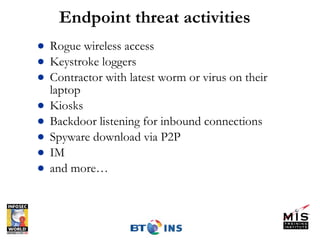
Endpoint threat activities Rogue wireless access Keystroke loggers Contractor with latest worm or virus on their laptop Kiosks Backdoor listening for inbound connections Spyware download via P2P IM and more…
Origination points Accessed by employees, consultants, customers, trading partners From home office, hotel, branch office,  client site, airport, conference, restaurant,  home, trains, planes, automobiles Using laptops running Windows, Linux, Mac OS/X;  PDA running PocketPC, Symbian or PalmOS; mobile phone, public kiosk Dial-up modem, hotel Ethernet, Wi-Fi, mobile carrier, cable modem, DSL To connect with email, Web-based intranet, terminal services, CRM, ERP, partner data Contrast this with the old dumb terminals One location, one hard connection.
Endpoint security benefits Manage zero-day threats Reduce incident response cost Eliminate system downtime Reduce hot fixes and patching Lower recovery cost Comply with regulatory requirements Single solution, multiple security functions, low performance impact Increased security of corporate resources Ensures endpoints (laptops, PC, PDA, servers, etc.) conform to security policy  Proactively protects against worms, viruses, spyware and malware Reduced risk of outbreak due to infected endpoints Safe access to networks through VPN access Controlled remediation and patching of unhealthy endpoints
Evolution of endpoint security Today Static network access Every device is permitted Infected or unhealthy devices are frequently the root of an outbreak Tomorrow…but more realistically in 5+ years  Dynamic network access based on policies Screen devices before granting access Infected or unhealthy devices treated separately
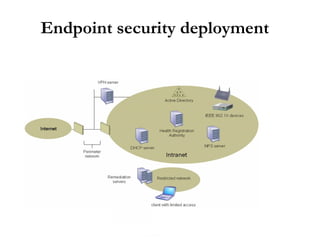
Endpoint security deployment
Start thinking about endpoint security Know what you want to inspect What policies do you want? Risk assessment Define in detail what are your risks Not all risks are created equal Not all endpoints are created equal What is your security problem and how do you expect an endpoint security solution to solve it?
Questions you need to ask How do we enforce compliance with our security policies in order to provide a safe and secure network environment for everyone? How do we identify unmanaged desktops to deliver our security message?  How do we ensure all types of users have adequate awareness and training of security issues?
Budget and Staffing Ensure that you have adequate budget and staff to support endpoint security Endpoint projects take a lot of money and manpower to deploy Regardless of what the vendor tells you, endpoint security costs a lot of $$$$ It is worth it, but it is in no way cheap If you don’t have the budget  and  staff, don’t even think of deploying endpoint security.
Next steps Define very specific goals for endpoint security Assessment of endpoint security requirements and needs Decision making based on policy compliance Admission enforcement at the network infrastructure level Quarantining/remediation of unhealthy devices
Context of the endpoint device Function Location Criticality Compliance state
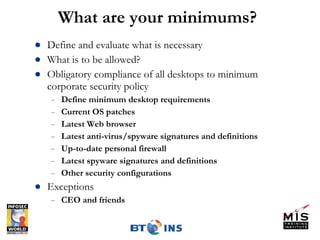
What are your minimums? Define and evaluate what is necessary  What is to be allowed?  Obligatory compliance of all desktops to minimum corporate security policy Define minimum desktop requirements Current OS patches Latest Web browser Latest anti-virus/spyware signatures and definitions Up-to-date personal firewall Latest spyware signatures and definitions Other security configurations Exceptions CEO and friends
Strategic endpoint security Effective endpoint security requires a  strategic  approach that understands the need to optimize connectivity while also ensuring protection for all critical resources This is not a trivial task Endpoint security is  not  plug and play deployments require a lot of initial TLC can break many applications cause others to crash
NAC - one-size does not fit all Biggest mistake in NAC design taking a one-size fits all approach NAC policies must address Who What Where When Why
NAC - one-size does not fit all Second biggest mistake in NAC design Inadequate piloting First pilot groups should be with users who are computer savvy NAC policies take a lot of tweaking to get them right Start small Don’t try a global deployment until you have a few successful localized deployments
Converged devices Devices such as notebooks, tablet PCs, PDAs, smartphones, iPod, Zune and other types of mobile devices also need to be secured They have increasing storage and performance capabilities They travel outside the bounds of physical and logical perimeters – and they aren’t connected to the network at all times These devices enter and leave your network many times over the course of the year That leaves myriad opportunities to return with malware
Converged devices These devices present a significant potential for financial loss, legal liability and brand damage since they are unprotected Many organizations have no idea if these devices are connected to their network or how many are connected Endpoint security can offer protection against the threats that converged devices bring
Non-corporate owned devices Consultants, contractors, hackers, employees and more will attempt to connect their own devices to the corporate network Be it a corporate-owned device or privately-owned endpoint, they  all  must be controlled before being given access to the network
Endpoint security recommendations An unsecured endpoint must not be allowed to connect to the network if doing so inappropriately increases the risk to the organization Management must identify the state of the endpoints before they are allowed access to internal networks CISO must be able to provide a level of assurance to management that information will be protected when it reaches the endpoint Remediation plans must be created for remote endpoints
Endpoint security - not a silver bullet While endpoint security is a hot topic with myriad hardware and software solutions, the reality is that: There are no standards Many current solutions are proprietary Still an immature solution Not a lot of experts in the field  Solutions are costly and complex to implement Not all solutions address  post-admission  control The endpoint security market is still evolving, and its noble objectives are still progressing.  Many of which have yet to be achieved.
What about post-admission control? Blocking access is easy The hard part is finding a way to safely conduct business when the unmanaged endpoint of a business partner or customer is not compliant Asking third-parties to install NAC software clients is often infeasible NAC does not completely track and control the flow of confidential data We must wait until the next generation of NAC/Endpoint security functionality
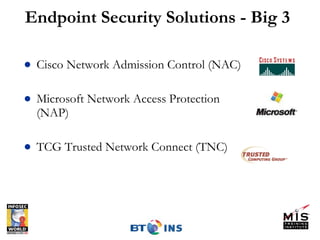
Endpoint Security Solutions - Big 3 Cisco Network Admission Control (NAC) Microsoft Network Access Protection (NAP) TCG Trusted Network Connect (TNC)
Other vendors in the space Check Point Endforce StillSecure Symantec Juniper Configuresoft Lockdown Networks eEye Qualys Funk 3Com Altiris ISS Citrix ConSentry Vernier Senforce McAfee Forescout InfoExpress Intel and many more….
Commonalities All of the solutions are basically attempting to perform the same task They all use routers, switches, wireless access points, software and security appliances to enforce endpoint security Require security credentials from endpoint device Relays them to a policy server Policy servers evaluate credentials and make admission control policy decision (permit, deny, quarantine or restrict)  Network access device enforces admission control policy decision
Commonality – Policy Server The policy server is generally a RADIUS, Kerberos or 802.1x system and is the central point for establishing network access policies and is the primary mechanism for the endpoint security workflow The policy server decides whether to allow an endpoint onto the network based on input from the baseline of the device The server interfaces with other security configuration management functions that hold information such as OS updates, AV, patches, etc.
802.1x is not NAC IEEE 802.1x – Standard for port-based network access control. It is not NAC as the industry knows it Port-based authentication Provides authentication to devices connected to a LAN port
Cisco NAC API-level enforcement & quarantine technology being built into Cisco network infrastructure In production Multiple vendors in program NAC focuses on network infrastructure, policy definition and management Built on a foundation of installed Cisco devices
Cisco NAC NAC works via trusted modules that are installed on Windows and Linux desktops (Cisco Trusted Agent - CTA) and implemented in Cisco routers and switches CTA gathers device information and passes it via 802.1x to the Cisco Secure Access Control Server (ACS) ACS communicates with the policy server to determine compliance and enforce network access via the Cisco switching infrastructure
Cisco NAC NAC requires a Cisco infrastructure running a current version of IOS 12.3(8)T or later For enterprises running legacy Cisco devices, this will require an expensive hardware upgrade For enterprises running older versions of IOS, this will require plans to upgrade
Cisco NAC Benefits Shipping now Somewhat mature Many deployments Supports Linux clients Disadvantages Proprietary solution Full solution works only with Cisco 802.1x equipment and authentication server Cisco switch-based Significant IOS upgrade may be required Requires software agent
Microsoft NAP Health assessment of host device API-level enforcement & quarantine technology via the Windows OS Available in Vista Multiple vendors in program and announcing support  Built on a Windows foundation and uses the Windows Quarantine Agent (QA)
NAP Components Administrators can use these technologies separately or together to limit noncompliant computers. NAP provides limited access enforcement components for the following technologies: IPsec Health Registration Authority (HRA) and IPsec NAP Enforcement Client (EC) 802.1x authenticated network connections NPS server and an EAPHost NAP EC component VPN VPN NAP Enforcement Server (ES) component/VPN NAP EC component  DHCP NAP ES component/DHCP NAP EC component
NAP characteristics Health Policy Validation When a user attempts to connect to the network, the computer’s health state is validated against the health policies as defined by the administrator.  Health Policy Compliance  Administrators can help ensure compliance with health policies by choosing to automatically update noncompliant computers with the missing requirements through management software. Limited Access Administrators can protect network assets by limiting the access of computers that do not comply with health policy requirements.  Non-compliant computers will have their access limited as defined by the administrator.
Microsoft NAP Microsoft states that NAP is not designed to secure a network from malicious users.  It’s designed to help administrators maintain the health of the computers on the network, which in turns helps maintain the network’s overall integrity. Microsoft’s new platform to limit the access of connecting computers until they are compliant with system health requirements
Microsoft NAP QA gathers device information and passes it to the Microsoft Network Policy Server (NPS) NPS works with other devices (DHCP, IPsec, VPN, 802.1x and more) for policy compliance Supported in Vista and Windows XP SP2
Microsoft NAP Benefits Single policy solution for Windows devices Supported by many vendors Disadvantages Just out of beta Only Vista and XP support No Linux support Proprietary
Trusted Computing Group Creating TNC (Trusted Network Connect) Standard Multiple API-level interfaces Broad approach to endpoint security Still in early stage of development Built on the assumption that every device has a specialized piece of hardware to verify that the endpoint has not been compromised Uses that hardware to monitor and enforce endpoint policies
Trusted Network Connect Trusted Network Connect is a set of open standards Mission is to develop and promote an open, vendor-neutral, industry standard specification for trusted computing building blocks and software interfaces across multiple platforms Not all of the standards have been fully defined Little product support to date Key components of TNC are a RADIUS server and 802.1x authentication servers, in addition to a trusted hardware chip (TPM) and software on the endpoint device
Trusted Network Connect The TPM (Trusted Platform Module) is used to authenticate the endpoint device Once authenticated, the TPM passes control to a software agent, which checks the device for compliance
Trusted Network Connect Benefits Provides security at the hardware level Broad architecture Wide support from laptop and other hardware vendors Open specification  Disadvantages Requires specialized TPM hardware Standards are incomplete Few major rollouts
References/Books NAP -  www.microsoft.com/nap   NAC -  www.cisco.com/en/US/netsol/ns466/networking_solutions_package.html   TNC  -  www.trustedcomputinggroup.org/groups/network   www.endpointsecurity.org   www.watchyourend.com Essential Trends and Dynamics of the Endpoint Security Industry www.zeltser.com/endpoint-security-trends
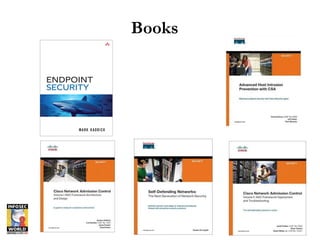
Books
Conclusions Endpoint security is a powerful technology whose time has come. Don’t underestimate the time and complexity it will take to deploy. Make sure you define your specific needs and requirements and map those to your environment. You will have to live with and support your decision, so make sure you make the right choice.
QA/Thanks for attending Any questions? comments?  Please fill out your evaluation sheets Ben Rothke CISSP, CISM BT PS [email_address]

Info Sec2007 End Point Final

  • 1.
  • 2.
    How to Planfor and Use Endpoint Security Session E3 Ben Rothke, CISSP CISM Wednesday, March 21, 2007 11:30AM - 1:00 PM
  • 3.
    About Me BenRothke, CISSP CISM Senior Security Consultant – BT INS, Inc. Previously with AXA Equitable, ThruPoint, Baltimore Technologies, Ernst & Young, Citibank. Have worked in the information technology sector since 1988 and information security since 1994 Frequent writer and speaker Author of Computer Security: 20 Things Every Employee Should Know (McGraw-Hill 2006)
  • 4.
    Agenda This sessionis: Why you need endpoint security Security risks of rogue devices Endpoint security solutions: The Big Three Universal product requirements This session is not: Product review A monologue Feel free to ask a question, make a comment, etc.
  • 5.
    Key Takeaway PointsEndpoint security is a powerful technology Don’t underestimate the time and complexity it will take to deploy Define your specific needs and requirements
  • 6.
    Times have changedA few years ago, when you called and spoke to someone in area code 212, you could reasonably assume that the person was indeed in New York City. Today, when you call area code 212, the person might be in Manhattan; but can also be in Los Angeles, Moscow, Rio or anyplace in the world. Endpoints are clearly changing, both in the physical world and in the digital world.
  • 7.
    Digital endpoint securityPerimeter of old was simply a router or firewall Today, the endpoint is the perimeter In most organizations, with a laptop and DHCP, everyone gets in with zero validation. Old perimeter is dead Network perimeter weakness Remote access with 80% of enterprises using VPNs Web-based extranet and partner connectivity Some firewalls are so open, that all they do is simply slow down traffic. In some organizations, it’s hard to tell the difference between a firewall and a router.
  • 8.
    Glass houses hadno rogues In the mainframe era of glass houses and dumb terminals, there were simply no rogue devices Networks were private, leased and closed Everything around the IBM mainframes was proprietary and closed. Today networks are made to be open Today rogue devices are a bane And endpoint security is becoming a crucial aspect of an information security endeavor.
  • 9.
    Security risks ofrogue devices The inability to control network admission exposes significant risk to an organization Can be accidental or malicious in nature Often leads to network downtime or exposure of sensitive information Therefore, only allow authorized devices onto the network With endpoint security, non-compliant endpoints attempt connection, but are first quarantined After inspection and remediation, only then are they admitted Endpoints are now starting to be secure
  • 10.
    Definition While thereis no single universal definition for endpoint security, a general definition is: Process of securing a host through a combination of policy management, configuration management, and desktop security software, such as anti-virus and anti-spyware. Sum total of the measures taken to implement security concerning endpoints. The use of a network access control system used to restrict network access only to systems that demonstrate adherence to a pre-defined corporate security policy
  • 11.
    Endpoint security vs.NAC Endpoint security Securing the endpoint computing device NAC Prevents unauthorized access to network resources Eliminates intrusions onto the network via worms, spyware, viruses, malware, etc. Significant overlap between the two Industry and media are using them synonymously For the purposes of this talk, I will also
  • 12.
    Why do weneed endpoint security? Viruses and worms continue to disrupt business Zero-day attacks make reactive solutions less effective Point technologies preserve host rather than network availability and enterprise resiliency Non-compliant servers and desktops are difficult to detect and contain Locating and isolating infected systems takes significant time and is extremely resource intensive Users are often authenticated, but devices are not Non-compliant/unmanaged devices pose an unacceptable risk Often source of infection Rogue assets untracked, invisible Device compliance as important as user authentication
  • 13.
    Worldwide NAC enforcementdevice revenue Source: Infonetics Research June 2006
  • 14.
    Endpoint threat sourcesRemote users Mobile users Regional, remote and branch offices Non-compliant laptops Interconnected networks Distributed data Business extranets Guests Contractors Remote access Web services Wireless Mobile smart devices VoIP phones and many more…
  • 15.
    Endpoint threat activitiesRogue wireless access Keystroke loggers Contractor with latest worm or virus on their laptop Kiosks Backdoor listening for inbound connections Spyware download via P2P IM and more…
  • 16.
    Origination points Accessedby employees, consultants, customers, trading partners From home office, hotel, branch office, client site, airport, conference, restaurant, home, trains, planes, automobiles Using laptops running Windows, Linux, Mac OS/X; PDA running PocketPC, Symbian or PalmOS; mobile phone, public kiosk Dial-up modem, hotel Ethernet, Wi-Fi, mobile carrier, cable modem, DSL To connect with email, Web-based intranet, terminal services, CRM, ERP, partner data Contrast this with the old dumb terminals One location, one hard connection.
  • 17.
    Endpoint security benefitsManage zero-day threats Reduce incident response cost Eliminate system downtime Reduce hot fixes and patching Lower recovery cost Comply with regulatory requirements Single solution, multiple security functions, low performance impact Increased security of corporate resources Ensures endpoints (laptops, PC, PDA, servers, etc.) conform to security policy Proactively protects against worms, viruses, spyware and malware Reduced risk of outbreak due to infected endpoints Safe access to networks through VPN access Controlled remediation and patching of unhealthy endpoints
  • 18.
    Evolution of endpointsecurity Today Static network access Every device is permitted Infected or unhealthy devices are frequently the root of an outbreak Tomorrow…but more realistically in 5+ years Dynamic network access based on policies Screen devices before granting access Infected or unhealthy devices treated separately
  • 19.
  • 20.
    Start thinking aboutendpoint security Know what you want to inspect What policies do you want? Risk assessment Define in detail what are your risks Not all risks are created equal Not all endpoints are created equal What is your security problem and how do you expect an endpoint security solution to solve it?
  • 21.
    Questions you needto ask How do we enforce compliance with our security policies in order to provide a safe and secure network environment for everyone? How do we identify unmanaged desktops to deliver our security message? How do we ensure all types of users have adequate awareness and training of security issues?
  • 22.
    Budget and StaffingEnsure that you have adequate budget and staff to support endpoint security Endpoint projects take a lot of money and manpower to deploy Regardless of what the vendor tells you, endpoint security costs a lot of $$$$ It is worth it, but it is in no way cheap If you don’t have the budget and staff, don’t even think of deploying endpoint security.
  • 23.
    Next steps Definevery specific goals for endpoint security Assessment of endpoint security requirements and needs Decision making based on policy compliance Admission enforcement at the network infrastructure level Quarantining/remediation of unhealthy devices
  • 24.
    Context of theendpoint device Function Location Criticality Compliance state
  • 25.
    What are yourminimums? Define and evaluate what is necessary What is to be allowed? Obligatory compliance of all desktops to minimum corporate security policy Define minimum desktop requirements Current OS patches Latest Web browser Latest anti-virus/spyware signatures and definitions Up-to-date personal firewall Latest spyware signatures and definitions Other security configurations Exceptions CEO and friends
  • 26.
    Strategic endpoint securityEffective endpoint security requires a strategic approach that understands the need to optimize connectivity while also ensuring protection for all critical resources This is not a trivial task Endpoint security is not plug and play deployments require a lot of initial TLC can break many applications cause others to crash
  • 27.
    NAC - one-sizedoes not fit all Biggest mistake in NAC design taking a one-size fits all approach NAC policies must address Who What Where When Why
  • 28.
    NAC - one-sizedoes not fit all Second biggest mistake in NAC design Inadequate piloting First pilot groups should be with users who are computer savvy NAC policies take a lot of tweaking to get them right Start small Don’t try a global deployment until you have a few successful localized deployments
  • 29.
    Converged devices Devicessuch as notebooks, tablet PCs, PDAs, smartphones, iPod, Zune and other types of mobile devices also need to be secured They have increasing storage and performance capabilities They travel outside the bounds of physical and logical perimeters – and they aren’t connected to the network at all times These devices enter and leave your network many times over the course of the year That leaves myriad opportunities to return with malware
  • 30.
    Converged devices Thesedevices present a significant potential for financial loss, legal liability and brand damage since they are unprotected Many organizations have no idea if these devices are connected to their network or how many are connected Endpoint security can offer protection against the threats that converged devices bring
  • 31.
    Non-corporate owned devicesConsultants, contractors, hackers, employees and more will attempt to connect their own devices to the corporate network Be it a corporate-owned device or privately-owned endpoint, they all must be controlled before being given access to the network
  • 32.
    Endpoint security recommendationsAn unsecured endpoint must not be allowed to connect to the network if doing so inappropriately increases the risk to the organization Management must identify the state of the endpoints before they are allowed access to internal networks CISO must be able to provide a level of assurance to management that information will be protected when it reaches the endpoint Remediation plans must be created for remote endpoints
  • 33.
    Endpoint security -not a silver bullet While endpoint security is a hot topic with myriad hardware and software solutions, the reality is that: There are no standards Many current solutions are proprietary Still an immature solution Not a lot of experts in the field Solutions are costly and complex to implement Not all solutions address post-admission control The endpoint security market is still evolving, and its noble objectives are still progressing. Many of which have yet to be achieved.
  • 34.
    What about post-admissioncontrol? Blocking access is easy The hard part is finding a way to safely conduct business when the unmanaged endpoint of a business partner or customer is not compliant Asking third-parties to install NAC software clients is often infeasible NAC does not completely track and control the flow of confidential data We must wait until the next generation of NAC/Endpoint security functionality
  • 35.
    Endpoint Security Solutions- Big 3 Cisco Network Admission Control (NAC) Microsoft Network Access Protection (NAP) TCG Trusted Network Connect (TNC)
  • 36.
    Other vendors inthe space Check Point Endforce StillSecure Symantec Juniper Configuresoft Lockdown Networks eEye Qualys Funk 3Com Altiris ISS Citrix ConSentry Vernier Senforce McAfee Forescout InfoExpress Intel and many more….
  • 37.
    Commonalities All ofthe solutions are basically attempting to perform the same task They all use routers, switches, wireless access points, software and security appliances to enforce endpoint security Require security credentials from endpoint device Relays them to a policy server Policy servers evaluate credentials and make admission control policy decision (permit, deny, quarantine or restrict) Network access device enforces admission control policy decision
  • 38.
    Commonality – PolicyServer The policy server is generally a RADIUS, Kerberos or 802.1x system and is the central point for establishing network access policies and is the primary mechanism for the endpoint security workflow The policy server decides whether to allow an endpoint onto the network based on input from the baseline of the device The server interfaces with other security configuration management functions that hold information such as OS updates, AV, patches, etc.
  • 39.
    802.1x is notNAC IEEE 802.1x – Standard for port-based network access control. It is not NAC as the industry knows it Port-based authentication Provides authentication to devices connected to a LAN port
  • 40.
    Cisco NAC API-levelenforcement & quarantine technology being built into Cisco network infrastructure In production Multiple vendors in program NAC focuses on network infrastructure, policy definition and management Built on a foundation of installed Cisco devices
  • 41.
    Cisco NAC NACworks via trusted modules that are installed on Windows and Linux desktops (Cisco Trusted Agent - CTA) and implemented in Cisco routers and switches CTA gathers device information and passes it via 802.1x to the Cisco Secure Access Control Server (ACS) ACS communicates with the policy server to determine compliance and enforce network access via the Cisco switching infrastructure
  • 42.
    Cisco NAC NACrequires a Cisco infrastructure running a current version of IOS 12.3(8)T or later For enterprises running legacy Cisco devices, this will require an expensive hardware upgrade For enterprises running older versions of IOS, this will require plans to upgrade
  • 43.
    Cisco NAC BenefitsShipping now Somewhat mature Many deployments Supports Linux clients Disadvantages Proprietary solution Full solution works only with Cisco 802.1x equipment and authentication server Cisco switch-based Significant IOS upgrade may be required Requires software agent
  • 44.
    Microsoft NAP Healthassessment of host device API-level enforcement & quarantine technology via the Windows OS Available in Vista Multiple vendors in program and announcing support Built on a Windows foundation and uses the Windows Quarantine Agent (QA)
  • 45.
    NAP Components Administratorscan use these technologies separately or together to limit noncompliant computers. NAP provides limited access enforcement components for the following technologies: IPsec Health Registration Authority (HRA) and IPsec NAP Enforcement Client (EC) 802.1x authenticated network connections NPS server and an EAPHost NAP EC component VPN VPN NAP Enforcement Server (ES) component/VPN NAP EC component DHCP NAP ES component/DHCP NAP EC component
  • 46.
    NAP characteristics HealthPolicy Validation When a user attempts to connect to the network, the computer’s health state is validated against the health policies as defined by the administrator. Health Policy Compliance Administrators can help ensure compliance with health policies by choosing to automatically update noncompliant computers with the missing requirements through management software. Limited Access Administrators can protect network assets by limiting the access of computers that do not comply with health policy requirements. Non-compliant computers will have their access limited as defined by the administrator.
  • 47.
    Microsoft NAP Microsoftstates that NAP is not designed to secure a network from malicious users. It’s designed to help administrators maintain the health of the computers on the network, which in turns helps maintain the network’s overall integrity. Microsoft’s new platform to limit the access of connecting computers until they are compliant with system health requirements
  • 48.
    Microsoft NAP QAgathers device information and passes it to the Microsoft Network Policy Server (NPS) NPS works with other devices (DHCP, IPsec, VPN, 802.1x and more) for policy compliance Supported in Vista and Windows XP SP2
  • 49.
    Microsoft NAP BenefitsSingle policy solution for Windows devices Supported by many vendors Disadvantages Just out of beta Only Vista and XP support No Linux support Proprietary
  • 50.
    Trusted Computing GroupCreating TNC (Trusted Network Connect) Standard Multiple API-level interfaces Broad approach to endpoint security Still in early stage of development Built on the assumption that every device has a specialized piece of hardware to verify that the endpoint has not been compromised Uses that hardware to monitor and enforce endpoint policies
  • 51.
    Trusted Network ConnectTrusted Network Connect is a set of open standards Mission is to develop and promote an open, vendor-neutral, industry standard specification for trusted computing building blocks and software interfaces across multiple platforms Not all of the standards have been fully defined Little product support to date Key components of TNC are a RADIUS server and 802.1x authentication servers, in addition to a trusted hardware chip (TPM) and software on the endpoint device
  • 52.
    Trusted Network ConnectThe TPM (Trusted Platform Module) is used to authenticate the endpoint device Once authenticated, the TPM passes control to a software agent, which checks the device for compliance
  • 53.
    Trusted Network ConnectBenefits Provides security at the hardware level Broad architecture Wide support from laptop and other hardware vendors Open specification Disadvantages Requires specialized TPM hardware Standards are incomplete Few major rollouts
  • 54.
    References/Books NAP - www.microsoft.com/nap NAC - www.cisco.com/en/US/netsol/ns466/networking_solutions_package.html TNC - www.trustedcomputinggroup.org/groups/network www.endpointsecurity.org www.watchyourend.com Essential Trends and Dynamics of the Endpoint Security Industry www.zeltser.com/endpoint-security-trends
  • 55.
  • 56.
    Conclusions Endpoint securityis a powerful technology whose time has come. Don’t underestimate the time and complexity it will take to deploy. Make sure you define your specific needs and requirements and map those to your environment. You will have to live with and support your decision, so make sure you make the right choice.
  • 57.
    QA/Thanks for attendingAny questions? comments? Please fill out your evaluation sheets Ben Rothke CISSP, CISM BT PS [email_address]