Visit https://ebookultra.com to download the full version and
explore more ebooks or textbooks
Endpoint Security 1st ed Edition Mark Kadrich
_____ Click the link below to download _____
https://ebookultra.com/download/endpoint-security-1st-ed-
edition-mark-kadrich/
Explore and download more ebooks or textbooks at ebookultra.com
Here are some recommended products that we believe you will be
interested in. You can click the link to download.
Security guide to network security fundamentals 3rd ed
Edition Mark D Ciampa
https://ebookultra.com/download/security-guide-to-network-security-
fundamentals-3rd-ed-edition-mark-d-ciampa/
Practical Hadoop Security 1st ed. Edition Lakhe
https://ebookultra.com/download/practical-hadoop-security-1st-ed-
edition-lakhe/
Inclusion Exclusion and the Governance of European
Security 1st Edition Mark Webber
https://ebookultra.com/download/inclusion-exclusion-and-the-
governance-of-european-security-1st-edition-mark-webber/
Computer security handbook 4th ed Edition Seymour Bosworth
https://ebookultra.com/download/computer-security-handbook-4th-ed-
edition-seymour-bosworth/
Introduction to homeland security 2nd ed. Edition Doss
https://ebookultra.com/download/introduction-to-homeland-security-2nd-
ed-edition-doss/
The Executive Guide to Information Security Threats
Challenges and Solutions 1st Edition Mark Egan
https://ebookultra.com/download/the-executive-guide-to-information-
security-threats-challenges-and-solutions-1st-edition-mark-egan/
Cyber security and IT infrastructure protection 1st ed
Edition Vacca
https://ebookultra.com/download/cyber-security-and-it-infrastructure-
protection-1st-ed-edition-vacca/
Evading EDR The Definitive Guide to Defeating Endpoint
Detection Systems 1st Edition Matt Hand
https://ebookultra.com/download/evading-edr-the-definitive-guide-to-
defeating-endpoint-detection-systems-1st-edition-matt-hand/
How to Lie With Maps 1st ed 1991 1st ed. 1991 Edition Mark
Monmonier
https://ebookultra.com/download/how-to-lie-with-maps-1st-ed-1991-1st-
ed-1991-edition-mark-monmonier/
Endpoint Security 1st ed Edition Mark Kadrich Digital
Instant Download
Author(s): Mark Kadrich
ISBN(s): 9780321436955, 0321436954
Edition: 1st ed
File Details: PDF, 5.75 MB
Year: 2007
Language: english
i
PRAISE FOR ENDPOINT SECURITY
“By the time I finished Mark’s book, he’d completely changed my mind on a lot of
things. Most important, I realized closed-loop endpoint security is not such the com-
plex nightmare it seems. For embedded devices, where closed loop is not achievable
at this time, he identifies what you can do to start closing the loop on these devices,
identifies which controls are missing, and makes plausible conjectures about how
the missing controls will fall into place.”
—Deb Radcliff, award-winning industry writer, computer crime and security
“Just what’s needed to cut through the hype surrounding NAC and its cousins.”
—Joe Knape, Security Engineer, a leading telecommunications provider
“This book moves beyond monitoring the network for security events and provides a
thorough guide both the novice and experienced information security specialist can
use to improve the security posture of a wide variety of endpoint devices.”
—Kirby Kuehl, IPS Developer, Cisco Systems, Inc.
“Network perimeter is no longer a solid demarcation line at the company’s firewalls.
The perimeter appears to have disappeared, and the question is, ‘How can a man-
ager secure the disappearing perimeter?’ Mark Kadrich has approached the subject
of securing the network perimeter using a new paradigm. His revolutionary, yet
simple approach will cause experienced security managers to wonder, ‘Why has this
method not been discussed before?’ Mark provides a scientific methodology that any
system administrator or security professional can quickly adopt and put into prac-
tice to secure their networks and endpoints.”
—Curtis Coleman, CISSP, CISM, MSIA
“Kadrich has successfully delivered an insightful and engaging perspective about the
real world of information security and why effectively addressing endpoint security
is so critical. Delivered with wit, humor, and candor, this book also serves as a wake-
up call to those who provide information security products and as a viable roadmap
for security professionals to better address both strategic security initiatives and the
attendant issues du jour. Bottom line: This book should be considered essential read-
ing for the layperson and the security professional.”
—Harry Bing-You, President, Anasazi Group Inc.
ii
Endpoint Security
This page intentionally left blank
Endpoint Security
Mark S. Kadrich, CISSP
Upper Saddle River, NJ • Boston • Indianapolis • San Francisco
New York • Toronto • Montreal • London • Munich • Paris • Madrid
Capetown • Sydney • Tokyo • Singapore • Mexico City
Many of the designations used by manufacturers and sellers to distinguish their products are claimed as trademarks.
Where those designations appear in this book, and the publisher was aware of a trademark claim, the designations have
been printed with initial capital letters or in all capitals.
The author and publisher have taken care in the preparation of this book, but make no expressed or implied warranty of
any kind and assume no responsibility for errors or omissions. No liability is assumed for incidental or consequential
damages in connection with or arising out of the use of the information or programs contained herein.
The publisher offers excellent discounts on this book when ordered in quantity for bulk purchases or special sales, which
may include electronic versions and/or custom covers and content particular to your business, training goals, marketing
focus, and branding interests. For more information, please contact:
U.S. Corporate and Government Sales
(800) 382-3419
corpsales@pearsontechgroup.com
For sales outside the United States please contact:
International Sales
international@pearsoned.com
Visit us on the Web: www.awprofessional.com
Library of Congress Cataloging-in-Publication Data:
Kadrich, Mark.
Endpoint security / Mark Kadrich. — 1st ed.
p. cm.
ISBN 0-321-43695-4 (pbk. : alk. paper) 1. Computer security. 2. Computer networks—Security measures. I. Title.
QA76.9.A25K325 2007
005.8—dc22
2006102875
Copyright © 2007 Pearson Education, Inc.
All rights reserved. Printed in the United States of America. This publication is protected by copyright, and permission
must be obtained from the publisher prior to any prohibited reproduction, storage in a retrieval system, or transmission
in any form or by any means, electronic, mechanical, photocopying, recording, or likewise. For information regarding
permissions, write to:
Pearson Education, Inc.
Rights and Contracts Department
75 Arlington Street, Suite 300
Boston, MA 02116
Fax: (617) 848-7047
ISBN 0-32-143695-4
Text printed in the United States on recycled paper at RR Donnelley, Crawfordsville, Indiana
First printing, April 2007
This book is dedicated to my father, John Richard Kadrich.
He taught me how to take things apart, to ask questions
when I didn’t know what the parts did, and put them back
together with no leftover parts.
This page intentionally left blank
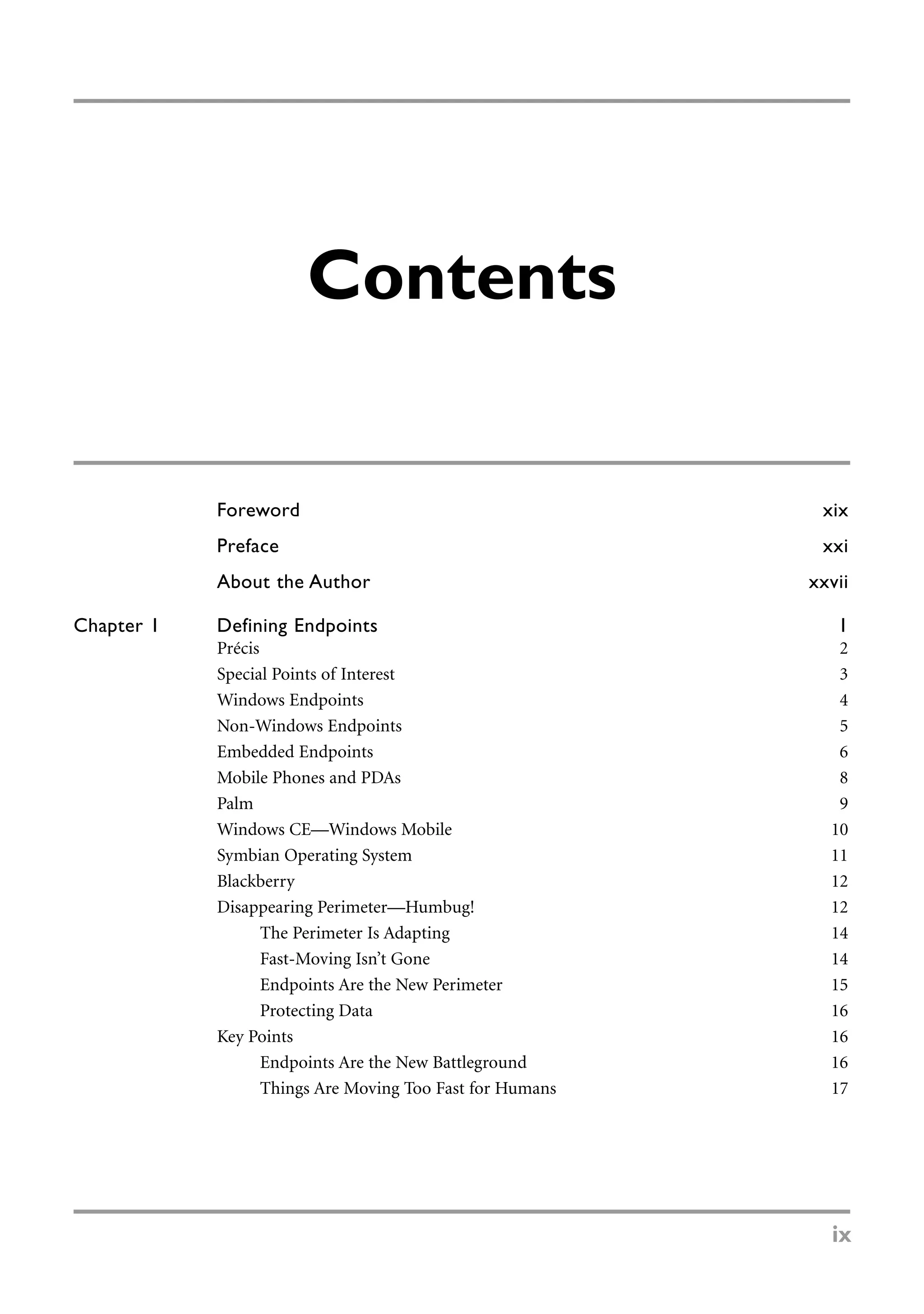
Foreword xix
Preface xxi
About the Author xxvii
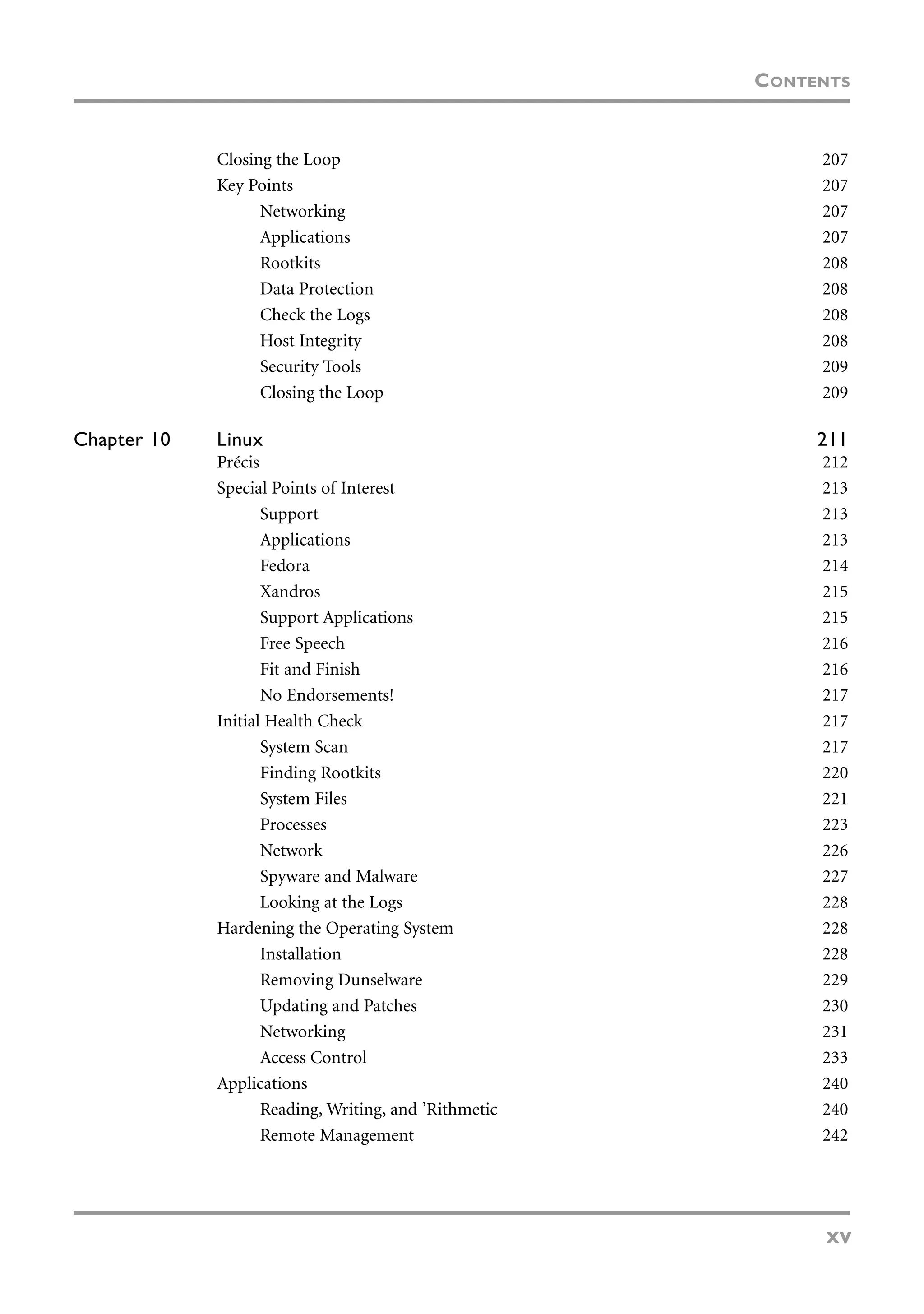
Chapter 1 Defining Endpoints 1
Précis 2
Special Points of Interest 3
Windows Endpoints 4
Non-Windows Endpoints 5
Embedded Endpoints 6
Mobile Phones and PDAs 8
Palm 9
Windows CE—Windows Mobile 10
Symbian Operating System 11
Blackberry 12
Disappearing Perimeter—Humbug! 12
The Perimeter Is Adapting 14
Fast-Moving Isn’t Gone 14
Endpoints Are the New Perimeter 15
Protecting Data 16
Key Points 16
Endpoints Are the New Battleground 16
Things Are Moving Too Fast for Humans 17
Contents
ix
Chapter 2 Why Security Fails 19
Précis 20
Special Points of Interest 20
Setting the Stage 21
Vendors Drive Process 23
Solutions Address the Past 24
We’re Not Asking Vendors Hard Questions 25
Viruses, Worms, Trojans, and Bots 26
Today’s Malware: Big, Fast, and Dangerous 27
High-Profile Failures 28
What Is Being Exploited? 28
Bots 29
Predictably Poor Results 31
Spending More Than Ever 31
We Have No Way to Predict Success 32
We’re Still Being Surprised 33
Is Something Missing? 34
What Are We Doing Wrong? 34
Have We Missed Some Clues? 35
Key Points 36
Malware Continues 36
Vendors Aren’t Helping 37
We Need to Ask Harder Questions 37
Are We Missing Something? 37
Chapter 3 Something Is Missing 39
Précis 40
Special Points of Interest 41
Present Attempts Have Failed (Present Modeling) 42
We Don’t Understand Why 43
We Continue to Use Old Thinking 43
Define Network as Control Problem 46
Map Control Modes to Technology 49
Identify Feedback Paths 50
Identify Metrics That Influence Other Metrics 51
Map Business and Technology Paths 52
Can We Build a Better Model? 53
Identifying Control Nodes 54
Map Technology to Control Nodes 54
Map Control Nodes to Control Modes 55
CONTENTS
x
Quantify Time Constants 56
Control Paths and the Business Processes 57
Completing the Picture 59
Key Points 64
We Need a Better Idea 64
Trust vs. Risk 64
Process Control Helps Build a Model 64
Business Processes Cannot Be Ignored 65
We Need a Common Language 65
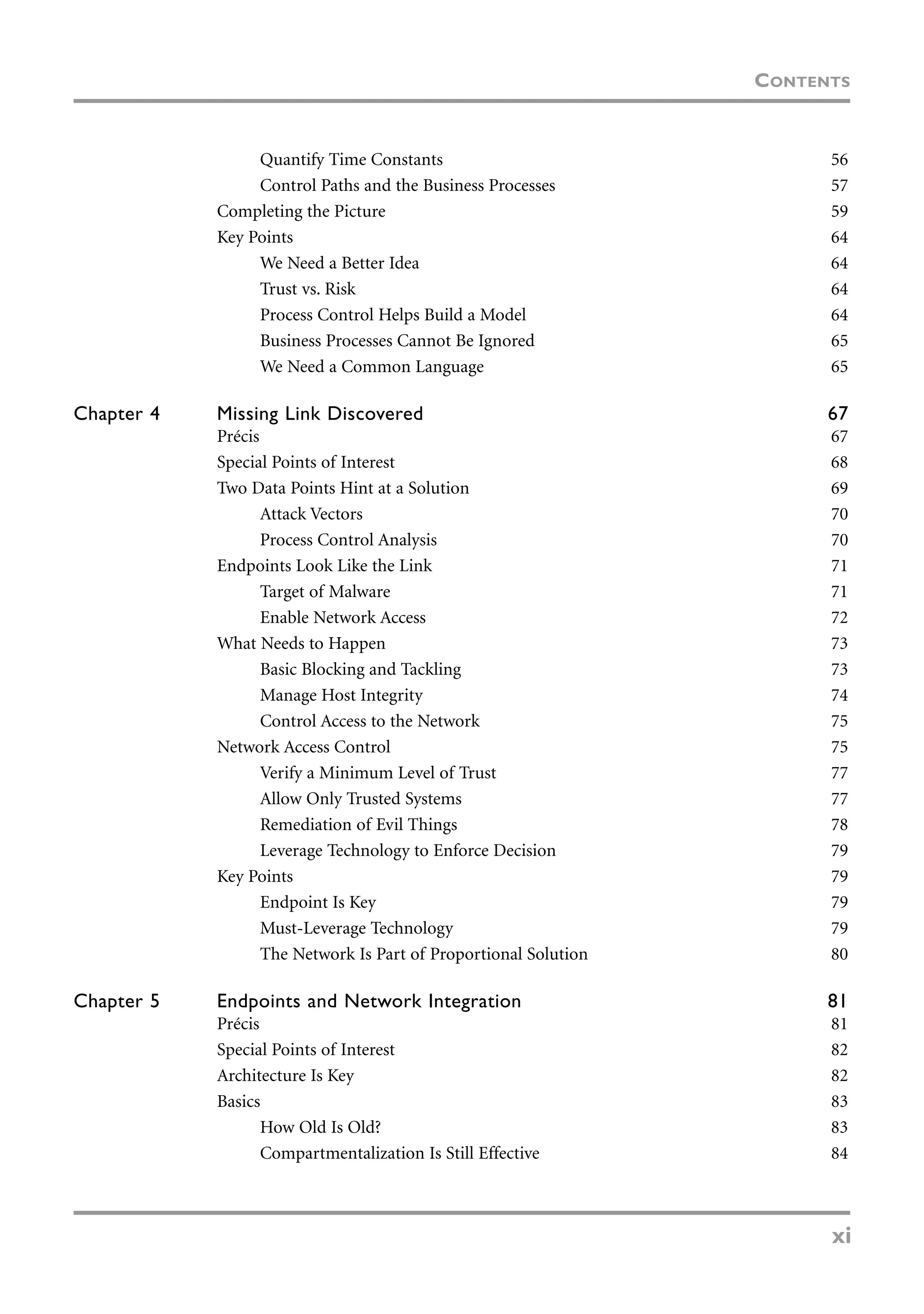
Chapter 4 Missing Link Discovered 67
Précis 67
Special Points of Interest 68
Two Data Points Hint at a Solution 69
Attack Vectors 70
Process Control Analysis 70
Endpoints Look Like the Link 71
Target of Malware 71
Enable Network Access 72
What Needs to Happen 73
Basic Blocking and Tackling 73
Manage Host Integrity 74
Control Access to the Network 75
Network Access Control 75
Verify a Minimum Level of Trust 77
Allow Only Trusted Systems 77
Remediation of Evil Things 78
Leverage Technology to Enforce Decision 79
Key Points 79
Endpoint Is Key 79
Must-Leverage Technology 79
The Network Is Part of Proportional Solution 80
Chapter 5 Endpoints and Network Integration 81
Précis 81
Special Points of Interest 82
Architecture Is Key 82
Basics 83
How Old Is Old? 83
Compartmentalization Is Still Effective 84
CONTENTS
xi
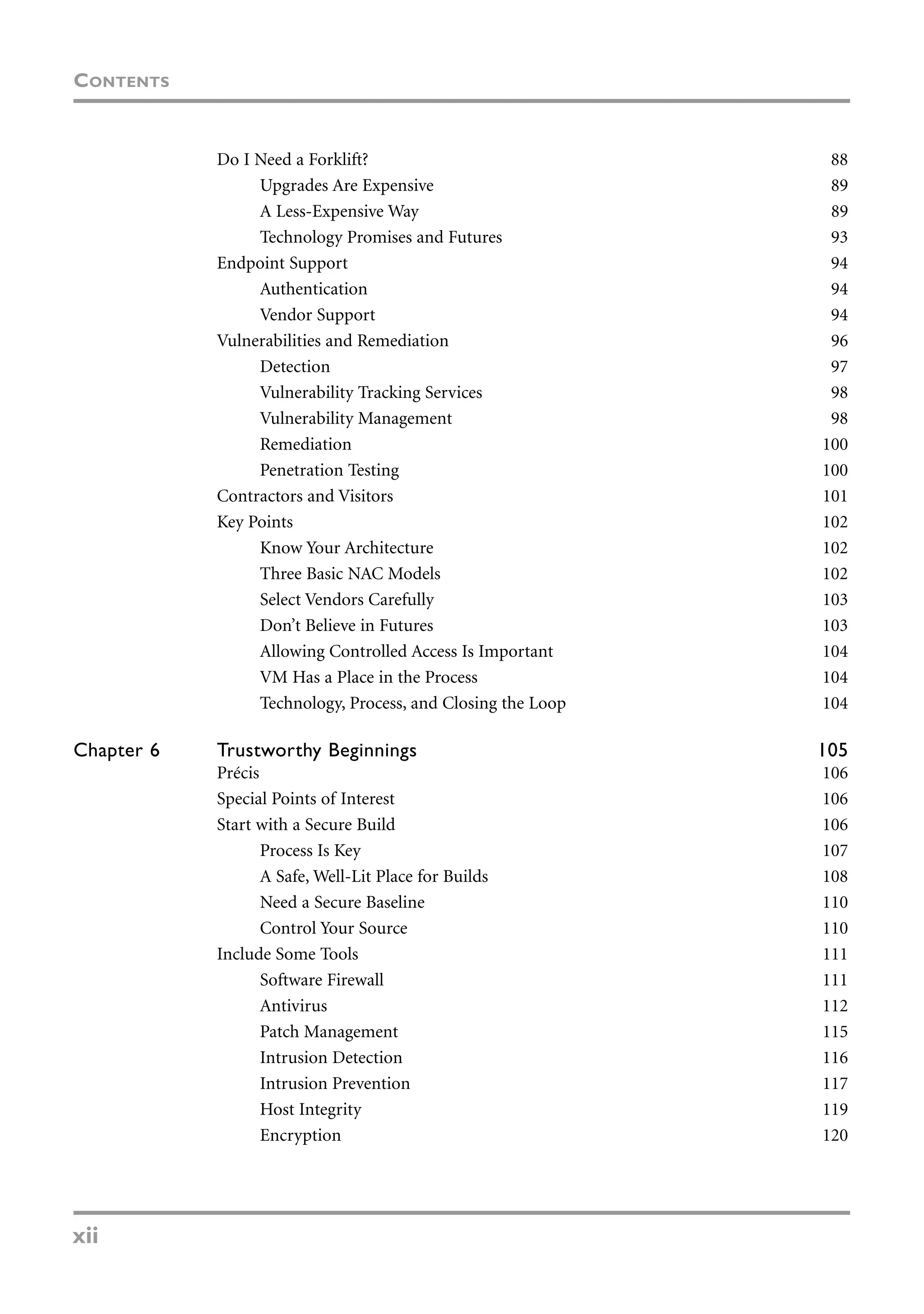
Do I Need a Forklift? 88
Upgrades Are Expensive 89
A Less-Expensive Way 89
Technology Promises and Futures 93
Endpoint Support 94
Authentication 94
Vendor Support 94
Vulnerabilities and Remediation 96
Detection 97
Vulnerability Tracking Services 98
Vulnerability Management 98
Remediation 100
Penetration Testing 100
Contractors and Visitors 101
Key Points 102
Know Your Architecture 102
Three Basic NAC Models 102
Select Vendors Carefully 103
Don’t Believe in Futures 103
Allowing Controlled Access Is Important 104
VM Has a Place in the Process 104
Technology, Process, and Closing the Loop 104
Chapter 6 Trustworthy Beginnings 105
Précis 106
Special Points of Interest 106
Start with a Secure Build 106
Process Is Key 107
A Safe, Well-Lit Place for Builds 108
Need a Secure Baseline 110
Control Your Source 110
Include Some Tools 111
Software Firewall 111
Antivirus 112
Patch Management 115
Intrusion Detection 116
Intrusion Prevention 117
Host Integrity 119
Encryption 120
CONTENTS
xii
Trust, but Verify 121
Test, Test, Test 121
Track Your Results 122
Key Points 123
Start Secure 123
Tools Are Needed 123
Check Your Results 123
Chapter 7 Threat Vectors 125
Précis 125
Special Points of Interest 126
Protecting the Operating System 126
Some Built-In Protections 126
Some Built-In Weaknesses 129
“Killer” Applications 132
Peer-to-Peer Attacks 133
Let’s “Chat” About It 134
Key Points 135
The Operating System Is Your Best Enemy 135
The Apps Are Your Worst Friend 135
Chapter 8 Microsoft Windows 137
Précis 137
Special Points of Interest 138
A Word About Vista 139
Initial Health Check 140
System Scan 141
Finding Rootkits 142
System Files 145
Alternate Data Streams 146
Registry Check 147
It’s About the Processes 149
Spyware 150
Looking at the Logs 151
Network Stuff 151
Mop Up 152
Hardening the Operating System 152
Stand-Alone System 153
Check Your AV 158
Cranking Down the Screws 160
CONTENTS
xiii
Applications 164
Software Restriction Policy 164
Internet Explorer 165
NetMeeting 166
Terminal Services 167
Windows Messenger 167
Windows Update 167
Enterprise Security 168
Servers 170
Closing the Loop 171
Tools and Vendors 172
Key Points 174
Start Fresh 174
Rootkits 174
The Security Arms Race 174
Windows Can Be Secure 175
Process Is Critical 175
The Loop Can Be Closed 175
Chapter 9 Apple OS X 177
Précis 178
Special Points of Interest 178
Initial Health Check 180
System Scan 181
Finding Rootkits 184
System Files 185
Processing Your Processes 186
What’s on the Network? 190
Spyware and Other Malware 193
Looking at the Logs 196
Hardening the Operating System 197
Applications 200
Networking 201
Tools and Vendors 203
Apple Remote Desktop 203
Little Snitch 204
Antivirus 205
Symantec 205
Virex 206
clamXav 206
CONTENTS
xiv
Closing the Loop 207
Key Points 207
Networking 207
Applications 207
Rootkits 208
Data Protection 208
Check the Logs 208
Host Integrity 208
Security Tools 209
Closing the Loop 209
Chapter 10 Linux 211
Précis 212
Special Points of Interest 213
Support 213
Applications 213
Fedora 214
Xandros 215
Support Applications 215
Free Speech 216
Fit and Finish 216
No Endorsements! 217
Initial Health Check 217
System Scan 217
Finding Rootkits 220
System Files 221
Processes 223
Network 226
Spyware and Malware 227
Looking at the Logs 228
Hardening the Operating System 228
Installation 228
Removing Dunselware 229
Updating and Patches 230
Networking 231
Access Control 233
Applications 240
Reading, Writing, and ’Rithmetic 240
Remote Management 242
CONTENTS
xv
Networking 243
NetBIOS Woes 243
Wireless 243
Network Applications 244
802.1x 246
Enterprise Management 246
Tools and Vendors 247
Closing the Loop 249
Key Points 250
Comparison of Two Extremes 250
Xandros Runs NetBIOS 251
Updating Fedora 251
Users Are Still the Problem 252
Plan for Success 252
Loop-Closure Possibilities 252
Chapter 11 PDAs and Smartphones 253
Précis 253
Points of Interest 254
A Serious Threat Today 255
Interesting Solutions 255
Connectedness 256
New Territory 256
Operating Systems 257
Windows Mobile 257
Symbian OS 259
Blackberry 261
Palm 262
Mobile Linux 262
Initial Health Check 263
Securing Handhelds 263
Windows Mobile 264
Symbian OS 264
Palm 265
Blackberry 265
Synchronization 266
Applications 267
Email 267
Messaging 268
Browsing 268
CONTENTS
xvi
Networking 268
WiFi 269
Bluetooth Security 270
Cell Protocols 273
Tools and Vendors 275
Good 275
Bluefire Security Technologies 276
SMobile Systems 277
Mobile Armor 278
AV Vendors 279
Nonenterprise Users 279
Web Sites 280
Closing the Loop 281
Key Points 281
The Industry Is Not Mature 281
Handhelds Are the Next Target 281
Networking Woes 282
Solution and Security Divergence 282
Enforcement Will Come 282
No CLPC Yet 282
Chapter 12 Embedded Devices 285
Précis 285
Special Points of Interest 286
What Is an Embedded System? 286
Where Are Embedded Systems? 287
Why Should I Worry? 289
Embedded Threats 291
Initial Health Check 292
Applications 297
Networking 298
Tools and Vendors 299
Embedded Security 299
Closing the Loop 300
Key Points 301
We’re Surrounded 301
No Real Security 302
TPM Isn’t Helping Embedded Solutions 302
Closing the Loop 302
You Can Do Something 303
CONTENTS
xvii
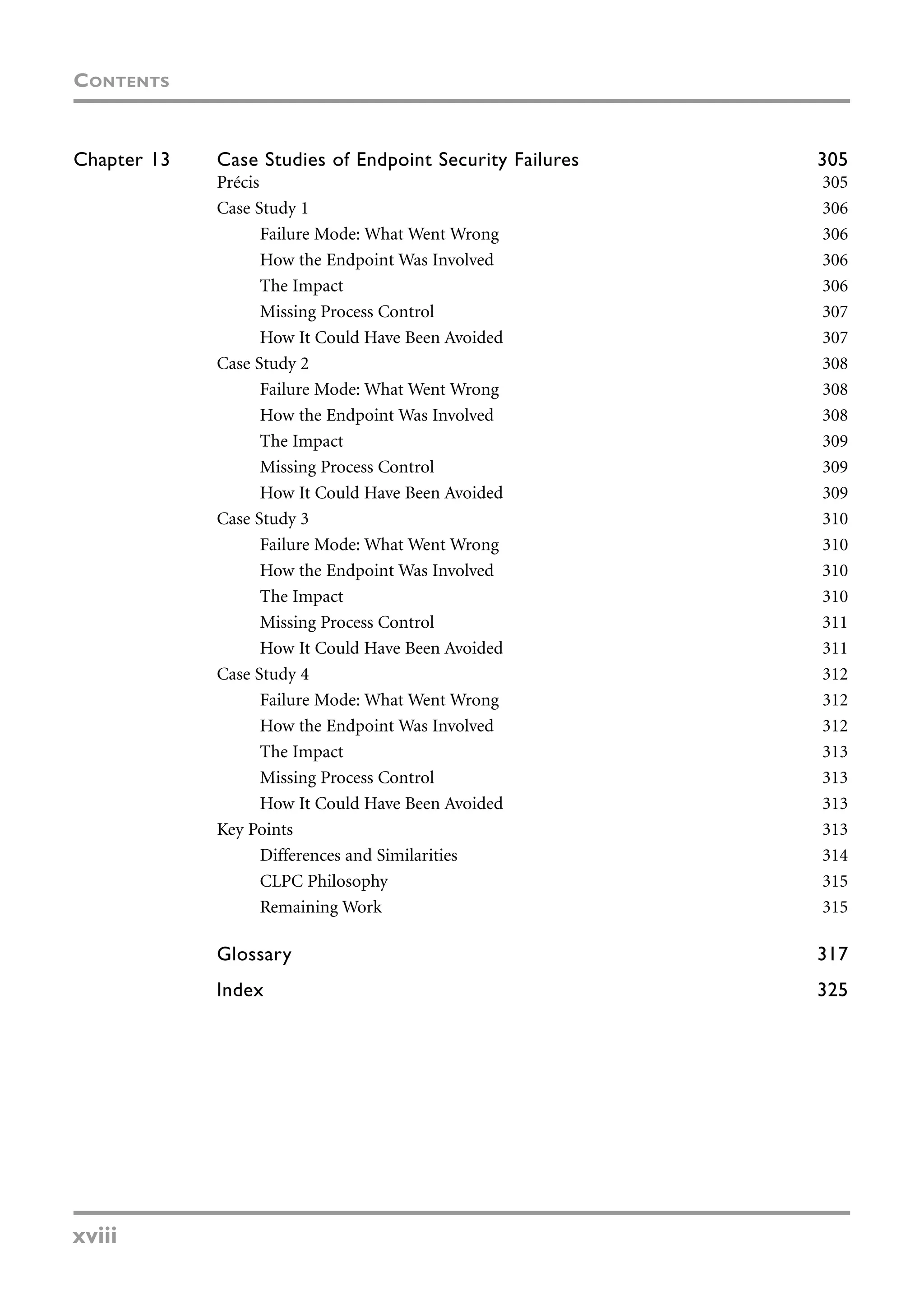
Chapter 13 Case Studies of Endpoint Security Failures 305
Précis 305
Case Study 1 306
Failure Mode: What Went Wrong 306
How the Endpoint Was Involved 306
The Impact 306
Missing Process Control 307
How It Could Have Been Avoided 307
Case Study 2 308
Failure Mode: What Went Wrong 308
How the Endpoint Was Involved 308
The Impact 309
Missing Process Control 309
How It Could Have Been Avoided 309
Case Study 3 310
Failure Mode: What Went Wrong 310
How the Endpoint Was Involved 310
The Impact 310
Missing Process Control 311
How It Could Have Been Avoided 311
Case Study 4 312
Failure Mode: What Went Wrong 312
How the Endpoint Was Involved 312
The Impact 313
Missing Process Control 313
How It Could Have Been Avoided 313
Key Points 313
Differences and Similarities 314
CLPC Philosophy 315
Remaining Work 315
Glossary 317
Index 325
CONTENTS
xviii
Foreword
Moving forward. This is the direction that information security needs to move today to
have an even more secure cyberspace tomorrow. Moving forward means that we need to
continue to innovate and be creative. In the past, people have innovated when they
believed that they had a better way of doing something and they thought that they could
make a difference. This book is about security innovation—it’s about doing something
new and making a difference.
We need new tools if we are to continue to secure our critical infrastructure from
those who would do us harm. Today’s security world isn’t just about hackers and thieves.
We have to add to that list organized criminals, spies, and even “hactivists.” A day doesn’t
go by when some part of our critical cyber infrastructure isn’t under attack. Nation states
are trying to steal trade secrets and military secrets. Organized criminals are constantly
chipping away at our cyber security with the hope of breaking through to a system that
will afford them the opportunity to do some real damage. Organized crime is also turn-
ing the personal information of everyone into a commodity that can be traded,
exploited, and hedged.
How we innovate is going to be the key to success in this battle, and part of that inno-
vation is going to involve looking at things a little differently than how we have in the
past. We need to be more than one step ahead of our enemies.
We need to move forward and quickly.
Information security has often been considered something between dark magic and
art for quite some time, whereas the underlying technology has been considered an
xix
Other documents randomly have
different content
diminished; yet, I hope, not much. Three have joined the church
since you last heard; five now stand propounded for admission; and
I think above thirty persons come commonly on a Monday to
converse with father about the condition of their souls.”
In September, 1716, when in his thirteenth year, Jonathan
entered Yale College. He devoted himself assiduously to study; and
the character of his mind may be inferred from the fact, that, when
but fifteen years of age, he was discussing with the utmost interest
such questions as “whether it were possible to add to matter the
property of thought:” he argued that “every thing did exist from all
eternity in uncreated idea;” that “truth is the agreement of our ideas
with the ideas of God;” that “the universe exists nowhere but in the
divine mind;” &c.
When about sixteen years of age, while in college, his mind
seems to have settled into a calm trust in God. His theological
opinions became unalterably formed. The peace which thus dawned
upon his mind he describes in his diary in glowing language:—
“The appearance of every thing was altered. There was, as it
were, a calm, sweet cast, or appearance, of divine glory in almost
every thing. God’s excellency, his wisdom, his purity and love,
seemed to appear in the sun, moon, and stars; in the clouds and
blue sky; in the grass, flowers, trees; in the water, and in all nature.”
After taking his degree, he remained for two years at New
Haven, studying theology; and, before he was nineteen years of age,
was invited to preach in a Presbyterian church in New York. He
preached with great fervor, and in the enjoyment of intense spiritual
delight, for eight months, when he returned to his father’s home in
East Windsor, where he continued his severe and unremitting
studies. Here, with much prayer, the young Christian wrote a series
of seventy resolutions to guide him in the conduct of life. We find in
them the resolves,—
To act always for the glory of God and for the good of mankind in
general; to lose not one moment of time; to live with all his might
while he did live; to let the knowledge of the failings of others only
promote shame in himself; to solve, as far as he could, any theorem
in divinity he might think of; to trace actions back to their original
source; to be firmly faithful to his trust; to live as he would if it were
but an hour before he should hear the last trump; to strive every
week for a higher and still higher exercise of grace.
In the diary of this young man of nineteen we find the following
narrative: “They say there is a young lady in New Haven who is
beloved of that great Being who made and rules the world; and that
there are certain seasons in which this great Being, in some way or
other, comes to her, and fills her mind with exceeding sweet delight;
and that she hardly cares for any thing except to meditate on him;
that she expects after a while to be received up where he is,—to be
raised up out of the world, and caught up into heaven, being
assured that he loves her too well to let her remain at a distance
from him always. There she is to dwell with him, and to be ravished
with his love and delight forever. Therefore, if you present all the
world, with the richest of its treasures, she disregards it, and cares
not for, and is unmindful of, any path of affliction.
“She has a singular purity in her affections; is most just and
conscientious in all her conduct; and you could not persuade her to
do any thing wrong or sinful if you would give her all this world, lest
she should offend this great Being. She is of a wonderful sweetness,
calmness, and universal benevolence, especially after this great God
has manifested himself to her mind. She will sometimes go about
from place to place, singing sweetly; and seems to be always full of
joy and pleasure, and no one knows for what. She loves to be alone,
walking the fields and groves; and seems to have some one invisible
always conversing with her.”
This young lady, Sarah Pierrepont, eventually became the wife of
Mr. Edwards. Though several congregations invited him to become
their pastor, he decided to devote two more years to study before
assuming the responsibilities of a parish. In June, 1724, he was
appointed tutor in Yale College. The duties of this station he fulfilled
with great success, devoting himself with tireless assiduity to study,
practising great abstinence both from food and sleep. In February,
1727, he entered upon the office of colleague-pastor with
Rev. Solomon Stoddard, his mother’s father, in Northampton, Mass.,
then, as now, one of the most beautiful towns in New England.
Immediately after his settlement, he sought the hand of Sarah
Pierrepont as his bride.
“She listened to his urgency; and on July 28, about five months
after he was settled, the youthful preacher was joined in wedlock at
New Haven with the wonderfully-endowed bride of his choice. She
was pure and kind, uncommonly beautiful and affectionate, and
notable as a housekeeper; he, holy and learned and eloquent, and
undoubtedly the ablest young preacher of his time; she seventeen,
he twenty-three. What was wanting to their happiness? The union
continued for more than thirty years; and she bore him three sons
and eight daughters.”
Rapidly the fame of the young preacher spread; for in his
sermons were found a union of the closest reasoning, glowing
imagination, and fervid piety. A wonderful revival of religion soon
followed his earnest ministrations, exceeding any thing which had
then been known in North America. Edwards wrote an account of
the surprising conversions which took place, which narrative was
republished in England and in Boston.
Thus the years passed rapidly, prosperously, and happily away, as
his powers of eloquence and the productions of his pen extended his
fame through Europe and America. But suddenly a bitter controversy
arose in the church to which he ministered. The Rev. Mr. Stoddard, a
man of mild character and lax discipline, had introduced to the
church many who did not profess to be in heart Christians, the
subjects of renewing grace. It had been tacitly assumed that the
Lord’s Supper was a converting ordinance, and that any person of
respectable character might unite with the church, and partake of
the Lord’s Supper, as he might attend upon the preaching of the
gospel. But Edwards urged that true conversion should precede
admission to the communion. In these views Edwards was
overborne by the majority of the church, who refused to allow him
to deliver a course of lectures upon the subject. Thus, after years of
a very unhappy controversy, Mr. Edwards was driven from his parish
in the twenty-fourth year of his pastorate. He was drawing near the
decline of life, had ten children dependent upon him, and was left
without any visible means of support. The magnanimity and firmness
which Mr. Edwards displayed has won for him the admiration of
posterity.
In the town of Stockbridge, among the mountains of Berkshire,
there was a remnant of a band of Indians called Housatonics. A few
white settlers had also purchased lands, and reared their farm-
houses in that region. A society in London, organized for the
purpose of propagating the gospel, appointed him as missionary to
these humble people. His income was so small, that it was found
necessary to add to it by the handiwork of his wife and daughters,
which was sent to Boston for sale.
As Mr. Edwards preached to the Indians extempore, and through
an interpreter, he found more leisure for general study than he had
ever before enjoyed; and from this retreat in the wilderness, during
six years of intense application, he sent forth productions which
arrested the attention of the whole thinking world. His renowned
dissertations upon “The Freedom of the Will,” upon “God’s Last End
in the Creation of the World,” upon “The Nature of True Virtue,” and
on “Original Sin,” placed him at once in the highest ranks of
theologians and philosophers.
While thus laboring in his humble home in the then inhospitable
frontiers of Massachusetts, he was invited to the presidency of
Princeton College, one of the most prominent seminaries in the
country. The small-pox was raging in the vicinity, and he was
inoculated as an act of prevention. The disease assumed a
malignant form; and on the 22d of March, 1758, he died at
Princeton, N.J., thirty-four days after his installation as president. He
had attained the age of fifty-four years. Fully conscious that death
was approaching, he sent messages of love to the absent members
of his family. His last words were, “Trust in God, and you need not
fear.”
There is probably no name in the modern history of Christianity
more prominent than that of John Wesley. It is certain that the
denomination of Methodists, of which he is the father and the
founder, has exerted an influence in reclaiming lost souls to the
Saviour second to that of no other branch of the Church of Christ. In
November, 1729,—less than a hundred and fifty years ago,—John
Wesley, then a young student but twenty-six years of age in Oxford
University, England, with his younger brother Charles and two other
students, united in a class for their own spiritual improvement. Their
strict habits and methodical improvement of time led their fellow-
students to give them, somewhat in derision, the name of
Methodists. They accepted the name, and made it honorable.
Such was the origin of a denomination of Christians which has
now become one of the largest and most influential in the world.
According to the statistics given in the Methodist Almanac for 1872,
the denomination now numbers, in the United States alone,—
21,086 Preachers.
1,436,396 Church-members.
193,979 Sunday-school teachers.
1,267,742 Sunday-school scholars.
$64,098,104 Value of church edifices and parsonages.217
John Wesley was the son of a mother alike remarkable for her
piety and her intellectual endowments. He was born at Epworth,
England, on the 17th of June, 1703. At the age of seventeen, he
entered the University at Oxford. Taking his first degree in 1724, he
was elected fellow of Lincoln College, and graduated master of arts
in 1726. He was at this time quite distinguished for his attainments,
particularly in the classics, and for his skill as a logician. Being
naturally of a sedate, thoughtful turn of mind, he had from childhood
been strongly inclined to the Christian ministry. The teachings of his
noble mother had inspired him with the intense desire of being
useful to his fellow-men. Being ordained to the ministry, he was for a
short time his father’s curate. Returning to Oxford still further to
prosecute his studies, he expressed strong dissatisfaction at the
want of zeal manifested in the Established Church for the conversion
of sinners. This led him to consecrate himself with great solemnity to
the more strict observance of the duties of religious life.
He formed a society for mutual religious improvement, which
consisted at first only of himself, his younger brother Charles, and
two others of his fellow-students. The number was, however, soon
increased to fifteen. Ten years passed away with their usual
vicissitudes, nothing occurring worthy of especial note. In 1735,
Mr. Wesley was induced to go to Georgia to preach to the colonists
there, and more especially to labor as a missionary among the
Indians. The mission proved very unsuccessful. The disturbed state
of the colony was such, that he could get no access to the Indians.
Though at first he had a large and flourishing congregation of
colonists to address in Savannah, there soon sprang up very bitter
alienation between him and the people of his charge. They rebelled
against the strictness of discipline which he attempted to introduce.
He refused to admit dissenters from the Episcopal Church to the
communion, unless they were rebaptized; insisted upon immersion
as the mode of performing that rite; and became involved in a very
serious matrimonial difficulty.
The result was, that he soon found his influence at an end in
Georgia. After a residence of two years at Savannah, he returned to
England, “shaking the dust off his feet,” as he said, in testimony
against the colonists. Recrossing the Atlantic, he visited the colony of
Moravian Christians, or United Brethren as they were also called, at
Hernhult, in Upper Lusatia. This colony was founded by Count
Zinzendorf upon what he considered as the model of the primitive
apostolic Christians. Leaving out all the distinctive doctrines of the
various Protestant denominations, he adopted as articles of faith
only those fundamental scriptural truths in which all evangelical
Christians agree.
Mr. Wesley soon made the extraordinary discovery, as he himself
states, that he had never been truly converted. While crossing the
ocean to lead others to the Saviour, he had never come to that
Saviour himself. “He felt,” he said, “a want of the victorious faith of
more experienced Christians.” Agitated by these thoughts, he at
length, in his estimation, became a subject of that renewing grace
entitled in the Bible being “born again.” So sudden was this change,
that he could not only point out the day and the hour, but the
moment also, when it took place. “It was,” he says, “at quarter
before nine o’clock on the evening of May 24, at a meeting of a
society in Aldergate Street, when one was reading Luther’s Preface
to the Epistle to the Romans.”
In this respect, the experience of Mr. Wesley was somewhat
similar to that of Dr. Chalmers. He at once began his labors of
preaching the gospel of Christ, with zeal and success, perhaps,
never surpassed. George Whitefield, one of the most impassioned
and eloquent of sacred orators, joined him. They both preached
several times a day in the prisons, and at all other places where they
could gain an audience. Their fervor attracted crowds; and strong
opposition began to be manifested against them. As the Established
clergy refused to open their churches to these zealous preachers,
they addressed audiences in the open fields, and particularly in an
immense building called the Foundery at Moorsfield. Here Mr. Wesley
organized his first church of but eight to ten persons. There was at
that time great deadness in the Established Church. Many of the
nominal pastors were utterly worldly men, who made no profession
of piety. The clergy were often younger sons of nobles, who had
been placed over the churches simply through the influence of their
fathers, that they might enjoy the revenues of the church. Reckless
men, devoted to pleasure, they were called “fox-hunting parsons;”
and the church became often the scene only of a heartless round of
ceremonies. The masses of the people found nothing in such a
religion either to cheer them in their sorrows, or to animate them to
a holy life.
The preaching of Wesley and his companions came directly home
to the hearts of the people. It was the earnest and impassioned
utterance to weary souls of the good news and glad tidings of the
gospel. The little church of eight or ten members which he
established at the Foundery was composed of those who, as Wesley
testifies, “came to him and desired him to spend some time with
them in prayer, and advise them how to escape from the wrath to
come.”
The church at the Foundery rapidly increased in numbers: crowds
flocked to listen to the earnest preaching. The building was
converted into a chapel, and became the centre of operations. From
this centre, Wesley and his associates made constant journeys into
the surrounding country, sometimes to a great distance, preaching
wherever they went. They generally preached twice every day, and
four times on the sabbath. At Kensington Common, Wesley at one
time addressed a concourse estimated to be not less than twenty
thousand persons.
“Wesley devoted himself to his work in Great Britain with such
completeness, that scarcely an hour was abstracted from the cause
on which he had set his heart. He seldom travelled less than forty
miles a day; and until near the close of life, when he used a chaise,
generally went on horseback. It is said that not an instance can be
found, during a period of fifty years, wherein the severest weather
hindered him for a single day. His journeys extended to Ireland,
Scotland, and Wales, in each of which countries he preached with
great success. He formed societies, and placed lay preachers over
them; appointed class-leaders, and established schools, the most
important of which was that of Kingswood, near Bristol, which was
designed more particularly for the education of the sons of
preachers. The most extraordinary revivals followed his ministry,
especially among the poor and destitute in the mining and
manufacturing districts.”218
Though Wesley continued to adhere to the Established Church,
still the principles of tolerance which he advocated tended more and
more, every day, to cause the rapidly-increasing Methodist churches
to be regarded as a distinct sect. At the first conference of the
Methodist clergy at the Foundery Chapel, in 1744, eight preachers
were present. Wesley then said,—
“You cannot be admitted to the church of Presbyterians, Baptists,
Quakers, or any others, unless you hold the same opinions with
them, and adhere to the same mode of worship. The Methodists
alone do not insist upon your holding this or that opinion; but they
think, and let think. Neither do they impose any particular mode of
worship; but you may continue to worship in your former manner, be
it what it may. Now, I do not know any other religious society, either
ancient or modern, wherein such liberty of conscience is now
allowed, or has been allowed since the days of the apostles. Here is
our glorying, and it is a glorying peculiar to us.”
In the year 1752, Wesley married a widow with four children. But
the religious zeal which inspired him was singularly manifested in the
marriage contract, in which it was stipulated that he should not
preach one sermon the less, nor travel one mile the less, on account
of his change of condition. It is, perhaps, not strange that the
marriage did not prove a happy one. After a life of activity and
usefulness to which few parallels can be found, John Wesley died in
London on the 2d of March, 1791, in the eighty-third year of his age.
The last four days of his life were days of Christian triumph, in which
the veteran servant of Christ found that faith in Jesus did indeed
make him victor over death and the grave. It is estimated, that,
during his ministry of sixty-five years, he travelled about two
hundred and seventy thousand miles, and delivered over forty
thousand sermons, besides addresses, exhortations, and prayers.
The denomination of which he was the founder is now exerting in
England and the United States an influence second certainly to that
of none other; and it is every hour increasing in all the elements of
prosperity and power.
Robert Hall, one of the brightest ornaments of the Baptist
Church, by universal assent occupies one of the most prominent
positions among men of genius and of culture, his works having
given him renown throughout Christendom. The celebrated Dr. Parr,
who was his intimate friend, says of him,—
“Mr. Hall has, like Jeremy Taylor, the eloquence of an orator, the
fancy of a poet, the subtlety of a schoolman, the profoundness of a
philosopher, and the piety of a saint.”
Robert Hall was born at Arnsby, Leicestershire, England, in
August, 1764. His father, who was a Baptist clergyman of
considerable note, early perceived a wonderful degree of intellectual
development in his child. He said to a friend,—
“Robert at nine years of age fully comprehended the reasoning in
the profoundly argumentative treatises of Edward on the Will and
the Affections.”
When fifteen years old, Robert became a student in the Baptist
College at Bristol; and in his eighteenth year entered King’s College,
Aberdeen. Here he became acquainted with Sir James Mackintosh,
which acquaintance ripened into a life-long friendship.
Upon leaving college, Mr. Hall commenced preaching, and with a
power which immediately drew around him, and elicited the
admiration of, crowds of the most intellectual of hearers. His
biographer says of him,—
“Mr. Hall’s voice is feeble, but very distinct: as he proceeds, it
trembles under his energy. The plainest and least-labored of his
discourses are not without delicate imagery and the most felicitous
turns of expression. He expatiates on the prophecies with a kindred
spirit, often conducting his audience to the top of the ‘Delectable
Mountains,’ where they can see from afar the gates of the Eternal
City. He seems at home among the marvellous revelations of
St. John; and, while he dwells upon them, he leads his hearer
breathless through ever-varying scenes of mystery far more glorious
and surprising than the wildest of Oriental fables. He stops where
they most desire he should proceed, where he has just disclosed the
dawnings of the inmost glory to their enraptured minds, and leaves
them full of imaginations of things not made with hands, of joys too
ravishing for similes.”
Robert Hall’s life was devoid of adventure, having been spent
almost exclusively in the study and the pulpit. His conversational
powers were of the highest order; and, in every social circle, crowds
gathered around him, charmed by the unstudied eloquence which
flowed from his lips. He was an indefatigable student; and, though
one of the most profound thinkers, was one of the most childlike of
men in unaffected simplicity of character. His pre-eminence in the
pulpit was universally acknowledged, and his extraordinary powers
ever crowded his church with the most distinguished auditors.
During his life he issued several pamphlets, which obtained celebrity
throughout all Christendom. A sermon which he preached upon
Modern Infidelity was published in repeated editions, and “sent a
thrill to every village and hamlet of Great Britain.” Its arguments
were so unanswerable, that no serious attempt was made to reply to
them.
“Whoever,” Dugald Stewart wrote, “wishes to see the English
language in its perfection, must read the writings of that great
divine, Robert Hall. He combines the beauties of Johnson, Addison,
and Burke, without their imperfections.”
A very severe chronic disease of the spine caused him
throughout his whole life severe suffering. Once or twice the disease
so ascended to the brain, that the mind lost its balance; and Mr. Hall
was compelled for a short time to withdraw from his customary
labors.
The works of this distinguished man are still read with
admiration, and will be ever regarded as among the highest
productions of the human intellect. He died, universally beloved and
lamented, on the 21st of February, 1831, in the sixty-eighth year of
his age.
There is, perhaps, no divine of the Church of England whose
name is more prominent in ecclesiastical annals, or more widely
known throughout the Christian world, than that of William Paley. He
was born in Peterborough, England, in July, 1743. His father, who
was curate of a parish, carefully instructed him in childhood, and,
when his son was sixteen years of age, entered him at Christ
College, in Cambridge. The superior intellect even then developed by
the young man is evidenced by the remark of his father, “He has by
far the clearest head I ever met with.”
At the university he applied himself very diligently to his studies,
and rapidly attained distinction. After graduating in 1763, he spent
three years as a teacher, and then returned to his college as a tutor.
In 1775 he was presented to the rectory of Musgrove, in
Westmoreland; and, marrying, he retired from the university to his
living.
The life of Paley was in many respects quite the reverse of that
of Wesley. He was by no means an ardent Christian. His piety, and
his appreciation of Christianity, were intellectual far more than
spiritual or emotional. He was not a popular preacher: his
appropriate field of labor was the silence and solitude of the study.
From this retreat he issued works upon God, Christian Morals, and
the Evidences of Christianity, which greatly baffled infidelity, and
silenced its cavils.
Being promoted from one living to another as he gained
reputation, in 1782 he was advanced to the Archdeanery of Carlyle.
Three years after this he published his first important work, entitled
“The Principles of Moral and Political Economy.” Though some of its
principles were violently assailed, it commanded the respectful
attention of all thoughtful men. The work became exceedingly
popular even with the masses, as Paley had the power of making the
most abstruse truths clear and entertaining to the popular mind.
Five years after this, in 1790, Paley published another work,
entitled “Horæ Paulinæ,” which is generally deemed the most
original and ingenious of all his writings. In this work, which
obtained renown through all Christendom, he maintained with
irresistible force of logic the genuineness of St. Paul’s Epistles and of
the Acts of the Apostles, from the reciprocal supports they received,
from the undesigned coincidences between them. This work added
greatly to the celebrity of the already distinguished writer, and
secured for him still more lucrative offices in the English Church.
Four years later, in 1794, he issued another volume, entitled
“View of the Evidences of Christianity.” It may be safely said that the
arguments here brought forward in attestation of the divine origin of
the religion of Jesus of Nazareth never have been, and never can be,
refuted. In clearness of diction, beauty of illustration, and force of
logic, the work has never been surpassed. It has been adopted as a
text-book in many of the most distinguished universities, and is
considered one of the most cogent arguments to be found in any
language in favor of the divine authority of Christianity.
Thus does God raise up different instruments to accomplish his
great purposes of benevolence. While Wesley and his coadjutors
were traversing thousands of miles, and, by their impassioned
eloquence, were rousing the humble and unlettered masses to an
acceptance of the glad tidings of the gospel, Paley, in the lonely
hours of entire seclusion in his study, was framing those arguments
which intellectually enthroned Christianity in the minds of the
thoughtful and the philosophic.
At the close of a studious life of sixty-two years, spent in his
study and his garden, with but few companions and few exciting
incidents, this illustrious servant of the Church of Christ fell asleep
on the 25th of May, 1805.
For nearly nineteen centuries, Christianity has struggled against
almost every conceivable form of human corruption. All the energies
of the powers of darkness have been combined against it. In this
unholy alliance, kings have contributed imperial power; so-called
philosophers, like Voltaire, have consecrated to the foul enterprise
the most brilliant endowments of wit and learning; while all “the
lewd fellows of the baser sort” have swelled the ranks of infidelity
with their legions of debauchees, inebriates, and blasphemers; but
all in vain: generation after generation of these despisers have
passed away, and perished.
Christianity has been steadily triumphing over all opposition, and
was never before such a power in the world as at this day. Could
you, upon some pleasant sabbath morning, look down from a
balloon, as with an angel’s eye, over the wide expanse of Europe,
witnessing the movement of its myriad population, and, as with an
angel’s ear, listen to the sounds which sweep over its mountains, its
valleys, and its plains, how wonderful the spectacle which would
meet the eye, and the vibrations which, like the fabled music of the
spheres, would fill the air! Suppose it to be such a sabbath morning
as Herbert describes,—
“Sweet day, so cool, so calm, so bright,
The bridal of the earth and sky:”
you would hear the chime of millions of church-bells floating in
Æolian harmony over crowded cities and green fields, melodious as
angel-voices proclaiming the praises of God. As you inquire, “What
causes this simultaneous clangor of sweet sounds over thousands of
leagues of territory, regardless of the barriers of mountains and
rivers, of national boundaries and diverse tongues? whence comes
the impulse which has created this wondrous summons to hundreds
of millions of people, spread over a majestic continent, under diverse
institutions, speaking different languages, inhabiting different climes,
and under all varieties of forms of government?” you would be told,
—and not an individual on the globe would dispute the assertion,
—“It is the religion of Jesus of Nazareth.”
As you listen, you look; and, lo! thronging millions are crowding
towards innumerable temples of every variety of form, size, and
structure. The gilded chariot waits at the portals of the castle and
the palace for the conveyance of nobles and kings to these
sanctuaries. Through all the streets of the cities, and over many
green-ribboned roads of the country, vehicles of every description
may be seen, crowded with men, women, and children, all
peacefully pressing on to alight at the doors of these temples. The
pavements of the crowded towns are thronged; pedestrians, in their
best attire, are hastening along the banks of the rivers, and crossing
the pastures and the flowery plains; while, some in wagons, some in
carts, some on horseback, the mighty mass, unnumbered and
innumerable, moves on to ten thousand times ten thousand
cathedrals and village churches, and to the humblest edifices, where
coarsely-clad and unlettered peasants meet for praise and prayer.
The innumerable throng sweeps along the base of the Carpathian
Mountains, threads the passes of the Tyrol, and winds its way
through the gorges of the Alps and the Apennines. In Russia,
wrapped in furs, they struggle through snow-drifts, and breast the
gale, as they crowd to the Greek Church. On the sunny banks of the
Mediterranean, in Italy, France, and Spain, through vineyards and
orange-groves, cheered by the songs of birds and the bloom of
flowers, nobles and peasants, princes and subjects, press along to
the massive, moss-covered churches where their ancestors for
centuries have worshipped according to the rites of the Catholic
Church. In Denmark, Sweden, Norway, and through all the highways
and byways of England, Scotland, and Wales, the inmates of lordly
castles, and humble artisans from mines and manufactories, are
moving onward to the churches where the religion of Jesus is
inculcated in accordance with the simple rites of the Protestant faith.
And, if we cross the Atlantic, we witness the same sublime
spectacle, extending from the icy regions north of the St. Lawrence
to the Gulf of Mexico, and from the Atlantic coast almost to the base
of the Rocky Mountains, and again repeated upon the Pacific shores
through the rapidly-populating plains of California and Oregon.
Scarcely have the hardy settlers reared half a dozen log-huts ere the
spire of the church rises, where the religion of Jesus is taught as the
first essential to the prosperity of the growing village. And so
through South America: through its conglomeration of States, where
light is contending with darkness; through Chili, Peru, Bolivia, and
along the majestic streams and wide-spreading savannas of the vast
empire of Brazil,—the religion of Jesus of Nazareth, notwithstanding
the imperfections which fallen humanity has attached to it, is potent
above all other influences in enlightening the masses, and in
moulding their manners and their minds. And now we begin faintly
to hear, along the western coast of Africa and the southern shores of
India, and upon many a green tropical island emerging from the
Pacific, the tolling of the church-bell, indicating that that religion
which has became dominant in Europe and America is destined to
bring the whole world, from pole to pole, under its benignant sway.
And it is worthy of note that the most thoroughly Christian
nations are the most enlightened, moral, and prosperous upon the
globe. Where we do not find this religion, we meet effeminate
Asiatics, stolid Chinamen, wandering Tartars, and Bedouins of the
desert. They are the Christian nations who stand forth luminous in
wealth, power, and intellect. These are the nations which seem now
to hold the destinies of the globe in their hand; and it is the religion
of Jesus which has crowned them with this wealth and influence.
And again: it is well to call attention to the fact, that every
literary and scientific university in Christendom, where the ablest
men in all intellectual culture do congregate, is mainly under the
control of those who bow in cordial assent to Jesus of Nazareth as
their Teacher and Lord.
The Universities of Cambridge and Oxford in England, of
Edinburgh and Glasgow in Scotland, of Harvard and Yale in the
United States, declare through their learned professors, with almost
one united voice, that the salvation of humanity can come only
through the religion of Jesus the Christ. In France, Italy, Germany,
Russia, in all the renowned, time-honored universities of Continental
Europe, the name of Jesus is revered as above every name, and his
teachings are regarded as the wisdom of God and the power of God.
There is hardly a university of learning of any note, in Europe or
America, where Jesus of Nazareth is not recognized as the Son of
God, who came to seek and to save the lost.
The standard of what is called goodness in this world greatly
varies. “There is honor among thieves.” A gang of debauchees,
gamblers, and inebriates, has its code of morals. The proudest
oppressors who have ever crushed humanity beneath a merciless
heel have usually some standard of right and wrong, so adroitly
formed as to enable them to flatter themselves that they are to be
numbered among the good men.
Socrates, unenlightened by revelation, simply through the
teachings of his own honest mind, declares him only to be a good
man who tries to make himself, and all whom he can influence, as
perfect as possible. The definition which Jesus gives of goodness,
even more comprehensive and beautiful, is, that a man should love
his Father, God, with all his heart, and his brother, man, as himself.
This is the only real goodness,—angelic goodness, divine goodness.
Now, it may be safely said that you cannot find at the present time,
or through all past ages, a truly good man, in either of the above
definitions of the term, whose character has not been modelled by
the principles laid down by Jesus of Nazareth.
Let the mind run along the list of great and good men, who, with
loving hearts and pure lives and beneficent actions, have been the
ornaments of humanity; men and women who have made their own
homes happy, who have ever had an open hand to relieve the
distressed, whose hearts have yearned over the wandering, and
whose lips have entreated them to return to the paths of virtue; and
where can you find one who has not manifested the spirit of Jesus,
and drawn his main inspiration from the principles which he has
inculcated?
There are now many men and women all over Christendom, of
self-denying lives, active in every good word and work, sympathizing
with the afflicted, helping the needy, praying for and trying to
reclaim their brothers and sisters of the human family who are
crowding the paths of sin; searching out the children of
abandonment, destitution, and woe, from the depravity of the
streets and from homes of wretchedness, that they may be clothed
and educated and made holy,—there are thousands of such; and yet
it would be difficult to find one, a single one, who does not
recognize the religion of Jesus as the only moral power which can
reclaim a lost world.
We have in the Bible the history of the world, and the biography
of its leading individuals, from the dawn of creation until those
modern days in which secular history takes up the record. Through
all these ages not a single man can be found, who by the purity of
his own life, by the beneficent influence of his example, and by his
self-denying efforts to promote the happiness of others, has not
developed the principles uttered by the lips of Jesus.
Indeed, there is an absolute, invincible necessity that every truly
good man should embrace these principles, and diffuse them to the
utmost of his power. The moment one awakes to the grandeur of his
own being,—an immortal created in the image of God,—and begins
to breathe the prayer, “O God! help me to resist every sin, and aid
me to cherish every virtue,” he finds at once, that, infinitely above all
other books, the Bible is the book to help him in this new and noble
life. He finds that every duty which his conscience suggests that he
ought to perform, the religion of Jesus urges upon him by motives of
infinite weight. He finds that every allurement, every indulgence,
which would retard his moral growth, the religion of Jesus urges
him, by motives of infinite weight, to avoid.
All through the Bible, from Genesis to Revelation, there is one
continual strain of urgency, enforced by every variety of argument,
warning, and illustration, to aid a man to attain a celestial character.
Ought we to watch over our bodies, that by appetite and passion
they be not defiled; over our thoughts, that impurity enter not the
secret chambers of the soul; over our words, that we may ever
speak as in the audience-chamber of God; over our minds, that we
may store them with all valuable knowledge; over our hearts, that
we may love God our Father, and man our brother; over our actions,
that every deed may be such as God will approve? Then it is to
Jesus of Nazareth we must look as our teacher, our guide, our
helper.
The Bible is the book which the good mother gives her boy as he
goes from home; and she knows full well, that if her boy will read
that book daily, and make it the guide of his life, he will be safe for
time and for eternity. Many a man has said years after a sainted
mother has ascended to her crown, “It was the Bible which my
mother gave me which rescued me from ruin.”
How noble is the character of the Christian wife and mother
formed upon the model of Jesus the Christ! Many of our readers
have seen the most beautiful exemplification of this in their own
homes. You have seen your mother all-forgetful of herself in her
generous devotion to others. You have seen her moving like an
angel of light in the dark homes of poverty, and around beds of
suffering and death, ever unmindful of her own ease if she could
only heal broken hearts and soothe the cry of anguish. Such nobility
the world will ever recognize, and love to honor.
Many such are found in the homes of our own land. Many a
reader can say, “Such was my mother, God bless her!” You have
seen her bending over the cradle, pale, gentle, loving as an angel;
you have seen her placid and cheerful amidst all the annoyances and
wasting cares of domestic life; you have seen her return home in the
morning, after watching during the night with a sick neighbor, to toil
all day long with fingers which never seem to tire, and with a gentle
spirit which even your waywardness could never discompose.
And, when the village-bell tolled her funeral, you have seen every
house emptied as rich and poor came together to weep over the
departure of one who was the friend and benefactor of them all. Oh,
how glorious must be the flight of such a spirit, ennobled by
suffering, victor over death and the grave, to join the peerage of
heaven, and to receive a coronet in the skies! Now, characters of
this stamp—of imperial type, though found in lowly homes—are
invariably formed upon the model which Jesus Christ has presented.
The men of true nobility who are found in almost every village of
our land—men devoted to every thing that is good, opposed to
every thing that is bad—are men who have deliberately enlisted in
the service of Jesus Christ as his disciples, his imitators. They
perseveringly struggle against all that is unworthy; they hunger and
thirst for every celestial virtue; they battle against temptation in
whatever form it may come; cultivate moral courage, that they may
boldly advocate the cause of their Saviour, amidst opposition and
derision if need be; and thus they are nerved to glorious
achievements in triumphing over the allurements to sin, and in
bringing themselves into entire subjection to their divine Master.
Material grandeur of crag and cataract has its sublimity; but there
is something in moral excellence which far surpasses, in all the
elements of the sublime, any combinations of ocean, earth, or sky.
When a man towers above his fellow-men in self-denial, in devotion
to the welfare of others, in the endeavor to extend virtue, piety, and
happiness, a spectacle is presented upon which angels gaze with
admiration. When we reflect upon what we may become in social
loveliness, in majesty of virtue, in dignity of character, we can hardly
wonder that even the Son of God should be willing to die upon the
cross to save such a one from the ruin of sin. Here below, in the
midst of all man’s frailties and wickedness, we catch glimpses of the
angel dignity from which he has fallen, and to which he may again
soar.
The wreck is to be repaired; the ruin is to be rebuilt. What a
glorious creation will man become, when, redeemed, regenerated,
created anew in Christ Jesus, he emerges from the fall in more than
the majesty of his original grandeur, no longer but a “little lower”
than the angels, but on an equality with the loftiest spirits who bow
before God’s throne!
And, oh! it is so sad—the saddest sight of earth—to see one who
is created of a noble nature, with glowing intellect and gushing
affections, formed to move like an angel of light amidst sorrowing
humanity, to cheer the heart-stricken, to strengthen the tempted, to
support the weak, to win and save the lost,—it is, indeed, a sad
sight to see such a one, all unmindful of his lofty lineage and
glorious inheritance, casting every thing that is noble away, and
living miserably for self and sin! Earth is full of such melancholy
wrecks, as of archangels ruined. All material ruins, all mouldering
turrets, and towers of baronial castles,—Melrose, Drachenfels,
Heidelberg,—before such moral wrecks, pale into insignificance.
There is a ship in a foreign port. The rude sailors from the
forecastle have gone on shore to the drinking-saloon and the
dancing-hall to spend the night in revelry and sin. But one has
remained behind. With the moral courage of a martyr, he has braved
the insults and ridicule of his companions. And now it is midnight.
He is kneeling beside his berth in prayer. There is a half-closed book
by his side. Does any one doubt what that book is? Is there any
other book but the Bible which can inspire him with such moral
courage as this? It is from its pages that he has learned that it is
better “to suffer affliction with the people of God than to enjoy the
pleasures of sin for a season.”219
Far away upon the lonely prairie, there was a settler in his
solitary log-cabin. From his humble door-sill, nought was to be seen
in the wide expanse of many leagues but the prairie’s undulating
ocean of grass and flowers, broken here and there with a clump of
trees, emerging as an island from the silent sea. In that vast solitude
there was a Christian family, impoverished by misfortune, struggling
to rear for themselves a new home: it consisted of a father, mother,
and nine children. Death came. The mother, who had ever been an
angel of light in her home, was stricken down by death. There were
no neighbors to help; there was no Christian minister near to offer
the supports of the gospel. Sadly the father dug the grave; sadly,
with the aid of his weeping children, he bore the sacred remains to
their burial; sadly, silently, with a broken heart, he filled up the
grave, which entombed all his earthly hopes and joys.
The evening sun was just sinking beneath the distant horizon of
the prairie: that Christian father, in his desolated cabin, crushed with
grief, had assembled, as had ever been his wont, his little household
around him, to seek the blessing of God. They were all bowed
together upon their knees. The angels hovering over them could
hear the sobs of the children and the moaning prayer of the father.
Upon the table there was one book,—one open book, from which
the husband and father had been reading. Can any one doubt what
that book was? It was opened at the consoling passage,—
“Let not your heart be troubled: ye believe in God; believe also in
me. In my Father’s house are many mansions: if it were not so,
I would have told you. I go to prepare a place for you. And, if I go
and prepare a place for you, I will come again, and receive you unto
myself; that where I am, there ye may be also.”220
What words of comfort to the mourner! O precious Bible! thou
instructor of the ignorant, guide of the erring, consoler of the
afflicted, supporter of the dying; thou unfailing friend of all the
weary and the heart-crushed; thou only hope of humanity,—thou art
indeed God’s best gift to our fallen race.
In the natural world there is infinite variety,—room for the
gratification of every diversity of taste. Here rise the craggy
mountains, with their eternal glaciers,—their pinnacles, thunder-
riven, storm-torn, piercing the skies; there sleeps the placid lake,
embowered in groves, fringed with blooming meadows, and upon
whose bosom float the graceful many-colored waterfowl
undisturbed: here extends the limitless prairie, an ocean of land,
embroidered with flowers whose hues Solomon, arrayed in all his
glory, could not outvie; there Sahara’s boundless sands in dreary
desolation glisten in the sun; and there the Dismal Swamp, which
even the foot of the moccasoned Indian cannot penetrate, frowns in
eternal gloom,—all subserving some good end, all ministering to the
glory of God and the good of his children.
So in the Bible, God’s Word, we find that which is adapted to
every variety of taste, every condition of mind, every gradation of
intellect and of culture. One page conducts you back to the pastoral
simplicity of the world’s infancy: you wander with the patriarchs as
they pitch their tents and tend their flocks beneath the sunny skies
of the Orient. Another page moves your soul with the sublime
denunciations of the prophets, before which denunciations monarchs
trembled, and empires crumbled to ruin. You turn the leaf; and the
majestic dynasties of the long-buried ages pass before you in
sombre procession, with all their vicissitudes of pomp and of death,
of revelry and of wailing. You open to another chapter; and your
soul is soothed with the penitential sweetness of the Psalms of
David, whose pensive strains bring solace to your soul in its hours of
deepest sadness. Again your spirit is ennobled by the precepts of
Jesus, who spake as never man spake; and your whole being is
inspired by the magnificent revelations of life and immortality
brought to light in the gospel.
Here is food alike for all,—for the peasant, for the philosopher,
for the dairyman’s untutored daughter, and for the profoundest
philosopher who ever honored humanity by his intellectual
achievements. Indeed, Christianity carries its own evidence. “If any
man will do his will,” says Jesus, “he shall know of the doctrine.”221
And again: “He that believeth on the Son of God hath the witness in
himself.”222
It is true that any child can ask questions which no philosopher
can answer. The infidel, be he never so weak in mind and shallow in
attainments, can easily present difficulties which no philosopher can
solve. The infidel is almost invariably a self-conceited man of “little
learning.” To him the remark of Lord Bacon is applicable: “A little
learning tendeth to unbelief; but more bringeth us back to religion.”
And what is this religion of Jesus, which is ever winning in such
increasing numbers the homage of human hearts? What are those
principles which have undermined and overthrown the proudest
systems of ancient idolatry, and which seem to be now commanding
the assent of every honest mind?
There is one God, existing as Father, Son, and Holy Ghost. He is
the common Father of us all; and therefore we are bound to love
and worship him. All men are brothers, of whatever race, color, or
condition: as kind brothers, they should seek to promote each
other’s welfare. All men have been and are sinners: they should
therefore repent, implore forgiveness, and abandon every thing
which an enlightened conscience teaches to be wrong. The Son of
God, the second person in the Trinity, assumed human nature, and,
by his sufferings and death, made atonement for sin. Salvation is
now freely offered to all who will accept that Saviour, and honestly
and perseveringly endeavor to return to a holy life. God’s desire to
save his rebellious children is so strong, that not only has he given
his Son to die for us, but he has sent the Holy Spirit, the third
person of the Trinity, on a special embassage to plead with us, that
we may return to him. All who yield to these strivings of the Spirit,
and, with penitence and faith, try to live as the Son of God by
example and precept has taught us, will be received to heaven, and
made eternally happy there, as if they had never sinned. All those
who refuse and continue in rebellion will be forever excluded from
heaven, and will be imprisoned with the Devil and his angels, where
their wickedness will make them ever wretched, but where they can
no longer mar the happiness of those who love and serve God.
Now, these are the fundamental principles of Christianity, as
avowed in the creeds and confessions of the overwhelming majority
of Christians, of all languages and every name, through all the
centuries. How simple and how grand are these principles! It must
be manifest to every candid mind, that in their acceptance is to be
found the only hope of our lost world. It is manifest that each
individual can here only hope for any permanent happiness in this
life or in that which is to come. In this wilderness of time, in the
midst of the storms with which we are driven and shattered here,
there can be no repose for the soul but in the well-founded
conviction that peace is made with God through penitence for sin,
and the cordial acceptance of salvation through the atonement of
Jesus Christ.
One fact is certain,—no man will deny it,—there have been
hundreds and thousands, who, on a dying-bed, have mourned most
bitterly, with anguish more dreadful than words can describe, that
they have not lived in accordance with the teachings of Christianity.
In that dread hour, gloom impenetrable has settled down upon the
soul as the dying sinner has exclaimed, “The harvest is past; the
summer is ended; and we are not saved.”223
Another fact is equally certain: there never was an individual,
who, on a dying-bed, regretted that he had repented of sin,
accepted Jesus as an atoning Saviour, confessed him before men,
and that he had endeavored to live the life of the Christian. There
cannot be found, in the history of the world, one single such case.
On the contrary, there are millions—more than can be numbered—
who have found, in the hour of death, that faith in Jesus has
dispelled all gloom from the dying-chamber, and has inspired the
departing soul with the most triumphant and rapturous joy. It is the
Christian alone who can say with Paul, when upon the pillow of
death,—
“I have fought a good fight; I have finished my course; I have
kept the faith. Henceforth there is laid up for me a crown of
righteousness, which the Lord, the righteous Judge, shall give me at
that day; and not to me only, but unto all them also that love his
appearing.”224
Welcome to our website – the ideal destination for book lovers and
knowledge seekers. With a mission to inspire endlessly, we offer a
vast collection of books, ranging from classic literary works to
specialized publications, self-development books, and children's
literature. Each book is a new journey of discovery, expanding
knowledge and enriching the soul of the reade
Our website is not just a platform for buying books, but a bridge
connecting readers to the timeless values of culture and wisdom. With
an elegant, user-friendly interface and an intelligent search system,
we are committed to providing a quick and convenient shopping
experience. Additionally, our special promotions and home delivery
services ensure that you save time and fully enjoy the joy of reading.
Let us accompany you on the journey of exploring knowledge and
personal growth!
ebookultra.com


Endpoint Security 1st ed Edition Mark Kadrich

  • 1.
    Visit https://ebookultra.com todownload the full version and explore more ebooks or textbooks Endpoint Security 1st ed Edition Mark Kadrich _____ Click the link below to download _____ https://ebookultra.com/download/endpoint-security-1st-ed- edition-mark-kadrich/ Explore and download more ebooks or textbooks at ebookultra.com
  • 2.
    Here are somerecommended products that we believe you will be interested in. You can click the link to download. Security guide to network security fundamentals 3rd ed Edition Mark D Ciampa https://ebookultra.com/download/security-guide-to-network-security- fundamentals-3rd-ed-edition-mark-d-ciampa/ Practical Hadoop Security 1st ed. Edition Lakhe https://ebookultra.com/download/practical-hadoop-security-1st-ed- edition-lakhe/ Inclusion Exclusion and the Governance of European Security 1st Edition Mark Webber https://ebookultra.com/download/inclusion-exclusion-and-the- governance-of-european-security-1st-edition-mark-webber/ Computer security handbook 4th ed Edition Seymour Bosworth https://ebookultra.com/download/computer-security-handbook-4th-ed- edition-seymour-bosworth/
  • 3.
    Introduction to homelandsecurity 2nd ed. Edition Doss https://ebookultra.com/download/introduction-to-homeland-security-2nd- ed-edition-doss/ The Executive Guide to Information Security Threats Challenges and Solutions 1st Edition Mark Egan https://ebookultra.com/download/the-executive-guide-to-information- security-threats-challenges-and-solutions-1st-edition-mark-egan/ Cyber security and IT infrastructure protection 1st ed Edition Vacca https://ebookultra.com/download/cyber-security-and-it-infrastructure- protection-1st-ed-edition-vacca/ Evading EDR The Definitive Guide to Defeating Endpoint Detection Systems 1st Edition Matt Hand https://ebookultra.com/download/evading-edr-the-definitive-guide-to- defeating-endpoint-detection-systems-1st-edition-matt-hand/ How to Lie With Maps 1st ed 1991 1st ed. 1991 Edition Mark Monmonier https://ebookultra.com/download/how-to-lie-with-maps-1st-ed-1991-1st- ed-1991-edition-mark-monmonier/
  • 5.
    Endpoint Security 1sted Edition Mark Kadrich Digital Instant Download Author(s): Mark Kadrich ISBN(s): 9780321436955, 0321436954 Edition: 1st ed File Details: PDF, 5.75 MB Year: 2007 Language: english
  • 7.
    i PRAISE FOR ENDPOINTSECURITY “By the time I finished Mark’s book, he’d completely changed my mind on a lot of things. Most important, I realized closed-loop endpoint security is not such the com- plex nightmare it seems. For embedded devices, where closed loop is not achievable at this time, he identifies what you can do to start closing the loop on these devices, identifies which controls are missing, and makes plausible conjectures about how the missing controls will fall into place.” —Deb Radcliff, award-winning industry writer, computer crime and security “Just what’s needed to cut through the hype surrounding NAC and its cousins.” —Joe Knape, Security Engineer, a leading telecommunications provider “This book moves beyond monitoring the network for security events and provides a thorough guide both the novice and experienced information security specialist can use to improve the security posture of a wide variety of endpoint devices.” —Kirby Kuehl, IPS Developer, Cisco Systems, Inc. “Network perimeter is no longer a solid demarcation line at the company’s firewalls. The perimeter appears to have disappeared, and the question is, ‘How can a man- ager secure the disappearing perimeter?’ Mark Kadrich has approached the subject of securing the network perimeter using a new paradigm. His revolutionary, yet simple approach will cause experienced security managers to wonder, ‘Why has this method not been discussed before?’ Mark provides a scientific methodology that any system administrator or security professional can quickly adopt and put into prac- tice to secure their networks and endpoints.” —Curtis Coleman, CISSP, CISM, MSIA
  • 8.
    “Kadrich has successfullydelivered an insightful and engaging perspective about the real world of information security and why effectively addressing endpoint security is so critical. Delivered with wit, humor, and candor, this book also serves as a wake- up call to those who provide information security products and as a viable roadmap for security professionals to better address both strategic security initiatives and the attendant issues du jour. Bottom line: This book should be considered essential read- ing for the layperson and the security professional.” —Harry Bing-You, President, Anasazi Group Inc. ii
  • 9.
  • 10.
  • 11.
    Endpoint Security Mark S.Kadrich, CISSP Upper Saddle River, NJ • Boston • Indianapolis • San Francisco New York • Toronto • Montreal • London • Munich • Paris • Madrid Capetown • Sydney • Tokyo • Singapore • Mexico City
  • 12.
    Many of thedesignations used by manufacturers and sellers to distinguish their products are claimed as trademarks. Where those designations appear in this book, and the publisher was aware of a trademark claim, the designations have been printed with initial capital letters or in all capitals. The author and publisher have taken care in the preparation of this book, but make no expressed or implied warranty of any kind and assume no responsibility for errors or omissions. No liability is assumed for incidental or consequential damages in connection with or arising out of the use of the information or programs contained herein. The publisher offers excellent discounts on this book when ordered in quantity for bulk purchases or special sales, which may include electronic versions and/or custom covers and content particular to your business, training goals, marketing focus, and branding interests. For more information, please contact: U.S. Corporate and Government Sales (800) 382-3419 corpsales@pearsontechgroup.com For sales outside the United States please contact: International Sales international@pearsoned.com Visit us on the Web: www.awprofessional.com Library of Congress Cataloging-in-Publication Data: Kadrich, Mark. Endpoint security / Mark Kadrich. — 1st ed. p. cm. ISBN 0-321-43695-4 (pbk. : alk. paper) 1. Computer security. 2. Computer networks—Security measures. I. Title. QA76.9.A25K325 2007 005.8—dc22 2006102875 Copyright © 2007 Pearson Education, Inc. All rights reserved. Printed in the United States of America. This publication is protected by copyright, and permission must be obtained from the publisher prior to any prohibited reproduction, storage in a retrieval system, or transmission in any form or by any means, electronic, mechanical, photocopying, recording, or likewise. For information regarding permissions, write to: Pearson Education, Inc. Rights and Contracts Department 75 Arlington Street, Suite 300 Boston, MA 02116 Fax: (617) 848-7047 ISBN 0-32-143695-4 Text printed in the United States on recycled paper at RR Donnelley, Crawfordsville, Indiana First printing, April 2007
  • 13.
    This book isdedicated to my father, John Richard Kadrich. He taught me how to take things apart, to ask questions when I didn’t know what the parts did, and put them back together with no leftover parts.
  • 14.
  • 15.
    Foreword xix Preface xxi Aboutthe Author xxvii Chapter 1 Defining Endpoints 1 Précis 2 Special Points of Interest 3 Windows Endpoints 4 Non-Windows Endpoints 5 Embedded Endpoints 6 Mobile Phones and PDAs 8 Palm 9 Windows CE—Windows Mobile 10 Symbian Operating System 11 Blackberry 12 Disappearing Perimeter—Humbug! 12 The Perimeter Is Adapting 14 Fast-Moving Isn’t Gone 14 Endpoints Are the New Perimeter 15 Protecting Data 16 Key Points 16 Endpoints Are the New Battleground 16 Things Are Moving Too Fast for Humans 17 Contents ix
  • 16.
    Chapter 2 WhySecurity Fails 19 Précis 20 Special Points of Interest 20 Setting the Stage 21 Vendors Drive Process 23 Solutions Address the Past 24 We’re Not Asking Vendors Hard Questions 25 Viruses, Worms, Trojans, and Bots 26 Today’s Malware: Big, Fast, and Dangerous 27 High-Profile Failures 28 What Is Being Exploited? 28 Bots 29 Predictably Poor Results 31 Spending More Than Ever 31 We Have No Way to Predict Success 32 We’re Still Being Surprised 33 Is Something Missing? 34 What Are We Doing Wrong? 34 Have We Missed Some Clues? 35 Key Points 36 Malware Continues 36 Vendors Aren’t Helping 37 We Need to Ask Harder Questions 37 Are We Missing Something? 37 Chapter 3 Something Is Missing 39 Précis 40 Special Points of Interest 41 Present Attempts Have Failed (Present Modeling) 42 We Don’t Understand Why 43 We Continue to Use Old Thinking 43 Define Network as Control Problem 46 Map Control Modes to Technology 49 Identify Feedback Paths 50 Identify Metrics That Influence Other Metrics 51 Map Business and Technology Paths 52 Can We Build a Better Model? 53 Identifying Control Nodes 54 Map Technology to Control Nodes 54 Map Control Nodes to Control Modes 55 CONTENTS x
  • 17.
    Quantify Time Constants56 Control Paths and the Business Processes 57 Completing the Picture 59 Key Points 64 We Need a Better Idea 64 Trust vs. Risk 64 Process Control Helps Build a Model 64 Business Processes Cannot Be Ignored 65 We Need a Common Language 65 Chapter 4 Missing Link Discovered 67 Précis 67 Special Points of Interest 68 Two Data Points Hint at a Solution 69 Attack Vectors 70 Process Control Analysis 70 Endpoints Look Like the Link 71 Target of Malware 71 Enable Network Access 72 What Needs to Happen 73 Basic Blocking and Tackling 73 Manage Host Integrity 74 Control Access to the Network 75 Network Access Control 75 Verify a Minimum Level of Trust 77 Allow Only Trusted Systems 77 Remediation of Evil Things 78 Leverage Technology to Enforce Decision 79 Key Points 79 Endpoint Is Key 79 Must-Leverage Technology 79 The Network Is Part of Proportional Solution 80 Chapter 5 Endpoints and Network Integration 81 Précis 81 Special Points of Interest 82 Architecture Is Key 82 Basics 83 How Old Is Old? 83 Compartmentalization Is Still Effective 84 CONTENTS xi
  • 18.
    Do I Needa Forklift? 88 Upgrades Are Expensive 89 A Less-Expensive Way 89 Technology Promises and Futures 93 Endpoint Support 94 Authentication 94 Vendor Support 94 Vulnerabilities and Remediation 96 Detection 97 Vulnerability Tracking Services 98 Vulnerability Management 98 Remediation 100 Penetration Testing 100 Contractors and Visitors 101 Key Points 102 Know Your Architecture 102 Three Basic NAC Models 102 Select Vendors Carefully 103 Don’t Believe in Futures 103 Allowing Controlled Access Is Important 104 VM Has a Place in the Process 104 Technology, Process, and Closing the Loop 104 Chapter 6 Trustworthy Beginnings 105 Précis 106 Special Points of Interest 106 Start with a Secure Build 106 Process Is Key 107 A Safe, Well-Lit Place for Builds 108 Need a Secure Baseline 110 Control Your Source 110 Include Some Tools 111 Software Firewall 111 Antivirus 112 Patch Management 115 Intrusion Detection 116 Intrusion Prevention 117 Host Integrity 119 Encryption 120 CONTENTS xii
  • 19.
    Trust, but Verify121 Test, Test, Test 121 Track Your Results 122 Key Points 123 Start Secure 123 Tools Are Needed 123 Check Your Results 123 Chapter 7 Threat Vectors 125 Précis 125 Special Points of Interest 126 Protecting the Operating System 126 Some Built-In Protections 126 Some Built-In Weaknesses 129 “Killer” Applications 132 Peer-to-Peer Attacks 133 Let’s “Chat” About It 134 Key Points 135 The Operating System Is Your Best Enemy 135 The Apps Are Your Worst Friend 135 Chapter 8 Microsoft Windows 137 Précis 137 Special Points of Interest 138 A Word About Vista 139 Initial Health Check 140 System Scan 141 Finding Rootkits 142 System Files 145 Alternate Data Streams 146 Registry Check 147 It’s About the Processes 149 Spyware 150 Looking at the Logs 151 Network Stuff 151 Mop Up 152 Hardening the Operating System 152 Stand-Alone System 153 Check Your AV 158 Cranking Down the Screws 160 CONTENTS xiii
  • 20.
    Applications 164 Software RestrictionPolicy 164 Internet Explorer 165 NetMeeting 166 Terminal Services 167 Windows Messenger 167 Windows Update 167 Enterprise Security 168 Servers 170 Closing the Loop 171 Tools and Vendors 172 Key Points 174 Start Fresh 174 Rootkits 174 The Security Arms Race 174 Windows Can Be Secure 175 Process Is Critical 175 The Loop Can Be Closed 175 Chapter 9 Apple OS X 177 Précis 178 Special Points of Interest 178 Initial Health Check 180 System Scan 181 Finding Rootkits 184 System Files 185 Processing Your Processes 186 What’s on the Network? 190 Spyware and Other Malware 193 Looking at the Logs 196 Hardening the Operating System 197 Applications 200 Networking 201 Tools and Vendors 203 Apple Remote Desktop 203 Little Snitch 204 Antivirus 205 Symantec 205 Virex 206 clamXav 206 CONTENTS xiv
  • 21.
    Closing the Loop207 Key Points 207 Networking 207 Applications 207 Rootkits 208 Data Protection 208 Check the Logs 208 Host Integrity 208 Security Tools 209 Closing the Loop 209 Chapter 10 Linux 211 Précis 212 Special Points of Interest 213 Support 213 Applications 213 Fedora 214 Xandros 215 Support Applications 215 Free Speech 216 Fit and Finish 216 No Endorsements! 217 Initial Health Check 217 System Scan 217 Finding Rootkits 220 System Files 221 Processes 223 Network 226 Spyware and Malware 227 Looking at the Logs 228 Hardening the Operating System 228 Installation 228 Removing Dunselware 229 Updating and Patches 230 Networking 231 Access Control 233 Applications 240 Reading, Writing, and ’Rithmetic 240 Remote Management 242 CONTENTS xv
  • 22.
    Networking 243 NetBIOS Woes243 Wireless 243 Network Applications 244 802.1x 246 Enterprise Management 246 Tools and Vendors 247 Closing the Loop 249 Key Points 250 Comparison of Two Extremes 250 Xandros Runs NetBIOS 251 Updating Fedora 251 Users Are Still the Problem 252 Plan for Success 252 Loop-Closure Possibilities 252 Chapter 11 PDAs and Smartphones 253 Précis 253 Points of Interest 254 A Serious Threat Today 255 Interesting Solutions 255 Connectedness 256 New Territory 256 Operating Systems 257 Windows Mobile 257 Symbian OS 259 Blackberry 261 Palm 262 Mobile Linux 262 Initial Health Check 263 Securing Handhelds 263 Windows Mobile 264 Symbian OS 264 Palm 265 Blackberry 265 Synchronization 266 Applications 267 Email 267 Messaging 268 Browsing 268 CONTENTS xvi
  • 23.
    Networking 268 WiFi 269 BluetoothSecurity 270 Cell Protocols 273 Tools and Vendors 275 Good 275 Bluefire Security Technologies 276 SMobile Systems 277 Mobile Armor 278 AV Vendors 279 Nonenterprise Users 279 Web Sites 280 Closing the Loop 281 Key Points 281 The Industry Is Not Mature 281 Handhelds Are the Next Target 281 Networking Woes 282 Solution and Security Divergence 282 Enforcement Will Come 282 No CLPC Yet 282 Chapter 12 Embedded Devices 285 Précis 285 Special Points of Interest 286 What Is an Embedded System? 286 Where Are Embedded Systems? 287 Why Should I Worry? 289 Embedded Threats 291 Initial Health Check 292 Applications 297 Networking 298 Tools and Vendors 299 Embedded Security 299 Closing the Loop 300 Key Points 301 We’re Surrounded 301 No Real Security 302 TPM Isn’t Helping Embedded Solutions 302 Closing the Loop 302 You Can Do Something 303 CONTENTS xvii
  • 24.
    Chapter 13 CaseStudies of Endpoint Security Failures 305 Précis 305 Case Study 1 306 Failure Mode: What Went Wrong 306 How the Endpoint Was Involved 306 The Impact 306 Missing Process Control 307 How It Could Have Been Avoided 307 Case Study 2 308 Failure Mode: What Went Wrong 308 How the Endpoint Was Involved 308 The Impact 309 Missing Process Control 309 How It Could Have Been Avoided 309 Case Study 3 310 Failure Mode: What Went Wrong 310 How the Endpoint Was Involved 310 The Impact 310 Missing Process Control 311 How It Could Have Been Avoided 311 Case Study 4 312 Failure Mode: What Went Wrong 312 How the Endpoint Was Involved 312 The Impact 313 Missing Process Control 313 How It Could Have Been Avoided 313 Key Points 313 Differences and Similarities 314 CLPC Philosophy 315 Remaining Work 315 Glossary 317 Index 325 CONTENTS xviii
  • 25.
    Foreword Moving forward. Thisis the direction that information security needs to move today to have an even more secure cyberspace tomorrow. Moving forward means that we need to continue to innovate and be creative. In the past, people have innovated when they believed that they had a better way of doing something and they thought that they could make a difference. This book is about security innovation—it’s about doing something new and making a difference. We need new tools if we are to continue to secure our critical infrastructure from those who would do us harm. Today’s security world isn’t just about hackers and thieves. We have to add to that list organized criminals, spies, and even “hactivists.” A day doesn’t go by when some part of our critical cyber infrastructure isn’t under attack. Nation states are trying to steal trade secrets and military secrets. Organized criminals are constantly chipping away at our cyber security with the hope of breaking through to a system that will afford them the opportunity to do some real damage. Organized crime is also turn- ing the personal information of everyone into a commodity that can be traded, exploited, and hedged. How we innovate is going to be the key to success in this battle, and part of that inno- vation is going to involve looking at things a little differently than how we have in the past. We need to be more than one step ahead of our enemies. We need to move forward and quickly. Information security has often been considered something between dark magic and art for quite some time, whereas the underlying technology has been considered an xix
  • 26.
    Other documents randomlyhave different content
  • 27.
    diminished; yet, Ihope, not much. Three have joined the church since you last heard; five now stand propounded for admission; and I think above thirty persons come commonly on a Monday to converse with father about the condition of their souls.” In September, 1716, when in his thirteenth year, Jonathan entered Yale College. He devoted himself assiduously to study; and the character of his mind may be inferred from the fact, that, when but fifteen years of age, he was discussing with the utmost interest such questions as “whether it were possible to add to matter the property of thought:” he argued that “every thing did exist from all eternity in uncreated idea;” that “truth is the agreement of our ideas with the ideas of God;” that “the universe exists nowhere but in the divine mind;” &c. When about sixteen years of age, while in college, his mind seems to have settled into a calm trust in God. His theological opinions became unalterably formed. The peace which thus dawned upon his mind he describes in his diary in glowing language:— “The appearance of every thing was altered. There was, as it were, a calm, sweet cast, or appearance, of divine glory in almost every thing. God’s excellency, his wisdom, his purity and love, seemed to appear in the sun, moon, and stars; in the clouds and blue sky; in the grass, flowers, trees; in the water, and in all nature.” After taking his degree, he remained for two years at New Haven, studying theology; and, before he was nineteen years of age, was invited to preach in a Presbyterian church in New York. He preached with great fervor, and in the enjoyment of intense spiritual delight, for eight months, when he returned to his father’s home in East Windsor, where he continued his severe and unremitting studies. Here, with much prayer, the young Christian wrote a series of seventy resolutions to guide him in the conduct of life. We find in them the resolves,—
  • 28.
    To act alwaysfor the glory of God and for the good of mankind in general; to lose not one moment of time; to live with all his might while he did live; to let the knowledge of the failings of others only promote shame in himself; to solve, as far as he could, any theorem in divinity he might think of; to trace actions back to their original source; to be firmly faithful to his trust; to live as he would if it were but an hour before he should hear the last trump; to strive every week for a higher and still higher exercise of grace. In the diary of this young man of nineteen we find the following narrative: “They say there is a young lady in New Haven who is beloved of that great Being who made and rules the world; and that there are certain seasons in which this great Being, in some way or other, comes to her, and fills her mind with exceeding sweet delight; and that she hardly cares for any thing except to meditate on him; that she expects after a while to be received up where he is,—to be raised up out of the world, and caught up into heaven, being assured that he loves her too well to let her remain at a distance from him always. There she is to dwell with him, and to be ravished with his love and delight forever. Therefore, if you present all the world, with the richest of its treasures, she disregards it, and cares not for, and is unmindful of, any path of affliction. “She has a singular purity in her affections; is most just and conscientious in all her conduct; and you could not persuade her to do any thing wrong or sinful if you would give her all this world, lest she should offend this great Being. She is of a wonderful sweetness, calmness, and universal benevolence, especially after this great God has manifested himself to her mind. She will sometimes go about from place to place, singing sweetly; and seems to be always full of joy and pleasure, and no one knows for what. She loves to be alone, walking the fields and groves; and seems to have some one invisible always conversing with her.” This young lady, Sarah Pierrepont, eventually became the wife of Mr. Edwards. Though several congregations invited him to become
  • 29.
    their pastor, hedecided to devote two more years to study before assuming the responsibilities of a parish. In June, 1724, he was appointed tutor in Yale College. The duties of this station he fulfilled with great success, devoting himself with tireless assiduity to study, practising great abstinence both from food and sleep. In February, 1727, he entered upon the office of colleague-pastor with Rev. Solomon Stoddard, his mother’s father, in Northampton, Mass., then, as now, one of the most beautiful towns in New England. Immediately after his settlement, he sought the hand of Sarah Pierrepont as his bride. “She listened to his urgency; and on July 28, about five months after he was settled, the youthful preacher was joined in wedlock at New Haven with the wonderfully-endowed bride of his choice. She was pure and kind, uncommonly beautiful and affectionate, and notable as a housekeeper; he, holy and learned and eloquent, and undoubtedly the ablest young preacher of his time; she seventeen, he twenty-three. What was wanting to their happiness? The union continued for more than thirty years; and she bore him three sons and eight daughters.” Rapidly the fame of the young preacher spread; for in his sermons were found a union of the closest reasoning, glowing imagination, and fervid piety. A wonderful revival of religion soon followed his earnest ministrations, exceeding any thing which had then been known in North America. Edwards wrote an account of the surprising conversions which took place, which narrative was republished in England and in Boston. Thus the years passed rapidly, prosperously, and happily away, as his powers of eloquence and the productions of his pen extended his fame through Europe and America. But suddenly a bitter controversy arose in the church to which he ministered. The Rev. Mr. Stoddard, a man of mild character and lax discipline, had introduced to the church many who did not profess to be in heart Christians, the subjects of renewing grace. It had been tacitly assumed that the
  • 30.
    Lord’s Supper wasa converting ordinance, and that any person of respectable character might unite with the church, and partake of the Lord’s Supper, as he might attend upon the preaching of the gospel. But Edwards urged that true conversion should precede admission to the communion. In these views Edwards was overborne by the majority of the church, who refused to allow him to deliver a course of lectures upon the subject. Thus, after years of a very unhappy controversy, Mr. Edwards was driven from his parish in the twenty-fourth year of his pastorate. He was drawing near the decline of life, had ten children dependent upon him, and was left without any visible means of support. The magnanimity and firmness which Mr. Edwards displayed has won for him the admiration of posterity. In the town of Stockbridge, among the mountains of Berkshire, there was a remnant of a band of Indians called Housatonics. A few white settlers had also purchased lands, and reared their farm- houses in that region. A society in London, organized for the purpose of propagating the gospel, appointed him as missionary to these humble people. His income was so small, that it was found necessary to add to it by the handiwork of his wife and daughters, which was sent to Boston for sale. As Mr. Edwards preached to the Indians extempore, and through an interpreter, he found more leisure for general study than he had ever before enjoyed; and from this retreat in the wilderness, during six years of intense application, he sent forth productions which arrested the attention of the whole thinking world. His renowned dissertations upon “The Freedom of the Will,” upon “God’s Last End in the Creation of the World,” upon “The Nature of True Virtue,” and on “Original Sin,” placed him at once in the highest ranks of theologians and philosophers. While thus laboring in his humble home in the then inhospitable frontiers of Massachusetts, he was invited to the presidency of Princeton College, one of the most prominent seminaries in the
  • 31.
    country. The small-poxwas raging in the vicinity, and he was inoculated as an act of prevention. The disease assumed a malignant form; and on the 22d of March, 1758, he died at Princeton, N.J., thirty-four days after his installation as president. He had attained the age of fifty-four years. Fully conscious that death was approaching, he sent messages of love to the absent members of his family. His last words were, “Trust in God, and you need not fear.” There is probably no name in the modern history of Christianity more prominent than that of John Wesley. It is certain that the denomination of Methodists, of which he is the father and the founder, has exerted an influence in reclaiming lost souls to the Saviour second to that of no other branch of the Church of Christ. In November, 1729,—less than a hundred and fifty years ago,—John Wesley, then a young student but twenty-six years of age in Oxford University, England, with his younger brother Charles and two other students, united in a class for their own spiritual improvement. Their strict habits and methodical improvement of time led their fellow- students to give them, somewhat in derision, the name of Methodists. They accepted the name, and made it honorable. Such was the origin of a denomination of Christians which has now become one of the largest and most influential in the world. According to the statistics given in the Methodist Almanac for 1872, the denomination now numbers, in the United States alone,— 21,086 Preachers. 1,436,396 Church-members. 193,979 Sunday-school teachers. 1,267,742 Sunday-school scholars. $64,098,104 Value of church edifices and parsonages.217 John Wesley was the son of a mother alike remarkable for her piety and her intellectual endowments. He was born at Epworth, England, on the 17th of June, 1703. At the age of seventeen, he entered the University at Oxford. Taking his first degree in 1724, he
  • 32.
    was elected fellowof Lincoln College, and graduated master of arts in 1726. He was at this time quite distinguished for his attainments, particularly in the classics, and for his skill as a logician. Being naturally of a sedate, thoughtful turn of mind, he had from childhood been strongly inclined to the Christian ministry. The teachings of his noble mother had inspired him with the intense desire of being useful to his fellow-men. Being ordained to the ministry, he was for a short time his father’s curate. Returning to Oxford still further to prosecute his studies, he expressed strong dissatisfaction at the want of zeal manifested in the Established Church for the conversion of sinners. This led him to consecrate himself with great solemnity to the more strict observance of the duties of religious life. He formed a society for mutual religious improvement, which consisted at first only of himself, his younger brother Charles, and two others of his fellow-students. The number was, however, soon increased to fifteen. Ten years passed away with their usual vicissitudes, nothing occurring worthy of especial note. In 1735, Mr. Wesley was induced to go to Georgia to preach to the colonists there, and more especially to labor as a missionary among the Indians. The mission proved very unsuccessful. The disturbed state of the colony was such, that he could get no access to the Indians. Though at first he had a large and flourishing congregation of colonists to address in Savannah, there soon sprang up very bitter alienation between him and the people of his charge. They rebelled against the strictness of discipline which he attempted to introduce. He refused to admit dissenters from the Episcopal Church to the communion, unless they were rebaptized; insisted upon immersion as the mode of performing that rite; and became involved in a very serious matrimonial difficulty. The result was, that he soon found his influence at an end in Georgia. After a residence of two years at Savannah, he returned to England, “shaking the dust off his feet,” as he said, in testimony against the colonists. Recrossing the Atlantic, he visited the colony of Moravian Christians, or United Brethren as they were also called, at
  • 33.
    Hernhult, in UpperLusatia. This colony was founded by Count Zinzendorf upon what he considered as the model of the primitive apostolic Christians. Leaving out all the distinctive doctrines of the various Protestant denominations, he adopted as articles of faith only those fundamental scriptural truths in which all evangelical Christians agree. Mr. Wesley soon made the extraordinary discovery, as he himself states, that he had never been truly converted. While crossing the ocean to lead others to the Saviour, he had never come to that Saviour himself. “He felt,” he said, “a want of the victorious faith of more experienced Christians.” Agitated by these thoughts, he at length, in his estimation, became a subject of that renewing grace entitled in the Bible being “born again.” So sudden was this change, that he could not only point out the day and the hour, but the moment also, when it took place. “It was,” he says, “at quarter before nine o’clock on the evening of May 24, at a meeting of a society in Aldergate Street, when one was reading Luther’s Preface to the Epistle to the Romans.” In this respect, the experience of Mr. Wesley was somewhat similar to that of Dr. Chalmers. He at once began his labors of preaching the gospel of Christ, with zeal and success, perhaps, never surpassed. George Whitefield, one of the most impassioned and eloquent of sacred orators, joined him. They both preached several times a day in the prisons, and at all other places where they could gain an audience. Their fervor attracted crowds; and strong opposition began to be manifested against them. As the Established clergy refused to open their churches to these zealous preachers, they addressed audiences in the open fields, and particularly in an immense building called the Foundery at Moorsfield. Here Mr. Wesley organized his first church of but eight to ten persons. There was at that time great deadness in the Established Church. Many of the nominal pastors were utterly worldly men, who made no profession of piety. The clergy were often younger sons of nobles, who had been placed over the churches simply through the influence of their
  • 34.
    fathers, that theymight enjoy the revenues of the church. Reckless men, devoted to pleasure, they were called “fox-hunting parsons;” and the church became often the scene only of a heartless round of ceremonies. The masses of the people found nothing in such a religion either to cheer them in their sorrows, or to animate them to a holy life. The preaching of Wesley and his companions came directly home to the hearts of the people. It was the earnest and impassioned utterance to weary souls of the good news and glad tidings of the gospel. The little church of eight or ten members which he established at the Foundery was composed of those who, as Wesley testifies, “came to him and desired him to spend some time with them in prayer, and advise them how to escape from the wrath to come.” The church at the Foundery rapidly increased in numbers: crowds flocked to listen to the earnest preaching. The building was converted into a chapel, and became the centre of operations. From this centre, Wesley and his associates made constant journeys into the surrounding country, sometimes to a great distance, preaching wherever they went. They generally preached twice every day, and four times on the sabbath. At Kensington Common, Wesley at one time addressed a concourse estimated to be not less than twenty thousand persons. “Wesley devoted himself to his work in Great Britain with such completeness, that scarcely an hour was abstracted from the cause on which he had set his heart. He seldom travelled less than forty miles a day; and until near the close of life, when he used a chaise, generally went on horseback. It is said that not an instance can be found, during a period of fifty years, wherein the severest weather hindered him for a single day. His journeys extended to Ireland, Scotland, and Wales, in each of which countries he preached with great success. He formed societies, and placed lay preachers over them; appointed class-leaders, and established schools, the most
  • 35.
    important of whichwas that of Kingswood, near Bristol, which was designed more particularly for the education of the sons of preachers. The most extraordinary revivals followed his ministry, especially among the poor and destitute in the mining and manufacturing districts.”218 Though Wesley continued to adhere to the Established Church, still the principles of tolerance which he advocated tended more and more, every day, to cause the rapidly-increasing Methodist churches to be regarded as a distinct sect. At the first conference of the Methodist clergy at the Foundery Chapel, in 1744, eight preachers were present. Wesley then said,— “You cannot be admitted to the church of Presbyterians, Baptists, Quakers, or any others, unless you hold the same opinions with them, and adhere to the same mode of worship. The Methodists alone do not insist upon your holding this or that opinion; but they think, and let think. Neither do they impose any particular mode of worship; but you may continue to worship in your former manner, be it what it may. Now, I do not know any other religious society, either ancient or modern, wherein such liberty of conscience is now allowed, or has been allowed since the days of the apostles. Here is our glorying, and it is a glorying peculiar to us.” In the year 1752, Wesley married a widow with four children. But the religious zeal which inspired him was singularly manifested in the marriage contract, in which it was stipulated that he should not preach one sermon the less, nor travel one mile the less, on account of his change of condition. It is, perhaps, not strange that the marriage did not prove a happy one. After a life of activity and usefulness to which few parallels can be found, John Wesley died in London on the 2d of March, 1791, in the eighty-third year of his age. The last four days of his life were days of Christian triumph, in which the veteran servant of Christ found that faith in Jesus did indeed make him victor over death and the grave. It is estimated, that, during his ministry of sixty-five years, he travelled about two
  • 36.
    hundred and seventythousand miles, and delivered over forty thousand sermons, besides addresses, exhortations, and prayers. The denomination of which he was the founder is now exerting in England and the United States an influence second certainly to that of none other; and it is every hour increasing in all the elements of prosperity and power. Robert Hall, one of the brightest ornaments of the Baptist Church, by universal assent occupies one of the most prominent positions among men of genius and of culture, his works having given him renown throughout Christendom. The celebrated Dr. Parr, who was his intimate friend, says of him,— “Mr. Hall has, like Jeremy Taylor, the eloquence of an orator, the fancy of a poet, the subtlety of a schoolman, the profoundness of a philosopher, and the piety of a saint.” Robert Hall was born at Arnsby, Leicestershire, England, in August, 1764. His father, who was a Baptist clergyman of considerable note, early perceived a wonderful degree of intellectual development in his child. He said to a friend,— “Robert at nine years of age fully comprehended the reasoning in the profoundly argumentative treatises of Edward on the Will and the Affections.” When fifteen years old, Robert became a student in the Baptist College at Bristol; and in his eighteenth year entered King’s College, Aberdeen. Here he became acquainted with Sir James Mackintosh, which acquaintance ripened into a life-long friendship. Upon leaving college, Mr. Hall commenced preaching, and with a power which immediately drew around him, and elicited the admiration of, crowds of the most intellectual of hearers. His biographer says of him,—
  • 37.
    “Mr. Hall’s voiceis feeble, but very distinct: as he proceeds, it trembles under his energy. The plainest and least-labored of his discourses are not without delicate imagery and the most felicitous turns of expression. He expatiates on the prophecies with a kindred spirit, often conducting his audience to the top of the ‘Delectable Mountains,’ where they can see from afar the gates of the Eternal City. He seems at home among the marvellous revelations of St. John; and, while he dwells upon them, he leads his hearer breathless through ever-varying scenes of mystery far more glorious and surprising than the wildest of Oriental fables. He stops where they most desire he should proceed, where he has just disclosed the dawnings of the inmost glory to their enraptured minds, and leaves them full of imaginations of things not made with hands, of joys too ravishing for similes.” Robert Hall’s life was devoid of adventure, having been spent almost exclusively in the study and the pulpit. His conversational powers were of the highest order; and, in every social circle, crowds gathered around him, charmed by the unstudied eloquence which flowed from his lips. He was an indefatigable student; and, though one of the most profound thinkers, was one of the most childlike of men in unaffected simplicity of character. His pre-eminence in the pulpit was universally acknowledged, and his extraordinary powers ever crowded his church with the most distinguished auditors. During his life he issued several pamphlets, which obtained celebrity throughout all Christendom. A sermon which he preached upon Modern Infidelity was published in repeated editions, and “sent a thrill to every village and hamlet of Great Britain.” Its arguments were so unanswerable, that no serious attempt was made to reply to them. “Whoever,” Dugald Stewart wrote, “wishes to see the English language in its perfection, must read the writings of that great divine, Robert Hall. He combines the beauties of Johnson, Addison, and Burke, without their imperfections.”
  • 38.
    A very severechronic disease of the spine caused him throughout his whole life severe suffering. Once or twice the disease so ascended to the brain, that the mind lost its balance; and Mr. Hall was compelled for a short time to withdraw from his customary labors. The works of this distinguished man are still read with admiration, and will be ever regarded as among the highest productions of the human intellect. He died, universally beloved and lamented, on the 21st of February, 1831, in the sixty-eighth year of his age. There is, perhaps, no divine of the Church of England whose name is more prominent in ecclesiastical annals, or more widely known throughout the Christian world, than that of William Paley. He was born in Peterborough, England, in July, 1743. His father, who was curate of a parish, carefully instructed him in childhood, and, when his son was sixteen years of age, entered him at Christ College, in Cambridge. The superior intellect even then developed by the young man is evidenced by the remark of his father, “He has by far the clearest head I ever met with.” At the university he applied himself very diligently to his studies, and rapidly attained distinction. After graduating in 1763, he spent three years as a teacher, and then returned to his college as a tutor. In 1775 he was presented to the rectory of Musgrove, in Westmoreland; and, marrying, he retired from the university to his living. The life of Paley was in many respects quite the reverse of that of Wesley. He was by no means an ardent Christian. His piety, and his appreciation of Christianity, were intellectual far more than spiritual or emotional. He was not a popular preacher: his appropriate field of labor was the silence and solitude of the study. From this retreat he issued works upon God, Christian Morals, and
  • 39.
    the Evidences ofChristianity, which greatly baffled infidelity, and silenced its cavils. Being promoted from one living to another as he gained reputation, in 1782 he was advanced to the Archdeanery of Carlyle. Three years after this he published his first important work, entitled “The Principles of Moral and Political Economy.” Though some of its principles were violently assailed, it commanded the respectful attention of all thoughtful men. The work became exceedingly popular even with the masses, as Paley had the power of making the most abstruse truths clear and entertaining to the popular mind. Five years after this, in 1790, Paley published another work, entitled “Horæ Paulinæ,” which is generally deemed the most original and ingenious of all his writings. In this work, which obtained renown through all Christendom, he maintained with irresistible force of logic the genuineness of St. Paul’s Epistles and of the Acts of the Apostles, from the reciprocal supports they received, from the undesigned coincidences between them. This work added greatly to the celebrity of the already distinguished writer, and secured for him still more lucrative offices in the English Church. Four years later, in 1794, he issued another volume, entitled “View of the Evidences of Christianity.” It may be safely said that the arguments here brought forward in attestation of the divine origin of the religion of Jesus of Nazareth never have been, and never can be, refuted. In clearness of diction, beauty of illustration, and force of logic, the work has never been surpassed. It has been adopted as a text-book in many of the most distinguished universities, and is considered one of the most cogent arguments to be found in any language in favor of the divine authority of Christianity. Thus does God raise up different instruments to accomplish his great purposes of benevolence. While Wesley and his coadjutors were traversing thousands of miles, and, by their impassioned eloquence, were rousing the humble and unlettered masses to an
  • 40.
    acceptance of theglad tidings of the gospel, Paley, in the lonely hours of entire seclusion in his study, was framing those arguments which intellectually enthroned Christianity in the minds of the thoughtful and the philosophic. At the close of a studious life of sixty-two years, spent in his study and his garden, with but few companions and few exciting incidents, this illustrious servant of the Church of Christ fell asleep on the 25th of May, 1805. For nearly nineteen centuries, Christianity has struggled against almost every conceivable form of human corruption. All the energies of the powers of darkness have been combined against it. In this unholy alliance, kings have contributed imperial power; so-called philosophers, like Voltaire, have consecrated to the foul enterprise the most brilliant endowments of wit and learning; while all “the lewd fellows of the baser sort” have swelled the ranks of infidelity with their legions of debauchees, inebriates, and blasphemers; but all in vain: generation after generation of these despisers have passed away, and perished. Christianity has been steadily triumphing over all opposition, and was never before such a power in the world as at this day. Could you, upon some pleasant sabbath morning, look down from a balloon, as with an angel’s eye, over the wide expanse of Europe, witnessing the movement of its myriad population, and, as with an angel’s ear, listen to the sounds which sweep over its mountains, its valleys, and its plains, how wonderful the spectacle which would meet the eye, and the vibrations which, like the fabled music of the spheres, would fill the air! Suppose it to be such a sabbath morning as Herbert describes,— “Sweet day, so cool, so calm, so bright, The bridal of the earth and sky:”
  • 41.
    you would hearthe chime of millions of church-bells floating in Æolian harmony over crowded cities and green fields, melodious as angel-voices proclaiming the praises of God. As you inquire, “What causes this simultaneous clangor of sweet sounds over thousands of leagues of territory, regardless of the barriers of mountains and rivers, of national boundaries and diverse tongues? whence comes the impulse which has created this wondrous summons to hundreds of millions of people, spread over a majestic continent, under diverse institutions, speaking different languages, inhabiting different climes, and under all varieties of forms of government?” you would be told, —and not an individual on the globe would dispute the assertion, —“It is the religion of Jesus of Nazareth.” As you listen, you look; and, lo! thronging millions are crowding towards innumerable temples of every variety of form, size, and structure. The gilded chariot waits at the portals of the castle and the palace for the conveyance of nobles and kings to these sanctuaries. Through all the streets of the cities, and over many green-ribboned roads of the country, vehicles of every description may be seen, crowded with men, women, and children, all peacefully pressing on to alight at the doors of these temples. The pavements of the crowded towns are thronged; pedestrians, in their best attire, are hastening along the banks of the rivers, and crossing the pastures and the flowery plains; while, some in wagons, some in carts, some on horseback, the mighty mass, unnumbered and innumerable, moves on to ten thousand times ten thousand cathedrals and village churches, and to the humblest edifices, where coarsely-clad and unlettered peasants meet for praise and prayer. The innumerable throng sweeps along the base of the Carpathian Mountains, threads the passes of the Tyrol, and winds its way through the gorges of the Alps and the Apennines. In Russia, wrapped in furs, they struggle through snow-drifts, and breast the gale, as they crowd to the Greek Church. On the sunny banks of the Mediterranean, in Italy, France, and Spain, through vineyards and orange-groves, cheered by the songs of birds and the bloom of
  • 42.
    flowers, nobles andpeasants, princes and subjects, press along to the massive, moss-covered churches where their ancestors for centuries have worshipped according to the rites of the Catholic Church. In Denmark, Sweden, Norway, and through all the highways and byways of England, Scotland, and Wales, the inmates of lordly castles, and humble artisans from mines and manufactories, are moving onward to the churches where the religion of Jesus is inculcated in accordance with the simple rites of the Protestant faith. And, if we cross the Atlantic, we witness the same sublime spectacle, extending from the icy regions north of the St. Lawrence to the Gulf of Mexico, and from the Atlantic coast almost to the base of the Rocky Mountains, and again repeated upon the Pacific shores through the rapidly-populating plains of California and Oregon. Scarcely have the hardy settlers reared half a dozen log-huts ere the spire of the church rises, where the religion of Jesus is taught as the first essential to the prosperity of the growing village. And so through South America: through its conglomeration of States, where light is contending with darkness; through Chili, Peru, Bolivia, and along the majestic streams and wide-spreading savannas of the vast empire of Brazil,—the religion of Jesus of Nazareth, notwithstanding the imperfections which fallen humanity has attached to it, is potent above all other influences in enlightening the masses, and in moulding their manners and their minds. And now we begin faintly to hear, along the western coast of Africa and the southern shores of India, and upon many a green tropical island emerging from the Pacific, the tolling of the church-bell, indicating that that religion which has became dominant in Europe and America is destined to bring the whole world, from pole to pole, under its benignant sway. And it is worthy of note that the most thoroughly Christian nations are the most enlightened, moral, and prosperous upon the globe. Where we do not find this religion, we meet effeminate Asiatics, stolid Chinamen, wandering Tartars, and Bedouins of the desert. They are the Christian nations who stand forth luminous in wealth, power, and intellect. These are the nations which seem now
  • 43.
    to hold thedestinies of the globe in their hand; and it is the religion of Jesus which has crowned them with this wealth and influence. And again: it is well to call attention to the fact, that every literary and scientific university in Christendom, where the ablest men in all intellectual culture do congregate, is mainly under the control of those who bow in cordial assent to Jesus of Nazareth as their Teacher and Lord. The Universities of Cambridge and Oxford in England, of Edinburgh and Glasgow in Scotland, of Harvard and Yale in the United States, declare through their learned professors, with almost one united voice, that the salvation of humanity can come only through the religion of Jesus the Christ. In France, Italy, Germany, Russia, in all the renowned, time-honored universities of Continental Europe, the name of Jesus is revered as above every name, and his teachings are regarded as the wisdom of God and the power of God. There is hardly a university of learning of any note, in Europe or America, where Jesus of Nazareth is not recognized as the Son of God, who came to seek and to save the lost. The standard of what is called goodness in this world greatly varies. “There is honor among thieves.” A gang of debauchees, gamblers, and inebriates, has its code of morals. The proudest oppressors who have ever crushed humanity beneath a merciless heel have usually some standard of right and wrong, so adroitly formed as to enable them to flatter themselves that they are to be numbered among the good men. Socrates, unenlightened by revelation, simply through the teachings of his own honest mind, declares him only to be a good man who tries to make himself, and all whom he can influence, as perfect as possible. The definition which Jesus gives of goodness, even more comprehensive and beautiful, is, that a man should love his Father, God, with all his heart, and his brother, man, as himself. This is the only real goodness,—angelic goodness, divine goodness.
  • 44.
    Now, it maybe safely said that you cannot find at the present time, or through all past ages, a truly good man, in either of the above definitions of the term, whose character has not been modelled by the principles laid down by Jesus of Nazareth. Let the mind run along the list of great and good men, who, with loving hearts and pure lives and beneficent actions, have been the ornaments of humanity; men and women who have made their own homes happy, who have ever had an open hand to relieve the distressed, whose hearts have yearned over the wandering, and whose lips have entreated them to return to the paths of virtue; and where can you find one who has not manifested the spirit of Jesus, and drawn his main inspiration from the principles which he has inculcated? There are now many men and women all over Christendom, of self-denying lives, active in every good word and work, sympathizing with the afflicted, helping the needy, praying for and trying to reclaim their brothers and sisters of the human family who are crowding the paths of sin; searching out the children of abandonment, destitution, and woe, from the depravity of the streets and from homes of wretchedness, that they may be clothed and educated and made holy,—there are thousands of such; and yet it would be difficult to find one, a single one, who does not recognize the religion of Jesus as the only moral power which can reclaim a lost world. We have in the Bible the history of the world, and the biography of its leading individuals, from the dawn of creation until those modern days in which secular history takes up the record. Through all these ages not a single man can be found, who by the purity of his own life, by the beneficent influence of his example, and by his self-denying efforts to promote the happiness of others, has not developed the principles uttered by the lips of Jesus.
  • 45.
    Indeed, there isan absolute, invincible necessity that every truly good man should embrace these principles, and diffuse them to the utmost of his power. The moment one awakes to the grandeur of his own being,—an immortal created in the image of God,—and begins to breathe the prayer, “O God! help me to resist every sin, and aid me to cherish every virtue,” he finds at once, that, infinitely above all other books, the Bible is the book to help him in this new and noble life. He finds that every duty which his conscience suggests that he ought to perform, the religion of Jesus urges upon him by motives of infinite weight. He finds that every allurement, every indulgence, which would retard his moral growth, the religion of Jesus urges him, by motives of infinite weight, to avoid. All through the Bible, from Genesis to Revelation, there is one continual strain of urgency, enforced by every variety of argument, warning, and illustration, to aid a man to attain a celestial character. Ought we to watch over our bodies, that by appetite and passion they be not defiled; over our thoughts, that impurity enter not the secret chambers of the soul; over our words, that we may ever speak as in the audience-chamber of God; over our minds, that we may store them with all valuable knowledge; over our hearts, that we may love God our Father, and man our brother; over our actions, that every deed may be such as God will approve? Then it is to Jesus of Nazareth we must look as our teacher, our guide, our helper. The Bible is the book which the good mother gives her boy as he goes from home; and she knows full well, that if her boy will read that book daily, and make it the guide of his life, he will be safe for time and for eternity. Many a man has said years after a sainted mother has ascended to her crown, “It was the Bible which my mother gave me which rescued me from ruin.” How noble is the character of the Christian wife and mother formed upon the model of Jesus the Christ! Many of our readers
  • 46.
    have seen themost beautiful exemplification of this in their own homes. You have seen your mother all-forgetful of herself in her generous devotion to others. You have seen her moving like an angel of light in the dark homes of poverty, and around beds of suffering and death, ever unmindful of her own ease if she could only heal broken hearts and soothe the cry of anguish. Such nobility the world will ever recognize, and love to honor. Many such are found in the homes of our own land. Many a reader can say, “Such was my mother, God bless her!” You have seen her bending over the cradle, pale, gentle, loving as an angel; you have seen her placid and cheerful amidst all the annoyances and wasting cares of domestic life; you have seen her return home in the morning, after watching during the night with a sick neighbor, to toil all day long with fingers which never seem to tire, and with a gentle spirit which even your waywardness could never discompose. And, when the village-bell tolled her funeral, you have seen every house emptied as rich and poor came together to weep over the departure of one who was the friend and benefactor of them all. Oh, how glorious must be the flight of such a spirit, ennobled by suffering, victor over death and the grave, to join the peerage of heaven, and to receive a coronet in the skies! Now, characters of this stamp—of imperial type, though found in lowly homes—are invariably formed upon the model which Jesus Christ has presented. The men of true nobility who are found in almost every village of our land—men devoted to every thing that is good, opposed to every thing that is bad—are men who have deliberately enlisted in the service of Jesus Christ as his disciples, his imitators. They perseveringly struggle against all that is unworthy; they hunger and thirst for every celestial virtue; they battle against temptation in whatever form it may come; cultivate moral courage, that they may boldly advocate the cause of their Saviour, amidst opposition and derision if need be; and thus they are nerved to glorious
  • 47.
    achievements in triumphingover the allurements to sin, and in bringing themselves into entire subjection to their divine Master. Material grandeur of crag and cataract has its sublimity; but there is something in moral excellence which far surpasses, in all the elements of the sublime, any combinations of ocean, earth, or sky. When a man towers above his fellow-men in self-denial, in devotion to the welfare of others, in the endeavor to extend virtue, piety, and happiness, a spectacle is presented upon which angels gaze with admiration. When we reflect upon what we may become in social loveliness, in majesty of virtue, in dignity of character, we can hardly wonder that even the Son of God should be willing to die upon the cross to save such a one from the ruin of sin. Here below, in the midst of all man’s frailties and wickedness, we catch glimpses of the angel dignity from which he has fallen, and to which he may again soar. The wreck is to be repaired; the ruin is to be rebuilt. What a glorious creation will man become, when, redeemed, regenerated, created anew in Christ Jesus, he emerges from the fall in more than the majesty of his original grandeur, no longer but a “little lower” than the angels, but on an equality with the loftiest spirits who bow before God’s throne! And, oh! it is so sad—the saddest sight of earth—to see one who is created of a noble nature, with glowing intellect and gushing affections, formed to move like an angel of light amidst sorrowing humanity, to cheer the heart-stricken, to strengthen the tempted, to support the weak, to win and save the lost,—it is, indeed, a sad sight to see such a one, all unmindful of his lofty lineage and glorious inheritance, casting every thing that is noble away, and living miserably for self and sin! Earth is full of such melancholy wrecks, as of archangels ruined. All material ruins, all mouldering turrets, and towers of baronial castles,—Melrose, Drachenfels, Heidelberg,—before such moral wrecks, pale into insignificance.
  • 48.
    There is aship in a foreign port. The rude sailors from the forecastle have gone on shore to the drinking-saloon and the dancing-hall to spend the night in revelry and sin. But one has remained behind. With the moral courage of a martyr, he has braved the insults and ridicule of his companions. And now it is midnight. He is kneeling beside his berth in prayer. There is a half-closed book by his side. Does any one doubt what that book is? Is there any other book but the Bible which can inspire him with such moral courage as this? It is from its pages that he has learned that it is better “to suffer affliction with the people of God than to enjoy the pleasures of sin for a season.”219 Far away upon the lonely prairie, there was a settler in his solitary log-cabin. From his humble door-sill, nought was to be seen in the wide expanse of many leagues but the prairie’s undulating ocean of grass and flowers, broken here and there with a clump of trees, emerging as an island from the silent sea. In that vast solitude there was a Christian family, impoverished by misfortune, struggling to rear for themselves a new home: it consisted of a father, mother, and nine children. Death came. The mother, who had ever been an angel of light in her home, was stricken down by death. There were no neighbors to help; there was no Christian minister near to offer the supports of the gospel. Sadly the father dug the grave; sadly, with the aid of his weeping children, he bore the sacred remains to their burial; sadly, silently, with a broken heart, he filled up the grave, which entombed all his earthly hopes and joys. The evening sun was just sinking beneath the distant horizon of the prairie: that Christian father, in his desolated cabin, crushed with grief, had assembled, as had ever been his wont, his little household around him, to seek the blessing of God. They were all bowed together upon their knees. The angels hovering over them could hear the sobs of the children and the moaning prayer of the father. Upon the table there was one book,—one open book, from which the husband and father had been reading. Can any one doubt what
  • 49.
    that book was?It was opened at the consoling passage,— “Let not your heart be troubled: ye believe in God; believe also in me. In my Father’s house are many mansions: if it were not so, I would have told you. I go to prepare a place for you. And, if I go and prepare a place for you, I will come again, and receive you unto myself; that where I am, there ye may be also.”220 What words of comfort to the mourner! O precious Bible! thou instructor of the ignorant, guide of the erring, consoler of the afflicted, supporter of the dying; thou unfailing friend of all the weary and the heart-crushed; thou only hope of humanity,—thou art indeed God’s best gift to our fallen race. In the natural world there is infinite variety,—room for the gratification of every diversity of taste. Here rise the craggy mountains, with their eternal glaciers,—their pinnacles, thunder- riven, storm-torn, piercing the skies; there sleeps the placid lake, embowered in groves, fringed with blooming meadows, and upon whose bosom float the graceful many-colored waterfowl undisturbed: here extends the limitless prairie, an ocean of land, embroidered with flowers whose hues Solomon, arrayed in all his glory, could not outvie; there Sahara’s boundless sands in dreary desolation glisten in the sun; and there the Dismal Swamp, which even the foot of the moccasoned Indian cannot penetrate, frowns in eternal gloom,—all subserving some good end, all ministering to the glory of God and the good of his children. So in the Bible, God’s Word, we find that which is adapted to every variety of taste, every condition of mind, every gradation of intellect and of culture. One page conducts you back to the pastoral simplicity of the world’s infancy: you wander with the patriarchs as they pitch their tents and tend their flocks beneath the sunny skies of the Orient. Another page moves your soul with the sublime denunciations of the prophets, before which denunciations monarchs trembled, and empires crumbled to ruin. You turn the leaf; and the
  • 50.
    majestic dynasties ofthe long-buried ages pass before you in sombre procession, with all their vicissitudes of pomp and of death, of revelry and of wailing. You open to another chapter; and your soul is soothed with the penitential sweetness of the Psalms of David, whose pensive strains bring solace to your soul in its hours of deepest sadness. Again your spirit is ennobled by the precepts of Jesus, who spake as never man spake; and your whole being is inspired by the magnificent revelations of life and immortality brought to light in the gospel. Here is food alike for all,—for the peasant, for the philosopher, for the dairyman’s untutored daughter, and for the profoundest philosopher who ever honored humanity by his intellectual achievements. Indeed, Christianity carries its own evidence. “If any man will do his will,” says Jesus, “he shall know of the doctrine.”221 And again: “He that believeth on the Son of God hath the witness in himself.”222 It is true that any child can ask questions which no philosopher can answer. The infidel, be he never so weak in mind and shallow in attainments, can easily present difficulties which no philosopher can solve. The infidel is almost invariably a self-conceited man of “little learning.” To him the remark of Lord Bacon is applicable: “A little learning tendeth to unbelief; but more bringeth us back to religion.” And what is this religion of Jesus, which is ever winning in such increasing numbers the homage of human hearts? What are those principles which have undermined and overthrown the proudest systems of ancient idolatry, and which seem to be now commanding the assent of every honest mind? There is one God, existing as Father, Son, and Holy Ghost. He is the common Father of us all; and therefore we are bound to love and worship him. All men are brothers, of whatever race, color, or condition: as kind brothers, they should seek to promote each other’s welfare. All men have been and are sinners: they should
  • 51.
    therefore repent, imploreforgiveness, and abandon every thing which an enlightened conscience teaches to be wrong. The Son of God, the second person in the Trinity, assumed human nature, and, by his sufferings and death, made atonement for sin. Salvation is now freely offered to all who will accept that Saviour, and honestly and perseveringly endeavor to return to a holy life. God’s desire to save his rebellious children is so strong, that not only has he given his Son to die for us, but he has sent the Holy Spirit, the third person of the Trinity, on a special embassage to plead with us, that we may return to him. All who yield to these strivings of the Spirit, and, with penitence and faith, try to live as the Son of God by example and precept has taught us, will be received to heaven, and made eternally happy there, as if they had never sinned. All those who refuse and continue in rebellion will be forever excluded from heaven, and will be imprisoned with the Devil and his angels, where their wickedness will make them ever wretched, but where they can no longer mar the happiness of those who love and serve God. Now, these are the fundamental principles of Christianity, as avowed in the creeds and confessions of the overwhelming majority of Christians, of all languages and every name, through all the centuries. How simple and how grand are these principles! It must be manifest to every candid mind, that in their acceptance is to be found the only hope of our lost world. It is manifest that each individual can here only hope for any permanent happiness in this life or in that which is to come. In this wilderness of time, in the midst of the storms with which we are driven and shattered here, there can be no repose for the soul but in the well-founded conviction that peace is made with God through penitence for sin, and the cordial acceptance of salvation through the atonement of Jesus Christ. One fact is certain,—no man will deny it,—there have been hundreds and thousands, who, on a dying-bed, have mourned most bitterly, with anguish more dreadful than words can describe, that they have not lived in accordance with the teachings of Christianity.
  • 52.
    In that dreadhour, gloom impenetrable has settled down upon the soul as the dying sinner has exclaimed, “The harvest is past; the summer is ended; and we are not saved.”223 Another fact is equally certain: there never was an individual, who, on a dying-bed, regretted that he had repented of sin, accepted Jesus as an atoning Saviour, confessed him before men, and that he had endeavored to live the life of the Christian. There cannot be found, in the history of the world, one single such case. On the contrary, there are millions—more than can be numbered— who have found, in the hour of death, that faith in Jesus has dispelled all gloom from the dying-chamber, and has inspired the departing soul with the most triumphant and rapturous joy. It is the Christian alone who can say with Paul, when upon the pillow of death,— “I have fought a good fight; I have finished my course; I have kept the faith. Henceforth there is laid up for me a crown of righteousness, which the Lord, the righteous Judge, shall give me at that day; and not to me only, but unto all them also that love his appearing.”224
  • 53.
    Welcome to ourwebsite – the ideal destination for book lovers and knowledge seekers. With a mission to inspire endlessly, we offer a vast collection of books, ranging from classic literary works to specialized publications, self-development books, and children's literature. Each book is a new journey of discovery, expanding knowledge and enriching the soul of the reade Our website is not just a platform for buying books, but a bridge connecting readers to the timeless values of culture and wisdom. With an elegant, user-friendly interface and an intelligent search system, we are committed to providing a quick and convenient shopping experience. Additionally, our special promotions and home delivery services ensure that you save time and fully enjoy the joy of reading. Let us accompany you on the journey of exploring knowledge and personal growth! ebookultra.com