PRESENTED BY:
1. PRATEEK GUPTA
2. SAMARTH ROY
3. SHUBHAM DHANGAR
4. SUJAY KUMAR

PRESENTED TO
CFA MONOJ SHARMA

Inflation


Types of inflation

Measures to control inflation

Deflation

Types of deflation

Measures to control deflation

CONTENTS
Inflation
An increase in the general level of prices in
an economy that is sustained over a period
of time is called inflation.

inflation

5
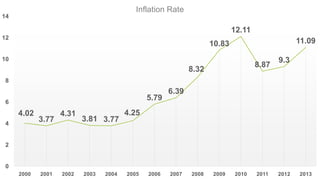
Inflation Rate
14

12.11
12

11.09

10.83

10

8.87

8.32

9.3

8

5.79

6

4.02
4

3.77

4.31

3.81 3.77

6.39

4.25

2

0
2000

2001

2002

2003

2004

2005

2006

2007

2008

2009

2010

2011

2012

6

2013
7
TYPES OF INFLATION
1. Demand-Pull Inflation

Types of Inflation

2. Cost-Push Inflation
3. Structural Inflation

8
DEMAND PULL INFLATION

Demand Pull Inflation represents a situation, wherein the aggregate
demand outweighs the aggregate supply.

Demand pull inflation

This increase in demand can be from the government, entrepreneurs, or
the households.


The demand is such that it can’t be met by the currently available supply
of output.

Thus, when pressure of aggregate demand for goods and services
exceeds the available supply of output, it naturally leads to rise in
price, i.e. Inflation.

9
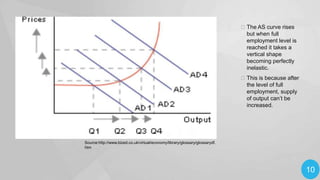
The AS curve rises
but when full
employment level is
reached it takes a
vertical shape
becoming perfectly
inelastic.
This is because after
the level of full
employment, supply
of output can’t be
increased.

Source:http://www.bized.co.uk/virtual/economy/library/glossary/glossarydf.
htm

10
COST PUSH INFLATION

Without any increase in aggregate demand, inflation can still arise.

This may happen if there is increase in cost independent of any
increase in aggregate demand.

Cost push inflation


Such an inflationary situation is known as Cost-Push inflation.


Three increases in cost which generate cost push inflation are

Wage Push Inflation

Profit Push Inflation


Increase in prices of raw materials
11
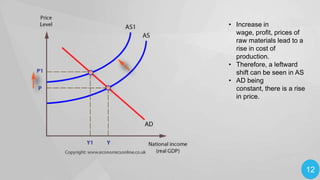
• Increase in
wage, profit, prices of
raw materials lead to a
rise in cost of
production.
• Therefore, a leftward
shift can be seen in AS
• AD being
constant, there is a rise
in price.

12
WAGE PUSH INFLATION

Growth of powerful trade unions can be one of the reason for the spread
and rise of inflation.

Wage push Inflation


This arises when trade union push for which are not justifiable either on
grounds of prior rise in productivity or on grounds of a cost of living, thus
producing a cost-push effect.

The employers agree to these wage claims because they hope to pass
on these rises in the cost to the consumer in the form of hike in prices.

13
PROFIT PUSH INFLATION

Increase in the profit margin by the firms working under monopolistic or
oligopolistic conditions.

Profit push Inflation


This leads to charging higher prices from the consumer.

 is called profit push inflation because the cause of cost-push is profit.
It


This also results in the shift in supply curve towards the left.

14
INCREASE IN PRICE OF RAW MATERIALS
 addition to a rise in wage rate and increase in profit margins, a rise in
In
price of raw materials leading to rise in price of cost of production also
plays a part in creating a cost-push situation.

Increase in price of raw
materials

 cost of production increases then the producers will obviously hike the
If
prices of their product in order to cover up that cost.

Sharp rise in world oil prices in 1973-1975 and 1979-1980 produced
significant rise, resulting in cost push inflation.

15
16
Measures to control Inflation
MEASURES TO CONTROL INFLATION


Monetary measure: Squeezing Credit

Fiscal measure: reducing purchasing power

17
18
Monetary Measures
MONETARY MEASURES
1. Bank Rate

2. Cash Reserve Ratio
3. Statutory Liquidity Ratio
4. Open market Operations

5. Margin Requirements

19
BANK RATE
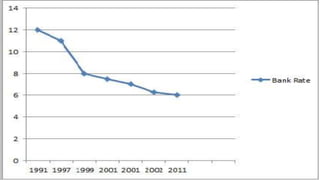
Bank Rate- The minimum rate at which RBI extends credit to commercial
Banks.

Bank Rate

In India, RBI follows type of measure in INFLATIONARY TIMES
 Dear Money measure(followed in period of boom and inflation)
-


Any increase in Bank rate results in an increase in interest rate
charged by Commercial banks which in turn leads to low level of
investment and low inflation
20
21
CRR (CASH RESERVE RATIO)
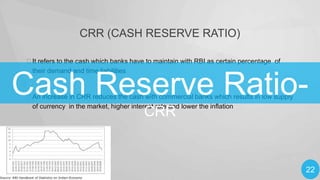
It refers to the cash which banks have to maintain with RBI as certain percentage of
their demand and time liabilities

Cash Reserve RatioAn increase in CRR reduces the cash with commercial banks which results in low supply
of currency in the market, higher interest rate and lower the inflation

CRR

22
STATUTORY LIQUIDITY RATIO
Commercial Banks have to maintain liquid assets cash, gold and approved
securities equal to not less than SLR(present SLR is 23%) of their total
demand and time deposit liabilities.

Statutory Liquidity Ratio
Objectives of SLR
 restrict expansion of Bank credit
To
 augment bank’s investment in government securities
To
 ensure solvency of banks
To

SLR is increased in case of

23
OPEN MARKET OPERATIONS

Govt. control the money supply by issuing govt. securities in public
govt. securities are issued by by govt. to raise the funds necessary to
pay its expenses

Open Market
Operations

these securities are nothing but bonds and debentures with a certain
maturity.

These securities lock the purchasing power of public for a certain period.

Therefore sale of securities can help regulate inflation.

24
25
MARGIN REQUIREMENTS

Margin requirement is the difference between the market value
of the security and its maximum loan value. A bank does not
advance loan equal to the market value of the security, but
less.

Margin Requirements

For example, it may lend Rs. 600 against the security worth
Rs.1000; thus the margin requirement in this case is 40%.

During inflation, the margin requirement can be raised to
reduce the loan one can get on a security.
26
27
Fiscal measure
INSTRUMENTS OF FISCAL POLICY

 Reduction of Govt. Expenditure

 Increase in Taxation
 Imposition of new Taxes
 Public Debt

Over valuation

28
29
Deflation
DEFLATION
A general decline in prices, often caused by a reduction in the supply
of money or credit. Deflation can be caused also by a decrease in
government, personal or investment spending. The opposite of
inflation, deflation has the side effect of increased unemployment
since there is a lower level of demand in the economy, which can
lead to an economic depression.

3
0
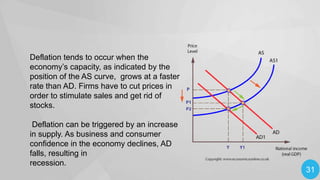
Deflation tends to occur when the
economy’s capacity, as indicated by the
position of the AS curve, grows at a faster
rate than AD. Firms have to cut prices in
order to stimulate sales and get rid of
stocks.
Deflation can be triggered by an increase
in supply. As business and consumer
confidence in the economy declines, AD
falls, resulting in
recession.

31
TYPES OF DEFLATIONS

DEBT DEFLATION

TYPES OF
DEFLATIONS


MONEY SIDE SUPPLY DEFLATION

BANK CREDIT DEFLATION


CONFISCATORY DEFLATION
32
33
Debt Deflation
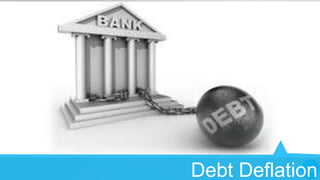
 This theory was given by IRVING FISHER.

 A situation in which the collateral used to secure a loan
(or another form of debt) decreases in value. This can
be detrimental because it may lead to a restructuring of
the loan agreement or the loan itself.
 Its also known as "worst deflation" and "collateral
deflation".
34
MONEY SIDE SUPPLY DEFLATION

This deflation is caused primarily by a reduction in the velocity
of money and/or the amount of money supply per person.

This happens when people tend to save more money which
results in decrease in the money flow.

36
BANK

CREDI
T
DEFLATIO
N
37

This happens when there is a decrease in the credit supply of
the bank and a contraction of the money supply from a nation’s
central bank.
 may be caused by the central bank initiating higher interest
It
rates.

38
CONFISCATORY DEFLATION

What it looks like

What it really

39

This is caused when central bank freezes bank deposits and
as a result it decreases money supply.


The freezing of bank deposits is done to counter inflation but if
it is not checked it may result in deflation.

40
EFFECTS OF

41
A slow-down or fall in lending leads to less money in circulation, with a further
sharp fall in money supply as confidence reduces and velocity weakens, with
a consequent sharp fall-off in demand for employment or goods. The fall in
demand causes a fall in prices as a supply glut develops. This becomes a
deflationary spiral when prices fall below the costs of financing production, or

repaying debt levels incurred at the prior price level. Businesses, unable to
make enough profit no matter how low they set prices, are then liquidated.
Banks get assets which have fallen dramatically in value since their mortgage
loan was made, and if they sell those assets, they further glut supply, which
only exacerbates the situation. To slow or halt the deflationary spiral, banks
will often withhold collecting on non-performing loans (as in Japan, and most
recently America and Spain). This is often no more than a stop-gap
measure, because they must then restrict credit, since they do not have
money to lend, which further reduces demand, and so on.

42
Measures to Control deflatio
Various measures to increase consumption and investment
expenditures in the economy.

1. Reduction in Taxation:
The government should reduce the number and burden of various taxes
levied on commodities. This will increase the purchasing power of the people.
As
a
result,
the
demand
for
goods
and
services
will
increase. Moreover, sufficient tax relief should be given to businessmen to
encourage investment.

2. Redistribution of Income:
Marginal propensity to consume can be raised by a redistribution of income
and wealth from the rich to the poor. Since the marginal propensity to
consume of the poor is high and that of the rich is low, such a measure will
help increasing the aggregate demand in the economy.

44
3. Repayment of Public Debt:
During deflation period, the government can repay the old public debts. This will
increase the purchasing power of the people and push up effective demand.

4. Subsidies:
The government should give subsidies to induce the businessmen to increase
investment.

5. Reduction in Interest Rate:
By adopting a cheap money policy, the monetary authority of a country reduced
the interest rate, which stimulates investment and thereby expands economic
activity in the economy.

45
6. Credit Expansion:
The central bank and the commercial banks should adopt a policy of credit
expansion to promote business and industry in the country. Bank credit should be
made easily available to the entrepreneurs for productive purposes.

7. Foreign Trade Policy:
To control deflation, the government should adopt such a foreign trade policy that, on the
one hand, increases exports, and, on the other hand, reduces imports. This kind of policy
will go a long way in solving the problem of overproduction, and help overcoming deflation.
8. Regulation of Production:
Production in the economy should be regulated in such a way that the problem of overproduction does not arise. Attempts should be made to adjust production with the existing
demand to avoid over-production.
46
CONCLUSION
Fiscal policy alone or monetary policy alone is not
sufficient to check deflation in an economy. A proper
co- ordination of fiscal, monetary and other measures
is essential to effectively deal with the deflation-ary
situation.

47

Inflation and Deflation- Indian context

  • 2.
    PRESENTED BY: 1. PRATEEKGUPTA 2. SAMARTH ROY 3. SHUBHAM DHANGAR 4. SUJAY KUMAR PRESENTED TO CFA MONOJ SHARMA
  • 3.
     Inflation  Types of inflation  Measuresto control inflation  Deflation  Types of deflation  Measures to control deflation CONTENTS
  • 4.
  • 5.
    An increase inthe general level of prices in an economy that is sustained over a period of time is called inflation. inflation 5
  • 6.
  • 7.
  • 8.
    TYPES OF INFLATION 1.Demand-Pull Inflation Types of Inflation 2. Cost-Push Inflation 3. Structural Inflation 8
  • 9.
    DEMAND PULL INFLATION  DemandPull Inflation represents a situation, wherein the aggregate demand outweighs the aggregate supply. Demand pull inflation  This increase in demand can be from the government, entrepreneurs, or the households.  The demand is such that it can’t be met by the currently available supply of output.  Thus, when pressure of aggregate demand for goods and services exceeds the available supply of output, it naturally leads to rise in price, i.e. Inflation. 9
  • 10.
    The AS curverises but when full employment level is reached it takes a vertical shape becoming perfectly inelastic. This is because after the level of full employment, supply of output can’t be increased. Source:http://www.bized.co.uk/virtual/economy/library/glossary/glossarydf. htm 10
  • 11.
    COST PUSH INFLATION  Withoutany increase in aggregate demand, inflation can still arise.  This may happen if there is increase in cost independent of any increase in aggregate demand. Cost push inflation  Such an inflationary situation is known as Cost-Push inflation.  Three increases in cost which generate cost push inflation are  Wage Push Inflation  Profit Push Inflation  Increase in prices of raw materials 11
  • 12.
    • Increase in wage,profit, prices of raw materials lead to a rise in cost of production. • Therefore, a leftward shift can be seen in AS • AD being constant, there is a rise in price. 12
  • 13.
    WAGE PUSH INFLATION  Growthof powerful trade unions can be one of the reason for the spread and rise of inflation. Wage push Inflation  This arises when trade union push for which are not justifiable either on grounds of prior rise in productivity or on grounds of a cost of living, thus producing a cost-push effect.  The employers agree to these wage claims because they hope to pass on these rises in the cost to the consumer in the form of hike in prices. 13
  • 14.
    PROFIT PUSH INFLATION  Increasein the profit margin by the firms working under monopolistic or oligopolistic conditions. Profit push Inflation  This leads to charging higher prices from the consumer.  is called profit push inflation because the cause of cost-push is profit. It  This also results in the shift in supply curve towards the left. 14
  • 15.
    INCREASE IN PRICEOF RAW MATERIALS  addition to a rise in wage rate and increase in profit margins, a rise in In price of raw materials leading to rise in price of cost of production also plays a part in creating a cost-push situation. Increase in price of raw materials  cost of production increases then the producers will obviously hike the If prices of their product in order to cover up that cost.  Sharp rise in world oil prices in 1973-1975 and 1979-1980 produced significant rise, resulting in cost push inflation. 15
  • 16.
  • 17.
    MEASURES TO CONTROLINFLATION  Monetary measure: Squeezing Credit  Fiscal measure: reducing purchasing power 17
  • 18.
  • 19.
    MONETARY MEASURES 1. BankRate 2. Cash Reserve Ratio 3. Statutory Liquidity Ratio 4. Open market Operations 5. Margin Requirements 19
  • 20.
    BANK RATE Bank Rate-The minimum rate at which RBI extends credit to commercial Banks. Bank Rate In India, RBI follows type of measure in INFLATIONARY TIMES  Dear Money measure(followed in period of boom and inflation) -  Any increase in Bank rate results in an increase in interest rate charged by Commercial banks which in turn leads to low level of investment and low inflation 20
  • 21.
  • 22.
    CRR (CASH RESERVERATIO) It refers to the cash which banks have to maintain with RBI as certain percentage of their demand and time liabilities Cash Reserve RatioAn increase in CRR reduces the cash with commercial banks which results in low supply of currency in the market, higher interest rate and lower the inflation CRR 22
  • 23.
    STATUTORY LIQUIDITY RATIO CommercialBanks have to maintain liquid assets cash, gold and approved securities equal to not less than SLR(present SLR is 23%) of their total demand and time deposit liabilities. Statutory Liquidity Ratio Objectives of SLR  restrict expansion of Bank credit To  augment bank’s investment in government securities To  ensure solvency of banks To SLR is increased in case of 23
  • 24.
    OPEN MARKET OPERATIONS  Govt.control the money supply by issuing govt. securities in public govt. securities are issued by by govt. to raise the funds necessary to pay its expenses Open Market Operations these securities are nothing but bonds and debentures with a certain maturity.  These securities lock the purchasing power of public for a certain period.  Therefore sale of securities can help regulate inflation. 24
  • 25.
  • 26.
    MARGIN REQUIREMENTS  Margin requirementis the difference between the market value of the security and its maximum loan value. A bank does not advance loan equal to the market value of the security, but less. Margin Requirements  For example, it may lend Rs. 600 against the security worth Rs.1000; thus the margin requirement in this case is 40%.  During inflation, the margin requirement can be raised to reduce the loan one can get on a security. 26
  • 27.
  • 28.
    INSTRUMENTS OF FISCALPOLICY  Reduction of Govt. Expenditure  Increase in Taxation  Imposition of new Taxes  Public Debt Over valuation 28
  • 29.
  • 30.
    DEFLATION A general declinein prices, often caused by a reduction in the supply of money or credit. Deflation can be caused also by a decrease in government, personal or investment spending. The opposite of inflation, deflation has the side effect of increased unemployment since there is a lower level of demand in the economy, which can lead to an economic depression. 3 0
  • 31.
    Deflation tends tooccur when the economy’s capacity, as indicated by the position of the AS curve, grows at a faster rate than AD. Firms have to cut prices in order to stimulate sales and get rid of stocks. Deflation can be triggered by an increase in supply. As business and consumer confidence in the economy declines, AD falls, resulting in recession. 31
  • 32.
    TYPES OF DEFLATIONS  DEBTDEFLATION TYPES OF DEFLATIONS  MONEY SIDE SUPPLY DEFLATION  BANK CREDIT DEFLATION  CONFISCATORY DEFLATION 32
  • 33.
  • 34.
     This theorywas given by IRVING FISHER.  A situation in which the collateral used to secure a loan (or another form of debt) decreases in value. This can be detrimental because it may lead to a restructuring of the loan agreement or the loan itself.  Its also known as "worst deflation" and "collateral deflation". 34
  • 35.
  • 36.
     This deflation iscaused primarily by a reduction in the velocity of money and/or the amount of money supply per person.  This happens when people tend to save more money which results in decrease in the money flow. 36
  • 37.
  • 38.
     This happens whenthere is a decrease in the credit supply of the bank and a contraction of the money supply from a nation’s central bank.  may be caused by the central bank initiating higher interest It rates. 38
  • 39.
    CONFISCATORY DEFLATION What itlooks like What it really 39
  • 40.
     This is causedwhen central bank freezes bank deposits and as a result it decreases money supply.  The freezing of bank deposits is done to counter inflation but if it is not checked it may result in deflation. 40
  • 41.
  • 42.
    A slow-down orfall in lending leads to less money in circulation, with a further sharp fall in money supply as confidence reduces and velocity weakens, with a consequent sharp fall-off in demand for employment or goods. The fall in demand causes a fall in prices as a supply glut develops. This becomes a deflationary spiral when prices fall below the costs of financing production, or repaying debt levels incurred at the prior price level. Businesses, unable to make enough profit no matter how low they set prices, are then liquidated. Banks get assets which have fallen dramatically in value since their mortgage loan was made, and if they sell those assets, they further glut supply, which only exacerbates the situation. To slow or halt the deflationary spiral, banks will often withhold collecting on non-performing loans (as in Japan, and most recently America and Spain). This is often no more than a stop-gap measure, because they must then restrict credit, since they do not have money to lend, which further reduces demand, and so on. 42
  • 43.
  • 44.
    Various measures toincrease consumption and investment expenditures in the economy. 1. Reduction in Taxation: The government should reduce the number and burden of various taxes levied on commodities. This will increase the purchasing power of the people. As a result, the demand for goods and services will increase. Moreover, sufficient tax relief should be given to businessmen to encourage investment. 2. Redistribution of Income: Marginal propensity to consume can be raised by a redistribution of income and wealth from the rich to the poor. Since the marginal propensity to consume of the poor is high and that of the rich is low, such a measure will help increasing the aggregate demand in the economy. 44
  • 45.
    3. Repayment ofPublic Debt: During deflation period, the government can repay the old public debts. This will increase the purchasing power of the people and push up effective demand. 4. Subsidies: The government should give subsidies to induce the businessmen to increase investment. 5. Reduction in Interest Rate: By adopting a cheap money policy, the monetary authority of a country reduced the interest rate, which stimulates investment and thereby expands economic activity in the economy. 45
  • 46.
    6. Credit Expansion: Thecentral bank and the commercial banks should adopt a policy of credit expansion to promote business and industry in the country. Bank credit should be made easily available to the entrepreneurs for productive purposes. 7. Foreign Trade Policy: To control deflation, the government should adopt such a foreign trade policy that, on the one hand, increases exports, and, on the other hand, reduces imports. This kind of policy will go a long way in solving the problem of overproduction, and help overcoming deflation. 8. Regulation of Production: Production in the economy should be regulated in such a way that the problem of overproduction does not arise. Attempts should be made to adjust production with the existing demand to avoid over-production. 46
  • 47.
    CONCLUSION Fiscal policy aloneor monetary policy alone is not sufficient to check deflation in an economy. A proper co- ordination of fiscal, monetary and other measures is essential to effectively deal with the deflation-ary situation. 47

Editor's Notes

  • #21 increase in bank rateThe rate at which central bank lends money to commercial banks. This is typically done to control money supply in the economy and the banking sector.A fluctuation in bank rate trigger ripple effect as it impacts every sphere of the country’s economy.Any revision in bank rate by central bank is an indication that bank should also increase deposit rate and base rate.Thus it can be said, that bank rates have been increased, commercial banks will soon increase lending rate, to make sure that they continue to make profit. Now the borrowing becomes dearer as interest increases, it discourages businessmen and consumers to take loans, this kind of measure helps to decrease inflationary pressure in the economy.
  • #23 Increase in CRRBanks in India are required to hold a certain proportion of their deposits in the form of cash.This cash is deposited with RBI The remaining cash with the banks is called as credit creation capacity An increase in CRR reduces the cash with commercial banks which results in low supply of currency in the market, higher interest rate and lower the inflation
  • #24 increase in bank rateThe rate at which central bank lends money to commercial banks. This is typically done to control money supply in the economy and the banking sector.A fluctuation in bank rate trigger ripple effect as it impacts every sphere of the country’s economy.Any revision in bank rate by central bank is an indication that bank should also increase deposit rate and base rate.Thus it can be said, that bank rates have been increased, commercial banks will soon increase lending rate, to make sure that they continue to make profit. Now the borrowing becomes dearer as interest increases, it discourages businessmen and consumers to take loans, this kind of measure helps to inflationarydecrease pressure in the economy.
  • #29 1. Gov. releases its money in the economy, every time it meets its exp.Excess money supply in the economy helps inflationIn order to control inflation, the govt has to reduce its expenditure.2. It is necessary to take excess purchasing power off the public, by the way of taxes.It helps to moderate the demand for goods and service to match with supply of the goods.Increasing taxes, and imposing some new taxes will control inflation. Up to some extent.4. Govt. borrows money from public and businessmen by way of bonds. The public borrowing soak up all excess purchasing power available to public and businessmen.5. Over valuation of the domestic currency will make domestic goods expensive for foreign market thus by reduced exports , the goods available in the country will increase , and they are available for for same money supplyWhich will automatically make their prices go down, resulting in decreased INFLATION