INFLATION
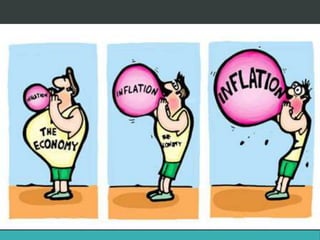
• In economics, Inflation is a rise in the general level of prices of goods and
services in an economy over a period of time.
• According to Webster's “An increase in the amount of currency in circulation,
resulting in a relatively sharp and sudden fall in its value and rise in prices: it
may be caused by an increase in the volume of paper money issued or of gold
mined, or a relative increase in expenditures as when the supply of goods fails
to meet the demand.
• A chief measure of price inflation is the inflation rate the annualized percentage
change in a general price index (normally the Consumer Price Index) over time.
EFFECTS OF INFLATION
• Inflation's effects on an economy are various and can be simultaneously
positive and negative.
• Negative effects of inflation include a decrease in the real value of money and other
monetary items over time, uncertainty over future inflation may discourage
investment and savings, and high inflation may lead to shortages of goods if
consumers begin hoarding out of concern that prices will increase in the future.
• Positive effects include ensuring central banks can adjust nominal interest rates
(intended to mitigate recessions),and encouraging investment in non-monetary
capital projects.
FEATURES OF INFLATION
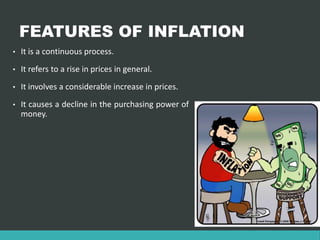
• It is a continuous process.
• It refers to a rise in prices in general.
• It involves a considerable increase in prices.
• It causes a decline in the purchasing power of
money.
TYPES OF INFLATION
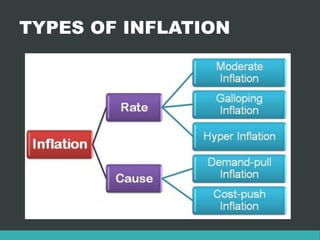
TYPES OF INFLATION: ON THE
BASIS OF RATE
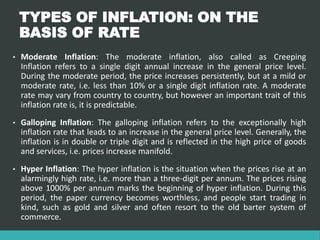
• Moderate Inflation: The moderate inflation, also called as Creeping
Inflation refers to a single digit annual increase in the general price level.
During the moderate period, the price increases persistently, but at a mild or
moderate rate, i.e. less than 10% or a single digit inflation rate. A moderate
rate may vary from country to country, but however an important trait of this
inflation rate is, it is predictable.
• Galloping Inflation: The galloping inflation refers to the exceptionally high
inflation rate that leads to an increase in the general price level. Generally, the
inflation is in double or triple digit and is reflected in the high price of goods
and services, i.e. prices increase manifold.
• Hyper Inflation: The hyper inflation is the situation when the prices rise at an
alarmingly high rate, i.e. more than a three-digit per annum. The prices rising
above 1000% per annum marks the beginning of hyper inflation. During this
period, the paper currency becomes worthless, and people start trading in
kind, such as gold and silver and often resort to the old barter system of
commerce.
TYPES OF INFLATION: ON THE
BASIS OF CAUSE
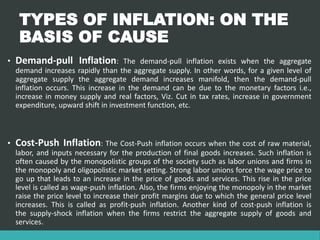
• Demand-pull Inflation: The demand-pull inflation exists when the aggregate
demand increases rapidly than the aggregate supply. In other words, for a given level of
aggregate supply the aggregate demand increases manifold, then the demand-pull
inflation occurs. This increase in the demand can be due to the monetary factors i.e.,
increase in money supply and real factors, Viz. Cut in tax rates, increase in government
expenditure, upward shift in investment function, etc.
• Cost-Push Inflation: The Cost-Push inflation occurs when the cost of raw material,
labor, and inputs necessary for the production of final goods increases. Such inflation is
often caused by the monopolistic groups of the society such as labor unions and firms in
the monopoly and oligopolistic market setting. Strong labor unions force the wage price to
go up that leads to an increase in the price of goods and services. This rise in the price
level is called as wage-push inflation. Also, the firms enjoying the monopoly in the market
raise the price level to increase their profit margins due to which the general price level
increases. This is called as profit-push inflation. Another kind of cost-push inflation is
the supply-shock inflation when the firms restrict the aggregate supply of goods and
services.
CAUSE FOR DEMAND-PULL
INFLATION
• Increase in Money Supply
• Increase in Black Marketing
• Increase in Hoarding
• Repayment of Past Internal Debt
• Increase in Exports
• Deficit Financing
• Increase in Income
• Increase in Black money
• Increase in Credit facilities
CAUSE FOR COST-PULL INFLATION
• Increase in cost of raw materials
• Shortage of Supplies
• Natural calamities
• Industrial Disputes
• Increase in Exports
• Increase in Wages
• Increase in Transportation Cost
• Huge Expenditure on Advertisement
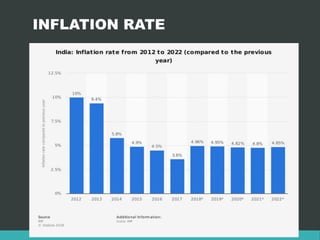
INFLATION RATE
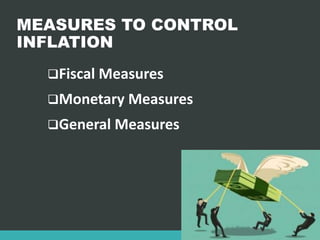
MEASURES TO CONTROL
INFLATION
Fiscal Measures
Monetary Measures
General Measures
MONETARY MEASURES
• The most important and commonly used method to control inflation is
monetary policy of the Central Bank. Most central banks use high interest rates
as the traditional way to fight or prevent inflation.
• Monetary measures used to control inflation include:
(i) Bank rate policy
(ii) CRR
(iii) Open market operations
FISCAL MEASURES
• Fiscal measures to control inflation include taxation, government expenditure
and public borrowings.
• Fiscal measures used to control inflation include:
(i) Increase in Taxes
(ii) Increase in savings
(iii) Surplus budgets
GENERAL MEASURES
• Increase productivity.
• Freeze prices and wages.
• Implement a wage restraint policy.
• Encourage personal savings.
• Price Stability
• Import control: make competing imported goods cheaper.
• Introduce price indexation: linking all prices to a particular index,
e.g. CPI.
DEFLATION
• Deflation is that state in which the value of goods and services falls
• A sustained decrease in average price level is called deflation
• Prices fall
• Opposite of inflation
• Not the same as disinflation, which is a reduction in the rate of inflation
• The inflation rate measures the trend in the average price level
REASON OF DEFLATION
• Govt. withdraws money from circulation
• Govt. imposes heavy direct taxes or takes heavy loans from the public
• Central bank sells the securities in open market
• Central bank controls the credit money and adopts various measures such as
increase in CRR, credit rationing and direct action
• The central bank increases the bank rate
• State of over-production takes place in the economy
DEVALUATION
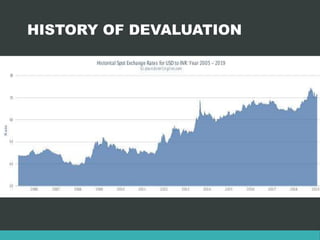
• Devaluation means decreasing the value of nation's currency relative to
gold or the currencies of other nations. Under it ,there is no change in
the internal purchasing power of the currency.
• For example, Rs 65=1$ (before devaluation)
Rs 70=1$ (after devaluation)
OBJECTIVE OF DEVALUATION
1. To encourage exports
2. To Discourage the imports
3. To correct the balance of payment
HISTORY OF DEVALUATION
TYPES OF DEVALUATION
1) Planned devaluation:- Planned devaluations are brought about almost
exclusively by government decisions to deliberately reduce the relative value
of a currency, usually intended as a means to some improvement in the
country's trading position.
2) Market-driven devaluation:- Formal recognition by a government,
frequently during a monetary crisis, that the value of its currency relative to
major world currencies— especially the dollar—has already depreciated
through trading in the foreign exchange markets
POLICIES TO STEM DEVALUATION
IN RUPEE
• Supply-side policies to improve competitiveness
• Reduce dependency on foreign oil, through domestic and renewable energy.
• Monetary policy to tackle inflation and reduce domestic demand. But, will
conflict with lower economic growth and lead to higher unemployment.
• Financial controls, e.g. limiting the amount of gold imports to reduce the
current account deficit.
DISINVESTMENT
• The action of an organisation/government selling or
liquidating an asset or subsidiary, also known as
divestment or divestiture.
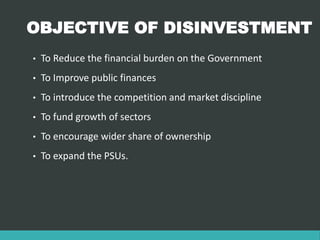
OBJECTIVE OF DISINVESTMENT
• To Reduce the financial burden on the Government
• To Improve public finances
• To introduce the competition and market discipline
• To fund growth of sectors
• To encourage wider share of ownership
• To expand the PSUs.
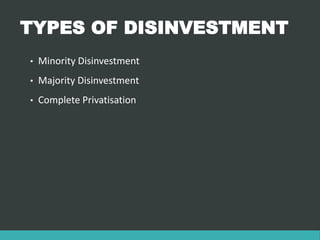
TYPES OF DISINVESTMENT
• Minority Disinvestment
• Majority Disinvestment
• Complete Privatisation
Inflation Deflation Devaluation & Disinvestment

Inflation Deflation Devaluation & Disinvestment

  • 3.
    INFLATION • In economics,Inflation is a rise in the general level of prices of goods and services in an economy over a period of time. • According to Webster's “An increase in the amount of currency in circulation, resulting in a relatively sharp and sudden fall in its value and rise in prices: it may be caused by an increase in the volume of paper money issued or of gold mined, or a relative increase in expenditures as when the supply of goods fails to meet the demand. • A chief measure of price inflation is the inflation rate the annualized percentage change in a general price index (normally the Consumer Price Index) over time.
  • 4.
    EFFECTS OF INFLATION •Inflation's effects on an economy are various and can be simultaneously positive and negative. • Negative effects of inflation include a decrease in the real value of money and other monetary items over time, uncertainty over future inflation may discourage investment and savings, and high inflation may lead to shortages of goods if consumers begin hoarding out of concern that prices will increase in the future. • Positive effects include ensuring central banks can adjust nominal interest rates (intended to mitigate recessions),and encouraging investment in non-monetary capital projects.
  • 5.
    FEATURES OF INFLATION •It is a continuous process. • It refers to a rise in prices in general. • It involves a considerable increase in prices. • It causes a decline in the purchasing power of money.
  • 6.
  • 7.
    TYPES OF INFLATION:ON THE BASIS OF RATE • Moderate Inflation: The moderate inflation, also called as Creeping Inflation refers to a single digit annual increase in the general price level. During the moderate period, the price increases persistently, but at a mild or moderate rate, i.e. less than 10% or a single digit inflation rate. A moderate rate may vary from country to country, but however an important trait of this inflation rate is, it is predictable. • Galloping Inflation: The galloping inflation refers to the exceptionally high inflation rate that leads to an increase in the general price level. Generally, the inflation is in double or triple digit and is reflected in the high price of goods and services, i.e. prices increase manifold. • Hyper Inflation: The hyper inflation is the situation when the prices rise at an alarmingly high rate, i.e. more than a three-digit per annum. The prices rising above 1000% per annum marks the beginning of hyper inflation. During this period, the paper currency becomes worthless, and people start trading in kind, such as gold and silver and often resort to the old barter system of commerce.
  • 8.
    TYPES OF INFLATION:ON THE BASIS OF CAUSE • Demand-pull Inflation: The demand-pull inflation exists when the aggregate demand increases rapidly than the aggregate supply. In other words, for a given level of aggregate supply the aggregate demand increases manifold, then the demand-pull inflation occurs. This increase in the demand can be due to the monetary factors i.e., increase in money supply and real factors, Viz. Cut in tax rates, increase in government expenditure, upward shift in investment function, etc. • Cost-Push Inflation: The Cost-Push inflation occurs when the cost of raw material, labor, and inputs necessary for the production of final goods increases. Such inflation is often caused by the monopolistic groups of the society such as labor unions and firms in the monopoly and oligopolistic market setting. Strong labor unions force the wage price to go up that leads to an increase in the price of goods and services. This rise in the price level is called as wage-push inflation. Also, the firms enjoying the monopoly in the market raise the price level to increase their profit margins due to which the general price level increases. This is called as profit-push inflation. Another kind of cost-push inflation is the supply-shock inflation when the firms restrict the aggregate supply of goods and services.
  • 9.
    CAUSE FOR DEMAND-PULL INFLATION •Increase in Money Supply • Increase in Black Marketing • Increase in Hoarding • Repayment of Past Internal Debt • Increase in Exports • Deficit Financing • Increase in Income • Increase in Black money • Increase in Credit facilities
  • 10.
    CAUSE FOR COST-PULLINFLATION • Increase in cost of raw materials • Shortage of Supplies • Natural calamities • Industrial Disputes • Increase in Exports • Increase in Wages • Increase in Transportation Cost • Huge Expenditure on Advertisement
  • 11.
  • 12.
    MEASURES TO CONTROL INFLATION FiscalMeasures Monetary Measures General Measures
  • 13.
    MONETARY MEASURES • Themost important and commonly used method to control inflation is monetary policy of the Central Bank. Most central banks use high interest rates as the traditional way to fight or prevent inflation. • Monetary measures used to control inflation include: (i) Bank rate policy (ii) CRR (iii) Open market operations
  • 14.
    FISCAL MEASURES • Fiscalmeasures to control inflation include taxation, government expenditure and public borrowings. • Fiscal measures used to control inflation include: (i) Increase in Taxes (ii) Increase in savings (iii) Surplus budgets
  • 15.
    GENERAL MEASURES • Increaseproductivity. • Freeze prices and wages. • Implement a wage restraint policy. • Encourage personal savings. • Price Stability • Import control: make competing imported goods cheaper. • Introduce price indexation: linking all prices to a particular index, e.g. CPI.
  • 16.
    DEFLATION • Deflation isthat state in which the value of goods and services falls • A sustained decrease in average price level is called deflation • Prices fall • Opposite of inflation • Not the same as disinflation, which is a reduction in the rate of inflation • The inflation rate measures the trend in the average price level
  • 17.
    REASON OF DEFLATION •Govt. withdraws money from circulation • Govt. imposes heavy direct taxes or takes heavy loans from the public • Central bank sells the securities in open market • Central bank controls the credit money and adopts various measures such as increase in CRR, credit rationing and direct action • The central bank increases the bank rate • State of over-production takes place in the economy
  • 18.
    DEVALUATION • Devaluation meansdecreasing the value of nation's currency relative to gold or the currencies of other nations. Under it ,there is no change in the internal purchasing power of the currency. • For example, Rs 65=1$ (before devaluation) Rs 70=1$ (after devaluation)
  • 19.
    OBJECTIVE OF DEVALUATION 1.To encourage exports 2. To Discourage the imports 3. To correct the balance of payment
  • 20.
  • 21.
    TYPES OF DEVALUATION 1)Planned devaluation:- Planned devaluations are brought about almost exclusively by government decisions to deliberately reduce the relative value of a currency, usually intended as a means to some improvement in the country's trading position. 2) Market-driven devaluation:- Formal recognition by a government, frequently during a monetary crisis, that the value of its currency relative to major world currencies— especially the dollar—has already depreciated through trading in the foreign exchange markets
  • 22.
    POLICIES TO STEMDEVALUATION IN RUPEE • Supply-side policies to improve competitiveness • Reduce dependency on foreign oil, through domestic and renewable energy. • Monetary policy to tackle inflation and reduce domestic demand. But, will conflict with lower economic growth and lead to higher unemployment. • Financial controls, e.g. limiting the amount of gold imports to reduce the current account deficit.
  • 23.
    DISINVESTMENT • The actionof an organisation/government selling or liquidating an asset or subsidiary, also known as divestment or divestiture.
  • 24.
    OBJECTIVE OF DISINVESTMENT •To Reduce the financial burden on the Government • To Improve public finances • To introduce the competition and market discipline • To fund growth of sectors • To encourage wider share of ownership • To expand the PSUs.
  • 25.
    TYPES OF DISINVESTMENT •Minority Disinvestment • Majority Disinvestment • Complete Privatisation