Inflation Accounting
Inflation: Definitions Decrease in purchasing power of money due to an increase in the general price level “ A process of steadily rising prices resulting in diminishing purchasing power of a given nominal sum of money” The Penguin Dictionary of Economics “ Rise in prices brought about by the expansion of the supply of bank money, credit, etc.” Oxford Advanced Learner’s Dictionary of Current English
Some Aspects on Inflation Accounting Problems: Subjectivity Often complicated calculations Benefits: maintaining production capacity shows the internal logic of accounting
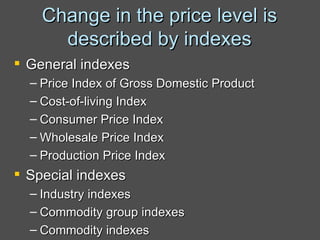
Change in the price level is described by indexes General indexes Price Index of Gross Domestic Product Cost-of-living Index Consumer Price Index Wholesale Price Index Production Price Index Special indexes Industry indexes Commodity group indexes Commodity indexes
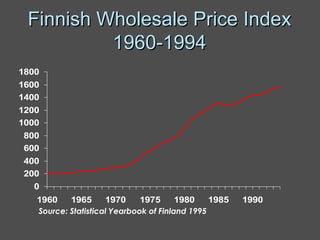
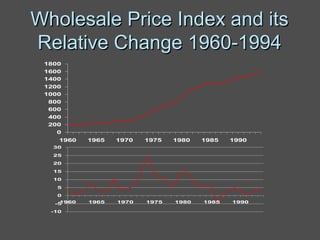
Finnish Wholesale Price Index 1960-1994 Source: Statistical Yearbook of Finland 1995
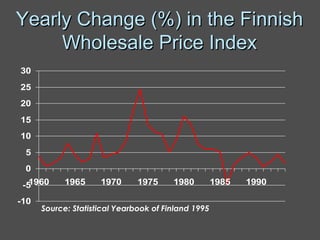
Yearly Change (%) in the Finnish Wholesale Price Index Source: Statistical Yearbook of Finland 1995
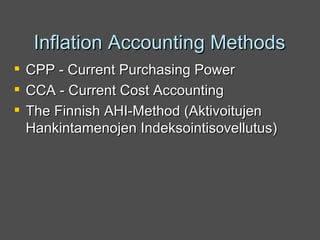
Inflation Accounting Methods CPP - Current Purchasing Power CCA - Current Cost Accounting The Finnish AHI-Method (Aktivoitujen Hankintamenojen Indeksointisovellutus)
Current Purchasing Power (CPP) Retains historic cost accounting conventions In U.S. General Purchasing Power (GPP) Expresses accounts in terms of “purchasing units” The purchase power of money at the end of the accounting period as the base Maintains the general purchasing power of the invested capital The original purchasing costs are corrected by correction coefficients applying some general index, for example Retail Price Index
Current Purchasing Power (CPP) Monetary items - financial assets and liabilities - remain unchanged Inventories: FIFO purchase cost is corrected by a suitable correction coefficient to correspond the purchase power of the end of accounting period Fixed assets:  The purchase cost is corrected to correspond the purchase power of the end of the accounting period The balance  value of  the fixed assets is the same percentage of the corrected purchase cost as the book value is of the original purchase cost
Current Purchasing Power (CPP) Equity is defined as Assets - Liabilities Shareholders’ point of view Unsuitable for financing decisions Work intensive method
Nominal Statement of Income TO - VC = GP -  FC = OP -  IC -  D = NP TO = Turnover VC = Variable Costs GP = Gross Profit FC = Fixed Costs OP = Operating Profit IC = Interest Costs D = Depreciation NP = Net Profit Below we also need: [ NG = Net Gain from Liabilities TP = Total Profit ]
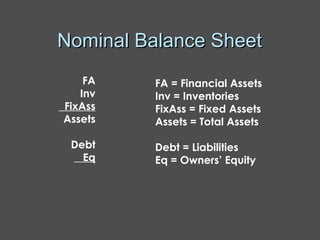
Nominal Balance Sheet FA Inv FixAss Assets Debt Eq FA = Financial Assets Inv = Inventories FixAss = Fixed Assets Assets = Total Assets Debt = Liabilities Eq = Owners’ Equity
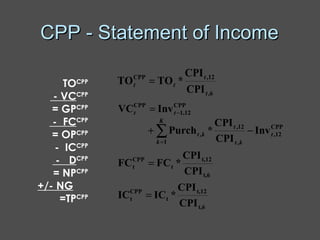
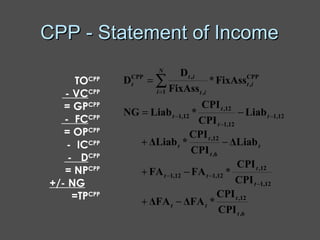
CPP - Statement of Income TO CPP - VC CPP = GP CPP -  FC CPP = OP CPP -  IC CPP -  D CPP = NP CPP +/- NG   =TP CPP
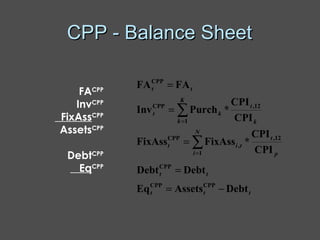
CPP - Balance Sheet FA CPP Inv CPP FixAss CPP Assets CPP Debt CPP Eq CPP
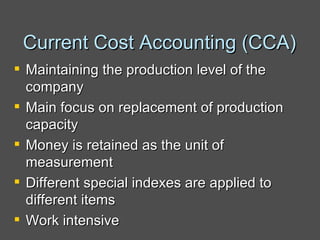
Current Cost Accounting (CCA) Maintaining the production level of the company Main focus on replacement of production capacity  Money is retained as the unit of measurement Different special indexes are applied to different items Work intensive
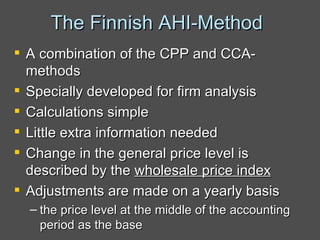
The Finnish AHI-Method  A combination of the CPP and CCA-methods Specially developed for firm analysis Calculations simple Little extra information needed Change in the general price level is described by the  wholesale price index Adjustments are made on a yearly basis the price level at the middle of the accounting period as the base
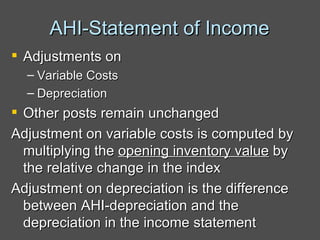
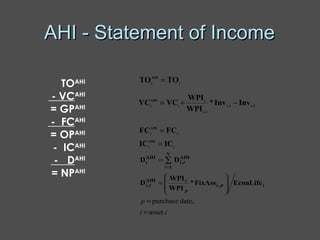
AHI-Statement of Income Adjustments on  Variable Costs Depreciation Other posts remain unchanged Adjustment on variable costs is computed by multiplying the  opening inventory value  by the relative change in the index Adjustment on depreciation is the difference between AHI-depreciation and the depreciation in the income statement
AHI - Statement of Income TO AHI - VC AHI = GP AHI -  FC AHI = OP AHI -  IC AHI -  D AHI = NP AHI
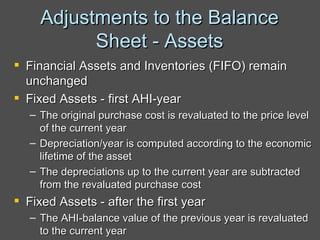
Adjustments to the Balance Sheet - Assets Financial Assets and Inventories (FIFO) remain unchanged Fixed Assets - first AHI-year The original purchase cost is revaluated to the price level of the current year Depreciation/year is computed according to the economic lifetime of the asset The depreciations up to the current year are subtracted from the revaluated purchase cost Fixed Assets - after the first year The AHI-balance value of the previous year is revaluated to the current year New depreciation is computed based on the remaining economic lifetime
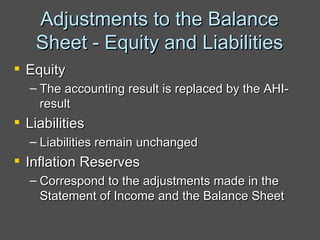
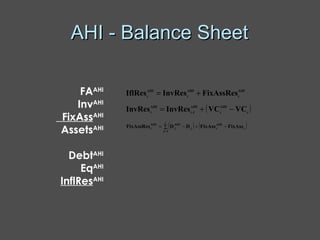
Adjustments to the Balance Sheet - Equity and Liabilities Equity The accounting result is replaced by the AHI-result Liabilities Liabilities remain unchanged Inflation Reserves Correspond to the adjustments made in the Statement of Income and the Balance Sheet
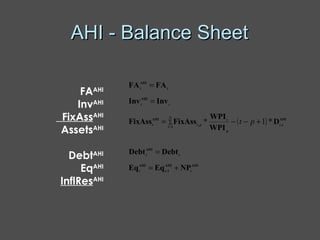
AHI - Balance Sheet FA AHI Inv AHI FixAss AHI Assets AHI Debt AHI Eq AHI InflRes AHI
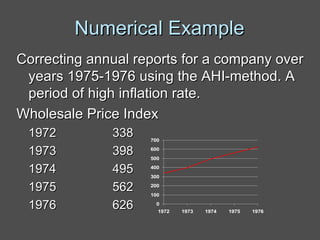
Numerical Example Correcting annual reports for a company over years 1975-1976 using the AHI-method. A period of high inflation rate. Wholesale Price Index 1972 338 1973 398 1974 495 1975 562 1976 626
Wholesale Price Index and its Relative Change 1960-1994
Learn More At http://www.svtuition.org

Inflation

  • 1.
  • 2.
    Inflation: Definitions Decreasein purchasing power of money due to an increase in the general price level “ A process of steadily rising prices resulting in diminishing purchasing power of a given nominal sum of money” The Penguin Dictionary of Economics “ Rise in prices brought about by the expansion of the supply of bank money, credit, etc.” Oxford Advanced Learner’s Dictionary of Current English
  • 3.
    Some Aspects onInflation Accounting Problems: Subjectivity Often complicated calculations Benefits: maintaining production capacity shows the internal logic of accounting
  • 4.
    Change in theprice level is described by indexes General indexes Price Index of Gross Domestic Product Cost-of-living Index Consumer Price Index Wholesale Price Index Production Price Index Special indexes Industry indexes Commodity group indexes Commodity indexes
  • 5.
    Finnish Wholesale PriceIndex 1960-1994 Source: Statistical Yearbook of Finland 1995
  • 6.
    Yearly Change (%)in the Finnish Wholesale Price Index Source: Statistical Yearbook of Finland 1995
  • 7.
    Inflation Accounting MethodsCPP - Current Purchasing Power CCA - Current Cost Accounting The Finnish AHI-Method (Aktivoitujen Hankintamenojen Indeksointisovellutus)
  • 8.
    Current Purchasing Power(CPP) Retains historic cost accounting conventions In U.S. General Purchasing Power (GPP) Expresses accounts in terms of “purchasing units” The purchase power of money at the end of the accounting period as the base Maintains the general purchasing power of the invested capital The original purchasing costs are corrected by correction coefficients applying some general index, for example Retail Price Index
  • 9.
    Current Purchasing Power(CPP) Monetary items - financial assets and liabilities - remain unchanged Inventories: FIFO purchase cost is corrected by a suitable correction coefficient to correspond the purchase power of the end of accounting period Fixed assets: The purchase cost is corrected to correspond the purchase power of the end of the accounting period The balance value of the fixed assets is the same percentage of the corrected purchase cost as the book value is of the original purchase cost
  • 10.
    Current Purchasing Power(CPP) Equity is defined as Assets - Liabilities Shareholders’ point of view Unsuitable for financing decisions Work intensive method
  • 11.
    Nominal Statement ofIncome TO - VC = GP - FC = OP - IC - D = NP TO = Turnover VC = Variable Costs GP = Gross Profit FC = Fixed Costs OP = Operating Profit IC = Interest Costs D = Depreciation NP = Net Profit Below we also need: [ NG = Net Gain from Liabilities TP = Total Profit ]
  • 12.
    Nominal Balance SheetFA Inv FixAss Assets Debt Eq FA = Financial Assets Inv = Inventories FixAss = Fixed Assets Assets = Total Assets Debt = Liabilities Eq = Owners’ Equity
  • 13.
    CPP - Statementof Income TO CPP - VC CPP = GP CPP - FC CPP = OP CPP - IC CPP - D CPP = NP CPP +/- NG =TP CPP
  • 14.
    CPP - Statementof Income TO CPP - VC CPP = GP CPP - FC CPP = OP CPP - IC CPP - D CPP = NP CPP +/- NG =TP CPP
  • 15.
    CPP - BalanceSheet FA CPP Inv CPP FixAss CPP Assets CPP Debt CPP Eq CPP
  • 16.
    Current Cost Accounting(CCA) Maintaining the production level of the company Main focus on replacement of production capacity Money is retained as the unit of measurement Different special indexes are applied to different items Work intensive
  • 17.
    The Finnish AHI-Method A combination of the CPP and CCA-methods Specially developed for firm analysis Calculations simple Little extra information needed Change in the general price level is described by the wholesale price index Adjustments are made on a yearly basis the price level at the middle of the accounting period as the base
  • 18.
    AHI-Statement of IncomeAdjustments on Variable Costs Depreciation Other posts remain unchanged Adjustment on variable costs is computed by multiplying the opening inventory value by the relative change in the index Adjustment on depreciation is the difference between AHI-depreciation and the depreciation in the income statement
  • 19.
    AHI - Statementof Income TO AHI - VC AHI = GP AHI - FC AHI = OP AHI - IC AHI - D AHI = NP AHI
  • 20.
    Adjustments to theBalance Sheet - Assets Financial Assets and Inventories (FIFO) remain unchanged Fixed Assets - first AHI-year The original purchase cost is revaluated to the price level of the current year Depreciation/year is computed according to the economic lifetime of the asset The depreciations up to the current year are subtracted from the revaluated purchase cost Fixed Assets - after the first year The AHI-balance value of the previous year is revaluated to the current year New depreciation is computed based on the remaining economic lifetime
  • 21.
    Adjustments to theBalance Sheet - Equity and Liabilities Equity The accounting result is replaced by the AHI-result Liabilities Liabilities remain unchanged Inflation Reserves Correspond to the adjustments made in the Statement of Income and the Balance Sheet
  • 22.
    AHI - BalanceSheet FA AHI Inv AHI FixAss AHI Assets AHI Debt AHI Eq AHI InflRes AHI
  • 23.
    AHI - BalanceSheet FA AHI Inv AHI FixAss AHI Assets AHI Debt AHI Eq AHI InflRes AHI
  • 24.
    Numerical Example Correctingannual reports for a company over years 1975-1976 using the AHI-method. A period of high inflation rate. Wholesale Price Index 1972 338 1973 398 1974 495 1975 562 1976 626
  • 25.
    Wholesale Price Indexand its Relative Change 1960-1994
  • 26.
    Learn More Athttp://www.svtuition.org