2017-2018
1
Overview
California’s Teacher Shortage
–STEM Teaching in Elementary
• About Project Tomorrow
–TTI (YT2L), SpeakUp, Innovation in Education
• About Educators Rising California
–Starting a Chapter!
–Educators Rising National
2
California’s Teacher
Shortage
A 2017 update
3
4
5
6
About Project Tomorrow
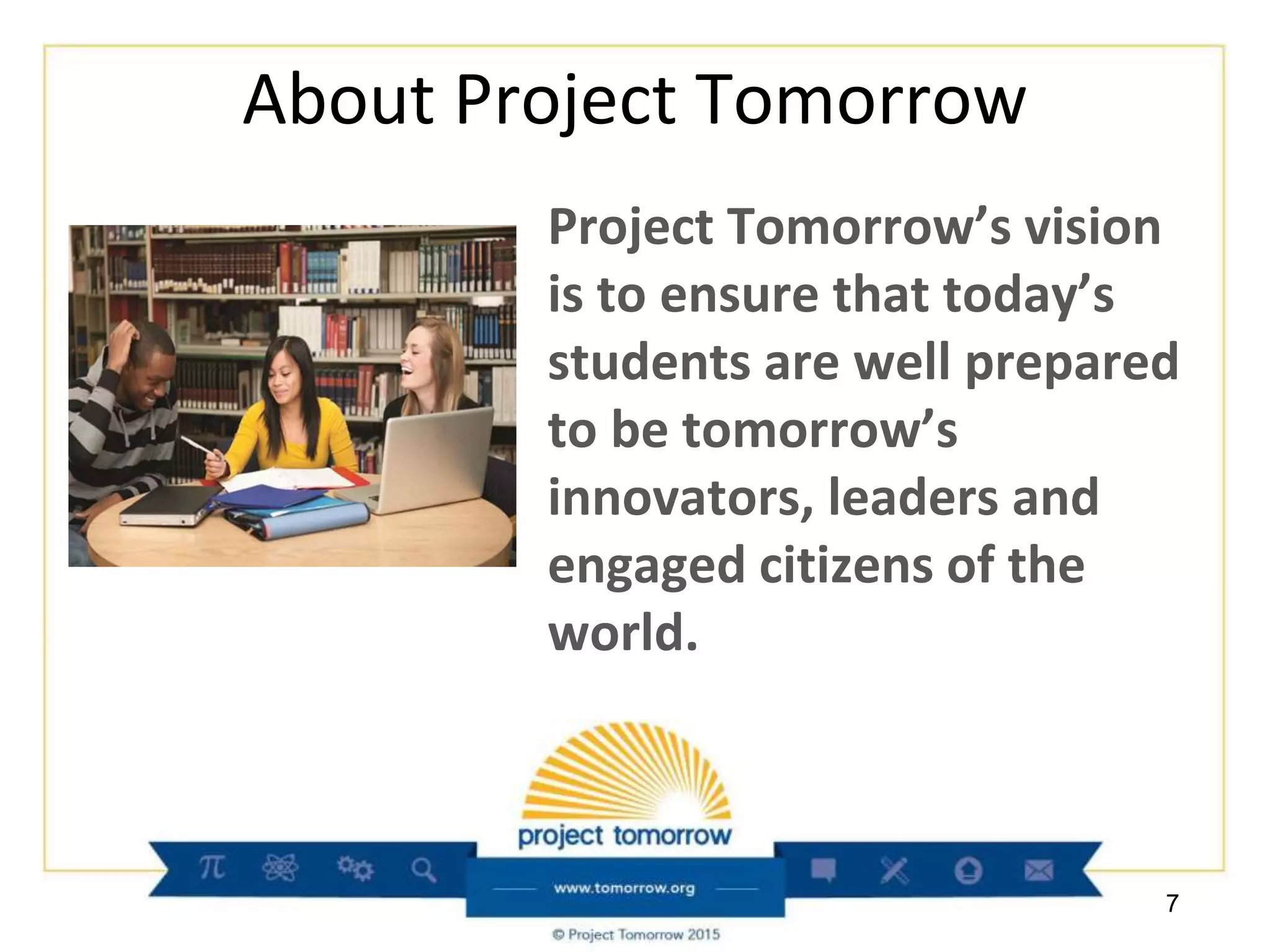
Project Tomorrow’s vision
is to ensure that today’s
students are well prepared
to be tomorrow’s
innovators, leaders and
engaged citizens of the
world.
7
Tomorrow’s Teachers Initiative
YouthTEACH2Learn
•7 schools, 140 high school students
•2017-18 participating high schools:
• Canyon High School, Orange Unified
• El Modena High School, Orange Unified
• Jefferson High School, LAUSD
• Oceanside High School, Oceanside
Unified
• Orange High School, Orange Unified
• Trabuco Hills High School, Saddleback
Unified
• Villa Park High School, Orange Unified
8
Saturday Academy - Fresno
Unified, 100 Students
Educators Rising California
•60 chapters, 1500 teacher
leaders/students
THE Youth TEACH2Learn Program
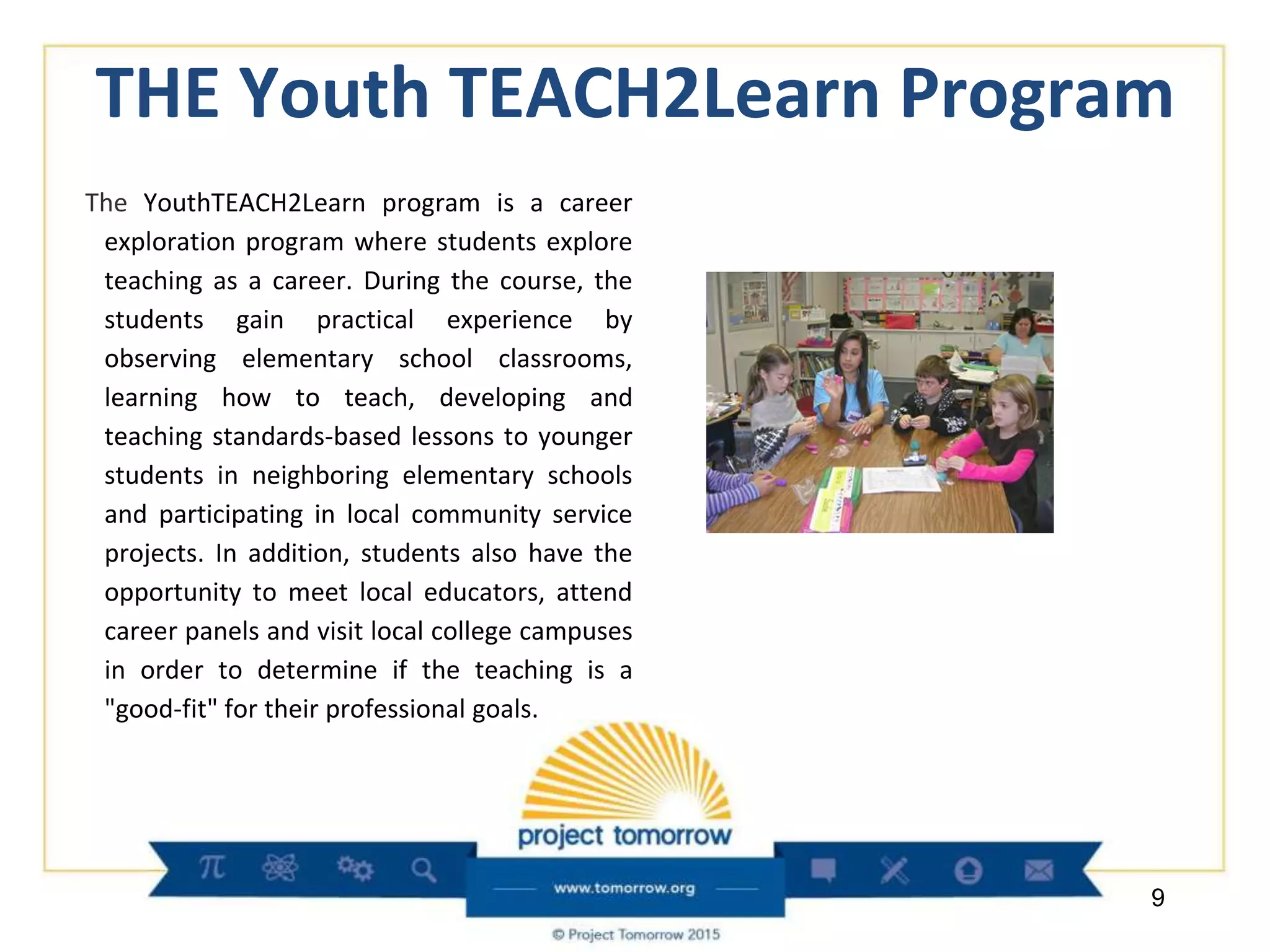
The YouthTEACH2Learn program is a career
exploration program where students explore
teaching as a career. During the course, the
students gain practical experience by
observing elementary school classrooms,
learning how to teach, developing and
teaching standards-based lessons to younger
students in neighboring elementary schools
and participating in local community service
projects. In addition, students also have the
opportunity to meet local educators, attend
career panels and visit local college campuses
in order to determine if the teaching is a
"good-fit" for their professional goals.
9
10
EDUCATION EXPLORATION:
CAREER TECHNICAL KNOWLEDGE & SKILLS
Module 1: Orientation & Educators Rising California
Module 2: The Structure & Economics of American Education
Module 3: The Effective Teacher*
Module 4: Human Growth & Development *
Module 5: Teaching Students with Special Needs
Module 6: Classroom Management & Community*
Module 7: Observation Cycles (Inquiry, Differentiation*, Technology*)
Module 8: Safety & Emergency Planning
Module 9: Government Regulations: IEPs, 504, & Mandated Reporter
Module 10: Standards-Based Instruction & Lesson Planning
Module 11: Instructional Strategies*
MATH
Module 12: Perspectives on Math
“How Many People?”
Math-o-Graphy
Algebra Readiness
Module 13: Math Standards
“Sleepy Time”
Understanding Common Core
An Introduction to Backwards Planning
Module 14: Manipulative Use
“Fraction Strips”
Module 15: Problem Solving
“Seats on the Bus”
Solving Word Problems
Module 16: Math Vocabulary
“Get it Together”
Math & English Language Learners
Module 17: Assessment Strategies
“Probability”
Formative & Summative Assessment
Student Interviews
Module 18: Lesson Development
Module 19: Health, Sanitation, & Nutrition
Module 20: What’s Next? Career Planning
ENVIRONMENTAL SCIENCE
Module 12: Perspectives on Science and Environmental Literacy
Ecosystem Services are Essential to Human Life
Focus on Water Filtration
Teaching Water Filtration
Module 13: Ecological Footprint
People Influence Natural Systems
Ecological Footprint Worksheet
Elements of Lesson Design
Think-Pair-Share Strategy
Module 14: Tragedy of the Commons
People Influence Natural Systems
“Tragedy of the Commons”
Claim-Evidence-Reasoning
Module 15: The Nitrogen Cycle
Dead Fish Case Study
Nitrogen Cycle Game
Module 16: Particulate Air Pollution
“Monitoring Particulate Pollution”
Protocols for Conducting an Effective Lab
Module 17: Making Environmental Decisions
Environmental Issue Analysis
Effective Presentation Skills
Module 18: What’s Next? Career Planning
SCIENCE
Module 12: Perspectives on Science
“Egg in the Bottle”
Sci-O-Graphy
Why Learn Science?
Module 13: Science Standards
“Balloon Powered Car”
Understanding Next Generation Science
Standards
An Introduction to Backwards Planning
Module 14: Hands-On Learning
“Index Card Towers”
Problem Solving & Inquiry
Module 15: Problem Solving & Inquiry
“Why Do Boats Float?”
Module 16: Science Vocabulary
“Have Your DNA and Eat it Too”
Science & English Language Learners
Module 17: Assessment Strategies
“Understanding Osmosis”
Formative & Summative Assessment
Student Interviews
Module 18: Lesson Development
Module 19: Heath, Sanitation, & Nutrition
Module 20: What’s Next? Career Planning
11
Goals of Program
• Provide opportunities to explore the teaching career
o Understand the elements of teaching and learning
o Explore perspectives on teaching and schools
o Develop a teaching skill set
• Increase interest in math and science
o At the high school level through content based
lessons, lesson development, and teaching
o At the elementary level through increased exposure
to hands-on science and math lessons
• Develop college and career ready skills
12
• Vision - Every teacher in America has the skills and experience to help all students achieve their potential.
•Mission - Educators Rising cultivates highly skilled educators by guiding young people on a path to becoming
accomplished teachers, beginning in high school and extending through college and into the profession.
•Who We Are - Educators Rising is a national network of students and teacher leaders who are inspired and
excited by the teaching profession.
•What We Do - Starting with high school students, we provide passionate young people with authentic
opportunities to experience teaching, sustain their interest in the profession, and help them cultivate the skills
they need to be successful educators.
•How We Do It - Educators Rising supports curricular programs where students explore the teaching
profession and gain hands-on teaching experience.
13
14 14
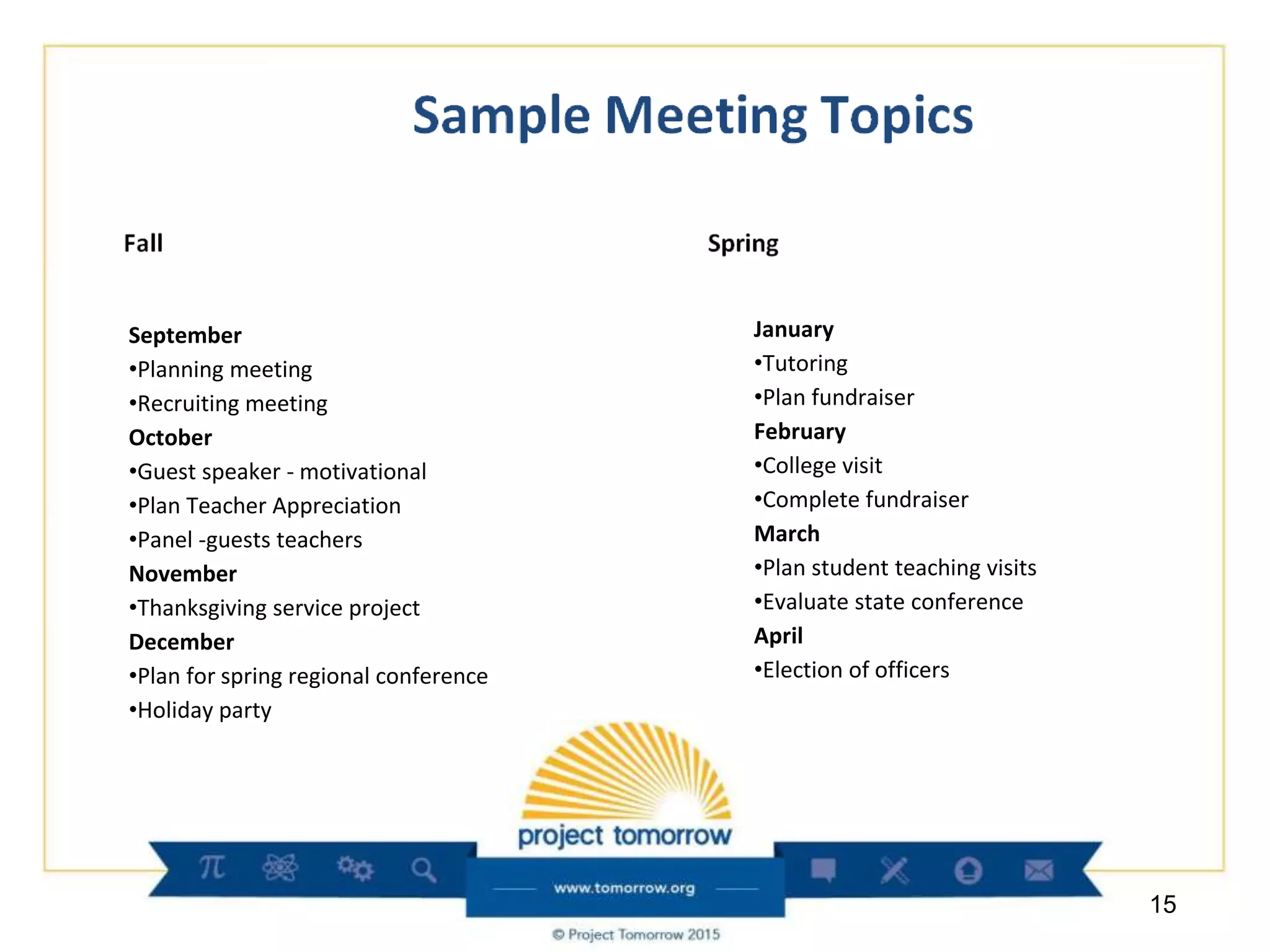
September
•Planning meeting
•Recruiting meeting
October
•Guest speaker - motivational
•Plan Teacher Appreciation
•Panel -guests teachers
November
•Thanksgiving service project
December
•Plan for spring regional conference
•Holiday party
15
January
•Tutoring
•Plan fundraiser
February
•College visit
•Complete fundraiser
March
•Plan student teaching visits
•Evaluate state conference
April
•Election of officers
•Volunteer experiences in local elementary schools such
as tutoring, helping teachers, supporting special events
•Learn about and raise awareness of the need for
teachers in California
•Educators Rising California Conference and National
Conference
•Educators Rising California State Competitions
•College tours
16
Advisor responsibilities,
Project Tomorrow supports
Teacher Leader/Advisor
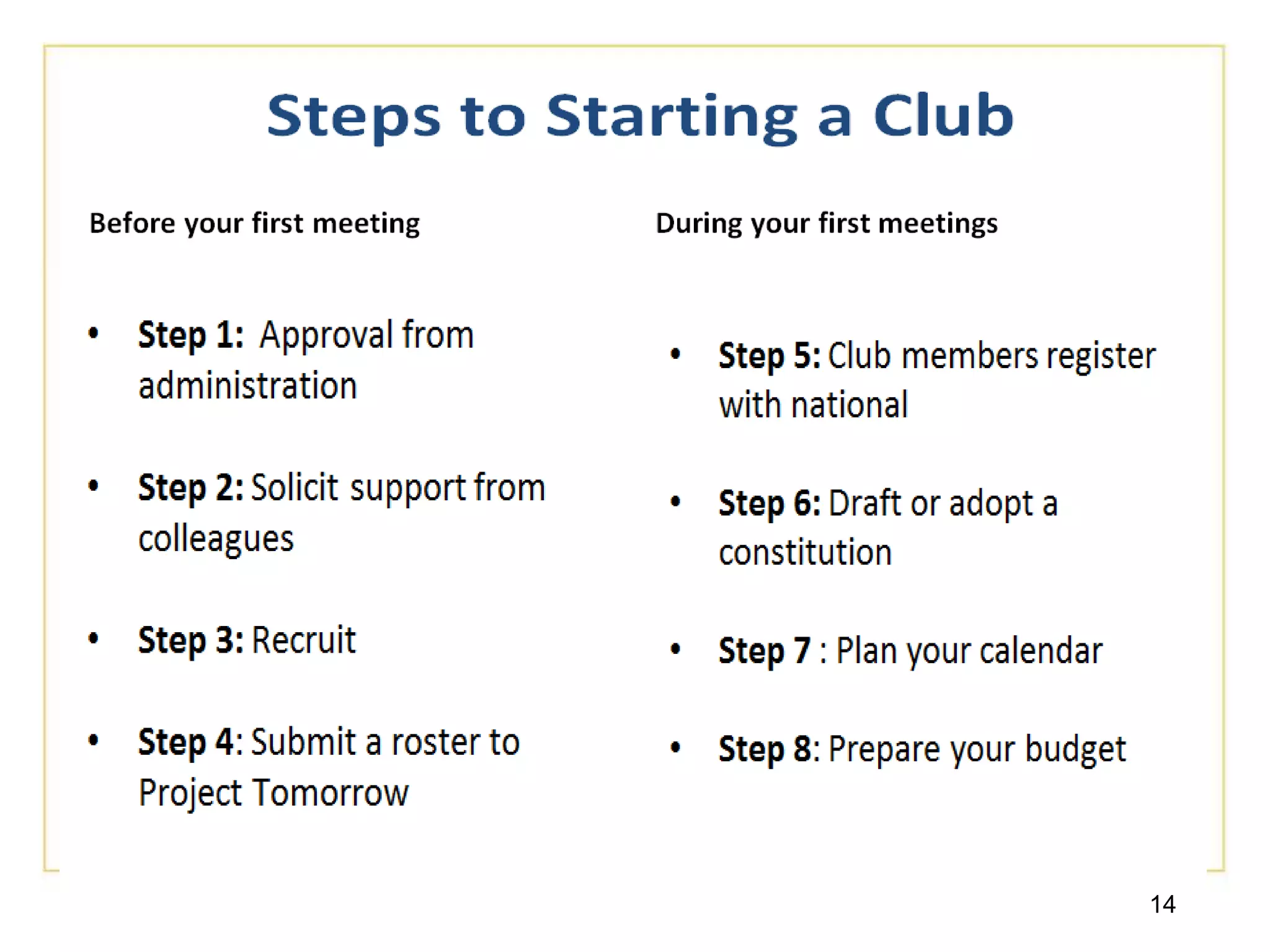
•Identify and recruit student participants
•Submit a roster to Project Tomorrow
•Make sure students register with
national
•Plan club activities
•Identify teaching opportunities
•Arrange guest speakers
•Identify community service projects
•Use YT2L curriculum where applicable
•Utilize Edmodo community resources
•Provide Project Tomorrow access to data
for evaluation purposes
•Present at conferences, as appropriate
17
Project Tomorrow
•Provide advisors with resources including
curricula and lesson planning resources
•Serve as a resource for day-to-day
operations
•Promote community service
opportunities
•Provide ongoing programmatic support
•Coordinate operations and logistics for
conferences offered to student
participants
•Provide ongoing training to Educators
Rising advisors
•To do list priorities
oDetermine meeting times/dates
oCreate a list of recruitment opportunities and needs
oIdentify how to acquire necessary materials
oConsider how best to use YT2L curriculum and other resources
oBrainstorm teaching opportunities
oCompose a list of potential guest speakers
oResearch potential club activities
•Guiding questions
–What resources do you need to acquire?
–Who do you need to communicate with in order to ensure that teaching experiences and
community service projects are approved and organized?
–How will you incorporate student interests into your club?
–How will you convey expectations for high school student teachers during teaching
opportunities, guest speakers visits, conferences, and college visits?
–How will you recruit club members?
Educators Rising National
19
Review the National Orientation
Sign up at the
Virtual Campus

All About Educators Rising

  • 1.
  • 2.
    Overview California’s Teacher Shortage –STEMTeaching in Elementary • About Project Tomorrow –TTI (YT2L), SpeakUp, Innovation in Education • About Educators Rising California –Starting a Chapter! –Educators Rising National 2
  • 3.
  • 4.
  • 5.
  • 6.
  • 7.
    About Project Tomorrow ProjectTomorrow’s vision is to ensure that today’s students are well prepared to be tomorrow’s innovators, leaders and engaged citizens of the world. 7
  • 8.
    Tomorrow’s Teachers Initiative YouthTEACH2Learn •7schools, 140 high school students •2017-18 participating high schools: • Canyon High School, Orange Unified • El Modena High School, Orange Unified • Jefferson High School, LAUSD • Oceanside High School, Oceanside Unified • Orange High School, Orange Unified • Trabuco Hills High School, Saddleback Unified • Villa Park High School, Orange Unified 8 Saturday Academy - Fresno Unified, 100 Students Educators Rising California •60 chapters, 1500 teacher leaders/students
  • 9.
    THE Youth TEACH2LearnProgram The YouthTEACH2Learn program is a career exploration program where students explore teaching as a career. During the course, the students gain practical experience by observing elementary school classrooms, learning how to teach, developing and teaching standards-based lessons to younger students in neighboring elementary schools and participating in local community service projects. In addition, students also have the opportunity to meet local educators, attend career panels and visit local college campuses in order to determine if the teaching is a "good-fit" for their professional goals. 9
  • 10.
    10 EDUCATION EXPLORATION: CAREER TECHNICALKNOWLEDGE & SKILLS Module 1: Orientation & Educators Rising California Module 2: The Structure & Economics of American Education Module 3: The Effective Teacher* Module 4: Human Growth & Development * Module 5: Teaching Students with Special Needs Module 6: Classroom Management & Community* Module 7: Observation Cycles (Inquiry, Differentiation*, Technology*) Module 8: Safety & Emergency Planning Module 9: Government Regulations: IEPs, 504, & Mandated Reporter Module 10: Standards-Based Instruction & Lesson Planning Module 11: Instructional Strategies* MATH Module 12: Perspectives on Math “How Many People?” Math-o-Graphy Algebra Readiness Module 13: Math Standards “Sleepy Time” Understanding Common Core An Introduction to Backwards Planning Module 14: Manipulative Use “Fraction Strips” Module 15: Problem Solving “Seats on the Bus” Solving Word Problems Module 16: Math Vocabulary “Get it Together” Math & English Language Learners Module 17: Assessment Strategies “Probability” Formative & Summative Assessment Student Interviews Module 18: Lesson Development Module 19: Health, Sanitation, & Nutrition Module 20: What’s Next? Career Planning ENVIRONMENTAL SCIENCE Module 12: Perspectives on Science and Environmental Literacy Ecosystem Services are Essential to Human Life Focus on Water Filtration Teaching Water Filtration Module 13: Ecological Footprint People Influence Natural Systems Ecological Footprint Worksheet Elements of Lesson Design Think-Pair-Share Strategy Module 14: Tragedy of the Commons People Influence Natural Systems “Tragedy of the Commons” Claim-Evidence-Reasoning Module 15: The Nitrogen Cycle Dead Fish Case Study Nitrogen Cycle Game Module 16: Particulate Air Pollution “Monitoring Particulate Pollution” Protocols for Conducting an Effective Lab Module 17: Making Environmental Decisions Environmental Issue Analysis Effective Presentation Skills Module 18: What’s Next? Career Planning SCIENCE Module 12: Perspectives on Science “Egg in the Bottle” Sci-O-Graphy Why Learn Science? Module 13: Science Standards “Balloon Powered Car” Understanding Next Generation Science Standards An Introduction to Backwards Planning Module 14: Hands-On Learning “Index Card Towers” Problem Solving & Inquiry Module 15: Problem Solving & Inquiry “Why Do Boats Float?” Module 16: Science Vocabulary “Have Your DNA and Eat it Too” Science & English Language Learners Module 17: Assessment Strategies “Understanding Osmosis” Formative & Summative Assessment Student Interviews Module 18: Lesson Development Module 19: Heath, Sanitation, & Nutrition Module 20: What’s Next? Career Planning
  • 11.
  • 12.
    Goals of Program •Provide opportunities to explore the teaching career o Understand the elements of teaching and learning o Explore perspectives on teaching and schools o Develop a teaching skill set • Increase interest in math and science o At the high school level through content based lessons, lesson development, and teaching o At the elementary level through increased exposure to hands-on science and math lessons • Develop college and career ready skills 12
  • 13.
    • Vision -Every teacher in America has the skills and experience to help all students achieve their potential. •Mission - Educators Rising cultivates highly skilled educators by guiding young people on a path to becoming accomplished teachers, beginning in high school and extending through college and into the profession. •Who We Are - Educators Rising is a national network of students and teacher leaders who are inspired and excited by the teaching profession. •What We Do - Starting with high school students, we provide passionate young people with authentic opportunities to experience teaching, sustain their interest in the profession, and help them cultivate the skills they need to be successful educators. •How We Do It - Educators Rising supports curricular programs where students explore the teaching profession and gain hands-on teaching experience. 13
  • 14.
  • 15.
    September •Planning meeting •Recruiting meeting October •Guestspeaker - motivational •Plan Teacher Appreciation •Panel -guests teachers November •Thanksgiving service project December •Plan for spring regional conference •Holiday party 15 January •Tutoring •Plan fundraiser February •College visit •Complete fundraiser March •Plan student teaching visits •Evaluate state conference April •Election of officers
  • 16.
    •Volunteer experiences inlocal elementary schools such as tutoring, helping teachers, supporting special events •Learn about and raise awareness of the need for teachers in California •Educators Rising California Conference and National Conference •Educators Rising California State Competitions •College tours 16
  • 17.
    Advisor responsibilities, Project Tomorrowsupports Teacher Leader/Advisor •Identify and recruit student participants •Submit a roster to Project Tomorrow •Make sure students register with national •Plan club activities •Identify teaching opportunities •Arrange guest speakers •Identify community service projects •Use YT2L curriculum where applicable •Utilize Edmodo community resources •Provide Project Tomorrow access to data for evaluation purposes •Present at conferences, as appropriate 17 Project Tomorrow •Provide advisors with resources including curricula and lesson planning resources •Serve as a resource for day-to-day operations •Promote community service opportunities •Provide ongoing programmatic support •Coordinate operations and logistics for conferences offered to student participants •Provide ongoing training to Educators Rising advisors
  • 18.
    •To do listpriorities oDetermine meeting times/dates oCreate a list of recruitment opportunities and needs oIdentify how to acquire necessary materials oConsider how best to use YT2L curriculum and other resources oBrainstorm teaching opportunities oCompose a list of potential guest speakers oResearch potential club activities •Guiding questions –What resources do you need to acquire? –Who do you need to communicate with in order to ensure that teaching experiences and community service projects are approved and organized? –How will you incorporate student interests into your club? –How will you convey expectations for high school student teachers during teaching opportunities, guest speakers visits, conferences, and college visits? –How will you recruit club members?
  • 19.
    Educators Rising National 19 Reviewthe National Orientation Sign up at the Virtual Campus